fuel pump FORD E150 2011 User Guide
[x] Cancel search | Manufacturer: FORD, Model Year: 2011, Model line: E150, Model: FORD E150 2011Pages: 339, PDF Size: 2.29 MB
Page 226 of 339
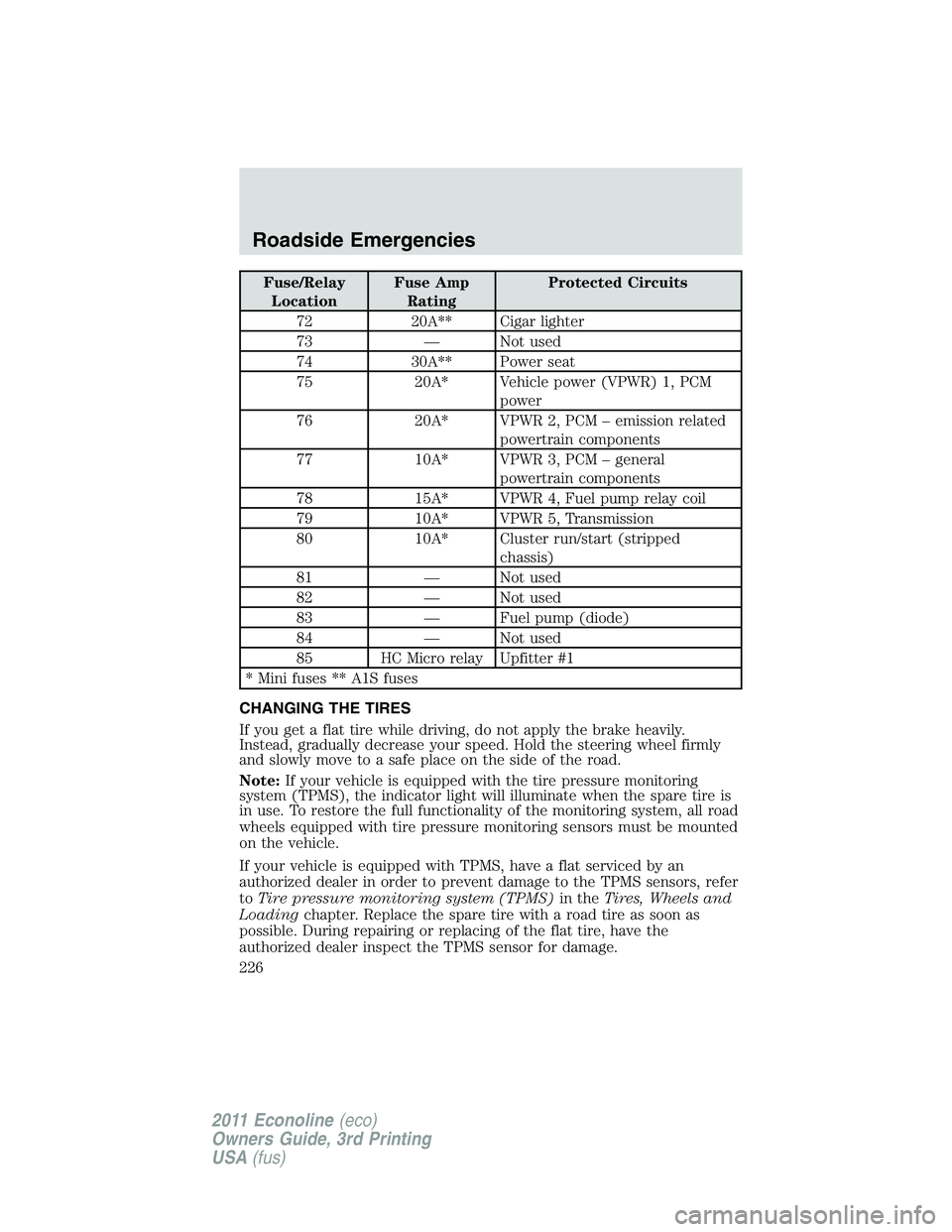
Fuse/Relay
LocationFuse Amp
RatingProtected Circuits
72 20A** Cigar lighter
73 — Not used
74 30A** Power seat
75 20A* Vehicle power (VPWR) 1, PCM
power
76 20A* VPWR 2, PCM – emission related
powertrain components
77 10A* VPWR 3, PCM – general
powertrain components
78 15A* VPWR 4, Fuel pump relay coil
79 10A* VPWR 5, Transmission
80 10A* Cluster run/start (stripped
chassis)
81 — Not used
82 — Not used
83 — Fuel pump (diode)
84 — Not used
85 HC Micro relay Upfitter #1
* Mini fuses ** A1S fuses
CHANGING THE TIRES
If you get a flat tire while driving, do not apply the brake heavily.
Instead, gradually decrease your speed. Hold the steering wheel firmly
and slowly move to a safe place on the side of the road.
Note:If your vehicle is equipped with the tire pressure monitoring
system (TPMS), the indicator light will illuminate when the spare tire is
in use. To restore the full functionality of the monitoring system, all road
wheels equipped with tire pressure monitoring sensors must be mounted
on the vehicle.
If your vehicle is equipped with TPMS, have a flat serviced by an
authorized dealer in order to prevent damage to the TPMS sensors, refer
toTire pressure monitoring system (TPMS)in theTires, Wheels and
Loadingchapter. Replace the spare tire with a road tire as soon as
possible. During repairing or replacing of the flat tire, have the
authorized dealer inspect the TPMS sensor for damage.
Roadside Emergencies
226
2011 Econoline(eco)
Owners Guide, 3rd Printing
USA(fus)
Page 276 of 339
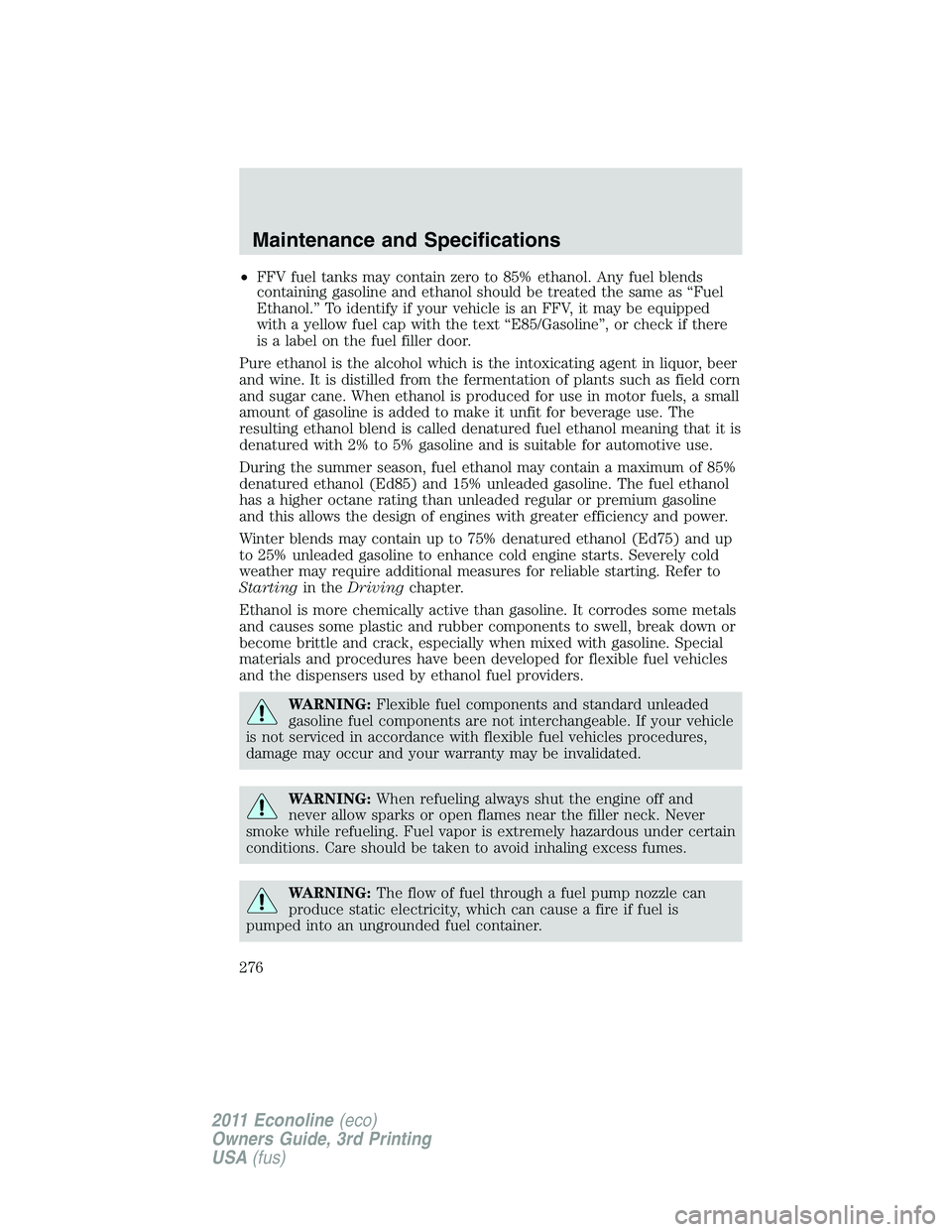
•FFV fuel tanks may contain zero to 85% ethanol. Any fuel blends
containing gasoline and ethanol should be treated the same as “Fuel
Ethanol.” To identify if your vehicle is an FFV, it may be equipped
with a yellow fuel cap with the text “E85/Gasoline”, or check if there
is a label on the fuel filler door.
Pure ethanol is the alcohol which is the intoxicating agent in liquor, beer
and wine. It is distilled from the fermentation of plants such as field corn
and sugar cane. When ethanol is produced for use in motor fuels, a small
amount of gasoline is added to make it unfit for beverage use. The
resulting ethanol blend is called denatured fuel ethanol meaning that it is
denatured with 2% to 5% gasoline and is suitable for automotive use.
During the summer season, fuel ethanol may contain a maximum of 85%
denatured ethanol (Ed85) and 15% unleaded gasoline. The fuel ethanol
has a higher octane rating than unleaded regular or premium gasoline
and this allows the design of engines with greater efficiency and power.
Winter blends may contain up to 75% denatured ethanol (Ed75) and up
to 25% unleaded gasoline to enhance cold engine starts. Severely cold
weather may require additional measures for reliable starting. Refer to
Startingin theDrivingchapter.
Ethanol is more chemically active than gasoline. It corrodes some metals
and causes some plastic and rubber components to swell, break down or
become brittle and crack, especially when mixed with gasoline. Special
materials and procedures have been developed for flexible fuel vehicles
and the dispensers used by ethanol fuel providers.
WARNING:Flexible fuel components and standard unleaded
gasoline fuel components are not interchangeable. If your vehicle
is not serviced in accordance with flexible fuel vehicles procedures,
damage may occur and your warranty may be invalidated.
WARNING:When refueling always shut the engine off and
never allow sparks or open flames near the filler neck. Never
smoke while refueling. Fuel vapor is extremely hazardous under certain
conditions. Care should be taken to avoid inhaling excess fumes.
WARNING:The flow of fuel through a fuel pump nozzle can
produce static electricity, which can cause a fire if fuel is
pumped into an ungrounded fuel container.
Maintenance and Specifications
276
2011 Econoline(eco)
Owners Guide, 3rd Printing
USA(fus)
Page 277 of 339
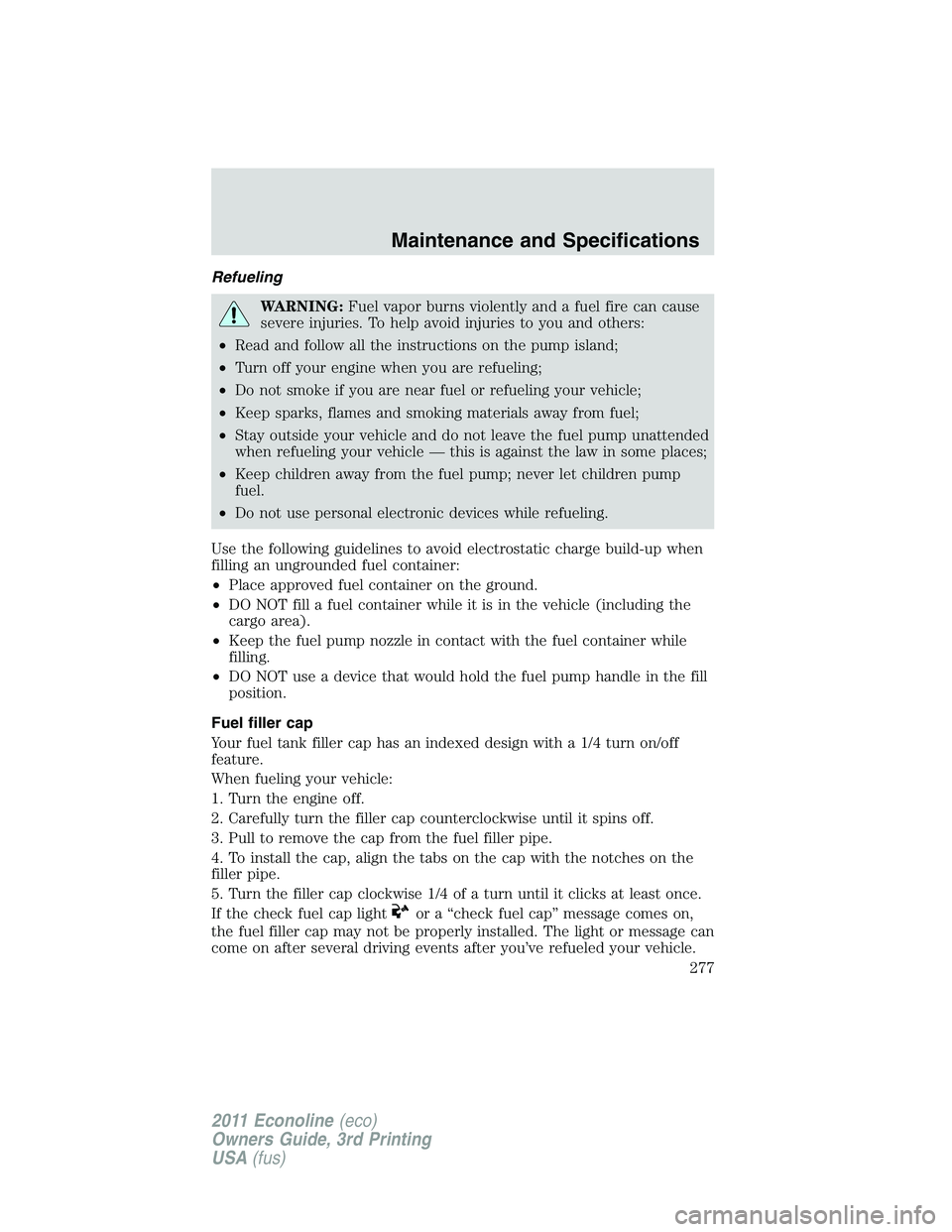
Refueling
WARNING:Fuel vapor burns violently and a fuel fire can cause
severe injuries. To help avoid injuries to you and others:
•Read and follow all the instructions on the pump island;
•Turn off your engine when you are refueling;
•Do not smoke if you are near fuel or refueling your vehicle;
•Keep sparks, flames and smoking materials away from fuel;
•Stay outside your vehicle and do not leave the fuel pump unattended
when refueling your vehicle — this is against the law in some places;
•Keep children away from the fuel pump; never let children pump
fuel.
•Do not use personal electronic devices while refueling.
Use the following guidelines to avoid electrostatic charge build-up when
filling an ungrounded fuel container:
•Place approved fuel container on the ground.
•DO NOT fill a fuel container while it is in the vehicle (including the
cargo area).
•Keep the fuel pump nozzle in contact with the fuel container while
filling.
•DO NOT use a device that would hold the fuel pump handle in the fill
position.
Fuel filler cap
Your fuel tank filler cap has an indexed design with a 1/4 turn on/off
feature.
When fueling your vehicle:
1. Turn the engine off.
2. Carefully turn the filler cap counterclockwise until it spins off.
3. Pull to remove the cap from the fuel filler pipe.
4. To install the cap, align the tabs on the cap with the notches on the
filler pipe.
5. Turn the filler cap clockwise 1/4 of a turn until it clicks at least once.
If the check fuel cap light
or a “check fuel cap” message comes on,
the fuel filler cap may not be properly installed. The light or message can
come on after several driving events after you’ve refueled your vehicle.
Maintenance and Specifications
277
2011 Econoline(eco)
Owners Guide, 3rd Printing
USA(fus)
Page 279 of 339
Note:Use of any fuel other than those recommended may cause
powertrain damage, a loss of vehicle performance, and repairs may not
be covered under warranty.
Cleaner air
Ford endorses the use of reformulated “cleaner-burning” gasolines to
improve air quality, per the recommendations in theChoosing the right
fuelsection.
Octane recommendations
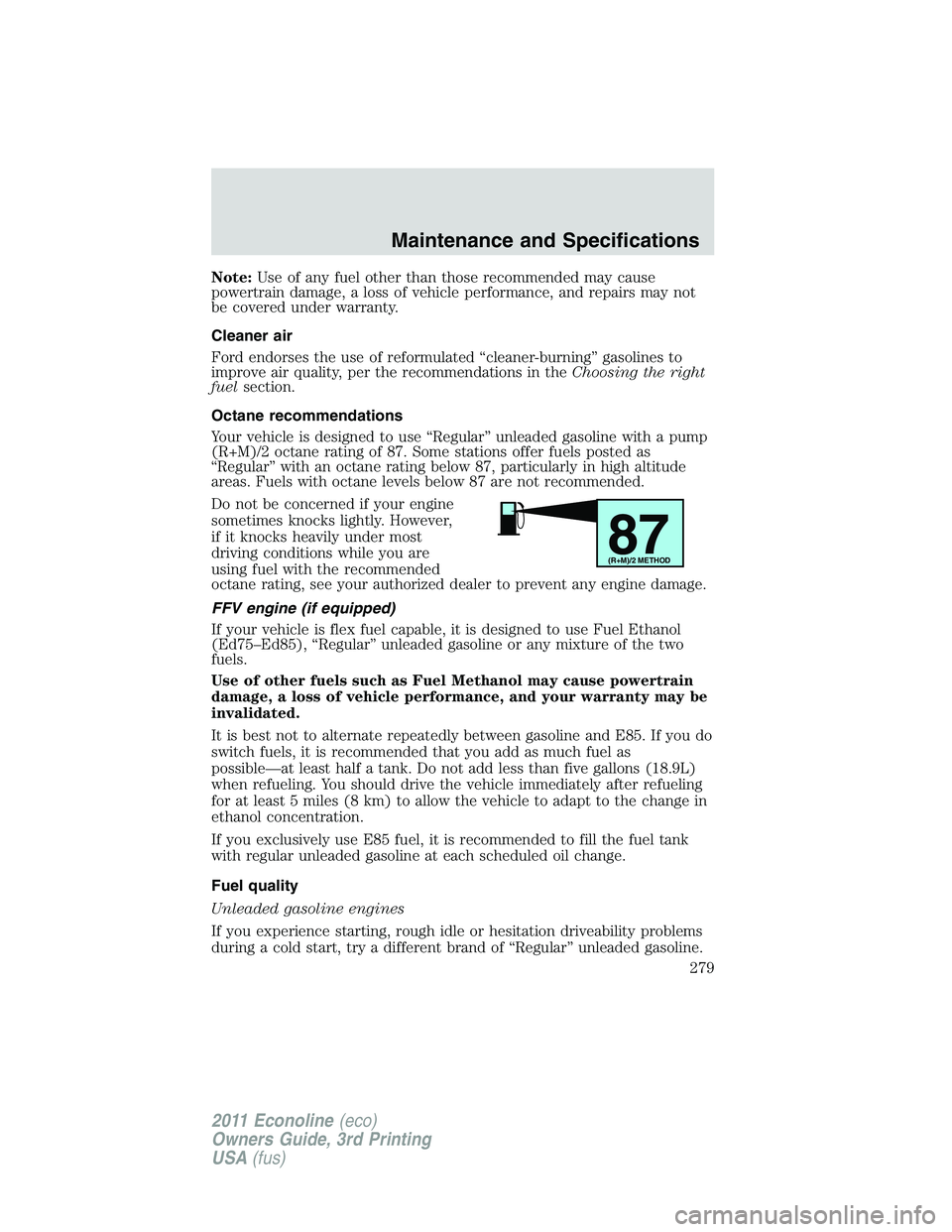
Your vehicle is designed to use “Regular” unleaded gasoline with a pump
(R+M)/2 octane rating of 87. Some stations offer fuels posted as
“Regular” with an octane rating below 87, particularly in high altitude
areas. Fuels with octane levels below 87 are not recommended.
Do not be concerned if your engine
sometimes knocks lightly. However,
if it knocks heavily under most
driving conditions while you are
using fuel with the recommended
octane rating, see your authorized dealer to prevent any engine damage.
FFV engine (if equipped)
If your vehicle is flex fuel capable, it is designed to use Fuel Ethanol
(Ed75–Ed85), “Regular” unleaded gasoline or any mixture of the two
fuels.
Use of other fuels such as Fuel Methanol may cause powertrain
damage, a loss of vehicle performance, and your warranty may be
invalidated.
It is best not to alternate repeatedly between gasoline and E85. If you do
switch fuels, it is recommended that you add as much fuel as
possible—at least half a tank. Do not add less than five gallons (18.9L)
when refueling. You should drive the vehicle immediately after refueling
for at least 5 miles (8 km) to allow the vehicle to adapt to the change in
ethanol concentration.
If you exclusively use E85 fuel, it is recommended to fill the fuel tank
with regular unleaded gasoline at each scheduled oil change.
Fuel quality
Unleaded gasoline engines
If you experience starting, rough idle or hesitation driveability problems
during a cold start, try a different brand of “Regular” unleaded gasoline.
87(R+M)/2 METHOD
Maintenance and Specifications
279
2011 Econoline(eco)
Owners Guide, 3rd Printing
USA(fus)
Page 280 of 339
“Premium” unleaded gasoline is not recommended for vehicles designed
to use “Regular” unleaded gasoline because it may cause these problems
to become more pronounced. If the problems persist, see your
authorized dealer.
FFV engines
If you experience starting, rough idle or hesitation driveability problems
during a cold start, try a different brand of E85 fuel. If the driveability
problems continue, fill the vehicle with regular unleaded gasoline and
drive vehicle normally until gasoline is used. See your authorized dealer
if the problem persists.
Do not add aftermarket fuel additive products to your fuel tank. It
should not be necessary to add any aftermarket products to your fuel
tank if you continue to use high quality fuel of the recommended octane
rating. These products have not been approved for your engine and
could cause damage to the fuel system. Repairs to correct the effects of
using an aftermarket product in your fuel may not be covered by your
warranty.
Many of the world’s automakers approved the World-Wide Fuel Charter
that recommends gasoline specifications to provide improved
performance and emission control system protection for your vehicle.
Gasolines that meet the World-Wide Fuel Charter should be used when
available. Ask your fuel supplier about gasolines that meet the
World-Wide Fuel Charter.
Running out of fuel
Avoid running out of fuel because this situation may have an adverse
effect on powertrain components.
If you have run out of fuel:
•You may need to cycle the ignition from off to on several times after
refueling to allow the fuel system to pump the fuel from the tank to
the engine. On restarting, cranking time will take a few seconds longer
than normal.
•Normally, adding 1 gallon (3.8L) of fuel is enough to restart the
engine. If the vehicle is out of fuel and on a steep grade, more than
1 gallon (3.8L) may be required.
•The service engine soon
indicator may come on. For more
information on the service engine soon
indicator, refer to
Warning lights and chimesin theInstrument Clusterchapter.
Maintenance and Specifications
280
2011 Econoline(eco)
Owners Guide, 3rd Printing
USA(fus)
Page 296 of 339

General
•Store all vehicles in a dry, ventilated place.
•Protect from sunlight, if possible.
•If vehicles are stored outside, they require regular maintenance to
protect against rust and damage.
Body
•Wash vehicle thoroughly to remove dirt, grease, oil, tar or mud from
exterior surfaces, rear-wheel housing and underside of front fenders.
See theCleaningchapter for more information.
•Periodically wash vehicles stored in exposed locations.
•Touch-up raw or primed metal to prevent rust.
•Cover chrome and stainless steel parts with a thick coat of auto wax
to prevent discoloration. Re-wax as necessary when the vehicle is
washed. See theCleaningchapter for more information.
•Lubricate all hood, door and trunk lid hinges, and latches with a light
grade oil. See theCleaningchapter for more information.
•Cover interior trim to prevent fading.
•Keep all rubber parts free from oil and solvents.
Engine
•The engine oil and filter should be changed prior to storage, as used
engine oil contain contaminates that may cause engine damage.
•Start the engine every 15 days. Run at fast idle until it reaches normal
operating temperature.
•With your foot on the brake, shift through all the gears while the
engine is running.
Fuel system
•Fill the fuel tank with high-quality fuel until the first automatic shutoff
of the fuel pump nozzle.
Note:During extended periods of vehicle storage (30 days or more),
fuel may deteriorate due to oxidation. Add a quality gas stabilizer
product to the vehicle fuel system whenever actual or expected storage
periods exceed 30 days. Follow the instructions on the additive label.
The vehicle should then be operated at idle speed to circulate the
additive throughout the fuel system.
Maintenance and Specifications
296
2011 Econoline(eco)
Owners Guide, 3rd Printing
USA(fus)
Page 336 of 339
Flexible Fuel Vehicle (FFV) ....274
Floor mats .............................72–73
Fluid capacities .........................299
Four-Wheel Drive vehicles
preparing to drive your
vehicle .....................................199
Fuel ............................................274
calculating fuel
economy ............................23, 281
cap ...........................................277
capacity ...................................299
choosing the right fuel ...........278
detergent in fuel .....................279
filling your vehicle with
fuel ...........................274, 277, 281
filter, specifications ........274, 298
fuel pump shut-off switch .....217
improving fuel economy ........281
octane rating ...................279, 303
quality ......................................279
running out of fuel .................280
safety information relating to
automotive fuels .....................274
Fuel - flex fuel vehicle
(FFV) .........................274, 278–279
Fuses ..................................218–219
G
Gas cap (see Fuel cap) ............277
Gas mileage
(see Fuel economy) .................281
Gauges .........................................19
H
Hazard flashers .........................216
Headlamps ...................................51
aiming ........................................54bulb specifications ....................57
daytime running lights .............52
flash to pass ..............................51
high beam .................................51
replacing bulbs .........................58
turning on and off ....................51
Head restraints ...........................86
Heating
heater only system .............48, 50
heating and air conditioning
system .......................................49
Hood ..........................................260
I
Ignition ...............................186, 303
Illuminated visor mirror .............64
Infant seats
(see Safety seats) .....................118
Inspection/maintenance (I/M)
testing ........................................286
Instrument panel
cleaning ...................................254
cluster ........................................14
lighting up panel and
interior .......................................52
J
Jack ............................................226
positioning ...............................226
storage .....................................226
Jump-starting your vehicle ......236
K
Keyless entry system
autolock .....................................73
Keys .............................................84
Index
336
2011 Econoline(eco)
Owners Guide, 3rd Printing
USA(fus)