150 FORD E450 2006 User Guide
[x] Cancel search | Manufacturer: FORD, Model Year: 2006, Model line: E450, Model: FORD E450 2006Pages: 256, PDF Size: 2.6 MB
Page 132 of 256
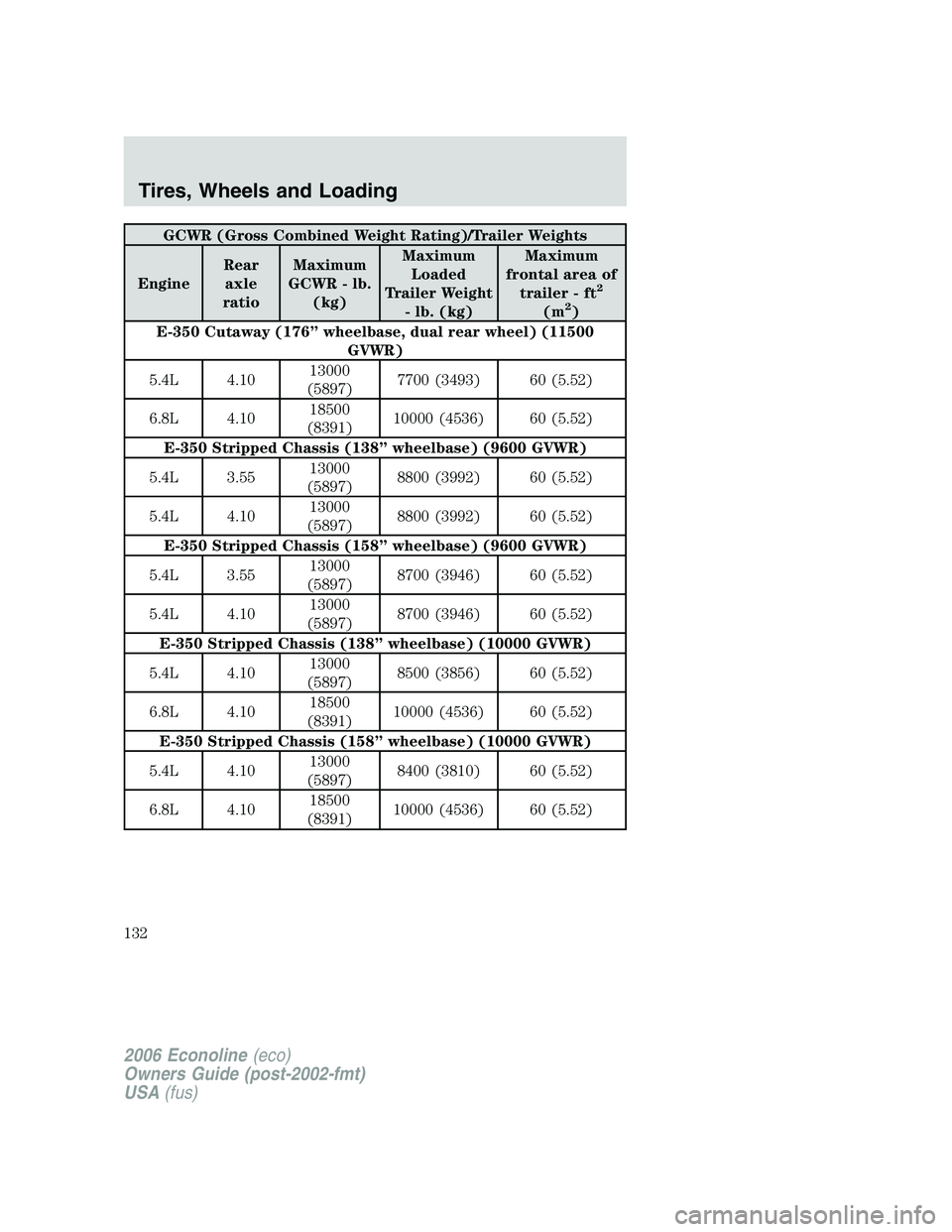
GCWR (Gross Combined Weight Rating)/Trailer Weights
EngineRear
axle
ratioMaximum
GCWR - lb.
(kg)Maximum
Loaded
Trailer Weight
- lb. (kg)Maximum
frontal area of
trailer - ft
2
(m2)
E-350 Cutaway (176” wheelbase, dual rear wheel) (11500
GVWR)
5.4L 4.1013000
(5897)7700 (3493) 60 (5.52)
6.8L 4.1018500
(8391)10000 (4536) 60 (5.52)
E-350 Stripped Chassis (138” wheelbase) (9600 GVWR)
5.4L 3.5513000
(5897)8800 (3992) 60 (5.52)
5.4L 4.1013000
(5897)8800 (3992) 60 (5.52)
E-350 Stripped Chassis (158” wheelbase) (9600 GVWR)
5.4L 3.5513000
(5897)8700 (3946) 60 (5.52)
5.4L 4.1013000
(5897)8700 (3946) 60 (5.52)
E-350 Stripped Chassis (138” wheelbase) (10000 GVWR)
5.4L 4.1013000
(5897)8500 (3856) 60 (5.52)
6.8L 4.1018500
(8391)10000 (4536) 60 (5.52)
E-350 Stripped Chassis (158” wheelbase) (10000 GVWR)
5.4L 4.1013000
(5897)8400 (3810) 60 (5.52)
6.8L 4.1018500
(8391)10000 (4536) 60 (5.52)
2006 Econoline(eco)
Owners Guide (post-2002-fmt)
USA(fus)
Tires, Wheels and Loading
132
Page 150 of 256
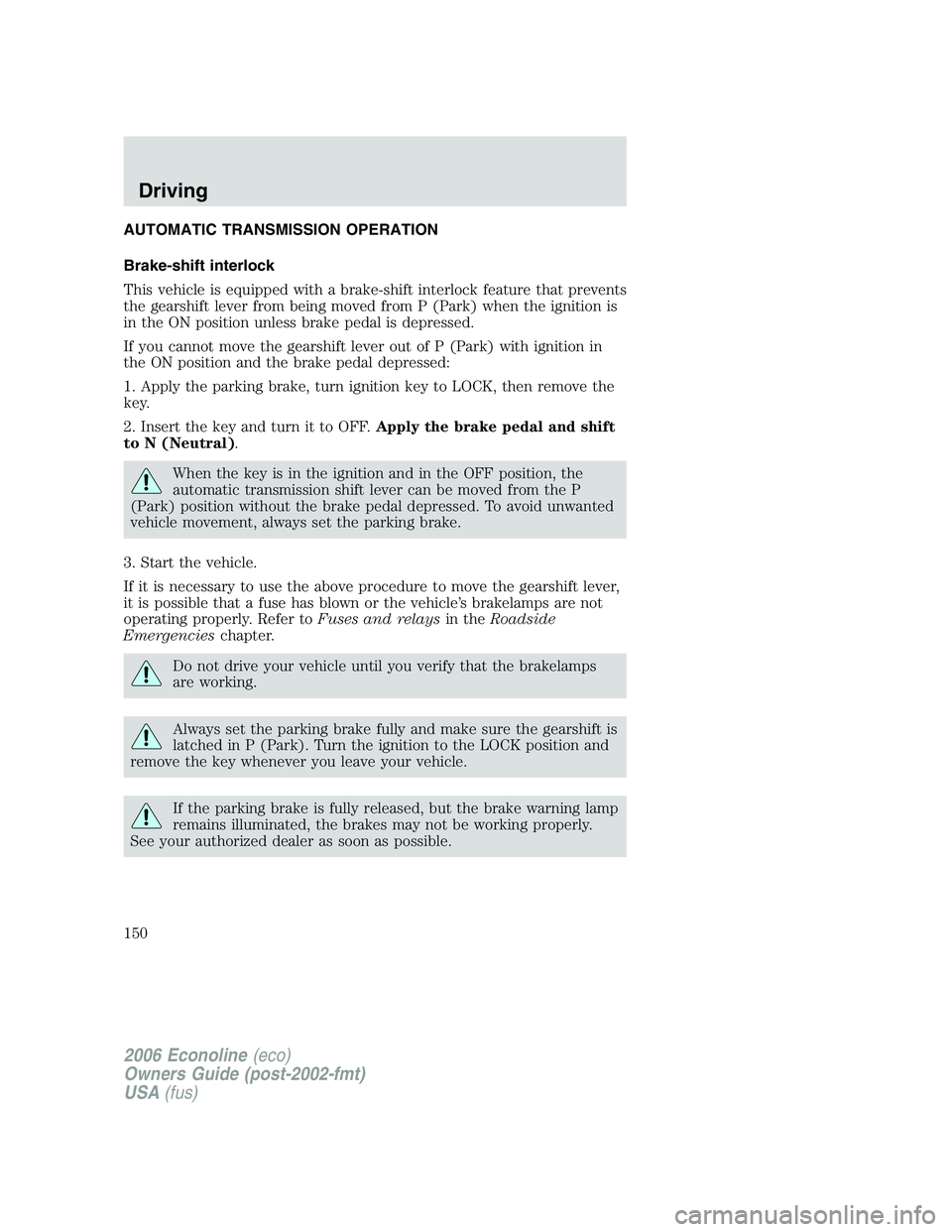
AUTOMATIC TRANSMISSION OPERATION
Brake-shift interlock
This vehicle is equipped with a brake-shift interlock feature that prevents
the gearshift lever from being moved from P (Park) when the ignition is
in the ON position unless brake pedal is depressed.
If you cannot move the gearshift lever out of P (Park) with ignition in
the ON position and the brake pedal depressed:
1. Apply the parking brake, turn ignition key to LOCK, then remove the
key.
2. Insert the key and turn it to OFF.Apply the brake pedal and shift
to N (Neutral).
When the key is in the ignition and in the OFF position, the
automatic transmission shift lever can be moved from the P
(Park) position without the brake pedal depressed. To avoid unwanted
vehicle movement, always set the parking brake.
3. Start the vehicle.
If it is necessary to use the above procedure to move the gearshift lever,
it is possible that a fuse has blown or the vehicle’s brakelamps are not
operating properly. Refer toFuses and relaysin theRoadside
Emergencieschapter.
Do not drive your vehicle until you verify that the brakelamps
are working.
Always set the parking brake fully and make sure the gearshift is
latched in P (Park). Turn the ignition to the LOCK position and
remove the key whenever you leave your vehicle.
If the parking brake is fully released, but the brake warning lamp
remains illuminated, the brakes may not be working properly.
See your authorized dealer as soon as possible.
2006 Econoline(eco)
Owners Guide (post-2002-fmt)
USA(fus)
Driving
150
Page 180 of 256
5. Repeat this tightness check procedure when servicing the spare tire
pressure (every six months, as per yourscheduled maintenance
information),or at any time that the spare tire is disturbed through
service of other components.
6. If removed, install the spare tire lock (if equipped) into the bumper
drive tube with the spare tire lock key (if equipped) and jack handle.
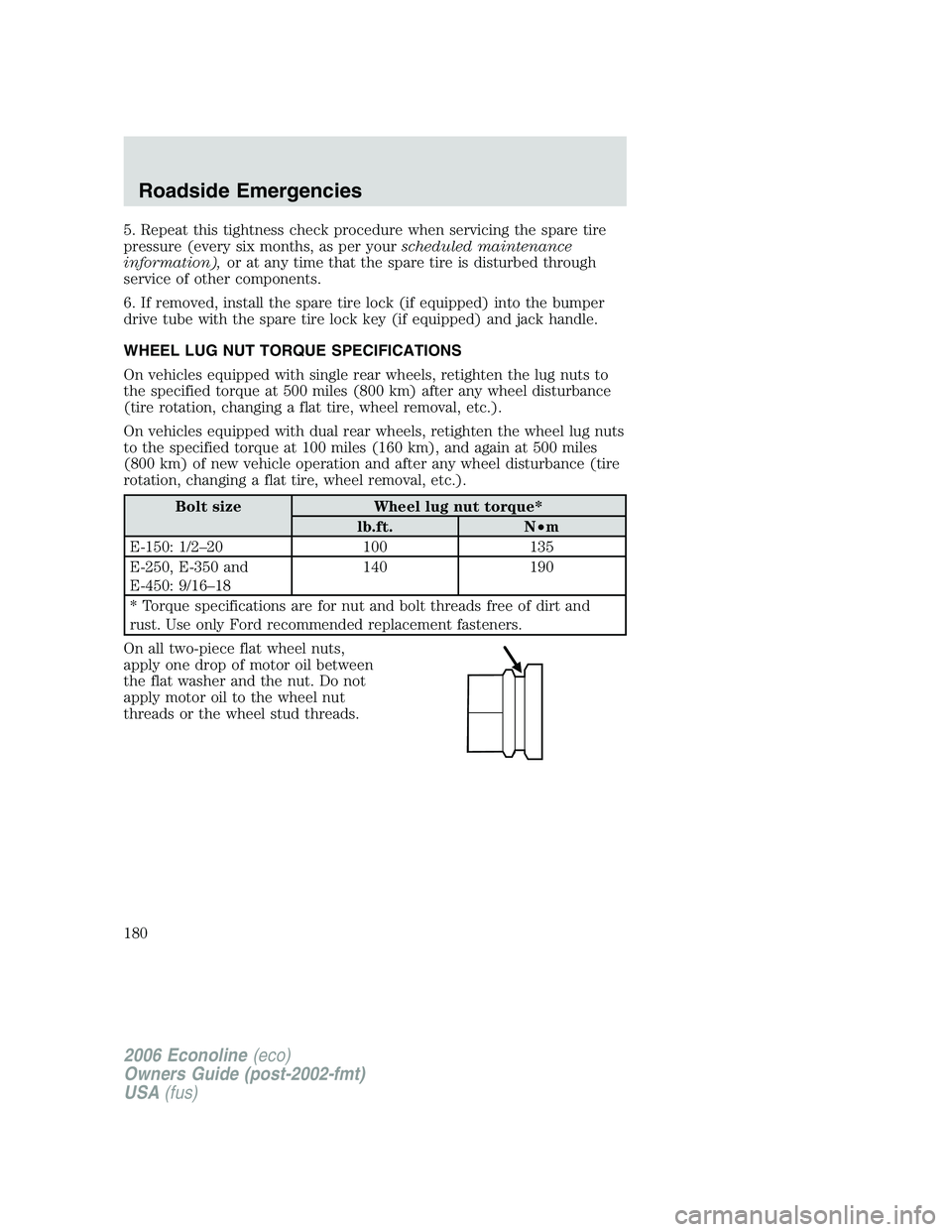
WHEEL LUG NUT TORQUE SPECIFICATIONS
On vehicles equipped with single rear wheels, retighten the lug nuts to
the specified torque at 500 miles (800 km) after any wheel disturbance
(tire rotation, changing a flat tire, wheel removal, etc.).
On vehicles equipped with dual rear wheels, retighten the wheel lug nuts
to the specified torque at 100 miles (160 km), and again at 500 miles
(800 km) of new vehicle operation and after any wheel disturbance (tire
rotation, changing a flat tire, wheel removal, etc.).
Bolt size Wheel lug nut torque*
lb.ft. N•m
E-150: 1/2–20 100 135
E-250, E-350 and
E-450: 9/16–18140 190
* Torque specifications are for nut and bolt threads free of dirt and
rust. Use only Ford recommended replacement fasteners.
On all two-piece flat wheel nuts,
apply one drop of motor oil between
the flat washer and the nut. Do not
apply motor oil to the wheel nut
threads or the wheel stud threads.
2006 Econoline(eco)
Owners Guide (post-2002-fmt)
USA(fus)
Roadside Emergencies
180
Page 193 of 256
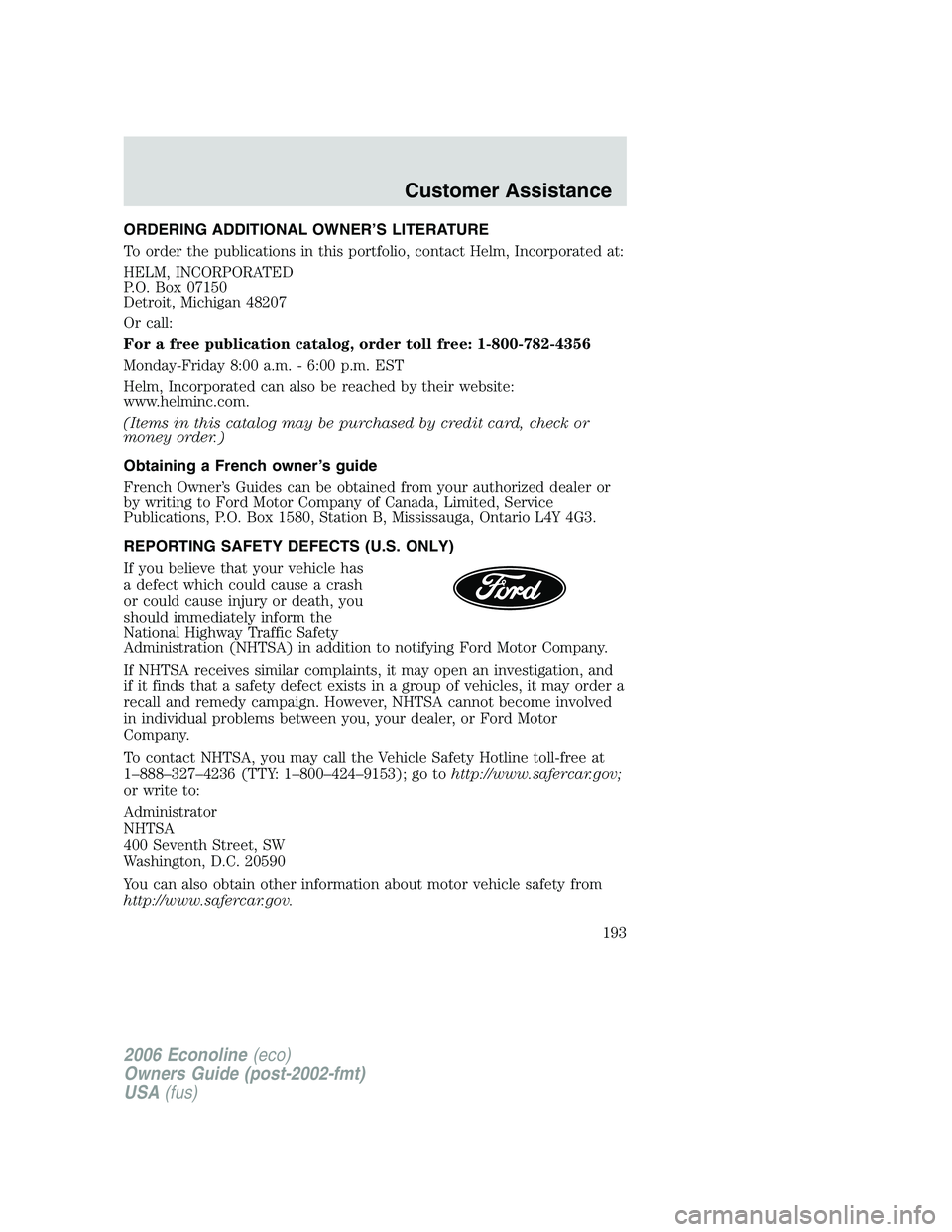
ORDERING ADDITIONAL OWNER’S LITERATURE
To order the publications in this portfolio, contact Helm, Incorporated at:
HELM, INCORPORATED
P.O. Box 07150
Detroit, Michigan 48207
Or call:
For a free publication catalog, order toll free: 1-800-782-4356
Monday-Friday 8:00 a.m. - 6:00 p.m. EST
Helm, Incorporated can also be reached by their website:
www.helminc.com.
(Items in this catalog may be purchased by credit card, check or
money order.)
Obtaining a French owner’s guide
French Owner’s Guides can be obtained from your authorized dealer or
by writing to Ford Motor Company of Canada, Limited, Service
Publications, P.O. Box 1580, Station B, Mississauga, Ontario L4Y 4G3.
REPORTING SAFETY DEFECTS (U.S. ONLY)
If you believe that your vehicle has
a defect which could cause a crash
or could cause injury or death, you
should immediately inform the
National Highway Traffic Safety
Administration (NHTSA) in addition to notifying Ford Motor Company.
If NHTSA receives similar complaints, it may open an investigation, and
if it finds that a safety defect exists in a group of vehicles, it may order a
recall and remedy campaign. However, NHTSA cannot become involved
in individual problems between you, your dealer, or Ford Motor
Company.
To contact NHTSA, you may call the Vehicle Safety Hotline toll-free at
1–888–327–4236 (TTY: 1–800–424–9153); go tohttp://www.safercar.gov;
or write to:
Administrator
NHTSA
400 Seventh Street, SW
Washington, D.C. 20590
You can also obtain other information about motor vehicle safety from
http://www.safercar.gov.
2006 Econoline(eco)
Owners Guide (post-2002-fmt)
USA(fus)
Customer Assistance
193
Page 227 of 256
TRANSMISSION FLUID
Checking automatic transmission fluid (if equipped)
Refer to yourscheduled maintenance informationfor scheduled
intervals for fluid checks and changes. Your transmission does not
consume fluid. However, the fluid level should be checked if the
transmission is not working properly, i.e., if the transmission slips or
shifts slowly or if you notice some sign of fluid leakage.
Automatic transmission fluid expands when warmed. To obtain an
accurate fluid check, drive the vehicle until it is at normal operating
temperature (approximately 20 miles [30 km]). If your vehicle has been
operated for an extended period at high speeds, in city traffic during hot
weather or pulling a trailer, the vehicle should be turned off for about 30
minutes to allow fluid to cool before checking.
1. Drive the vehicle 20 miles (30 km) or until it reaches normal operating
temperature.
2. Park the vehicle on a level surface and engage the parking brake.
3. With the parking brake engaged and your foot on the brake pedal,
start the engine and move the gearshift lever through all of the gear
ranges. Allow sufficient time for each gear to engage.
4. Latch the gearshift lever in P (Park) and leave the engine running.
5. Remove the dipstick, wiping it clean with a clean, dry lint free rag. If
necessary, refer toIdentifying components in the engine compartment
in this chapter for the location of the dipstick.
6. Install the dipstick making sure it is fully seated in the filler tube.
7. Remove the dipstick and inspect the fluid level. The fluid should be in
the designated area for normal operating temperature or ambient
temperature.
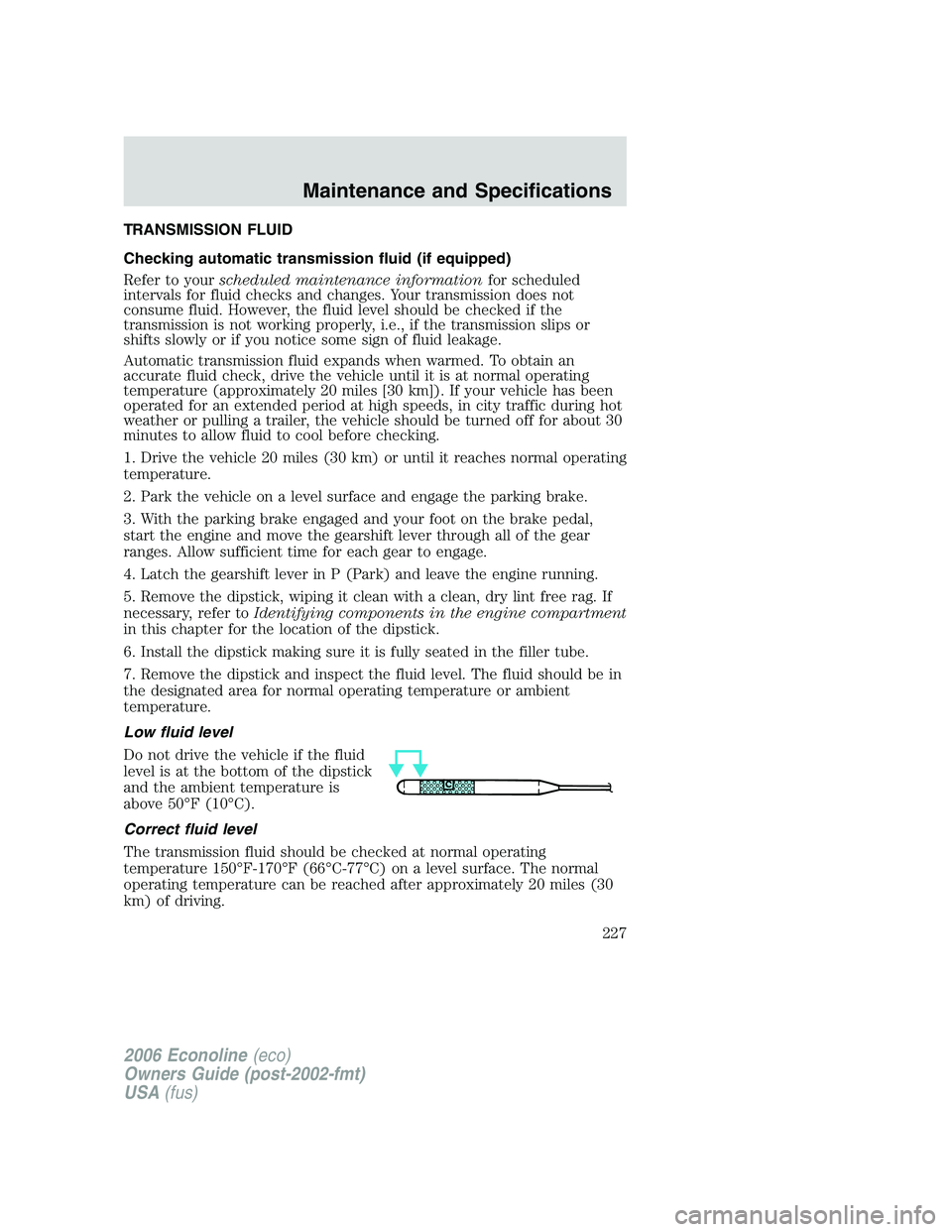
Low fluid level
Do not drive the vehicle if the fluid
level is at the bottom of the dipstick
and the ambient temperature is
above 50°F (10°C).
Correct fluid level
The transmission fluid should be checked at normal operating
temperature 150°F-170°F (66°C-77°C) on a level surface. The normal
operating temperature can be reached after approximately 20 miles (30
km) of driving.
2006 Econoline(eco)
Owners Guide (post-2002-fmt)
USA(fus)
Maintenance and Specifications
227
Page 228 of 256
You can check the fluid without driving if the ambient temperature is
above 50°F (10°C). However, if fluid is added at this time, an overfill
condition could result when the vehicle reaches normal operating
temperature.
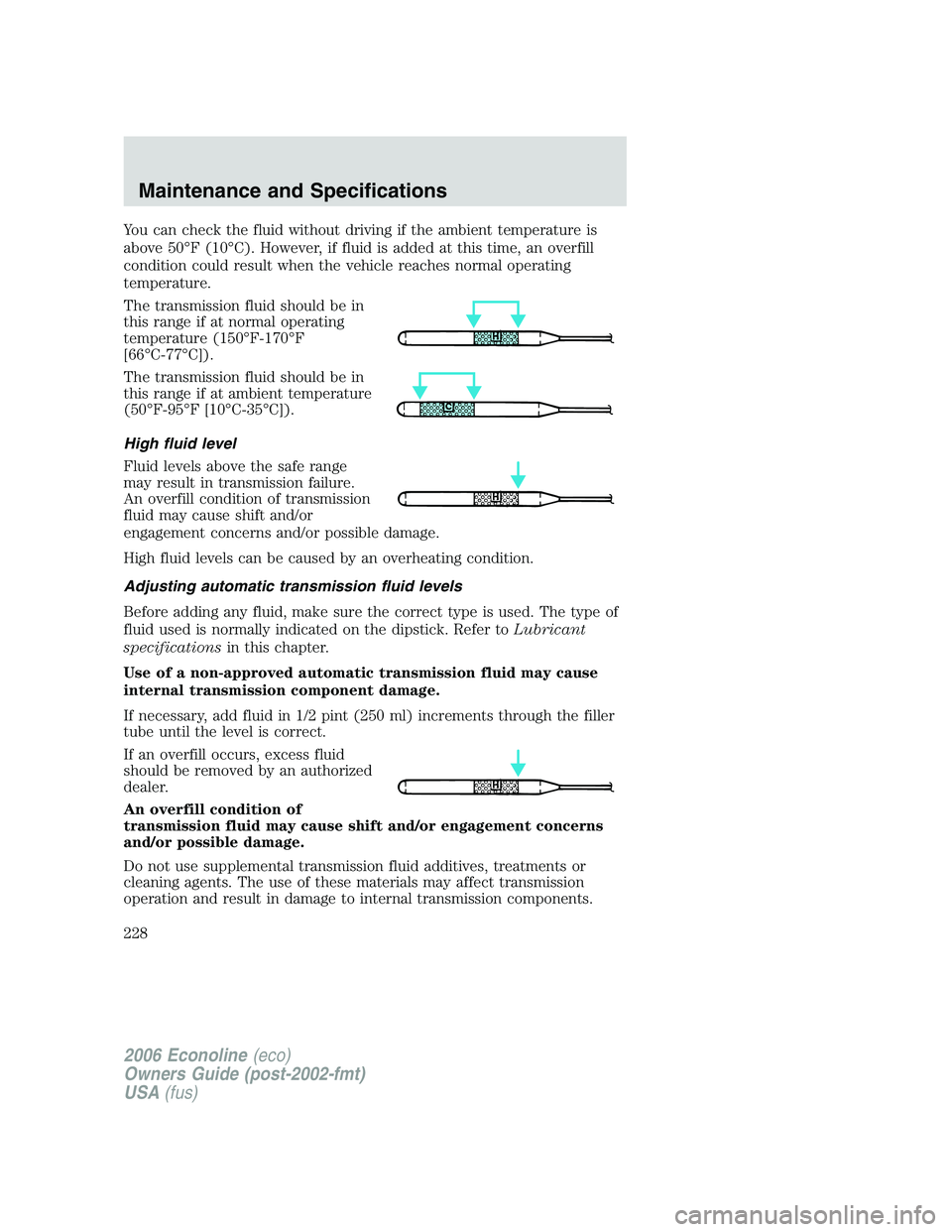
The transmission fluid should be in
this range if at normal operating
temperature (150°F-170°F
[66°C-77°C]).
The transmission fluid should be in
this range if at ambient temperature
(50°F-95°F [10°C-35°C]).
High fluid level
Fluid levels above the safe range
may result in transmission failure.
An overfill condition of transmission
fluid may cause shift and/or
engagement concerns and/or possible damage.
High fluid levels can be caused by an overheating condition.
Adjusting automatic transmission fluid levels
Before adding any fluid, make sure the correct type is used. The type of
fluid used is normally indicated on the dipstick. Refer toLubricant
specificationsin this chapter.
Use of a non-approved automatic transmission fluid may cause
internal transmission component damage.
If necessary, add fluid in 1/2 pint (250 ml) increments through the filler
tube until the level is correct.
If an overfill occurs, excess fluid
should be removed by an authorized
dealer.
An overfill condition of
transmission fluid may cause shift and/or engagement concerns
and/or possible damage.
Do not use supplemental transmission fluid additives, treatments or
cleaning agents. The use of these materials may affect transmission
operation and result in damage to internal transmission components.
2006 Econoline(eco)
Owners Guide (post-2002-fmt)
USA(fus)
Maintenance and Specifications
228
Page 240 of 256
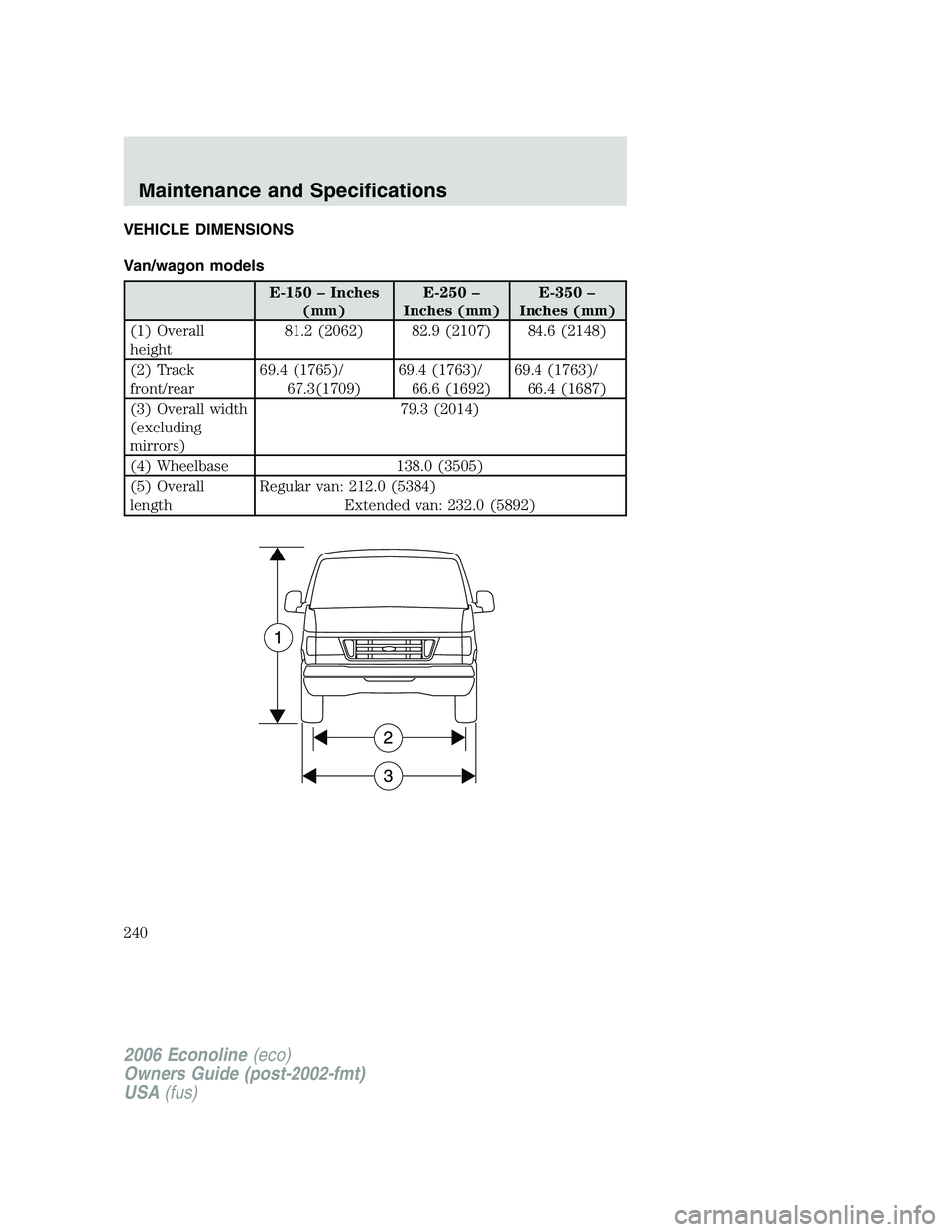
VEHICLE DIMENSIONS
Van/wagon models
E-150 – Inches
(mm)E-250 –
Inches (mm)E-350 –
Inches (mm)
(1) Overall
height81.2 (2062) 82.9 (2107) 84.6 (2148)
(2) Track
front/rear69.4 (1765)/
67.3(1709)69.4 (1763)/
66.6 (1692)69.4 (1763)/
66.4 (1687)
(3) Overall width
(excluding
mirrors)79.3 (2014)
(4) Wheelbase 138.0 (3505)
(5) Overall
lengthRegular van: 212.0 (5384)
Extended van: 232.0 (5892)
2006 Econoline(eco)
Owners Guide (post-2002-fmt)
USA(fus)
Maintenance and Specifications
240
Page 246 of 256
A
Accessory delay ..........................48
AdvanceTrac ..............................144
Air cleaner filter ...............229–231
Airbag supplemental restraint
system ....................................75–76
and child safety seats ..............77
description ................................76
disposal ......................................79
driver airbag ..............................78
indicator light ...........................79
operation ...................................78
passenger airbag .......................78
passenger deactivation switch .80
Ambulance packages ....................8
Antifreeze
(see Engine coolant) ................209
Anti-lock brake system
(see Brakes) ..............................143
Audio system (see Radio) ..19–20,
25
Automatic transmission
driving an automatic
overdrive .................151, 153, 156
fluid, adding ............................227
fluid, checking ........................227
fluid, refill capacities ..............232
fluid, specification ..................239
Auxiliary power point .................47
Axle
lubricant specifications ..236, 239
refill capacities ........................232
traction lok ..............................148
B
Battery .......................................207
acid, treating emergencies .....207battery saver .............................34
jumping a disabled battery ....181
maintenance-free ....................207
replacement, specifications ...231
servicing ..................................207
BeltMinder ...................................71
Brakes ........................................142
anti-lock ...................................143
anti-lock brake system (ABS)
warning light ...........................143
fluid, checking and adding ....226
fluid, refill capacities ..............232
fluid, specifications .........236, 239
lubricant specifications ..236, 239
parking ....................................144
shift interlock ..........................150
Break-in period .............................5
Bulbs ............................................39
C
Capacities for refilling fluids ....232
Cell phone use ..............................9
Child safety restraints ................85
child safety belts ......................85
Child safety seats ........................89
in front seat ..............................90
in rear seat ................................90
tether anchorage hardware .....93
Cleaning your vehicle
engine compartment ..............196
exterior ....................................198
instrument panel ....................197
interior .....................................198
interior trim ............................198
plastic parts ............................196
safety belts ..............................198
washing ....................................194
waxing .....................................194
wheels ......................................195
2006 Econoline(eco)
Owners Guide (post-2002-fmt)
USA(fus)
Index
246
Page 250 of 256
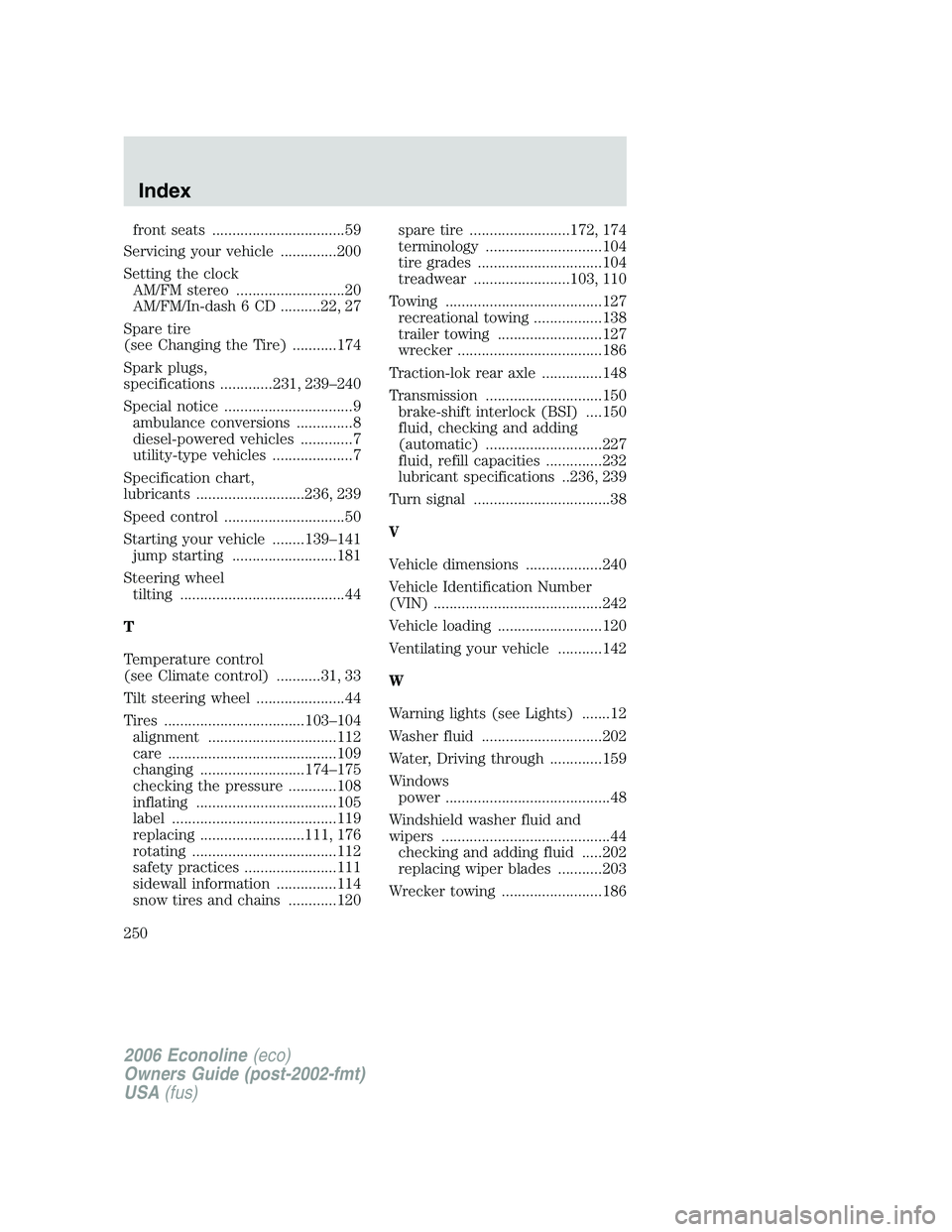
front seats .................................59
Servicing your vehicle ..............200
Setting the clock
AM/FM stereo ...........................20
AM/FM/In-dash 6 CD ..........22, 27
Spare tire
(see Changing the Tire) ...........174
Spark plugs,
specifications .............231, 239–240
Special notice ................................9
ambulance conversions ..............8
diesel-powered vehicles .............7
utility-type vehicles ....................7
Specification chart,
lubricants ...........................236, 239
Speed control ..............................50
Starting your vehicle ........139–141
jump starting ..........................181
Steering wheel
tilting .........................................44
T
Temperature control
(see Climate control) ...........31, 33
Tilt steering wheel ......................44
Tires ...................................103–104
alignment ................................112
care ..........................................109
changing ..........................174–175
checking the pressure ............108
inflating ...................................105
label .........................................119
replacing ..........................111, 176
rotating ....................................112
safety practices .......................111
sidewall information ...............114
snow tires and chains ............120spare tire .........................172, 174
terminology .............................104
tire grades ...............................104
treadwear ........................103, 110
Towing .......................................127
recreational towing .................138
trailer towing ..........................127
wrecker ....................................186
Traction-lok rear axle ...............148
Transmission .............................150
brake-shift interlock (BSI) ....150
fluid, checking and adding
(automatic) .............................227
fluid, refill capacities ..............232
lubricant specifications ..236, 239
Turn signal ..................................38
V
Vehicle dimensions ...................240
Vehicle Identification Number
(VIN) ..........................................242
Vehicle loading ..........................120
Ventilating your vehicle ...........142
W
Warning lights (see Lights) .......12
Washer fluid ..............................202
Water, Driving through .............159
Windows
power .........................................48
Windshield washer fluid and
wipers ..........................................44
checking and adding fluid .....202
replacing wiper blades ...........203
Wrecker towing .........................186
2006 Econoline(eco)
Owners Guide (post-2002-fmt)
USA(fus)
Index
250