air condition FORD E450 2009 Owner's Manual
[x] Cancel search | Manufacturer: FORD, Model Year: 2009, Model line: E450, Model: FORD E450 2009Pages: 320, PDF Size: 2.24 MB
Page 288 of 320
Choosing the right fuel
If your vehicle is a flexible fuel vehicle (FFV), use only UNLEADED
FUEL and FUEL ETHANOL (Ed75–Ed85).
If your vehicle is not a flexible fuel vehicle (FFV), then only use
UNLEADED fuel or UNLEADED fuel blended with a maximum of 10%
ethanol. Do not use fuel ethanol (E85), diesel, methanol, leaded fuel or
any other fuel.
The use of leaded fuel is prohibited by law and could damage your
vehicle.
Your vehicle was not designed to use fuel or fuel additives with metallic
compounds, including manganese-based additives.
Note:Use of any fuel other than those recommended may cause
powertrain damage, a loss of vehicle performance, and repairs may not
be covered under warranty.
Cleaner air
Ford endorses the use of reformulated “cleaner-burning” gasolines to
improve air quality, per the recommendations in theChoosing the right
fuelsection.
Octane recommendations
Do not be concerned if your engine
sometimes knocks lightly. However,
if it knocks heavily under most
driving conditions while you are
using fuel with the recommended
octane rating, see your authorized dealer to prevent any engine damage.
Unleaded Gasoline Engines
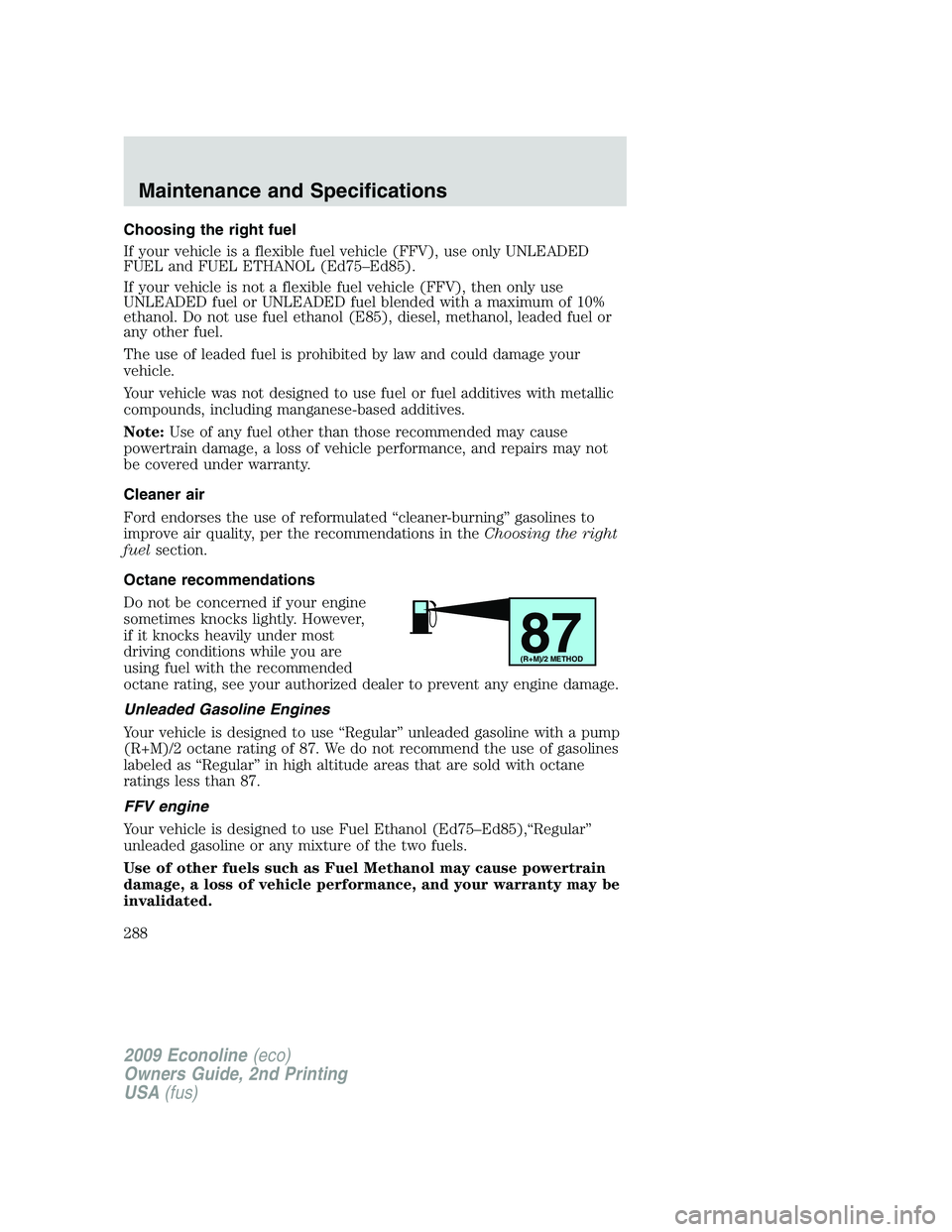
Your vehicle is designed to use “Regular” unleaded gasoline with a pump
(R+M)/2 octane rating of 87. We do not recommend the use of gasolines
labeled as “Regular” in high altitude areas that are sold with octane
ratings less than 87.
FFV engine
Your vehicle is designed to use Fuel Ethanol (Ed75–Ed85),“Regular”
unleaded gasoline or any mixture of the two fuels.
Use of other fuels such as Fuel Methanol may cause powertrain
damage, a loss of vehicle performance, and your warranty may be
invalidated.
87(R+M)/2 METHOD
2009 Econoline(eco)
Owners Guide, 2nd Printing
USA(fus)
Maintenance and Specifications
288
Page 292 of 320
•Anticipate stopping; slowing down may eliminate the need to stop.
•Sudden or hard accelerations may reduce fuel economy.
•Slow down gradually.
•Driving at reasonable speeds (traveling at 55 mph [88 km/h] uses 15%
less fuel than traveling at 65 mph [105 km/h]).
•Revving the engine before turning it off may reduce fuel economy.
•Using the air conditioner or defroster may reduce fuel economy.
•You may want to turn off the speed control in hilly terrain if
unnecessary shifting between the top gears occurs. Unnecessary
shifting of this type could result in reduced fuel economy.
•Warming up a vehicle on cold mornings is not required and may
reduce fuel economy.
•Resting your foot on the brake pedal while driving may reduce fuel
economy.
•Combine errands and minimize stop-and-go driving.
Maintenance
•Keep tires properly inflated and use only recommended size.
•Operating a vehicle with the wheels out of alignment will reduce fuel
economy.
•Use recommended engine oil. Refer toMaintenance product
specifications and capacitiesin this chapter.
•Perform all regularly scheduled maintenance items. Follow the
recommended maintenance schedule and owner maintenance checks
found inscheduled maintenance information.
Conditions
•Heavily loading a vehicle or towing a trailer may reduce fuel economy
at any speed.
•Carrying unnecessary weight may reduce fuel economy (approximately
1 mpg [0.4 km/L] is lost for every 400 lb [180 kg] of weight carried).
•Adding certain accessories to your vehicle (for example bug
deflectors, rollbars/light bars, running boards, ski/luggage racks) may
reduce fuel economy.
•Using fuel blended with alcohol may lower fuel economy.
•Fuel economy may decrease with lower temperatures during the first
8–10 miles (12–16 km) of driving.
2009 Econoline(eco)
Owners Guide, 2nd Printing
USA(fus)
Maintenance and Specifications
292
Page 302 of 320
An overfill condition of transmission fluid may cause shift and/or
engagement concerns and/or possible damage.
Do not use supplemental transmission fluid additives, treatments or
cleaning agents. The use of these materials may affect transmission
operation and result in damage to internal transmission components.
Automatic transmission fluid filter
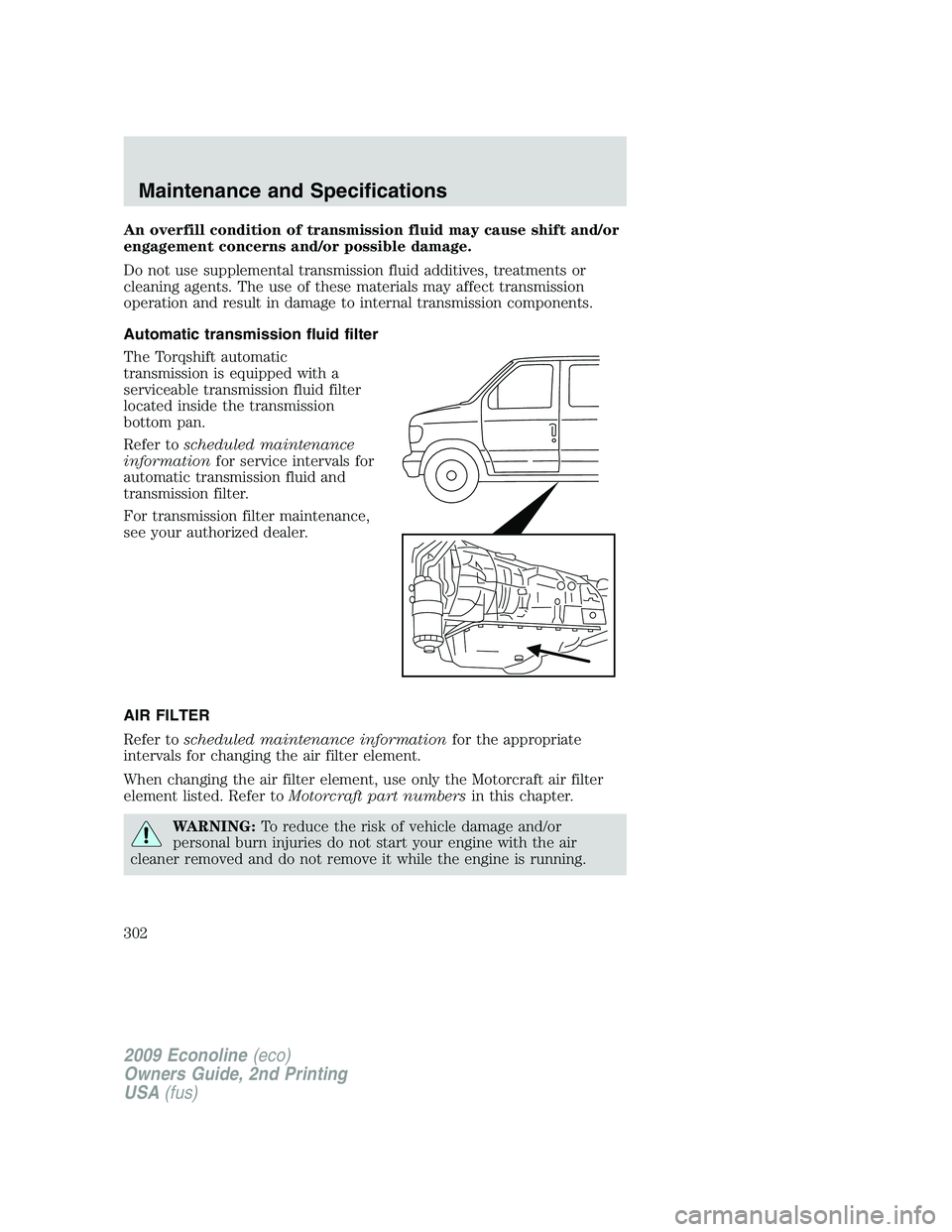
The Torqshift automatic
transmission is equipped with a
serviceable transmission fluid filter
located inside the transmission
bottom pan.
Refer toscheduled maintenance
informationfor service intervals for
automatic transmission fluid and
transmission filter.
For transmission filter maintenance,
see your authorized dealer.
AIR FILTER
Refer toscheduled maintenance informationfor the appropriate
intervals for changing the air filter element.
When changing the air filter element, use only the Motorcraft air filter
element listed. Refer toMotorcraft part numbersin this chapter.
WARNING:To reduce the risk of vehicle damage and/or
personal burn injuries do not start your engine with the air
cleaner removed and do not remove it while the engine is running.
2009 Econoline(eco)
Owners Guide, 2nd Printing
USA(fus)
Maintenance and Specifications
302
Page 316 of 320
instrument panel ....................265
interior .....................................265
plastic parts ............................264
safety belts ..............................265
washing ....................................261
waxing .....................................262
wheels ......................................262
wiper blades ............................264
Climate control (see Air
conditioning or Heating) ......44–46
Clock adjust
6-CD in dash .............................30
AM/FM Stereo ...........................23
AM/FM/CD .................................25
Compass, electronic ....................62
calibration .................................63
set zone adjustment .................62
Console
overhead ..............................60–61
Controls
power seat .................................94
Coolant
checking and adding ..............277
refill capacities ................281, 305
specifications ..........................305
Cruise control
(see Speed control) ....................68
Customer Assistance ................224
Ford Extended Service
Plan ..........................................258
Getting assistance outside the
U.S. and Canada .....................258
Getting roadside assistance ...224
Getting the service you
need .........................................253
Ordering additional owner’s
literature .................................259
Utilizing the
Mediation/Arbitration
Program ...................................257D
Daytime running lamps
(see Lamps) ................................47
Dipstick
automatic transmission
fluid ..........................................298
engine oil .................................271
Driveline universal joint and
slip yoke ....................................298
Driving under special
conditions
through water .........................223
E
Electronic message center .........71
Emergencies, roadside
jump-starting ..........................245
Emergency Flashers .................226
Emission control system ..........293
Engine ........................................309
cleaning ...................................263
coolant .....................................277
diesel ...........................................8
fail-safe cooling .......................282
idle speed control ...................274
lubrication specifications .......305
refill capacities ........................305
service points ..........................269
starting after a collision .........226
Engine block heater .................196
Engine oil ..................................271
checking and adding ..............271
dipstick ....................................271
filter, specifications ........273, 304
recommendations ...................273
refill capacities ........................305
specifications ..........................305
2009 Econoline(eco)
Owners Guide, 2nd Printing
USA(fus)
Index
316
Page 317 of 320
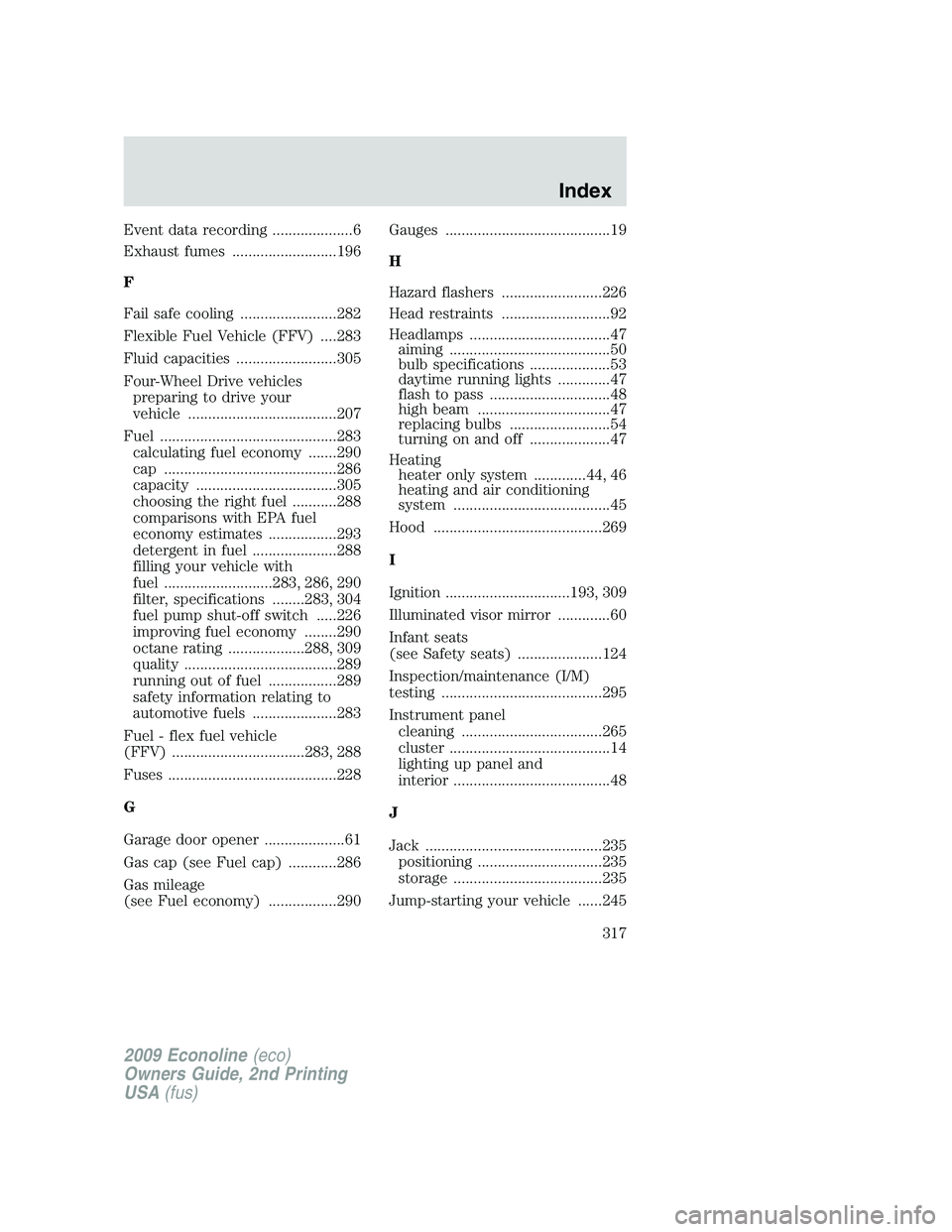
Event data recording ....................6
Exhaust fumes ..........................196
F
Fail safe cooling ........................282
Flexible Fuel Vehicle (FFV) ....283
Fluid capacities .........................305
Four-Wheel Drive vehicles
preparing to drive your
vehicle .....................................207
Fuel ............................................283
calculating fuel economy .......290
cap ...........................................286
capacity ...................................305
choosing the right fuel ...........288
comparisons with EPA fuel
economy estimates .................293
detergent in fuel .....................288
filling your vehicle with
fuel ...........................283, 286, 290
filter, specifications ........283, 304
fuel pump shut-off switch .....226
improving fuel economy ........290
octane rating ...................288, 309
quality ......................................289
running out of fuel .................289
safety information relating to
automotive fuels .....................283
Fuel - flex fuel vehicle
(FFV) .................................283, 288
Fuses ..........................................228
G
Garage door opener ....................61
Gas cap (see Fuel cap) ............286
Gas mileage
(see Fuel economy) .................290Gauges .........................................19
H
Hazard flashers .........................226
Head restraints ...........................92
Headlamps ...................................47
aiming ........................................50
bulb specifications ....................53
daytime running lights .............47
flash to pass ..............................48
high beam .................................47
replacing bulbs .........................54
turning on and off ....................47
Heating
heater only system .............44, 46
heating and air conditioning
system .......................................45
Hood ..........................................269
I
Ignition ...............................193, 309
Illuminated visor mirror .............60
Infant seats
(see Safety seats) .....................124
Inspection/maintenance (I/M)
testing ........................................295
Instrument panel
cleaning ...................................265
cluster ........................................14
lighting up panel and
interior .......................................48
J
Jack ............................................235
positioning ...............................235
storage .....................................235
Jump-starting your vehicle ......245
2009 Econoline(eco)
Owners Guide, 2nd Printing
USA(fus)
Index
317