trailer FORD E450 2012 User Guide
[x] Cancel search | Manufacturer: FORD, Model Year: 2012, Model line: E450, Model: FORD E450 2012Pages: 335, PDF Size: 2.34 MB
Page 165 of 335
Follow these guidelines when using snow tires and chains:
•If possible, avoid fully loading your vehicle.
•Use only SAE Class S chains.
•Install chains securely, verifying that the chains do not touch any
wiring, brake lines or fuel lines.
•Drive cautiously. If you hear the chains rub or bang against your
vehicle, stop and retighten the chains. If this does not work, remove
the chains to prevent damage to your vehicle.
•Remove the tire chains when they are no longer needed. Do not use
tire chains on dry roads.
VEHICLE LOADING – WITH AND WITHOUT A TRAILER
This section will guide you in the proper loading of your vehicle and/or
trailer, to keep your loaded vehicle weight within its design rating
capability, with or without a trailer. Properly loading your vehicle will
provide maximum return of vehicle design performance. Before loading
your vehicle, familiarize yourself with the following terms for determining
your vehicle’s weight ratings, with or without a trailer, from the vehicle’s
Tire Label or Safety Compliance Certification Label:
Base Curb Weight– is the weight of the vehicle including a full tank of
fuel and all standard equipment. It does not include passengers, cargo, or
optional equipment.
Vehicle Curb Weight– is the weight of your new vehicle when you
picked it up from your authorized dealer plus any aftermarket
equipment.
Tires, Wheels and Loading
165
2012 Econoline(eco)
Owners Guide, 1st Printing
USA(fus)
Page 167 of 335
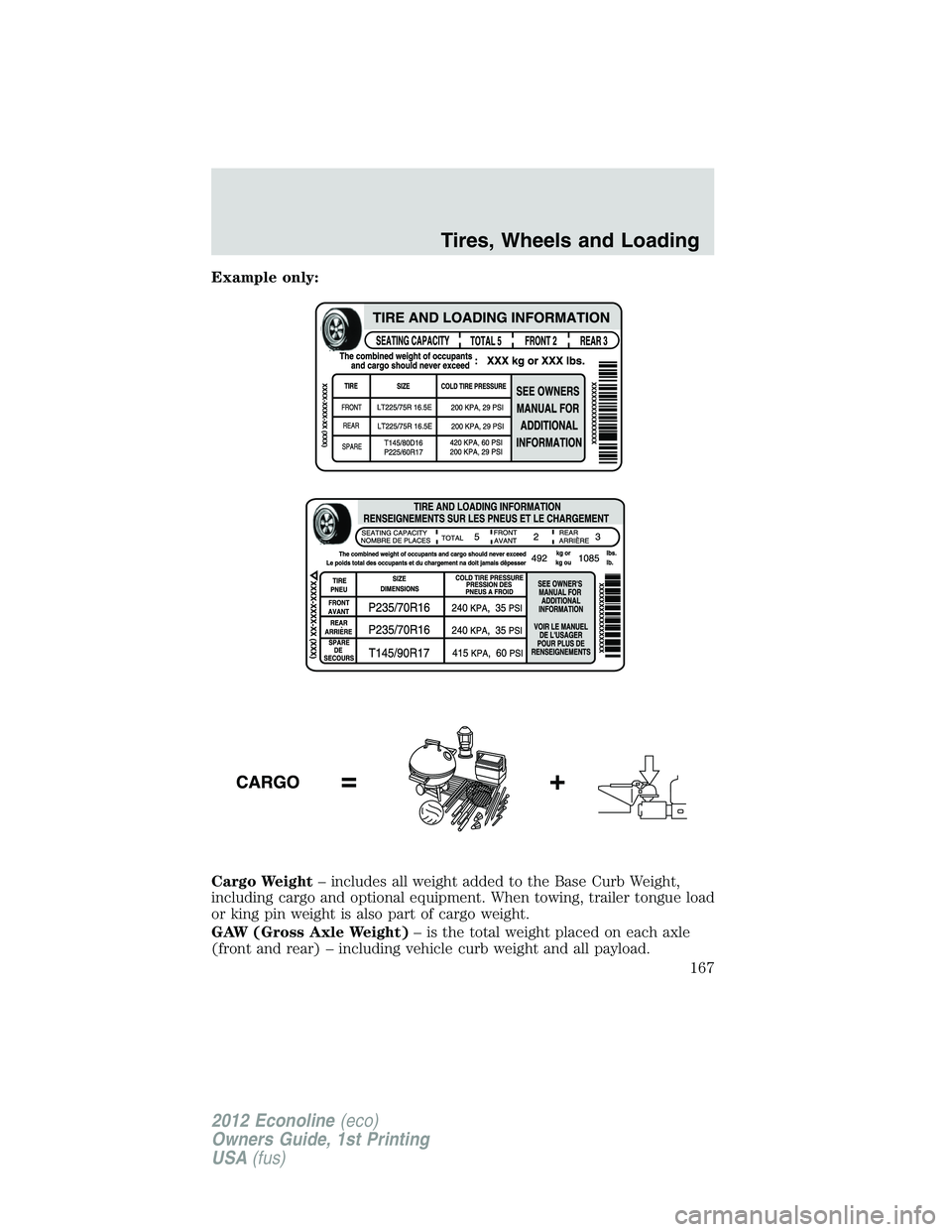
Example only:
Cargo Weight– includes all weight added to the Base Curb Weight,
including cargo and optional equipment. When towing, trailer tongue load
or king pin weight is also part of cargo weight.
GAW (Gross Axle Weight)– is the total weight placed on each axle
(front and rear) – including vehicle curb weight and all payload.
Tires, Wheels and Loading
167
2012 Econoline(eco)
Owners Guide, 1st Printing
USA(fus)
Page 168 of 335
GAWR (Gross Axle Weight Rating)– is the maximum allowable
weight that can be carried by a single axle (front or rear).These
numbers are shown on the Safety Compliance Certification Label
located on the B-Pillar or the edge of the driver’s door. The total
load on each axle must never exceed its GAWR.
Note:For trailer towing information refer toTrailer towingfound in
this chapter or theRV and Trailer Towing Guideprovided by your
authorized dealer.
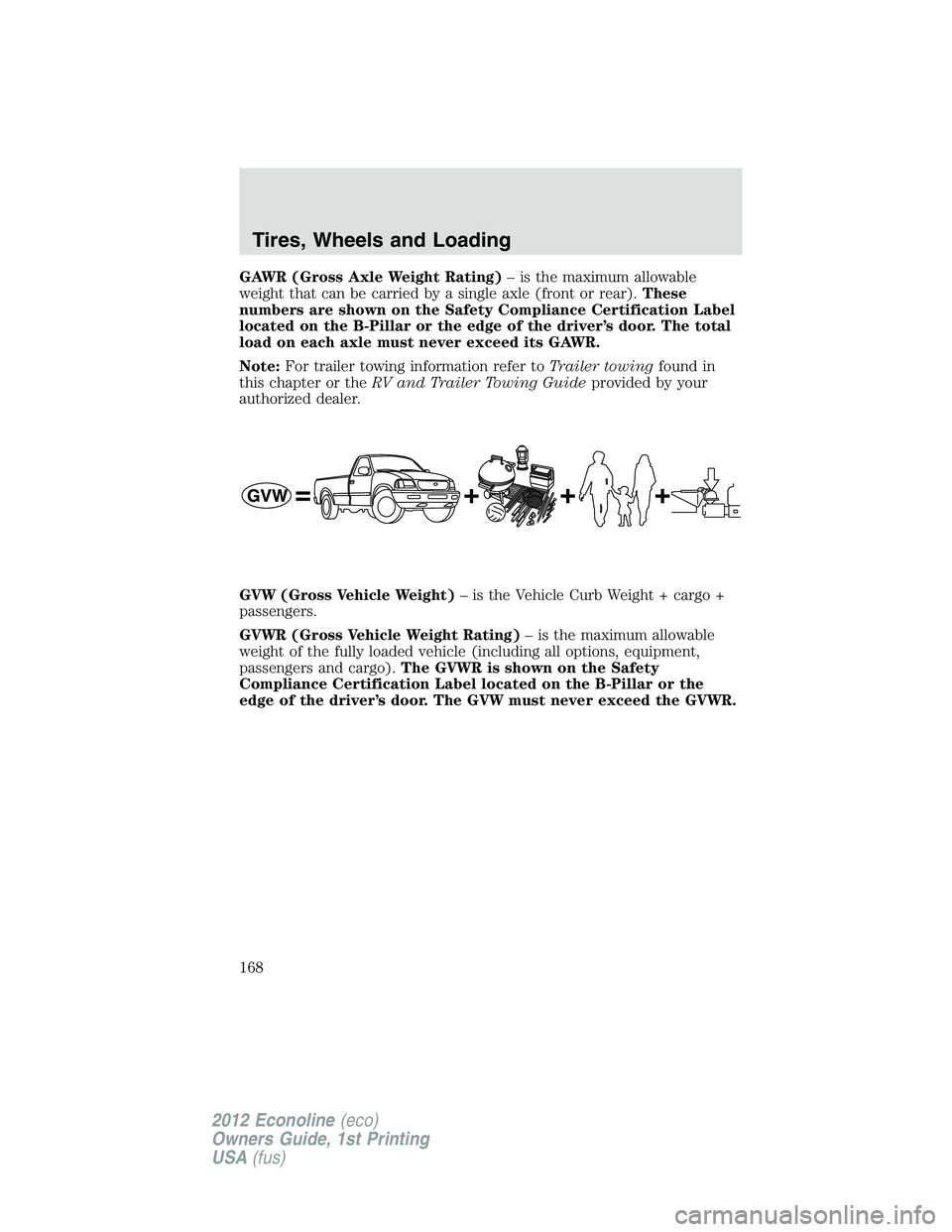
GVW (Gross Vehicle Weight)– is the Vehicle Curb Weight + cargo +
passengers.
GVWR (Gross Vehicle Weight Rating)– is the maximum allowable
weight of the fully loaded vehicle (including all options, equipment,
passengers and cargo).The GVWR is shown on the Safety
Compliance Certification Label located on the B-Pillar or the
edge of the driver’s door. The GVW must never exceed the GVWR.
Tires, Wheels and Loading
168
2012 Econoline(eco)
Owners Guide, 1st Printing
USA(fus)
Page 170 of 335
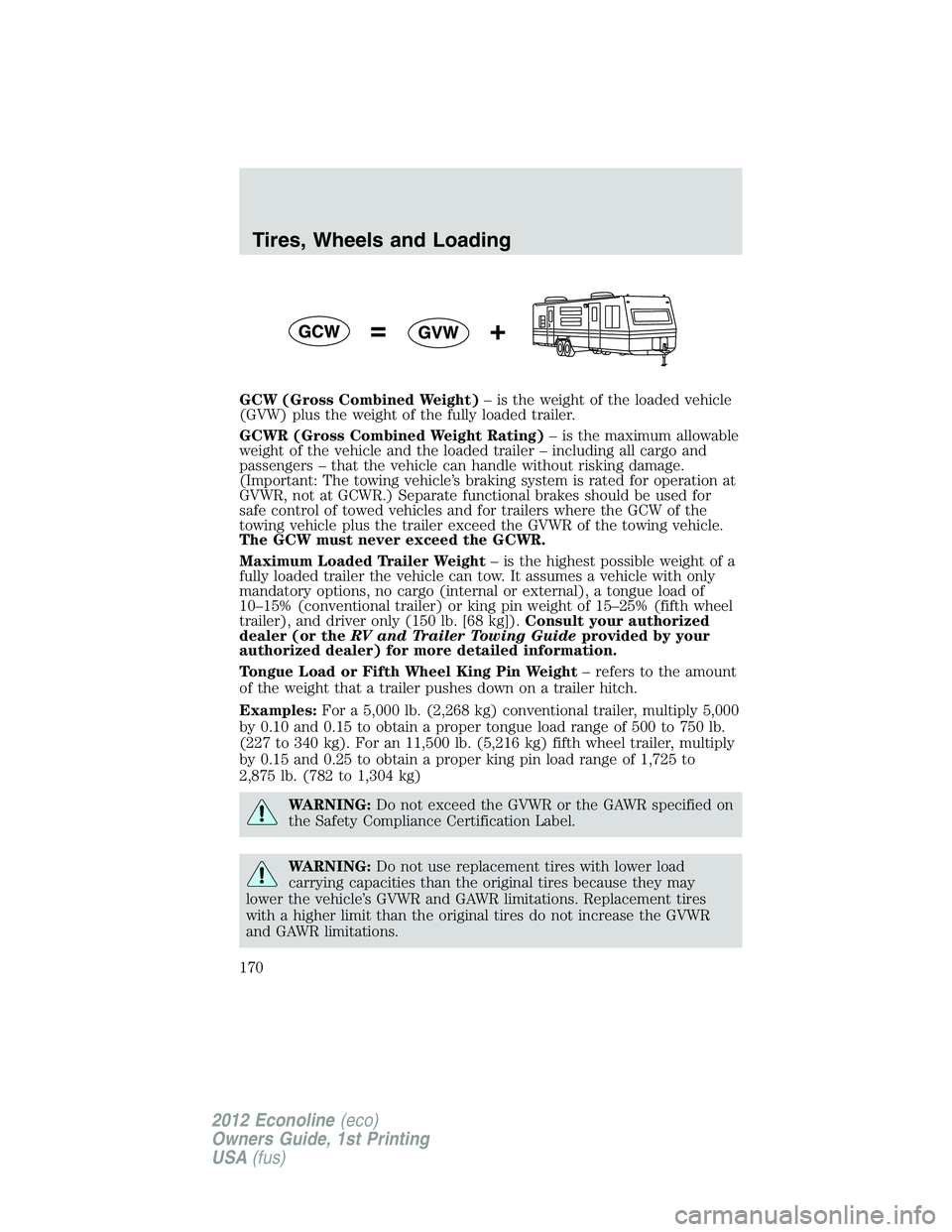
GCW (Gross Combined Weight)– is the weight of the loaded vehicle
(GVW) plus the weight of the fully loaded trailer.
GCWR (Gross Combined Weight Rating)– is the maximum allowable
weight of the vehicle and the loaded trailer – including all cargo and
passengers – that the vehicle can handle without risking damage.
(Important: The towing vehicle’s braking system is rated for operation at
GVWR, not at GCWR.) Separate functional brakes should be used for
safe control of towed vehicles and for trailers where the GCW of the
towing vehicle plus the trailer exceed the GVWR of the towing vehicle.
The GCW must never exceed the GCWR.
Maximum Loaded Trailer Weight– is the highest possible weight of a
fully loaded trailer the vehicle can tow. It assumes a vehicle with only
mandatory options, no cargo (internal or external), a tongue load of
10–15% (conventional trailer) or king pin weight of 15–25% (fifth wheel
trailer), and driver only (150 lb. [68 kg]).Consult your authorized
dealer (or theRV and Trailer Towing Guideprovided by your
authorized dealer) for more detailed information.
Tongue Load or Fifth Wheel King Pin Weight– refers to the amount
of the weight that a trailer pushes down on a trailer hitch.
Examples:For a 5,000 lb. (2,268 kg) conventional trailer, multiply 5,000
by 0.10 and 0.15 to obtain a proper tongue load range of 500 to 750 lb.
(227 to 340 kg). For an 11,500 lb. (5,216 kg) fifth wheel trailer, multiply
by 0.15 and 0.25 to obtain a proper king pin load range of 1,725 to
2,875 lb. (782 to 1,304 kg)
WARNING:Do not exceed the GVWR or the GAWR specified on
the Safety Compliance Certification Label.
WARNING:Do not use replacement tires with lower load
carrying capacities than the original tires because they may
lower the vehicle’s GVWR and GAWR limitations. Replacement tires
with a higher limit than the original tires do not increase the GVWR
and GAWR limitations.
Tires, Wheels and Loading
170
2012 Econoline(eco)
Owners Guide, 1st Printing
USA(fus)
Page 171 of 335
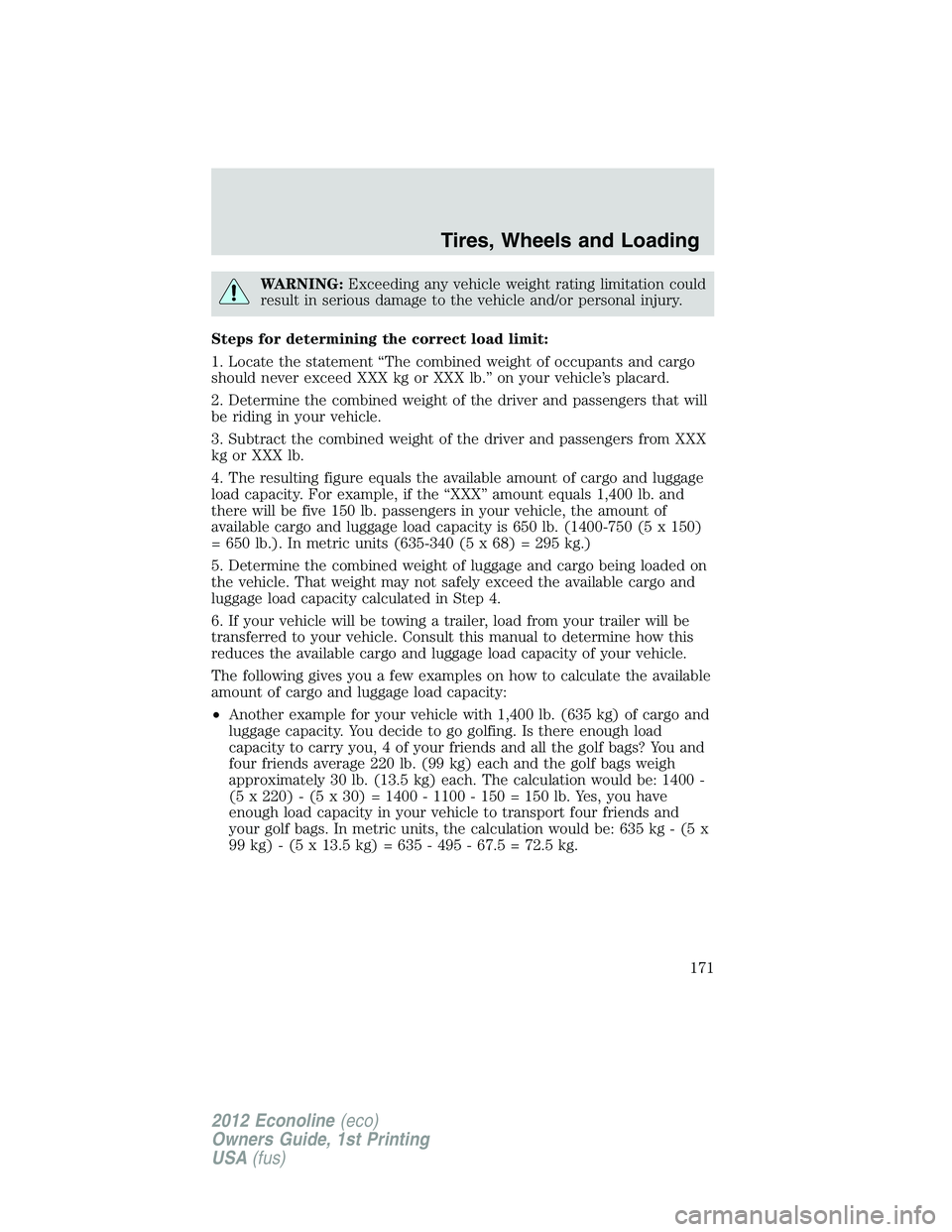
WARNING:Exceeding any vehicle weight rating limitation could
result in serious damage to the vehicle and/or personal injury.
Steps for determining the correct load limit:
1. Locate the statement “The combined weight of occupants and cargo
should never exceed XXX kg or XXX lb.” on your vehicle’s placard.
2. Determine the combined weight of the driver and passengers that will
be riding in your vehicle.
3. Subtract the combined weight of the driver and passengers from XXX
kg or XXX lb.
4. The resulting figure equals the available amount of cargo and luggage
load capacity. For example, if the “XXX” amount equals 1,400 lb. and
there will be five 150 lb. passengers in your vehicle, the amount of
available cargo and luggage load capacity is 650 lb. (1400-750 (5 x 150)
= 650 lb.). In metric units (635-340 (5 x 68) = 295 kg.)
5. Determine the combined weight of luggage and cargo being loaded on
the vehicle. That weight may not safely exceed the available cargo and
luggage load capacity calculated in Step 4.
6. If your vehicle will be towing a trailer, load from your trailer will be
transferred to your vehicle. Consult this manual to determine how this
reduces the available cargo and luggage load capacity of your vehicle.
The following gives you a few examples on how to calculate the available
amount of cargo and luggage load capacity:
•Another example for your vehicle with 1,400 lb. (635 kg) of cargo and
luggage capacity. You decide to go golfing. Is there enough load
capacity to carry you, 4 of your friends and all the golf bags? You and
four friends average 220 lb. (99 kg) each and the golf bags weigh
approximately 30 lb. (13.5 kg) each. The calculation would be: 1400 -
(5 x 220) - (5 x 30) = 1400 - 1100 - 150 = 150 lb. Yes, you have
enough load capacity in your vehicle to transport four friends and
your golf bags. In metric units, the calculation would be: 635 kg - (5 x
99 kg) - (5 x 13.5 kg) = 635 - 495 - 67.5 = 72.5 kg.
Tires, Wheels and Loading
171
2012 Econoline(eco)
Owners Guide, 1st Printing
USA(fus)
Page 173 of 335
TRAILER TOWING
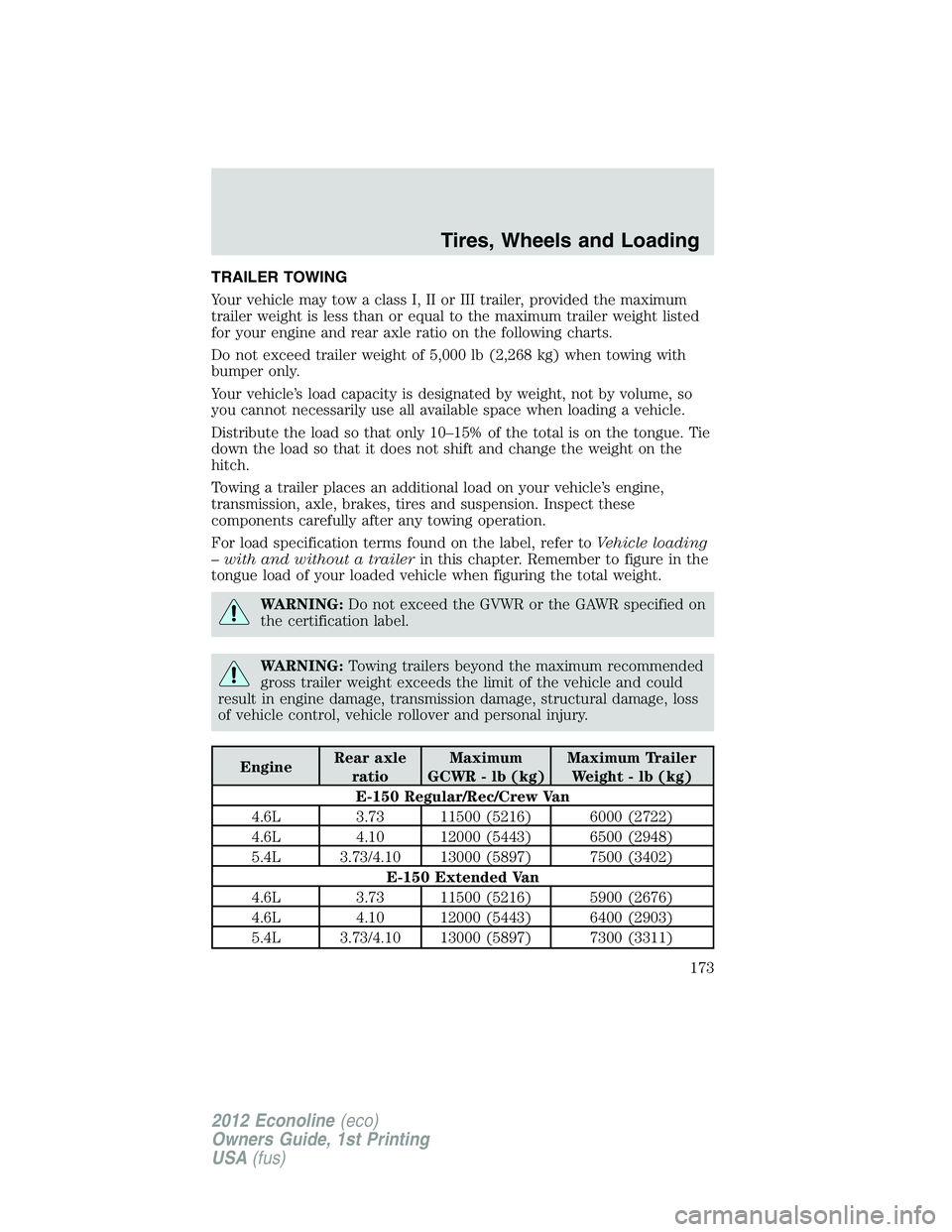
Your vehicle may tow a class I, II or III trailer, provided the maximum
trailer weight is less than or equal to the maximum trailer weight listed
for your engine and rear axle ratio on the following charts.
Do not exceed trailer weight of 5,000 lb (2,268 kg) when towing with
bumper only.
Your vehicle’s load capacity is designated by weight, not by volume, so
you cannot necessarily use all available space when loading a vehicle.
Distribute the load so that only 10–15% of the total is on the tongue. Tie
down the load so that it does not shift and change the weight on the
hitch.
Towing a trailer places an additional load on your vehicle’s engine,
transmission, axle, brakes, tires and suspension. Inspect these
components carefully after any towing operation.
For load specification terms found on the label, refer toVehicle loading
– with and without a trailerin this chapter. Remember to figure in the
tongue load of your loaded vehicle when figuring the total weight.
WARNING:Do not exceed the GVWR or the GAWR specified on
the certification label.
WARNING:Towing trailers beyond the maximum recommended
gross trailer weight exceeds the limit of the vehicle and could
result in engine damage, transmission damage, structural damage, loss
of vehicle control, vehicle rollover and personal injury.
EngineRear axle
ratioMaximum
GCWR - lb (kg)Maximum Trailer
Weight - lb (kg)
E-150 Regular/Rec/Crew Van
4.6L 3.73 11500 (5216) 6000 (2722)
4.6L 4.10 12000 (5443) 6500 (2948)
5.4L 3.73/4.10 13000 (5897) 7500 (3402)
E-150 Extended Van
4.6L 3.73 11500 (5216) 5900 (2676)
4.6L 4.10 12000 (5443) 6400 (2903)
5.4L 3.73/4.10 13000 (5897) 7300 (3311)
Tires, Wheels and Loading
173
2012 Econoline(eco)
Owners Guide, 1st Printing
USA(fus)
Page 174 of 335
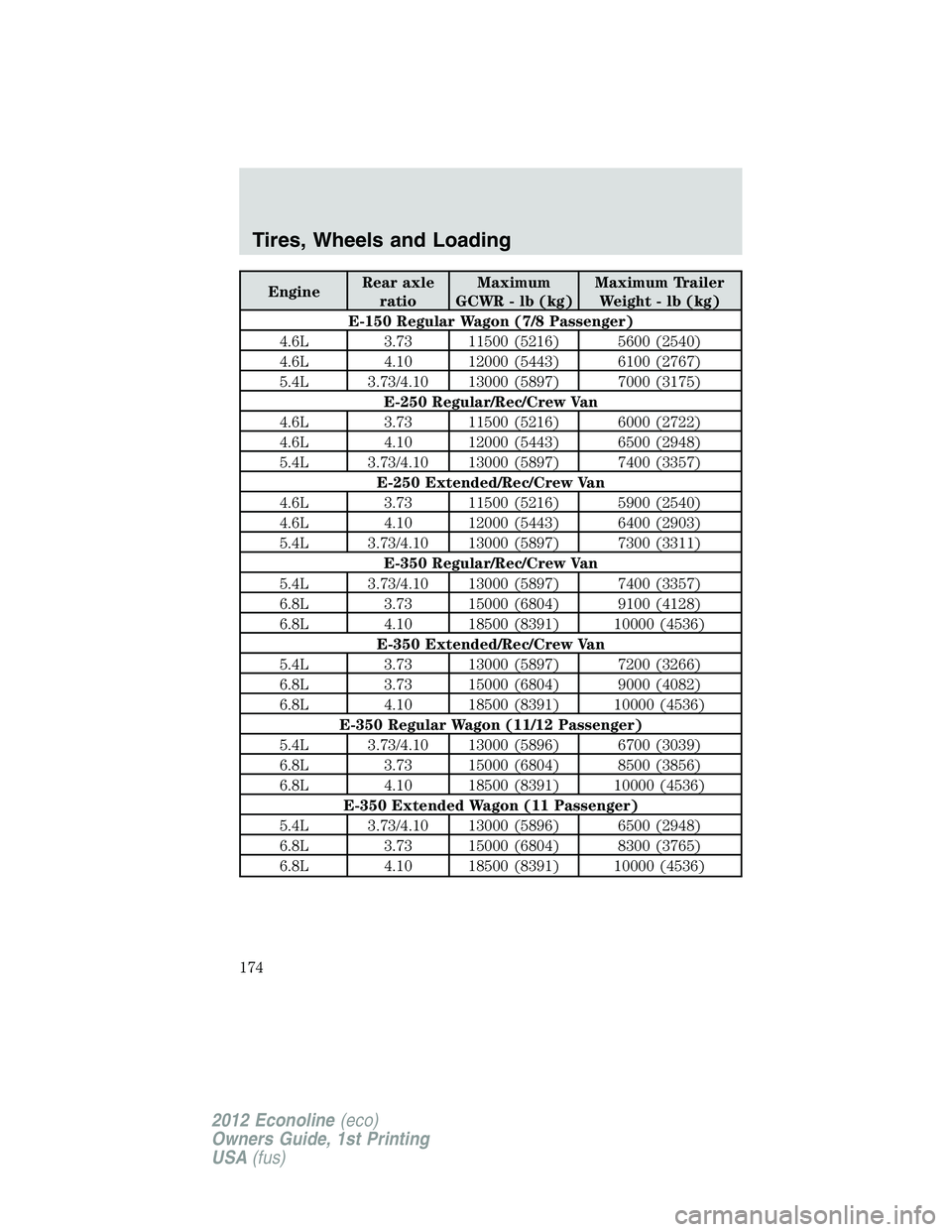
EngineRear axle
ratioMaximum
GCWR - lb (kg)Maximum Trailer
Weight - lb (kg)
E-150 Regular Wagon (7/8 Passenger)
4.6L 3.73 11500 (5216) 5600 (2540)
4.6L 4.10 12000 (5443) 6100 (2767)
5.4L 3.73/4.10 13000 (5897) 7000 (3175)
E-250 Regular/Rec/Crew Van
4.6L 3.73 11500 (5216) 6000 (2722)
4.6L 4.10 12000 (5443) 6500 (2948)
5.4L 3.73/4.10 13000 (5897) 7400 (3357)
E-250 Extended/Rec/Crew Van
4.6L 3.73 11500 (5216) 5900 (2540)
4.6L 4.10 12000 (5443) 6400 (2903)
5.4L 3.73/4.10 13000 (5897) 7300 (3311)
E-350 Regular/Rec/Crew Van
5.4L 3.73/4.10 13000 (5897) 7400 (3357)
6.8L 3.73 15000 (6804) 9100 (4128)
6.8L 4.10 18500 (8391) 10000 (4536)
E-350 Extended/Rec/Crew Van
5.4L 3.73 13000 (5897) 7200 (3266)
6.8L 3.73 15000 (6804) 9000 (4082)
6.8L 4.10 18500 (8391) 10000 (4536)
E-350 Regular Wagon (11/12 Passenger)
5.4L 3.73/4.10 13000 (5896) 6700 (3039)
6.8L 3.73 15000 (6804) 8500 (3856)
6.8L 4.10 18500 (8391) 10000 (4536)
E-350 Extended Wagon (11 Passenger)
5.4L 3.73/4.10 13000 (5896) 6500 (2948)
6.8L 3.73 15000 (6804) 8300 (3765)
6.8L 4.10 18500 (8391) 10000 (4536)
Tires, Wheels and Loading
174
2012 Econoline(eco)
Owners Guide, 1st Printing
USA(fus)
Page 175 of 335
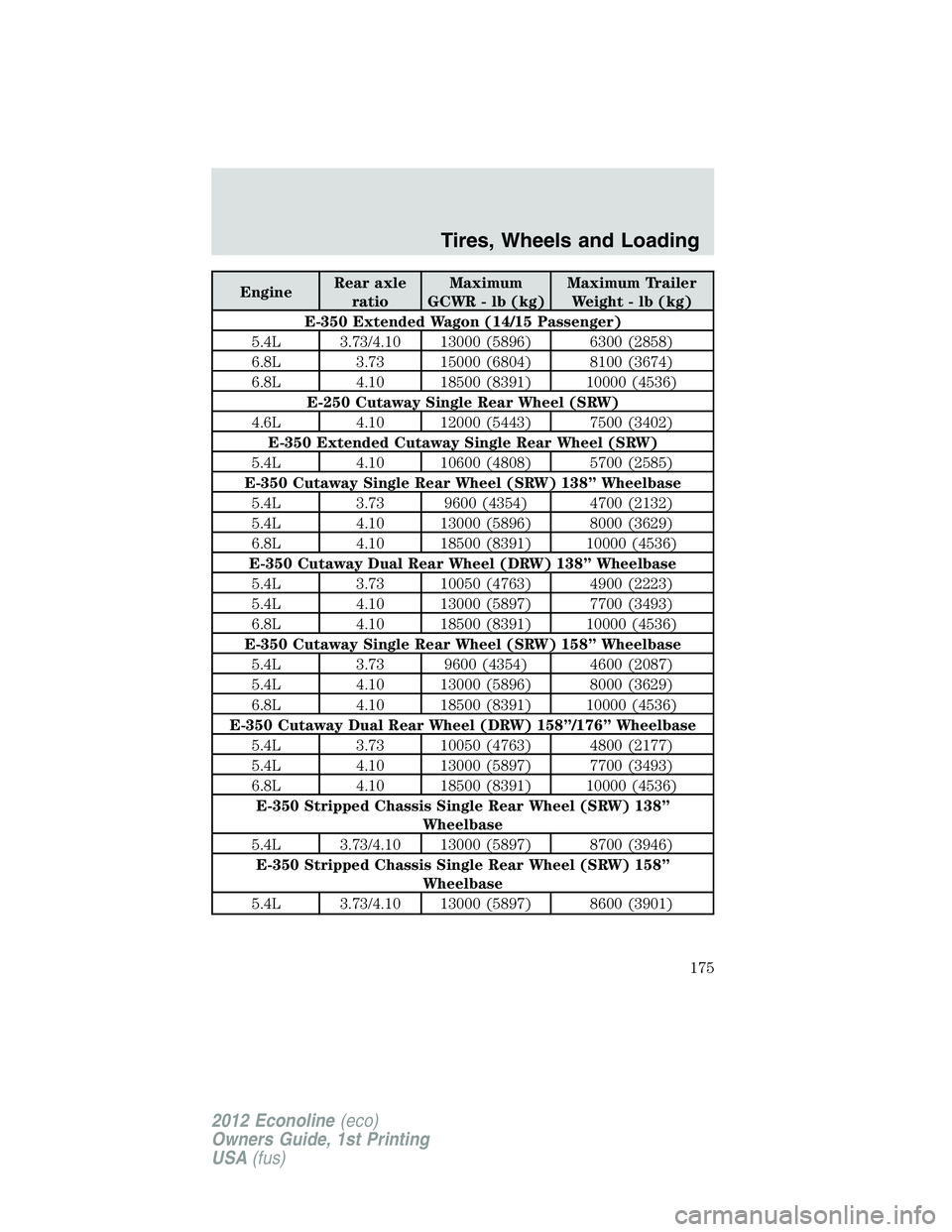
EngineRear axle
ratioMaximum
GCWR - lb (kg)Maximum Trailer
Weight - lb (kg)
E-350 Extended Wagon (14/15 Passenger)
5.4L 3.73/4.10 13000 (5896) 6300 (2858)
6.8L 3.73 15000 (6804) 8100 (3674)
6.8L 4.10 18500 (8391) 10000 (4536)
E-250 Cutaway Single Rear Wheel (SRW)
4.6L 4.10 12000 (5443) 7500 (3402)
E-350 Extended Cutaway Single Rear Wheel (SRW)
5.4L 4.10 10600 (4808) 5700 (2585)
E-350 Cutaway Single Rear Wheel (SRW) 138” Wheelbase
5.4L 3.73 9600 (4354) 4700 (2132)
5.4L 4.10 13000 (5896) 8000 (3629)
6.8L 4.10 18500 (8391) 10000 (4536)
E-350 Cutaway Dual Rear Wheel (DRW) 138” Wheelbase
5.4L 3.73 10050 (4763) 4900 (2223)
5.4L 4.10 13000 (5897) 7700 (3493)
6.8L 4.10 18500 (8391) 10000 (4536)
E-350 Cutaway Single Rear Wheel (SRW) 158” Wheelbase
5.4L 3.73 9600 (4354) 4600 (2087)
5.4L 4.10 13000 (5896) 8000 (3629)
6.8L 4.10 18500 (8391) 10000 (4536)
E-350 Cutaway Dual Rear Wheel (DRW) 158”/176” Wheelbase
5.4L 3.73 10050 (4763) 4800 (2177)
5.4L 4.10 13000 (5897) 7700 (3493)
6.8L 4.10 18500 (8391) 10000 (4536)
E-350 Stripped Chassis Single Rear Wheel (SRW) 138”
Wheelbase
5.4L 3.73/4.10 13000 (5897) 8700 (3946)
E-350 Stripped Chassis Single Rear Wheel (SRW) 158”
Wheelbase
5.4L 3.73/4.10 13000 (5897) 8600 (3901)
Tires, Wheels and Loading
175
2012 Econoline(eco)
Owners Guide, 1st Printing
USA(fus)
Page 176 of 335
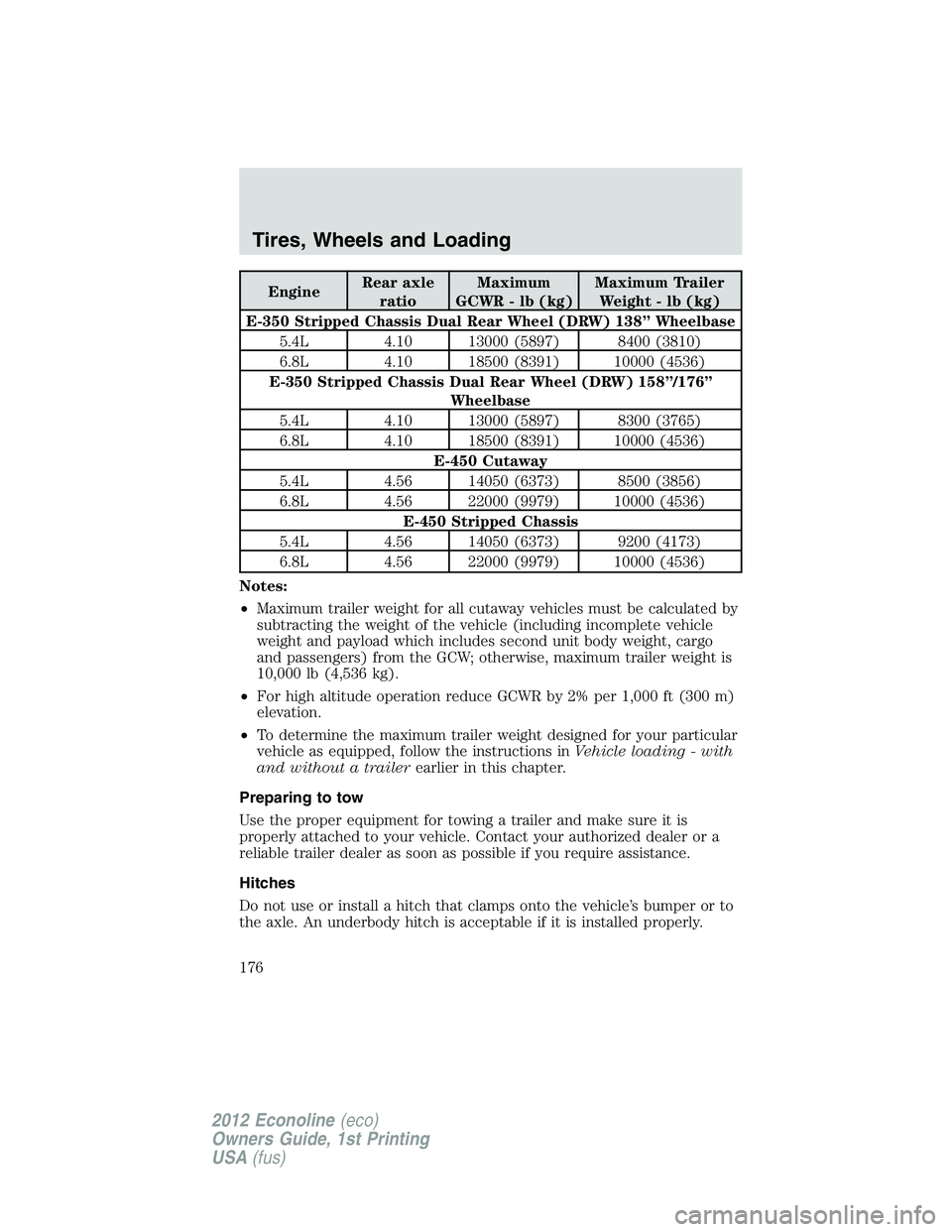
EngineRear axle
ratioMaximum
GCWR - lb (kg)Maximum Trailer
Weight - lb (kg)
E-350 Stripped Chassis Dual Rear Wheel (DRW) 138” Wheelbase
5.4L 4.10 13000 (5897) 8400 (3810)
6.8L 4.10 18500 (8391) 10000 (4536)
E-350 Stripped Chassis Dual Rear Wheel (DRW) 158”/176”
Wheelbase
5.4L 4.10 13000 (5897) 8300 (3765)
6.8L 4.10 18500 (8391) 10000 (4536)
E-450 Cutaway
5.4L 4.56 14050 (6373) 8500 (3856)
6.8L 4.56 22000 (9979) 10000 (4536)
E-450 Stripped Chassis
5.4L 4.56 14050 (6373) 9200 (4173)
6.8L 4.56 22000 (9979) 10000 (4536)
Notes:
•Maximum trailer weight for all cutaway vehicles must be calculated by
subtracting the weight of the vehicle (including incomplete vehicle
weight and payload which includes second unit body weight, cargo
and passengers) from the GCW; otherwise, maximum trailer weight is
10,000 lb (4,536 kg).
•For high altitude operation reduce GCWR by 2% per 1,000 ft (300 m)
elevation.
•To determine the maximum trailer weight designed for your particular
vehicle as equipped, follow the instructions inVehicle loading - with
and without a trailerearlier in this chapter.
Preparing to tow
Use the proper equipment for towing a trailer and make sure it is
properly attached to your vehicle. Contact your authorized dealer or a
reliable trailer dealer as soon as possible if you require assistance.
Hitches
Do not use or install a hitch that clamps onto the vehicle’s bumper or to
the axle. An underbody hitch is acceptable if it is installed properly.
Tires, Wheels and Loading
176
2012 Econoline(eco)
Owners Guide, 1st Printing
USA(fus)
Page 177 of 335
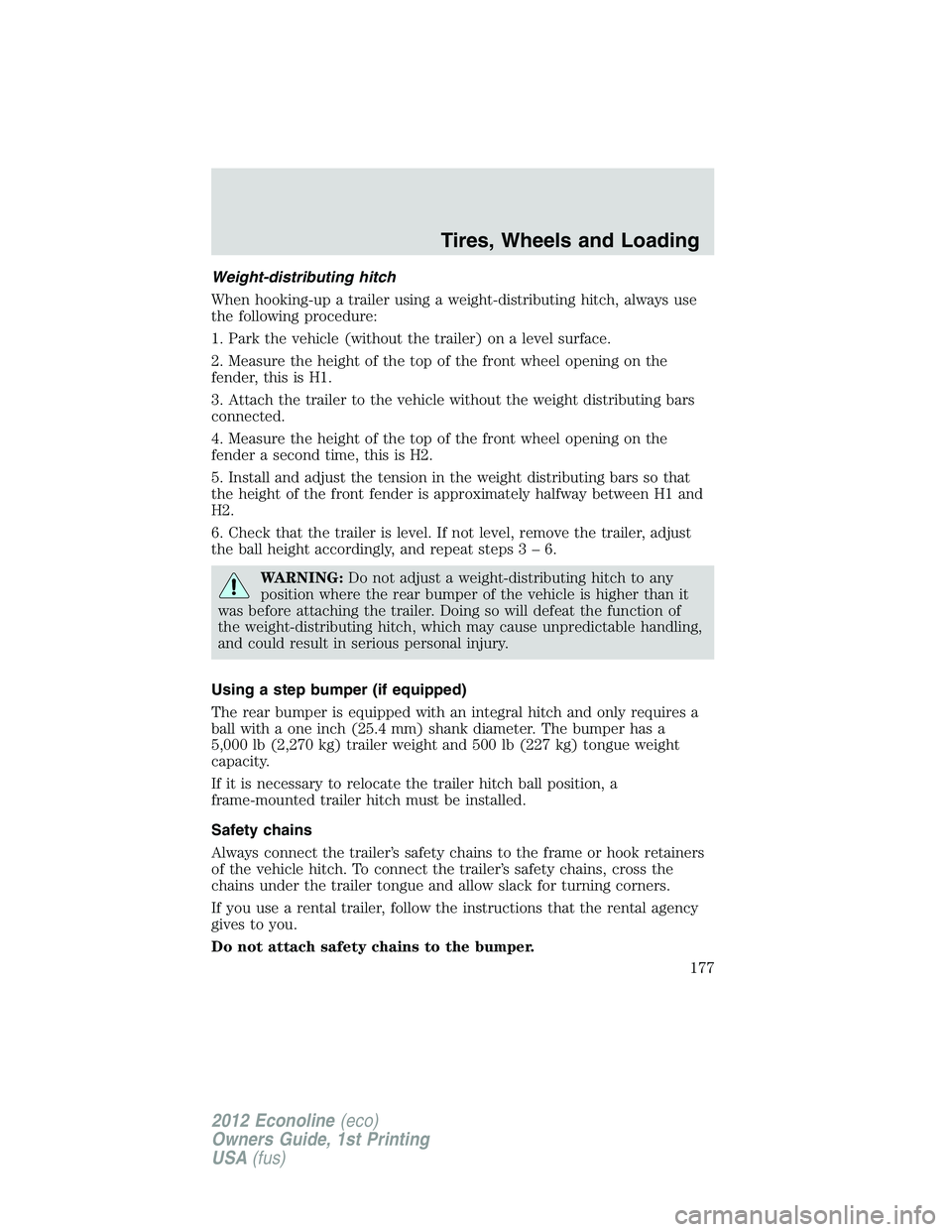
Weight-distributing hitch
When hooking-up a trailer using a weight-distributing hitch, always use
the following procedure:
1. Park the vehicle (without the trailer) on a level surface.
2. Measure the height of the top of the front wheel opening on the
fender, this is H1.
3. Attach the trailer to the vehicle without the weight distributing bars
connected.
4. Measure the height of the top of the front wheel opening on the
fender a second time, this is H2.
5. Install and adjust the tension in the weight distributing bars so that
the height of the front fender is approximately halfway between H1 and
H2.
6. Check that the trailer is level. If not level, remove the trailer, adjust
the ball height accordingly, and repeat steps3–6.
WARNING:Do not adjust a weight-distributing hitch to any
position where the rear bumper of the vehicle is higher than it
was before attaching the trailer. Doing so will defeat the function of
the weight-distributing hitch, which may cause unpredictable handling,
and could result in serious personal injury.
Using a step bumper (if equipped)
The rear bumper is equipped with an integral hitch and only requires a
ball with a one inch (25.4 mm) shank diameter. The bumper has a
5,000 lb (2,270 kg) trailer weight and 500 lb (227 kg) tongue weight
capacity.
If it is necessary to relocate the trailer hitch ball position, a
frame-mounted trailer hitch must be installed.
Safety chains
Always connect the trailer’s safety chains to the frame or hook retainers
of the vehicle hitch. To connect the trailer’s safety chains, cross the
chains under the trailer tongue and allow slack for turning corners.
If you use a rental trailer, follow the instructions that the rental agency
gives to you.
Do not attach safety chains to the bumper.
Tires, Wheels and Loading
177
2012 Econoline(eco)
Owners Guide, 1st Printing
USA(fus)