window FORD ECOSPORT 2018 User Guide
[x] Cancel search | Manufacturer: FORD, Model Year: 2018, Model line: ECOSPORT, Model: FORD ECOSPORT 2018Pages: 452, PDF Size: 17.04 MB
Page 82 of 452
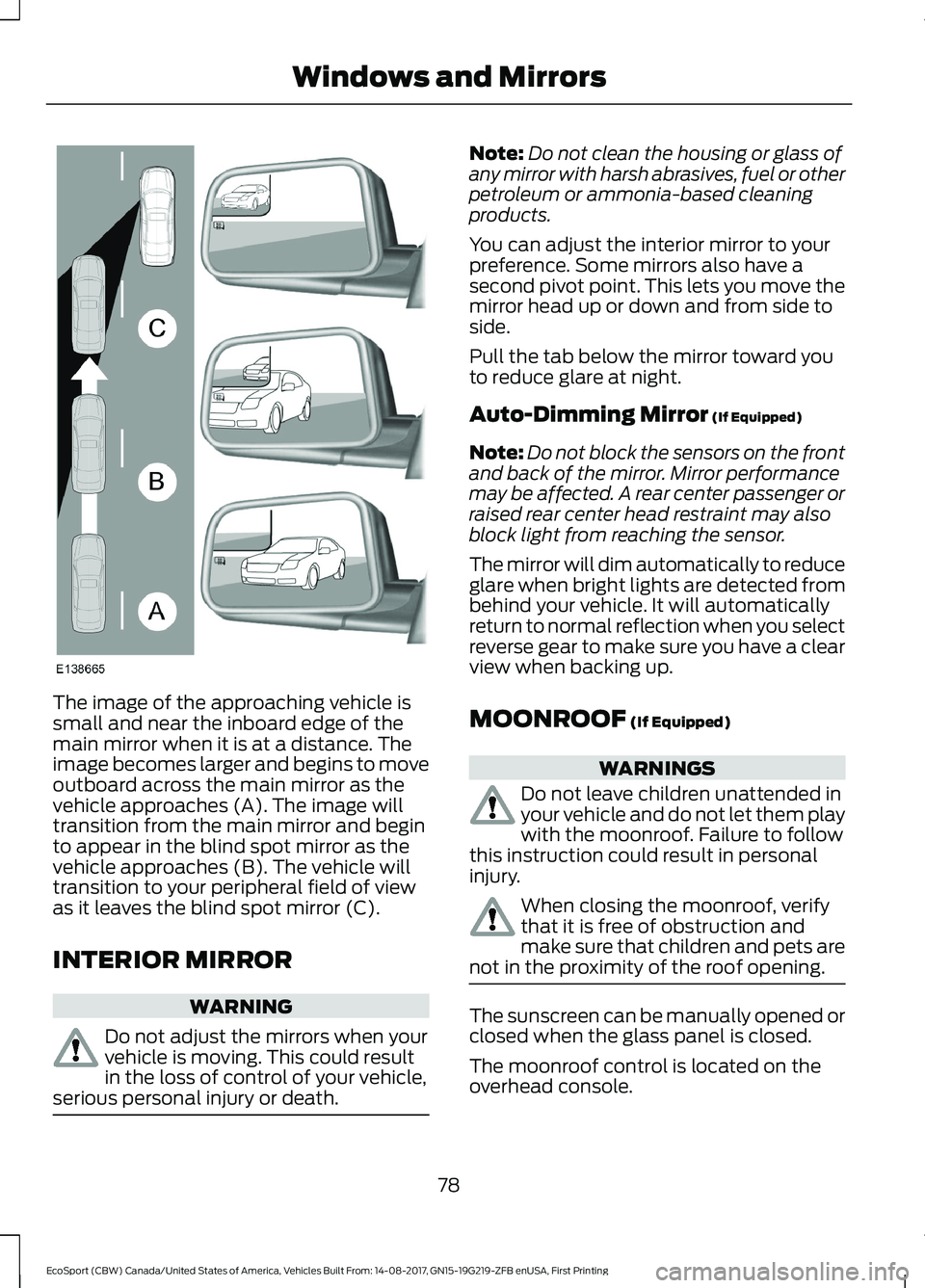
The image of the approaching vehicle issmall and near the inboard edge of themain mirror when it is at a distance. Theimage becomes larger and begins to moveoutboard across the main mirror as thevehicle approaches (A). The image willtransition from the main mirror and beginto appear in the blind spot mirror as thevehicle approaches (B). The vehicle willtransition to your peripheral field of viewas it leaves the blind spot mirror (C).
INTERIOR MIRROR
WARNING
Do not adjust the mirrors when yourvehicle is moving. This could resultin the loss of control of your vehicle,serious personal injury or death.
Note:Do not clean the housing or glass ofany mirror with harsh abrasives, fuel or otherpetroleum or ammonia-based cleaningproducts.
You can adjust the interior mirror to yourpreference. Some mirrors also have asecond pivot point. This lets you move themirror head up or down and from side toside.
Pull the tab below the mirror toward youto reduce glare at night.
Auto-Dimming Mirror (If Equipped)
Note:Do not block the sensors on the frontand back of the mirror. Mirror performancemay be affected. A rear center passenger orraised rear center head restraint may alsoblock light from reaching the sensor.
The mirror will dim automatically to reduceglare when bright lights are detected frombehind your vehicle. It will automaticallyreturn to normal reflection when you selectreverse gear to make sure you have a clearview when backing up.
MOONROOF (If Equipped)
WARNINGS
Do not leave children unattended inyour vehicle and do not let them playwith the moonroof. Failure to followthis instruction could result in personalinjury.
When closing the moonroof, verifythat it is free of obstruction andmake sure that children and pets arenot in the proximity of the roof opening.
The sunscreen can be manually opened orclosed when the glass panel is closed.
The moonroof control is located on theoverhead console.
78EcoSport (CBW) Canada/United States of America, Vehicles Built From: 14-08-2017, GN15-19G219-ZFB enUSA, First PrintingWindows and Mirrors
Page 83 of 452
The moonroof has a one-touch open andclose feature. To stop it during one-touchoperation, press the control a second time.
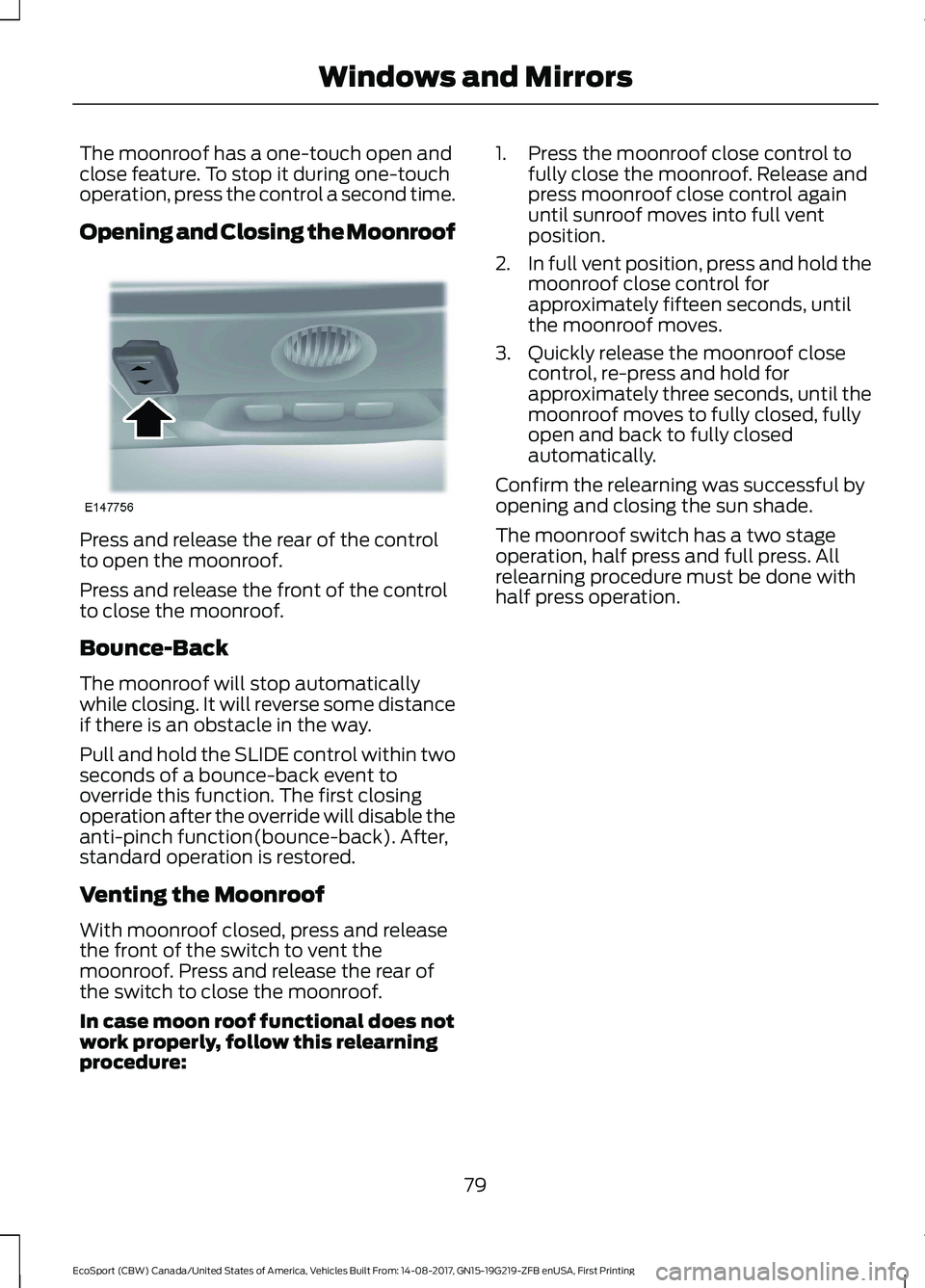
Opening and Closing the Moonroof
Press and release the rear of the controlto open the moonroof.
Press and release the front of the controlto close the moonroof.
Bounce-Back
The moonroof will stop automaticallywhile closing. It will reverse some distanceif there is an obstacle in the way.
Pull and hold the SLIDE control within twoseconds of a bounce-back event tooverride this function. The first closingoperation after the override will disable theanti-pinch function(bounce-back). After,standard operation is restored.
Venting the Moonroof
With moonroof closed, press and releasethe front of the switch to vent themoonroof. Press and release the rear ofthe switch to close the moonroof.
In case moon roof functional does notwork properly, follow this relearningprocedure:
1.Press the moonroof close control tofully close the moonroof. Release andpress moonroof close control againuntil sunroof moves into full ventposition.
2.In full vent position, press and hold themoonroof close control forapproximately fifteen seconds, untilthe moonroof moves.
3.Quickly release the moonroof closecontrol, re-press and hold forapproximately three seconds, until themoonroof moves to fully closed, fullyopen and back to fully closedautomatically.
Confirm the relearning was successful byopening and closing the sun shade.
The moonroof switch has a two stageoperation, half press and full press. Allrelearning procedure must be done withhalf press operation.
79EcoSport (CBW) Canada/United States of America, Vehicles Built From: 14-08-2017, GN15-19G219-ZFB enUSA, First PrintingWindows and Mirrors
Page 102 of 452
PRINCIPLE OF OPERATION
Outside Air
Keep the air intakes in front of thewindshield free from obstruction (such assnow or leaves) to allow the climatecontrol system to function effectively.
Recirculated Air
The air currently in the passengercompartment recirculates. Outside air doesnot enter your vehicle.
Note:Prolonged use of recirculated air maycause the windows to fog up.
Heating
Heating performance depends on thetemperature of the coolant.
General Information on Controllingthe Interior Climate
Close the windows.
Warming the Interior
Direct the air toward your feet. In cold orhumid weather conditions, direct some ofthe air toward the windshield and the doorwindows.
Cooling the Interior
Direct the air toward your face.
Air Conditioning
The system directs condensation to theoutside of your vehicle, which could causea small pool of water to form under yourvehicle. This is normal.
Note:The air conditioning operates onlywhen the temperature is above 39°F (4°C).
Note:When you use air conditioning, yourvehicle uses more fuel.
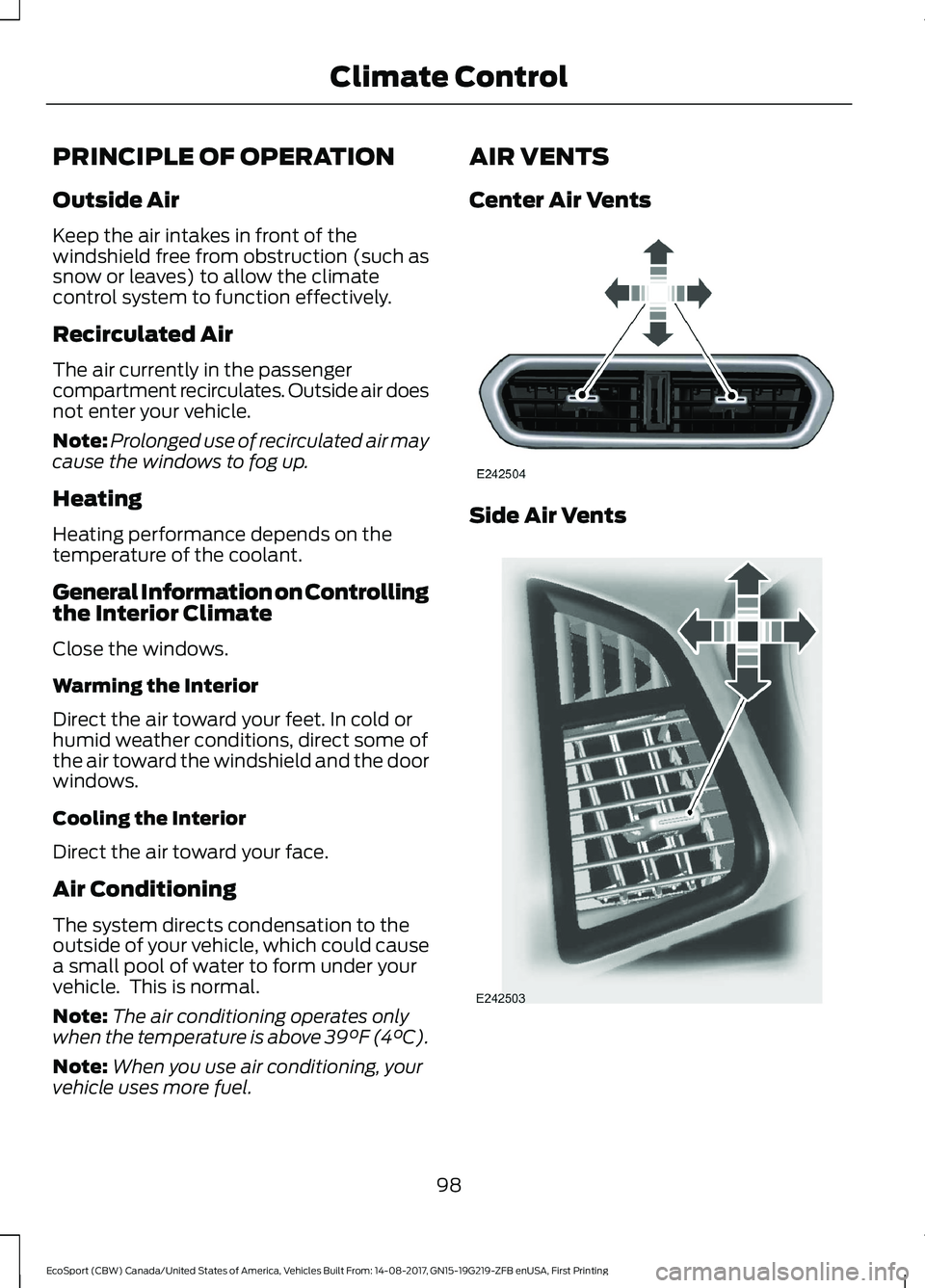
AIR VENTS
Center Air Vents
Side Air Vents
98EcoSport (CBW) Canada/United States of America, Vehicles Built From: 14-08-2017, GN15-19G219-ZFB enUSA, First PrintingClimate Control
Page 103 of 452
MANUAL CLIMATE CONTROL
- VEHICLES WITH:
ELECTRONIC MANUAL
TEMPERATURE CONTROL
(EMTC)
Switching Climate Control On andOff
Switching Recirculated Air On andOff
Recirculates air to reduceunwanted odors from enteringthe vehicle.
Switching Air Conditioning On andOff
Switching Maximum Defrost Onand Off
Turn the temperature controlclockwise to the full heatposition to maximize defrosting.
Note:When you switch maximum defrostoff, theWindshield Wiper De-icer and heatedrear window remain on.
Switching Maximum Cooling Onand Off
Turn the temperature controlcounterclockwise to the lowestsetting to maximize cooling.
Note:When you switch maximum coolingoff, air conditioning remains on.
Adjusting the Blower Motor Speed
Lights on the control illuminateto indicate the fan speed.
Changing the Direction of Airflow
Directs air through thewindshield air vents.
Directs air through theinstrument panel air vents.
Directs air through the footwellair vents.
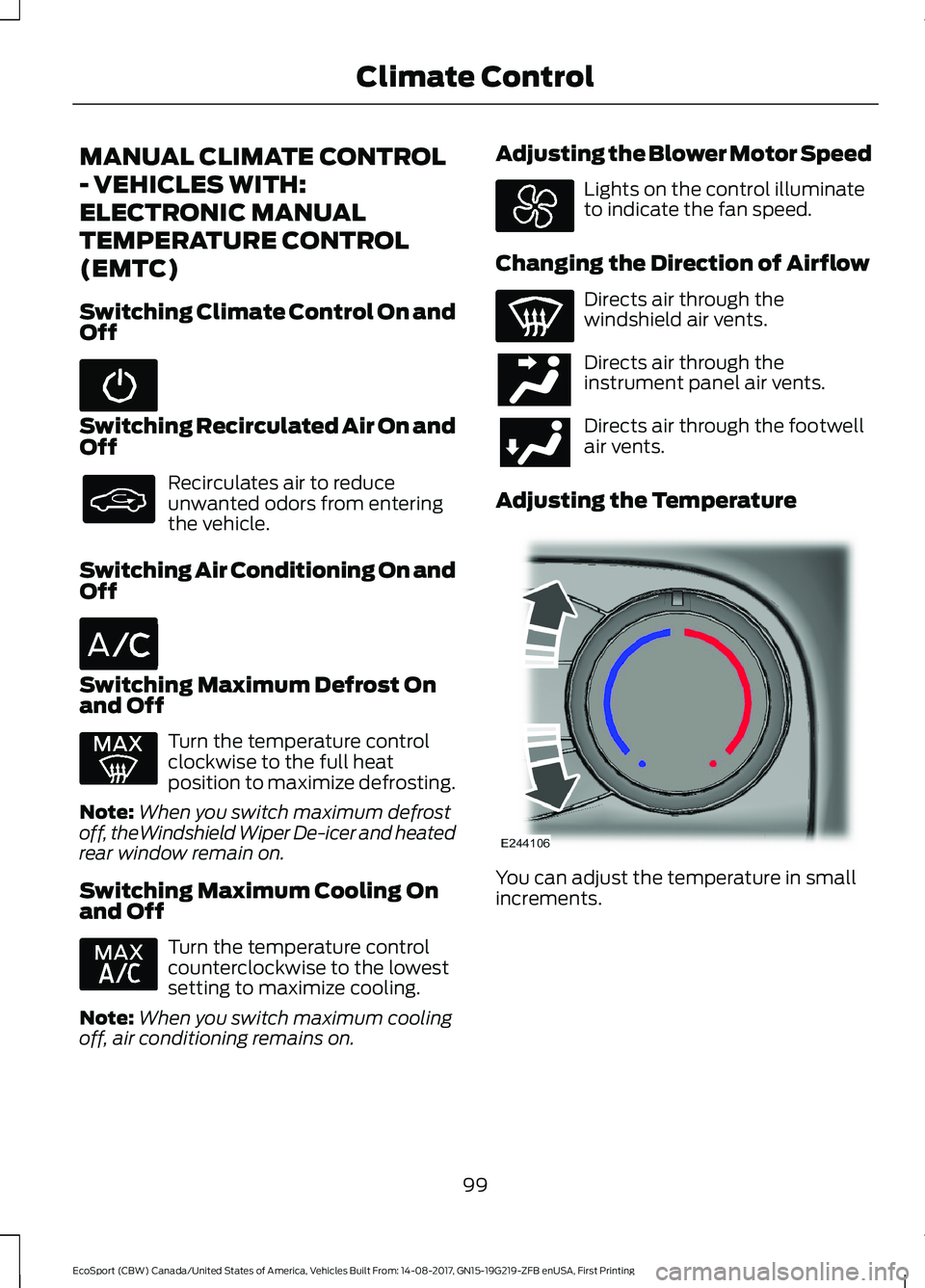
Adjusting the Temperature
You can adjust the temperature in smallincrements.
99EcoSport (CBW) Canada/United States of America, Vehicles Built From: 14-08-2017, GN15-19G219-ZFB enUSA, First PrintingClimate Control
Page 104 of 452
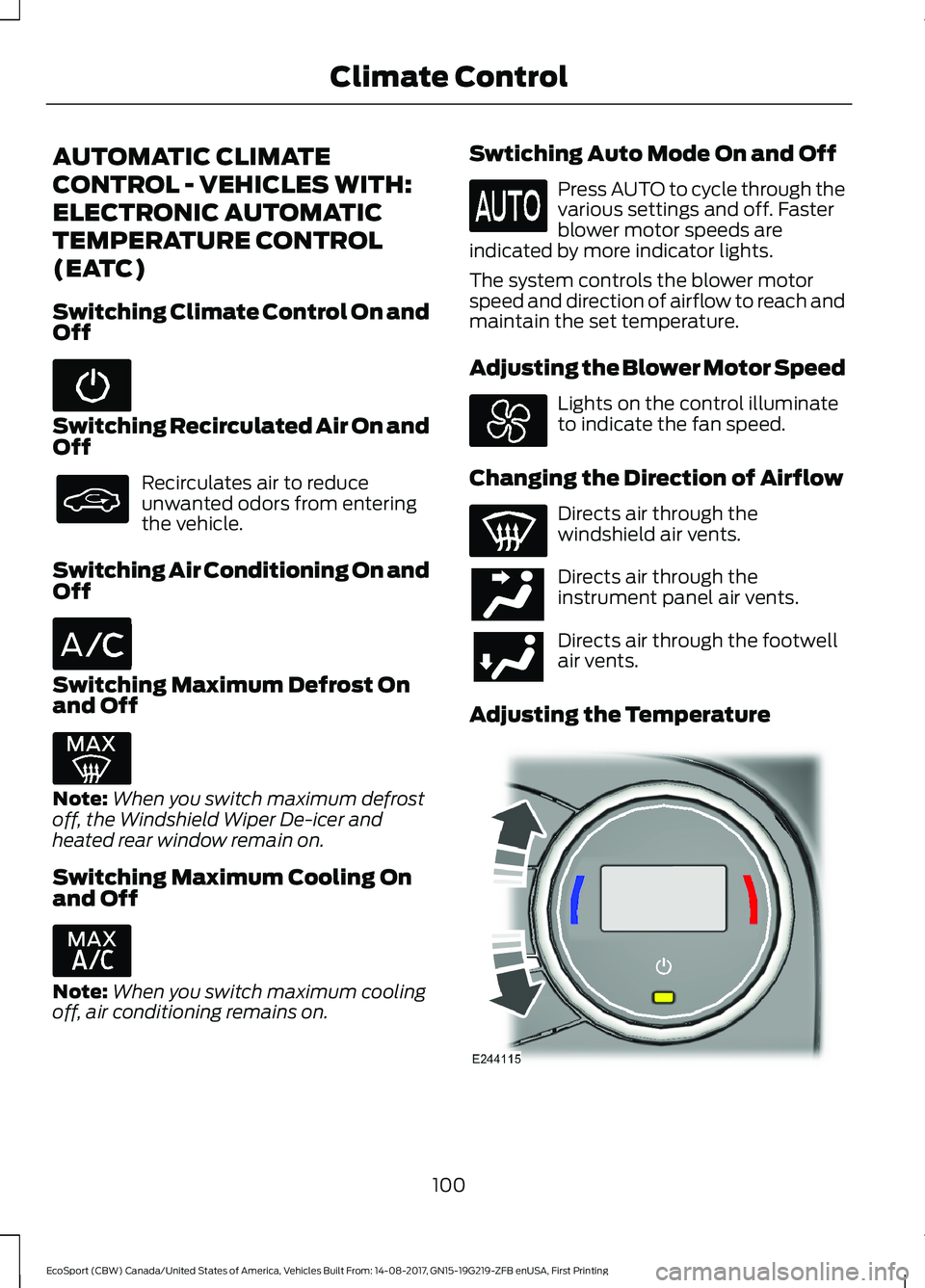
AUTOMATIC CLIMATE
CONTROL - VEHICLES WITH:
ELECTRONIC AUTOMATIC
TEMPERATURE CONTROL
(EATC)
Switching Climate Control On andOff
Switching Recirculated Air On andOff
Recirculates air to reduceunwanted odors from enteringthe vehicle.
Switching Air Conditioning On andOff
Switching Maximum Defrost Onand Off
Note:When you switch maximum defrostoff, the Windshield Wiper De-icer andheated rear window remain on.
Switching Maximum Cooling Onand Off
Note:When you switch maximum coolingoff, air conditioning remains on.
Swtiching Auto Mode On and Off
Press AUTO to cycle through thevarious settings and off. Fasterblower motor speeds areindicated by more indicator lights.
The system controls the blower motorspeed and direction of airflow to reach andmaintain the set temperature.
Adjusting the Blower Motor Speed
Lights on the control illuminateto indicate the fan speed.
Changing the Direction of Airflow
Directs air through thewindshield air vents.
Directs air through theinstrument panel air vents.
Directs air through the footwellair vents.
Adjusting the Temperature
100EcoSport (CBW) Canada/United States of America, Vehicles Built From: 14-08-2017, GN15-19G219-ZFB enUSA, First PrintingClimate Control
Page 105 of 452
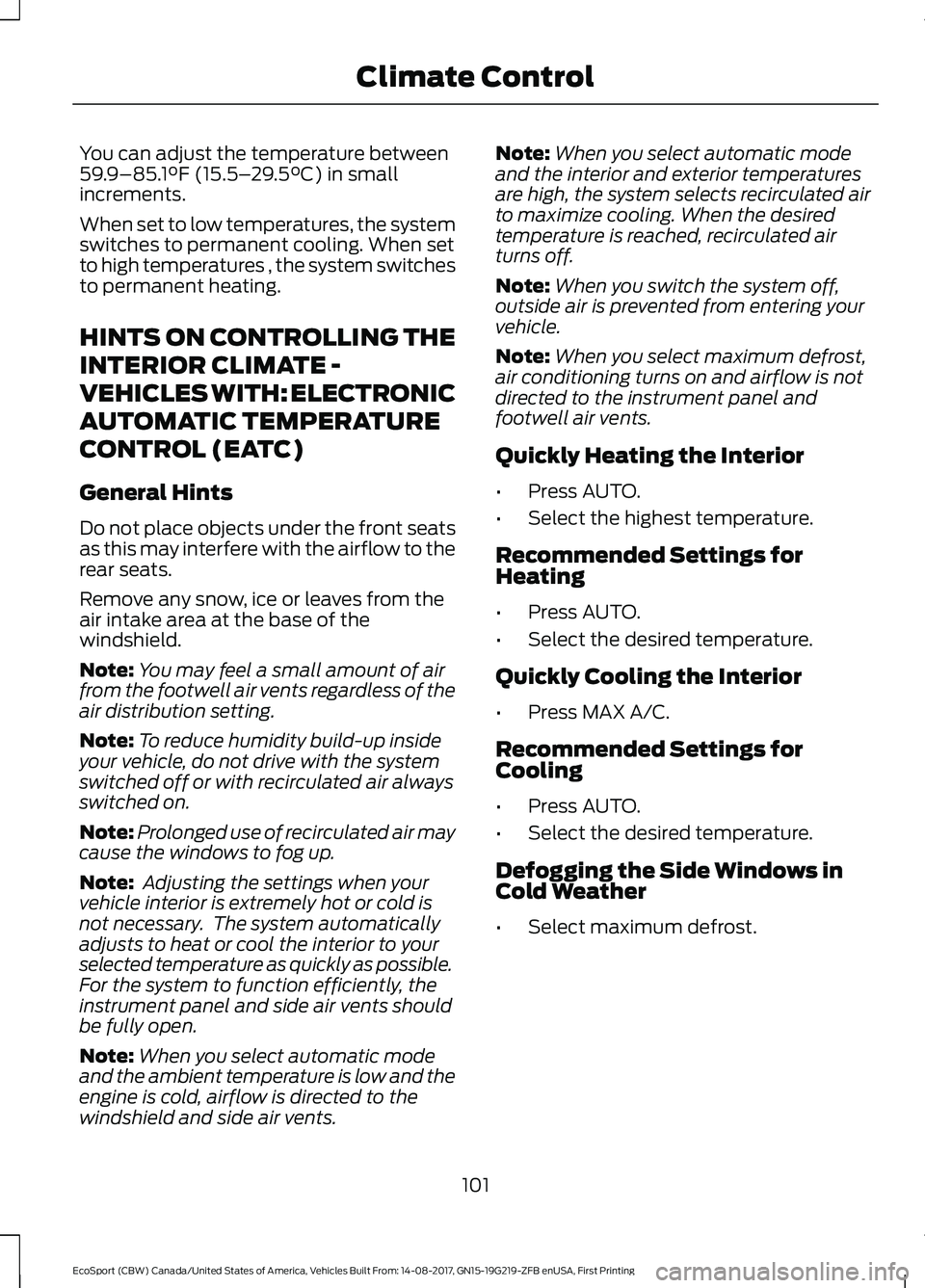
You can adjust the temperature between59.9–85.1°F (15.5–29.5°C) in smallincrements.
When set to low temperatures, the systemswitches to permanent cooling. When setto high temperatures , the system switchesto permanent heating.
HINTS ON CONTROLLING THE
INTERIOR CLIMATE -
VEHICLES WITH: ELECTRONIC
AUTOMATIC TEMPERATURE
CONTROL (EATC)
General Hints
Do not place objects under the front seatsas this may interfere with the airflow to therear seats.
Remove any snow, ice or leaves from theair intake area at the base of thewindshield.
Note:You may feel a small amount of airfrom the footwell air vents regardless of theair distribution setting.
Note:To reduce humidity build-up insideyour vehicle, do not drive with the systemswitched off or with recirculated air alwaysswitched on.
Note:Prolonged use of recirculated air maycause the windows to fog up.
Note: Adjusting the settings when yourvehicle interior is extremely hot or cold isnot necessary. The system automaticallyadjusts to heat or cool the interior to yourselected temperature as quickly as possible.For the system to function efficiently, theinstrument panel and side air vents shouldbe fully open.
Note:When you select automatic modeand the ambient temperature is low and theengine is cold, airflow is directed to thewindshield and side air vents.
Note:When you select automatic modeand the interior and exterior temperaturesare high, the system selects recirculated airto maximize cooling. When the desiredtemperature is reached, recirculated airturns off.
Note:When you switch the system off,outside air is prevented from entering yourvehicle.
Note:When you select maximum defrost,air conditioning turns on and airflow is notdirected to the instrument panel andfootwell air vents.
Quickly Heating the Interior
•Press AUTO.
•Select the highest temperature.
Recommended Settings forHeating
•Press AUTO.
•Select the desired temperature.
Quickly Cooling the Interior
•Press MAX A/C.
Recommended Settings forCooling
•Press AUTO.
•Select the desired temperature.
Defogging the Side Windows inCold Weather
•Select maximum defrost.
101EcoSport (CBW) Canada/United States of America, Vehicles Built From: 14-08-2017, GN15-19G219-ZFB enUSA, First PrintingClimate Control
Page 106 of 452
Maximum Cooling Using theInstrument Panel and Footwell AirVents
•Select the lowest temperature.
•Switch on the air conditioning andrecirculated air.
•Select the highest blower motor speedand then adjust to suit comfort levels.
HINTS ON CONTROLLING THE
INTERIOR CLIMATE -
VEHICLES WITH: ELECTRONIC
MANUAL TEMPERATURE
CONTROL (EMTC)
General Hints
Do not place objects under the front seatsas this may interfere with the airflow to therear seats.
Remove any snow, ice or leaves from theair intake area at the base of thewindshield.
Note:You may feel a small amount of airfrom the footwell air vents regardless of theair distribution setting.
Note:To reduce humidity build-up insideyour vehicle, do not drive with the systemswitched off or with recirculated air alwaysswitched on.
Note:When you switch the system off,outside air is prevented from entering yourvehicle.
Note:To reduce fogging of the windshieldduring humid weather, direct airflow to thewindshield air vents.
Note:Prolonged use of recirculated air maycause the windows to fog up.
Quickly Heating the Interior
•Select the highest blower motor speed.
•Select the highest temperature.
•Direct the airflow to the footwell airvents.
Recommended Settings forHeating
•Select a high blower motor speed.
•Select the desired temperature.
•Direct the airflow to the footwell andwindshield air vents.
Quickly Cooling the Interior
•Select maximum cooling.
Recommended Settings forCooling
•Select the highest blower motor speed.
•Select the desired temperature.
•Direct the airflow to the instrumentpanel air vents.
•Press A/C.
Defogging the Side Windows inCold Weather
•Select maximum defrost.
Maximum Cooling Using theInstrument Panel and Footwell AirVents
•Turn the temperature controlcounterclockwise to the lowest setting.
•Switch on the air conditioning andrecirculated air.
•Select the highest blower motor speedand then adjust to suit comfort levels.
102EcoSport (CBW) Canada/United States of America, Vehicles Built From: 14-08-2017, GN15-19G219-ZFB enUSA, First PrintingClimate Control
Page 107 of 452
HEATED REAR WINDOW -
VEHICLES WITH: ELECTRONIC
AUTOMATIC TEMPERATURE
CONTROL (EATC)
Press the button to clear the rearwindow of thin ice and fog. Theheated rear window turns offafter a short period of time.
Note:Make sure the engine is on beforeoperating the heated windows.
Note: Do not use razor blades or othersharp objects to clean or remove decalsfrom the inside of the heated rear window.The vehicle Warranty may not coverdamage caused to the heated rear windowgrid lines.
HEATED REAR WINDOW -
VEHICLES WITH: ELECTRONIC
MANUAL TEMPERATURE
CONTROL (EMTC)
Press the button to clear the rearwindow of thin ice and fog. Theheated rear window turns offafter a short period of time.
Note:Make sure the engine is on beforeoperating the heated windows.
Note: Do not use razor blades or othersharp objects to clean or remove decalsfrom the inside of the heated rear window.The vehicle Warranty may not coverdamage caused to the heated rear windowgrid lines.
HEATED EXTERIOR MIRRORS
When you switch the heated rear windowon, the heated exterior mirrors turn on.
Note:Do not remove ice from the mirrorswith a scraper or adjust the mirror glasswhen it is frozen in place.
Note:Do not clean the mirror housing orglass with harsh abrasives, fuel or otherpetroleum-based cleaning products.
Windshield Wiper De-icer (If Equipped)
The windshield wiper de-icer turns on inlow temperatures or when you manuallyswitch the heated rear window on.
CABIN AIR FILTER
Your vehicle is equipped with a cabin airfilter, which gives you and your passengersthe following benefits:
•It improves your driving comfort byreducing particle concentration.
•It improves the interior compartmentcleanliness.
•It protects the climate controlcomponents from particle deposits.
You can locate the cabin air filter behindthe center console, on the passenger side.
Note:Make sure you have a cabin air filterinstalled at all times. This prevents foreignobjects from entering the system. Runningthe system without a filter in place couldresult in degradation or damage to thesystem.
Replace the filter at regular intervals. SeeScheduled Maintenance (page 383).
For additional cabin air filter information,or to replace the filter, see an authorizeddealer.
103EcoSport (CBW) Canada/United States of America, Vehicles Built From: 14-08-2017, GN15-19G219-ZFB enUSA, First PrintingClimate Control
Page 130 of 452
Automatic Engine Restart
Any of the following conditions will resultin an automatic restart of the engine:
•Your foot is removed from the brakepedal.
•You press the accelerator pedal.
•You press the accelerator and thebrake pedal at the same time.
•The driver seatbelt becomesunfastened or the driver door is ajar.
•The transmission is moved from drive(D).
•Your vehicle is moving.
•The interior compartment does notmeet customer comfort when airconditioning or heat is on.
•Fogging of the windows could occurand the air conditioning is on.
•The battery is not within optimaloperating conditions.
•The maximum engine off time isexceeded.
•When you press the Auto-Start-Stopbutton while the engine is stoppedautomatically.
•The heated windshield is turned on.
Any of the following conditions may resultin an automatic restart of the engine:
•The blower fan speed is increased orthe climate control temperature ischanged.
•An electrical accessory is turned on orplugged in.
Disabling Auto-Start-Stop
Press the Auto-Start-Stop button locatedon the center console to switch the systemoff. The button will illuminate. The systemwill only be deactivated for the currentignition cycle. Press the button again torestore Auto-Start-Stop function.
If your vehicle is in an Auto-Start-Stopstate and you shift the transmission toreverse while the brake is not depressed,a message telling you to press the brakewill appear. You must press the brakepedal within 10 seconds, or a shift to parkand a manual restart will be required.
Note:If the Shift to P, Restart Enginemessage appears and the amberAuto-Start-Stop indicator light is flashing,automatic restart is not available. Thevehicle must be restarted manually. SeeInformation Displays (page 85).
126EcoSport (CBW) Canada/United States of America, Vehicles Built From: 14-08-2017, GN15-19G219-ZFB enUSA, First PrintingUnique Driving Characteristics
Page 182 of 452
BREAKING-IN
Tires
Note:New tires need to be run-in forapproximately 310.7 mi (500 km). Duringthis time, you may experience differentdriving characteristics.
Brakes and Clutch
Note:If possible, avoid heavy braking andclutching during the first 93.2 mi (150 km)in the city, and the first 932.1 mi (1,500 km)in highways.
ECONOMICAL DRIVING
Fuel economy is affected by several thingssuch as how you drive, the conditions youdrive under and how you maintain yourvehicle.
There are some things to keep in mind thatmay improve your fuel economy:
•Accelerate and slow down in a smooth,moderate fashion.
•Drive at steady speeds.
•Anticipate stops; slowing down mayeliminate the need to stop.
•Combine errands and minimizestop-and-go driving (When runningerrands, go to the furthest destinationfirst and then work your way backhome).
•Close the windows for high-speeddriving.
•Drive at reasonable speeds.
•Keep the tires properly inflated and useonly the recommended size.
•Use the recommended engine oil.
•Perform all regularly scheduledmaintenance.
There are also some things you may wantto avoid doing because they reduce yourfuel economy:
•Avoid sudden or hard accelerations.
•Avoid revving the engine before turningoff the car.
•Avoid long idle periods.
•Do not warm up your vehicle on coldmornings.
•Reduce the use of air conditioning andheat.
•Avoid using speed control in hillyterrain.
•Do not rest your foot on the brakepedal while driving.
•Avoid carrying unnecessary weight.
•Avoid adding particular accessories toyour vehicle (e.g. bug deflectors,rollbars/light bars, running boards, skiracks).
•Avoid driving with the wheels out ofalignment.
COLD WEATHER
PRECAUTIONS
The functional operation of somecomponents and systems can be affectedat temperatures below -13°F (-25°C).
DRIVING THROUGH WATER
WARNING
Do not drive through flowing or deepwater as you may lose control of yourvehicle.
Note:Driving through standing water cancause vehicle damage.
Note:Engine damage can occur if waterenters the air filter.
178EcoSport (CBW) Canada/United States of America, Vehicles Built From: 14-08-2017, GN15-19G219-ZFB enUSA, First PrintingDriving Hints