heating FORD ECOSPORT 2019 User Guide
[x] Cancel search | Manufacturer: FORD, Model Year: 2019, Model line: ECOSPORT, Model: FORD ECOSPORT 2019Pages: 458, PDF Size: 16.79 MB
Page 207 of 458
Battery Fuse Box
Protected componentsFuse amp ratingFuse
Engine compartment fuse box.250A1
Electric power assist steering.60A2
Body control module.100A3
Heating control unit.70A4
Starter.275A5
CHANGING A FUSE
Fuses
WARNING: Always replace a fusewith one that has the specifiedamperage rating. Using a fuse with ahigher amperage rating can cause severewire damage and could start a fire.
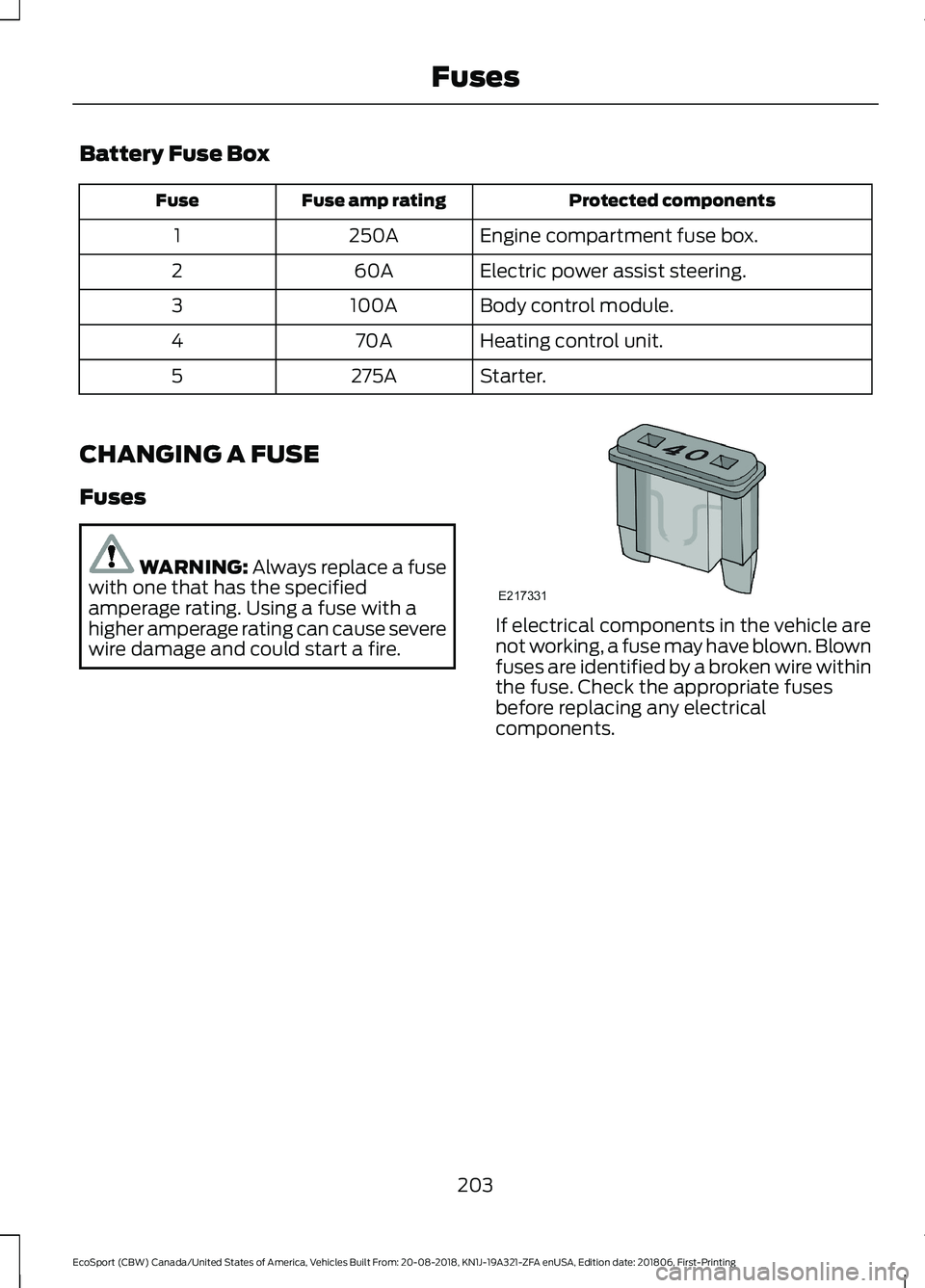
If electrical components in the vehicle arenot working, a fuse may have blown. Blownfuses are identified by a broken wire withinthe fuse. Check the appropriate fusesbefore replacing any electricalcomponents.
203
EcoSport (CBW) Canada/United States of America, Vehicles Built From: 20-08-2018, KN1J-19A321-ZFA enUSA, Edition date: 201806, First-PrintingFuses
Page 214 of 458
5.After 25 seconds, a message appearsconfirming that the reset is complete.
6.Release the accelerator and brakepedals.
7.Switch the ignition off.
ENGINE COOLING FAN
WARNING: Keep your hands andclothing clear of the engine cooling fan.
Under certain conditions, the enginecooling fan may continue to run for severalminutes after you switch your vehicle off.This could happen in low ambienttemperatures and independent of theengine coolant temperature, for exampleshort journeys or low coolant temperature.
ENGINE COOLANT CHECK
WARNING: Do not add enginecoolant when the engine is hot. Steamand scalding liquids released from a hotcooling system can burn you badly. Also,spilling coolant on hot engine parts canburn you.
WARNING: Do not put enginecoolant in the windshield washer fluidcontainer. If sprayed on the windshield,engine coolant could make it difficult tosee through the windshield.
WARNING: To reduce the risk ofpersonal injury, make sure the engine iscool before unscrewing the coolantpressure relief cap. The cooling systemis under pressure. Steam and hot liquidcan come out forcefully when you loosenthe cap slightly.
WARNING: Do not add coolantfurther than the MAX mark.
When the engine is cold, check theconcentration and level of the coolant atthe intervals listed in the scheduledmaintenance information. See ScheduledMaintenance (page 385).
Note:Make sure that the coolant level isbetween the MIN and MAX marks on thecoolant reservoir.
Note: Coolant expands when it is hot. Thelevel may extend beyond the MAX mark.
Maintain coolant concentration within48% to 50%, which equates to a freezepoint between -30°F (-34°C) and -34°F(-37°C). Coolant concentration should bechecked using a refractometer. We do notrecommend the use of hydrometers orcoolant test strips for measuring coolantconcentration.
Adding Coolant
WARNING: Never remove thecoolant reservoir cap when the engine isrunning or hot.
Note:Automotive fluids are notinterchangeable. Do not use coolant orwindshield washer fluid outside of itsspecified function and vehicle location.
Note: Do not use stop leak pellets, coolingsystem sealants, or non-specified additivesas they can cause damage to the enginecooling or heating systems. Resultingcomponent damage may not be covered bythe vehicle Warranty.
210
EcoSport (CBW) Canada/United States of America, Vehicles Built From: 20-08-2018, KN1J-19A321-ZFA enUSA, Edition date: 201806, First-PrintingMaintenance
Page 215 of 458
It is very important to use predilutedcoolant approved to the correctspecification in order to avoid plugging thesmall passageways in the engine coolingsystem. See Capacities andSpecifications (page 278). Do not mixdifferent colors or types of coolant in yourvehicle. Mixing of engine coolants or usingan incorrect coolant may harm the engineor cooling system components and maynot be covered by the vehicle Warranty.
Note:If prediluted coolant is not available,use the approved concentrated coolantdiluting it to 50/50 with distilled water. SeeCapacities and Specifications (page 278).Using water that has not been deionisedmay contribute to deposit formation,corrosion and plugging of the small coolingsystem passageways.
Note:Coolants marketed for all makes andmodels may not be approved to Fordspecifications and may cause damage tothe cooling system. Resulting componentdamage may not be covered by the vehicleWarranty.
If the coolant level is at or below theminimum mark, add prediluted coolantimmediately.
To top up the coolant level do thefollowing:
1.Unscrew the cap slowly. Any pressureescapes as you unscrew the cap.
2.Add prediluted coolant approved tothe correct specification. SeeCapacities and Specifications (page270).
3.Add enough prediluted coolant toreach the correct level.
4.Replace the coolant reservoir cap, turnit clockwise until you feel a strongresistance.
5.Check the coolant level in the coolantreservoir the next few times you driveyour vehicle. If necessary, add enoughprediluted engine coolant to bring thecoolant level to the correct level.
If you have to add more than 1.1 qt (1 L) ofengine coolant per month, have yourvehicle checked as soon as possible.Operating an engine with a low level ofcoolant can result in engine overheatingand possible engine damage.
Note:During normal vehicle operation, thecoolant may change color from orange topink or light red. As long as the coolant isclear and uncontaminated, this color changedoes not indicate the coolant has degradednor does it require the coolant to be drained,the system to be flushed, or the coolant tobe replaced.
Note:In case of emergency, you can add alarge amount of water without coolant inorder to reach a vehicle service location.Water alone, without coolant, can causeengine damage from corrosion, overheatingor freezing. When you reach a servicelocation, you must have the cooling systemdrained and refilled with prediluted coolantapproved to the correct specification. SeeCapacities and Specifications (page 278).
Do not use the following as a coolantsubstitute:
•Alcohol.
•Methanol.
•Brine.
•Any coolant mixed with alcohol ormethanol antifreeze.
Alcohol and other liquids can cause enginedamage from overheating or freezing.
Do not add extra inhibitors or additives tothe coolant. These can be harmful andcompromise the corrosion protection ofthe coolant.
211
EcoSport (CBW) Canada/United States of America, Vehicles Built From: 20-08-2018, KN1J-19A321-ZFA enUSA, Edition date: 201806, First-PrintingMaintenance
Page 217 of 458
When Fail-Safe Mode Is Activated
WARNING: Fail-safe mode is foruse during emergencies only. Operateyour vehicle in fail-safe mode only aslong as necessary to bring your vehicleto rest in a safe location and seekimmediate repairs. When in fail-safemode, your vehicle will have limitedpower, will not be able to maintainhigh-speed operation, and maycompletely shut down without warning,potentially losing engine power, powersteering assist, and power brake assist,which may increase the possibility of acrash resulting in serious injury.
WARNING: Never remove thecoolant reservoir cap when the engine isrunning or hot.
Your vehicle has limited engine powerwhen in the fail-safe mode, drive yourvehicle with caution. Your vehicle does notmaintain high-speed operation and theengine may operate poorly.
Remember that the engine is capable ofautomatically shutting down to preventengine damage. In this situation:
1.Pull off the road as soon as safelypossible and switch the engine off.
2.If you are a member of a roadsideassistance program, we recommendthat you contact your roadsideassistance service provider.
3.If this is not possible, wait a shortperiod for the engine to cool.
4.Check the coolant level. If the coolantlevel is at or below the minimum mark,add prediluted coolant immediately.
5.When the engine temperature cools,you can re-start the engine. Have yourvehicle checked as soon as possible tominimize engine damage.
Note:Driving your vehicle without repairincreases the chance of engine damage.
Engine Coolant TemperatureManagement (If Equipped)
WARNING: To reduce the risk ofcrash and injury, be prepared that thevehicle speed may reduce and thevehicle may not be able to acceleratewith full power until the coolanttemperature reduces.
If you tow a trailer with your vehicle, theengine may temporarily reach a highertemperature during severe operatingconditions, for example ascending a longor steep grade in high ambienttemperatures.
At this time, you may notice the coolanttemperature gauge moves toward the redzone and a message may appear in theinformation display.
You may notice a reduction in vehiclespeed caused by reduced engine power.In order to manage the engine coolanttemperature. Your vehicle may enter thismode if certain high-temperature andhigh-load conditions take place. Theamount of speed reduction depends onvehicle loading, grade and ambienttemperature. If this occurs, there is no needto pull off the road. You can continue todrive your vehicle.
The air conditioning may automaticallyturn on and off during severe operatingconditions to protect the engine fromoverheating. When the coolanttemperature decreases to the normaloperating temperature, the air conditioningturns on.
213
EcoSport (CBW) Canada/United States of America, Vehicles Built From: 20-08-2018, KN1J-19A321-ZFA enUSA, Edition date: 201806, First-PrintingMaintenance
Page 248 of 458
Punctures larger than 0.24 in (6 mm) maynot be sealable. Tire sidewall damagecannot be temporarily repaired.
Note:Do note use the kit if you haveseverely damaged a tire. Only sealpunctures located within the tire tread withthe kit.
Loss of air pressure may adversely affecttire performance. For this reason:
•Drive carefully and avoid abruptsteering maneuvers.
•Periodically monitor tire inflationpressure in the affected tire; if the tireis losing pressure, have the vehicletowed.
•Read the information in the Tips forUse of the Kit section to make sure safeoperation of the kit and your vehicle.
Note:Do not drive the vehicle above50 mph (80 km/h).
Note:Do not drive further than 124 mi(200 km). Drive only to the closestauthorized Ford dealer or tire repair shop tohave your tire inspected.
Tips for use of the kit
To ensure safe operation of the kit:
•Read all instructions and cautions fully.
•Before operating the kit, make sureyour vehicle is safely off the road andaway from moving traffic. Switch onthe hazard lights.
•Always set the parking brake to ensurethe vehicle doesn't move unexpectedly.
•Do not remove any foreign objects,such as nails or screws, from the tire.
•When using the kit, if the vehicle isoutdoors or in a well-ventilated area,leave the engine running so thecompressor does not drain thevehicle's battery.
•Do not allow the compressor tooperate continuously for more than 15minutes. This will help prevent thecompressor from overheating.
•Never leave the kit unattended whenit is operating.
•Keep the kit away from children.
•Only use the kit when the ambienttemperature is between -22.0°F(-30°C) and 157.9°F (70°C).
•Only use the sealing compound beforethe use-by date which is printed on thetop of sealant bottle.
•After sealant use, an authorized Forddealer must replace the tire pressuremonitoring system sensor and valvestem on the wheel.
•Operating the kit could cause anelectrical disturbance in radio, CD, andDVD player operation.
What to do when a tire is punctured
A tire puncture within the tire's tread areacan be sealed in two stages with the kit.
•In the first stage, the tire will bereinflated with a sealing compoundand air. After the tire has been inflated,you will need to drive the vehicleapproximately 4 mi (6 km) to distributethe sealant in the tire.
•In the second stage, you will need tocheck the tire pressure and adjust, ifnecessary, to the vehicle's specifiedtire inflation pressure.
244
EcoSport (CBW) Canada/United States of America, Vehicles Built From: 20-08-2018, KN1J-19A321-ZFA enUSA, Edition date: 201806, First-PrintingWheels and Tires
Page 268 of 458
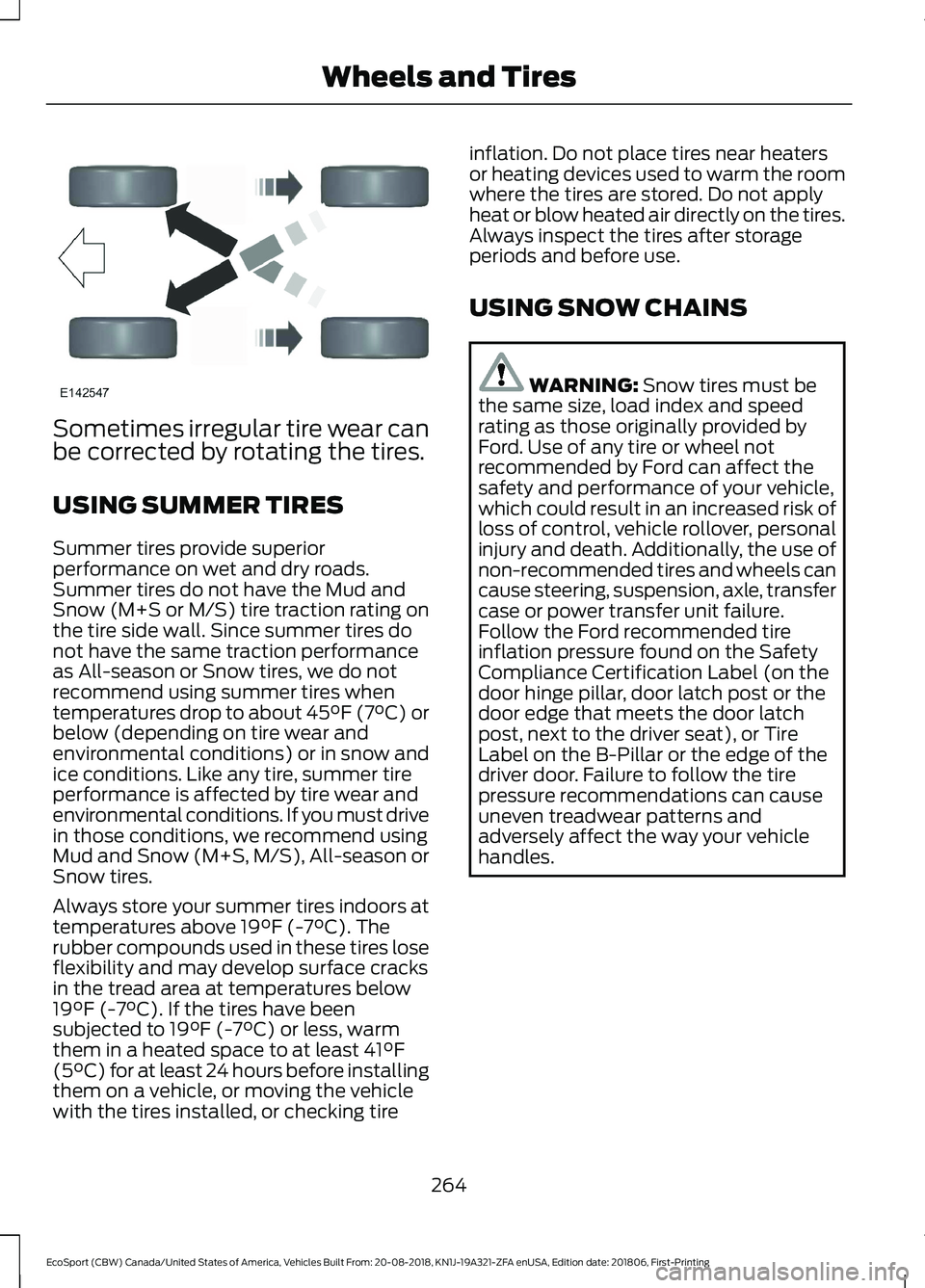
Sometimes irregular tire wear canbe corrected by rotating the tires.
USING SUMMER TIRES
Summer tires provide superiorperformance on wet and dry roads.Summer tires do not have the Mud andSnow (M+S or M/S) tire traction rating onthe tire side wall. Since summer tires donot have the same traction performanceas All-season or Snow tires, we do notrecommend using summer tires whentemperatures drop to about 45°F (7°C) orbelow (depending on tire wear andenvironmental conditions) or in snow andice conditions. Like any tire, summer tireperformance is affected by tire wear andenvironmental conditions. If you must drivein those conditions, we recommend usingMud and Snow (M+S, M/S), All-season orSnow tires.
Always store your summer tires indoors attemperatures above 19°F (-7°C). Therubber compounds used in these tires loseflexibility and may develop surface cracksin the tread area at temperatures below19°F (-7°C). If the tires have beensubjected to 19°F (-7°C) or less, warmthem in a heated space to at least 41°F(5°C) for at least 24 hours before installingthem on a vehicle, or moving the vehiclewith the tires installed, or checking tire
inflation. Do not place tires near heatersor heating devices used to warm the roomwhere the tires are stored. Do not applyheat or blow heated air directly on the tires.Always inspect the tires after storageperiods and before use.
USING SNOW CHAINS
WARNING: Snow tires must bethe same size, load index and speedrating as those originally provided byFord. Use of any tire or wheel notrecommended by Ford can affect thesafety and performance of your vehicle,which could result in an increased risk ofloss of control, vehicle rollover, personalinjury and death. Additionally, the use ofnon-recommended tires and wheels cancause steering, suspension, axle, transfercase or power transfer unit failure.Follow the Ford recommended tireinflation pressure found on the SafetyCompliance Certification Label (on thedoor hinge pillar, door latch post or thedoor edge that meets the door latchpost, next to the driver seat), or TireLabel on the B-Pillar or the edge of thedriver door. Failure to follow the tirepressure recommendations can causeuneven treadwear patterns andadversely affect the way your vehiclehandles.
264
EcoSport (CBW) Canada/United States of America, Vehicles Built From: 20-08-2018, KN1J-19A321-ZFA enUSA, Edition date: 201806, First-PrintingWheels and Tires
Page 390 of 458
If ENGINE OIL CHANGE DUE NEXTSERVICE or OIL CHANGE REQUIREDappears in the information display, it istime for an oil change; the oil change mustbe done within two weeks or 500 miles(800 kilometers) of the ENGINE OILCHANGE DUE NEXT SERVICE or OILCHANGE REQUIRED message appearing.The oil minder system must be reset aftereach oil change. See Oil ChangeIndicator Reset (page 209).
If your information display resetsprematurely or becomes inoperative, youshould perform the oil change interval atsix months or 5000 miles (8000kilometers) from your last oil change.Never exceed one year or 10000 miles(16000 kilometers) between oil changeintervals.
Your vehicle is very sophisticated and builtwith multiple, complex, performancesystems. Every manufacturer developsthese systems using differentspecifications and performance features.That is why it is important to rely upon yourdealership to properly diagnose and repairyour vehicle.
Ford Motor Company has recommendedmaintenance intervals for various partsand component systems based uponengineering testing. Ford Motor Companyrelies upon this testing to determine themost appropriate mileage for replacementof oils and fluids to protect your vehicle atthe lowest overall cost to you andrecommends against maintenanceschedules that deviate from the scheduledmaintenance information.
We strongly recommend the use of onlygenuine Ford, Motorcraft orFord-authorized re-manufacturedreplacement parts engineered for yourvehicle.
Additives and Chemicals
This owner's manual and the FordWorkshop Manual list the recommendedadditives and chemicals for your vehicle.We do not recommend using chemicals oradditives not approved by us as part ofyour vehicle’s normal maintenance. Pleaseconsult your warranty information.
Oils, Fluids and Flushing
In many cases, fluid discoloration is anormal operating characteristic and, byitself, does not necessarily indicate aconcern or that the fluid needs to bechanged. However, a qualified expert, suchas the factory-trained technicians at yourdealership, should inspect discolored fluidsthat also show signs of overheating orforeign material contaminationimmediately.
Make sure to change your vehicle’s oils andfluids at the specified intervals or inconjunction with a repair. Flushing is aviable way to change fluid for many vehiclesub-systems during scheduledmaintenance. It is critical that systems areflushed only with new fluid that is the sameas that required to fill and operate thesystem or using a Ford-approved flushingchemical.
Owner Checks and Services
Make sure you perform the following basicmaintenance checks and inspections everymonth or at six-month intervals.
386
EcoSport (CBW) Canada/United States of America, Vehicles Built From: 20-08-2018, KN1J-19A321-ZFA enUSA, Edition date: 201806, First-PrintingScheduled Maintenance
Page 449 of 458
Front Passenger Sensing System............38Fuel and Refueling........................................131Fuel Consumption........................................136Advertised Capacity..........................................136Filling the Fuel Tank...........................................136Fuel Economy.......................................................137Fuel Filler Funnel Location........................132Fuel Quality - Gasoline................................131Choosing the Right Fuel....................................131Fuel Shutoff...................................................184Fuse Box Locations.....................................196Battey Fuse Box..................................................196Engine Compartment Fuse Box...................196Passenger Compartment Fuse Box............196Fuses.................................................................196Fuse Specification Chart...........................196Battery Fuse Box................................................203Engine Compartment Fuse Box....................197Passenger Compartment Fuse Box............201
G
Gauges...............................................................83Engine Coolant Temperature Gauge............84Fuel Gauge.............................................................84Information Display.............................................83GearboxSee: Transmission..............................................142General Information on RadioFrequencies...................................................46General Maintenance Information.......385Multi-Point Inspection.....................................387Owner Checks and Services.........................386Protecting Your Investment...........................385Why Maintain Your Vehicle?.........................385Why Maintain Your Vehicle at YourDealership?.....................................................385Getting Assistance Outside the U.S. andCanada..........................................................192Getting the Services You Need...............189Away From Home..............................................189Glasses Holder...............................................122
H
HandbrakeSee: Parking Brake..............................................152
Hazard Flashers............................................184Hazard Flashers Warning Lamp...................184Switching the Hazard Flashers On orOff.......................................................................184Headlamp AdjustingSee: Adjusting the Headlamps......................218Headlamp Exit Delay.....................................75Headlamp RemovalSee: Removing a Headlamp..........................220HeadrestSee: Head Restraints........................................109Head Restraints............................................109Folding the Rear Seat Outermost HeadRestraint..............................................................111Installing the Head Restraint............................111Lowering the Head Restraint............................111Raising the Head Restraint...............................111Removing the Head Restraint..........................111Tilting the Front Seat Head Restraint...........111Heated Exterior Mirrors...............................107Windshield Wiper De-icer................................107Heated Rear Window - Vehicles With:Electronic Automatic TemperatureControl (EATC)...........................................107Heated Rear Window - Vehicles With:Electronic Manual TemperatureControl (EMTC)..........................................107Heated Seats..................................................119Heated Steering Wheel................................67HeatingSee: Climate Control..........................................101Hill Start Assist..............................................152Switching the System On and Off................153Using Hill Start Assist........................................153Hints on Controlling the Interior Climate- Vehicles With: Electronic AutomaticTemperature Control (EATC)...............105Defogging or Clearing the Windshield ofThin Ice..............................................................106Defogging the Side Windows in ColdWeather............................................................106General Hints.......................................................105Quickly Cooling the Interior............................106Recommended Settings for Cooling..........106Recommended Settings for Heating..........106
445
EcoSport (CBW) Canada/United States of America, Vehicles Built From: 20-08-2018, KN1J-19A321-ZFA enUSA, Edition date: 201806, First-PrintingIndex
Page 450 of 458
Hints on Controlling the Interior Climate- Vehicles With: Electronic ManualTemperature Control (EMTC)..............106Defogging or Clearing the Windshield ofThin Ice...............................................................107Defogging the Side Windows in ColdWeather.............................................................107General Hints.......................................................106Quickly Cooling the Interior.............................107Quickly Heating the Interior............................106Recommended Settings for Cooling...........107Recommended Settings for Heating..........106Hints on Driving With Anti-LockBrakes..............................................................151Home Screen.................................................319Hood LockSee: Opening and Closing the Hood..........205
I
Ignition Switch...............................................123Starting the Engine............................................124Switching the Ignition Off................................123Switching the Ignition On................................123Switching the Ignition to AccessoryMode...................................................................123In California (U.S. Only).............................190Information Display Control.......................67Information Displays....................................88General Information...........................................88Information Messages..................................91Accessory Power..................................................92Airbag........................................................................92Alarm........................................................................92Battery and Charging System.........................93Brake System.........................................................93Engine.......................................................................94Fuel System...........................................................94Hill Start Assist.....................................................94Keyless Vehicle.....................................................95Lighting....................................................................95Maintenance..........................................................95MyKey.......................................................................96Park Aid....................................................................97Park Brake...............................................................97Power Steering.....................................................98Stability Control...................................................98Starting System ...................................................98
Tire Pressure Monitoring System...................93Traction Control...................................................99Transmission.........................................................99Vehicle Settings..................................................100Installing Child Restraints.............................17Child Seats...............................................................17Using Lap and Shoulder Belts..........................18Using Lower Anchors and Tethers forCHildren (LATCH)...........................................20Using Tether Straps.............................................22Instrument Cluster........................................83Instrument Lighting Dimmer......................75Interior Lamps..................................................77Courtesy lamp........................................................77Reading lamps.......................................................77Vanity lamp.............................................................78Interior Mirror....................................................81Auto-Dimming Mirror...........................................81Introduction.........................................................7
J
Jump Starting the Vehicle.........................185Connecting the Jumper Cables.....................186Jump Starting.......................................................187Preparing Your Vehicle.....................................185Removing the Jumper Cables........................187
K
Keyless Entry...................................................58Disabled Keys........................................................59General Information............................................58Intelligent Access - Locking and Unlockingthe Doors with the Key Blade.....................59Locking Using Intelligent Access....................58Unlocking only Driver Door...............................59Unlocking Using Intelligent Access...............58Keys and Remote Controls........................46Principle of Operation........................................46
L
Lighting Control...............................................73Headlamp Flasher................................................74High Beams.............................................................74Parking Lamps.......................................................73
446
EcoSport (CBW) Canada/United States of America, Vehicles Built From: 20-08-2018, KN1J-19A321-ZFA enUSA, Edition date: 201806, First-PrintingIndex