weight FORD ECOSPORT 2020 Owners Manual
[x] Cancel search | Manufacturer: FORD, Model Year: 2020, Model line: ECOSPORT, Model: FORD ECOSPORT 2020Pages: 448, PDF Size: 16.57 MB
Page 7 of 448
Starting and Stopping theEngine
General Information...................................130
Ignition Switch..............................................130
Push Button Ignition Switch.....................131
Starting a Gasoline Engine.......................133
Engine Block Heater...................................134
Automatic Engine Shutdown..................135
Unique Driving Characteristics
Auto-Start-Stop..........................................136
Fuel and Refueling
Safety Precautions.....................................138
Fuel Quality - Gasoline..............................138
Fuel Filler Funnel Location.......................139
Running Out of Fuel...................................139
Refueling..........................................................141
Fuel Consumption.......................................143
Engine Emission Control
Emission Law................................................145
Catalytic Converter.....................................146
Transmission
Automatic Transmission..........................149
Four-Wheel Drive
Using Four-Wheel Drive............................153
Brakes
General Information....................................157
Hints on Driving With Anti-Lock Brakes.........................................................................158
Parking Brake................................................158
Hill Start Assist.............................................158
Traction Control
Principle of Operation...............................160
Using Traction Control..............................160
Stability Control
Principle of Operation.................................161
Using Stability Control...............................161
Parking Aids
Principle of Operation................................162
Rear Parking Aid...........................................162
Rear View Camera......................................163
Cruise Control
Principle of Operation................................167
Using Cruise Control...................................167
Driving Aids
Blind Spot Information System.............169
Cross Traffic Alert........................................170
Steering............................................................173
Load Carrying
Luggage Anchor Points..............................174
Rear Under Floor Storage.........................174
Luggage Covers............................................174
Roof Racks and Load Carriers.................175
Load Limit.......................................................176
Towing
Towing a Trailer.............................................181
Trailer Sway Control....................................181
Recommended Towing Weights...........182
Essential Towing Checks..........................183
Towing Points...............................................185
Transporting the Vehicle..........................186
Towing the Vehicle on Four Wheels......187
Driving Hints
Breaking-In....................................................188
Economical Driving.....................................188
3
EcoSport (CBW) Canada/United States of America, Vehicles Built From: 17-06-2019, LN1J-19A321-ZFA enUSA, Edition date: 201904, First-PrintingTable of Contents
Page 22 of 448
GENERAL INFORMATION
See the following sections for directionson how to properly use safety restraintsfor children.
WARNING: Always make sure yourchild is secured properly in a device thatis appropriate for their height, age andweight. Child safety restraints must bebought separately from your vehicle.Failure to follow these instructions andguidelines may result in an increased riskof serious injury or death to your child.
WARNING: All children are shapeddifferently. The National Highway TrafficSafety Administration and other safetyorganizations, base theirrecommendations for child restraints onprobable child height, age and weightthresholds, or on the minimumrequirements of the law. We recommendthat you check with a NHTSA CertifiedChild Passenger Safety Technician
(CPST) to make sure that you properlyinstall the child restraint in your vehicleand that you consult your pediatrician tomake sure you have a child restraintappropriate for your child. To locate achild restraint fitting station and CPST,contact NHTSA toll free at1-888-327-4236 or go towww.nhtsa.dot.gov. In Canada, contactTransport Canada toll free at1-800-333-0371 or go to www.tc.gc.cato find a Child Car Seat Clinic in yourarea. Failure to properly restrain childrenin child restraints made especially fortheir height, age and weight, may resultin an increased risk of serious injury ordeath to your child.
WARNING: On hot days, thetemperature inside the vehicle can risevery quickly. Exposure of people oranimals to these high temperatures foreven a short time can cause death orserious heat related injuries, includingbrain damage. Small children areparticularly at risk.
18
EcoSport (CBW) Canada/United States of America, Vehicles Built From: 17-06-2019, LN1J-19A321-ZFA enUSA, Edition date: 201904, First-PrintingChild Safety
Page 23 of 448
Recommendations for Safety Restraints for Children
Recommended RestraintTypeChild Size, Height, Weight, or AgeChild
Use a child restraint(sometimes called aninfant carrier, convertibleseat, or toddler seat).
Children weighing 40 lb (18 kg) or less(generally age four or younger).Infants ortoddlers
Use a belt-positioningbooster seat.
Children who have outgrown or no longerproperly fit in a child restraint (generallychildren who are less than 57 in (1.45 m)tall, are greater than age four and lessthan age 12, and between 40 lb (18 kg)and 80 lb (36 kg) and upward to 100 lb(45 kg) if recommended by your childrestraint manufacturer).
Small children
Use a vehicle seatbelthaving the lap belt snugand low across the hips,shoulder belt centeredacross the shoulder andchest, and seat backrestupright.
Children who have outgrown or no longerproperly fit in a belt-positioning boosterseat (generally children who are at least57 in (1.45 m) tall or greater than 80 lb(36 kg) or 100 lb (45 kg) if recommendedby child restraint manufacturer).
Larger children
•You are required by law to properly usechild restraints for infants and toddlersin the United States and Canada.
•Many states and provinces require thatsmall children use approved boosterseats until they reach age eight, aheight of 57 in (1.45 m) tall, or 80 lb(36 kg). Check your local and state orprovincial laws for specificrequirements about the safety ofchildren in your vehicle.
•When possible, properly restrainchildren 12 years of age and under in arear seating position of your vehicle.Accident statistics suggest thatchildren are safer when properlyrestrained in the rear seating positionsthan in a front seating position. SeeGeneral Information (page 18).
•When installing a rear facing childrestraint, adjust the vehicle seats toavoid interference between the childrestraint and the vehicle seat in frontof the child restraint.
19
EcoSport (CBW) Canada/United States of America, Vehicles Built From: 17-06-2019, LN1J-19A321-ZFA enUSA, Edition date: 201904, First-PrintingChild Safety
Page 26 of 448
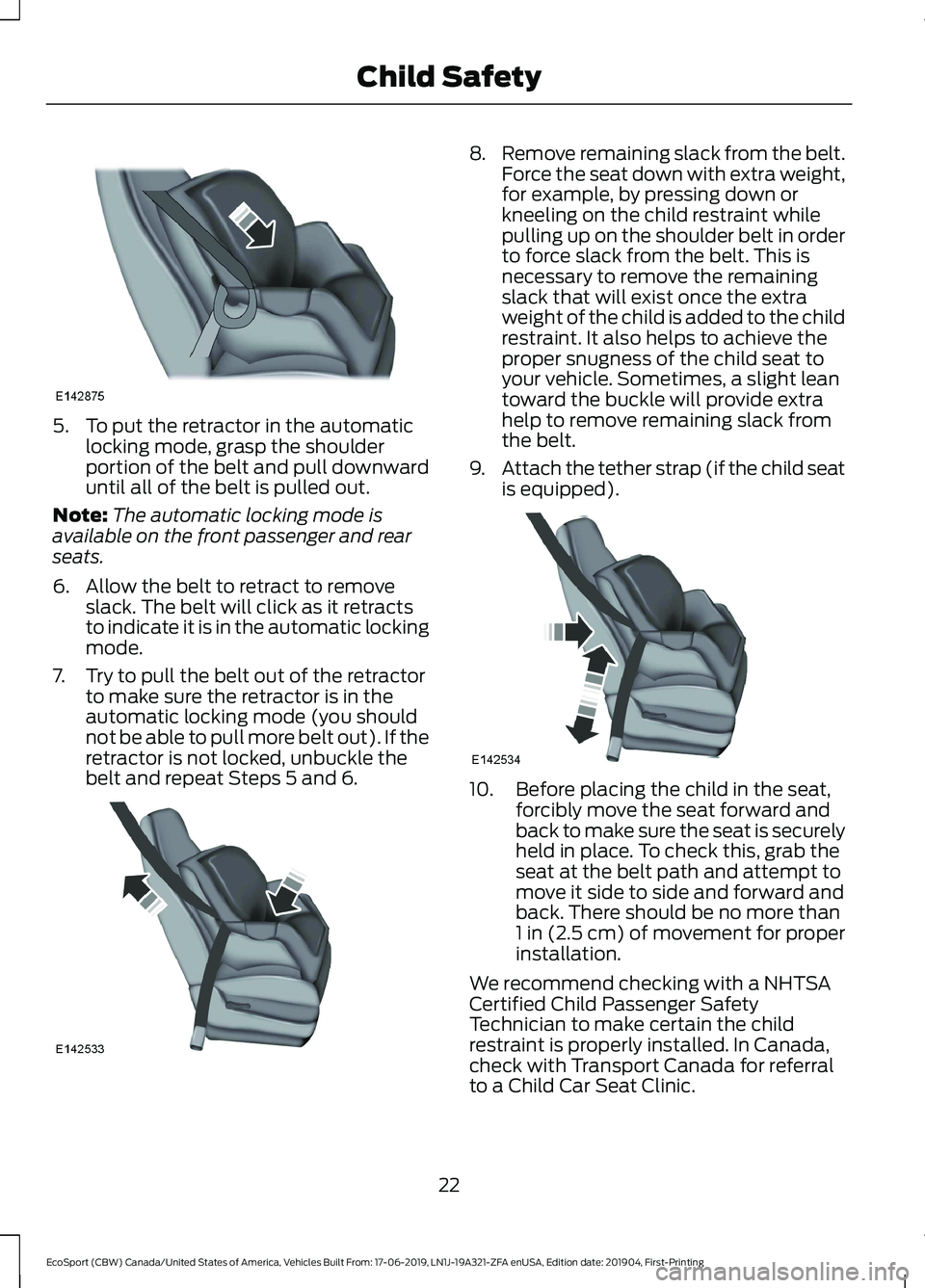
5.To put the retractor in the automaticlocking mode, grasp the shoulderportion of the belt and pull downwarduntil all of the belt is pulled out.
Note:The automatic locking mode isavailable on the front passenger and rearseats.
6.Allow the belt to retract to removeslack. The belt will click as it retractsto indicate it is in the automatic lockingmode.
7.Try to pull the belt out of the retractorto make sure the retractor is in theautomatic locking mode (you shouldnot be able to pull more belt out). If theretractor is not locked, unbuckle thebelt and repeat Steps 5 and 6.
8.Remove remaining slack from the belt.Force the seat down with extra weight,for example, by pressing down orkneeling on the child restraint whilepulling up on the shoulder belt in orderto force slack from the belt. This isnecessary to remove the remainingslack that will exist once the extraweight of the child is added to the childrestraint. It also helps to achieve theproper snugness of the child seat toyour vehicle. Sometimes, a slight leantoward the buckle will provide extrahelp to remove remaining slack fromthe belt.
9.Attach the tether strap (if the child seatis equipped).
10.Before placing the child in the seat,forcibly move the seat forward andback to make sure the seat is securelyheld in place. To check this, grab theseat at the belt path and attempt tomove it side to side and forward andback. There should be no more than1 in (2.5 cm) of movement for properinstallation.
We recommend checking with a NHTSACertified Child Passenger SafetyTechnician to make certain the childrestraint is properly installed. In Canada,check with Transport Canada for referralto a Child Car Seat Clinic.
22
EcoSport (CBW) Canada/United States of America, Vehicles Built From: 17-06-2019, LN1J-19A321-ZFA enUSA, Edition date: 201904, First-PrintingChild Safety
Page 32 of 448
WARNING: Properly securechildren 12 years old and under in a rearseating position whenever possible. Ifyou are unable to properly secure allchildren in a rear seating position,properly secure the largest child on thefront seat. If you must use a forwardfacing child restraint on the front seat,move the seat as far back as possible.Failure to follow these instructions couldresult in personal injury or death.
WARNING: Always carefullyfollow the instructions and warningsprovided by the manufacturer of anychild restraint to determine if therestraint device is appropriate for yourchild's size, height, weight, or age. Followthe child restraint manufacturer'sinstructions and warnings provided forinstallation and use in conjunction withthe instructions and warnings providedby your vehicle manufacturer. A safetyseat that is improperly installed orutilized, is inappropriate for your child'sheight, age, or weight or does notproperly fit the child may increase therisk of serious injury or death.
WARNING: Do not allow apassenger to hold a child on their lapwhen your vehicle is moving. Failure tofollow this instruction could result inpersonal injury or death in the event of asudden stop or crash.
WARNING: Do not use pillows,books or towels to boost your child'sheight. Failure to follow this instructioncould result in personal injury or death.
WARNING: Properly secure childrestraints or booster seats when they arenot in use. They could become projectilesin a sudden stop or crash. Failure tofollow this instruction could result inpersonal injury or death.
WARNING: Do not put theshoulder section of the seatbelt or allowthe child to put the shoulder section ofthe seatbelt under their arm or behindtheir back. Failure to follow thisinstruction could reduce theeffectiveness of the seatbelt andincrease the risk of injury or death in acrash.
WARNING: Do not leave childrenor pets unattended in your vehicle.Failure to follow this instruction couldresult in personal injury or death.
28
EcoSport (CBW) Canada/United States of America, Vehicles Built From: 17-06-2019, LN1J-19A321-ZFA enUSA, Edition date: 201904, First-PrintingChild Safety
Page 33 of 448
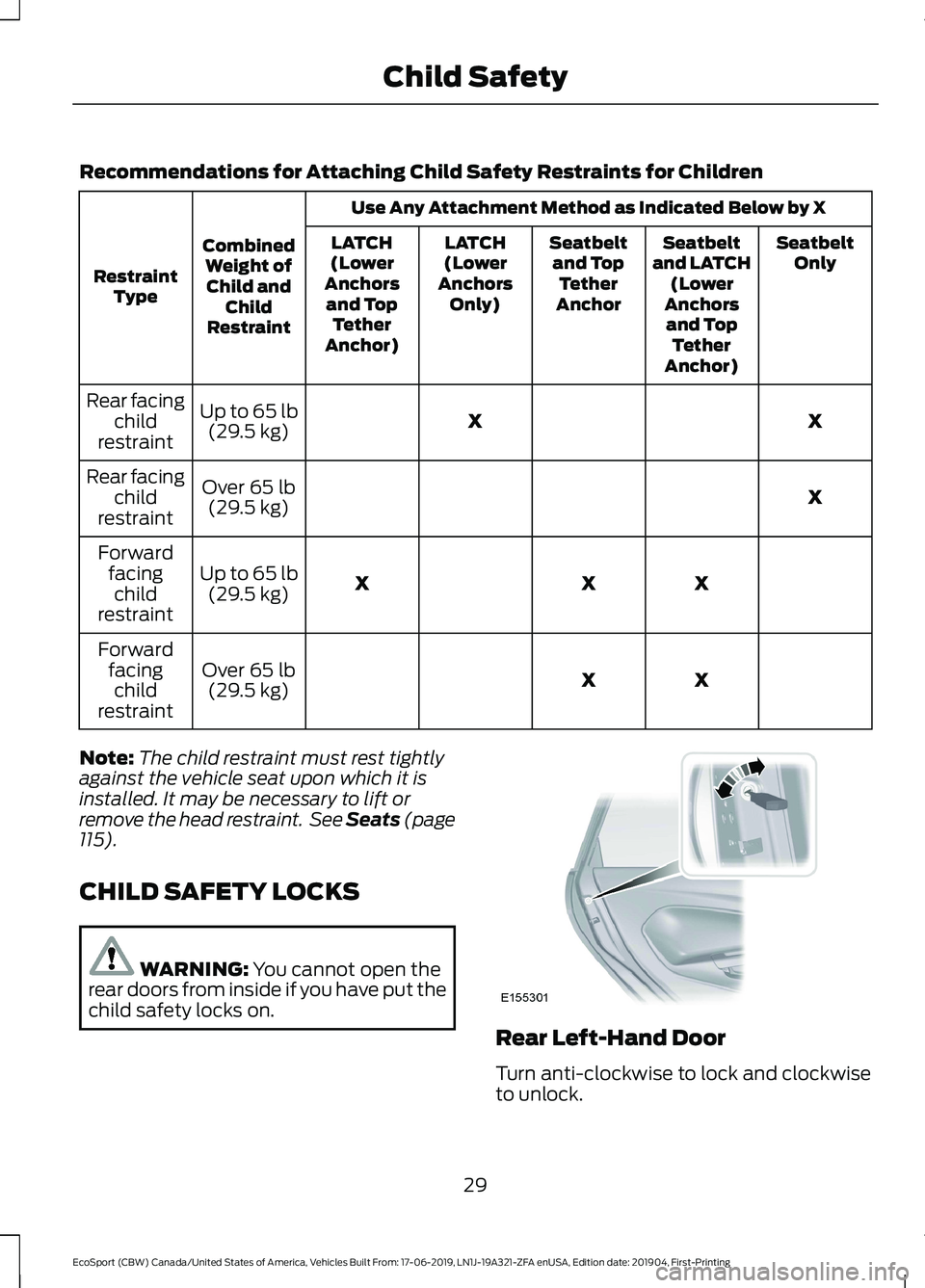
Recommendations for Attaching Child Safety Restraints for Children
Use Any Attachment Method as Indicated Below by X
CombinedWeight ofChild andChildRestraint
RestraintType
SeatbeltOnlySeatbeltand LATCH(LowerAnchorsand TopTetherAnchor)
Seatbeltand TopTetherAnchor
LATCH(LowerAnchorsOnly)
LATCH(LowerAnchorsand TopTetherAnchor)
XXUp to 65 lb(29.5 kg)
Rear facingchildrestraint
XOver 65 lb(29.5 kg)
Rear facingchildrestraint
XXXUp to 65 lb(29.5 kg)
Forwardfacingchildrestraint
XXOver 65 lb(29.5 kg)
Forwardfacingchildrestraint
Note:The child restraint must rest tightlyagainst the vehicle seat upon which it isinstalled. It may be necessary to lift orremove the head restraint. See Seats (page115).
CHILD SAFETY LOCKS
WARNING: You cannot open therear doors from inside if you have put thechild safety locks on.
Rear Left-Hand Door
Turn anti-clockwise to lock and clockwiseto unlock.
29
EcoSport (CBW) Canada/United States of America, Vehicles Built From: 17-06-2019, LN1J-19A321-ZFA enUSA, Edition date: 201904, First-PrintingChild Safety
Page 45 of 448
After all occupants have adjusted theirseats and put on seatbelts, it is veryimportant that they continue to sitproperly. A properly seated occupant sitsupright, leaning against the seatback, andcentered on the seat cushion, with theirfeet comfortably extended on the floor.Sitting improperly can increase the chanceof injury in a crash event. For example, ifan occupant slouches, lies down, turnssideways, sits forward, leans forward orsideways, or puts one or both feet up, thechance of injury during a crash is greatlyincreased.
Children and Airbags
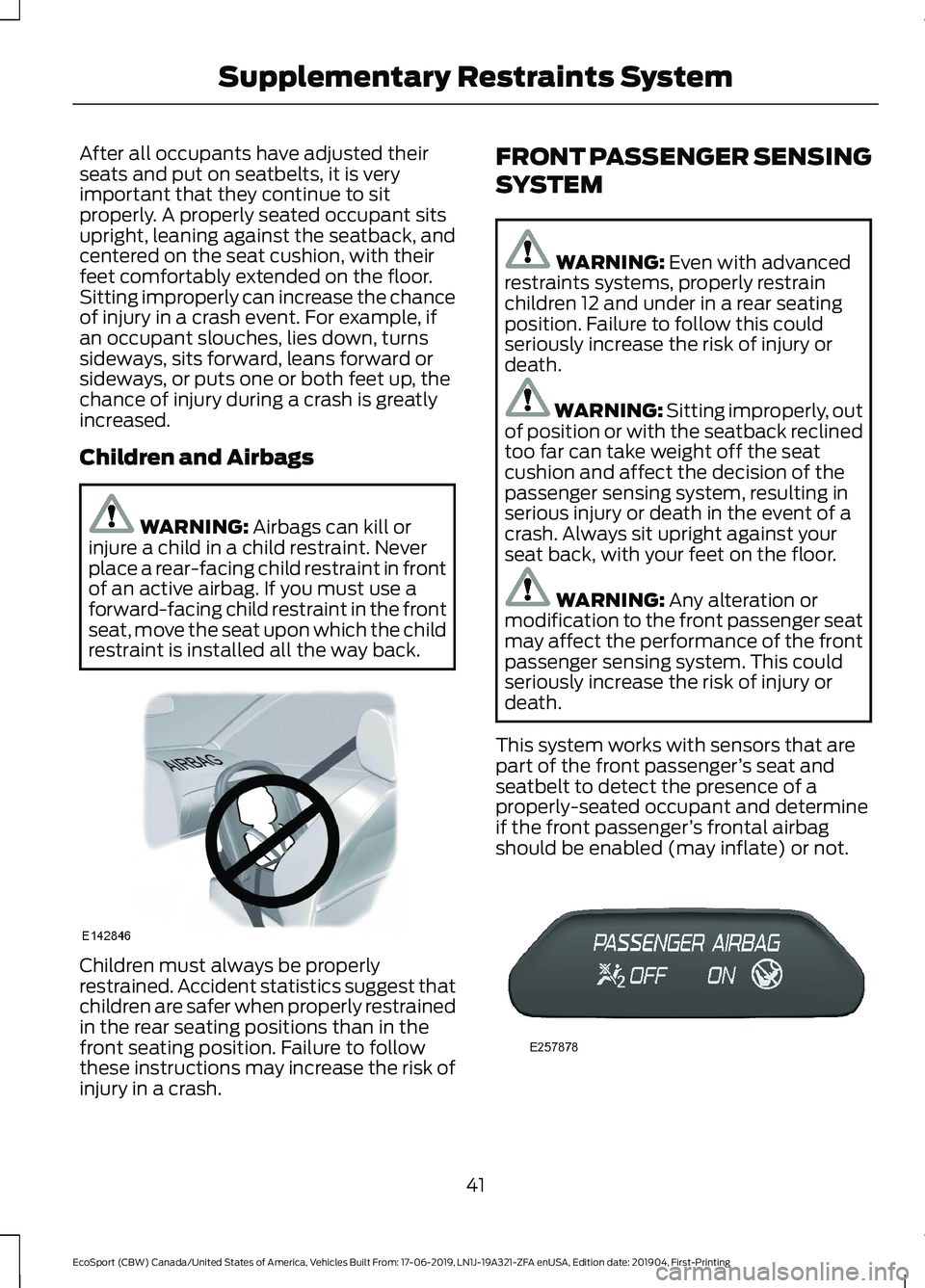
WARNING: Airbags can kill orinjure a child in a child restraint. Neverplace a rear-facing child restraint in frontof an active airbag. If you must use aforward-facing child restraint in the frontseat, move the seat upon which the childrestraint is installed all the way back.
Children must always be properlyrestrained. Accident statistics suggest thatchildren are safer when properly restrainedin the rear seating positions than in thefront seating position. Failure to followthese instructions may increase the risk ofinjury in a crash.
FRONT PASSENGER SENSING
SYSTEM
WARNING: Even with advancedrestraints systems, properly restrainchildren 12 and under in a rear seatingposition. Failure to follow this couldseriously increase the risk of injury ordeath.
WARNING: Sitting improperly, outof position or with the seatback reclinedtoo far can take weight off the seatcushion and affect the decision of thepassenger sensing system, resulting inserious injury or death in the event of acrash. Always sit upright against yourseat back, with your feet on the floor.
WARNING: Any alteration ormodification to the front passenger seatmay affect the performance of the frontpassenger sensing system. This couldseriously increase the risk of injury ordeath.
This system works with sensors that arepart of the front passenger’s seat andseatbelt to detect the presence of aproperly-seated occupant and determineif the front passenger’s frontal airbagshould be enabled (may inflate) or not.
41
EcoSport (CBW) Canada/United States of America, Vehicles Built From: 17-06-2019, LN1J-19A321-ZFA enUSA, Edition date: 201904, First-PrintingSupplementary Restraints System
Page 47 of 448
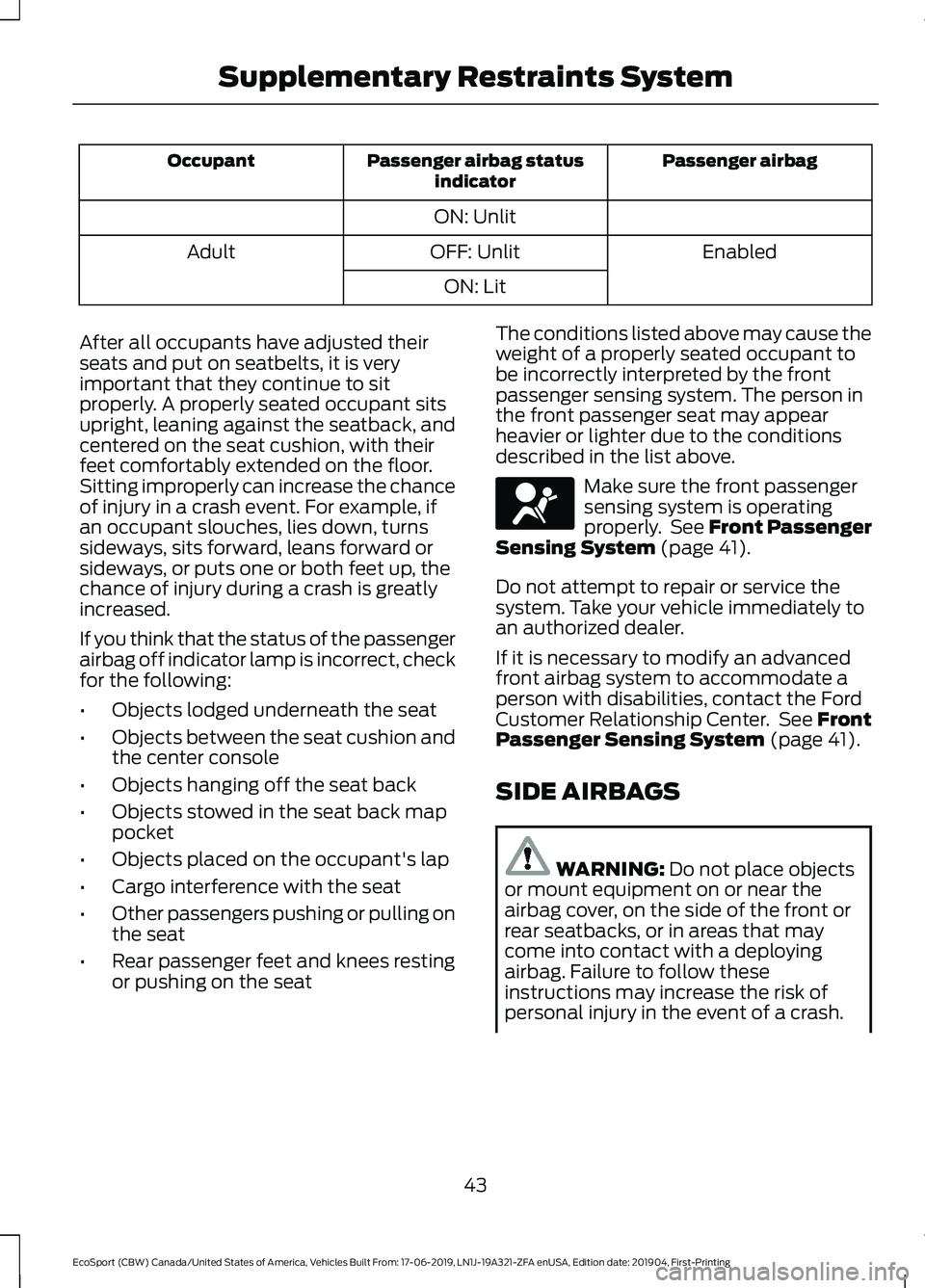
Passenger airbagPassenger airbag statusindicatorOccupant
ON: Unlit
EnabledOFF: UnlitAdult
ON: Lit
After all occupants have adjusted theirseats and put on seatbelts, it is veryimportant that they continue to sitproperly. A properly seated occupant sitsupright, leaning against the seatback, andcentered on the seat cushion, with theirfeet comfortably extended on the floor.Sitting improperly can increase the chanceof injury in a crash event. For example, ifan occupant slouches, lies down, turnssideways, sits forward, leans forward orsideways, or puts one or both feet up, thechance of injury during a crash is greatlyincreased.
If you think that the status of the passengerairbag off indicator lamp is incorrect, checkfor the following:
•Objects lodged underneath the seat
•Objects between the seat cushion andthe center console
•Objects hanging off the seat back
•Objects stowed in the seat back mappocket
•Objects placed on the occupant's lap
•Cargo interference with the seat
•Other passengers pushing or pulling onthe seat
•Rear passenger feet and knees restingor pushing on the seat
The conditions listed above may cause theweight of a properly seated occupant tobe incorrectly interpreted by the frontpassenger sensing system. The person inthe front passenger seat may appearheavier or lighter due to the conditionsdescribed in the list above.
Make sure the front passengersensing system is operatingproperly. See Front PassengerSensing System (page 41).
Do not attempt to repair or service thesystem. Take your vehicle immediately toan authorized dealer.
If it is necessary to modify an advancedfront airbag system to accommodate aperson with disabilities, contact the FordCustomer Relationship Center. See FrontPassenger Sensing System (page 41).
SIDE AIRBAGS
WARNING: Do not place objectsor mount equipment on or near theairbag cover, on the side of the front orrear seatbacks, or in areas that maycome into contact with a deployingairbag. Failure to follow theseinstructions may increase the risk ofpersonal injury in the event of a crash.
43
EcoSport (CBW) Canada/United States of America, Vehicles Built From: 17-06-2019, LN1J-19A321-ZFA enUSA, Edition date: 201904, First-PrintingSupplementary Restraints System
Page 138 of 448
Engine Idle Speed after Starting
The speed at which the engine idlesimmediately after starting minimizesvehicle emissions and maximizes cabincomfort and fuel economy.
The idle speed varies depending on certainfactors. These include vehicle componentand ambient temperatures as well aselectrical and climate system demands.
Failure to Start
Vehicles with Manual Transmission
If the engine does not crank when you fullydepress the clutch pedal with the ignitionkey in position III, follow this procedure:
1.Fully depress both the clutch and brakepedals.
2.Turn the key to position III until theengine has started.
ENGINE BLOCK HEATER (IF
EQUIPPED)
WARNING: Failure to followengine block heater instructions couldresult in property damage or seriouspersonal injury.
WARNING: Do not use your heaterwith ungrounded electrical systems ortwo-pronged adapters. There is a risk ofelectrical shock.
WARNING: Do not fully close thehood, or allow it to drop under its ownweight when using the engine blockheater. This could damage the powercable and may cause an electrical shortresulting in fire, injury and propertydamage.
Note:The heater is most effective whenoutdoor temperatures are below 0°F(-18°C).
The heater acts as a starting aid bywarming the engine coolant. This allowsthe climate control system to respondquickly. The equipment includes a heaterelement (installed in the engine block) anda wire harness. You can connect thesystem to a grounded 120-volt ACelectrical source.
We recommend that you do the followingfor a safe and correct operation:
•Use a 16-gauge outdoor extension cordthat is product certified byUnderwriter’s Laboratory (UL) orCanadian Standards Association(CSA). This extension cord must besuitable for use outdoors, in coldtemperatures, and be clearly markedSuitable for Use with OutdoorAppliances. Do not use an indoorextension cord outdoors. This couldresult in an electric shock or become afire hazard.
•Use as short an extension cord aspossible.
•Do not use multiple extension cords.
•Make sure that when in operation, theextension cord plug and heater cordplug connections are free and clear ofwater. This could cause an electricshock or fire.
•Make sure your vehicle is parked in aclean area, clear of combustibles.
•Make sure the heater, heater cord andextension cord are firmly connected.
•Check for heat anywhere in theelectrical hookup once the system hasbeen operating for approximately 30minutes.
134
EcoSport (CBW) Canada/United States of America, Vehicles Built From: 17-06-2019, LN1J-19A321-ZFA enUSA, Edition date: 201904, First-PrintingStarting and Stopping the Engine
Page 148 of 448
•Turn the ignition off before fueling; aninaccurate reading results if the engineis left running.
•Use the same fill rate(low-medium-high) each time the tankis filled.
•The maximum tank capacity, duringfueling, is reached when the pump isautomatically cut off for the secondtime.
Results are most accurate when the fillingmethod is consistent.
Fuel Economy
Your vehicle calculates fuel economyfigures through the trip computer averagefuel function. See Trip Computer (page96).
The first 1,000 mi (1,500 km) of driving isthe break-in period of the engine. A moreaccurate measurement is obtained after2,000 mi (3,000 km).
Impacting Fuel Economy
•Incorrect tire inflation pressures.
•Fully loading your vehicle.
•Carrying unnecessary weight.
•Adding certain accessories to yourvehicle such as bug deflectors, rollbarsor light bars, running boards and skiracks.
•Using fuel blended with alcohol.
•Fuel economy may decrease with lowertemperatures.
•Fuel economy may decrease whendriving short distances.
•You may get better fuel economy whendriving on flat terrain than when drivingon hilly terrain.
144
EcoSport (CBW) Canada/United States of America, Vehicles Built From: 17-06-2019, LN1J-19A321-ZFA enUSA, Edition date: 201904, First-PrintingFuel and Refueling