change time FORD EDGE 2009 1.G User Guide
[x] Cancel search | Manufacturer: FORD, Model Year: 2009, Model line: EDGE, Model: FORD EDGE 2009 1.GPages: 320, PDF Size: 2.26 MB
Page 301 of 320
Do not make any unauthorized changes to your vehicle or engine. By
law, vehicle owners and anyone who manufactures, repairs, services,
sells, leases, trades vehicles, or supervises a fleet of vehicles are not
permitted to intentionally remove an emission control device or prevent
it from working. Information about your vehicle’s emission system is on
the Vehicle Emission Control Information Decal located on or near the
engine. This decal also lists engine displacement.
Please consult yourWarranty Guide/Customer Information Guidefor
complete emission warranty information.
On board diagnostics (OBD-II)
Your vehicle is equipped with a computer that monitors the engine’s
emission control system. This system is commonly known as the On
Board Diagnostics System (OBD-II). The OBD-II system protects the
environment by ensuring that your vehicle continues to meet
government emission standards. The OBD-II system also assists your
authorized dealer in properly servicing your vehicle. When theService
engine soon
indicator illuminates, the OBD-II system has detected
a malfunction. Temporary malfunctions may cause theService engine
soon
indicator to illuminate. Examples are:
1. The vehicle has run out of fuel—the engine may misfire or run poorly.
2. Poor fuel quality or water in the fuel—the engine may misfire or run
poorly.
3. The fuel cap may not have been securely tightened. SeeFuel filler
capin this chapter.
4. Driving through deep water—the electrical system may be wet.
These temporary malfunctions can be corrected by filling the fuel tank
with good quality fuel, properly tightening the fuel cap or letting the
electrical system dry out. After three driving cycles without these or any
other temporary malfunctions present, theService engine soon
indicator should stay off the next time the engine is started. A driving
cycle consists of a cold engine startup followed by mixed city/highway
driving. No additional vehicle service is required.
If theService engine soon
indicator remains on, have your vehicle
serviced at the first available opportunity. Although some malfunctions
detected by the OBD-II may not have symptoms that are apparent,
continued driving with theService engine soon
indicator on can
result in increased emissions, lower fuel economy, reduced engine and
transmission smoothness, and lead to more costly repairs.
2009 Edge(edg)
Owners Guide, 1st Printing
USA(fus)
Maintenance and Specifications
301
Page 304 of 320
TRANSMISSION FLUID
Checking automatic transmission fluid
Refer to yourscheduled maintenance informationfor scheduled
intervals for fluid checks and changes. Your transmission does not
consume fluid. However, the fluid level should be checked if the
transmission is not working properly, i.e., if the transmission slips or
shifts slowly or if you notice some sign of fluid leakage.
Automatic transmission fluid expands when warmed. To obtain an
accurate fluid check, drive the vehicle until it is warmed up
(approximately 20 miles [30 km]). If your vehicle has been
operated for an extended period at high speeds, in city traffic
during hot weather or pulling a trailer, the vehicle should be
turned off for about 30 minutes to allow fluid to cool before
checking.
1. Drive the vehicle 20 miles (30 km) or until it reaches normal operating
temperature.
2. Park the vehicle on a level surface and engage the parking brake.
3. With the parking brake engaged and your foot on the brake pedal,
start the engine and move the gearshift lever through all of the gear
ranges. Allow sufficient time for each gear to engage.
4. Latch the gearshift lever in P (Park) and leave the engine running.
5. Remove the dipstick, wiping it clean with a clean, dry lint free rag. If
necessary, refer toIdentifying components in the engine compartment
in this chapter for the location of the dipstick.
6. Install the dipstick making sure it is fully seated in the filler tube.
7. Remove the dipstick and inspect the fluid level. The fluid should be in
the designated areas for normal operating temperature.
Low fluid level
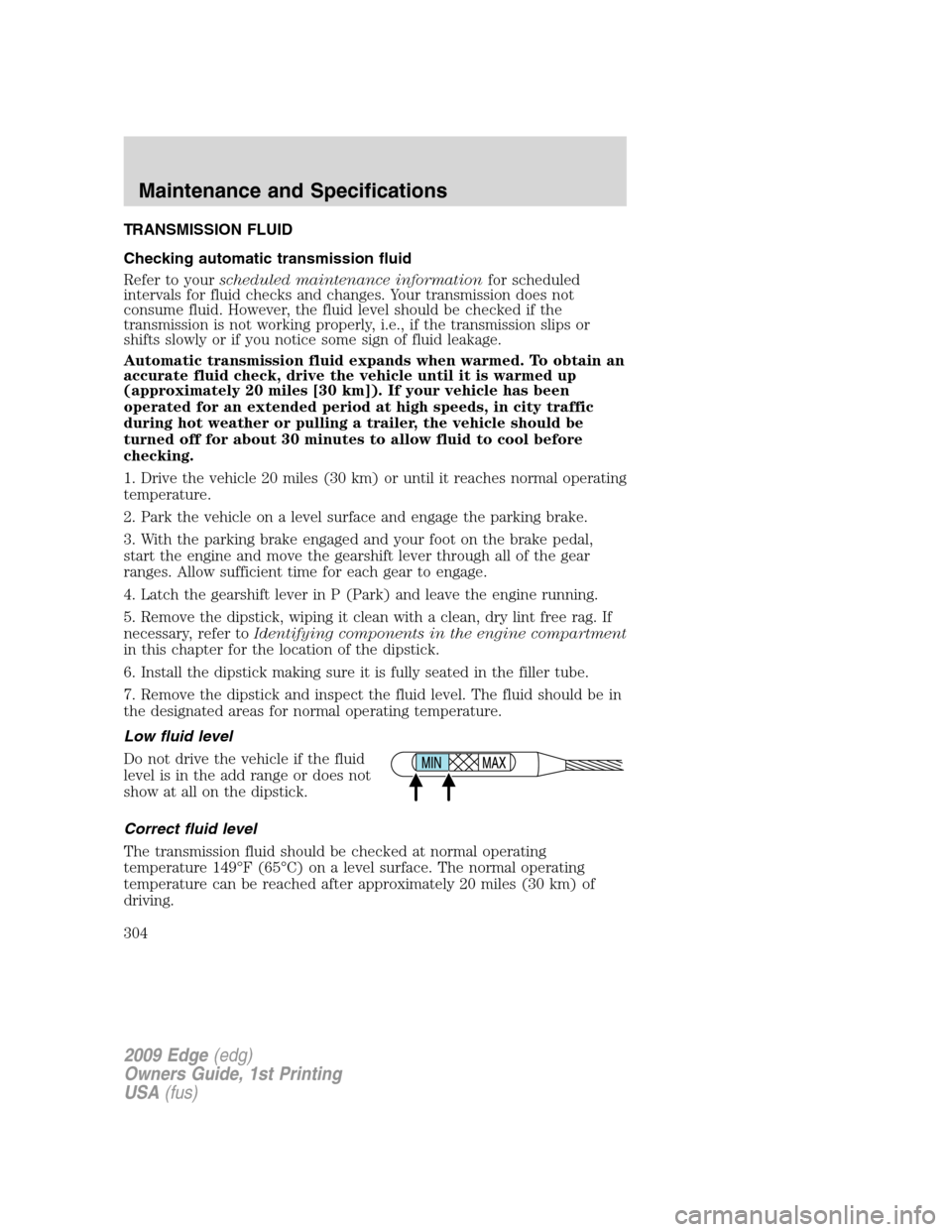
Do not drive the vehicle if the fluid
level is in the add range or does not
show at all on the dipstick.
Correct fluid level
The transmission fluid should be checked at normal operating
temperature 149°F (65°C) on a level surface. The normal operating
temperature can be reached after approximately 20 miles (30 km) of
driving.
2009 Edge(edg)
Owners Guide, 1st Printing
USA(fus)
Maintenance and Specifications
304
Page 316 of 320
Cleaning your vehicle
engine compartment ..............271
instrument panel ....................272
interior .....................................273
plastic parts ............................271
safety belts ..............................273
washing ....................................269
waxing .....................................270
wheels ......................................270
wiper blades ............................271
Climate control (see Air
conditioning or Heating) ............51
Clock adjust
6-CD in dash .............................34
AM/FM/CD .................................26
Compass, electronic
set zone adjustment .................86
Console ........................................68
overhead ....................................67
Controls
power seat ...............................126
steering column ........................76
Convertible
cleaning ...................................272
Coolant
checking and adding ..............286
refill capacities ................289, 308
specifications ..........................308
Cruise control (see Speed
control) ........................................73
Cupholder(s) .............................132
Customer Assistance ................239
Ford Extended Service
Plan ..........................................266
Getting assistance outside the
U.S. and Canada .....................266
Getting roadside assistance ...239
Getting the service you
need .........................................262Ordering additional owner’s
literature .................................267
Utilizing the
Mediation/Arbitration
Program ...................................265
D
Daytime running lamps (see
Lamps) .........................................56
Dipstick
automatic transmission
fluid ..........................................304
engine oil .................................281
Driving under special
conditions ..................229, 234, 236
sand .........................................235
snow and ice ...........................237
through water .................235, 238
E
Electronic message center ...83–84
Emergencies, roadside
jump-starting ..........................255
Emission control system ..........300
Engine ........................................310
cleaning ...................................271
coolant .....................................286
fail-safe cooling .......................290
idle speed control ...................284
lubrication specifications .......308
refill capacities ........................308
service points ..................278–279
starting after a collision .........240
Engine block heater .................216
Engine oil ..................................281
change oil soon warning,
message center .......................281
checking and adding ..............281
dipstick ....................................281
filter, specifications ........283, 307
recommendations ...................283
2009 Edge(edg)
Owners Guide, 1st Printing
USA(fus)
Index
316