ECU FORD EDGE 2010 1.G Workshop Manual
[x] Cancel search | Manufacturer: FORD, Model Year: 2010, Model line: EDGE, Model: FORD EDGE 2010 1.GPages: 328, PDF Size: 2.29 MB
Page 175 of 328
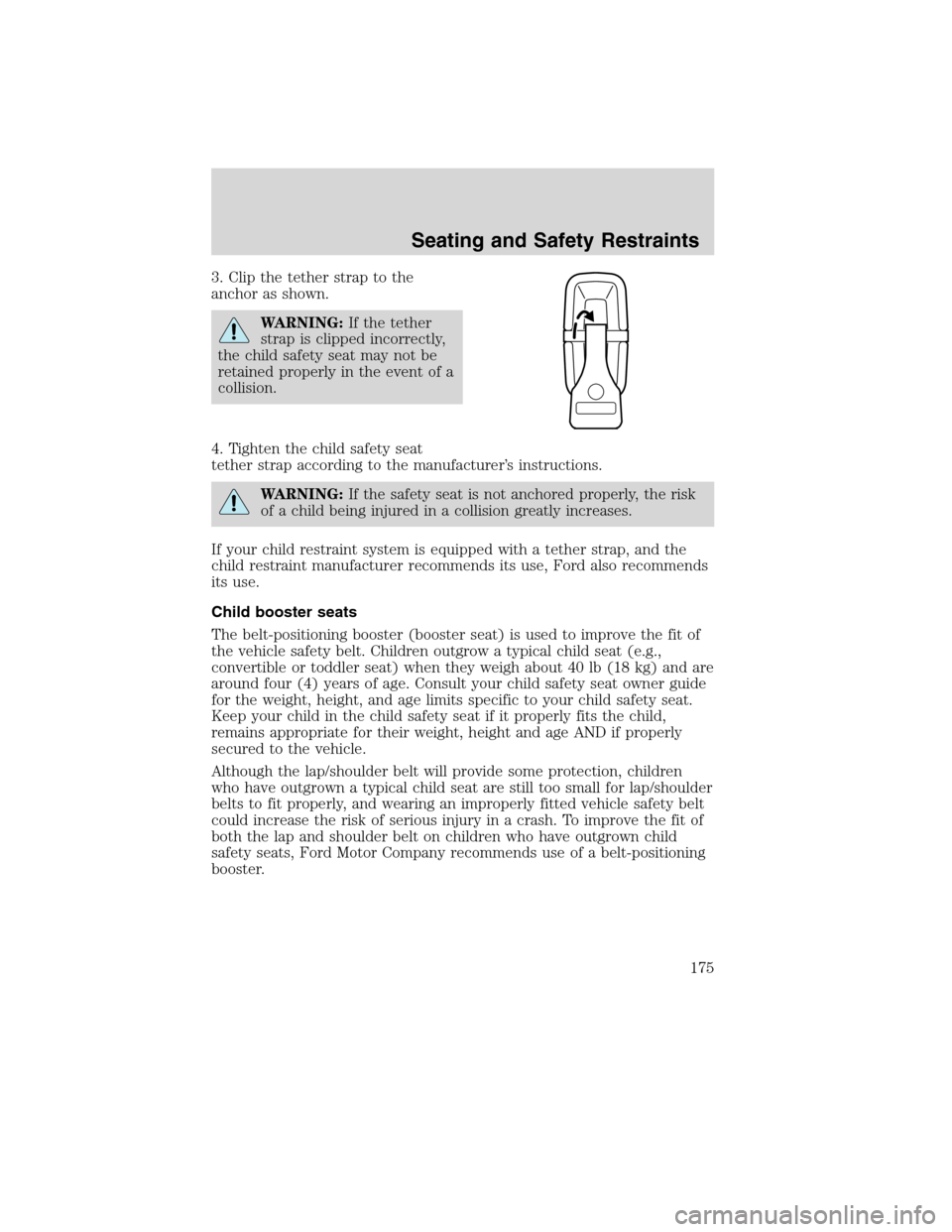
3. Clip the tether strap to the
anchor as shown.
WARNING:If the tether
strap is clipped incorrectly,
the child safety seat may not be
retained properly in the event of a
collision.
4. Tighten the child safety seat
tether strap according to the manufacturer’s instructions.
WARNING:If the safety seat is not anchored properly, the risk
of a child being injured in a collision greatly increases.
If your child restraint system is equipped with a tether strap, and the
child restraint manufacturer recommends its use, Ford also recommends
its use.
Child booster seats
The belt-positioning booster (booster seat) is used to improve the fit of
the vehicle safety belt. Children outgrow a typical child seat (e.g.,
convertible or toddler seat) when they weigh about 40 lb (18 kg) and are
around four (4) years of age. Consult your child safety seat owner guide
for the weight, height, and age limits specific to your child safety seat.
Keep your child in the child safety seat if it properly fits the child,
remains appropriate for their weight, height and age AND if properly
secured to the vehicle.
Although the lap/shoulder belt will provide some protection, children
who have outgrown a typical child seat are still too small for lap/shoulder
belts to fit properly, and wearing an improperly fitted vehicle safety belt
could increase the risk of serious injury in a crash. To improve the fit of
both the lap and shoulder belt on children who have outgrown child
safety seats, Ford Motor Company recommends use of a belt-positioning
booster.
Seating and Safety Restraints
175
2010 Edge(edg)
Owners Guide(own2002), 1st Printing
USA(fus)
Page 200 of 328
When you believe your system is not operating properly
The main function of the Tire Pressure Monitoring System is to warn you
when your tires need air. It can also warn you in the event the system is
no longer capable of functioning as intended. Please refer to the
following chart for information concerning your Tire Pressure Monitoring
System:
Low Tire
Pressure
Warning LightPossible
causeCustomer Action Required
Solid Warning
LightTire(s)
under-inflated1. Check your tire pressure to
ensure tires are properly inflated;
refer toInflating your tiresin
this chapter.
2. After inflating your tires to the
manufacturer’s recommended
inflation pressure as shown on the
Tire Label (located on the edge of
driver’s door or the B-Pillar), the
vehicle must be driven for at least
two minutes over 20 mph
(32 km/h) before the light will
turn OFF.
Spare tire in
useYour temporary spare tire is in
use. Repair the damaged road
wheel/tire and reinstall it on the
vehicle to restore system
functionality. For a description on
how the system functions, refer to
When your temporary spare tire
is installedin this section.
TPMS
malfunctionIf your tires are properly inflated
and your spare tire is not in use
and the light remains ON, contact
your authorized dealer as soon as
possible.
Tires, Wheels and Loading
200
2010 Edge(edg)
Owners Guide(own2002), 1st Printing
USA(fus)
Page 201 of 328
Low Tire
Pressure
Warning LightPossible
causeCustomer Action Required
Flashing Warning
LightSpare tire in
useYour temporary spare tire is in
use. Repair the damaged road
wheel and re-mount it on the
vehicle to restore system
functionality. For a description of
how the system functions under
these conditions, refer toWhen
your temporary spare tire is
installedin this section.
TPMS
malfunctionIf your tires are properly inflated
and your spare tire is not in use
and the TPMS warning light still
flashes, contact your authorized
dealer as soon as possible.
When inflating your tires
When putting air into your tires (such as at a gas station or in your
garage), the Tire Pressure Monitoring System may not respond
immediately to the air added to your tires.
It may take up to two minutes of driving over 20 mph (32 km/h) for the
light to turn OFF after you have filled your tires to the recommended
inflation pressure.
How temperature affects your tire pressure
The Tire Pressure Monitoring System (TPMS) monitors tire pressure in
each pneumatic tire. While driving in a normal manner, a typical
passenger tire inflation pressure may increase approximately 2 to 4 psi
(14 to 28 kPa) from a cold start situation. If the vehicle is stationary
over night with the outside temperature significantly lower than the
daytime temperature, the tire pressure may decrease approximately 3 psi
(21 kPa) for a drop of 30°F (17°C) in ambient temperature. This lower
pressure value may be detected by the TPMS as being significantly lower
than the recommended inflation pressure and activate the TPMS warning
for low tire pressure. If the low tire pressure warning light is ON, visually
check each tire to verify that no tire is flat. (If one or more tires are flat,
repair as necessary.) Check air pressure in the road tires. If any tire is
Tires, Wheels and Loading
201
2010 Edge(edg)
Owners Guide(own2002), 1st Printing
USA(fus)
Page 221 of 328
ABS warning lamp
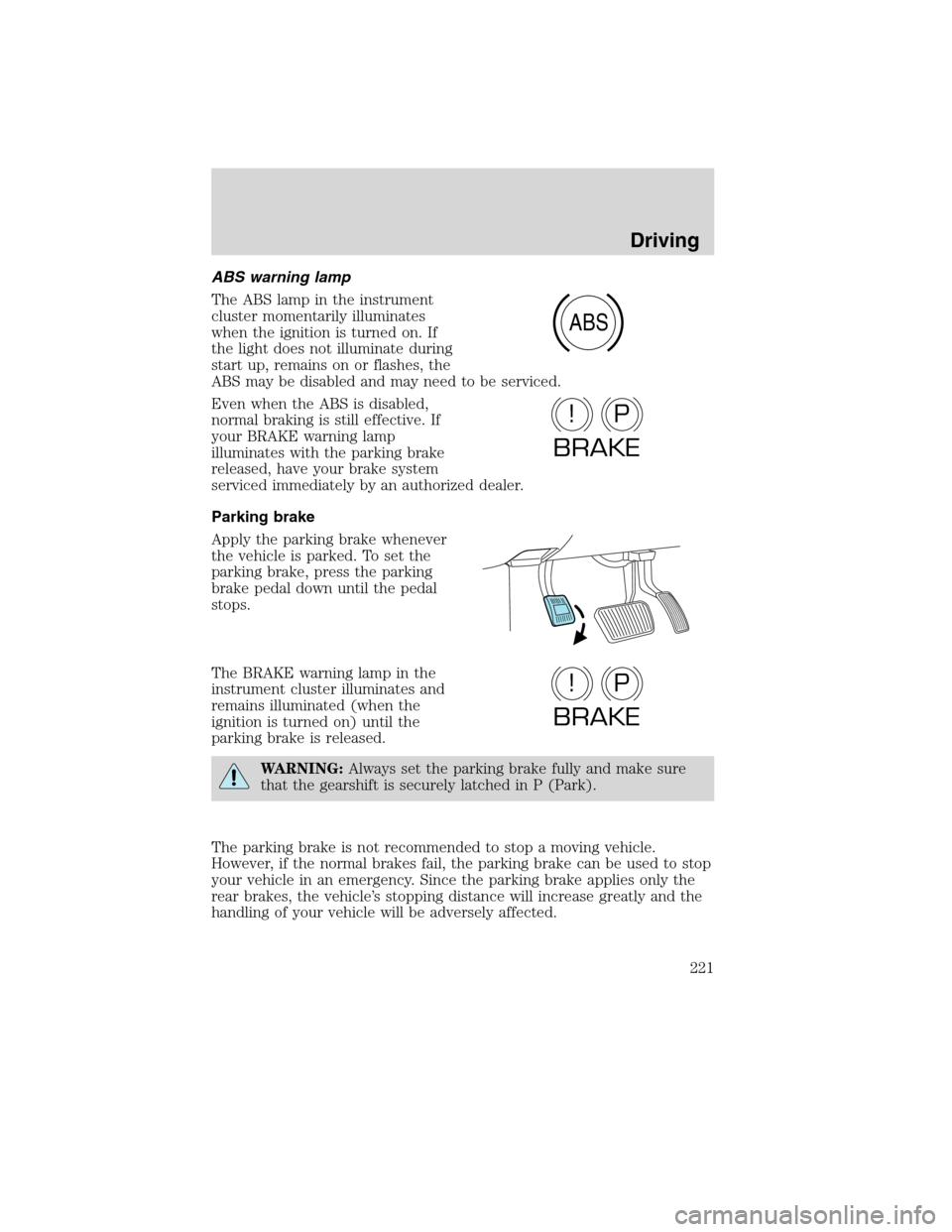
The ABS lamp in the instrument
cluster momentarily illuminates
when the ignition is turned on. If
the light does not illuminate during
start up, remains on or flashes, the
ABS may be disabled and may need to be serviced.
Even when the ABS is disabled,
normal braking is still effective. If
your BRAKE warning lamp
illuminates with the parking brake
released, have your brake system
serviced immediately by an authorized dealer.
Parking brake
Apply the parking brake whenever
the vehicle is parked. To set the
parking brake, press the parking
brake pedal down until the pedal
stops.
The BRAKE warning lamp in the
instrument cluster illuminates and
remains illuminated (when the
ignition is turned on) until the
parking brake is released.
WARNING:Always set the parking brake fully and make sure
that the gearshift is securely latched in P (Park).
The parking brake is not recommended to stop a moving vehicle.
However, if the normal brakes fail, the parking brake can be used to stop
your vehicle in an emergency. Since the parking brake applies only the
rear brakes, the vehicle’s stopping distance will increase greatly and the
handling of your vehicle will be adversely affected.
ABS
P!
BRAKE
P!
BRAKE
Driving
221
2010 Edge(edg)
Owners Guide(own2002), 1st Printing
USA(fus)
Page 229 of 328
WARNING:If the parking brake is fully released, but the brake
warning lamp remains illuminated, the brakes may not be
working properly. See your authorized dealer.
AUTOMATIC TRANSMISSION OPERATION
Automatic Transmission Adaptive Learning
Your transmission is equipped with an adaptive learning strategy found in
the vehicle computer. This feature is designed to increase durability and
provide consistent shift feel over the life of the vehicle. A new vehicle or
transmission may have firm and/or soft shifts. This operation is
considered normal and will not affect function or durability of the
transmission. Over time, the adaptive learning process will fully update
transmission operation. Additionally, whenever the battery is
disconnected or a new battery installed, the strategy must be relearned.
Understanding the gearshift positions of the 6–speed automatic
transmission
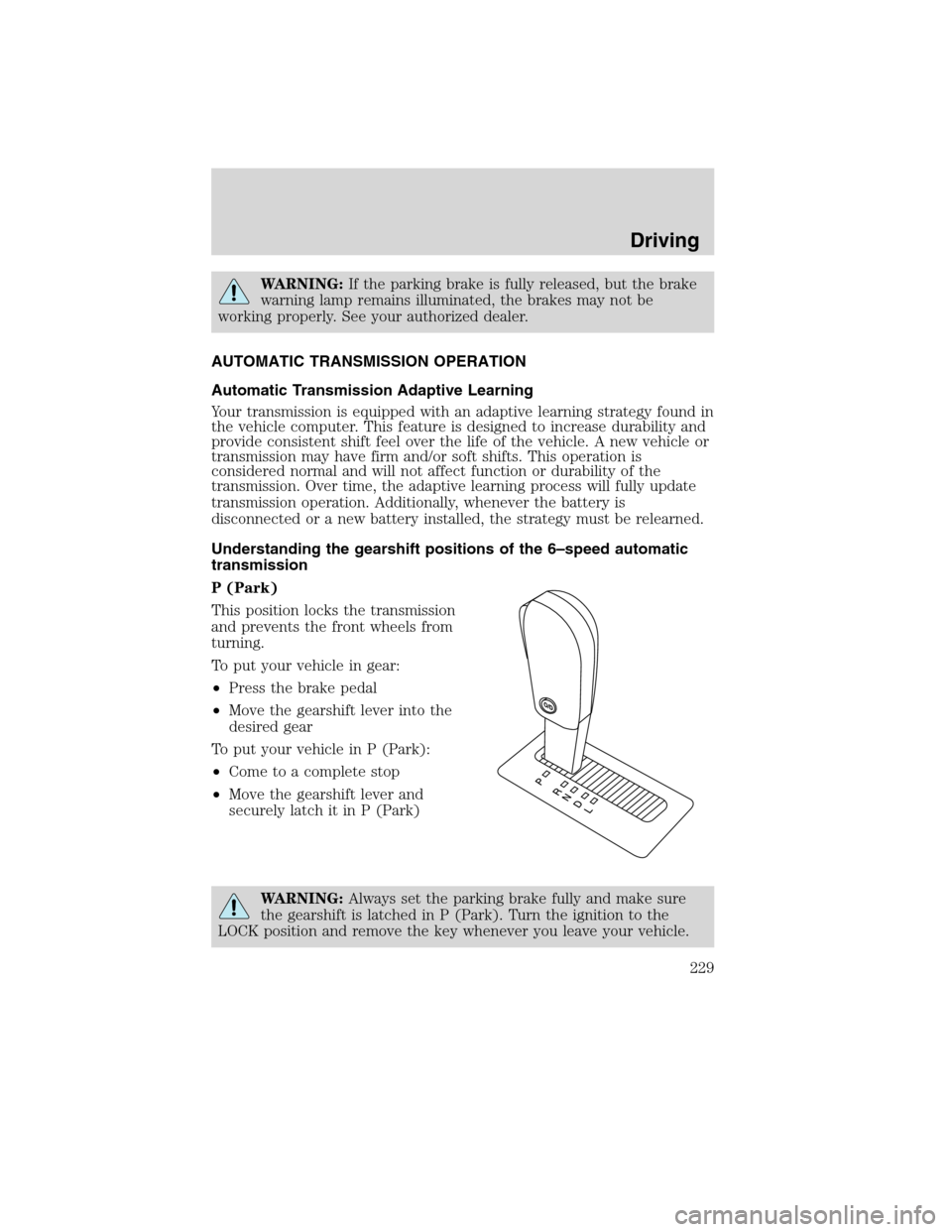
P (Park)
This position locks the transmission
and prevents the front wheels from
turning.
To put your vehicle in gear:
•Press the brake pedal
•Move the gearshift lever into the
desired gear
To put your vehicle in P (Park):
•Come to a complete stop
•Move the gearshift lever and
securely latch it in P (Park)
WARNING:Always set the parking brake fully and make sure
the gearshift is latched in P (Park). Turn the ignition to the
LOCK position and remove the key whenever you leave your vehicle.
Driving
229
2010 Edge(edg)
Owners Guide(own2002), 1st Printing
USA(fus)
Page 243 of 328
Canadian customers refer to your Customer Information Guide
for information on:
•coverage period
•exact fuel amounts
•towing of your disabled vehicle
•emergency travel expense reimbursement
•travel planning benefits
In Canada, for uninterrupted Roadside Assistance coverage, you may
purchase extended coverage prior to your Basic Warranty’s Roadside
Assistance expiring. For more information and enrollment, contact
1–877–294–2582 or visit our website at www.ford.ca.
Using roadside assistance
Complete the roadside assistance identification card and place it in your
wallet for quick reference. In the United States, this card is found in the
Owner Guide portfolio in the glove compartment. In Canada, the card is
found in theCustomer Information Guidein the glove compartment.
U.S. Ford, Mercury and Lincoln vehicle customers who require Roadside
Assistance, call 1-800-241-3673.
Canadian customers who require roadside assistance, call
1-800-665-2006.
If you need to arrange roadside assistance for yourself, Ford Motor
Company will reimburse a reasonable amount for towing to the nearest
dealership within 35 miles. To obtain reimbursement information, U.S.
Ford, Mercury and Lincoln vehicle customers call 1-800-241-3673.
Customers will be asked to submit their original receipts.
Canadian customers who need to obtain reimbursement information, call
1–800–665–2006.
HAZARD FLASHER CONTROL
The hazard flasher control is located
on the instrument panel by the radio.
The hazard flashers will operate
when the ignition is in any position
or if the key is not in the ignition.
Press in the flasher control and all
front and rear direction signals will flash. Press the flasher control again
to turn them off. Use it when your vehicle is disabled and is creating a
safety hazard for other motorists.
Note:With extended use, the flasher may run down your battery.
Roadside Emergencies
243
2010 Edge(edg)
Owners Guide(own2002), 1st Printing
USA(fus)
Page 245 of 328
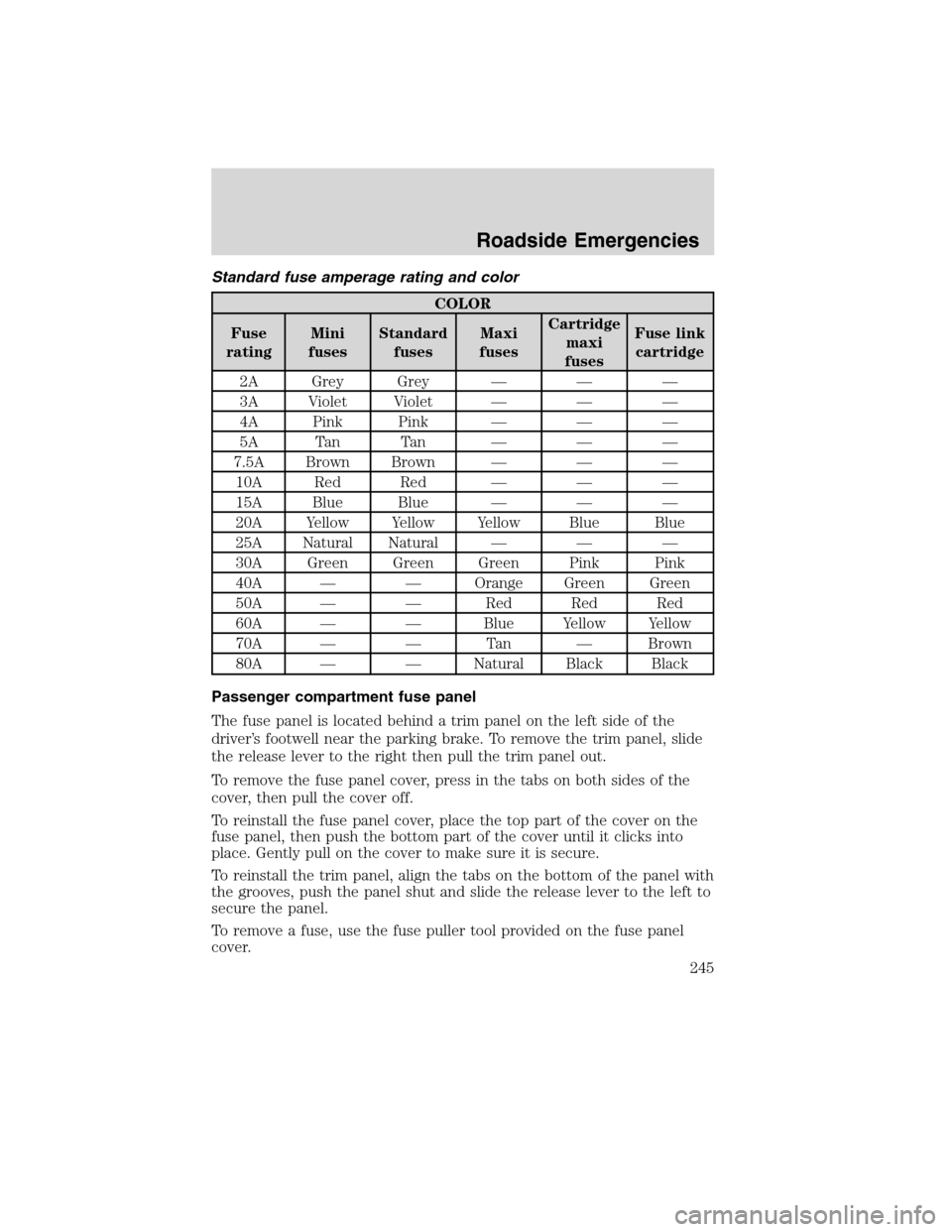
Standard fuse amperage rating and color
COLOR
Fuse
ratingMini
fusesStandard
fusesMaxi
fusesCartridge
maxi
fusesFuse link
cartridge
2A Grey Grey — — —
3A Violet Violet — — —
4A Pink Pink — — —
5A Tan Tan — — —
7.5A Brown Brown — — —
10A Red Red — — —
15A Blue Blue — — —
20A Yellow Yellow Yellow Blue Blue
25A Natural Natural — — —
30A Green Green Green Pink Pink
40A — — Orange Green Green
50A — — Red Red Red
60A — — Blue Yellow Yellow
70A — — Tan — Brown
80A — — Natural Black Black
Passenger compartment fuse panel
The fuse panel is located behind a trim panel on the left side of the
driver’s footwell near the parking brake. To remove the trim panel, slide
the release lever to the right then pull the trim panel out.
To remove the fuse panel cover, press in the tabs on both sides of the
cover, then pull the cover off.
To reinstall the fuse panel cover, place the top part of the cover on the
fuse panel, then push the bottom part of the cover until it clicks into
place. Gently pull on the cover to make sure it is secure.
To reinstall the trim panel, align the tabs on the bottom of the panel with
the grooves, push the panel shut and slide the release lever to the left to
secure the panel.
To remove a fuse, use the fuse puller tool provided on the fuse panel
cover.
Roadside Emergencies
245
2010 Edge(edg)
Owners Guide(own2002), 1st Printing
USA(fus)
Page 254 of 328
When driving with the full-size dissimilar spare tire/wheel additional
caution should be given to:
•Towing a trailer
•Driving vehicles equipped with a camper body
•Driving vehicles with a load on the cargo rack
Drive cautiously when using a full-size dissimilar spare tire/wheel and
seek service as soon as possible.
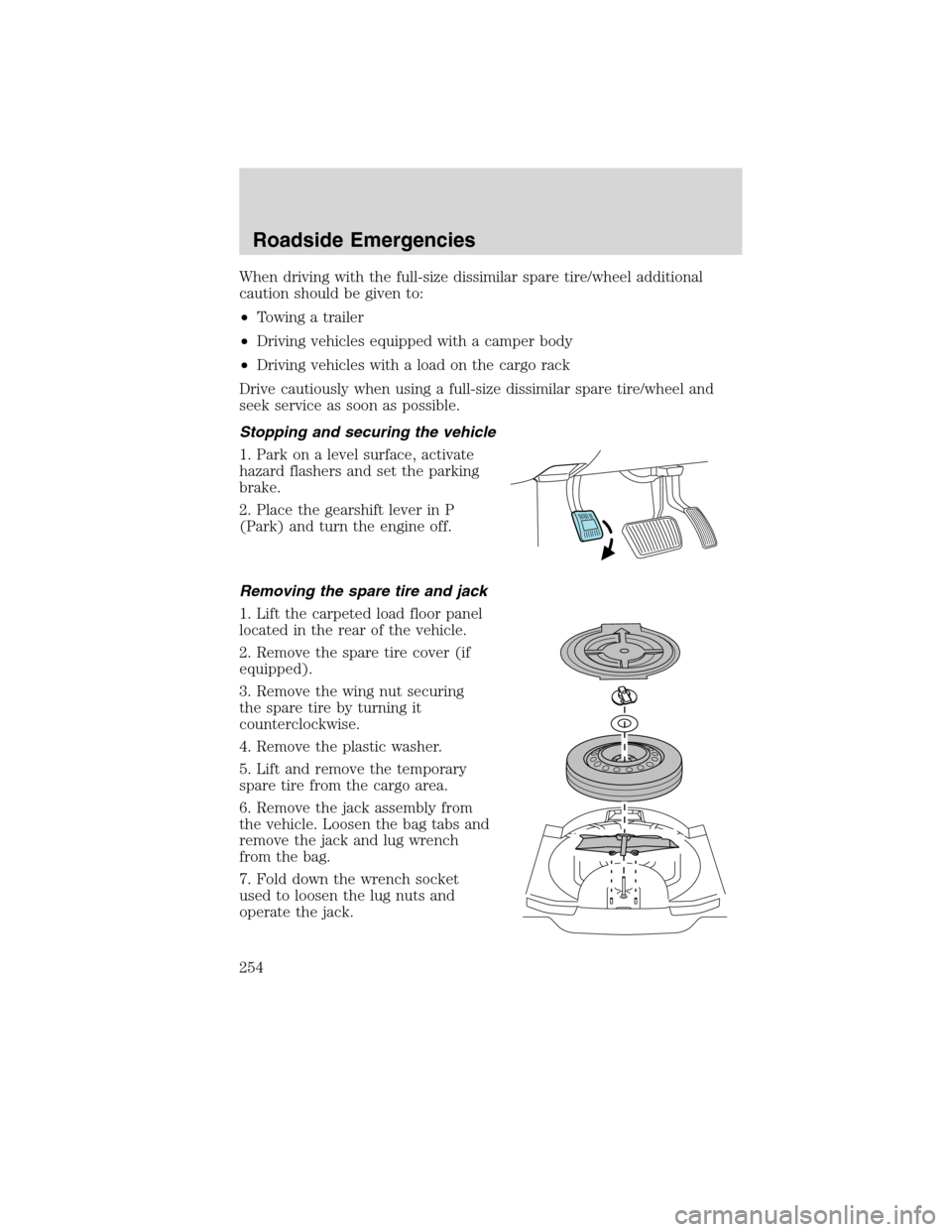
Stopping and securing the vehicle
1. Park on a level surface, activate
hazard flashers and set the parking
brake.
2. Place the gearshift lever in P
(Park) and turn the engine off.
Removing the spare tire and jack
1. Lift the carpeted load floor panel
located in the rear of the vehicle.
2. Remove the spare tire cover (if
equipped).
3. Remove the wing nut securing
the spare tire by turning it
counterclockwise.
4. Remove the plastic washer.
5. Lift and remove the temporary
spare tire from the cargo area.
6. Remove the jack assembly from
the vehicle. Loosen the bag tabs and
remove the jack and lug wrench
from the bag.
7. Fold down the wrench socket
used to loosen the lug nuts and
operate the jack.
Roadside Emergencies
254
2010 Edge(edg)
Owners Guide(own2002), 1st Printing
USA(fus)
Page 257 of 328
Stowing the flat/spare tire and jack
1. Fully collapse the jack, fold the wrench socket into the handle and
place them both into the bag making sure to secure the tabs.
2. Place the jack assembly in the spare tire well aligning it with the two
vertical studs.
3. Place the tire in the spare tire well over the jack assembly.
If you are stowing a flat 22 inch tire and wheel assembly,
temporarily remove the load floor, plastic stowage bins, and the foam
load floor supports to make space for the 22 inch tire and wheel
assembly. Place the 22 inch tire & wheel assembly in the spare tire well
with the valve stem facing down. Rotate the tire until the jack assembly
is able to protrude through a wheel opening. Replace the plastic stowage
bins and foam supports around the 22 inch tire and wheel assembly and
then replace the load floor.
If you are stowing a flat tire,place the tire in the spare tire well with
the valve stem facing down. Rotate the tire until the jack assembly is
able to protrude through a wheel opening.
If you are stowing the spare tire,place the spare in the spare tire
well in its original position.
4. Secure the wheel by replacing the washer and the wing nut and
turning the wing nut clockwise.
WHEEL LUG NUT TORQUE SPECIFICATIONS
Retighten the lug nuts to the specified torque within 100 miles (160 km)
after any wheel disturbance (rotation, flat tire, wheel removal, etc.).
Lug nut socket
size/Bolt sizeWheel lug nut torque*
lb.ft. N•m
Lug nut socket size:
34
inch (19 mm) hex
Bolt size:12x20100 135
* Torque specifications are for nut and bolt threads free of dirt and
rust. Use only Ford recommended replacement fasteners.
Roadside Emergencies
257
2010 Edge(edg)
Owners Guide(own2002), 1st Printing
USA(fus)
Page 258 of 328
WARNING:When a wheel is installed, always remove any
corrosion, dirt or foreign materials present on the mounting
surfaces of the wheel or the surface of the wheel hub, brake drum or
brake disc that contacts the wheel. Ensure that any fasteners that
attach the rotor to the hub are secured so they do not interfere with
the mounting surfaces of the wheel. Installing wheels without correct
metal-to-metal contact at the wheel mounting surfaces can cause the
wheel nuts to loosen and the wheel to come off while the vehicle is in
motion, resulting in loss of control.
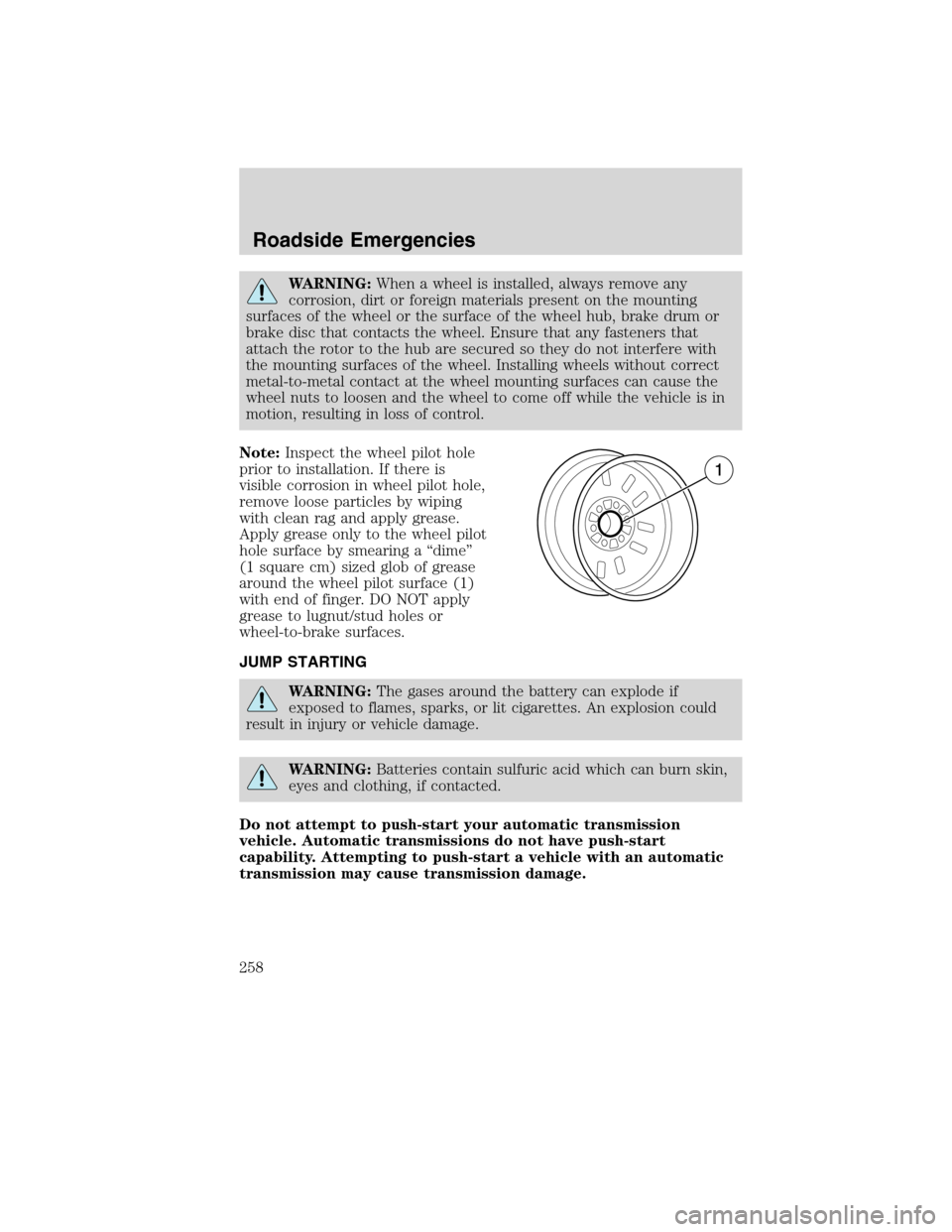
Note:Inspect the wheel pilot hole
prior to installation. If there is
visible corrosion in wheel pilot hole,
remove loose particles by wiping
with clean rag and apply grease.
Apply grease only to the wheel pilot
hole surface by smearing a “dime”
(1 square cm) sized glob of grease
around the wheel pilot surface (1)
with end of finger. DO NOT apply
grease to lugnut/stud holes or
wheel-to-brake surfaces.
JUMP STARTING
WARNING:The gases around the battery can explode if
exposed to flames, sparks, or lit cigarettes. An explosion could
result in injury or vehicle damage.
WARNING:Batteries contain sulfuric acid which can burn skin,
eyes and clothing, if contacted.
Do not attempt to push-start your automatic transmission
vehicle. Automatic transmissions do not have push-start
capability. Attempting to push-start a vehicle with an automatic
transmission may cause transmission damage.
Roadside Emergencies
258
2010 Edge(edg)
Owners Guide(own2002), 1st Printing
USA(fus)