weight FORD EDGE 2013 1.G Owner's Manual
[x] Cancel search | Manufacturer: FORD, Model Year: 2013, Model line: EDGE, Model: FORD EDGE 2013 1.GPages: 526, PDF Size: 5.98 MB
Page 244 of 526
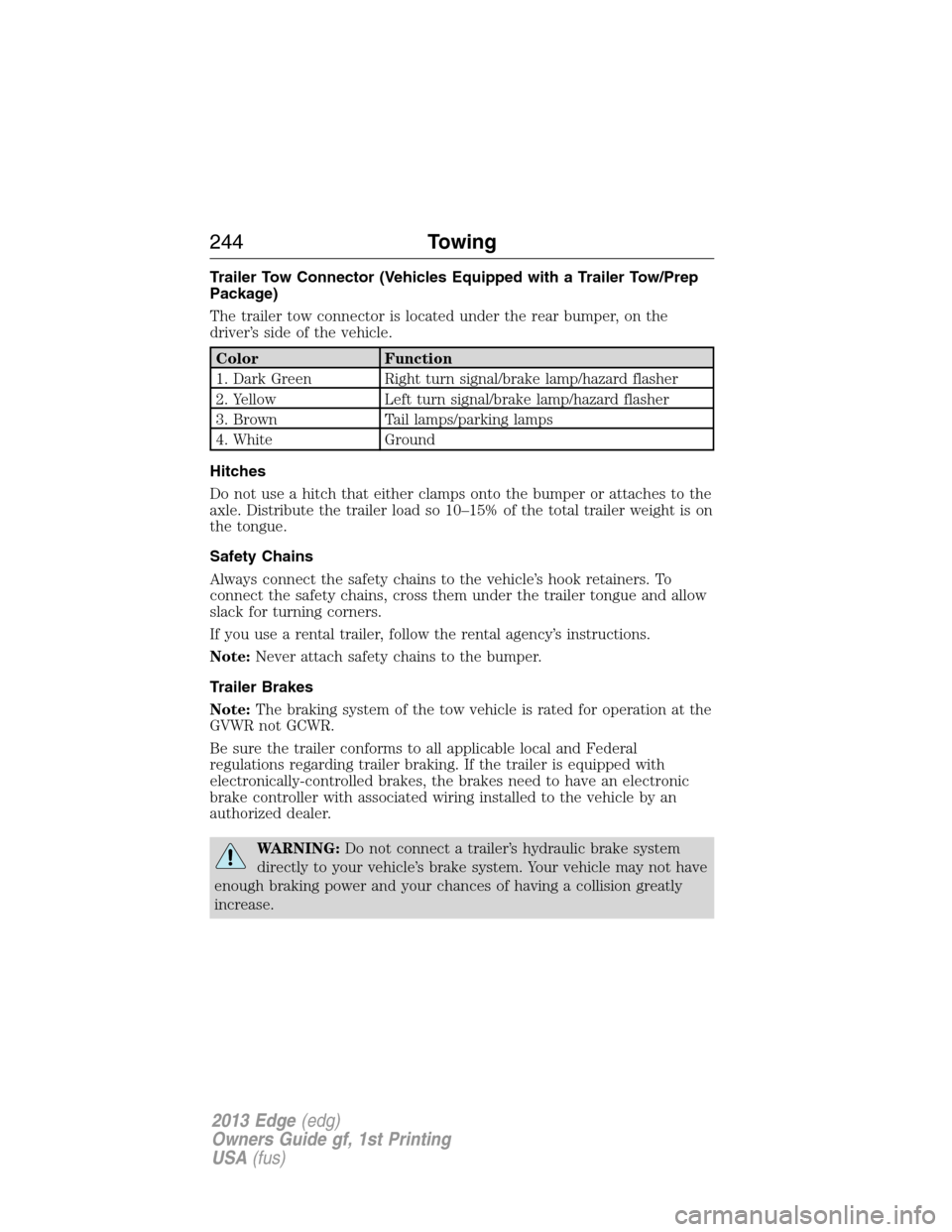
Trailer Tow Connector (Vehicles Equipped with a Trailer Tow/Prep
Package)
The trailer tow connector is located under the rear bumper, on the
driver’s side of the vehicle.
Color Function
1. Dark Green Right turn signal/brake lamp/hazard flasher
2. Yellow Left turn signal/brake lamp/hazard flasher
3. Brown Tail lamps/parking lamps
4. White Ground
Hitches
Do not use a hitch that either clamps onto the bumper or attaches to the
axle. Distribute the trailer load so 10–15% of the total trailer weight is on
the tongue.
Safety Chains
Always connect the safety chains to the vehicle’s hook retainers. To
connect the safety chains, cross them under the trailer tongue and allow
slack for turning corners.
If you use a rental trailer, follow the rental agency’s instructions.
Note:Never attach safety chains to the bumper.
Trailer Brakes
Note:The braking system of the tow vehicle is rated for operation at the
GVWR not GCWR.
Be sure the trailer conforms to all applicable local and Federal
regulations regarding trailer braking. If the trailer is equipped with
electronically-controlled brakes, the brakes need to have an electronic
brake controller with associated wiring installed to the vehicle by an
authorized dealer.
WARNING:Do not connect a trailer’s hydraulic brake system
directly to your vehicle’s brake system. Your vehicle may not have
enough braking power and your chances of having a collision greatly
increase.
244Towing
2013 Edge(edg)
Owners Guide gf, 1st Printing
USA(fus)
Page 250 of 526
![FORD EDGE 2013 1.G Owners Manual •Drive a heavily loaded vehicle or tow a trailer.
•Carry unnecessary weight (approximately 1 mpg [0.4 km/L] is lost for
every 400 lb [180 kg] of weight carried).
•Add particular accessories to y](/img/11/4843/w960_4843-249.png "FORD EDGE 2013 1.G Owners Manual •Drive a heavily loaded vehicle or tow a trailer.
•Carry unnecessary weight (approximately 1 mpg [0.4 km/L] is lost for
every 400 lb [180 kg] of weight carried).
•Add particular accessories to y")
•Drive a heavily loaded vehicle or tow a trailer.
•Carry unnecessary weight (approximately 1 mpg [0.4 km/L] is lost for
every 400 lb [180 kg] of weight carried).
•Add particular accessories to your vehicle (e.g. bug deflectors,
rollbars/light bars, running boards, ski racks).
•Drive with the wheels out of alignment.
DRIVING THROUGH WATER
WARNING:Drive through water in an emergency only, and not
as part of normal driving.
WARNING:Engine damage can occur if water enters the air
filter.
Note:Driving through deep water may allow water into the transmission
or air intake and can cause internal vehicle damage or cause it to stall.
Note:Once through the water, always dry the brakes by moving your
vehicle slowly while applying light pressure on the brake pedal.
If driving through deep or standing water is unavoidable, proceed very
slowly. Never drive through water that is higher than the bottom of the
wheel rims (for cars) or the bottom
of the hubs (for trucks).
When driving through water,
traction or brake capability may be
limited. Also, water may enter your
engine’s air intake and severely
damage your engine or your vehicle
may stall.
Wet brakes do not stop the vehicle
as quickly as dry brakes.
250Driving Hints
2013 Edge(edg)
Owners Guide gf, 1st Printing
USA(fus)
Page 314 of 526
Glossary of Tire Terminology
•Tire label:A label showing the OE (Original Equipment) tire sizes,
recommended inflation pressure and the maximum weight the vehicle
can carry.
•Tire Identification Number (TIN):A number on the sidewall of
each tire providing information about the tire brand and manufacturing
plant, tire size and date of manufacture. Also referred to as DOT code.
•Inflation pressure:A measure of the amount of air in a tire.
•Standard load:A class of P-metric or Metric tires designed to carry a
maximum load at 35 psi [37 psi (2.5 bar) for Metric tires]. Increasing
the inflation pressure beyond this pressure will not increase the tire’s
load carrying capability.
•Extra load:A class of P-metric or Metric tires designed to carry a
heavier maximum load at 41 psi [43 psi (2.9 bar) for Metric tires].
Increasing the inflation pressure beyond this pressure will not increase
the tire’s load carrying capability.
•kPa:Kilopascal, a metric unit of air pressure.
•PSI:Pounds per square inch, a standard unit of air pressure.
•Cold inflation pressure:The tire pressure when the vehicle has
been stationary and out of direct sunlight for an hour or more and
prior to the vehicle being driven for 1 mile (1.6 km).
•Recommended inflation pressure:The cold inflation pressure found
on the Safety Compliance Certification Label (affixed to either the
door hinge pillar, door-latch post, or the door edge that meets the
door-latch post, next to the driver ’s seating position), or Tire Label
located on the B-Pillar or the edge of the driver’s door.
•B-pillar:The structural member at the side of the vehicle behind the
front door.
•Bead area of the tire:Area of the tire next to the rim.
•Sidewall of the tire:Area between the bead area and the tread.
•Tread area of the tire:Area of the perimeter of the tire that
contacts the road when mounted on the vehicle.
•Rim:The metal support (wheel) for a tire or a tire and tube assembly
upon which the tire beads are seated.
314Wheels and Tires
2013 Edge(edg)
Owners Guide gf, 1st Printing
USA(fus)
Page 315 of 526
Information Contained on the Tire Sidewall
Both U.S. and Canada Federal regulations require tire manufacturers to
place standardized information on the sidewall of all tires. This
information identifies and describes the fundamental characteristics of
the tire and also provides a U.S. DOT Tire Identification Number for
safety standard certification and in case of a recall.
Information on “P” Type Tires
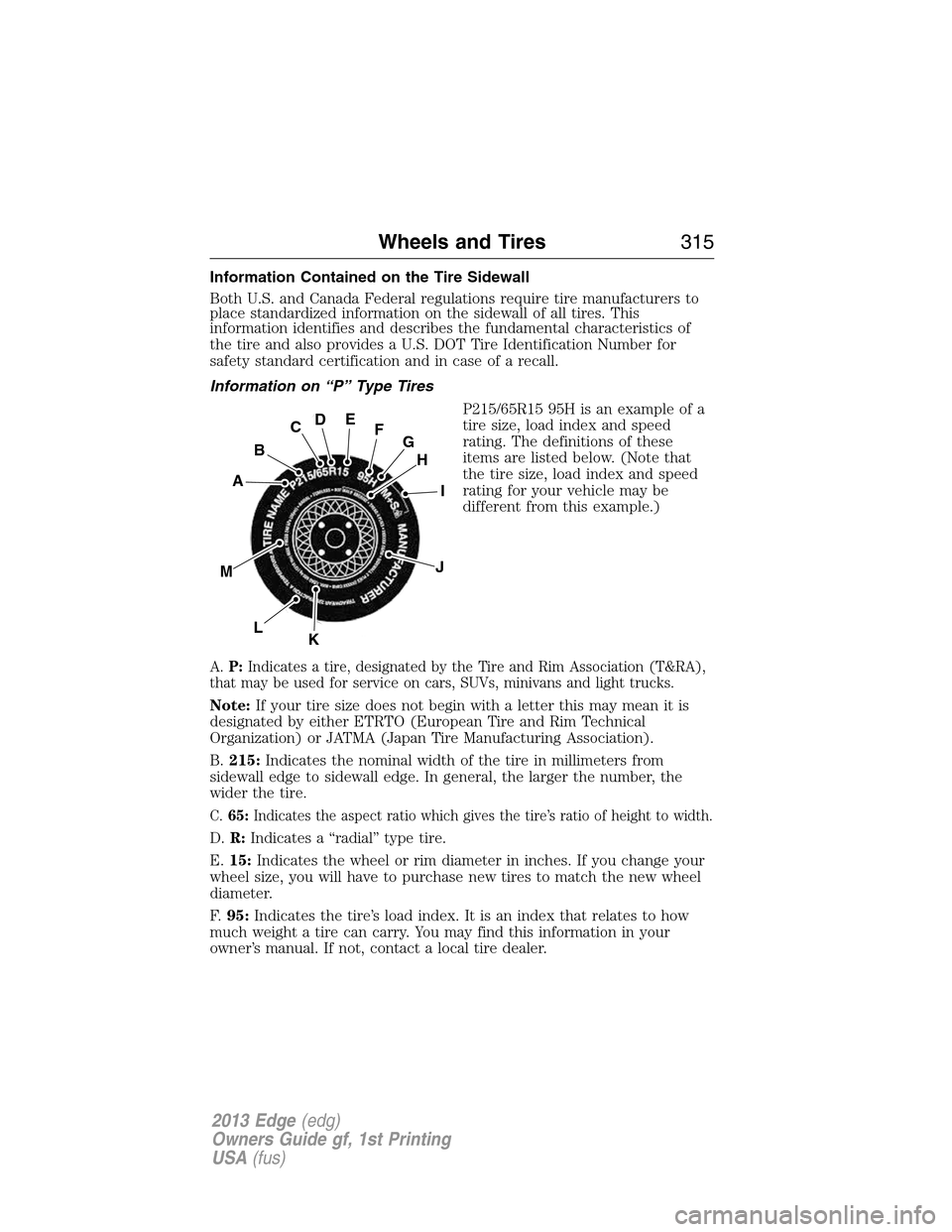
P215/65R15 95H is an example of a
tire size, load index and speed
rating. The definitions of these
items are listed below. (Note that
the tire size, load index and speed
rating for your vehicle may be
different from this example.)
A.P:Indicates a tire, designated by the Tire and Rim Association (T&RA),
that may be used for service on cars, SUVs, minivans and light trucks.
Note:If your tire size does not begin with a letter this may mean it is
designated by either ETRTO (European Tire and Rim Technical
Organization) or JATMA (Japan Tire Manufacturing Association).
B.215:Indicates the nominal width of the tire in millimeters from
sidewall edge to sidewall edge. In general, the larger the number, the
wider the tire.
C.65:Indicates the aspect ratio which gives the tire’s ratio of height to width.
D.R:Indicates a “radial” type tire.
E.15:Indicates the wheel or rim diameter in inches. If you change your
wheel size, you will have to purchase new tires to match the new wheel
diameter.
F.95:Indicates the tire’s load index. It is an index that relates to how
much weight a tire can carry. You may find this information in your
owner’s manual. If not, contact a local tire dealer.
H
I
J
KL
M
A
B
CDEFG
Wheels and Tires315
2013 Edge(edg)
Owners Guide gf, 1st Printing
USA(fus)
Page 345 of 526
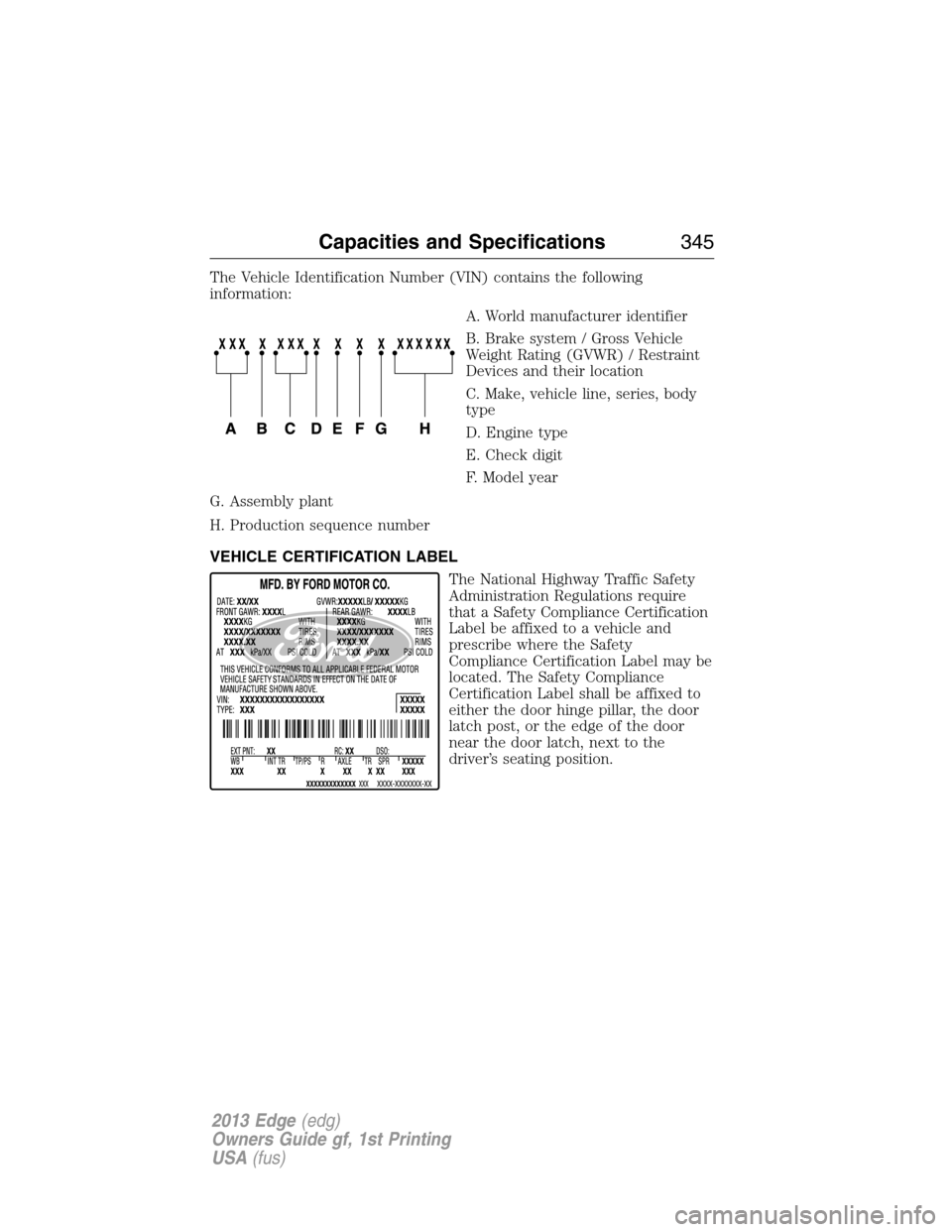
The Vehicle Identification Number (VIN) contains the following
information:
A. World manufacturer identifier
B. Brake system / Gross Vehicle
Weight Rating (GVWR) / Restraint
Devices and their location
C. Make, vehicle line, series, body
type
D. Engine type
E. Check digit
F. Model year
G. Assembly plant
H. Production sequence number
VEHICLE CERTIFICATION LABEL
The National Highway Traffic Safety
Administration Regulations require
that a Safety Compliance Certification
Label be affixed to a vehicle and
prescribe where the Safety
Compliance Certification Label may be
located. The Safety Compliance
Certification Label shall be affixed to
either the door hinge pillar, the door
latch post, or the edge of the door
near the door latch, next to the
driver’s seating position.
Capacities and Specifications345
2013 Edge(edg)
Owners Guide gf, 1st Printing
USA(fus)
Page 348 of 526
Lifestyle
•Ash cup / coin holder
•Cross bars and roof rails
•Trailer hitches, wiring harnesses and accessories
•Cargo organization and management
•Roof rack and carriers*
•SUV camping tent*
•Cargo net*
Peace of mind
•Remote start
•Keyless entry keypad
•Cargo security shade
•Vehicle security
•Bumper protector
•Wheel locks
•Locking fuel plug
•Cargo area protector
•Bumper and hitch mounted parking sensors*
*Ford Licensed Accessories (FLA) are warranted by the accessory
manufacturer’s warranty. Ford Licensed Accessories are fully designed
and developed by the accessory manufacturer and have not been
designed or tested to Ford Motor Company engineering requirements.
Contact your Ford dealer for details regarding the manufacturer’s limited
warranty and/or a copy of the FLA product limited warranty offered by
the accessory manufacturer.
For maximum vehicle performance, keep the following information in
mind when adding accessories or equipment to your vehicle:
•When adding accessories, equipment, passengers and luggage to your
vehicle, do not exceed the total weight capacity of the vehicle or of
the front or rear axle (GVWR or GAWR as indicated on the Safety
Compliance Certification label). Consult your authorized dealer for
specific weight information.
348Accessories
2013 Edge(edg)
Owners Guide gf, 1st Printing
USA(fus)