washer fluid FORD EDGE 2017 2.G Owners Manual
[x] Cancel search | Manufacturer: FORD, Model Year: 2017, Model line: EDGE, Model: FORD EDGE 2017 2.GPages: 544, PDF Size: 25.27 MB
Page 7 of 544
Trailer Sway Control.....................................231
Recommended Towing Weights.............231
Essential Towing Checks..........................233
Towing the Vehicle on Four Wheels -
6-Speed Automatic Transmission -
6F35..............................................................235
Towing the Vehicle on Four Wheels - 6-Speed Automatic Transmission -
6F50/6F55................................................235
Driving Hints
Breaking-In.....................................................238
Economical Driving.....................................238
Cold Weather Precautions.......................238
Driving Through Water...............................238
Floor Mats.......................................................239
Roadside Emergencies
Roadside Assistance...................................241
Hazard Warning Flashers..........................242
Fuel Shutoff
...................................................242
Jump Starting the Vehicle........................243
Post-Crash Alert System..........................245
Transporting the Vehicle
...........................245
Customer Assistance
Getting the Services You Need...............247
In California (U.S. Only)............................248
The Better Business Bureau (BBB) Auto Line Program (U.S. Only).....................249
Utilizing the Mediation/Arbitration Program (Canada Only).......................250
Getting Assistance Outside the U.S. and Canada........................................................250
Ordering Additional Owner's Literature......................................................251
Reporting Safety Defects (U.S. Only).............................................................252
Reporting Safety Defects (Canada Only).............................................................252 Fuses
Fuse Specification Chart
..........................254
Changing a Fuse..........................................264
Maintenance
General Information...................................266
Opening and Closing the Hood..............266
Under Hood Overview - 2.0L EcoBoost™...............................................268
Under Hood Overview - 2.7L EcoBoost™...............................................269
Under Hood Overview - 3.5L...................270
Engine Oil Dipstick - 2.0L EcoBoost™.................................................271
Engine Oil Dipstick - 2.7L EcoBoost™.................................................271
Engine Oil Dipstick - 3.5L...........................271
Engine Oil Check............................................271
Oil Change Indicator Reset.......................273
Engine Coolant Check
................................273
Automatic Transmission Fluid Check - 2.0L EcoBoost™.......................................277
Automatic Transmission Fluid Check - 2.7L EcoBoost™/3.5L
.............................277
Brake Fluid Check........................................279
Power Steering Fluid Check....................280
Washer Fluid Check....................................280
Fuel Filter
........................................................280
Changing the 12V Battery.........................280
Checking the Wiper Blades......................282
Changing the Wiper Blades.....................282
Adjusting the Headlamps.........................283
Removing a Headlamp.............................285
Changing a Bulb...........................................285
Bulb Specification Chart...........................287
Changing the Engine Air Filter................289
Vehicle Care
General Information
...................................290
Cleaning Products
......................................290
4
Edge (CDQ) Canada/United States of America, enUSA, Edition date: 201608, First Printing Table of Contents
Page 86 of 544
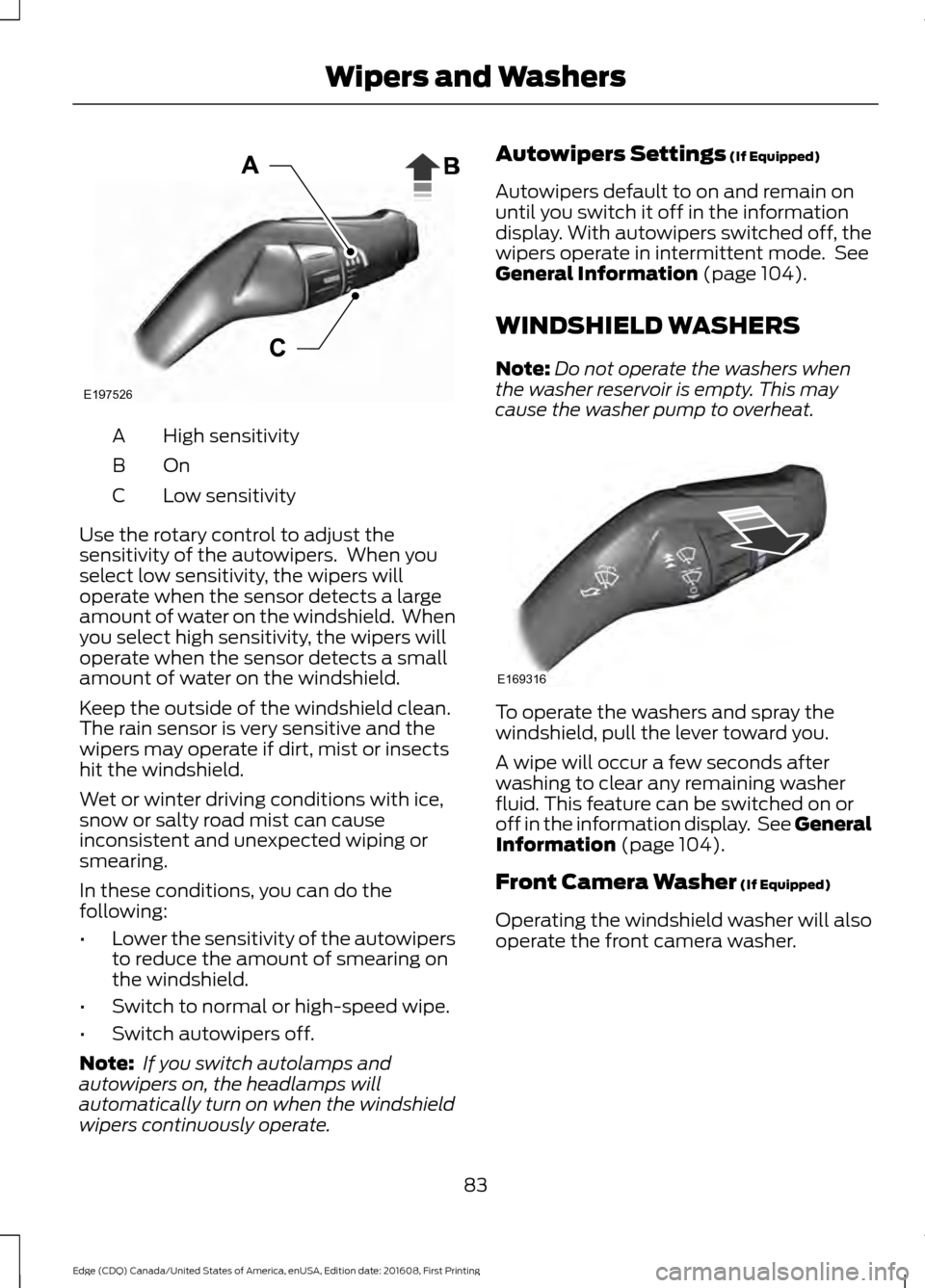
High sensitivity
A
OnB
Low sensitivity
C
Use the rotary control to adjust the
sensitivity of the autowipers. When you
select low sensitivity, the wipers will
operate when the sensor detects a large
amount of water on the windshield. When
you select high sensitivity, the wipers will
operate when the sensor detects a small
amount of water on the windshield.
Keep the outside of the windshield clean.
The rain sensor is very sensitive and the
wipers may operate if dirt, mist or insects
hit the windshield.
Wet or winter driving conditions with ice,
snow or salty road mist can cause
inconsistent and unexpected wiping or
smearing.
In these conditions, you can do the
following:
• Lower the sensitivity of the autowipers
to reduce the amount of smearing on
the windshield.
• Switch to normal or high-speed wipe.
• Switch autowipers off.
Note: If you switch autolamps and
autowipers on, the headlamps will
automatically turn on when the windshield
wipers continuously operate. Autowipers Settings (If Equipped)
Autowipers default to on and remain on
until you switch it off in the information
display. With autowipers switched off, the
wipers operate in intermittent mode. See
General Information
(page 104).
WINDSHIELD WASHERS
Note: Do not operate the washers when
the washer reservoir is empty. This may
cause the washer pump to overheat. To operate the washers and spray the
windshield, pull the lever toward you.
A wipe will occur a few seconds after
washing to clear any remaining washer
fluid. This feature can be switched on or
off in the information display. See General
Information
(page 104).
Front Camera Washer
(If Equipped)
Operating the windshield washer will also
operate the front camera washer.
83
Edge (CDQ) Canada/United States of America, enUSA, Edition date: 201608, First Printing Wipers and WashersE197526 E169316
Page 89 of 544
Headlamp Flasher
Pull the lever toward you slightly and
release it to flash the headlamps.
AUTOLAMPS (If Equipped)
WARNING
The autolamps switch position may
not activate the headlamps in all low
visibility conditions, such as daytime
fog. Always ensure that your headlamps
are switched to auto or on, as appropriate,
during all low visibility conditions. Failure
to do so may result in a collision. When the lighting control is in the
autolamps position, the headlamps
automatically turn on in low light situations
or when the wipers activate. If equipped, the following also activate
when the lighting control is in the
autolamps position and you switch them
on in the information display:
•
Configurable daytime running lamps.
• Automatic high beam control.
• Adaptive headlamp control.
The headlamps remain on for a period of
time after you switch the ignition off. Use
the information display controls to adjust
the period of time that the headlamps
remain on. See
Information Displays
(page 104).
Note: With the headlamps in the
autolamps position, you cannot switch the
high beam headlamps on until the
autolamps system turns the low beam
headlamps on.
Windshield Wiper Activated
Headlamps
The windshield wiper activated headlamps
turn on within 10 seconds when you switch
the windshield wipers on and the lighting
control is in the autolamps position. They
turn off approximately 60 seconds after
you switch the windshield wipers off.
The headlamps will not turn on by wiper
activation:
• During a mist wipe.
• When the wipers are on to clear washer
fluid during a wash condition.
• If the wipers are in intermittent mode.
Note: If you switch autolamps and
autowipers on, the headlamps will
automatically turn on when the windshield
wipers continuously operate.
86
Edge (CDQ) Canada/United States of America, enUSA, Edition date: 201608, First Printing LightingE162680 E142451
Page 105 of 544
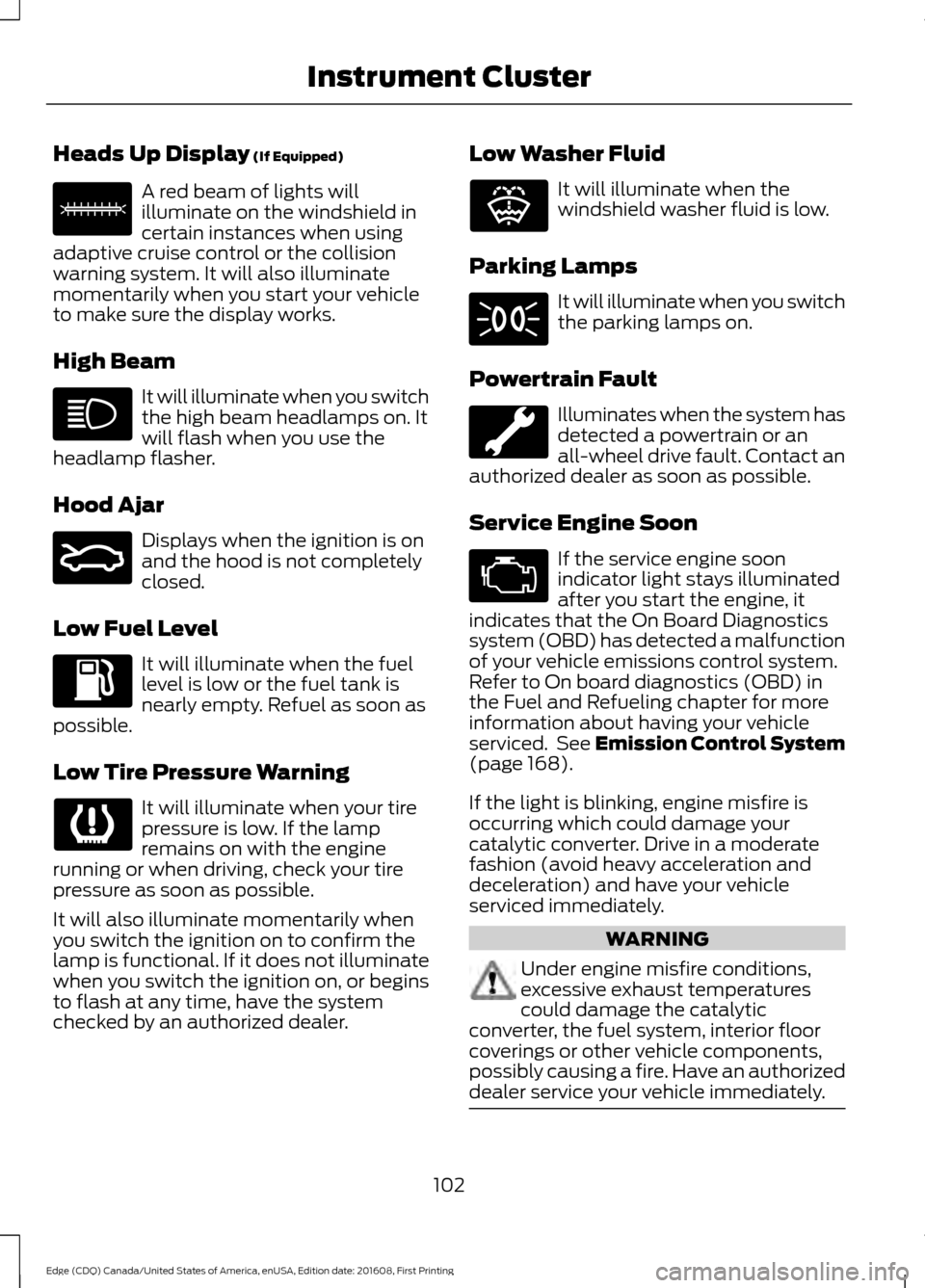
Heads Up Display (If Equipped)
A red beam of lights will
illuminate on the windshield in
certain instances when using
adaptive cruise control or the collision
warning system. It will also illuminate
momentarily when you start your vehicle
to make sure the display works.
High Beam It will illuminate when you switch
the high beam headlamps on. It
will flash when you use the
headlamp flasher.
Hood Ajar Displays when the ignition is on
and the hood is not completely
closed.
Low Fuel Level It will illuminate when the fuel
level is low or the fuel tank is
nearly empty. Refuel as soon as
possible.
Low Tire Pressure Warning It will illuminate when your tire
pressure is low. If the lamp
remains on with the engine
running or when driving, check your tire
pressure as soon as possible.
It will also illuminate momentarily when
you switch the ignition on to confirm the
lamp is functional. If it does not illuminate
when you switch the ignition on, or begins
to flash at any time, have the system
checked by an authorized dealer. Low Washer Fluid It will illuminate when the
windshield washer fluid is low.
Parking Lamps It will illuminate when you switch
the parking lamps on.
Powertrain Fault Illuminates when the system has
detected a powertrain or an
all-wheel drive fault. Contact an
authorized dealer as soon as possible.
Service Engine Soon If the service engine soon
indicator light stays illuminated
after you start the engine, it
indicates that the On Board Diagnostics
system (OBD) has detected a malfunction
of your vehicle emissions control system.
Refer to On board diagnostics (OBD) in
the Fuel and Refueling chapter for more
information about having your vehicle
serviced. See Emission Control System
(page
168).
If the light is blinking, engine misfire is
occurring which could damage your
catalytic converter. Drive in a moderate
fashion (avoid heavy acceleration and
deceleration) and have your vehicle
serviced immediately. WARNING
Under engine misfire conditions,
excessive exhaust temperatures
could damage the catalytic
converter, the fuel system, interior floor
coverings or other vehicle components,
possibly causing a fire. Have an authorized
dealer service your vehicle immediately. 102
Edge (CDQ) Canada/United States of America, enUSA, Edition date: 201608, First Printing Instrument ClusterE156133 E159324 E132353
Page 271 of 544
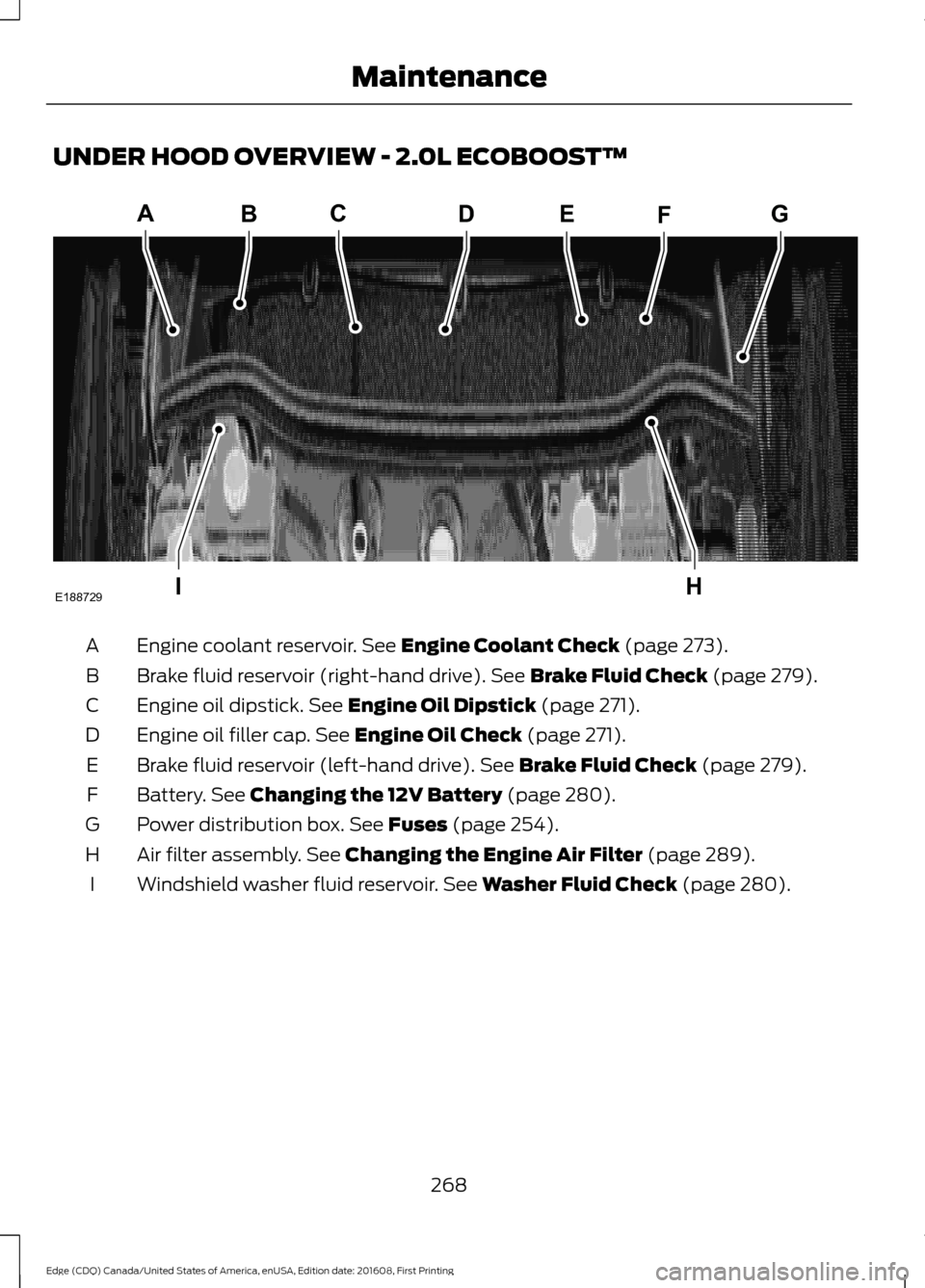
UNDER HOOD OVERVIEW - 2.0L ECOBOOST™
Engine coolant reservoir. See Engine Coolant Check (page 273).
A
Brake fluid reservoir (right-hand drive).
See Brake Fluid Check (page 279).
B
Engine oil dipstick.
See Engine Oil Dipstick (page 271).
C
Engine oil filler cap.
See Engine Oil Check (page 271).
D
Brake fluid reservoir (left-hand drive).
See Brake Fluid Check (page 279).
E
Battery.
See Changing the 12V Battery (page 280).
F
Power distribution box.
See Fuses (page 254).
G
Air filter assembly.
See Changing the Engine Air Filter (page 289).
H
Windshield washer fluid reservoir.
See Washer Fluid Check (page 280).
I
268
Edge (CDQ) Canada/United States of America, enUSA, Edition date: 201608, First Printing MaintenanceA
IH
EBCDFG
E188729
Page 272 of 544
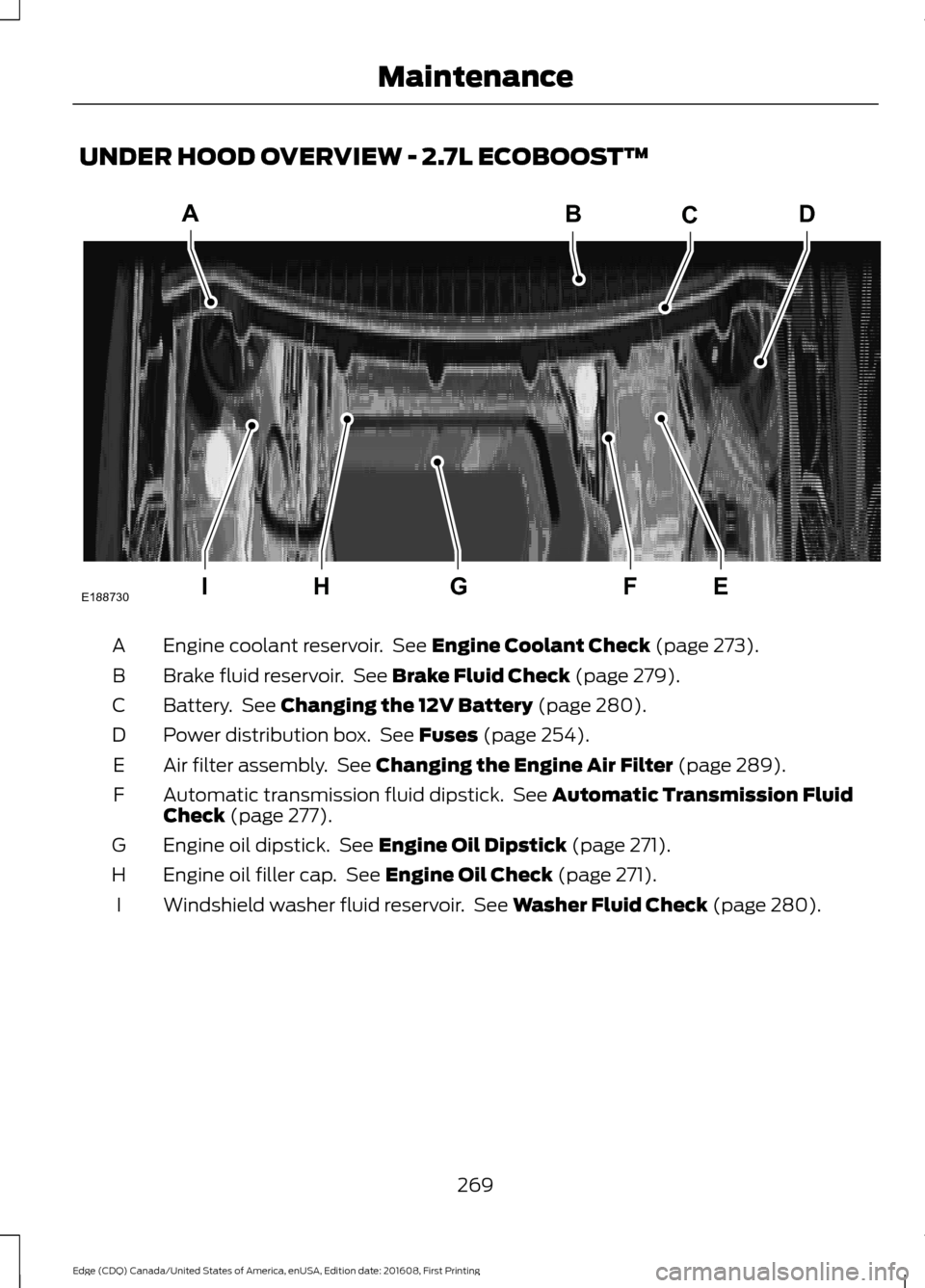
UNDER HOOD OVERVIEW - 2.7L ECOBOOST™
Engine coolant reservoir. See Engine Coolant Check (page 273).
A
Brake fluid reservoir. See
Brake Fluid Check (page 279).
B
Battery. See
Changing the 12V Battery (page 280).
C
Power distribution box. See
Fuses (page 254).
D
Air filter assembly. See
Changing the Engine Air Filter (page 289).
E
Automatic transmission fluid dipstick. See
Automatic Transmission Fluid
Check (page 277).
F
Engine oil dipstick. See
Engine Oil Dipstick (page 271).
G
Engine oil filler cap. See
Engine Oil Check (page 271).
H
Windshield washer fluid reservoir. See
Washer Fluid Check (page 280).
I
269
Edge (CDQ) Canada/United States of America, enUSA, Edition date: 201608, First Printing MaintenanceA
IEFGH
BCD
E188730
Page 273 of 544
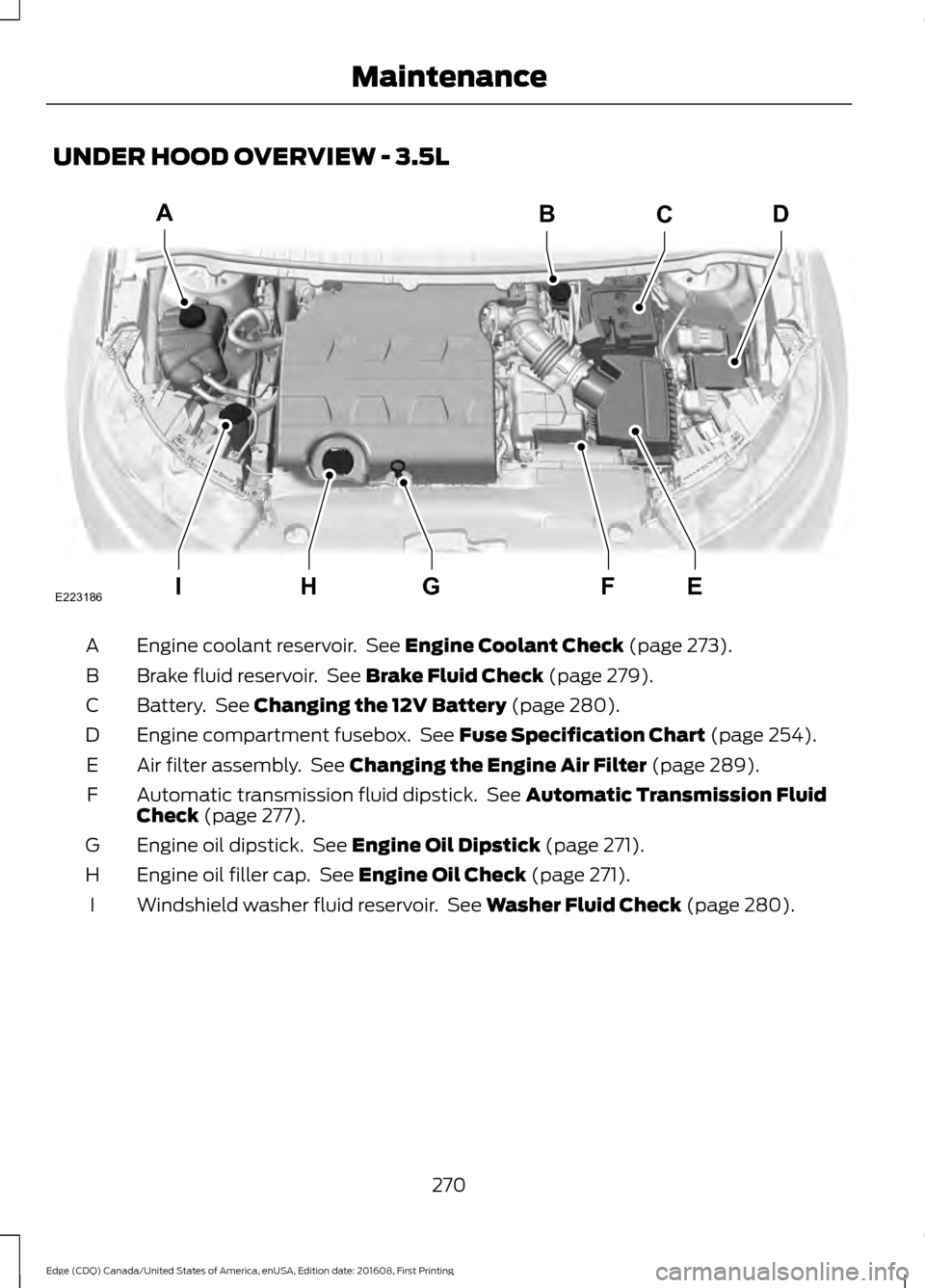
UNDER HOOD OVERVIEW - 3.5L
Engine coolant reservoir. See Engine Coolant Check (page 273).
A
Brake fluid reservoir. See
Brake Fluid Check (page 279).
B
Battery. See
Changing the 12V Battery (page 280).
C
Engine compartment fusebox. See
Fuse Specification Chart (page 254).
D
Air filter assembly. See
Changing the Engine Air Filter (page 289).
E
Automatic transmission fluid dipstick. See
Automatic Transmission Fluid
Check (page 277).
F
Engine oil dipstick. See
Engine Oil Dipstick (page 271).
G
Engine oil filler cap. See
Engine Oil Check (page 271).
H
Windshield washer fluid reservoir. See
Washer Fluid Check (page 280).
I
270
Edge (CDQ) Canada/United States of America, enUSA, Edition date: 201608, First Printing MaintenanceIEFGH
ABCD
E223186
Page 276 of 544
Note:
Make sure you install the oil filler cap
correctly.
Note: Soak up any spillage with an
absorbent cloth immediately.
OIL CHANGE INDICATOR
RESET
Use the information display controls on
the steering wheel to reset the oil change
indicator.
From the main menu scroll to: Action and description
Message
Press the right arrow button,
then from this menu scroll
to the following message.
Settings
Press the right arrow button,
then from this menu scroll
to the following message.
Vehicle
Press the right arrow button,
then from this menu scroll
to the following message.
Oil Life
Press and hold the OK
button until the instrument
cluster displays the
following message.
Hold OK to
Reset
Reset Successful
When the oil change indic-
ator resets the instrument
cluster displays 100%.
Remaining Life
{00}% Action and description
Message
If the instrument cluster
displays one of the following
messages, repeat the
process.
Not Reset
Reset Cancelled
ENGINE COOLANT CHECK WARNINGS
Do not add engine coolant when the
engine is hot. Steam and scalding
liquids released from a hot cooling
system can burn you badly. Also, spilling
coolant on hot engine parts can burn you. Do not put engine coolant in the
windshield washer fluid container. If
sprayed on the windshield, engine
coolant could make it difficult to see
through the windshield. To reduce the risk of personal injury,
make sure the engine is cool before
unscrewing the coolant pressure
relief cap. The cooling system is under
pressure. Steam and hot liquid can come
out forcefully when you loosen the cap
slightly. Do not add coolant further than the
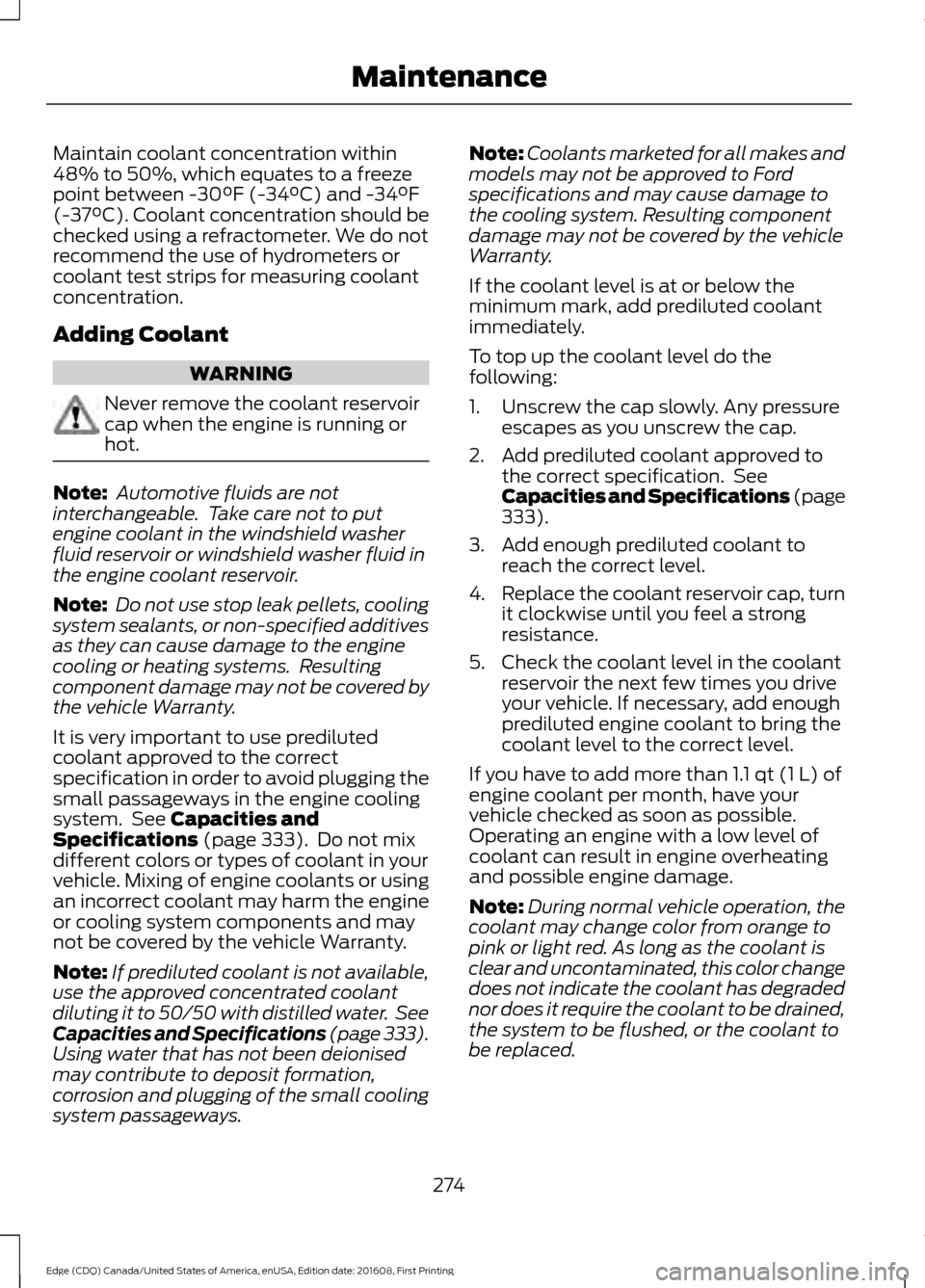
MAX
mark.
When the engine is cold, check the
concentration and level of the coolant at
the intervals listed in the scheduled
maintenance information. See Scheduled
Maintenance
(page 486).
Note: Make sure that the coolant level is
between the
MIN and MAX marks on the
coolant reservoir.
Note: Coolant expands when it is hot. The
level may extend beyond the
MAX mark.
273
Edge (CDQ) Canada/United States of America, enUSA, Edition date: 201608, First Printing Maintenance
Page 277 of 544
Maintain coolant concentration within
48% to 50%, which equates to a freeze
point between -30°F (-34°C) and -34°F
(-37°C). Coolant concentration should be
checked using a refractometer. We do not
recommend the use of hydrometers or
coolant test strips for measuring coolant
concentration.
Adding Coolant
WARNING
Never remove the coolant reservoir
cap when the engine is running or
hot.
Note:
Automotive fluids are not
interchangeable. Take care not to put
engine coolant in the windshield washer
fluid reservoir or windshield washer fluid in
the engine coolant reservoir.
Note: Do not use stop leak pellets, cooling
system sealants, or non-specified additives
as they can cause damage to the engine
cooling or heating systems. Resulting
component damage may not be covered by
the vehicle Warranty.
It is very important to use prediluted
coolant approved to the correct
specification in order to avoid plugging the
small passageways in the engine cooling
system. See Capacities and
Specifications (page 333). Do not mix
different colors or types of coolant in your
vehicle. Mixing of engine coolants or using
an incorrect coolant may harm the engine
or cooling system components and may
not be covered by the vehicle Warranty.
Note: If prediluted coolant is not available,
use the approved concentrated coolant
diluting it to 50/50 with distilled water. See
Capacities and Specifications
(page 333).
Using water that has not been deionised
may contribute to deposit formation,
corrosion and plugging of the small cooling
system passageways. Note:
Coolants marketed for all makes and
models may not be approved to Ford
specifications and may cause damage to
the cooling system. Resulting component
damage may not be covered by the vehicle
Warranty.
If the coolant level is at or below the
minimum mark, add prediluted coolant
immediately.
To top up the coolant level do the
following:
1. Unscrew the cap slowly. Any pressure escapes as you unscrew the cap.
2. Add prediluted coolant approved to the correct specification. See
Capacities and Specifications (page
333
).
3. Add enough prediluted coolant to reach the correct level.
4. Replace the coolant reservoir cap, turn
it clockwise until you feel a strong
resistance.
5. Check the coolant level in the coolant reservoir the next few times you drive
your vehicle. If necessary, add enough
prediluted engine coolant to bring the
coolant level to the correct level.
If you have to add more than
1.1 qt (1 L) of
engine coolant per month, have your
vehicle checked as soon as possible.
Operating an engine with a low level of
coolant can result in engine overheating
and possible engine damage.
Note: During normal vehicle operation, the
coolant may change color from orange to
pink or light red. As long as the coolant is
clear and uncontaminated, this color change
does not indicate the coolant has degraded
nor does it require the coolant to be drained,
the system to be flushed, or the coolant to
be replaced.
274
Edge (CDQ) Canada/United States of America, enUSA, Edition date: 201608, First Printing Maintenance
Page 283 of 544
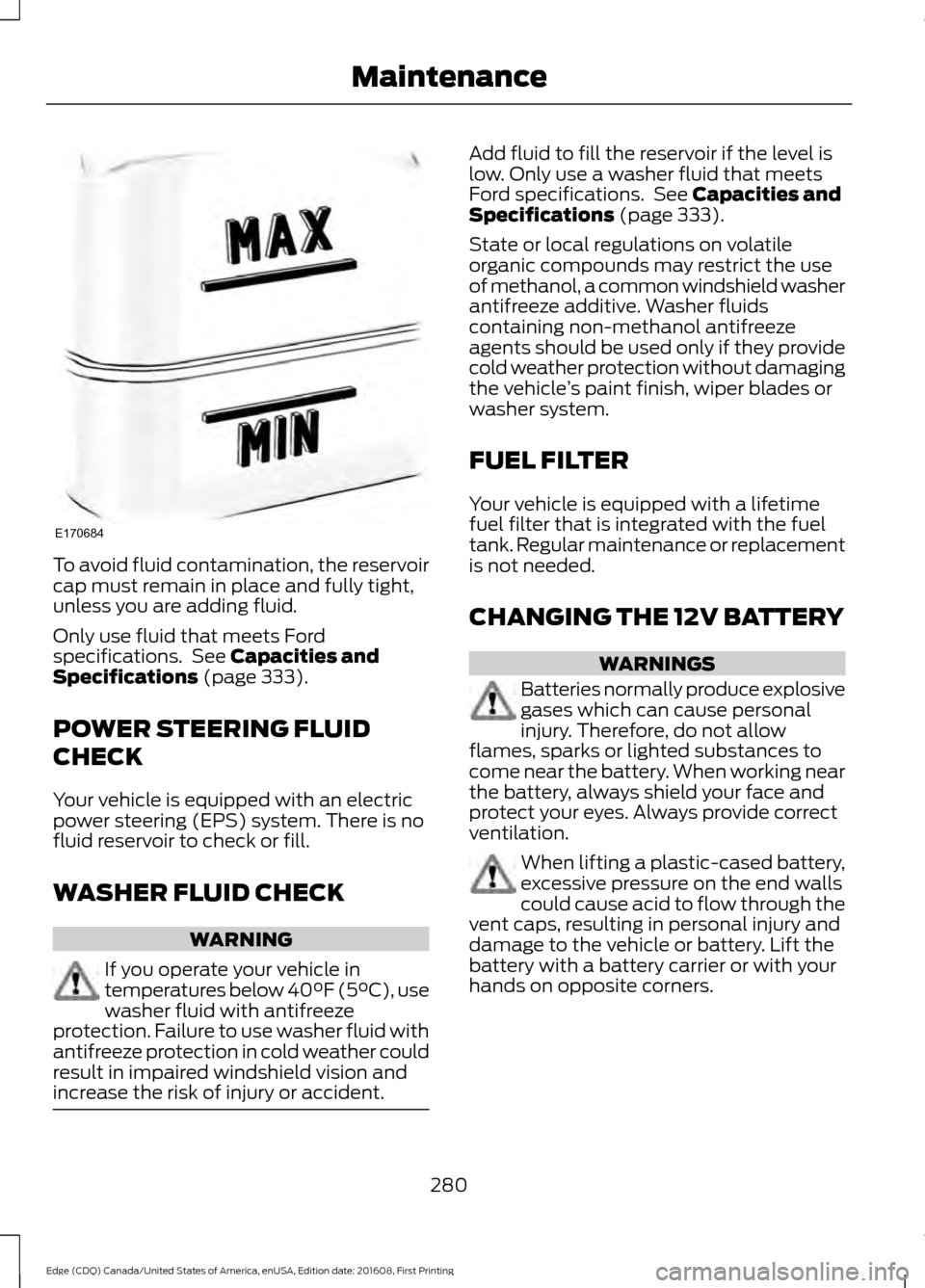
To avoid fluid contamination, the reservoir
cap must remain in place and fully tight,
unless you are adding fluid.
Only use fluid that meets Ford
specifications. See Capacities and
Specifications (page 333).
POWER STEERING FLUID
CHECK
Your vehicle is equipped with an electric
power steering (EPS) system. There is no
fluid reservoir to check or fill.
WASHER FLUID CHECK WARNING
If you operate your vehicle in
temperatures below 40°F (5°C), use
washer fluid with antifreeze
protection. Failure to use washer fluid with
antifreeze protection in cold weather could
result in impaired windshield vision and
increase the risk of injury or accident. Add fluid to fill the reservoir if the level is
low. Only use a washer fluid that meets
Ford specifications. See
Capacities and
Specifications (page 333).
State or local regulations on volatile
organic compounds may restrict the use
of methanol, a common windshield washer
antifreeze additive. Washer fluids
containing non-methanol antifreeze
agents should be used only if they provide
cold weather protection without damaging
the vehicle ’s paint finish, wiper blades or
washer system.
FUEL FILTER
Your vehicle is equipped with a lifetime
fuel filter that is integrated with the fuel
tank. Regular maintenance or replacement
is not needed.
CHANGING THE 12V BATTERY WARNINGS
Batteries normally produce explosive
gases which can cause personal
injury. Therefore, do not allow
flames, sparks or lighted substances to
come near the battery. When working near
the battery, always shield your face and
protect your eyes. Always provide correct
ventilation. When lifting a plastic-cased battery,
excessive pressure on the end walls
could cause acid to flow through the
vent caps, resulting in personal injury and
damage to the vehicle or battery. Lift the
battery with a battery carrier or with your
hands on opposite corners.
280
Edge (CDQ) Canada/United States of America, enUSA, Edition date: 201608, First Printing MaintenanceE170684