inflation pressure FORD EDGE 2018 Owner's Manual
[x] Cancel search | Manufacturer: FORD, Model Year: 2018, Model line: EDGE, Model: FORD EDGE 2018Pages: 557, PDF Size: 7.02 MB
Page 336 of 557
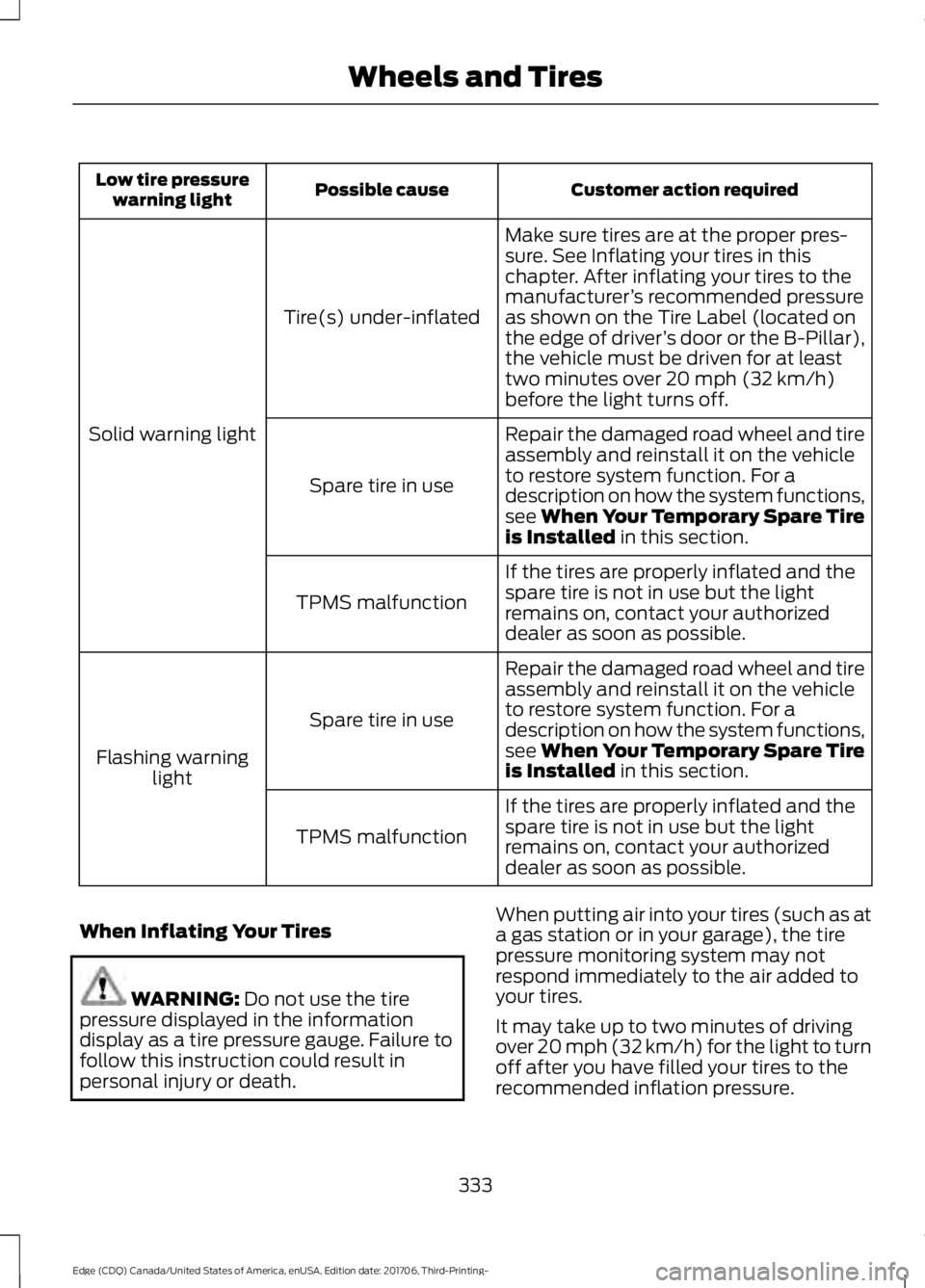
Customer action required
Possible cause
Low tire pressure
warning light
Make sure tires are at the proper pres-
sure. See Inflating your tires in this
chapter. After inflating your tires to the
manufacturer’s recommended pressure
as shown on the Tire Label (located on
the edge of driver ’s door or the B-Pillar),
the vehicle must be driven for at least
two minutes over 20 mph (32 km/h)
before the light turns off.
Tire(s) under-inflated
Solid warning light Repair the damaged road wheel and tire
assembly and reinstall it on the vehicle
to restore system function. For a
description on how the system functions,
see When Your Temporary Spare Tire
is Installed
in this section.
Spare tire in use
If the tires are properly inflated and the
spare tire is not in use but the light
remains on, contact your authorized
dealer as soon as possible.
TPMS malfunction
Repair the damaged road wheel and tire
assembly and reinstall it on the vehicle
to restore system function. For a
description on how the system functions,
see When Your Temporary Spare Tire
is Installed
in this section.
Spare tire in use
Flashing warning light
If the tires are properly inflated and the
spare tire is not in use but the light
remains on, contact your authorized
dealer as soon as possible.
TPMS malfunction
When Inflating Your Tires WARNING:
Do not use the tire
pressure displayed in the information
display as a tire pressure gauge. Failure to
follow this instruction could result in
personal injury or death. When putting air into your tires (such as at
a gas station or in your garage), the tire
pressure monitoring system may not
respond immediately to the air added to
your tires.
It may take up to two minutes of driving
over 20 mph (32 km/h) for the light to turn
off after you have filled your tires to the
recommended inflation pressure.
333
Edge (CDQ) Canada/United States of America, enUSA, Edition date: 201706, Third-Printing- Wheels and Tires
Page 337 of 557
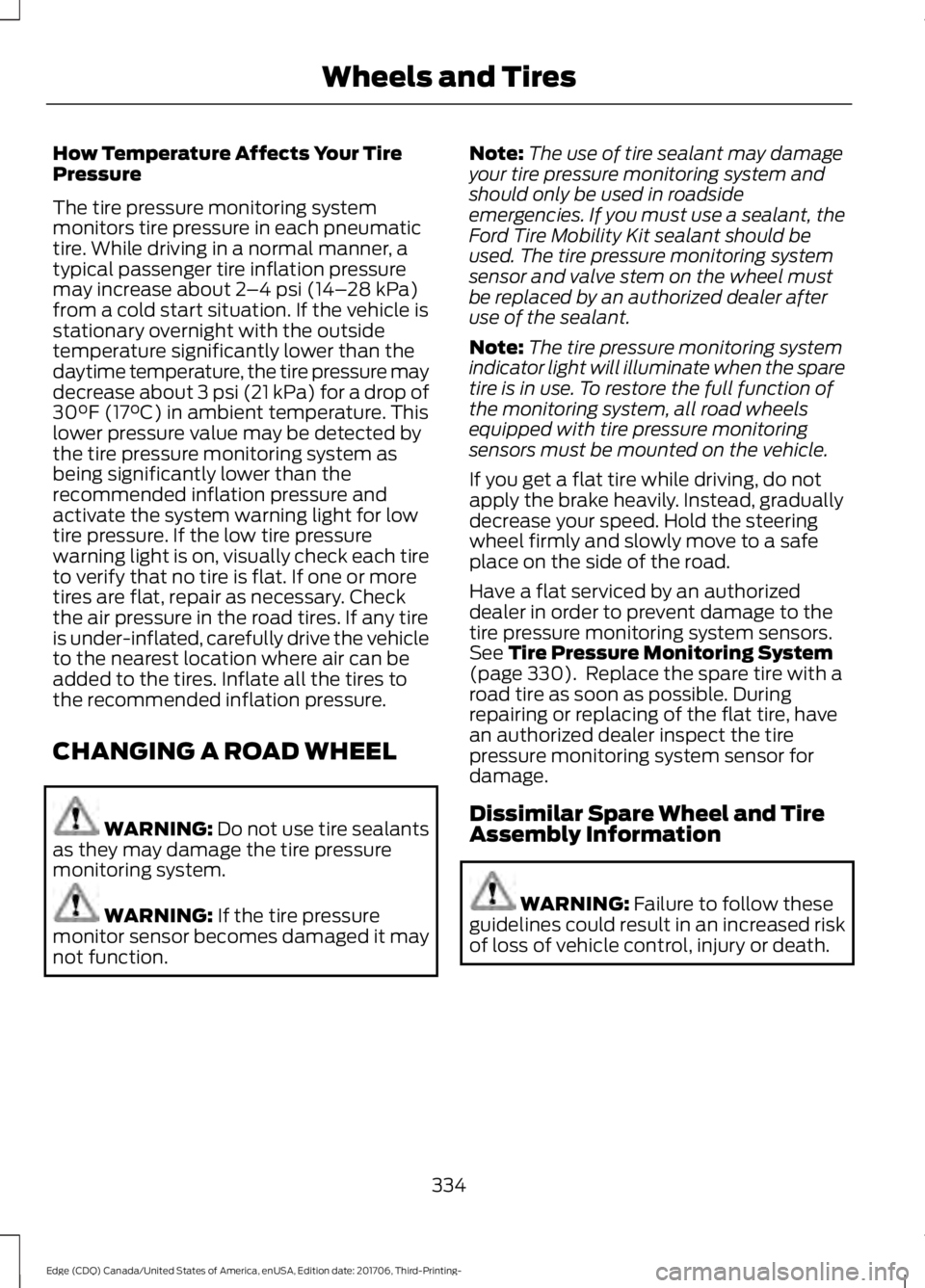
How Temperature Affects Your Tire
Pressure
The tire pressure monitoring system
monitors tire pressure in each pneumatic
tire. While driving in a normal manner, a
typical passenger tire inflation pressure
may increase about 2
–4 psi (14– 28 kPa)
from a cold start situation. If the vehicle is
stationary overnight with the outside
temperature significantly lower than the
daytime temperature, the tire pressure may
decrease about 3 psi (21 kPa) for a drop of
30°F (17°C) in ambient temperature. This
lower pressure value may be detected by
the tire pressure monitoring system as
being significantly lower than the
recommended inflation pressure and
activate the system warning light for low
tire pressure. If the low tire pressure
warning light is on, visually check each tire
to verify that no tire is flat. If one or more
tires are flat, repair as necessary. Check
the air pressure in the road tires. If any tire
is under-inflated, carefully drive the vehicle
to the nearest location where air can be
added to the tires. Inflate all the tires to
the recommended inflation pressure.
CHANGING A ROAD WHEEL WARNING:
Do not use tire sealants
as they may damage the tire pressure
monitoring system. WARNING:
If the tire pressure
monitor sensor becomes damaged it may
not function. Note:
The use of tire sealant may damage
your tire pressure monitoring system and
should only be used in roadside
emergencies. If you must use a sealant, the
Ford Tire Mobility Kit sealant should be
used. The tire pressure monitoring system
sensor and valve stem on the wheel must
be replaced by an authorized dealer after
use of the sealant.
Note: The tire pressure monitoring system
indicator light will illuminate when the spare
tire is in use. To restore the full function of
the monitoring system, all road wheels
equipped with tire pressure monitoring
sensors must be mounted on the vehicle.
If you get a flat tire while driving, do not
apply the brake heavily. Instead, gradually
decrease your speed. Hold the steering
wheel firmly and slowly move to a safe
place on the side of the road.
Have a flat serviced by an authorized
dealer in order to prevent damage to the
tire pressure monitoring system sensors.
See
Tire Pressure Monitoring System
(page 330). Replace the spare tire with a
road tire as soon as possible. During
repairing or replacing of the flat tire, have
an authorized dealer inspect the tire
pressure monitoring system sensor for
damage.
Dissimilar Spare Wheel and Tire
Assembly Information WARNING:
Failure to follow these
guidelines could result in an increased risk
of loss of vehicle control, injury or death.
334
Edge (CDQ) Canada/United States of America, enUSA, Edition date: 201706, Third-Printing- Wheels and Tires
Page 555 of 557
Important Information About Sport Tires
and Wheels...................................................... 313
Information About Uniform Tire Quality Grading.............................................................. 314
Information Contained on the Tire Sidewall............................................................. 317
Notice to Crossover Vehicle Owners...........314
Temperature A B C............................................. 316
Tire Rotation........................................................ 328
Traction AA A B C................................................ 315
Treadwear.............................................................. 315
Tire Inflation When Punctured See: Tire Sealant and Inflator Kit................306
Tire Pressure Monitoring System..........330 Changing Tires With a Tire Pressure
Monitoring System........................................ 331
Understanding Your Tire Pressure Monitoring System ...................................... 332
Tire Repair Kit See: Tire Sealant and Inflator Kit................306
Tire Sealant and Inflator Kit....................306 First Stage: Inflating the Tire with Sealing
Compound and Air...................................... 308
General Information......................................... 307
Second Stage: Checking Tire Pressure............................................................ 310
Tips for Use of the Kit....................................... 307
What to Do After the Tire has Been Sealed................................................................. 311
What to do When a Tire Is Punctured....................................................... 308
Tires See: Wheels and Tires..................................... 304
Towing a Trailer............................................238 Load Placement................................................. 238
Towing the Vehicle on Four Wheels - 6-Speed Automatic Transmission -
6F35..............................................................244
Emergency Towing............................................ 244
Recreational Towing......................................... 244
Towing the Vehicle on Four Wheels - 6-Speed Automatic Transmission -
6F50/6F55..................................................243
Emergency Towing............................................ 243
Recreational Towing......................................... 243
Towing.............................................................238
Traction Control.............................................191
Principle of Operation........................................ 191Trailer Sway Control...................................239
Transmission Code Designation
............346
Transmission...................................................177
Transporting the Vehicle...........................252
U
Under Hood Overview - 2.0L EcoBoost™..................................................273
Under Hood Overview - 2.7L EcoBoost™..................................................274
Under Hood Overview - 3.5L...................275
Unique Driving Characteristics
................164
Universal Garage Door Opener................151 HomeLink Wireless Control System.............151
USB Port
..........................................................374
Using Adaptive Cruise Control................210 Automatic Cancellation................................... 213
Blocked Sensor.................................................... 214
Canceling the Set Speed................................. 213
Changing the Set Speed.................................. 213
Detection Issues.................................................. 213
Following a Vehicle............................................. 211
Hilly Condition Usage........................................ 213
Overriding the Set Speed................................. 212
Resuming the Set Speed................................. 213
Setting the Adaptive Cruise Speed...............211
Setting the Gap Distance................................. 212
Switching Adaptive Cruise Control Off........................................................................\
213
Switching Adaptive Cruise Control On........................................................................\
210
Switching to Normal Cruise Control............215
System Not Available........................................ 214
Using All-Wheel Drive..................................181 Driving In Special Conditions With
All-Wheel Drive (AWD)................................ 181
Using Cruise Control
..................................209
Switching Cruise Control Off........................209
Switching Cruise Control On......................... 209
Using MyKey With Remote Start Systems...........................................................61
Using Snow Chains.....................................329
Using Stability Control...............................193
Using Summer Tires...................................329
Using SYNC™ With Your Media Player............................................................396
Accessing Your USB Song Library..............400
552
Edge (CDQ) Canada/United States of America, enUSA, Edition date: 201706, Third-Printing- Index