air filter FORD EDGE 2021 Owners Manual
[x] Cancel search | Manufacturer: FORD, Model Year: 2021, Model line: EDGE, Model: FORD EDGE 2021Pages: 500, PDF Size: 8.52 MB
Page 8 of 500
What Are the Instrument Cluster
Indicators .....................................................116
Instrument Cluster Indicators ..................
116
Instrument Cluster Display
Using the Instrument Cluster Display Controls ........................................................
117
Instrument Cluster Display Main Menu ........................................................................\
..
117
Trip Computer ................................................
118
Customizing the Instrument Cluster Display .........................................................
120
Personalized Settings ................................
120
Remote Start
What Is Remote Start ................................
125
Remote Start Precautions ........................
125
Remote Start Limitations .........................
125
Enabling Remote Start ..............................
125
Remotely Starting and Stopping the Vehicle .........................................................
125
Extending the Remote Start Duration ........................................................................\
.
126
Remote Start Remote Control Indicators ........................................................................\
.
126
Remote Start Settings ...............................
126
Climate Control
Switching Climate Control On and Off ........................................................................\
.
128
Switching Recirculated Air On and Off ........................................................................\
.
128
Switching Air Conditioning On and Off ........................................................................\
.
128
Switching Defrost On and Off ................
128
Switching Maximum Defrost On and Off ........................................................................\
.
128
Switching Maximum Cooling On and Off ........................................................................\
.
128
Switching the Heated Rear Window On and Off ........................................................
129
Switching the Heated Mirrors On and Off ........................................................................\
.
129 Setting the Blower Motor Speed
...........
129
Setting the Temperature ..........................
129
Directing the Flow of Air ............................
129
Auto Mode .....................................................
130
Climate Control – Troubleshooting .......
131
Interior Air Quality
What Is the Cabin Air Filter .......................
132
Locating the Cabin Air Filter .....................
132
Replacing the Cabin Air Filter ..................
132
Front Seats
Front Seat Precautions ..............................
133
Sitting in the Correct Position .................
133
Manual Seats ................................................
134
Power Seats ..................................................
136
Heated Seats ................................................
139
Cooled Seats .................................................
140
Rear Seats
Manual Seats .................................................
141
Power Seats ...................................................
142
Heated Seats .................................................
143
Rear Occupant Alert System
What is the Rear Occupant Alert System ........................................................................\
.
144
How Does the Rear Occupant Alert System Work .............................................
144
Rear Occupant Alert System Precautions ........................................................................\
.
144
Rear Occupant Alert System Limitations ........................................................................\
.
144
Switching Rear Occupant Alert System On and Off .................................................
144
Rear Occupant Alert System Indicators ........................................................................\
.
145
Rear Occupant Alert System Audible Warnings .....................................................
145
4
2021 Edge (CDQ) Canada/United States of America, enUSA, Edition date: 202011, First-Printing Table of Contents
Page 14 of 500
Under Hood Fuse Box
...............................279
Body Control Module Fuse Box ............
286
Identifying Fuse Types .............................
289
Fuses – Troubleshooting .........................
289
Maintenance
Maintenance Precautions .......................
290
Opening and Closing the Hood ............
290
Under Hood Overview - 2.0L EcoBoost™ ........................................................................\
.
291
Under Hood Overview - 2.7L EcoBoost™ ........................................................................\
292
Engine Oil .......................................................
293
Checking the Coolant ...............................
294
Changing the Engine Air Filter ...............
298
Changing the Fuel Filter ...........................
298
Drive Belt Routing Overview - 2.0L EcoBoost™ ..............................................
299
Drive Belt Routing Overview - 2.7L EcoBoost™ ..............................................
299
Changing the 12V Battery ........................
299
Adjusting the Headlamps ........................
301
Exterior Bulbs ...............................................
303
Interior Bulbs ...............................................
306
Vehicle Care
Cleaning Products ......................................
307
Cleaning the Exterior .................................
307
Cleaning the Interior ..................................
309
Repairing Minor Paint Damage ................
311
Waxing Your Vehicle ....................................
311
Body Styling Kits
Body Styling Kit Precautions ...................
312
Storing Your Vehicle
Preparing Your Vehicle for Storage .......
313
Removing Your Vehicle From Storage ........................................................................\
.
314 Wheel and Tire Information
Locating the Tire label
...............................
315
Department of Transportation Uniform Tire Quality Grades .................................
315
Information on the Tire Sidewall ...........
316
Glossary of Tire Terminology ...................
321
Tire Replacement Requirements ..........
322
Using Snow Chains ....................................
324
Tire Care
Checking the Tire Pressures ...................
326
Inflating the Tires ........................................
326
Inspecting the Tire for Wear ....................
327
Inspecting the Tire for Damage .............
327
Inspecting the Wheel Valve Stems ......
328
Tire Rotation .................................................
328
Tire Sealant and Inflator Kit
What Is the Tire Sealant and Inflator Kit ........................................................................\
330
Tire Sealant and Inflator Kit Precautions ........................................................................\
330
Locating the Tire Sealant and Inflator Kit ........................................................................\
330
Tire Sealant and Inflator Kit Components ........................................................................\
.
331
Using the Tire Sealant and Inflator Kit ........................................................................\
.
331
Tire Pressure Monitoring System
What Is the Tire Pressure Monitoring System .......................................................
336
Tire Pressure Monitoring System Overview ....................................................
336
Tire Pressure Monitoring System Precautions ...............................................
337
Tire Pressure Monitoring System Limitations .................................................
337
Viewing the Tire Pressures ......................
338
Resetting Tire Pressure Monitoring System .......................................................
338
10
2021 Edge (CDQ) Canada/United States of America, enUSA, Edition date: 202011, First-Printing Table of Contents
Page 23 of 500
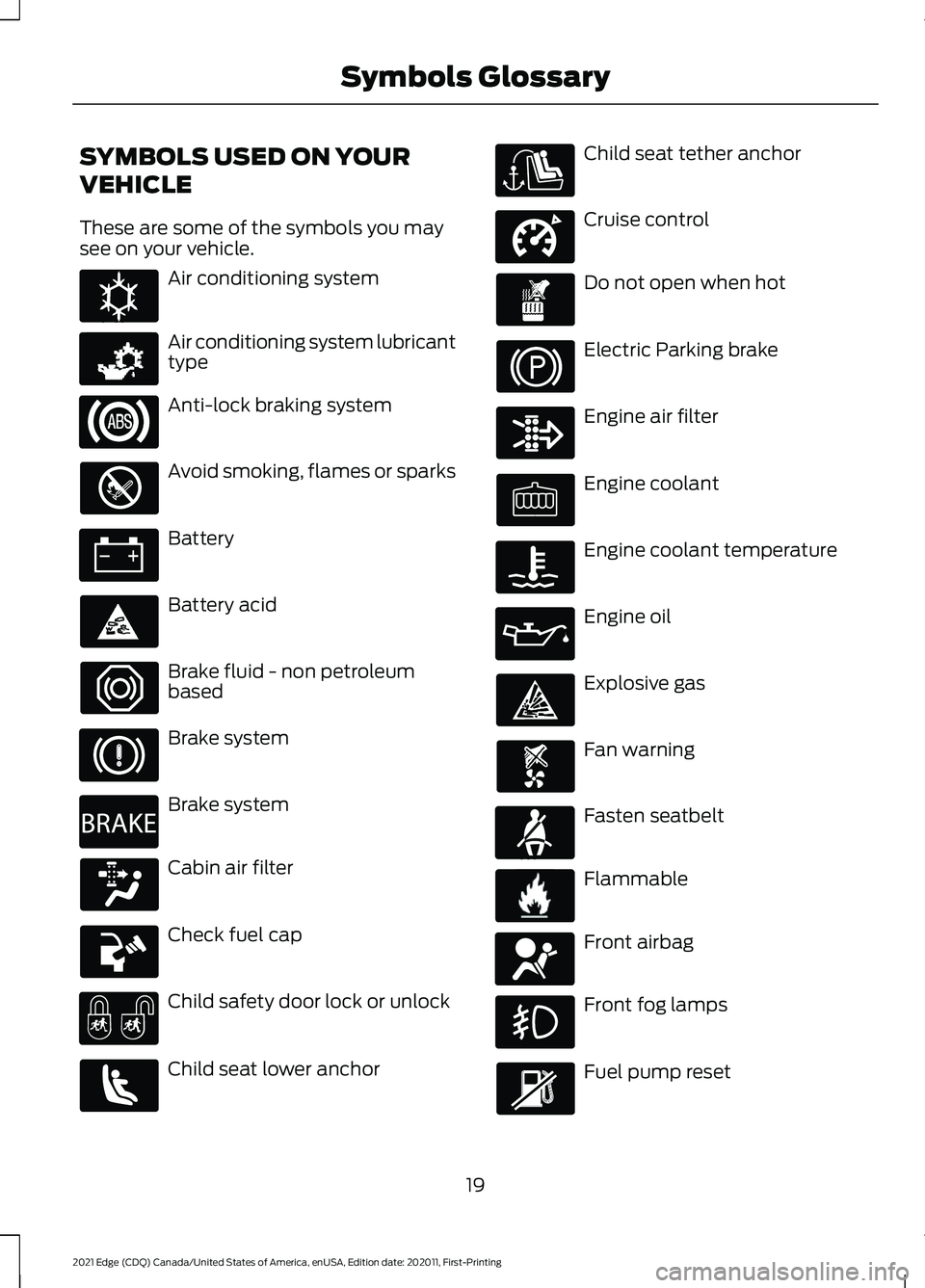
SYMBOLS USED ON YOUR
VEHICLE
These are some of the symbols you may
see on your vehicle.
Air conditioning system
Air conditioning system lubricant
type
Anti-lock braking system
Avoid smoking, flames or sparks
Battery
Battery acid
Brake fluid - non petroleum
based
Brake system
Brake system
Cabin air filter
Check fuel cap
Child safety door lock or unlock
Child seat lower anchor Child seat tether anchor
Cruise control
Do not open when hot
Electric Parking brake
Engine air filter
Engine coolant
Engine coolant temperature
Engine oil
Explosive gas
Fan warning
Fasten seatbelt
Flammable
Front airbag
Front fog lamps
Fuel pump reset
19
2021 Edge (CDQ) Canada/United States of America, enUSA, Edition date: 202011, First-Printing Symbols GlossaryE162384 E231157 E270480 E332905 E71880 E231160 E67017
Page 31 of 500
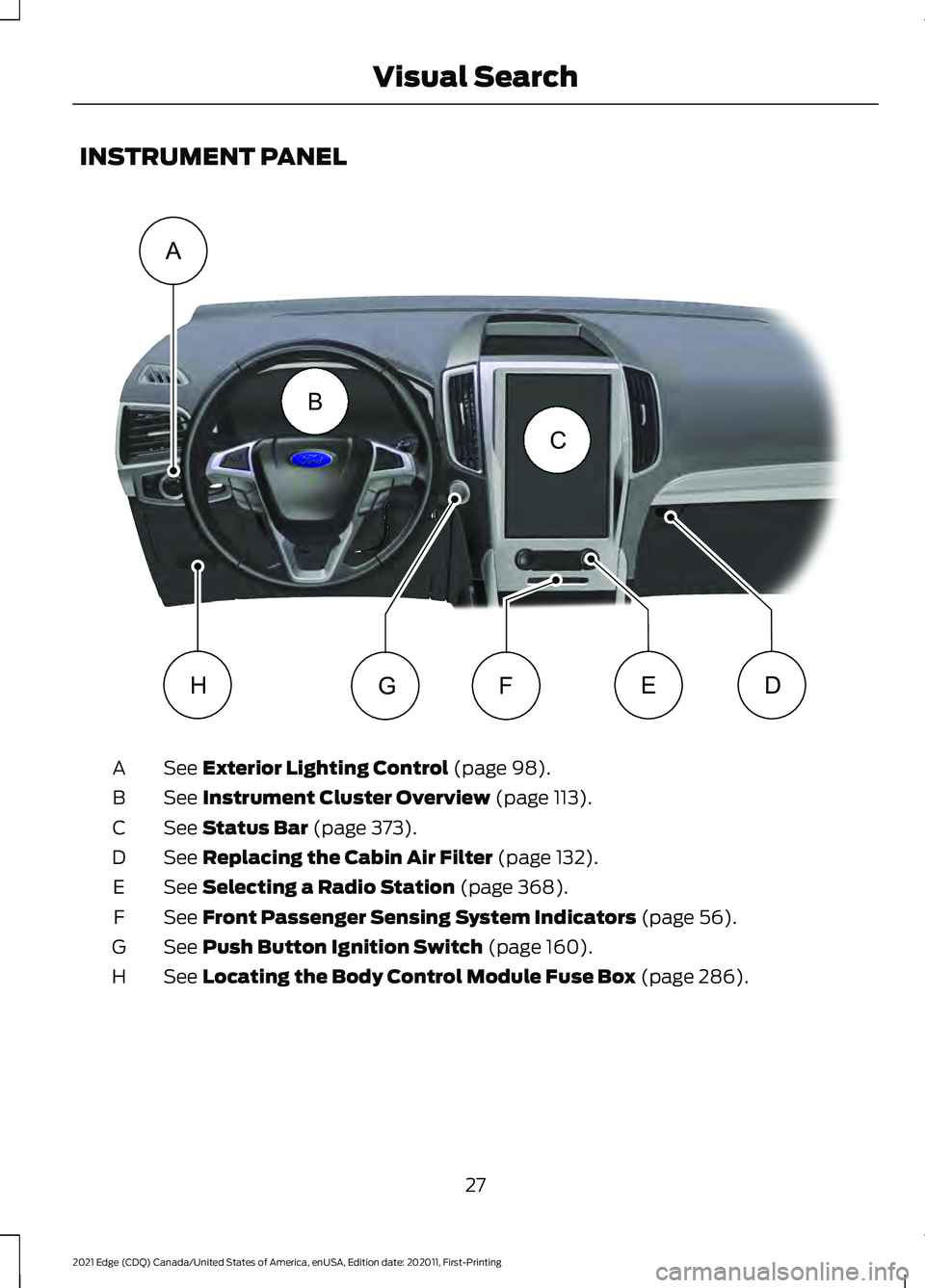
INSTRUMENT PANEL
See Exterior Lighting Control (page 98).
A
See
Instrument Cluster Overview (page 113).
B
See
Status Bar (page 373).
C
See
Replacing the Cabin Air Filter (page 132).
D
See
Selecting a Radio Station (page 368).
E
See
Front Passenger Sensing System Indicators (page 56).
F
See
Push Button Ignition Switch (page 160).
G
See
Locating the Body Control Module Fuse Box (page 286).
H
27
2021 Edge (CDQ) Canada/United States of America, enUSA, Edition date: 202011, First-Printing Visual SearchA
B
C
DEFGHE332331
Page 136 of 500
WHAT IS THE CABIN AIR
FILTER
The cabin air filter improves the quality of
air in your vehicle by trapping dust, pollen
and other particles.
LOCATING THE CABIN AIR
FILTER
You can locate the cabin air filter behind
the glove box.
REPLACING THE CABIN AIR
FILTER
Replace the filter at regular intervals. See
Scheduled Maintenance (page 391).
Note: Make sure you have a cabin air filter
installed at all times. This prevents foreign
objects from entering the system. Running
the system without a filter in place could
result in degradation or damage to the
system.
Note: Using an aftermarket cabin air filter
could reduce cabin air filtration and climate
control performance.
132
2021 Edge (CDQ) Canada/United States of America, enUSA, Edition date: 202011, First-Printing Interior Air Quality
Page 180 of 500
WHAT IS THE CATALYTIC
CONVERTER
The catalytic converter is part of your
vehicle's emissions system and filters
harmful pollutants from the exhaust gas.
CATALYTIC CONVERTER
PRECAUTIONS
WARNING: Do not park, idle or
drive your vehicle on dry grass or other
dry ground cover. The emission system
heats up the engine compartment and
exhaust system, creating the risk of fire. WARNING:
The normal operating
temperature of the exhaust system is
very high. Never work around or attempt
to repair any part of the exhaust system
until it has cooled. Use special care when
working around the catalytic converter.
The catalytic converter heats up to a very
high temperature after only a short
period of engine operation and stays hot
after the engine is switched off.
To avoid damaging the catalytic converter:
• Do not crank the engine for more than
10 seconds at a time.
• Do not run the engine with a spark plug
lead disconnected.
• Do not push-start or tow-start your
vehicle. Use booster cables. See Jump
Starting Precautions
(page 266).
• Use the correct fuel.
See Fuel and
Refueling (page 170).
• Do not switch the ignition off when your
vehicle is moving.
• Avoid running out of fuel.
• Have the items listed in scheduled
maintenance information performed
according to the specified schedule. Note:
Do not make any unauthorized
changes to your vehicle or engine. By law,
vehicle owners and anyone who
manufactures, repairs, or services a fleet of
vehicles are not permitted to intentionally
remove an emission control device or
prevent it from working.
CATALYTIC CONVERTER –
TROUBLESHOOTING
Catalytic Converter – Warning
Lamps
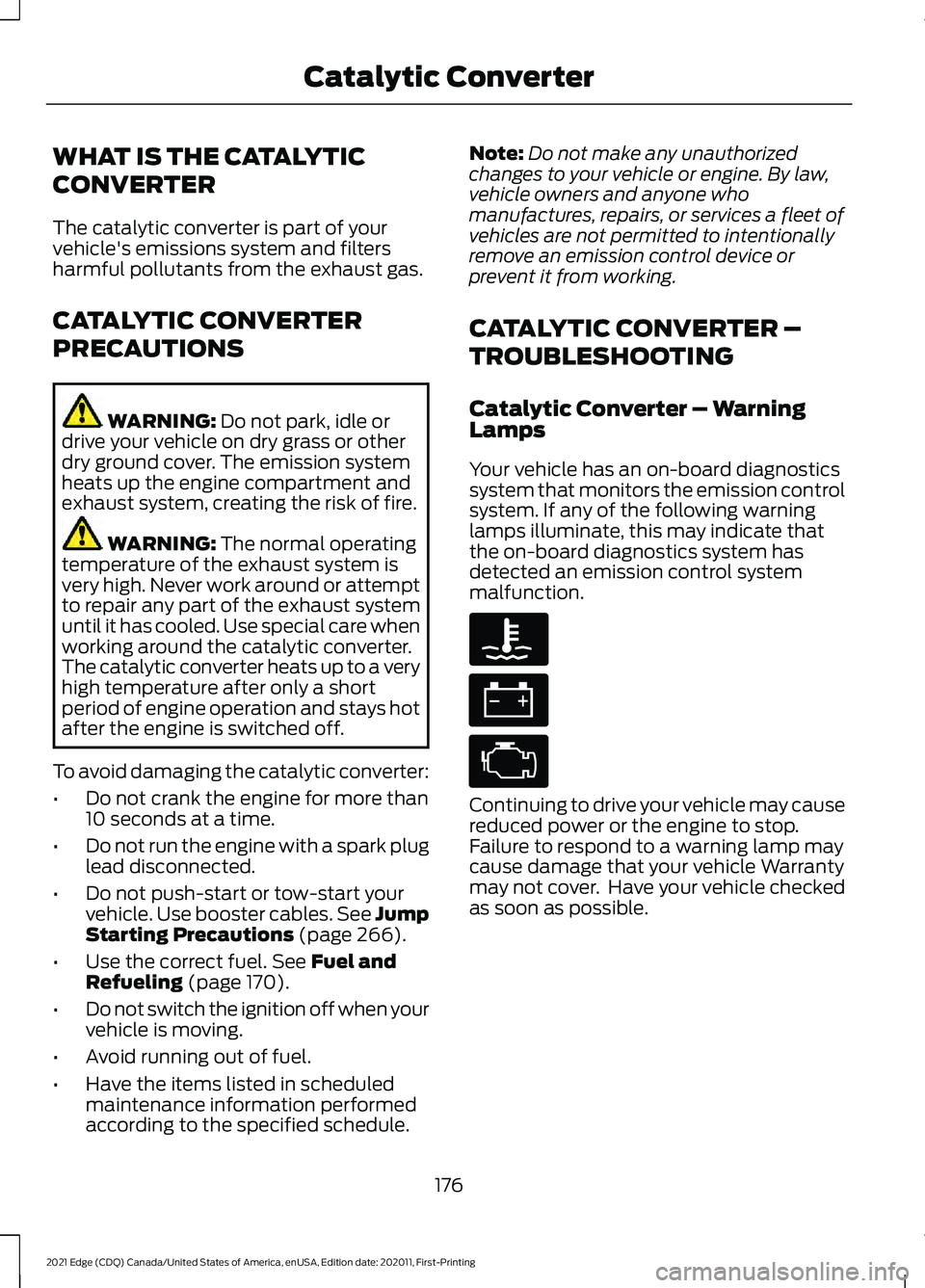
Your vehicle has an on-board diagnostics
system that monitors the emission control
system. If any of the following warning
lamps illuminate, this may indicate that
the on-board diagnostics system has
detected an emission control system
malfunction. Continuing to drive your vehicle may cause
reduced power or the engine to stop.
Failure to respond to a warning lamp may
cause damage that your vehicle Warranty
may not cover. Have your vehicle checked
as soon as possible.
176
2021 Edge (CDQ) Canada/United States of America, enUSA, Edition date: 202011, First-Printing Catalytic Converter
Page 267 of 500
COLD WEATHER
PRECAUTIONS
The functional operation of some
components and systems can be affected
at temperatures below approximately
-13°F (-25°C).
BREAKING-IN
Tires
You need to break in new tires for
approximately
300 mi (480 km). During
this time, your vehicle may exhibit some
unusual driving characteristics.
Brakes and Clutch
Avoid heavy use of the brakes and clutch
if possible for the first
100 mi (160 km) in
town and for the first 1,000 mi (1,600 km)
on freeways.
DRIVING THROUGH WATER WARNING:
Do not drive through
flowing or deep water as you may lose
control of your vehicle.
Note: Driving through standing water can
cause vehicle damage.
Note: Engine damage can occur if water
enters the air filter.
Before driving through standing water,
check the depth. Never drive through water
that is higher than the bottom of the front
rocker area of your vehicle. When driving through standing water, drive
very slowly and do not stop your vehicle.
Your brake performance and traction may
be limited. After driving through water and
as soon as it is safe to do so:
•
Lightly press the brake pedal to dry the
brakes and to check that they work.
• Check that the horn works.
• Check that the exterior lights work.
• Turn the steering wheel to check that
the steering power assist works.
DRIVING ECONOMICALLY
The following helps to improve fuel
consumption:
• Drive smoothly, accelerate gently and
anticipate the road ahead to avoid
heavy braking.
• Regularly check your tire pressures and
make sure that they are inflated to the
correct pressure.
• Follow the recommended maintenance
schedule and carry out the
recommended checks.
• Plan your journey and check the traffic
before you set off. It is more efficient
to combine errands into a single trip
whenever possible.
263
2021 Edge (CDQ) Canada/United States of America, enUSA, Edition date: 202011, First-Printing Driving HintsE259345
Page 296 of 500
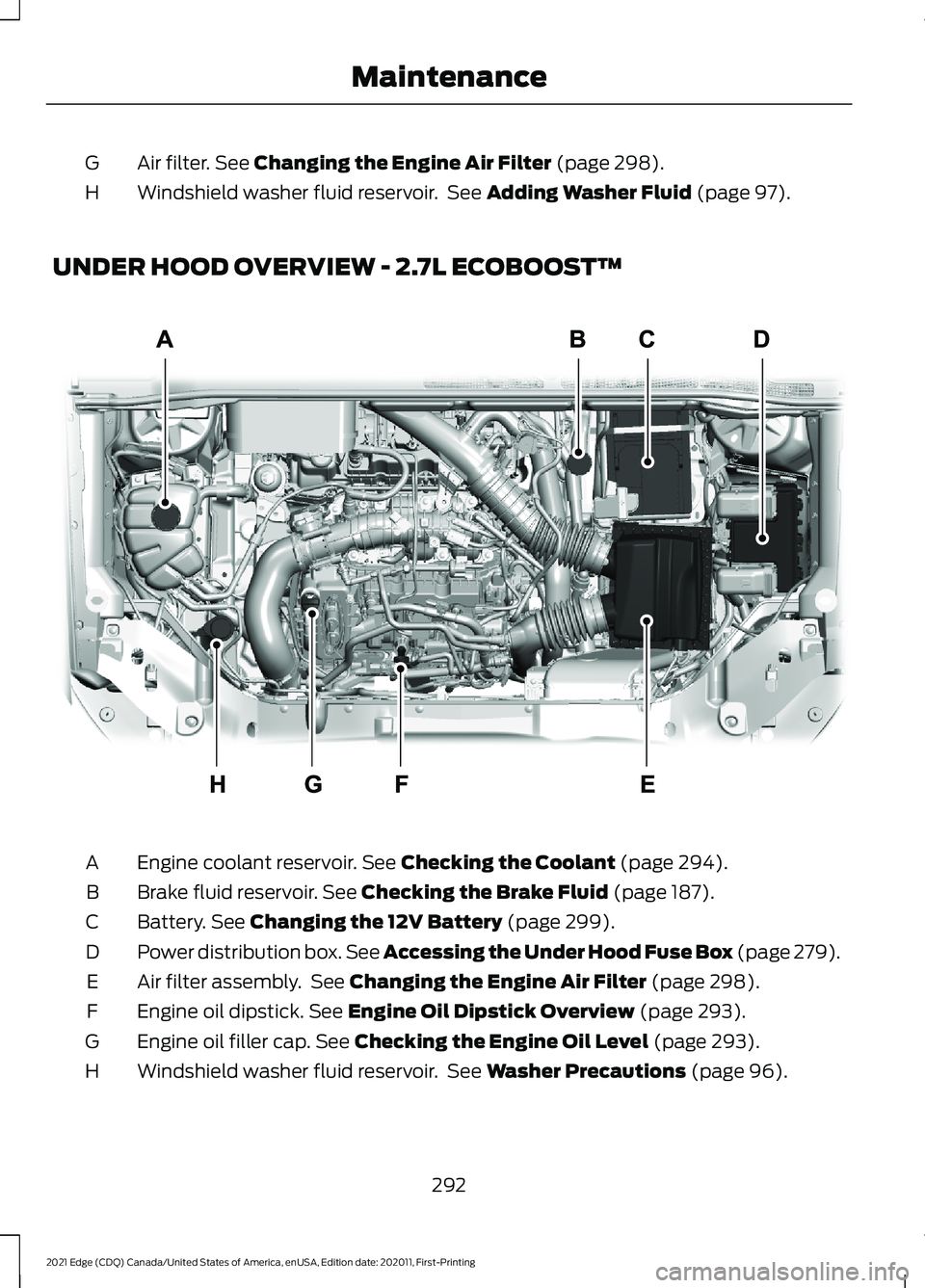
Air filter. See Changing the Engine Air Filter (page 298).
G
Windshield washer fluid reservoir. See
Adding Washer Fluid (page 97).
H
UNDER HOOD OVERVIEW - 2.7L ECOBOOST™ Engine coolant reservoir.
See Checking the Coolant (page 294).
A
Brake fluid reservoir.
See Checking the Brake Fluid (page 187).
B
Battery.
See Changing the 12V Battery (page 299).
C
Power distribution box. See Accessing the Under Hood Fuse Box (page 279).
D
Air filter assembly. See
Changing the Engine Air Filter (page 298).
E
Engine oil dipstick.
See Engine Oil Dipstick Overview (page 293).
F
Engine oil filler cap.
See Checking the Engine Oil Level (page 293).
G
Windshield washer fluid reservoir. See
Washer Precautions (page 96).
H
292
2021 Edge (CDQ) Canada/United States of America, enUSA, Edition date: 202011, First-Printing MaintenanceE341585
Page 302 of 500
1. Stop your vehicle as soon as it is safe
to do so. Fully apply the parking brake,
shift into park (P) or neutral (N).
2. Leave the engine running until the coolant temperature gauge needle
returns to the normal position. If the
temperature does not drop after
several minutes, follow the remaining
steps.
3. Switch the engine off and wait for it to
cool. Check the coolant level.
4. If the coolant level is at or below the minimum mark, add prediluted coolant
immediately.
5. If the coolant level is normal, restart the engine and continue.
CHANGING THE ENGINE AIR
FILTER WARNING: To reduce the risk of
vehicle damage and personal burn
injuries, do not start your engine with the
air cleaner removed and do not remove
it while the engine is running.
When changing the air filter element, use
only the air filter element listed. See
Capacities and Specifications
(page
349).
For turbocharged equipped vehicles: When
servicing the air cleaner, it is important that
no foreign material enter the air induction
system. The engine and turbocharger are
susceptible to damage from even small
particles.
Change the air filter element at the proper
interval. See
Scheduled Maintenance
(page 391). Note:
Failure to use the correct air filter
element may result in severe engine
damage. The customer warranty may be
void for any damage to the engine if the
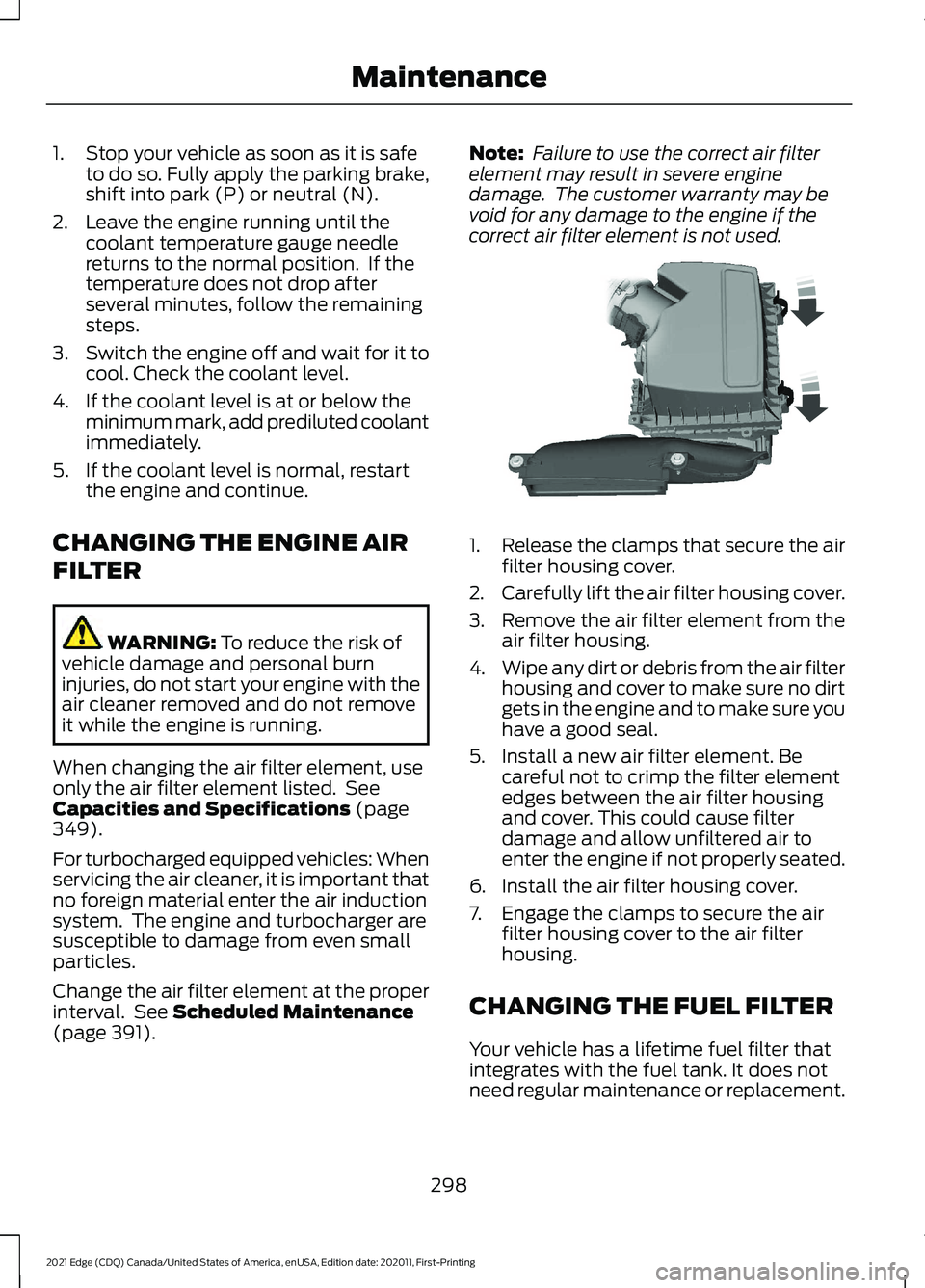
correct air filter element is not used. 1.
Release the clamps that secure the air
filter housing cover.
2. Carefully lift the air filter housing cover.
3. Remove the air filter element from the
air filter housing.
4. Wipe any dirt or debris from the air filter
housing and cover to make sure no dirt
gets in the engine and to make sure you
have a good seal.
5. Install a new air filter element. Be careful not to crimp the filter element
edges between the air filter housing
and cover. This could cause filter
damage and allow unfiltered air to
enter the engine if not properly seated.
6. Install the air filter housing cover.
7. Engage the clamps to secure the air filter housing cover to the air filter
housing.
CHANGING THE FUEL FILTER
Your vehicle has a lifetime fuel filter that
integrates with the fuel tank. It does not
need regular maintenance or replacement.
298
2021 Edge (CDQ) Canada/United States of America, enUSA, Edition date: 202011, First-Printing MaintenanceE144365
Page 312 of 500
Do not scrape the lamps.
Do not wipe lamps when they are dry.
Cleaning Windows and Wiper
Blades
To clean the windshield and wiper blades:
•
Clean the windshield with a
non-abrasive glass cleaner.
Note: When cleaning the interior of the
windshield, avoid getting any glass cleaner
on the instrument panel or door panels.
Wipe any glass cleaner off these surfaces
immediately.
• Clean the wiper blades with washer
fluid or water applied with a soft
sponge or cloth.
Note: Do not use razor blades or other
sharp objects to clean or remove decals
from the inside of the heated rear window.
This can cause damage not covered by the
vehicle Warranty.
Cleaning Chrome, Aluminium or
Stainless Steel
We recommend that you only use a car
shampoo, a soft cloth and water on
bumpers and other chrome, aluminium or
stainless steel parts.
Note: For additional information and
assistance, we recommend that you contact
an authorized dealer.
Note: Rinse the area well after cleaning.
Note: Do not use abrasive materials, for
example steel wool or plastic pads, as they
can scratch these surfaces.
Note: Do not use chrome cleaner, metal
cleaner or polish on wheels or wheel covers. Cleaning Wheels
Only use a recommended wheel and tire
cleaner to clean the wheels weekly. For
additional information and assistance, we
recommend that you contact an
authorized dealer.
1. Use a sponge to remove heavy
deposits of dirt and brake dust.
2. Rinse well after cleaning.
Note: Do not apply a cleaning chemical to
warm or hot wheel rims and covers.
If you intend on parking your vehicle for an
extended period after cleaning the wheels
with a wheel cleaner, drive your vehicle for
a few minutes before parking your vehicle.
This reduces the risk of corrosion of the
brake discs, brake pads and linings.
Do not clean the wheels when they are hot.
Note: Some car washes could damage
wheel rims and covers.
Note: Using non-recommended cleaners,
harsh cleaning products, chrome wheel
cleaners or abrasive materials could
damage wheel rims and covers.
Cleaning the Engine Compartment
Use a vacuum cleaner to remove debris
from the screen area below windshield.
Note: If you are not familiar with the parts
around the engine do not wash the engine
compartment. Avoid frequent engine
washes.
When washing the engine compartment:
• Never wash or rinse the engine while it
is hot or running.
• Never wash or rinse any ignition coil,
spark plug wire or spark plug well.
• Cover the battery, power distribution
box, and air filter assembly to prevent
water damage.
308
2021 Edge (CDQ) Canada/United States of America, enUSA, Edition date: 202011, First-Printing Vehicle Care