key FORD ESCAPE 2001 1.G User Guide
[x] Cancel search | Manufacturer: FORD, Model Year: 2001, Model line: ESCAPE, Model: FORD ESCAPE 2001 1.GPages: 280, PDF Size: 2.65 MB
Page 96 of 280
If there is any potential perimeter anti-theft problem with your vehicle,
ensureALL key fobs(remote entry transmitters) are brought to the
dealership, to aid in troubleshooting.
Arming the system
When armed, this system will help protect your vehicle from
unauthorized entry. When unauthorized entry occurs, the system will
flash the headlamps, parking lamps and will sound the horn.
The system is ready to arm whenever the key is removed from the
ignition. Either of the following actions will prearm the alarm system:
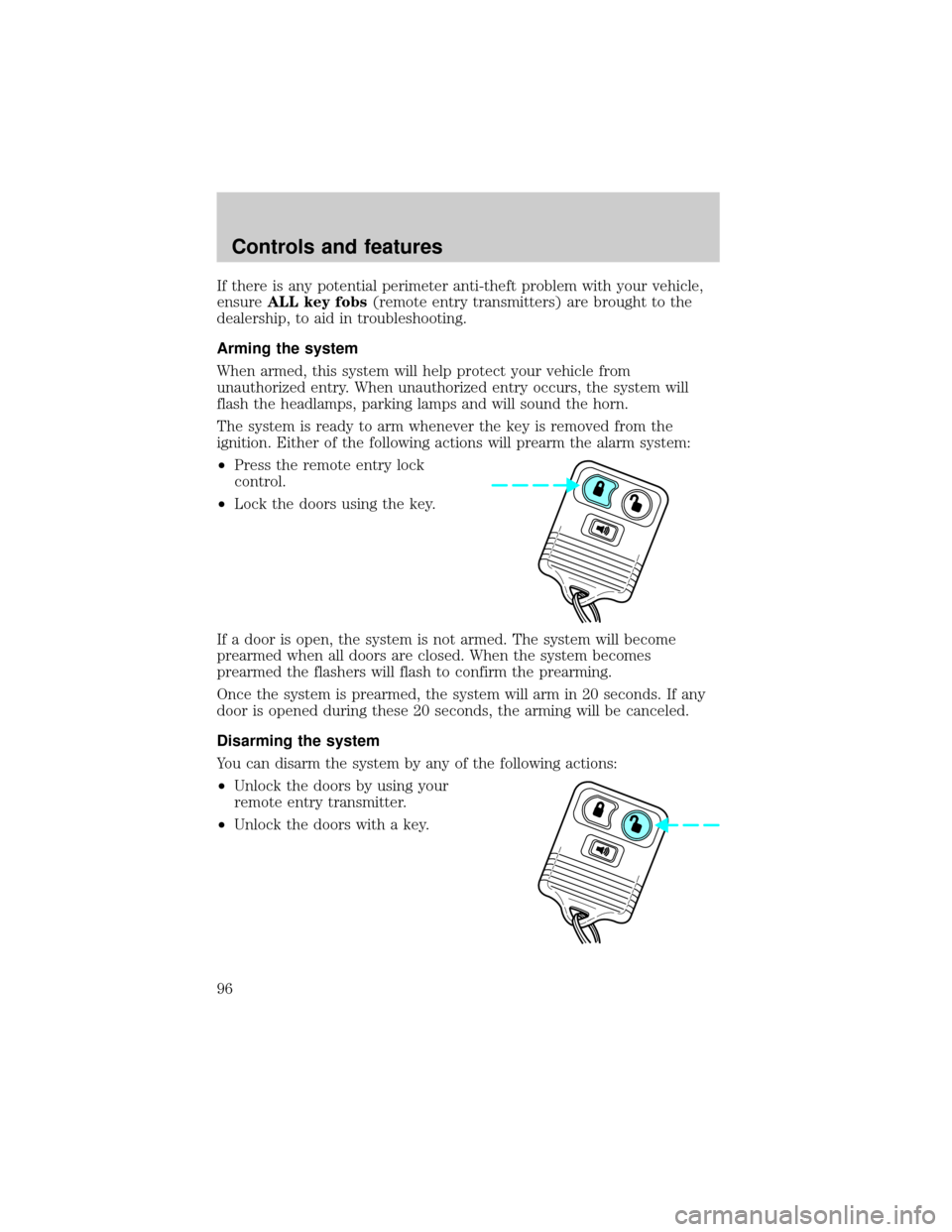
²Press the remote entry lock
control.
²Lock the doors using the key.
If a door is open, the system is not armed. The system will become
prearmed when all doors are closed. When the system becomes
prearmed the flashers will flash to confirm the prearming.
Once the system is prearmed, the system will arm in 20 seconds. If any
door is opened during these 20 seconds, the arming will be canceled.
Disarming the system
You can disarm the system by any of the following actions:
²Unlock the doors by using your
remote entry transmitter.
²Unlock the doors with a key.
Controls and features
96
Page 139 of 280
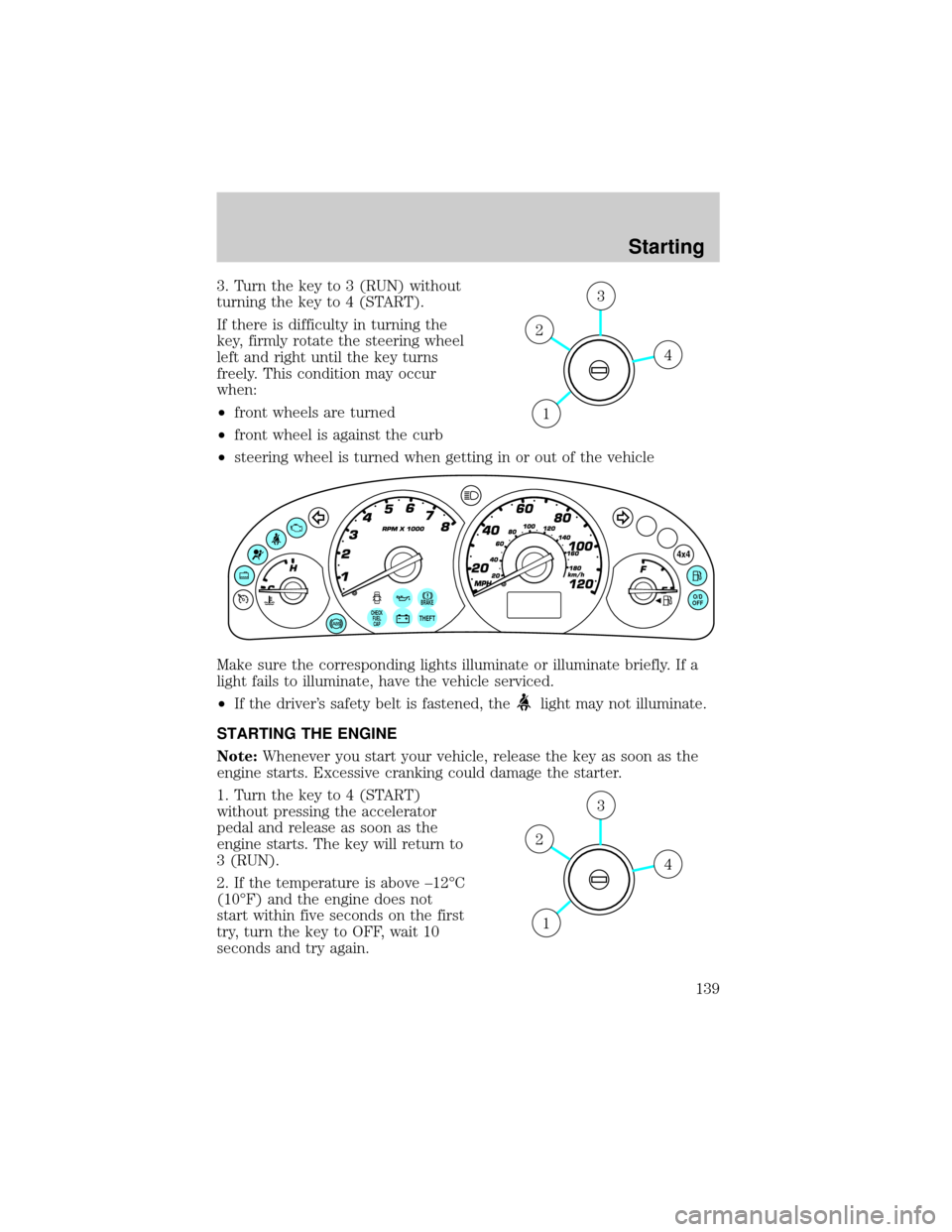
3. Turn the key to 3 (RUN) without
turning the key to 4 (START).
If there is difficulty in turning the
key, firmly rotate the steering wheel
left and right until the key turns
freely. This condition may occur
when:
²front wheels are turned
²front wheel is against the curb
²steering wheel is turned when getting in or out of the vehicle
Make sure the corresponding lights illuminate or illuminate briefly. If a
light fails to illuminate, have the vehicle serviced.
²If the driver's safety belt is fastened, the
light may not illuminate.
STARTING THE ENGINE
Note:Whenever you start your vehicle, release the key as soon as the
engine starts. Excessive cranking could damage the starter.
1. Turn the key to 4 (START)
without pressing the accelerator
pedal and release as soon as the
engine starts. The key will return to
3 (RUN).
2. If the temperature is above ±12ÉC
(10ÉF) and the engine does not
start within five seconds on the first
try, turn the key to OFF, wait 10
seconds and try again.
4
3
2
1
BRAKE
THEFT
4x4
O/D
OFF
CHECK
FUEL
CAP
4
3
2
1
Starting
139
Page 140 of 280
3. If the temperature is below -12É C (10É F) and the engine does not
start in 15 seconds on the first try, turn the key OFF and wait 10
seconds and try again. If the engine does not start in two attempts, Press
the accelerator pedal all the way to floor and hold. Turn the key to
START position.
4. When the engine starts, release the key, then release the accelerator
pedal gradually as the engine speeds up.
5. After idling for a few seconds, apply the brake and release the parking
brake.
Using the engine block heater (if equipped)
An engine block heater warms the engine coolant, which improves
starting, warms up the engine faster and allows the heater-defroster
system to respond quickly. Use of an engine block heater is strongly
recommended if you live in a region where temperatures reach -23É C
(-10É F) or below.
For best results, plug the heater in at least three hours before starting
the vehicle. Using the heater for longer than three hours will not harm
the engine, so the heater can be plugged in the night before starting the
vehicle.
To prevent electrical shock, do not use your heater with
ungrounded electrical systems or two-pronged (cheater)
adapters.
Guarding against exhaust fumes
Although odorless and colorless, carbon monoxide is present in exhaust
fumes. Take precautions to avoid its dangerous effects.
If you ever smell exhaust fumes of any kind inside your vehicle,
have your dealer inspect and fix your vehicle immediately. Do
not drive if you smell exhaust fumes. These fumes are harmful and
could kill you.
Have the exhaust and body ventilation systems checked whenever:
²the vehicle is raised for service
²the sound of the exhaust system changes
²the vehicle has been damaged in a collision
Starting
140
Page 175 of 280
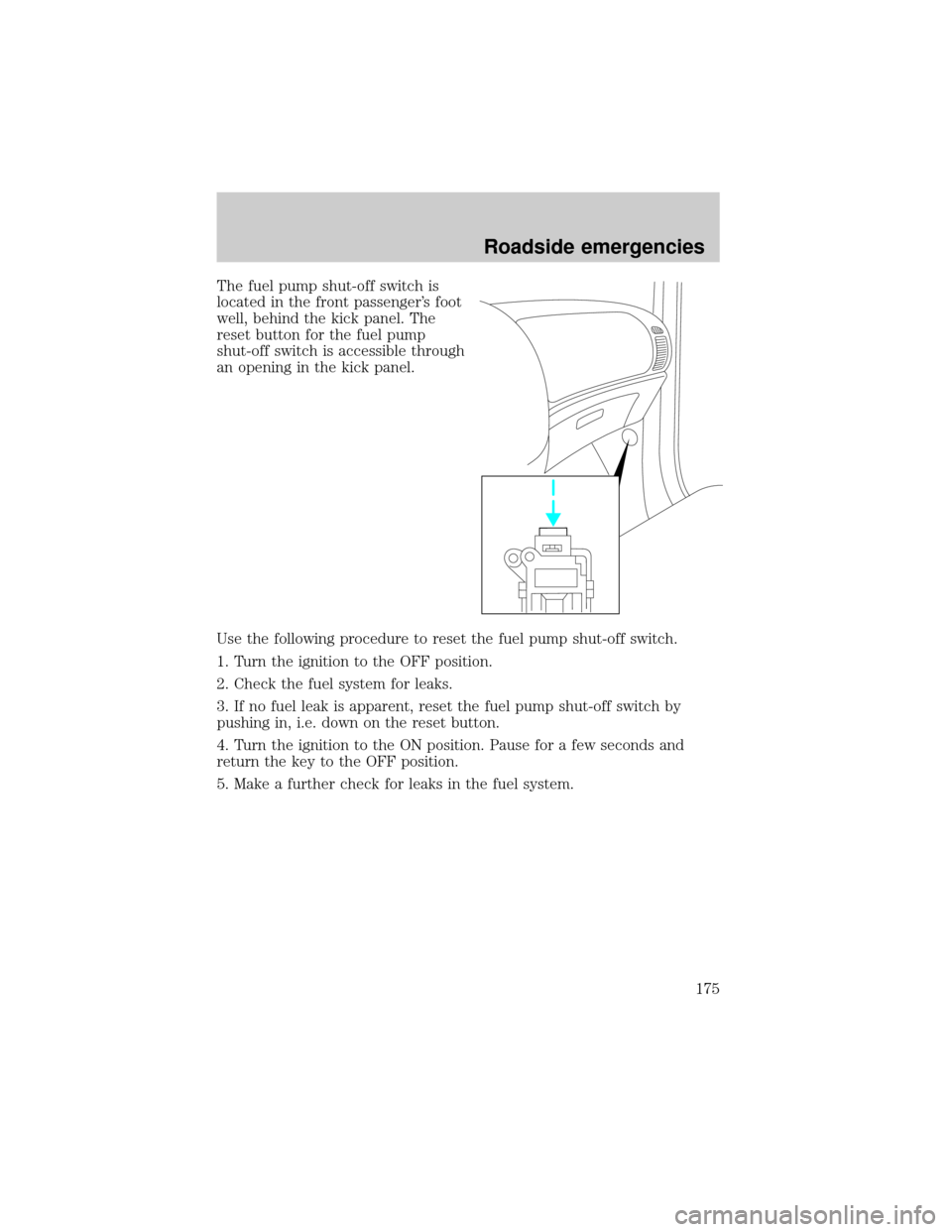
The fuel pump shut-off switch is
located in the front passenger's foot
well, behind the kick panel. The
reset button for the fuel pump
shut-off switch is accessible through
an opening in the kick panel.
Use the following procedure to reset the fuel pump shut-off switch.
1. Turn the ignition to the OFF position.
2. Check the fuel system for leaks.
3. If no fuel leak is apparent, reset the fuel pump shut-off switch by
pushing in, i.e. down on the reset button.
4. Turn the ignition to the ON position. Pause for a few seconds and
return the key to the OFF position.
5. Make a further check for leaks in the fuel system.
Roadside emergencies
175
Page 178 of 280
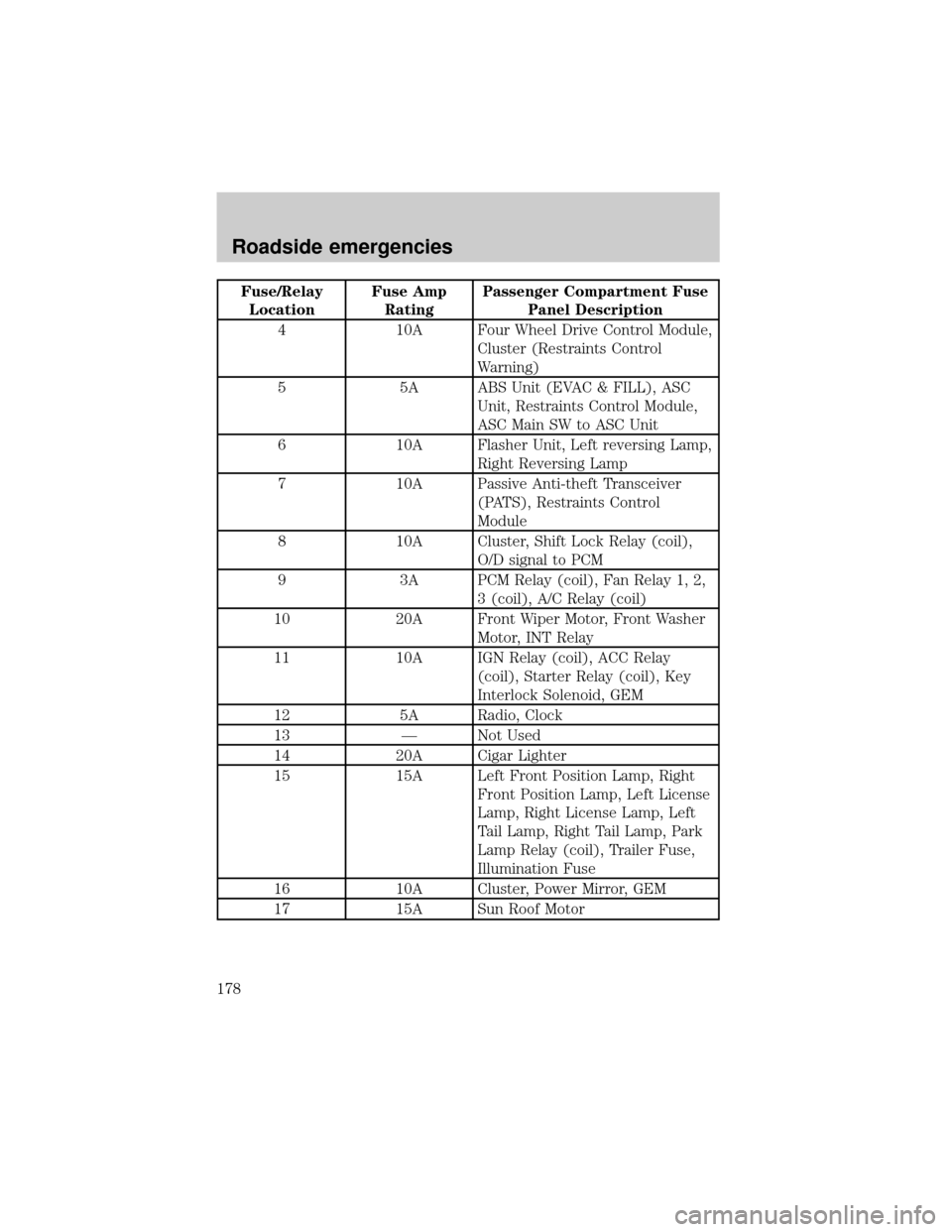
Fuse/Relay
LocationFuse Amp
RatingPassenger Compartment Fuse
Panel Description
4 10A Four Wheel Drive Control Module,
Cluster (Restraints Control
Warning)
5 5A ABS Unit (EVAC & FILL), ASC
Unit, Restraints Control Module,
ASC Main SW to ASC Unit
6 10A Flasher Unit, Left reversing Lamp,
Right Reversing Lamp
7 10A Passive Anti-theft Transceiver
(PATS), Restraints Control
Module
8 10A Cluster, Shift Lock Relay (coil),
O/D signal to PCM
9 3A PCM Relay (coil), Fan Relay 1, 2,
3 (coil), A/C Relay (coil)
10 20A Front Wiper Motor, Front Washer
Motor, INT Relay
11 10A IGN Relay (coil), ACC Relay
(coil), Starter Relay (coil), Key
Interlock Solenoid, GEM
12 5A Radio, Clock
13 Ð Not Used
14 20A Cigar Lighter
15 15A Left Front Position Lamp, Right
Front Position Lamp, Left License
Lamp, Right License Lamp, Left
Tail Lamp, Right Tail Lamp, Park
Lamp Relay (coil), Trailer Fuse,
Illumination Fuse
16 10A Cluster, Power Mirror, GEM
17 15A Sun Roof Motor
Roadside emergencies
178
Page 196 of 280

SERVICE RECOMMENDATIONS
To help you service your vehicle:
²We highlight do-it-yourself items in the engine compartment for easy
location.
²We provide a scheduled maintenance guide which makes tracking
routine service easy.
If your vehicle requires professional service, your dealership can provide
the necessary parts and service. Check yourWarranty Guideto find out
which parts and services are covered.
Use only recommended fuels, lubricants, fluids and service parts
conforming to specifications. Motorcraft parts are designed and built to
provide the best performance in your vehicle.
PRECAUTIONS WHEN SERVICING YOUR VEHICLE
Be especially careful when inspecting or servicing your vehicle.
²Do not work on a hot engine.
²When the engine is running, make sure that loose clothing, jewelry or
long hair does not get caught up in moving parts.
²Do not work on a vehicle with the engine running in an enclosed
space, unless you are sure you have enough ventilation.
²Keep all lit cigarettes, open flames and other lit material away from
the battery and all fuel related parts.
If you disconnect the battery, the engine must ªrelearnº its idle
conditions before your vehicle will drive properly, as explained inBattery
in this chapter.
Working with the engine off
²Automatic transmission:
1. Set the parking brake and ensure the gearshift is securely latched in P
(Park).
2. Turn off the engine and remove the key.
3. Block the wheels to prevent the vehicle from moving unexpectedly.
²Manual transmission:
1. Set the parking brake.
2. Depress the clutch and place the gearshift in 1 (First).
Maintenance and care
196
Page 197 of 280
3. Turn off the engine and remove the key.
4. Block the wheels to prevent the vehicle from moving unexpectedly.
Working with the engine on
²Automatic transmission:
1. Set the parking brake and ensure the gearshift is securely latched in P
(Park).
2. Block the wheels to prevent the vehicle from moving unexpectedly.
Note:Do not start your engine with the air cleaner removed and do not
remove it while the engine is running.
²Manual transmission:
1. Set the parking brake, depress the clutch and place the gearshift in
neutral.
2. Block the wheels to prevent the vehicle from moving unexpectedly.
Note:Do not start your engine with the air cleaner removed and do not
remove it while the engine is running.
The cooling fan is automatic and may come on at any time.
Always disconnect the negative terminal of the battery before
working near the fan.
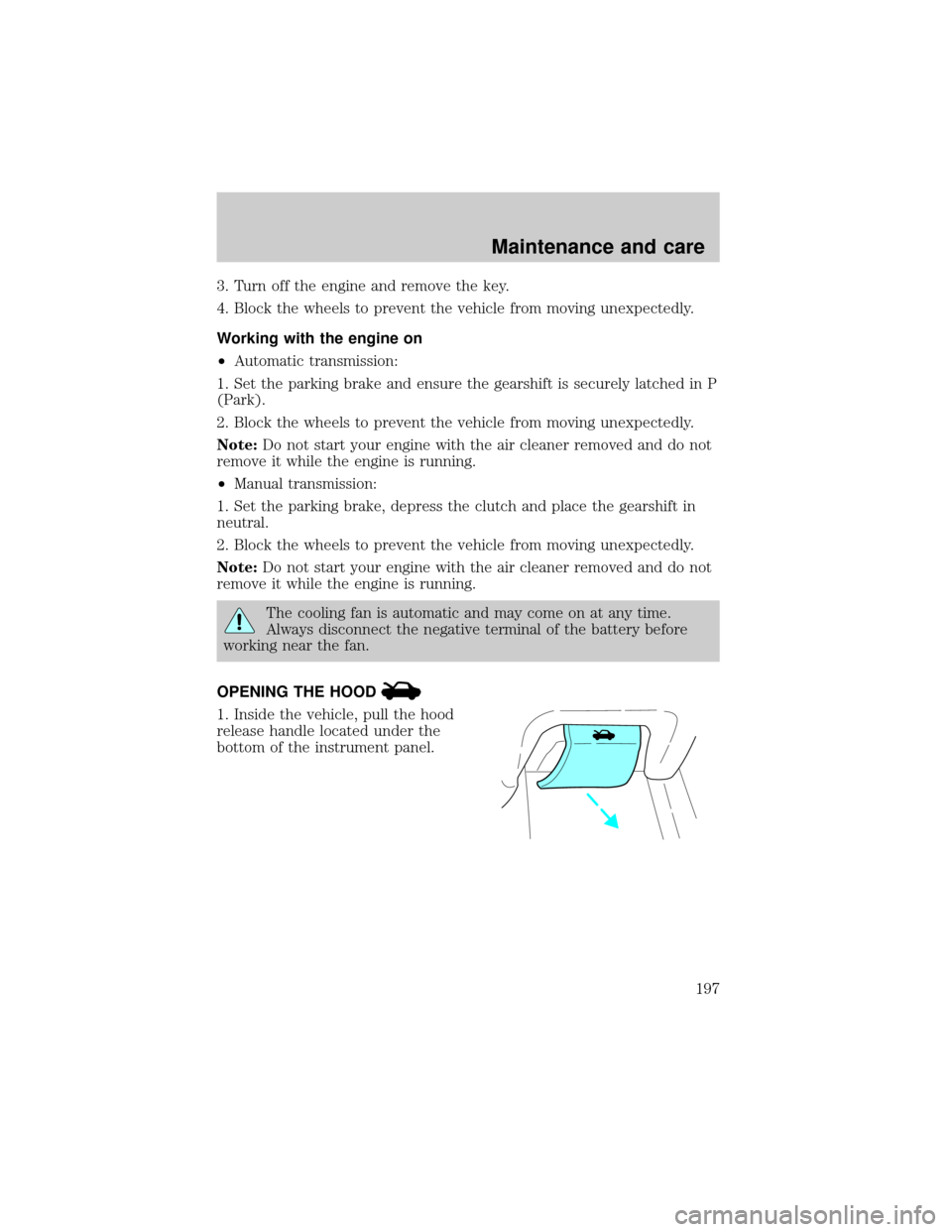
OPENING THE HOOD
1. Inside the vehicle, pull the hood
release handle located under the
bottom of the instrument panel.
Maintenance and care
197
Page 273 of 280

Headlamps ...................................81
aiming ......................................240
bulb specifications ..................239
daytime running lights .............81
flash to pass ..............................82
high beam ...........................13, 81
replacing bulbs .......................235
turning on and off ....................81
warning chime ..........................15
Heating ........................................21
heater only system ...................21
heating and air conditioning
system .......................................22
Hood ..........................................197
I
Ignition .................................71, 252
Infant seats
(see Safety seats) .....................128
Inspection/maintenance (I/M)
testing ........................................234
Instrument panel
cleaning ...................................245
cluster ................................10, 246
lighting up panel and
interior .......................................19
location of components ............10
J
Jack ............................................183
positioning ...............................183
storage .....................................183
Jump-starting your vehicle ......188K
Keys .......................................93±94
key in ignition chime ...............15
positions of the ignition ...........71
L
Lamps
bulb replacement
specifications chart ................239
cargo lamps ...............................19
daytime running light ...............81
fog lamps ...................................82
headlamps .................................81
headlamps, flash to pass ..........82
instrument panel, dimming .....19
interior lamps .............79±80, 239
replacing bulbs .......235, 237±239
Lane change indicator (see
Turn signal) .................................71
Liftgate ........................................89
Lights, warning and indicator ....10
air bag ........................................11
anti-lock brakes (ABS) ....12, 142
anti-theft ...................................13
brake ..........................................12
charging system ........................13
cruise indicator .........................13
door ajar ....................................14
fuel cap light .............................15
high beam .................................13
low coolant ................................14
low fuel ......................................11
oil pressure ...............................13
overdrive off ..............................14
safety belt .................................12
service engine soon ..................10
turn signal indicator .................12
Index
273