brake FORD ESCAPE 2001 1.G Service Manual
[x] Cancel search | Manufacturer: FORD, Model Year: 2001, Model line: ESCAPE, Model: FORD ESCAPE 2001 1.GPages: 280, PDF Size: 2.65 MB
Page 224 of 280
The tires on your vehicle have all-weather treads to provide traction in
rain and snow. However, in some climates, using snow tires or traction
devices may be necessary. Ford offers tire cables as a Ford approved
accessory and recommends use of these or SAE class ªSº. See your
dealer or qualified service technician for more information on tire cables
for your vehicle.
Follow these guidelines when using snow tires and traction devices:
²Cables or chains should only be used on the rear wheels.
²Install cables or chains securely, verifying that the cables or chains do
not touch any wiring, brake lines or fuel lines.
²Drive cautiously. If you hear the cables or chains rub or bang against
the vehicle, stop and retighten them. If this does not work, remove the
cables or chains to prevent vehicle damage.
²Avoid overloading your vehicle.
²Remove the cables or chains when they are no longer needed.
²Do not use cables or chains on dry roads.
²Do not exceed 48 km/h (30 mph) with tire cables or chains on your
vehicle.
Consult your dealer for information on other Ford approved methods of
traction control.
Maintenance and care
224
Page 232 of 280
²Idling for long periods of time (greater than one minute) may waste
fuel.
²Anticipate stopping; slowing down may eliminate the need to stop.
²Sudden or hard accelerations may reduce fuel economy.
²Slow down gradually.
²Driving at reasonable speeds (traveling at 88 km/h [55 mph] uses 15%
less fuel than traveling at 105 km/h [65 mph]).
²Revving the engine before turning it off may reduce fuel economy.
²Using the air conditioner or defroster may reduce fuel economy.
²You may want to turn off the speed control in hilly terrain if
unnecessary shifting between third and fourth gear occurs.
Unnecessary shifting of this type could result in reduced fuel
economy.
²Warming up a vehicle on cold mornings is not required and may
reduce fuel economy.
²Resting your foot on the brake pedal while driving may reduce fuel
economy.
²Combine errands and minimize stop-and-go driving.
Maintenance
²Keep tires properly inflated and use only recommended size.
²Operating a vehicle with the wheels out of alignment will reduce fuel
economy.
²Perform all regularly scheduled maintenance items. Follow the
recommended maintenance schedule and owner maintenance checks
found in your vehicle scheduled maintenance guide.
Conditions
²Heavily loading a vehicle or towing a trailer may reduce fuel economy
at any speed.
²Carrying unnecessary weight may reduce fuel economy (approximately
0.4 km/L [1 mpg] is lost for every 180 kg [400 lb] of weight carried).
²Adding certain accessories to your vehicle (for example bug
deflectors, rollbars/light bars, running boards, ski/luggage racks) may
reduce fuel economy.
²Using fuel blended with alcohol may lower fuel economy.
Maintenance and care
232
Page 235 of 280
Allow the vehicle to sit for at least eight hours without starting the
engine. Then, start the engine and complete the above driving cycle. The
engine must warm up to its normal operating temperature. Once started,
do not turn off the engine until the above driving cycle is complete.
BULBS
Replacing exterior bulbs
Check the operation of the following lamps frequently:
²Headlamps
²Foglamps
²High-mount brakelamp
²Brakelamps
²Turn signals
²License plate lamp
²Tail lamps
²Back-up lamps
Do not remove lamp bulbs unless they can be replaced immediately with
new ones. If a bulb is removed for an extended period of time,
contaminants may enter the lamp housings and affect lamp performance.
Replacing headlamp bulbs
1. Make sure that the headlamp control is in the OFF position.
2. Open the hood.
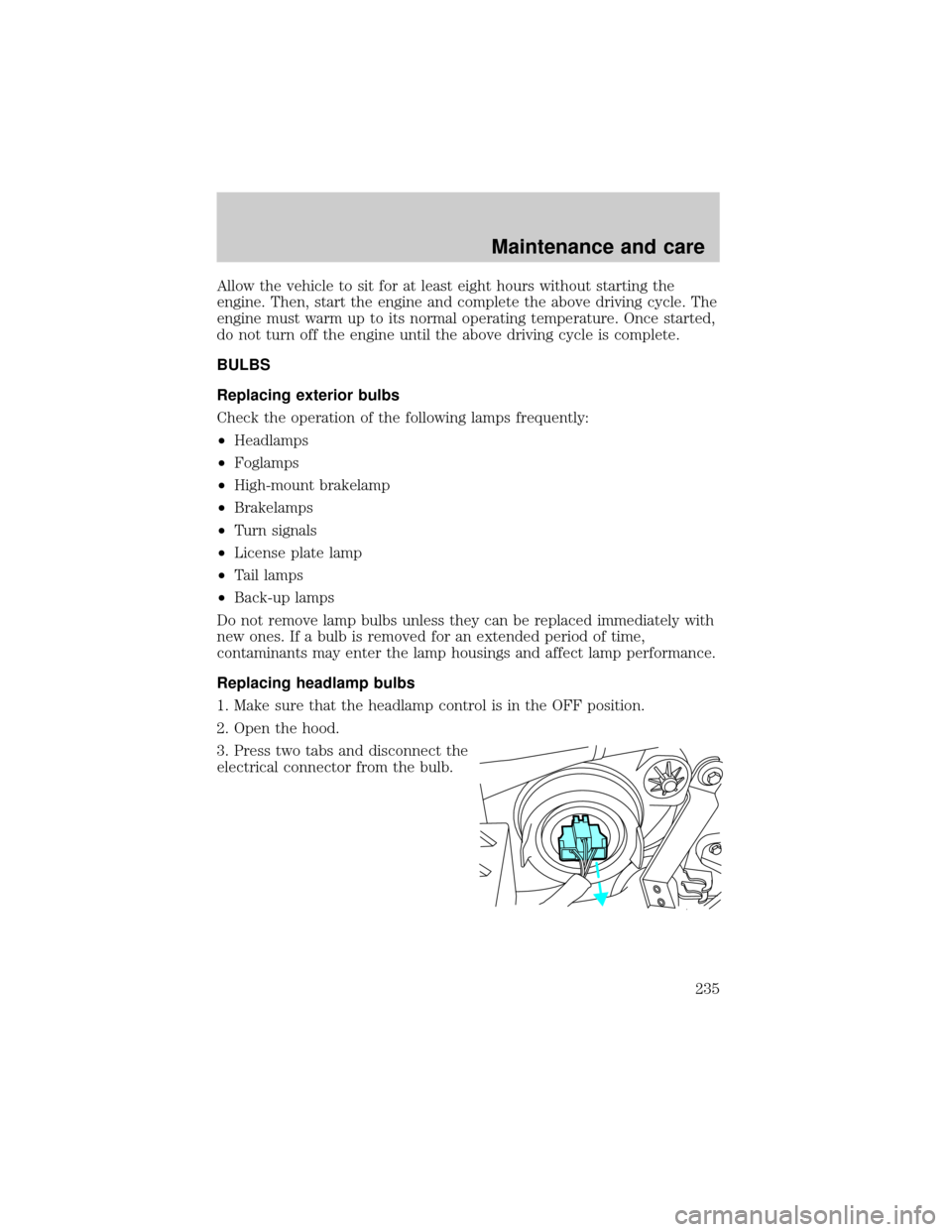
3. Press two tabs and disconnect the
electrical connector from the bulb.
Maintenance and care
235
Page 237 of 280
7. Insert the glass end of the new bulb into the headlamp assembly.
When the bulb's three metal tabs are aligned with the grooves in the
plastic base, push the bulb into the lamp assembly until the bulb's metal
base contacts the plastic base.
8. Rotate the retainer spring over the bulb metal base and secure it on
the bulb hooks.
9. Install rubber boot on the lamp assembly. Be sure to press firmly
around the perimeter of the boot and around the bulb to ensure the
proper seal of the bulb.
10. Connect the electrical connector into the rear of the bulb until it
ªsnaps.º
Replacing brake/tail/turn/backup/rear fog lamp bulbs
The brake/tail/turn/backup/rear fog lamp bulbs are located in the tail
lamp assembly, one just below the other. Follow the same steps to
replace either bulb:
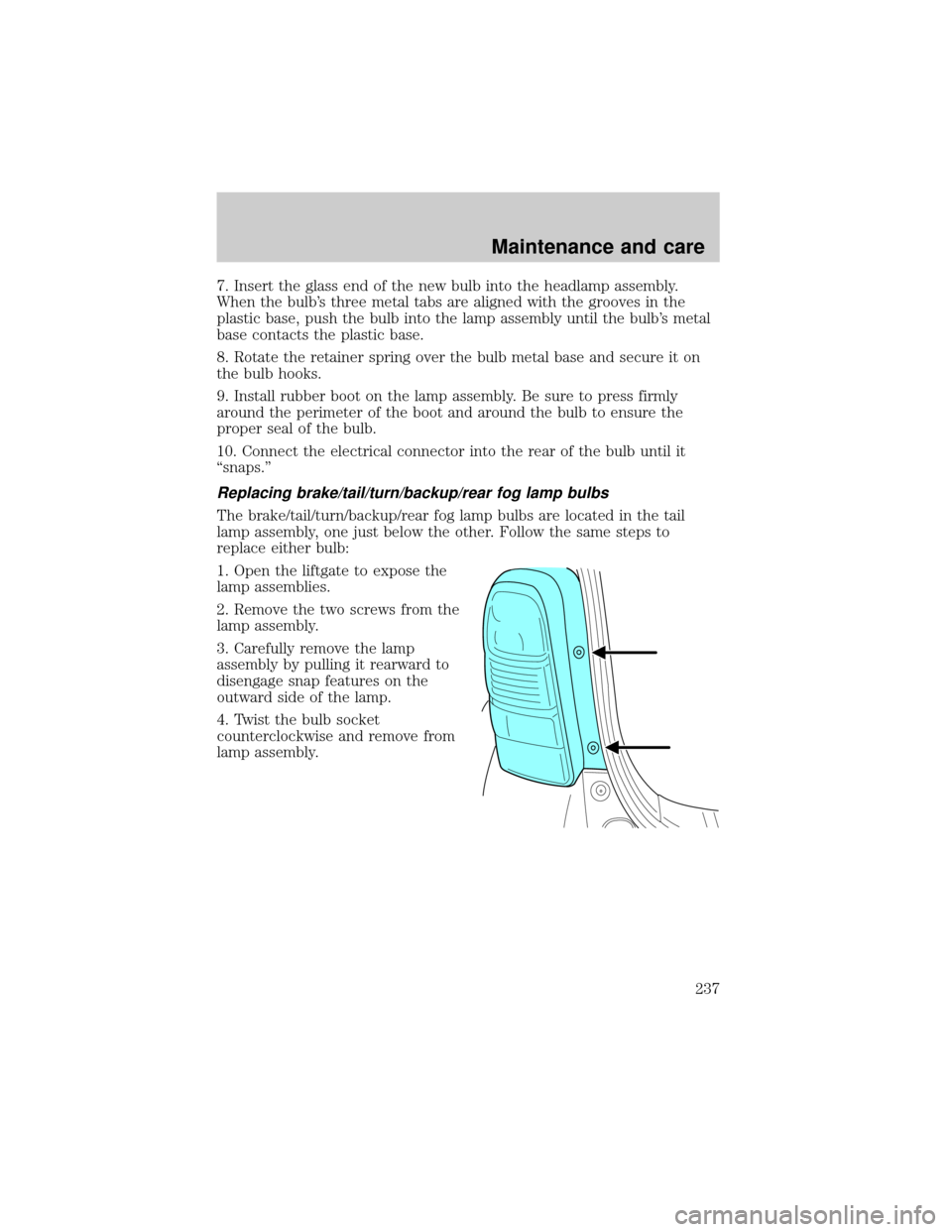
1. Open the liftgate to expose the
lamp assemblies.
2. Remove the two screws from the
lamp assembly.
3. Carefully remove the lamp
assembly by pulling it rearward to
disengage snap features on the
outward side of the lamp.
4. Twist the bulb socket
counterclockwise and remove from
lamp assembly.
Maintenance and care
237
Page 238 of 280
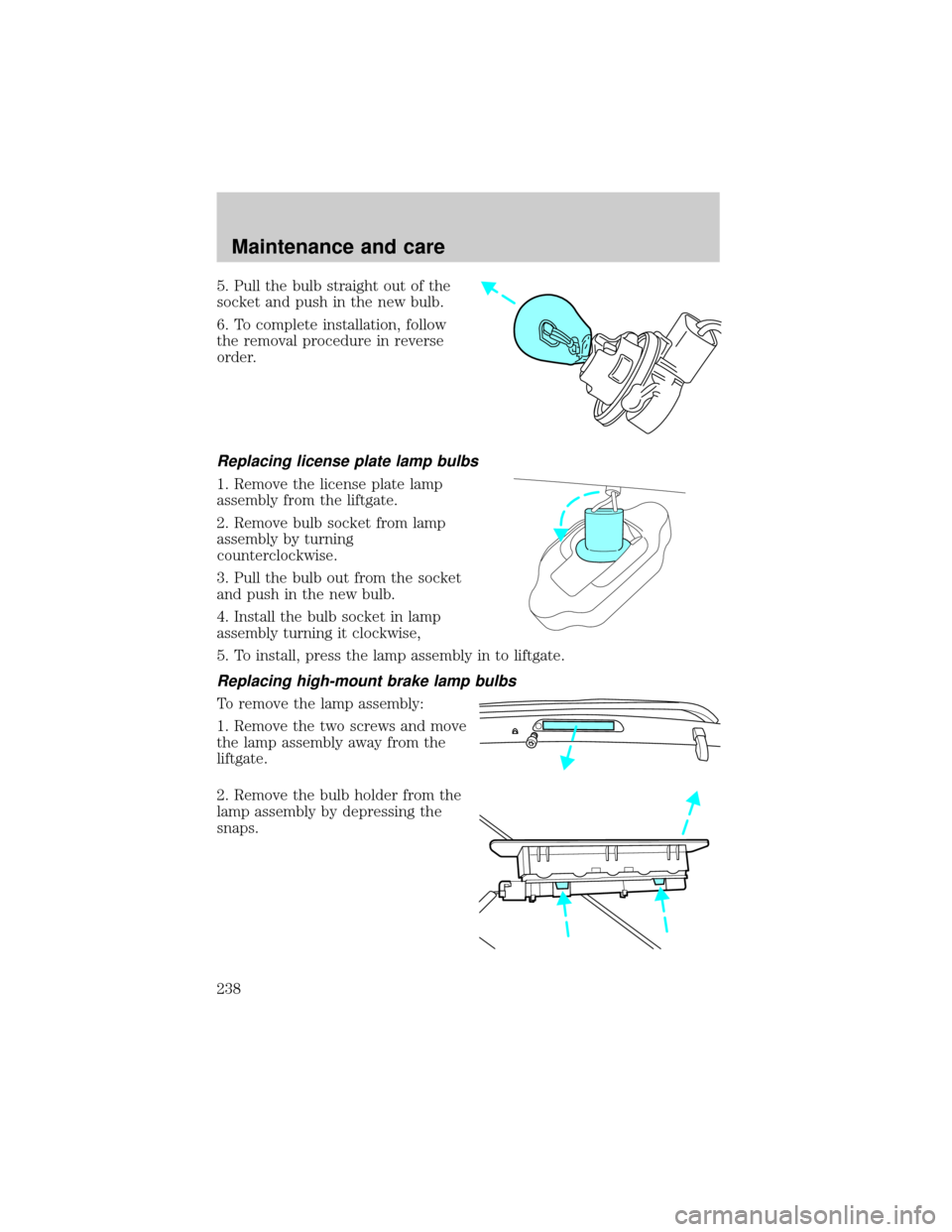
5. Pull the bulb straight out of the
socket and push in the new bulb.
6. To complete installation, follow
the removal procedure in reverse
order.
Replacing license plate lamp bulbs
1. Remove the license plate lamp
assembly from the liftgate.
2. Remove bulb socket from lamp
assembly by turning
counterclockwise.
3. Pull the bulb out from the socket
and push in the new bulb.
4. Install the bulb socket in lamp
assembly turning it clockwise,
5. To install, press the lamp assembly in to liftgate.
Replacing high-mount brake lamp bulbs
To remove the lamp assembly:
1. Remove the two screws and move
the lamp assembly away from the
liftgate.
2. Remove the bulb holder from the
lamp assembly by depressing the
snaps.
Maintenance and care
238
Page 242 of 280
Washing your vehicle
Wash your vehicle regularly with
cold or lukewarm water. Never use
strong detergents or soap. If your
vehicle is particularly dirty, use a
quality car wash detergent. Always
use a clean sponge, washing glove
or similar device and plenty of water
for best results. To avoid spots,
avoid washing when the hood is still
warm, immediately after or during
exposure to strong sunlight.
During winter months, it is especially important to wash the vehicle on a
regular basis. Large quantities of dirt and road salt are difficult to
remove and also cause damage to the vehicle.
Any gasoline spilled on the vehicle or deposits such as bird droppings
should be washed and sponged off as soon as possible. Deposits not
removed promptly can cause damage to the vehicle's paintwork.
Remove any exterior accessories, such as antennas, before entering a car
wash. If you have wax applied to the vehicle at a commercial car wash, it
is recommended that you clean the wiper blades and windshield as
described inCleaning the wiper blades and windshield.
After washing, apply the brakes several times to dry them.
Underbody
Flush the complete underside of vehicle frequently. Keep body drain
holes unplugged. Inspect for road damage.
Waxing your vehicle
Waxing your vehicle on a regular basis will reduce minor scratches and
paint damage.
Wax when water stops beading on the surface. This could be every three
or four months, depending on operating conditions.
Use only carnauba or synthetic-based waxes. Use a cleaning fluid with a
clean cloth to remove any bugs before waxing your vehicle. Use tar
remover to remove any tar spots.
Maintenance and care
242
Page 247 of 280
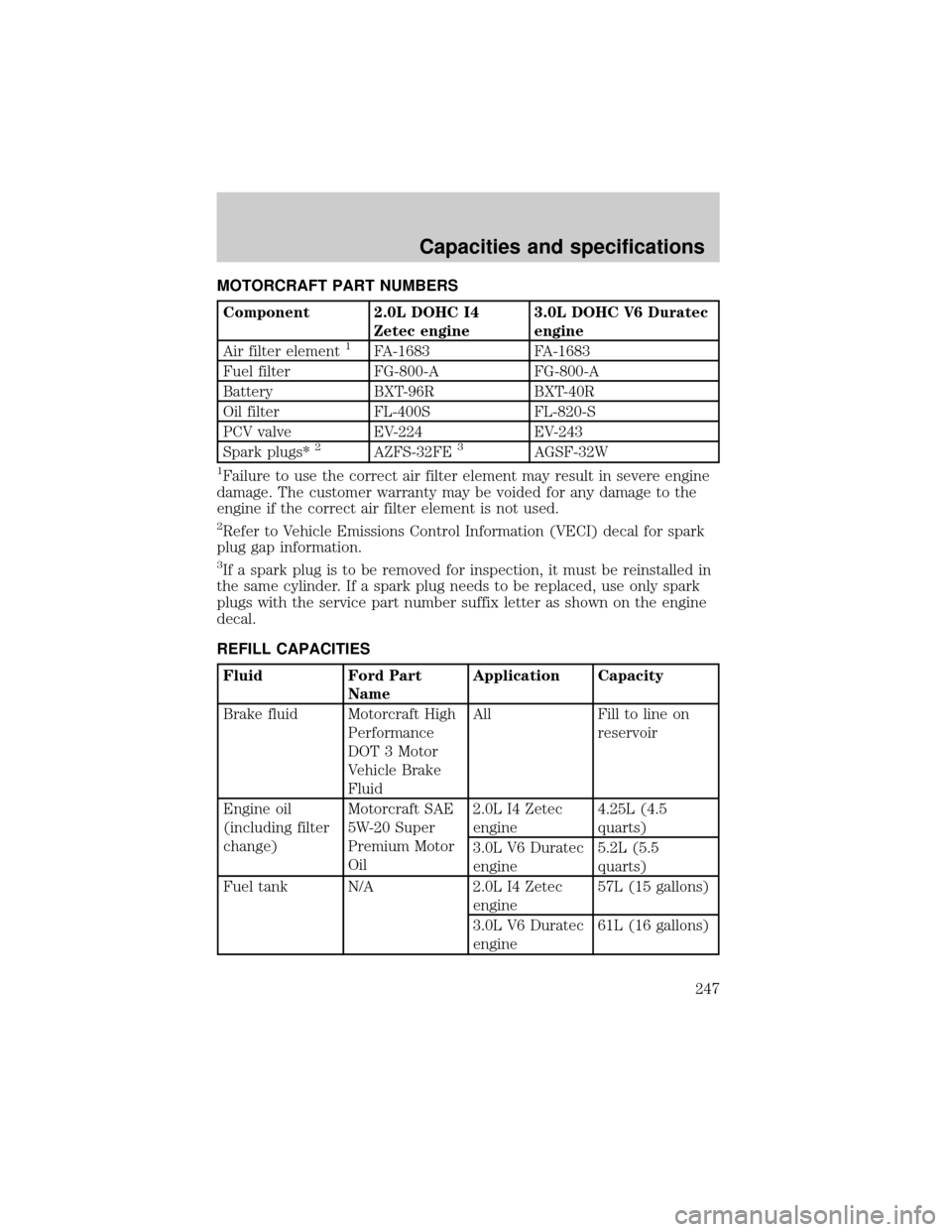
MOTORCRAFT PART NUMBERS
Component 2.0L DOHC I4
Zetec engine3.0L DOHC V6 Duratec
engine
Air filter element
1FA-1683 FA-1683
Fuel filter FG-800-A FG-800-A
Battery BXT-96R BXT-40R
Oil filter FL-400S FL-820-S
PCV valve EV-224 EV-243
Spark plugs*
2AZFS-32FE3AGSF-32W
1Failure to use the correct air filter element may result in severe engine
damage. The customer warranty may be voided for any damage to the
engine if the correct air filter element is not used.
2Refer to Vehicle Emissions Control Information (VECI) decal for spark
plug gap information.
3If a spark plug is to be removed for inspection, it must be reinstalled in
the same cylinder. If a spark plug needs to be replaced, use only spark
plugs with the service part number suffix letter as shown on the engine
decal.
REFILL CAPACITIES
Fluid Ford Part
NameApplication Capacity
Brake fluid Motorcraft High
Performance
DOT 3 Motor
Vehicle Brake
FluidAll Fill to line on
reservoir
Engine oil
(including filter
change)Motorcraft SAE
5W-20 Super
Premium Motor
Oil2.0L I4 Zetec
engine4.25L (4.5
quarts)
3.0L V6 Duratec
engine5.2L (5.5
quarts)
Fuel tank N/A 2.0L I4 Zetec
engine57L (15 gallons)
3.0L V6 Duratec
engine61L (16 gallons)
Capacities and specifications
247
Page 250 of 280
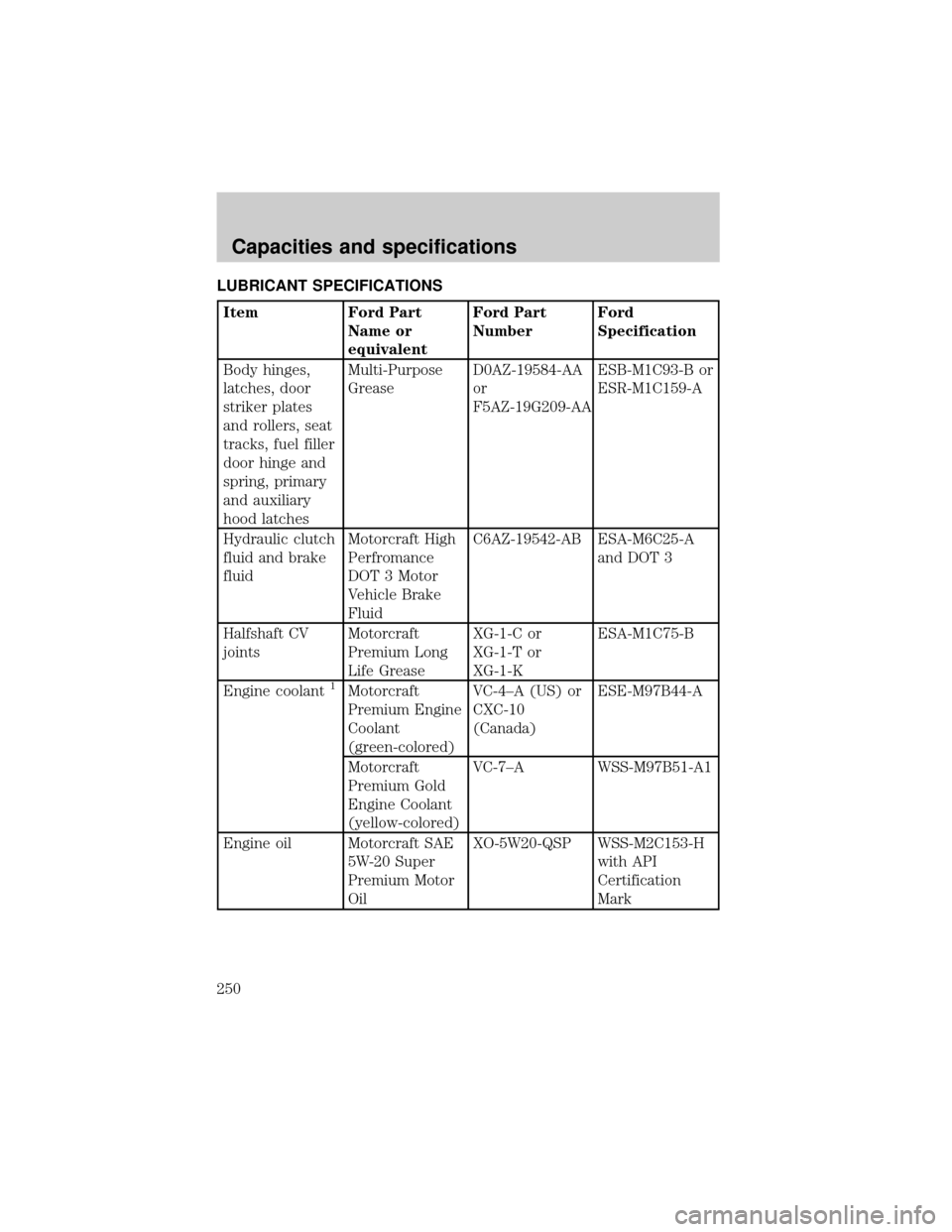
LUBRICANT SPECIFICATIONS
Item Ford Part
Name or
equivalentFord Part
NumberFord
Specification
Body hinges,
latches, door
striker plates
and rollers, seat
tracks, fuel filler
door hinge and
spring, primary
and auxiliary
hood latchesMulti-Purpose
GreaseD0AZ-19584-AA
or
F5AZ-19G209-AAESB-M1C93-B or
ESR-M1C159-A
Hydraulic clutch
fluid and brake
fluidMotorcraft High
Perfromance
DOT 3 Motor
Vehicle Brake
FluidC6AZ-19542-AB ESA-M6C25-A
and DOT 3
Halfshaft CV
jointsMotorcraft
Premium Long
Life GreaseXG-1-C or
XG-1-T or
XG-1-KESA-M1C75-B
Engine coolant
1Motorcraft
Premium Engine
Coolant
(green-colored)VC-4±A (US) or
CXC-10
(Canada)ESE-M97B44-A
Motorcraft
Premium Gold
Engine Coolant
(yellow-colored)VC-7±A WSS-M97B51-A1
Engine oil Motorcraft SAE
5W-20 Super
Premium Motor
OilXO-5W20-QSP WSS-M2C153-H
with API
Certification
Mark
Capacities and specifications
250
Page 270 of 280

A
Air bag supplemental restraint
system ........................118±119, 124
and child safety seats ............121
description ......................119, 124
disposal ....................................127
driver air bag ..................121, 125
indicator light ...........11, 123, 126
operation .........................121, 125
passenger air bag ...........121, 125
side air bag ..............................124
Air cleaner filter ...............207, 247
Air conditioning ..........................21
All Wheel Drive (AWD),
driving off road ...................20, 150
Ambulance packages ....................5
Antifreeze (see Engine
coolant) .....................................208
Anti-lock brake system (see
Brakes) ..............................142±143
Anti-theft system ........................95
arming the system ....................96
disarming a triggered system ..96
warning light .............................13
Audio system (see Radio) ...26, 54
Automatic transaxle .................146
driving with .............................147
fluid, adding ............................214
fluid, checking ........................214
Automatic transmission
fluid, refill capacities ..............247
fluid, specification ..................252
Auxiliary power point .................85
Axle
lubricant specifications ..250, 252
refill capacities ........................247B
Battery .......................................216
acid, treating emergencies .....216
charging system warning light 13
jumping a disabled battery ....188
maintenance-free ....................216
replacement, specifications ...247
servicing ..................................216
Belt minder ...............................113
Brakes ........................................142
anti-lock ...........................142±143
anti-lock brake system (ABS)
warning light .....................12, 142
brake warning light ..................12
fluid, checking and adding ....205
fluid, refill capacities ..............247
fluid, specifications .........250, 252
lubricant specifications ..250, 252
parking ....................................143
shift interlock ..........................146
Break-in period .............................3
C
Capacities for refilling fluids ....247
Cargo cover .................................86
Cargo net .....................................86
Certification Label ....................254
Child safety restraints ..............127
child safety belts ....................127
Child safety seats ......................128
attaching with tether straps ..132
in front seat ............................129
in rear seat ..............................129
LATCH .....................................134
Cleaning your vehicle ...............241
engine compartment ..............243
Index
270
Page 273 of 280

Headlamps ...................................81
aiming ......................................240
bulb specifications ..................239
daytime running lights .............81
flash to pass ..............................82
high beam ...........................13, 81
replacing bulbs .......................235
turning on and off ....................81
warning chime ..........................15
Heating ........................................21
heater only system ...................21
heating and air conditioning
system .......................................22
Hood ..........................................197
I
Ignition .................................71, 252
Infant seats
(see Safety seats) .....................128
Inspection/maintenance (I/M)
testing ........................................234
Instrument panel
cleaning ...................................245
cluster ................................10, 246
lighting up panel and
interior .......................................19
location of components ............10
J
Jack ............................................183
positioning ...............................183
storage .....................................183
Jump-starting your vehicle ......188K
Keys .......................................93±94
key in ignition chime ...............15
positions of the ignition ...........71
L
Lamps
bulb replacement
specifications chart ................239
cargo lamps ...............................19
daytime running light ...............81
fog lamps ...................................82
headlamps .................................81
headlamps, flash to pass ..........82
instrument panel, dimming .....19
interior lamps .............79±80, 239
replacing bulbs .......235, 237±239
Lane change indicator (see
Turn signal) .................................71
Liftgate ........................................89
Lights, warning and indicator ....10
air bag ........................................11
anti-lock brakes (ABS) ....12, 142
anti-theft ...................................13
brake ..........................................12
charging system ........................13
cruise indicator .........................13
door ajar ....................................14
fuel cap light .............................15
high beam .................................13
low coolant ................................14
low fuel ......................................11
oil pressure ...............................13
overdrive off ..............................14
safety belt .................................12
service engine soon ..................10
turn signal indicator .................12
Index
273