seats FORD ESCAPE 2003 1.G Owner's Manual
[x] Cancel search | Manufacturer: FORD, Model Year: 2003, Model line: ESCAPE, Model: FORD ESCAPE 2003 1.GPages: 240, PDF Size: 2.6 MB
Page 106 of 240
When installing a child safety seat:
•Review and follow the information
presented in theAir bag
supplemental restraint system
(SRS) section in this chapter.
•Use the correct safety belt buckle
for that seating position (the
buckle closest to the direction the
tongue is coming from).
•Insert the belt tongue into the
proper buckle until you hear a
snap and feel it latch. Make sure the tongue is securely fastened in the
buckle.
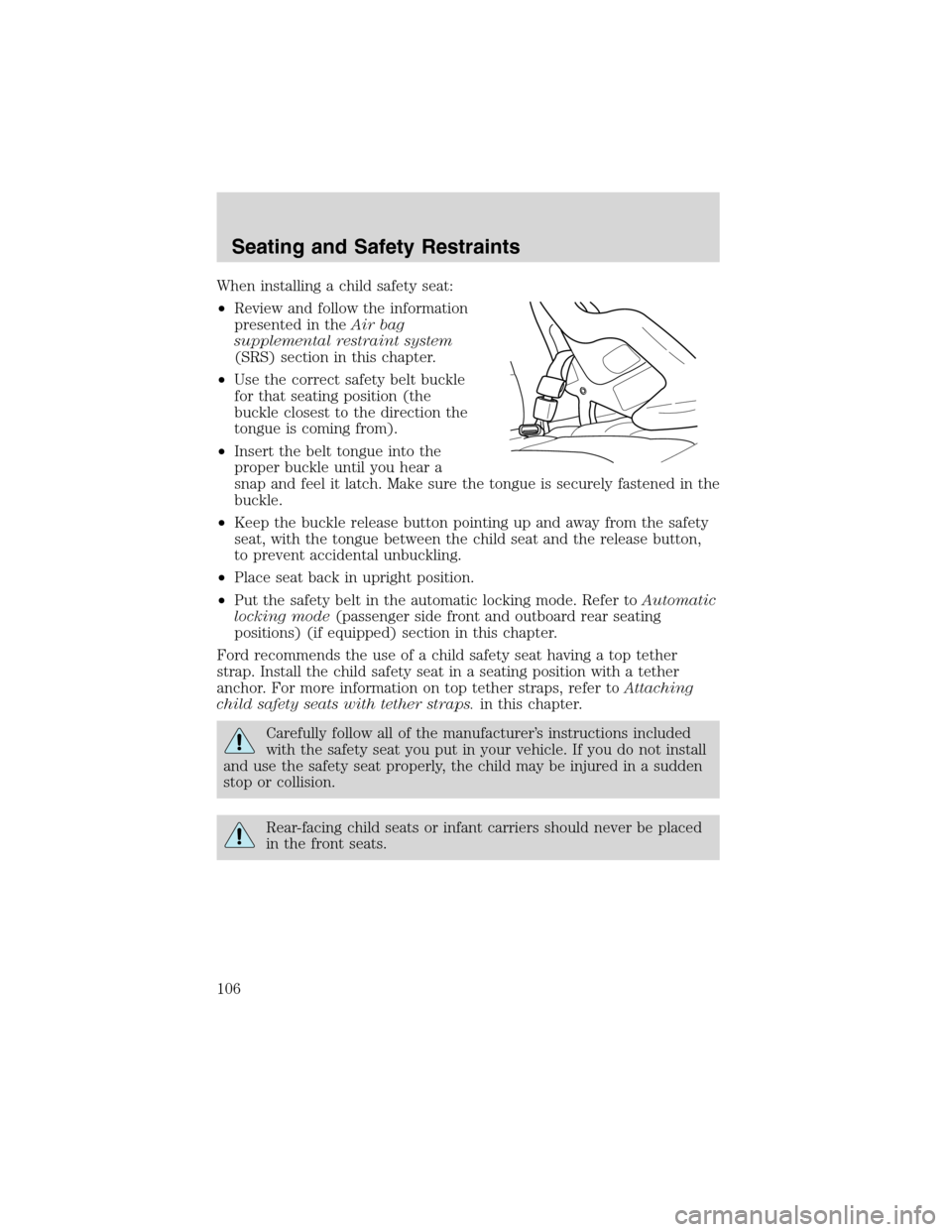
•Keep the buckle release button pointing up and away from the safety
seat, with the tongue between the child seat and the release button,
to prevent accidental unbuckling.
•Place seat back in upright position.
•Put the safety belt in the automatic locking mode. Refer toAutomatic
locking mode(passenger side front and outboard rear seating
positions) (if equipped) section in this chapter.
Ford recommends the use of a child safety seat having a top tether
strap. Install the child safety seat in a seating position with a tether
anchor. For more information on top tether straps, refer toAttaching
child safety seats with tether straps.in this chapter.
Carefully follow all of the manufacturer’s instructions included
with the safety seat you put in your vehicle. If you do not install
and use the safety seat properly, the child may be injured in a sudden
stop or collision.
Rear-facing child seats or infant carriers should never be placed
in the front seats.
Seating and Safety Restraints
106
Page 107 of 240
Installing child safety seats with combination lap and shoulder
belts
The rear seat head restraints must be removed when using a child
seat.
Air bags can kill or injure a child in a child seat.NEVERplace a
rear-facing child seat in front of an active air bag. If you must
use a forward-facing child seat in the front seat, move the seat all the
way back.
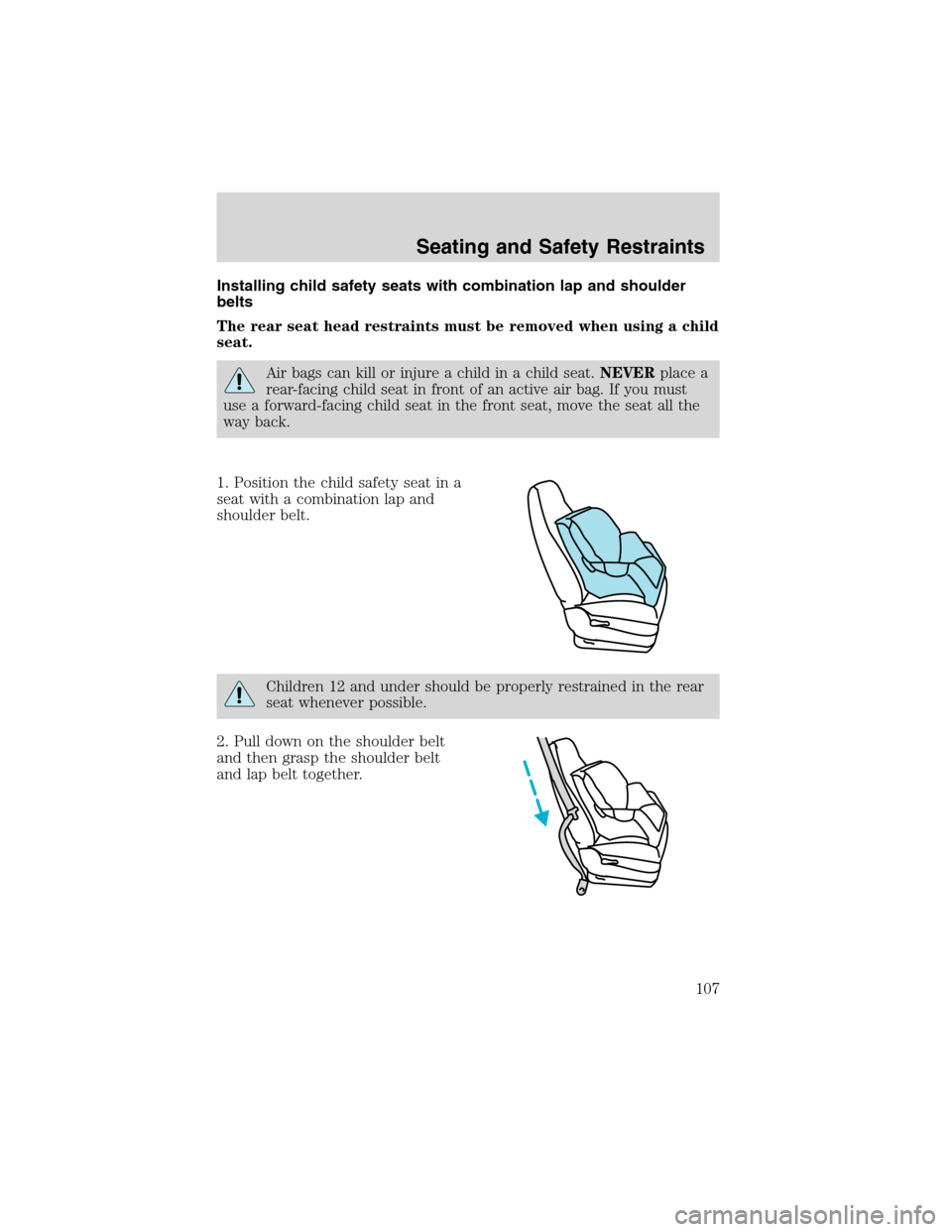
1. Position the child safety seat in a
seat with a combination lap and
shoulder belt.
Children 12 and under should be properly restrained in the rear
seat whenever possible.
2. Pull down on the shoulder belt
and then grasp the shoulder belt
and lap belt together.
Seating and Safety Restraints
107
Page 109 of 240
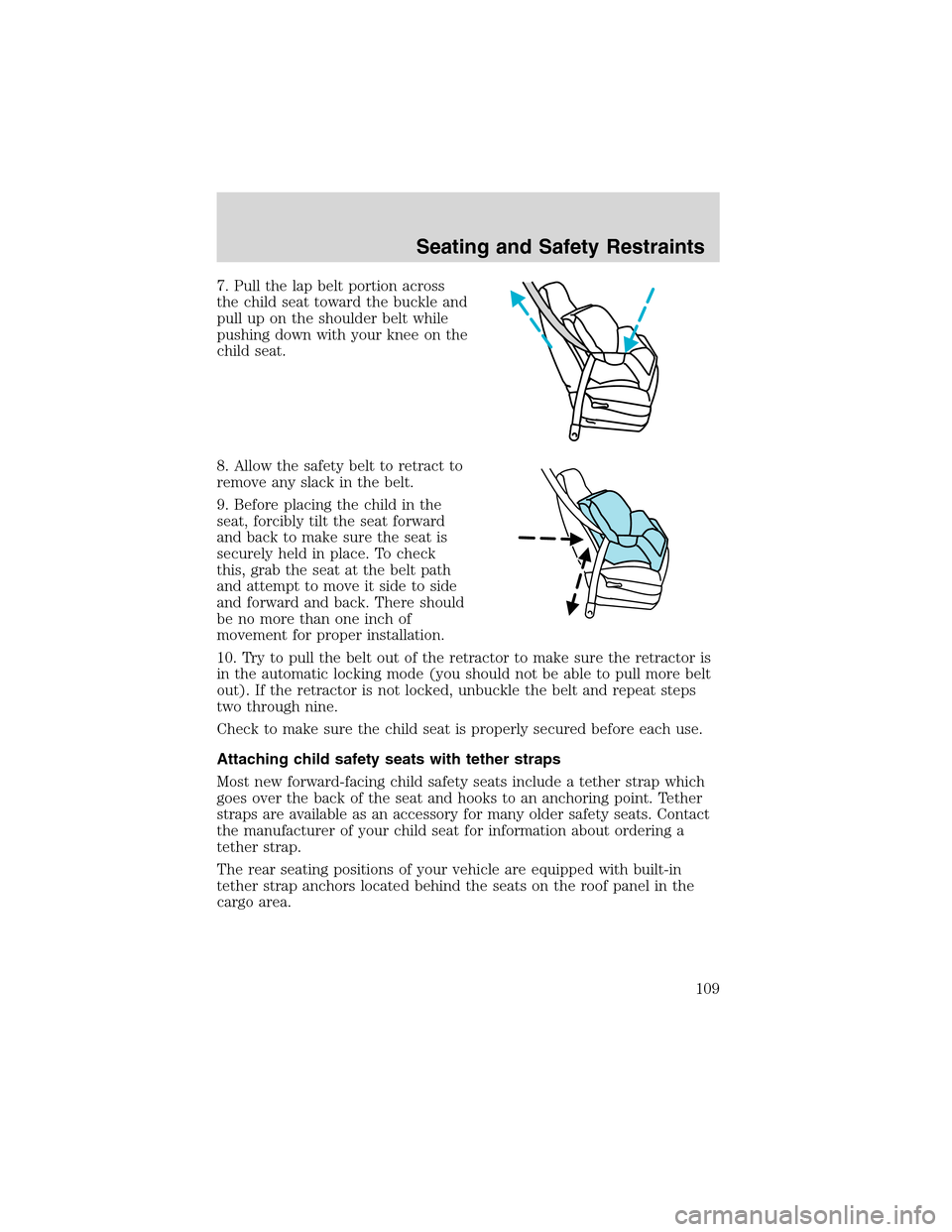
7. Pull the lap belt portion across
the child seat toward the buckle and
pull up on the shoulder belt while
pushing down with your knee on the
child seat.
8. Allow the safety belt to retract to
remove any slack in the belt.
9. Before placing the child in the
seat, forcibly tilt the seat forward
and back to make sure the seat is
securely held in place. To check
this, grab the seat at the belt path
and attempt to move it side to side
and forward and back. There should
be no more than one inch of
movement for proper installation.
10. Try to pull the belt out of the retractor to make sure the retractor is
in the automatic locking mode (you should not be able to pull more belt
out). If the retractor is not locked, unbuckle the belt and repeat steps
two through nine.
Check to make sure the child seat is properly secured before each use.
Attaching child safety seats with tether straps
Most new forward-facing child safety seats include a tether strap which
goes over the back of the seat and hooks to an anchoring point. Tether
straps are available as an accessory for many older safety seats. Contact
the manufacturer of your child seat for information about ordering a
tether strap.
The rear seating positions of your vehicle are equipped with built-in
tether strap anchors located behind the seats on the roof panel in the
cargo area.
Seating and Safety Restraints
109
Page 111 of 240
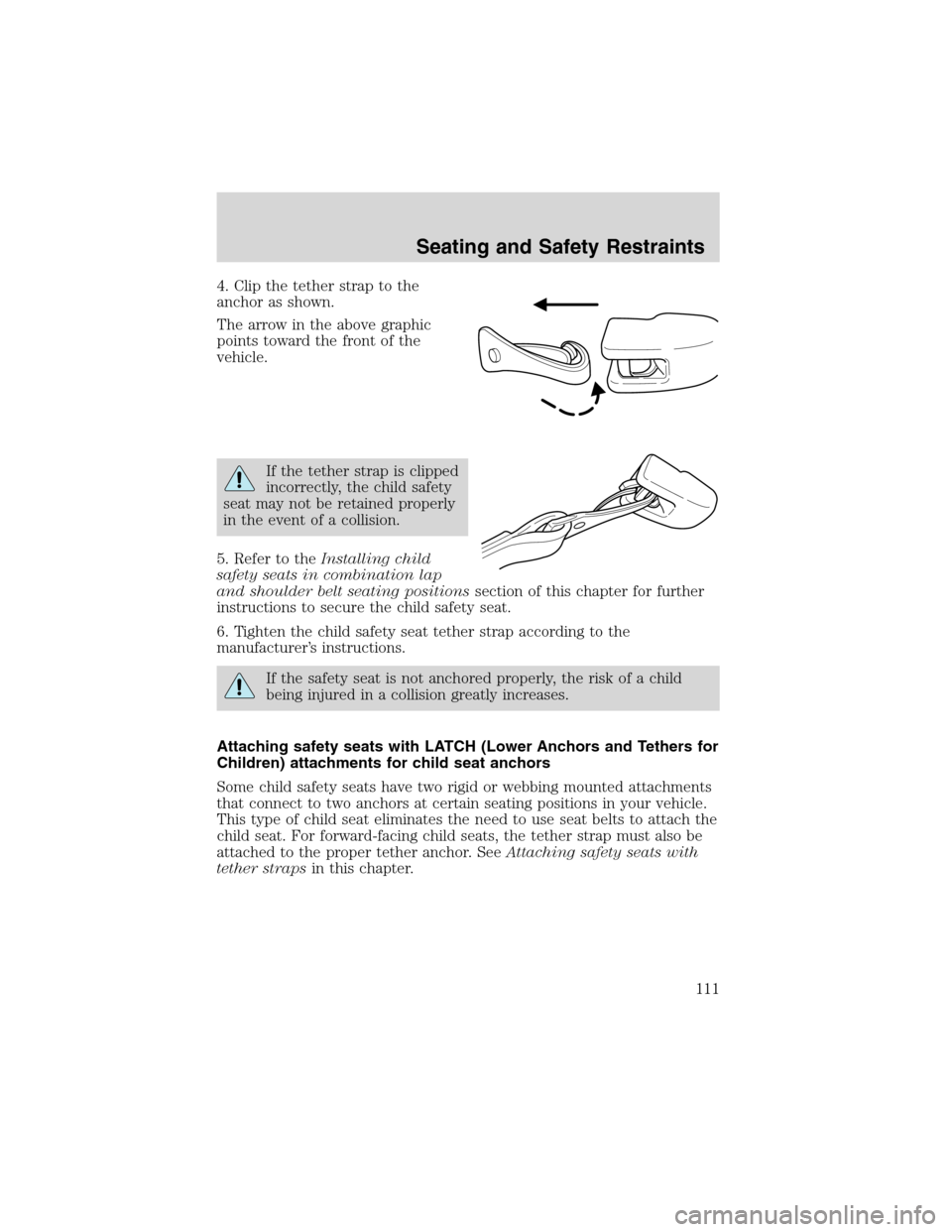
4. Clip the tether strap to the
anchor as shown.
The arrow in the above graphic
points toward the front of the
vehicle.
If the tether strap is clipped
incorrectly, the child safety
seat may not be retained properly
in the event of a collision.
5. Refer to theInstalling child
safety seats in combination lap
and shoulder belt seating positionssection of this chapter for further
instructions to secure the child safety seat.
6. Tighten the child safety seat tether strap according to the
manufacturer’s instructions.
If the safety seat is not anchored properly, the risk of a child
being injured in a collision greatly increases.
Attaching safety seats with LATCH (Lower Anchors and Tethers for
Children) attachments for child seat anchors
Some child safety seats have two rigid or webbing mounted attachments
that connect to two anchors at certain seating positions in your vehicle.
This type of child seat eliminates the need to use seat belts to attach the
child seat. For forward-facing child seats, the tether strap must also be
attached to the proper tether anchor. SeeAttaching safety seats with
tether strapsin this chapter.
Seating and Safety Restraints
111
Page 112 of 240
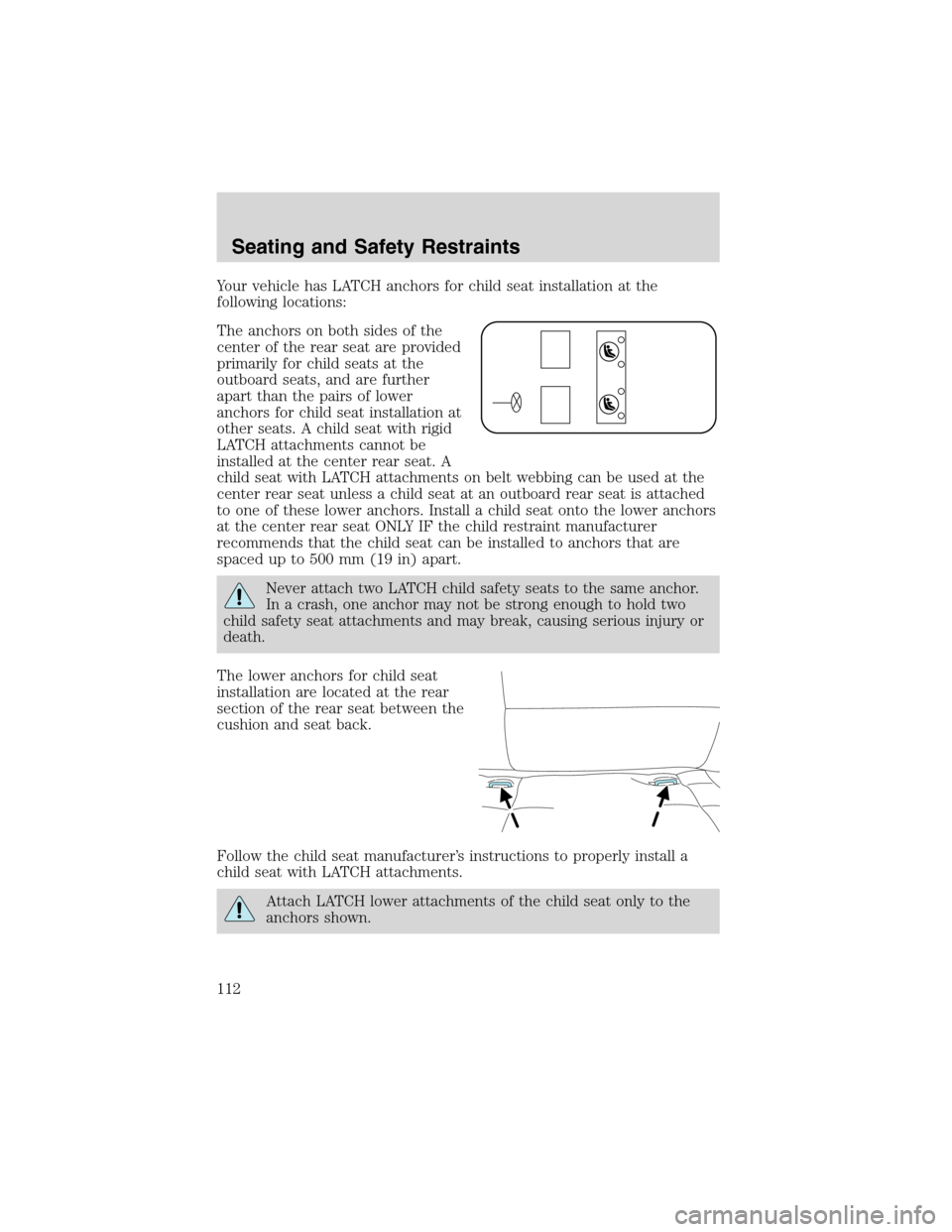
Your vehicle has LATCH anchors for child seat installation at the
following locations:
The anchors on both sides of the
center of the rear seat are provided
primarily for child seats at the
outboard seats, and are further
apart than the pairs of lower
anchors for child seat installation at
other seats. A child seat with rigid
LATCH attachments cannot be
installed at the center rear seat. A
child seat with LATCH attachments on belt webbing can be used at the
center rear seat unless a child seat at an outboard rear seat is attached
to one of these lower anchors. Install a child seat onto the lower anchors
at the center rear seat ONLY IF the child restraint manufacturer
recommends that the child seat can be installed to anchors that are
spaced up to 500 mm (19 in) apart.
Never attach two LATCH child safety seats to the same anchor.
In a crash, one anchor may not be strong enough to hold two
child safety seat attachments and may break, causing serious injury or
death.
The lower anchors for child seat
installation are located at the rear
section of the rear seat between the
cushion and seat back.
Follow the child seat manufacturer’s instructions to properly install a
child seat with LATCH attachments.
Attach LATCH lower attachments of the child seat only to the
anchors shown.
Seating and Safety Restraints
112
Page 150 of 240
Fuse/Relay
LocationFuse Amp
RatingPassenger Compartment Fuse
Panel Description
7 10A Passive Anti-theft Transceiver
(PATS), RCM, EEC fuse
8 10A Cluster, Shift lock relay (coil), O/D
signal to PCM, GEM, E/C autolamp
mirror
9 3A PCM relay (coil), Fan relay 1, 2, 3
(coil), A/C relay (coil)
10 20A Front wiper motor, Front washer
motor
11 10A ACC relay (coil), Key interlock
solenoid, GEM
12 5A Radio
13—Not used
14 20A Cigar lighter
15 15A Park lamp relay, Front position
lamps, License lamps, Tail lamps,
Park lamp relay (coil), Trailer fuse,
Illumination fuse
16 10A Cluster, Power mirror, GEM,
Heated seats
17 15A Sun roof motor
18 5A Illumination for: Cluster, Heater
unit, Radio, Hazard switch, Rear
defrost switch, 4WD switch, Front
fog switch
19 10A Subwoofer amp
20 15A Turn Indicators, Front Side Turn
Lamps, Front turn lamps, Rear turn
lamps, Trailer turn, Flasher unit
21 10A Trailer position lamps
22 15A Not used
23 20A Horn relay
Roadside Emergencies
150
Page 152 of 240
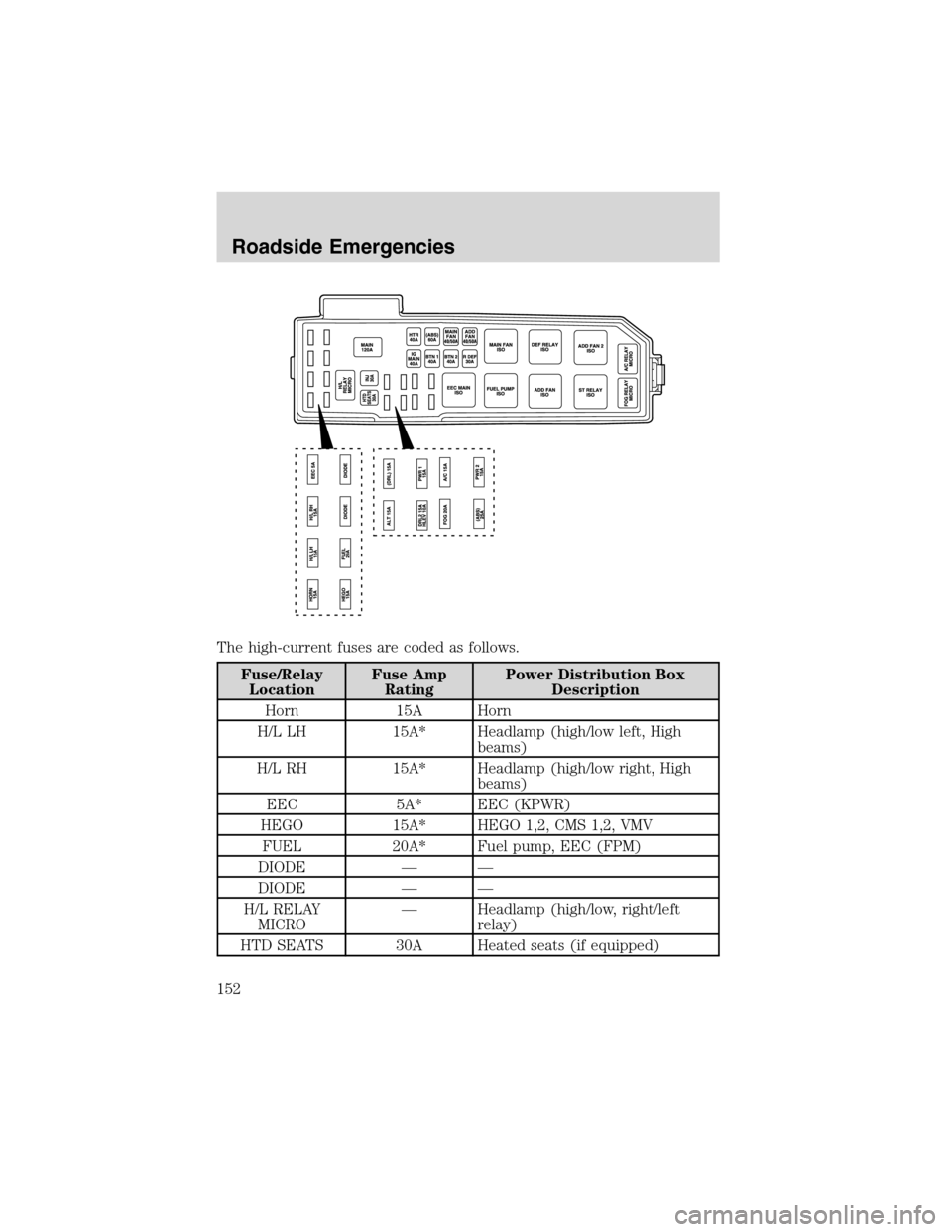
The high-current fuses are coded as follows.
Fuse/Relay
LocationFuse Amp
RatingPower Distribution Box
Description
Horn 15A Horn
H/L LH 15A* Headlamp (high/low left, High
beams)
H/L RH 15A* Headlamp (high/low right, High
beams)
EEC 5A* EEC (KPWR)
HEGO 15A* HEGO 1,2, CMS 1,2, VMV
FUEL 20A* Fuel pump, EEC (FPM)
DIODE——
DIODE——
H/L RELAY
MICRO—Headlamp (high/low, right/left
relay)
HTD SEATS 30A Heated seats (if equipped)
Roadside Emergencies
152
Page 181 of 240
INTERIOR
For fabric, carpets, cloth seats, safety belts and seats equipped with side
air bags:
•Remove dust and loose dirt with a vacuum cleaner.
•Remove light stains and soil with Ford Extra Strength Upholstery
Cleaner (E8AZ-19523–AA).
•If grease or tar is present on the material, spot-clean the area first
with Motorcraft Spot and Stain Remover (ZC-14).
•Never saturate the seat covers with cleaning solution.
•Do not use household cleaning products or glass cleaners, which can
stain and discolor the fabric and affect the flame retardant abilities of
the seat materials.
Do not use cleaning solvents, bleach or dye on the vehicle’s
safety belts, as these actions may weaken the belt webbing.
LEATHER SEATS (IF EQUIPPED)
Your leather seating surfaces have a clear, protective coating over the
leather.
•To clean, use a soft cloth with Motorcraft Deluxe Leather and Vinyl
Cleaner (ZC-11–A). Dry the area with a soft cloth.
•To help maintain its resiliency and color, use the Motorcraft Deluxe
Leather Care Kit (ZC-11–D), available from your authorized dealer.
•Do not use household cleaning products, alcohol solutions, solvents or
cleaners intended for rubber, vinyl and plastics, or oil/petroleum-based
leather conditioners. These products may cause premature wearing of
the clear, protective coating.
UNDERBODY
Flush the complete underside of your vehicle frequently. Keep body and
door drain holes free from packed dirt.
Cleaning
181
Page 231 of 240
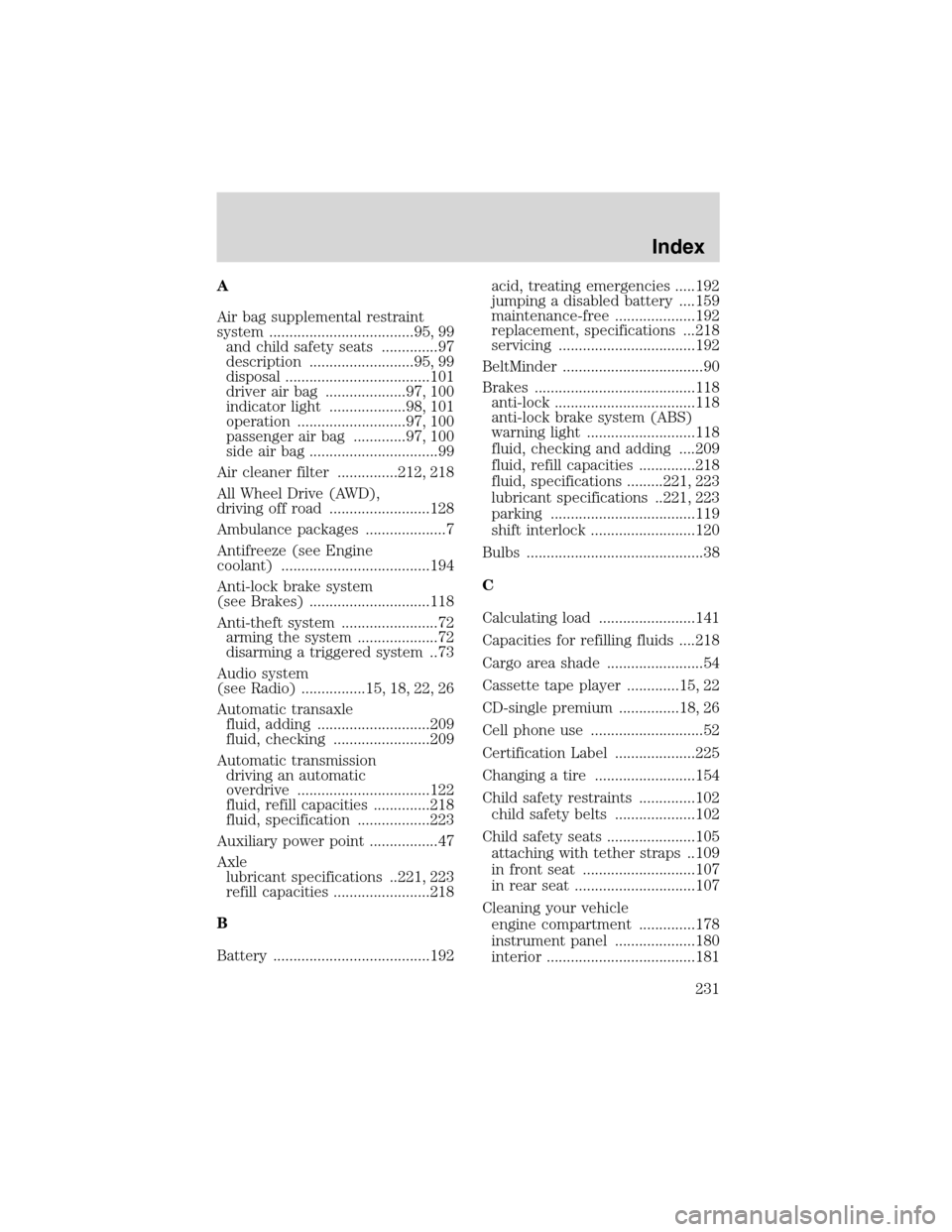
A
Air bag supplemental restraint
system ....................................95, 99
and child safety seats ..............97
description ..........................95, 99
disposal ....................................101
driver air bag ....................97, 100
indicator light ...................98, 101
operation ...........................97, 100
passenger air bag .............97, 100
side air bag ................................99
Air cleaner filter ...............212, 218
All Wheel Drive (AWD),
driving off road .........................128
Ambulance packages ....................7
Antifreeze (see Engine
coolant) .....................................194
Anti-lock brake system
(see Brakes) ..............................118
Anti-theft system ........................72
arming the system ....................72
disarming a triggered system ..73
Audio system
(see Radio) ................15, 18, 22, 26
Automatic transaxle
fluid, adding ............................209
fluid, checking ........................209
Automatic transmission
driving an automatic
overdrive .................................122
fluid, refill capacities ..............218
fluid, specification ..................223
Auxiliary power point .................47
Axle
lubricant specifications ..221, 223
refill capacities ........................218
B
Battery .......................................192acid, treating emergencies .....192
jumping a disabled battery ....159
maintenance-free ....................192
replacement, specifications ...218
servicing ..................................192
BeltMinder ...................................90
Brakes ........................................118
anti-lock ...................................118
anti-lock brake system (ABS)
warning light ...........................118
fluid, checking and adding ....209
fluid, refill capacities ..............218
fluid, specifications .........221, 223
lubricant specifications ..221, 223
parking ....................................119
shift interlock ..........................120
Bulbs ............................................38
C
Calculating load ........................141
Capacities for refilling fluids ....218
Cargo area shade ........................54
Cassette tape player .............15, 22
CD-single premium ...............18, 26
Cell phone use ............................52
Certification Label ....................225
Changing a tire .........................154
Child safety restraints ..............102
child safety belts ....................102
Child safety seats ......................105
attaching with tether straps ..109
in front seat ............................107
in rear seat ..............................107
Cleaning your vehicle
engine compartment ..............178
instrument panel ....................180
interior .....................................181
Index
231
Page 233 of 240
Exhaust fumes ..........................117
F
Fluid capacities .........................218
Foglamps .....................................33
Four-Wheel Drive vehicles
driving off road .......................129
indicator light .........................128
preparing to drive your
vehicle .....................................119
Fuel ............................................199
calculating fuel economy .......203
cap ...........................................201
capacity ...................................218
choosing the right fuel ...........201
comparisons with EPA fuel
economy estimates .................206
detergent in fuel .....................203
filling your vehicle with
fuel ...........................199, 201, 203
filter, specifications ........203, 218
fuel pump shut-off switch .....146
improving fuel economy ........203
octane rating ...................202, 223
quality ......................................202
running out of fuel .................203
safety information relating to
automotive fuels .....................199
Fuses ..................................147–148
G
Garage door opener ....................46
Gas cap (see Fuel cap) ............201
Gas mileage (see Fuel
economy) ...................................203
Gauges .........................................13
GAWR (Gross Axle Weight
Rating) .......................................139calculating ...............................141
definition .................................139
driving with a heavy load ......139
location ....................................139
GVWR (Gross Vehicle Weight
Rating) .......................................139
calculating .......................139, 141
definition .................................139
driving with a heavy load ......139
location ....................................139
H
Hazard flashers .........................146
Head restraints .....................75, 77
Headlamps ...................................33
aiming ........................................35
autolamp system .................33, 46
bulb specifications ....................38
daytime running lights .............33
flash to pass ..............................34
high beam .................................34
replacing bulbs .........................39
turning on and off ....................33
Heating
heater only system ...................30
Hood ..........................................184
I
Ignition ...............................114, 223
Infant seats
(see Safety seats) .....................105
Inspection/maintenance (I/M)
testing ........................................207
Instrument panel
cleaning ...................................180
cluster ........................................10
lighting up panel and
interior .......................................34
Index
233