heating FORD ESCAPE 2004 1.G Owners Manual
[x] Cancel search | Manufacturer: FORD, Model Year: 2004, Model line: ESCAPE, Model: FORD ESCAPE 2004 1.GPages: 240, PDF Size: 2.5 MB
Page 1 of 240
Introduction 4
Instrument Cluster 10
Warning and control lights 10
Gauges 13
Entertainment Systems 15
AM/FM stereo with CD 15
AM/FM stereo cassette with CD 18
Climate Controls 31
Heater only 31
Manual heating and air conditioning 32
Lights 34
Headlamps 34
Turn signal control 37
Bulb replacement 39
Driver Controls 44
Windshield wiper/washer control 44
Steering wheel adjustment 46
Power windows 49
Mirrors 50
Speed control 51
Locks and Security 65
Keys 65
Locks 65
Anti-theft system 70
2004 Escape(204)
Owners Guide (post-2002-fmt)
USA English(fus)
Table of Contents
Table of Contents
1
Page 13 of 240
Key-in-ignition warning chime:Sounds when the key is left in the
ignition in the OFF/LOCK or ACC position and the driver’s door is
opened.
Headlamps on warning chime:Sounds when the headlamps or parking
lamps are on, the ignition is off (the key is not in the ignition) and the
driver’s door is opened.
GAUGES
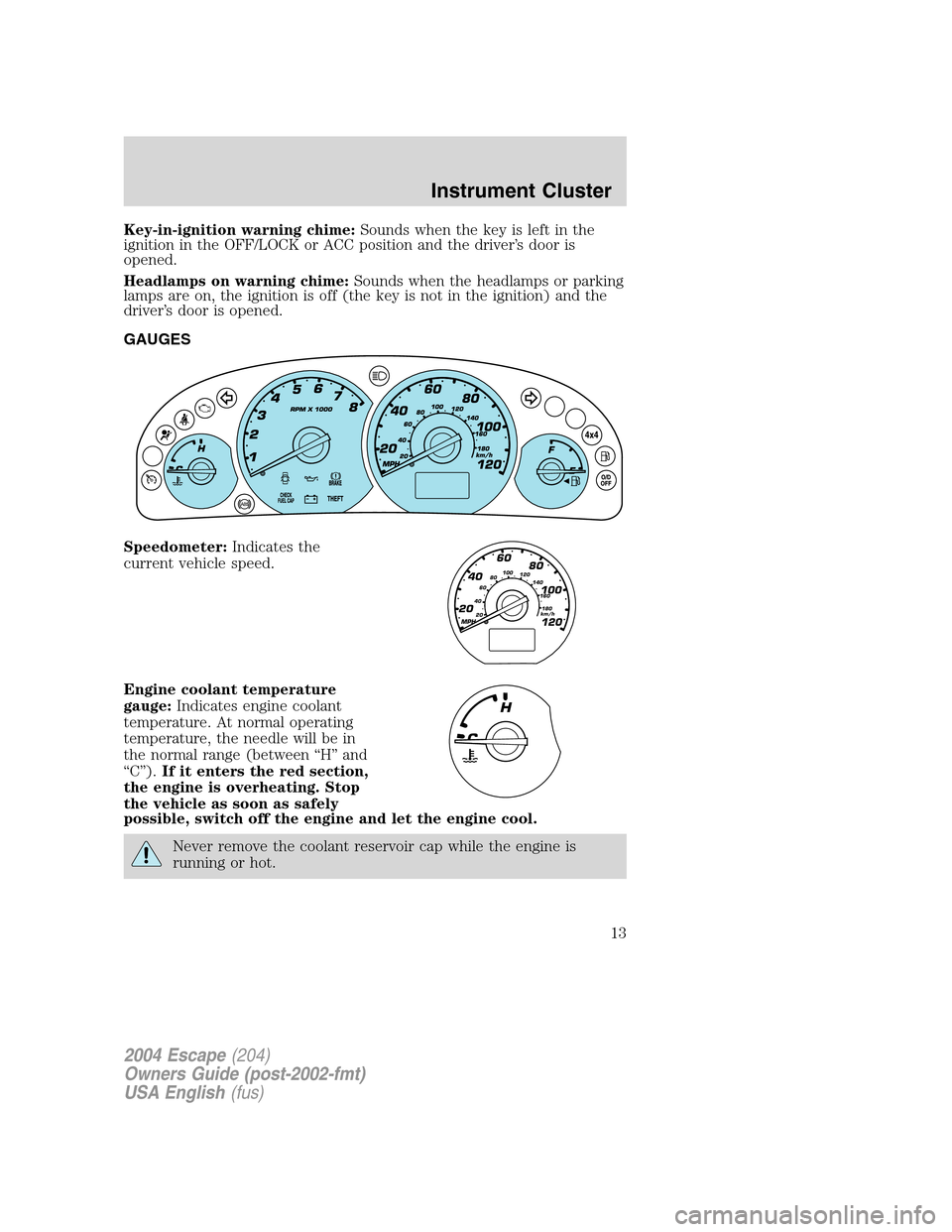
Speedometer:Indicates the
current vehicle speed.
Engine coolant temperature
gauge:Indicates engine coolant
temperature. At normal operating
temperature, the needle will be in
the normal range (between “H” and
“C”).If it enters the red section,
the engine is overheating. Stop
the vehicle as soon as safely
possible, switch off the engine and let the engine cool.
Never remove the coolant reservoir cap while the engine is
running or hot.
MPH
60
40
20
20 406080100
120
140
160
180
80
100
120
km/h
2004 Escape(204)
Owners Guide (post-2002-fmt)
USA English(fus)
Instrument Cluster
13
Page 32 of 240
4. Direct the outer instrument panel vents towards the side windows
To increase airflow to the outer instrument panel vents, close the vents
located in the middle of the instrument panel.
Do not place objects on top of the instrument panel as these
objects may become projectiles in a collision or sudden stop.
MANUAL HEATING AND AIR
CONDITIONING SYSTEM
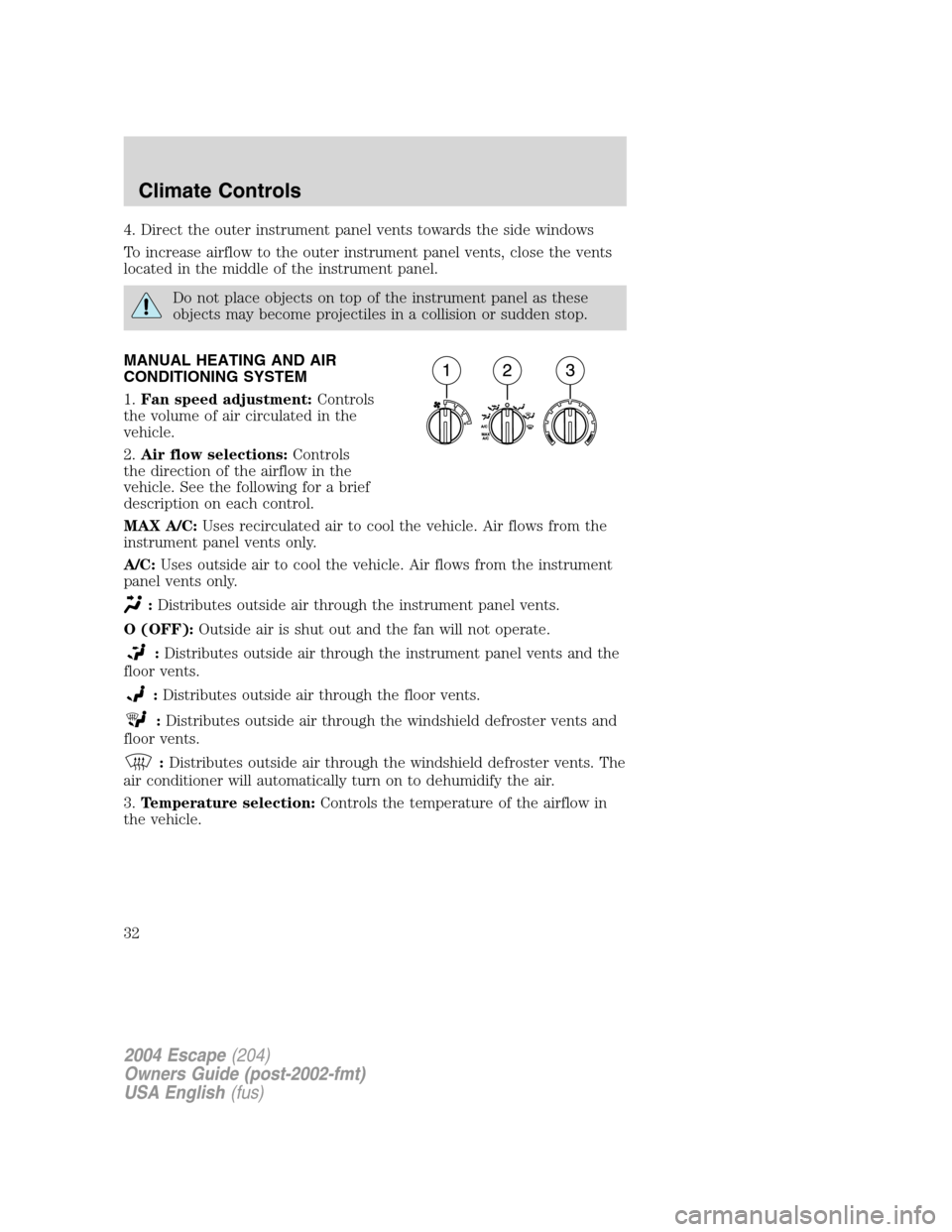
1.Fan speed adjustment:Controls
the volume of air circulated in the
vehicle.
2.Air flow selections:Controls
the direction of the airflow in the
vehicle. See the following for a brief
description on each control.
MAX A/C:Uses recirculated air to cool the vehicle. Air flows from the
instrument panel vents only.
A/C:Uses outside air to cool the vehicle. Air flows from the instrument
panel vents only.
:Distributes outside air through the instrument panel vents.
O (OFF):Outside air is shut out and the fan will not operate.
:Distributes outside air through the instrument panel vents and the
floor vents.
:Distributes outside air through the floor vents.
:Distributes outside air through the windshield defroster vents and
floor vents.
:Distributes outside air through the windshield defroster vents. The
air conditioner will automatically turn on to dehumidify the air.
3.Temperature selection:Controls the temperature of the airflow in
the vehicle.
2004 Escape(204)
Owners Guide (post-2002-fmt)
USA English(fus)
Climate Controls
32
Page 119 of 240
Important ventilating information
If the engine is idling while the vehicle is stopped for a long period of
time, open the windows at least 2.5 cm (one inch) or adjust the heating
or air conditioning to bring in fresh air.
BRAKES
Occasional brake noise is normal. If a metal-to-metal, continuous grinding
or continuous squeal sound is present, the brake linings may be worn-out
and should be inspected by a qualified service technician. If the vehicle
has continuous vibration or shudder in the steering wheel while braking,
the vehicle should be inspected by a qualified service technician.
Under normal operating conditions, brake dust may accumulate on the
wheels. Some brake dust is inevitable as brakes wear and does not
contribute to brake noise. The use of modern friction materials with
emphasis on improved performance and environmental considerations
can lead to more dust than in the past. Brake dust can be cleaned by
weekly washing with soapy water and a soft sponge. Heavier deposits can
be removed with Motorcraft Wheel and Tire Cleaner (ZC-37–A).
Four-wheel anti-lock brake system (ABS) (if equipped)
Your vehicle may be equipped with an Anti-lock Braking System (ABS).
This system helps you maintain steering control during emergency stops
by keeping the brakes from locking. Noise from the ABS pump motor
and brake pedal pulsation may be observed during ABS braking; any
pulsation or mechanical noise you may feel or hear is normal.
Using ABS
When hard braking is required, apply continuous force on the brake
pedal; do not pump the brake pedal since this will reduce the
effectiveness of the ABS and will increase your vehicle’s stopping
distance. The ABS will be activated immediately, allowing you to retain
full steering control during hard braking and on slippery surfaces.
However, the ABS does not decrease stopping distance.
ABS warning lamp
ABS
TheABSlamp in the instrument cluster momentarily illuminates when
the ignition is turned to ON. If the light does not illuminate during start
up, remains on or flashes, the ABS may be disabled and may need to be
serviced
2004 Escape(204)
Owners Guide (post-2002-fmt)
USA English(fus)
Driving
119
Page 136 of 240
Apply just enough power to the wheels to climb the hill. Too much
power will cause the tires to slip, spin or lose traction, resulting in loss of
vehicle control.
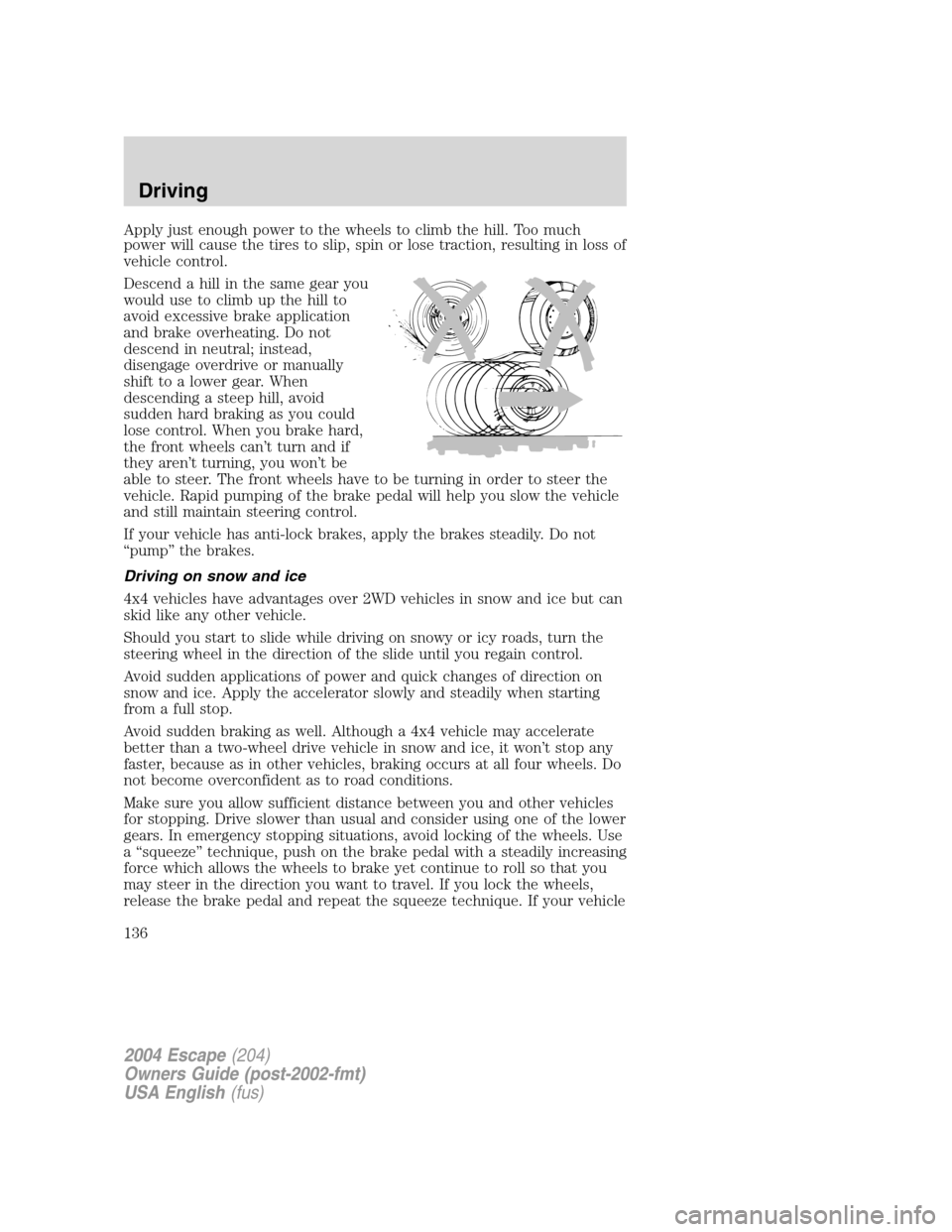
Descend a hill in the same gear you
would use to climb up the hill to
avoid excessive brake application
and brake overheating. Do not
descend in neutral; instead,
disengage overdrive or manually
shift to a lower gear. When
descending a steep hill, avoid
sudden hard braking as you could
lose control. When you brake hard,
the front wheels can’t turn and if
they aren’t turning, you won’t be
able to steer. The front wheels have to be turning in order to steer the
vehicle. Rapid pumping of the brake pedal will help you slow the vehicle
and still maintain steering control.
If your vehicle has anti-lock brakes, apply the brakes steadily. Do not
“pump” the brakes.
Driving on snow and ice
4x4 vehicles have advantages over 2WD vehicles in snow and ice but can
skid like any other vehicle.
Should you start to slide while driving on snowy or icy roads, turn the
steering wheel in the direction of the slide until you regain control.
Avoid sudden applications of power and quick changes of direction on
snow and ice. Apply the accelerator slowly and steadily when starting
from a full stop.
Avoid sudden braking as well. Although a 4x4 vehicle may accelerate
better than a two-wheel drive vehicle in snow and ice, it won’t stop any
faster, because as in other vehicles, braking occurs at all four wheels. Do
not become overconfident as to road conditions.
Make sure you allow sufficient distance between you and other vehicles
for stopping. Drive slower than usual and consider using one of the lower
gears. In emergency stopping situations, avoid locking of the wheels. Use
a “squeeze” technique, push on the brake pedal with a steadily increasing
force which allows the wheels to brake yet continue to roll so that you
may steer in the direction you want to travel. If you lock the wheels,
release the brake pedal and repeat the squeeze technique. If your vehicle
2004 Escape(204)
Owners Guide (post-2002-fmt)
USA English(fus)
Driving
136
Page 198 of 240
Note:Use of Motorcraft Cooling System Stop Leak Pellets, VC-6, may
darken the color of Motorcraft Premium Gold Engine Coolant from
yellow to golden tan.
•Do not add/mix an orange-colored, extended life coolant such
as Motorcraft Speciality Orange Engine Coolant, VC-2 (US) or
CXC-209 (Canada), meeting Ford specification WSS-M97B44–D
with the factory-filled coolant.Mixing Motorcraft Speciality Orange
Engine Coolant or any orange-colored extended life product with your
factory filled coolant can result in degraded corrosion protection.
•A large amount of water without engine coolant may be added, in case
of emergency, to reach a vehicle service location. In this instance, the
cooling system must be drained and refilled with a 50/50 mixture of
engine coolant and distilled water as soon as possible. Water alone
(without engine coolant) can cause engine damage from corrosion,
overheating or freezing.
•Do not use alcohol, methanol, brine or any engine coolants
mixed with alcohol or methanol antifreeze (coolant).Alcohol
and other liquids can cause engine damage from overheating or
freezing.
•Do not add extra inhibitors or additives to the coolant.These
can be harmful and compromise the corrosion protection of the engine
coolant.
For vehicles with overflow coolant systems with a non-pressurized cap
on the coolant recovery system, add coolant to the coolant recovery
reservoir when the engine is cool. Add the proper mixture of coolant and
water to the “cold full” level. For all other vehicles, which have a coolant
degas system with a pressurized cap, or if it is necessary to remove the
coolant pressure relief cap on the radiator of a vehicle with an overflow
system, follow these steps to add engine coolant.
To reduce the risk of personal injury, make sure the engine is
cool before unscrewing the coolant pressure relief cap. The
cooling system is under pressure; steam and hot liquid can come out
forcefully when the cap is loosened slightly.
1. Before you begin, turn the engine off and let it cool.
2. When the engine is cool, wrap a thick cloth around the coolant
pressure relief cap on the coolant reservoir (a translucent plastic bottle).
Slowly turn cap counterclockwise (left) until pressure begins to release.
3. Step back while the pressure releases.
2004 Escape(204)
Owners Guide (post-2002-fmt)
USA English(fus)
Maintenance and Specifications
198
Page 199 of 240
4. When you are sure that all the pressure has been released, use the
cloth to turn it counterclockwise and remove the cap.
5. Fill the coolant reservoir slowly with the proper coolant mixture (see
above), to within the “cold fill range” or the “cold full” level on the
reservoir. If you removed the radiator cap in an overflow system, fill the
radiator until the coolant is visible and radiator is almost full.
6. Replace the cap. Turn until tightly installed. (Cap must be tightly
installed to prevent coolant loss.)
After any coolant has been added, check the coolant concentration, refer
toChecking Engine Coolantsection. If the concentration is not 50/50
(protection to –34° F/–36° C), drain some coolant and adjust the
concentration. It may take several drains and additions to obtain a 50/50
coolant concentration.
Whenever coolant has been added, the coolant level in the coolant
reservoir should be checked the next few times you drive the vehicle. If
necessary, add enough 50/50 concentration of engine coolant and
distilled water to bring the liquid level to the proper level.
If you have to add more than 1.0 liter (1.0 quart) of engine coolant per
month, have your dealer check the engine cooling system. Your cooling
system may have a leak. Operating an engine with a low level of coolant
can result in engine overheating and possible engine damage.
Recycled engine coolant
Ford Motor Company does NOT recommend the use of recycled engine
coolant in vehicles originally equipped with Motorcraft Premium Gold
Engine Coolant since a Ford-approved recycling process is not yet
available.
Used engine coolant should be disposed of in an appropriate
manner. Follow your community’s regulations and standards for recycling
and disposing of automotive fluids.
Coolant refill capacity
To find out how much fluid your vehicle’s cooling system can hold, refer
toRefill capacitiesin this chapter.
Fill your engine coolant reservoir as outlined inAdding engine coolant
in this chapter.
2004 Escape(204)
Owners Guide (post-2002-fmt)
USA English(fus)
Maintenance and Specifications
199
Page 213 of 240
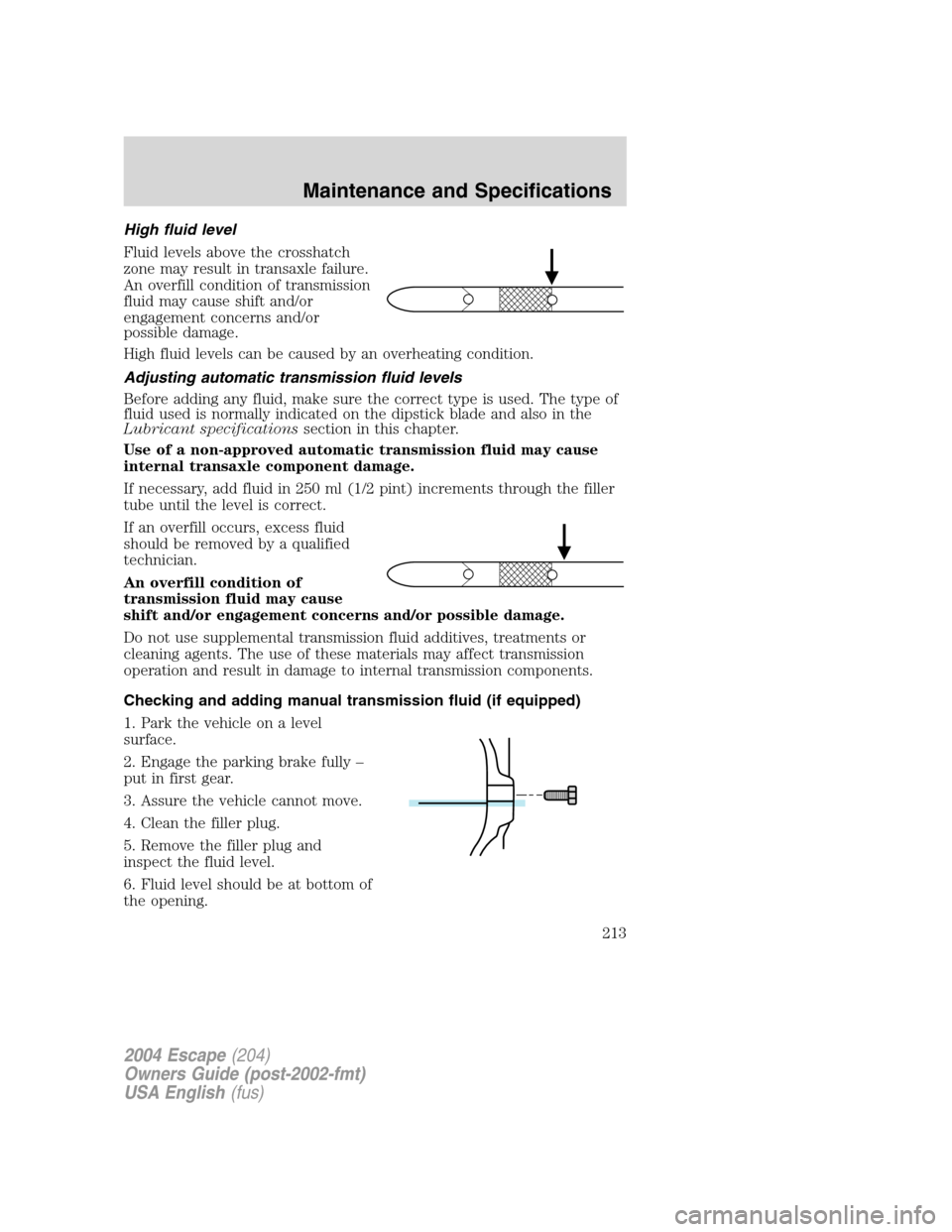
High fluid level
Fluid levels above the crosshatch
zone may result in transaxle failure.
An overfill condition of transmission
fluid may cause shift and/or
engagement concerns and/or
possible damage.
High fluid levels can be caused by an overheating condition.
Adjusting automatic transmission fluid levels
Before adding any fluid, make sure the correct type is used. The type of
fluid used is normally indicated on the dipstick blade and also in the
Lubricant specificationssection in this chapter.
Use of a non-approved automatic transmission fluid may cause
internal transaxle component damage.
If necessary, add fluid in 250 ml (1/2 pint) increments through the filler
tube until the level is correct.
If an overfill occurs, excess fluid
should be removed by a qualified
technician.
An overfill condition of
transmission fluid may cause
shift and/or engagement concerns and/or possible damage.
Do not use supplemental transmission fluid additives, treatments or
cleaning agents. The use of these materials may affect transmission
operation and result in damage to internal transmission components.
Checking and adding manual transmission fluid (if equipped)
1. Park the vehicle on a level
surface.
2. Engage the parking brake fully –
put in first gear.
3. Assure the vehicle cannot move.
4. Clean the filler plug.
5. Remove the filler plug and
inspect the fluid level.
6. Fluid level should be at bottom of
the opening.
2004 Escape(204)
Owners Guide (post-2002-fmt)
USA English(fus)
Maintenance and Specifications
213
Page 232 of 240
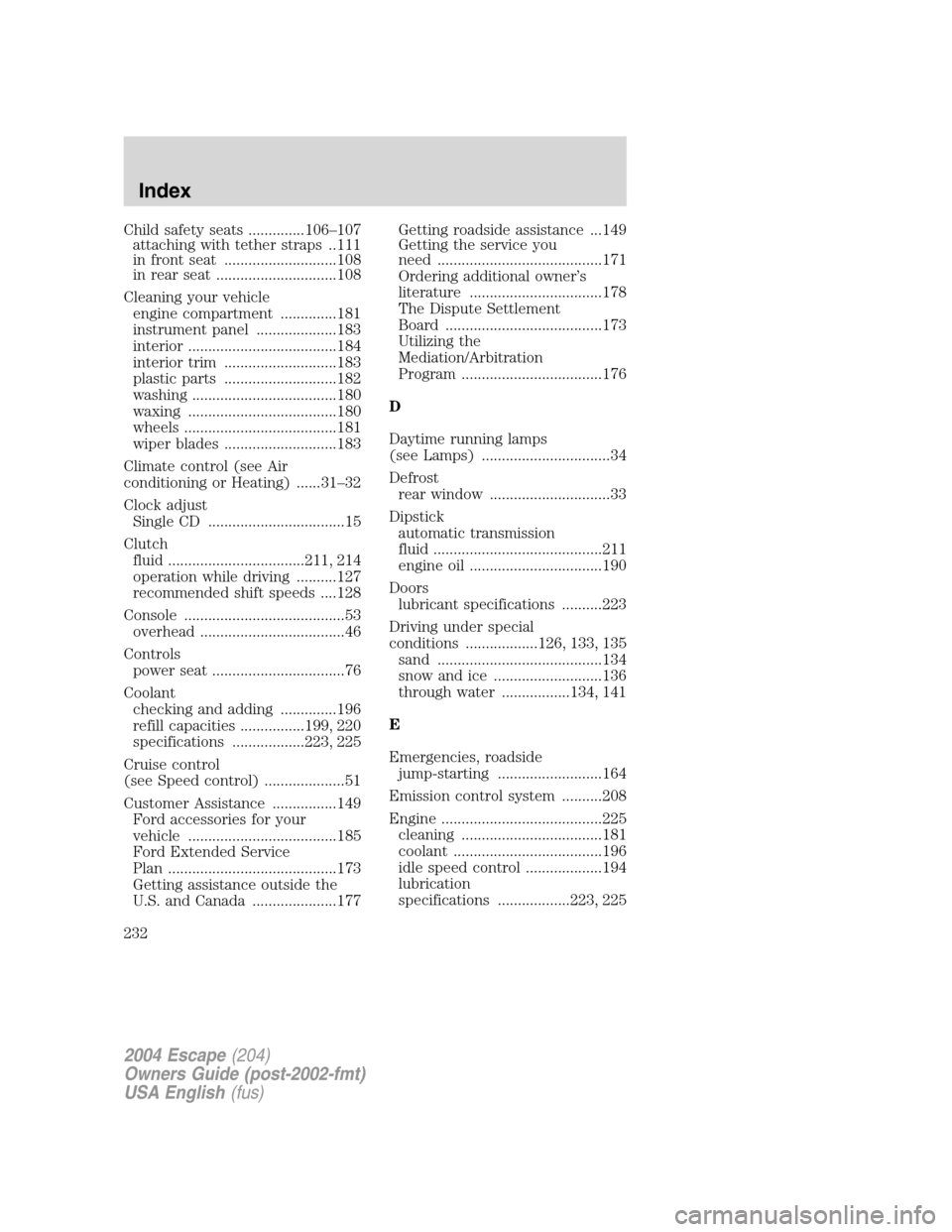
Child safety seats ..............106–107
attaching with tether straps ..111
in front seat ............................108
in rear seat ..............................108
Cleaning your vehicle
engine compartment ..............181
instrument panel ....................183
interior .....................................184
interior trim ............................183
plastic parts ............................182
washing ....................................180
waxing .....................................180
wheels ......................................181
wiper blades ............................183
Climate control (see Air
conditioning or Heating) ......31–32
Clock adjust
Single CD ..................................15
Clutch
fluid ..................................211, 214
operation while driving ..........127
recommended shift speeds ....128
Console ........................................53
overhead ....................................46
Controls
power seat .................................76
Coolant
checking and adding ..............196
refill capacities ................199, 220
specifications ..................223, 225
Cruise control
(see Speed control) ....................51
Customer Assistance ................149
Ford accessories for your
vehicle .....................................185
Ford Extended Service
Plan ..........................................173
Getting assistance outside the
U.S. and Canada .....................177Getting roadside assistance ...149
Getting the service you
need .........................................171
Ordering additional owner’s
literature .................................178
The Dispute Settlement
Board .......................................173
Utilizing the
Mediation/Arbitration
Program ...................................176
D
Daytime running lamps
(see Lamps) ................................34
Defrost
rear window ..............................33
Dipstick
automatic transmission
fluid ..........................................211
engine oil .................................190
Doors
lubricant specifications ..........223
Driving under special
conditions ..................126, 133, 135
sand .........................................134
snow and ice ...........................136
through water .................134, 141
E
Emergencies, roadside
jump-starting ..........................164
Emission control system ..........208
Engine ........................................225
cleaning ...................................181
coolant .....................................196
idle speed control ...................194
lubrication
specifications ..................223, 225
2004 Escape(204)
Owners Guide (post-2002-fmt)
USA English(fus)
Index
232
Page 233 of 240
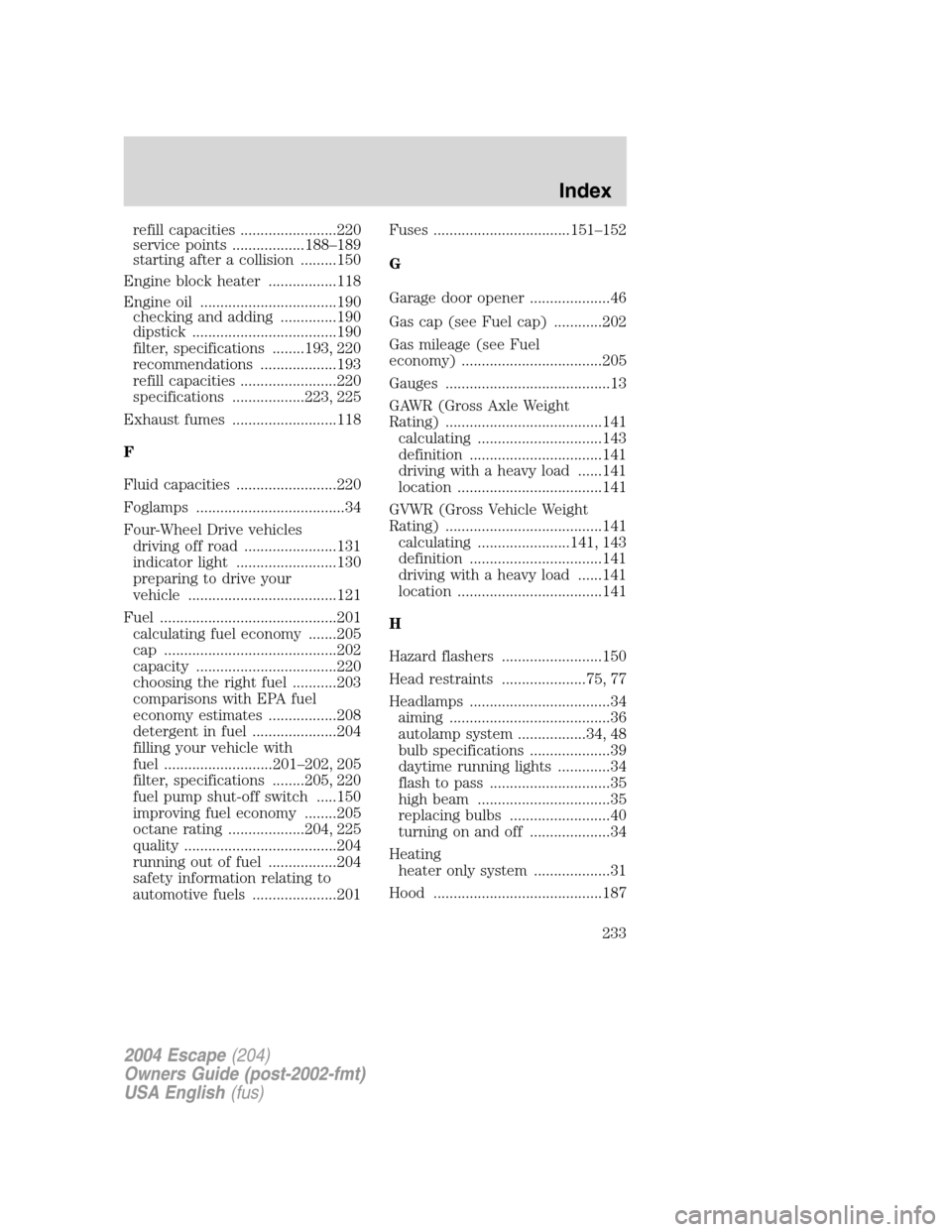
refill capacities ........................220
service points ..................188–189
starting after a collision .........150
Engine block heater .................118
Engine oil ..................................190
checking and adding ..............190
dipstick ....................................190
filter, specifications ........193, 220
recommendations ...................193
refill capacities ........................220
specifications ..................223, 225
Exhaust fumes ..........................118
F
Fluid capacities .........................220
Foglamps .....................................34
Four-Wheel Drive vehicles
driving off road .......................131
indicator light .........................130
preparing to drive your
vehicle .....................................121
Fuel ............................................201
calculating fuel economy .......205
cap ...........................................202
capacity ...................................220
choosing the right fuel ...........203
comparisons with EPA fuel
economy estimates .................208
detergent in fuel .....................204
filling your vehicle with
fuel ...........................201–202, 205
filter, specifications ........205, 220
fuel pump shut-off switch .....150
improving fuel economy ........205
octane rating ...................204, 225
quality ......................................204
running out of fuel .................204
safety information relating to
automotive fuels .....................201Fuses ..................................151–152
G
Garage door opener ....................46
Gas cap (see Fuel cap) ............202
Gas mileage (see Fuel
economy) ...................................205
Gauges .........................................13
GAWR (Gross Axle Weight
Rating) .......................................141
calculating ...............................143
definition .................................141
driving with a heavy load ......141
location ....................................141
GVWR (Gross Vehicle Weight
Rating) .......................................141
calculating .......................141, 143
definition .................................141
driving with a heavy load ......141
location ....................................141
H
Hazard flashers .........................150
Head restraints .....................75, 77
Headlamps ...................................34
aiming ........................................36
autolamp system .................34, 48
bulb specifications ....................39
daytime running lights .............34
flash to pass ..............................35
high beam .................................35
replacing bulbs .........................40
turning on and off ....................34
Heating
heater only system ...................31
Hood ..........................................187
2004 Escape(204)
Owners Guide (post-2002-fmt)
USA English(fus)
Index
233