trailer FORD ESCAPE 2005 1.G User Guide
[x] Cancel search | Manufacturer: FORD, Model Year: 2005, Model line: ESCAPE, Model: FORD ESCAPE 2005 1.GPages: 272, PDF Size: 15.08 MB
Page 163 of 272
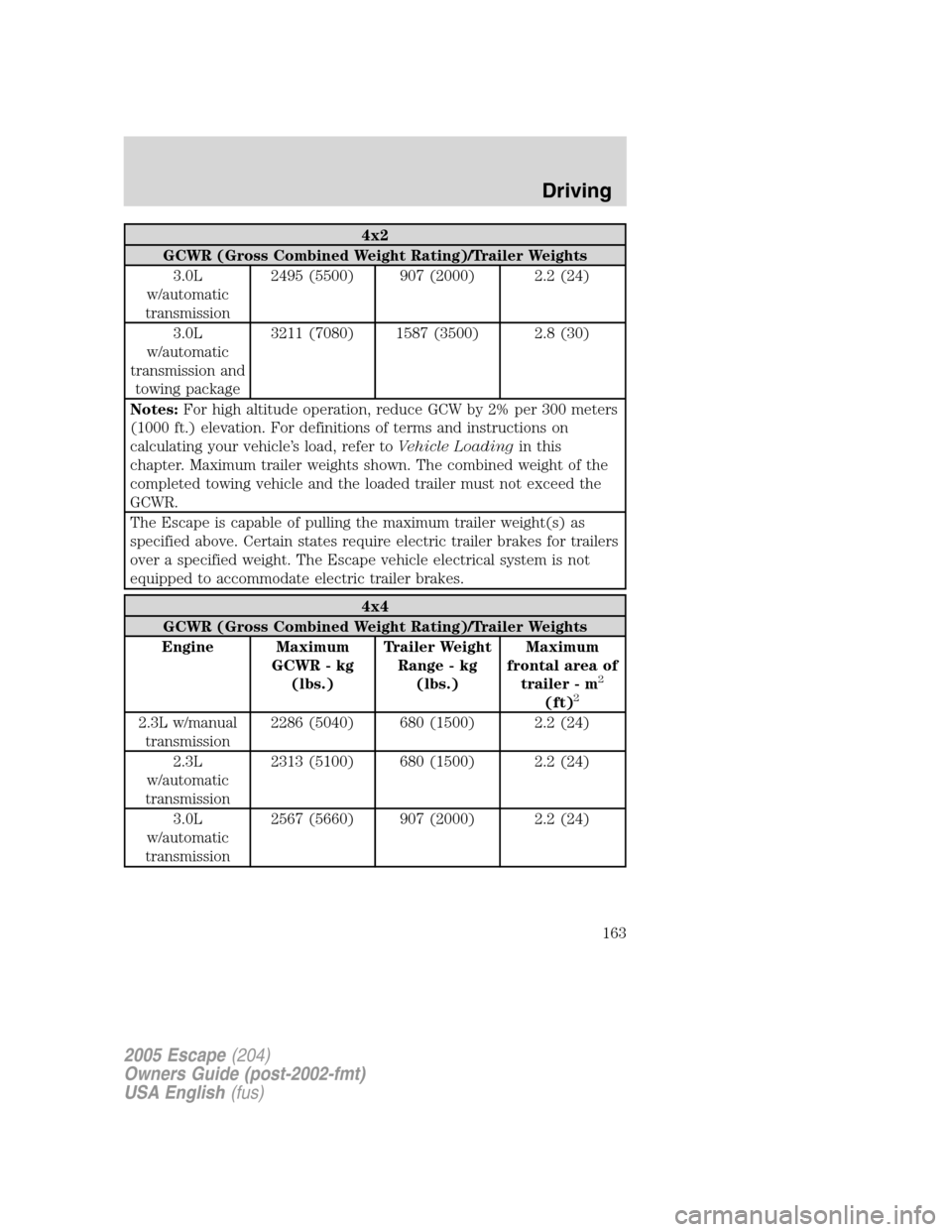
4x2
GCWR (Gross Combined Weight Rating)/Trailer Weights
3.0L
w/automatic
transmission2495 (5500) 907 (2000) 2.2 (24)
3.0L
w/automatic
transmission and
towing package3211 (7080) 1587 (3500) 2.8 (30)
Notes:For high altitude operation, reduce GCW by 2% per 300 meters
(1000 ft.) elevation. For definitions of terms and instructions on
calculating your vehicle’s load, refer toVehicle Loadingin this
chapter. Maximum trailer weights shown. The combined weight of the
completed towing vehicle and the loaded trailer must not exceed the
GCWR.
The Escape is capable of pulling the maximum trailer weight(s) as
specified above. Certain states require electric trailer brakes for trailers
over a specified weight. The Escape vehicle electrical system is not
equipped to accommodate electric trailer brakes.
4x4
GCWR (Gross Combined Weight Rating)/Trailer Weights
Engine Maximum
GCWR - kg
(lbs.)Trailer Weight
Range - kg
(lbs.)Maximum
frontal area of
trailer - m
2
(ft)2
2.3L w/manual
transmission2286 (5040) 680 (1500) 2.2 (24)
2.3L
w/automatic
transmission2313 (5100) 680 (1500) 2.2 (24)
3.0L
w/automatic
transmission2567 (5660) 907 (2000) 2.2 (24)
2005 Escape(204)
Owners Guide (post-2002-fmt)
USA English(fus)
Driving
163
Page 164 of 272
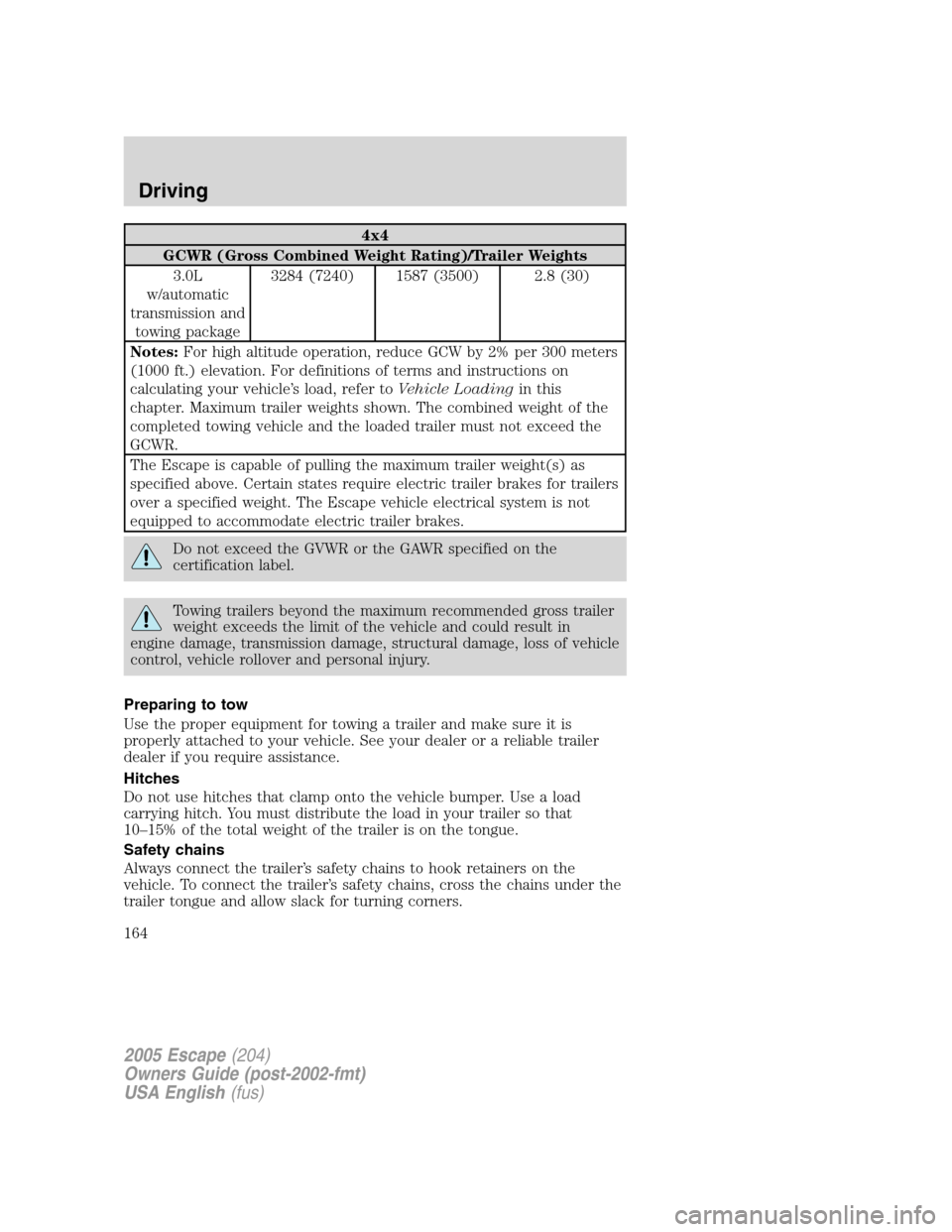
4x4
GCWR (Gross Combined Weight Rating)/Trailer Weights
3.0L
w/automatic
transmission and
towing package3284 (7240) 1587 (3500) 2.8 (30)
Notes:For high altitude operation, reduce GCW by 2% per 300 meters
(1000 ft.) elevation. For definitions of terms and instructions on
calculating your vehicle’s load, refer toVehicle Loadingin this
chapter. Maximum trailer weights shown. The combined weight of the
completed towing vehicle and the loaded trailer must not exceed the
GCWR.
The Escape is capable of pulling the maximum trailer weight(s) as
specified above. Certain states require electric trailer brakes for trailers
over a specified weight. The Escape vehicle electrical system is not
equipped to accommodate electric trailer brakes.
Do not exceed the GVWR or the GAWR specified on the
certification label.
Towing trailers beyond the maximum recommended gross trailer
weight exceeds the limit of the vehicle and could result in
engine damage, transmission damage, structural damage, loss of vehicle
control, vehicle rollover and personal injury.
Preparing to tow
Use the proper equipment for towing a trailer and make sure it is
properly attached to your vehicle. See your dealer or a reliable trailer
dealer if you require assistance.
Hitches
Do not use hitches that clamp onto the vehicle bumper. Use a load
carrying hitch. You must distribute the load in your trailer so that
10–15% of the total weight of the trailer is on the tongue.
Safety chains
Always connect the trailer’s safety chains to hook retainers on the
vehicle. To connect the trailer’s safety chains, cross the chains under the
trailer tongue and allow slack for turning corners.
2005 Escape(204)
Owners Guide (post-2002-fmt)
USA English(fus)
Driving
164
Page 165 of 272
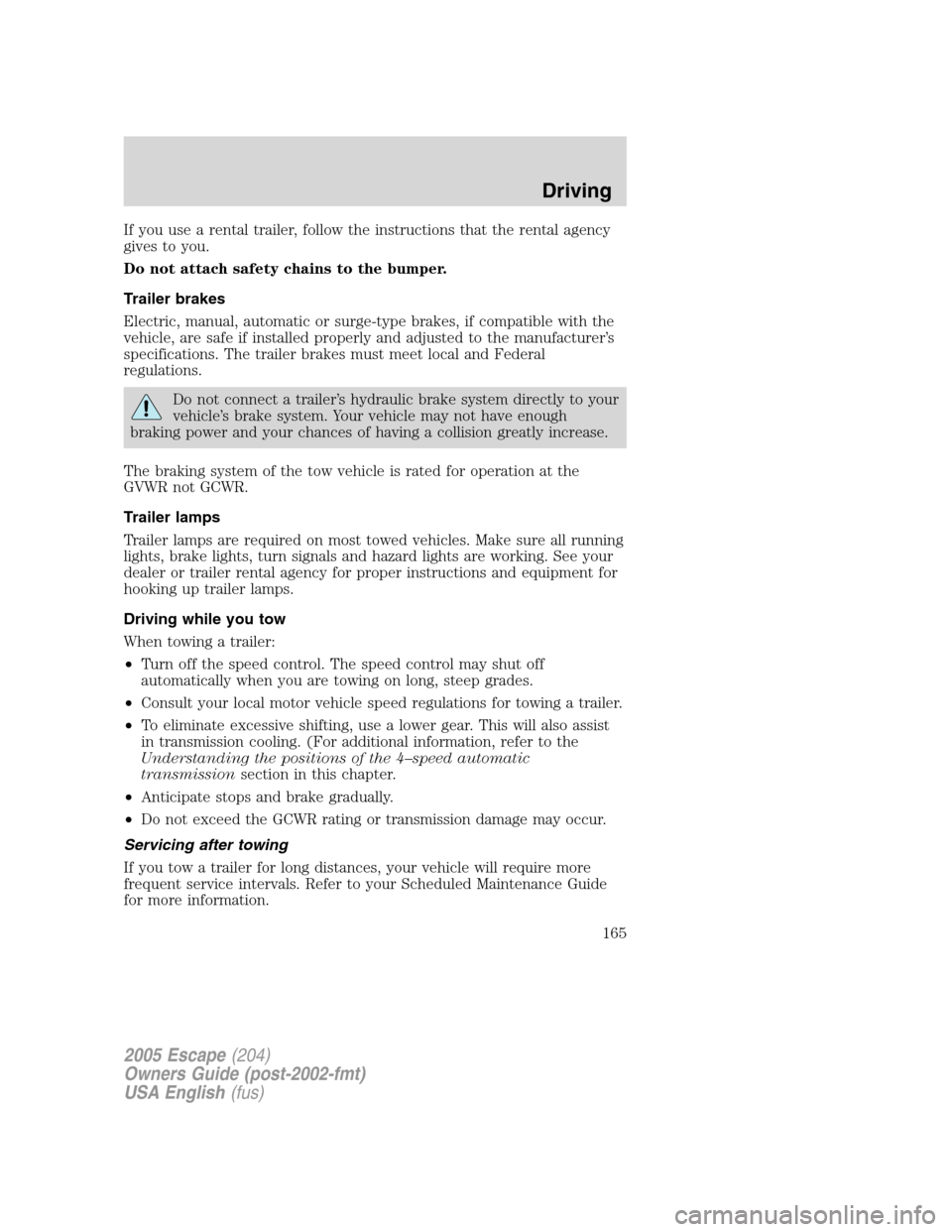
If you use a rental trailer, follow the instructions that the rental agency
gives to you.
Do not attach safety chains to the bumper.
Trailer brakes
Electric, manual, automatic or surge-type brakes, if compatible with the
vehicle, are safe if installed properly and adjusted to the manufacturer’s
specifications. The trailer brakes must meet local and Federal
regulations.
Do not connect a trailer’s hydraulic brake system directly to your
vehicle’s brake system. Your vehicle may not have enough
braking power and your chances of having a collision greatly increase.
The braking system of the tow vehicle is rated for operation at the
GVWR not GCWR.
Trailer lamps
Trailer lamps are required on most towed vehicles. Make sure all running
lights, brake lights, turn signals and hazard lights are working. See your
dealer or trailer rental agency for proper instructions and equipment for
hooking up trailer lamps.
Driving while you tow
When towing a trailer:
•Turn off the speed control. The speed control may shut off
automatically when you are towing on long, steep grades.
•Consult your local motor vehicle speed regulations for towing a trailer.
•To eliminate excessive shifting, use a lower gear. This will also assist
in transmission cooling. (For additional information, refer to the
Understanding the positions of the 4–speed automatic
transmissionsection in this chapter.
•Anticipate stops and brake gradually.
•Do not exceed the GCWR rating or transmission damage may occur.
Servicing after towing
If you tow a trailer for long distances, your vehicle will require more
frequent service intervals. Refer to your Scheduled Maintenance Guide
for more information.
2005 Escape(204)
Owners Guide (post-2002-fmt)
USA English(fus)
Driving
165
Page 166 of 272
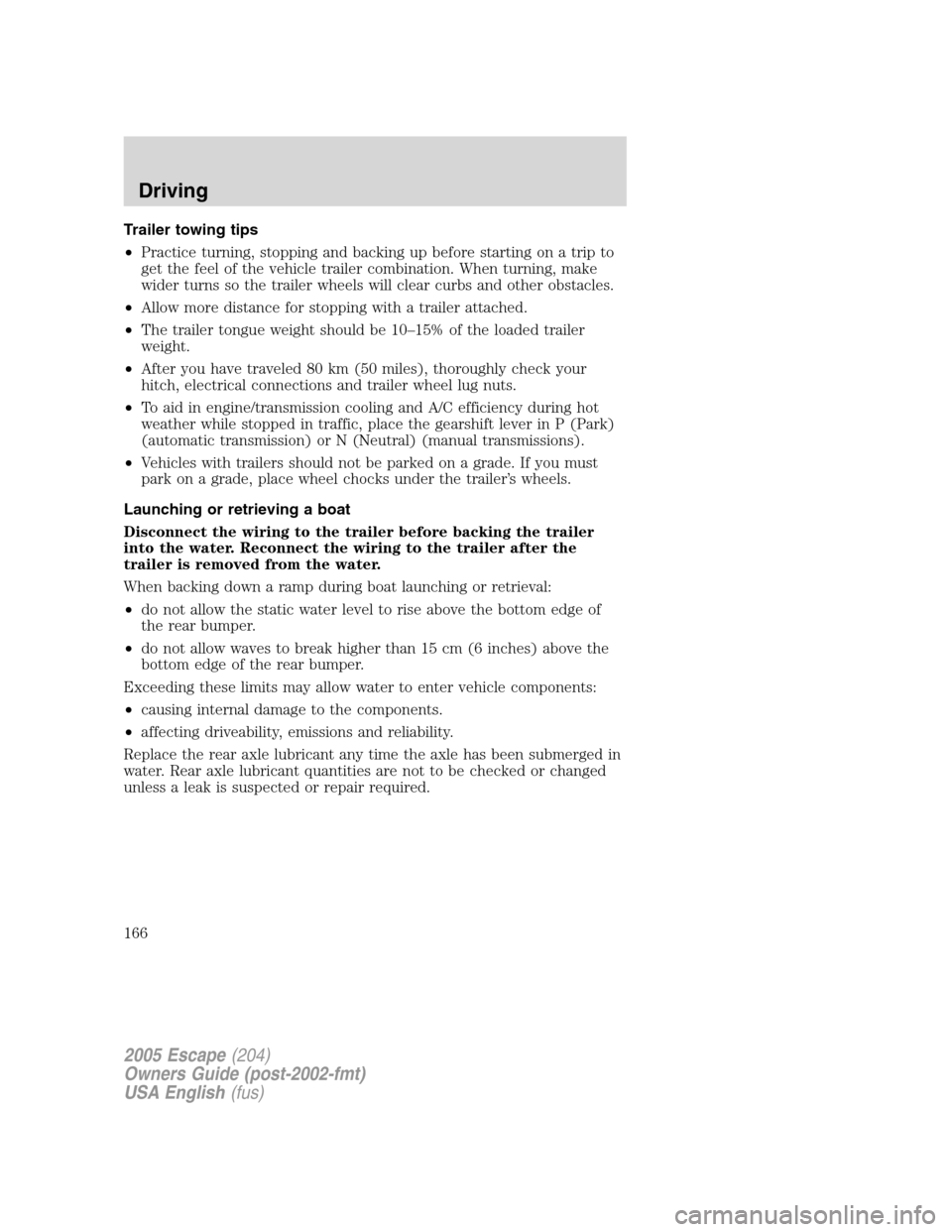
Trailer towing tips
•Practice turning, stopping and backing up before starting on a trip to
get the feel of the vehicle trailer combination. When turning, make
wider turns so the trailer wheels will clear curbs and other obstacles.
•Allow more distance for stopping with a trailer attached.
•The trailer tongue weight should be 10–15% of the loaded trailer
weight.
•After you have traveled 80 km (50 miles), thoroughly check your
hitch, electrical connections and trailer wheel lug nuts.
•To aid in engine/transmission cooling and A/C efficiency during hot
weather while stopped in traffic, place the gearshift lever in P (Park)
(automatic transmission) or N (Neutral) (manual transmissions).
•Vehicles with trailers should not be parked on a grade. If you must
park on a grade, place wheel chocks under the trailer’s wheels.
Launching or retrieving a boat
Disconnect the wiring to the trailer before backing the trailer
into the water. Reconnect the wiring to the trailer after the
trailer is removed from the water.
When backing down a ramp during boat launching or retrieval:
•do not allow the static water level to rise above the bottom edge of
the rear bumper.
•do not allow waves to break higher than 15 cm (6 inches) above the
bottom edge of the rear bumper.
Exceeding these limits may allow water to enter vehicle components:
•causing internal damage to the components.
•affecting driveability, emissions and reliability.
Replace the rear axle lubricant any time the axle has been submerged in
water. Rear axle lubricant quantities are not to be checked or changed
unless a leak is suspected or repair required.
2005 Escape(204)
Owners Guide (post-2002-fmt)
USA English(fus)
Driving
166
Page 167 of 272
RECREATIONAL TOWING
An example of“recreational towing”is towing your vehicle behind a
motorhome.
If your vehicle is automatic transmission equipped, with a 4x2
(front-wheel drive only) configured powertrain,“recreational towing”is
permitted by trailering the vehicle with its front wheels on a dolly. This
protects the transmission’s internal mechanical components from
potential lack of lubrication damage.
If your vehicle is automatic transmission equipped, with a 4x4 (all-wheel
drive) configured powertrain,“recreational towing”is permitted only if
the vehicle is trailered with all four (4) wheels off the ground. Otherwise,
no“recreational towing”is permitted.
If your vehicle is manual transmission equipped (both 4x2 and 4x4),
shifting the transmission into neutral permits“flat-towing”(all wheels on
the ground) for pulling behind a motorhome. Your vehicle may be towed
up to a speed of 113 km/h (70 mph) but you should always obey local
speed limits.
For other towing requirements, refer toWrecker towingin theRoadside
Emergencieschapter.
2005 Escape(204)
Owners Guide (post-2002-fmt)
USA English(fus)
Driving
167
Page 173 of 272
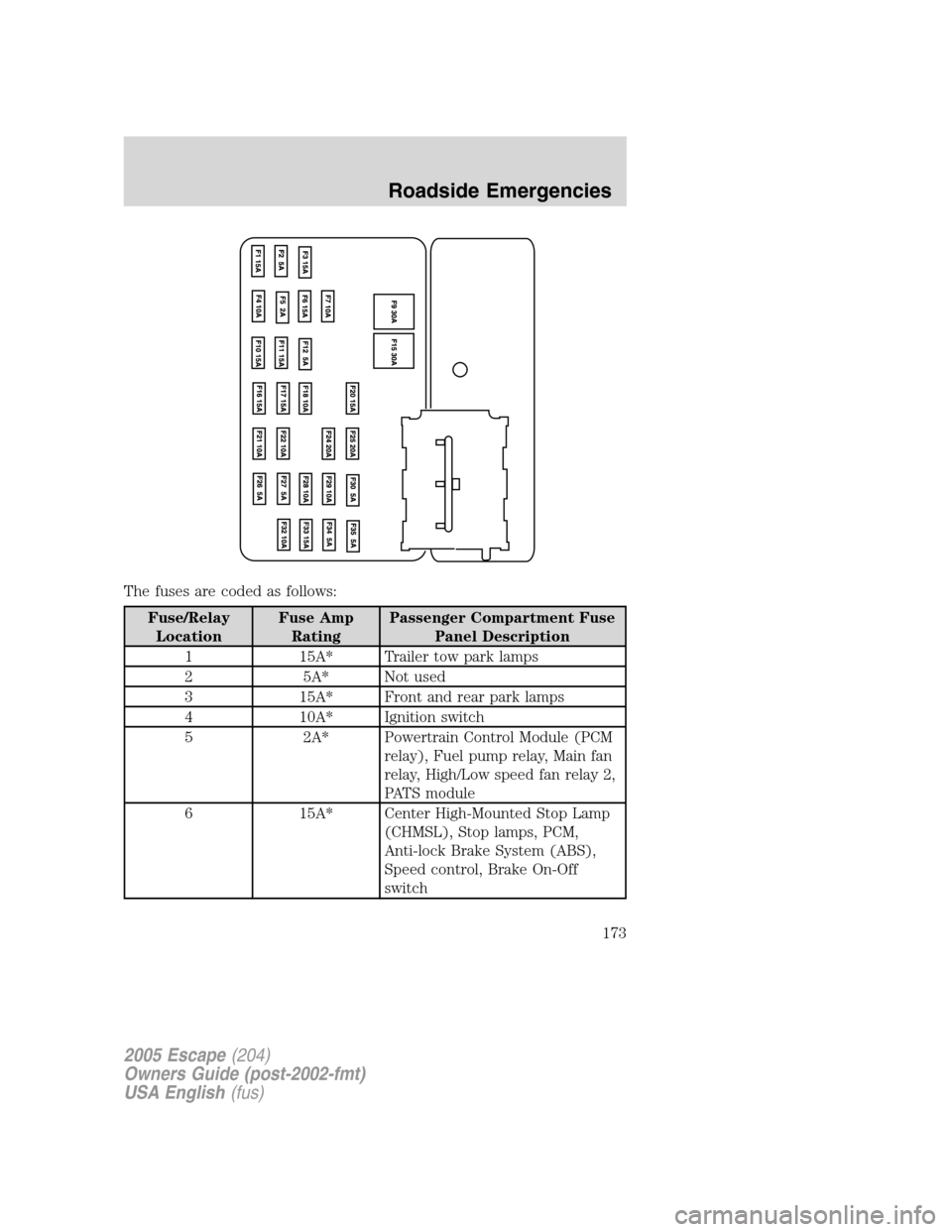
The fuses are coded as follows:
Fuse/Relay
LocationFuse Amp
RatingPassenger Compartment Fuse
Panel Description
1 15A* Trailer tow park lamps
2 5A* Not used
3 15A* Front and rear park lamps
4 10A* Ignition switch
5 2A* Powertrain Control Module (PCM
relay), Fuel pump relay, Main fan
relay, High/Low speed fan relay 2,
PATS module
6 15A* Center High-Mounted Stop Lamp
(CHMSL), Stop lamps, PCM,
Anti-lock Brake System (ABS),
Speed control, Brake On-Off
switch
2005 Escape(204)
Owners Guide (post-2002-fmt)
USA English(fus)
Roadside Emergencies
173
Page 178 of 272
T-Type/Mini-Spare Tire Information
Your vehicle may be equipped with a T-type/mini-spare tire. This tire will
have the words“Temporary Use Only”molded into the tire sidewall. This
spare tire is considered“temporary”. Replace the T-type/mini-spare with
a tire of the same size, speed rating and load carrying capacity as the
other road tires as soon as possible.
It is not recommended that the vehicle be operated in 4WD modes with
a T-type/mini-spare tire. If 4WD operation is necessary, do not operate
above speeds of 16 km/h (10 mph) or for distances above 80 km (50
miles).
When driving with the T-type/mini-spare tiredo not:
•Exceed 80 km/h (50 mph)
•Load the vehicle beyond maximum vehicle load rating listed on the
Safety Compliance Label
•Tow a trailer
•Use snow chains on the end of the vehicle with the T-type/mini spare
tire
•Use more than one T-type/mini spare tire at a time
•Use commercial car washing equipment
•Try to repair the T-type/mini spare tire
Use of a T-type/mini spare tire at any one wheel location can lead to
impairment of the following:
•Handling, stability and braking performance
•Comfort and noise
•Ground clearance and parking at curbs
•Winter weather driving capability
•Wet weather driving capability
Dissimilar spare tire/wheel information
Failure to follow these guidelines could result in an increased
risk of loss of vehicle control, injury or death.
Your vehicle may be equipped with a dissimilar spare tire/wheel. A
dissimilar spare tire/wheel is defined as a spare tire and/or wheel that is
different in brand, size or appearance from the road tires and wheels. If
2005 Escape(204)
Owners Guide (post-2002-fmt)
USA English(fus)
Roadside Emergencies
178
Page 179 of 272
you have a dissimilar spare tire/wheel, then it is intended for temporary
use only. This means that if you need to use it, you should replace it as
soon as possible with a road tire/wheel that is the same size and type as
the road tires and wheels that were originally provided by Ford. If the
dissimilar spare tire or wheel is damaged, it should be replaced rather
than repaired.
When driving with the dissimilar spare tire/wheel,do not:
•Exceed 113 km/h (70 mph)
•Use more than one dissimilar spare tire/wheel at a time
•Use commercial car washing equipment
•Use snow chains on the end of the vehicle with the dissimilar spare
tire/wheel
The usage of a dissimilar spare tire/wheel can lead to impairment of the
following:
•Handling, stability and braking performance
•Comfort and noise
•Ground clearance and parking at curbs
•Winter weather driving capability
•Wet weather driving capability
•All-Wheel Driving Capability (if applicable)
•Load Leveling Adjustment (if applicable)
When driving with the dissimilar spare tire/wheel additional caution
should be given to:
•Towing a trailer
•Driving vehicles equipped with a camper body
•Driving vehicles with a load on the cargo rack
Drive cautiously when using a dissimilar spare tire/wheel and seek
service as soon as possible.
Tire change procedure
When one of the front wheels is off the ground, the transmission
alone will not prevent the vehicle from moving or slipping off the
jack, even if the vehicle is in P (Park) (automatic transaxle) or R
(Reverse) (manual transaxle).
2005 Escape(204)
Owners Guide (post-2002-fmt)
USA English(fus)
Roadside Emergencies
179
Page 193 of 272
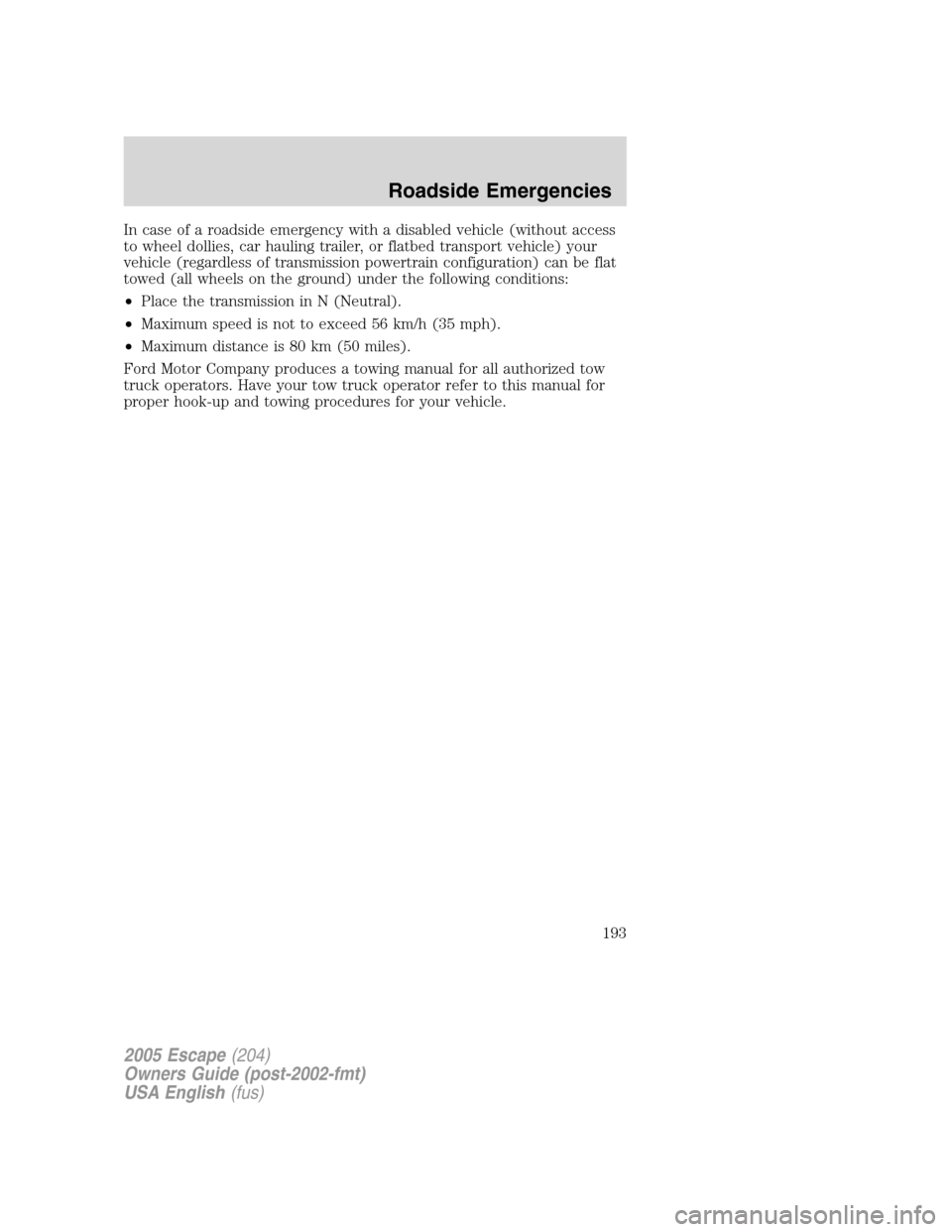
In case of a roadside emergency with a disabled vehicle (without access
to wheel dollies, car hauling trailer, or flatbed transport vehicle) your
vehicle (regardless of transmission powertrain configuration) can be flat
towed (all wheels on the ground) under the following conditions:
•Place the transmission in N (Neutral).
•Maximum speed is not to exceed 56 km/h (35 mph).
•Maximum distance is 80 km (50 miles).
Ford Motor Company produces a towing manual for all authorized tow
truck operators. Have your tow truck operator refer to this manual for
proper hook-up and towing procedures for your vehicle.
2005 Escape(204)
Owners Guide (post-2002-fmt)
USA English(fus)
Roadside Emergencies
193
Page 231 of 272
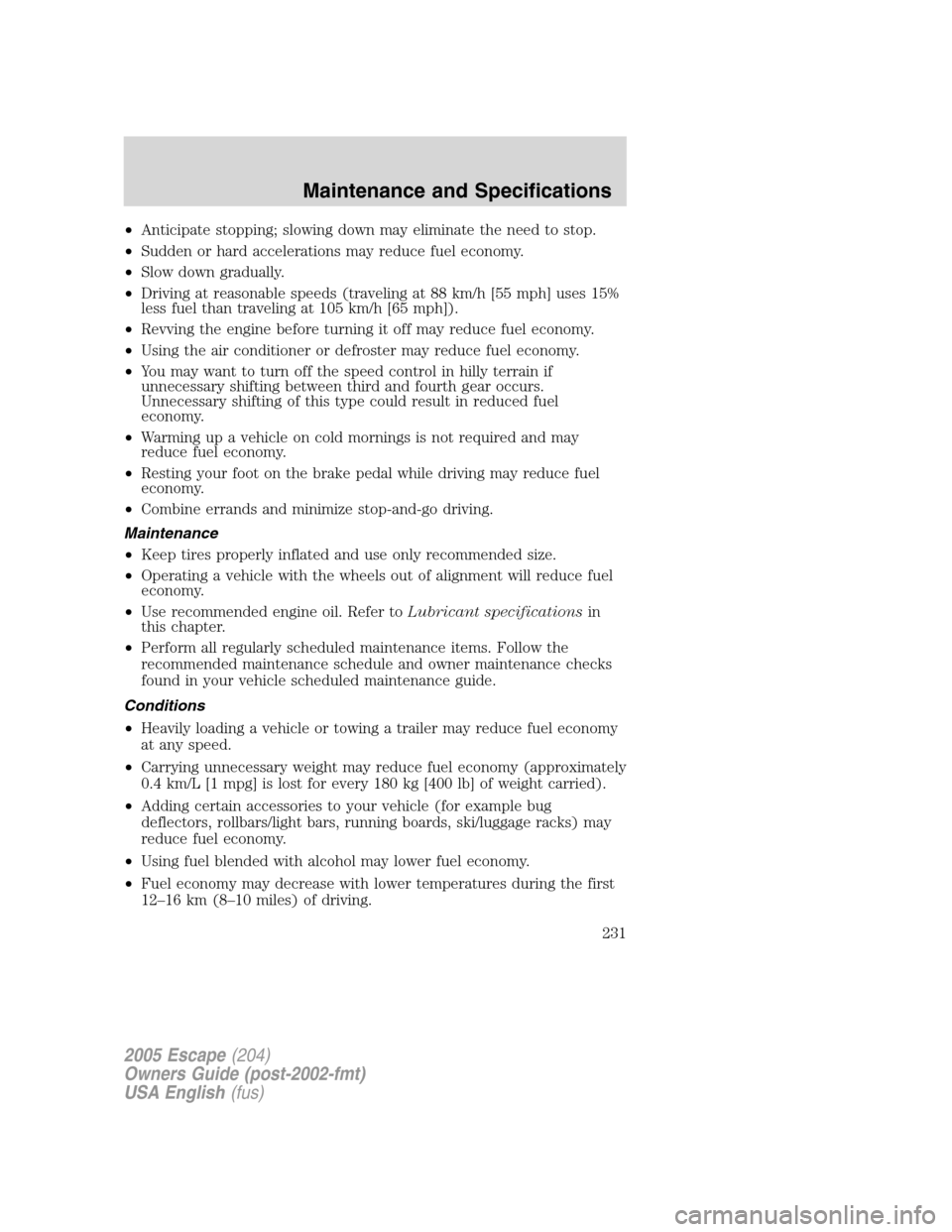
•Anticipate stopping; slowing down may eliminate the need to stop.
•Sudden or hard accelerations may reduce fuel economy.
•Slow down gradually.
•Driving at reasonable speeds (traveling at 88 km/h [55 mph] uses 15%
less fuel than traveling at 105 km/h [65 mph]).
•Revving the engine before turning it off may reduce fuel economy.
•Using the air conditioner or defroster may reduce fuel economy.
•You may want to turn off the speed control in hilly terrain if
unnecessary shifting between third and fourth gear occurs.
Unnecessary shifting of this type could result in reduced fuel
economy.
•Warming up a vehicle on cold mornings is not required and may
reduce fuel economy.
•Resting your foot on the brake pedal while driving may reduce fuel
economy.
•Combine errands and minimize stop-and-go driving.
Maintenance
•Keep tires properly inflated and use only recommended size.
•Operating a vehicle with the wheels out of alignment will reduce fuel
economy.
•Use recommended engine oil. Refer toLubricant specificationsin
this chapter.
•Perform all regularly scheduled maintenance items. Follow the
recommended maintenance schedule and owner maintenance checks
found in your vehicle scheduled maintenance guide.
Conditions
•Heavily loading a vehicle or towing a trailer may reduce fuel economy
at any speed.
•Carrying unnecessary weight may reduce fuel economy (approximately
0.4 km/L [1 mpg] is lost for every 180 kg [400 lb] of weight carried).
•Adding certain accessories to your vehicle (for example bug
deflectors, rollbars/light bars, running boards, ski/luggage racks) may
reduce fuel economy.
•Using fuel blended with alcohol may lower fuel economy.
•Fuel economy may decrease with lower temperatures during the first
12–16 km (8–10 miles) of driving.
2005 Escape(204)
Owners Guide (post-2002-fmt)
USA English(fus)
Maintenance and Specifications
231