tow FORD ESCAPE 2005 1.G Owner's Guide
[x] Cancel search | Manufacturer: FORD, Model Year: 2005, Model line: ESCAPE, Model: FORD ESCAPE 2005 1.GPages: 272, PDF Size: 15.08 MB
Page 166 of 272
Trailer towing tips
•Practice turning, stopping and backing up before starting on a trip to
get the feel of the vehicle trailer combination. When turning, make
wider turns so the trailer wheels will clear curbs and other obstacles.
•Allow more distance for stopping with a trailer attached.
•The trailer tongue weight should be 10–15% of the loaded trailer
weight.
•After you have traveled 80 km (50 miles), thoroughly check your
hitch, electrical connections and trailer wheel lug nuts.
•To aid in engine/transmission cooling and A/C efficiency during hot
weather while stopped in traffic, place the gearshift lever in P (Park)
(automatic transmission) or N (Neutral) (manual transmissions).
•Vehicles with trailers should not be parked on a grade. If you must
park on a grade, place wheel chocks under the trailer’s wheels.
Launching or retrieving a boat
Disconnect the wiring to the trailer before backing the trailer
into the water. Reconnect the wiring to the trailer after the
trailer is removed from the water.
When backing down a ramp during boat launching or retrieval:
•do not allow the static water level to rise above the bottom edge of
the rear bumper.
•do not allow waves to break higher than 15 cm (6 inches) above the
bottom edge of the rear bumper.
Exceeding these limits may allow water to enter vehicle components:
•causing internal damage to the components.
•affecting driveability, emissions and reliability.
Replace the rear axle lubricant any time the axle has been submerged in
water. Rear axle lubricant quantities are not to be checked or changed
unless a leak is suspected or repair required.
2005 Escape(204)
Owners Guide (post-2002-fmt)
USA English(fus)
Driving
166
Page 167 of 272
RECREATIONAL TOWING
An example of“recreational towing”is towing your vehicle behind a
motorhome.
If your vehicle is automatic transmission equipped, with a 4x2
(front-wheel drive only) configured powertrain,“recreational towing”is
permitted by trailering the vehicle with its front wheels on a dolly. This
protects the transmission’s internal mechanical components from
potential lack of lubrication damage.
If your vehicle is automatic transmission equipped, with a 4x4 (all-wheel
drive) configured powertrain,“recreational towing”is permitted only if
the vehicle is trailered with all four (4) wheels off the ground. Otherwise,
no“recreational towing”is permitted.
If your vehicle is manual transmission equipped (both 4x2 and 4x4),
shifting the transmission into neutral permits“flat-towing”(all wheels on
the ground) for pulling behind a motorhome. Your vehicle may be towed
up to a speed of 113 km/h (70 mph) but you should always obey local
speed limits.
For other towing requirements, refer toWrecker towingin theRoadside
Emergencieschapter.
2005 Escape(204)
Owners Guide (post-2002-fmt)
USA English(fus)
Driving
167
Page 168 of 272
GETTING ROADSIDE ASSISTANCE
To fully assist you should you have a vehicle concern, Ford Motor
Company offers a complimentary roadside assistance program. This
program is separate from the New Vehicle Limited Warranty. The service
is available:
•24–hours, seven days a week
•for the New Vehicle Limited Warranty period of three years or
60,000 km (36,000 miles), whichever occurs first on Ford and Mercury
vehicles, and four years or 80,000 km (50,000 miles) on Lincoln
vehicles.
Roadside assistance will cover:
•changing a flat tire
•jump-starts
•lock-out assistance
•limited fuel delivery
•towing of your disabled vehicle to the nearest Ford Motor Company
dealership, or your selling dealer if within 56.3 km (35 miles) of the
nearest Ford Motor Company dealership (one tow per disablement).
Even non-warranty related tows, like accidents or getting stuck in the
mud or snow, are covered (some exclusions apply, such as impound
towing or repossession).
Canadian customers refer to your Owner Information Guide for
information on:
•coverage period
•exact fuel amounts
•towing of your disabled vehicle
•emergency travel expense reimbursement
•travel planning benefits
2005 Escape(204)
Owners Guide (post-2002-fmt)
USA English(fus)
Roadside Emergencies
Roadside Emergencies
168
Page 173 of 272
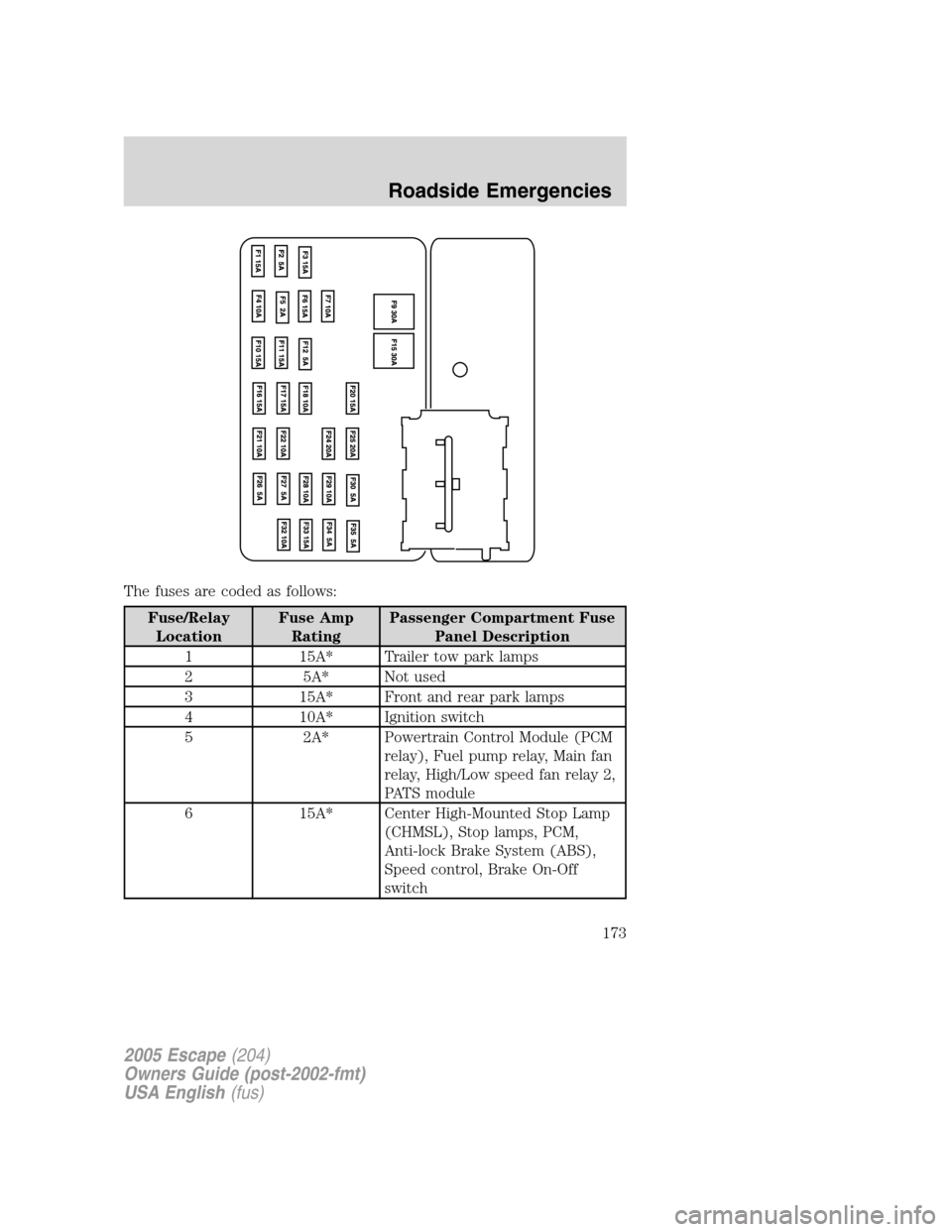
The fuses are coded as follows:
Fuse/Relay
LocationFuse Amp
RatingPassenger Compartment Fuse
Panel Description
1 15A* Trailer tow park lamps
2 5A* Not used
3 15A* Front and rear park lamps
4 10A* Ignition switch
5 2A* Powertrain Control Module (PCM
relay), Fuel pump relay, Main fan
relay, High/Low speed fan relay 2,
PATS module
6 15A* Center High-Mounted Stop Lamp
(CHMSL), Stop lamps, PCM,
Anti-lock Brake System (ABS),
Speed control, Brake On-Off
switch
2005 Escape(204)
Owners Guide (post-2002-fmt)
USA English(fus)
Roadside Emergencies
173
Page 178 of 272
T-Type/Mini-Spare Tire Information
Your vehicle may be equipped with a T-type/mini-spare tire. This tire will
have the words“Temporary Use Only”molded into the tire sidewall. This
spare tire is considered“temporary”. Replace the T-type/mini-spare with
a tire of the same size, speed rating and load carrying capacity as the
other road tires as soon as possible.
It is not recommended that the vehicle be operated in 4WD modes with
a T-type/mini-spare tire. If 4WD operation is necessary, do not operate
above speeds of 16 km/h (10 mph) or for distances above 80 km (50
miles).
When driving with the T-type/mini-spare tiredo not:
•Exceed 80 km/h (50 mph)
•Load the vehicle beyond maximum vehicle load rating listed on the
Safety Compliance Label
•Tow a trailer
•Use snow chains on the end of the vehicle with the T-type/mini spare
tire
•Use more than one T-type/mini spare tire at a time
•Use commercial car washing equipment
•Try to repair the T-type/mini spare tire
Use of a T-type/mini spare tire at any one wheel location can lead to
impairment of the following:
•Handling, stability and braking performance
•Comfort and noise
•Ground clearance and parking at curbs
•Winter weather driving capability
•Wet weather driving capability
Dissimilar spare tire/wheel information
Failure to follow these guidelines could result in an increased
risk of loss of vehicle control, injury or death.
Your vehicle may be equipped with a dissimilar spare tire/wheel. A
dissimilar spare tire/wheel is defined as a spare tire and/or wheel that is
different in brand, size or appearance from the road tires and wheels. If
2005 Escape(204)
Owners Guide (post-2002-fmt)
USA English(fus)
Roadside Emergencies
178
Page 179 of 272
you have a dissimilar spare tire/wheel, then it is intended for temporary
use only. This means that if you need to use it, you should replace it as
soon as possible with a road tire/wheel that is the same size and type as
the road tires and wheels that were originally provided by Ford. If the
dissimilar spare tire or wheel is damaged, it should be replaced rather
than repaired.
When driving with the dissimilar spare tire/wheel,do not:
•Exceed 113 km/h (70 mph)
•Use more than one dissimilar spare tire/wheel at a time
•Use commercial car washing equipment
•Use snow chains on the end of the vehicle with the dissimilar spare
tire/wheel
The usage of a dissimilar spare tire/wheel can lead to impairment of the
following:
•Handling, stability and braking performance
•Comfort and noise
•Ground clearance and parking at curbs
•Winter weather driving capability
•Wet weather driving capability
•All-Wheel Driving Capability (if applicable)
•Load Leveling Adjustment (if applicable)
When driving with the dissimilar spare tire/wheel additional caution
should be given to:
•Towing a trailer
•Driving vehicles equipped with a camper body
•Driving vehicles with a load on the cargo rack
Drive cautiously when using a dissimilar spare tire/wheel and seek
service as soon as possible.
Tire change procedure
When one of the front wheels is off the ground, the transmission
alone will not prevent the vehicle from moving or slipping off the
jack, even if the vehicle is in P (Park) (automatic transaxle) or R
(Reverse) (manual transaxle).
2005 Escape(204)
Owners Guide (post-2002-fmt)
USA English(fus)
Roadside Emergencies
179
Page 185 of 272
Stowing the flat/spare tire
Note:Failure to follow spare tire stowage instructions may result in
failure of cable or loss of spare tire.
If you are stowing a tire that requires reattaching it to the
vehicle with a tether, perform these steps first, then proceed with
the steps following.
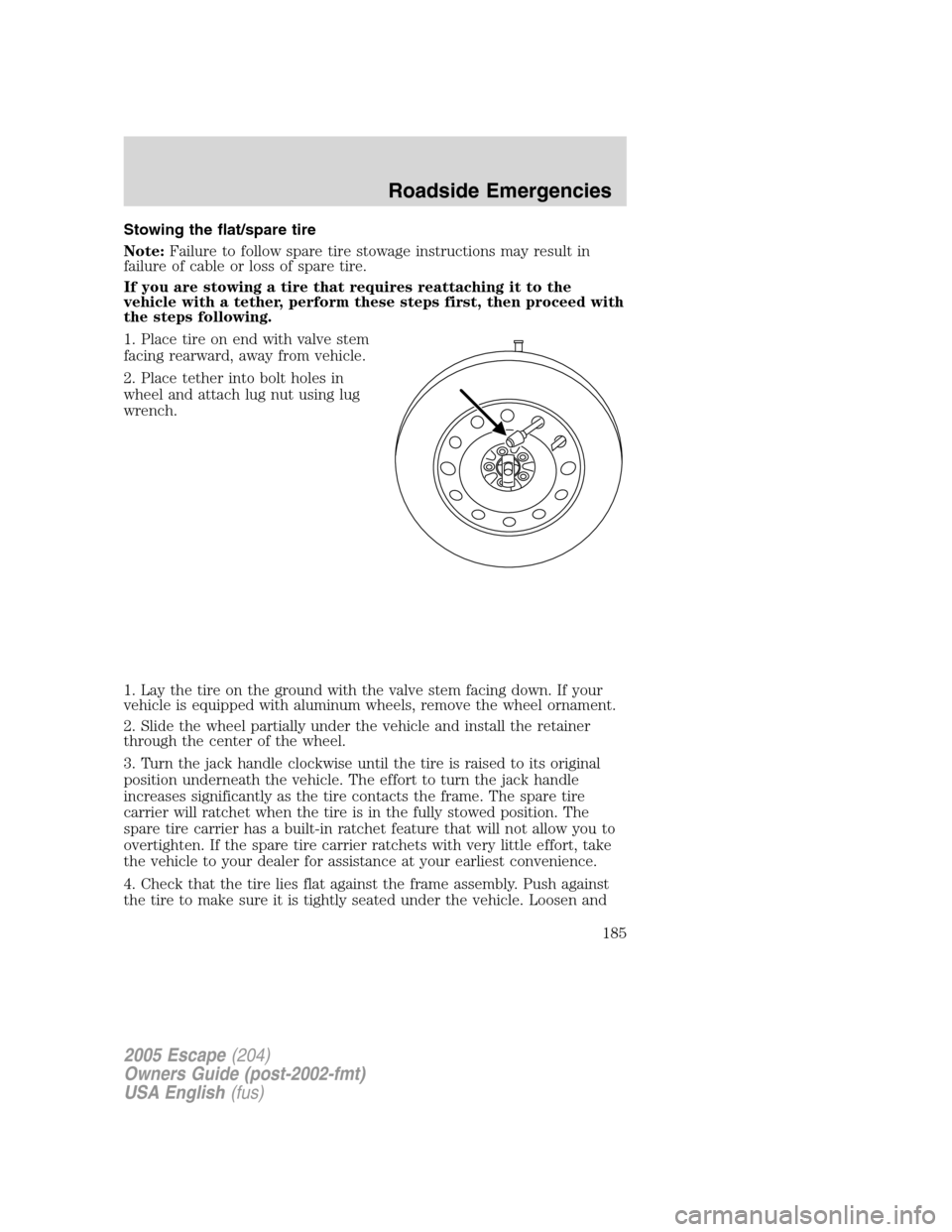
1. Place tire on end with valve stem
facing rearward, away from vehicle.
2. Place tether into bolt holes in
wheel and attach lug nut using lug
wrench.
1. Lay the tire on the ground with the valve stem facing down. If your
vehicle is equipped with aluminum wheels, remove the wheel ornament.
2. Slide the wheel partially under the vehicle and install the retainer
through the center of the wheel.
3. Turn the jack handle clockwise until the tire is raised to its original
position underneath the vehicle. The effort to turn the jack handle
increases significantly as the tire contacts the frame. The spare tire
carrier will ratchet when the tire is in the fully stowed position. The
spare tire carrier has a built-in ratchet feature that will not allow you to
overtighten. If the spare tire carrier ratchets with very little effort, take
the vehicle to your dealer for assistance at your earliest convenience.
4. Check that the tire lies flat against the frame assembly. Push against
the tire to make sure it is tightly seated under the vehicle. Loosen and
2005 Escape(204)
Owners Guide (post-2002-fmt)
USA English(fus)
Roadside Emergencies
185
Page 186 of 272
retighten, if necessary. Failure to properly stow the spare tire may result
in failure of the winch cable and loss of the spare tire.
5. Repeat this tightness check procedure when servicing the spare tire
pressure (every six months, per Scheduled Maintenance Guide), or at
any time that the spare tire is disturbed through service of other
components.
Wheel lug nut torque specifications
Retighten the lug nuts to the specified torque at 800 km (500 miles)
after any wheel disturbance (tire rotation, changing a flat tire, wheel
removal, etc.).
Bolt size Wheel lug nut torque*
N•m lb-ft
M12 x 1.5 136 100
* Torque specifications are for nut and bolt threads free of dirt and
rust. Use only Ford recommended replacement fasteners.
When a wheel is installed, always remove any corrosion, dirt or
foreign materials present on the mounting surfaces of the wheel
or the surface of the front disc brake hub and rotor that contacts the
wheel. Installing wheels without correct metal-to-metal contact at the
wheel mounting surfaces can cause the wheel nuts to loosen and the
wheel to come off while the vehicle is in motion, resulting in loss of
control.
JUMP STARTING YOUR VEHICLE
The gases around the battery can explode if exposed to flames,
sparks, or lit cigarettes. An explosion could result in injury or
vehicle damage.
Batteries contain sulfuric acid which can burn skin, eyes and
clothing, if contacted.
Do not attempt to push-start your vehicle. Automatic
transmissions do not have push-start capability; doing so may
damage the catalytic converter.
2005 Escape(204)
Owners Guide (post-2002-fmt)
USA English(fus)
Roadside Emergencies
186
Page 192 of 272
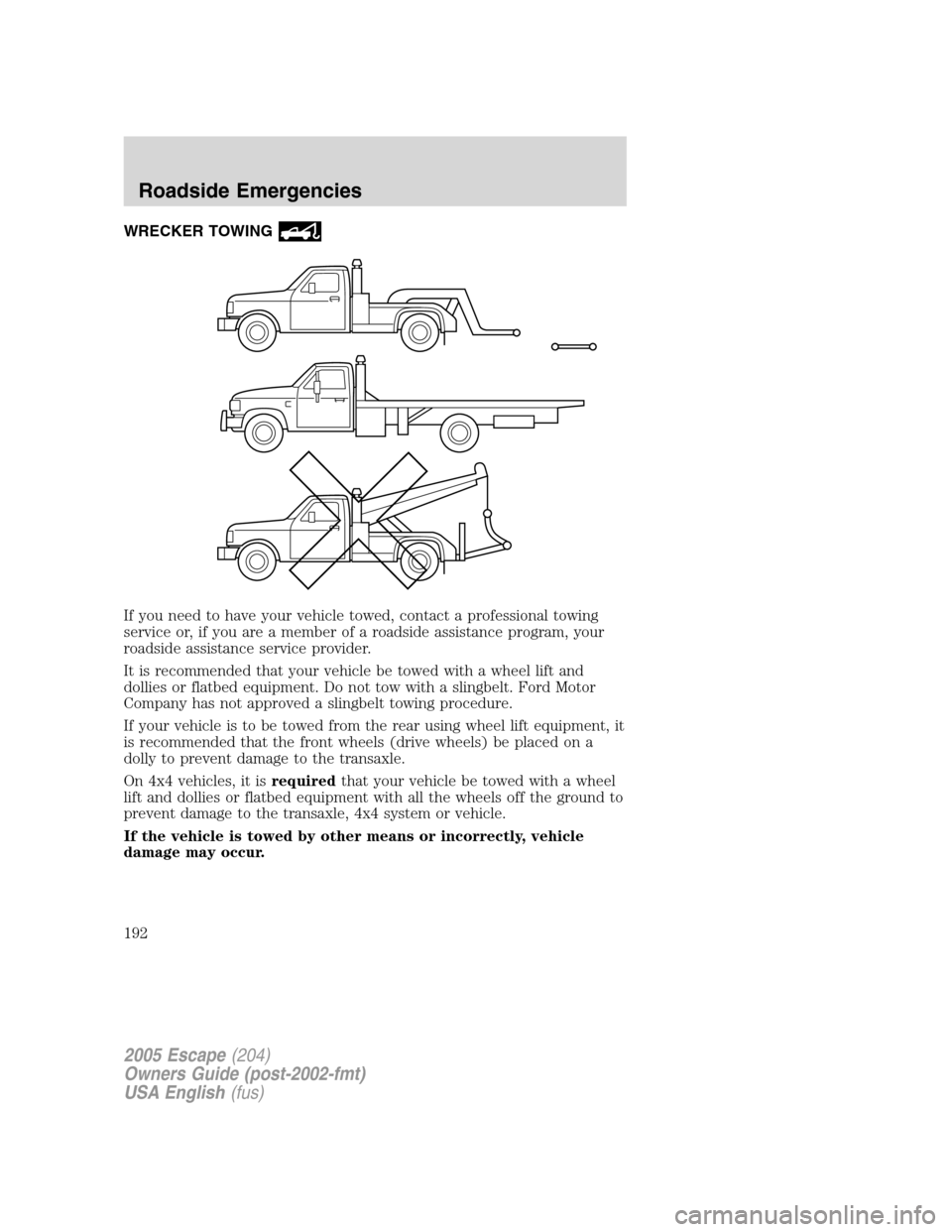
WRECKER TOWING
If you need to have your vehicle towed, contact a professional towing
service or, if you are a member of a roadside assistance program, your
roadside assistance service provider.
It is recommended that your vehicle be towed with a wheel lift and
dollies or flatbed equipment. Do not tow with a slingbelt. Ford Motor
Company has not approved a slingbelt towing procedure.
If your vehicle is to be towed from the rear using wheel lift equipment, it
is recommended that the front wheels (drive wheels) be placed on a
dolly to prevent damage to the transaxle.
On 4x4 vehicles, it isrequiredthat your vehicle be towed with a wheel
lift and dollies or flatbed equipment with all the wheels off the ground to
prevent damage to the transaxle, 4x4 system or vehicle.
If the vehicle is towed by other means or incorrectly, vehicle
damage may occur.
2005 Escape(204)
Owners Guide (post-2002-fmt)
USA English(fus)
Roadside Emergencies
192
Page 193 of 272
In case of a roadside emergency with a disabled vehicle (without access
to wheel dollies, car hauling trailer, or flatbed transport vehicle) your
vehicle (regardless of transmission powertrain configuration) can be flat
towed (all wheels on the ground) under the following conditions:
•Place the transmission in N (Neutral).
•Maximum speed is not to exceed 56 km/h (35 mph).
•Maximum distance is 80 km (50 miles).
Ford Motor Company produces a towing manual for all authorized tow
truck operators. Have your tow truck operator refer to this manual for
proper hook-up and towing procedures for your vehicle.
2005 Escape(204)
Owners Guide (post-2002-fmt)
USA English(fus)
Roadside Emergencies
193