power FORD ESCAPE 2006 1.G Owner's Manual
[x] Cancel search | Manufacturer: FORD, Model Year: 2006, Model line: ESCAPE, Model: FORD ESCAPE 2006 1.GPages: 288, PDF Size: 2.9 MB
Page 166 of 288
Hitches
Do not use hitches that clamp onto the vehicle bumper. Use a load
carrying hitch. You must distribute the load in your trailer so that
10–15% of the total weight of the trailer is on the tongue.
Safety chains
Always connect the trailer’s safety chains to hook retainers on the
vehicle. To connect the trailer’s safety chains, cross the chains under the
trailer tongue and allow slack for turning corners.
If you use a rental trailer, follow the instructions that the rental agency
gives to you.
Do not attach safety chains to the bumper.
Trailer brakes
Electric, manual, automatic or surge-type brakes, if compatible with the
vehicle, are safe if installed properly and adjusted to the manufacturer’s
specifications. The trailer brakes must meet local and Federal regulations.
Do not connect a trailer’s hydraulic brake system directly to your
vehicle’s brake system. Your vehicle may not have enough
braking power and your chances of having a collision greatly increase.
The braking system of the tow vehicle is rated for operation at the
GVWR not GCWR.
Trailer lamps
Trailer lamps are required on most towed vehicles. Make sure all running
lights, brake lights, turn signals and hazard lights are working. Do not
connect trailer lamps directly to your vehicle’s tail lamps. This can cause
damage to your vehicle’s electrical system. See your dealer or trailer rental
agency for proper instructions and equipment for hooking up trailer lamps.
Driving while you tow
When towing a trailer:
•Turn off the speed control. The speed control may shut off
automatically when you are towing on long, steep grades.
•Consult your local motor vehicle speed regulations for towing a trailer.
2006 Escape(204)
Owners Guide (post-2002-fmt)
USA(fus)
Tires, Wheels and Loading
166
Page 168 of 288
Exceeding these limits may allow water to enter vehicle components:
•causing internal damage to the components.
•affecting driveability, emissions and reliability.
Replace the rear axle lubricant any time the axle has been submerged in
water. Rear axle lubricant quantities are not to be checked or changed
unless a leak is suspected or repair required.
RECREATIONAL TOWING
An example of “recreational towing” is towing your vehicle behind a
motorhome.
If your vehicle is automatic transmission equipped, with a 4x2
(front-wheel drive only) configured powertrain, “recreational towing” is
permitted by trailering the vehicle with its front wheels on a dolly. This
protects the transmission’s internal mechanical components from
potential lack of lubrication damage.
If your vehicle is automatic transmission equipped, with a 4x4 (all-wheel
drive) configured powertrain, “recreational towing” is permitted only if
the vehicle is trailered with all four (4) wheels off the ground. Otherwise,
no “recreational towing” is permitted.
If your vehicle is manual transmission equipped (both 4x2 and 4x4),
shifting the transmission into neutral permits “flat-towing” (all wheels on
the ground) for pulling behind a motorhome. Your vehicle may be towed
up to a speed of 113 km/h (70 mph) but you should always obey local
speed limits.
For other towing requirements, refer toWrecker towingin theRoadside
Emergencieschapter.
2006 Escape(204)
Owners Guide (post-2002-fmt)
USA(fus)
Tires, Wheels and Loading
168
Page 169 of 288
STARTING
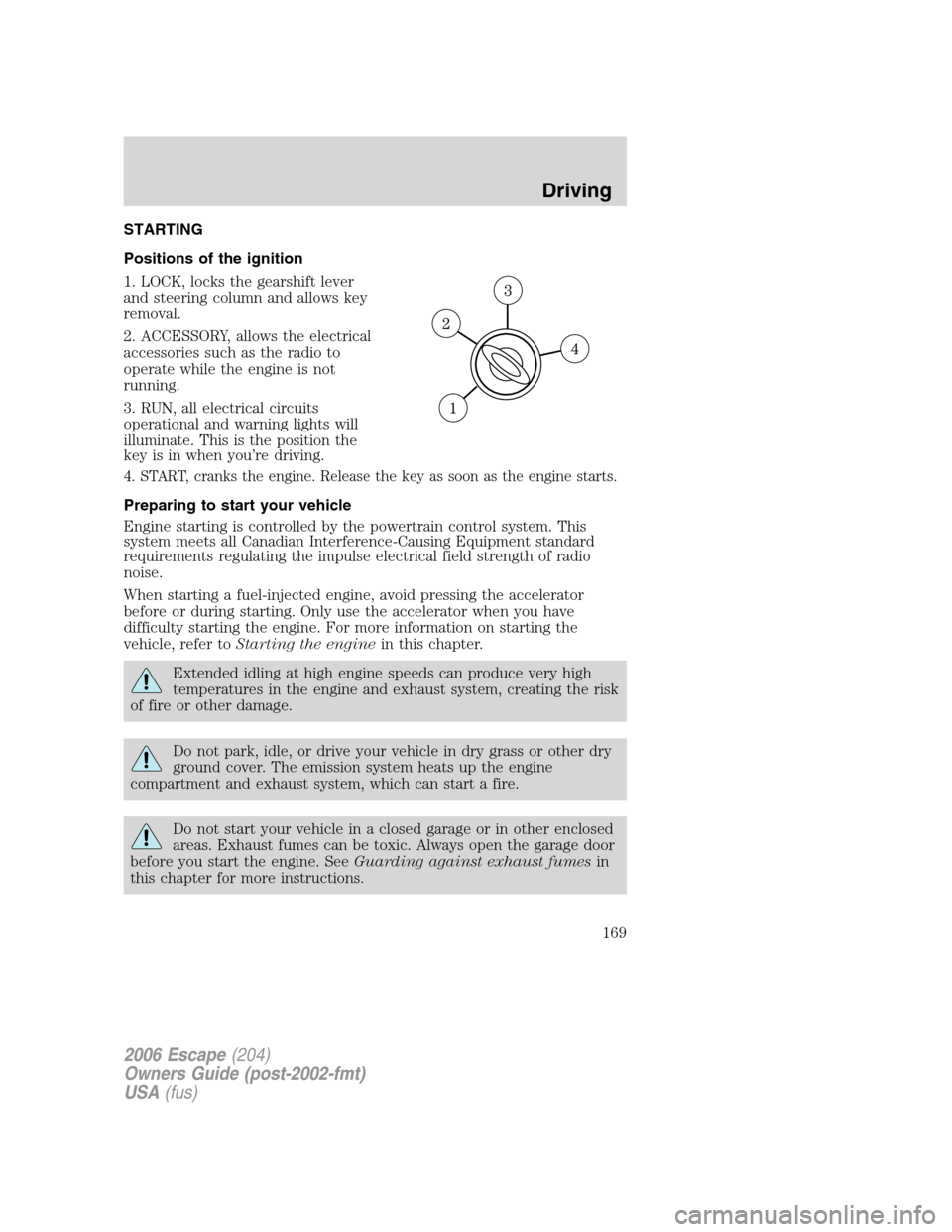
Positions of the ignition
1. LOCK, locks the gearshift lever
and steering column and allows key
removal.
2. ACCESSORY, allows the electrical
accessories such as the radio to
operate while the engine is not
running.
3. RUN, all electrical circuits
operational and warning lights will
illuminate. This is the position the
key is in when you’re driving.
4. START, cranks the engine. Release the key as soon as the engine starts.
Preparing to start your vehicle
Engine starting is controlled by the powertrain control system. This
system meets all Canadian Interference-Causing Equipment standard
requirements regulating the impulse electrical field strength of radio
noise.
When starting a fuel-injected engine, avoid pressing the accelerator
before or during starting. Only use the accelerator when you have
difficulty starting the engine. For more information on starting the
vehicle, refer toStarting the enginein this chapter.
Extended idling at high engine speeds can produce very high
temperatures in the engine and exhaust system, creating the risk
of fire or other damage.
Do not park, idle, or drive your vehicle in dry grass or other dry
ground cover. The emission system heats up the engine
compartment and exhaust system, which can start a fire.
Do not start your vehicle in a closed garage or in other enclosed
areas. Exhaust fumes can be toxic. Always open the garage door
before you start the engine. SeeGuarding against exhaust fumesin
this chapter for more instructions.
2006 Escape(204)
Owners Guide (post-2002-fmt)
USA(fus)
Driving
169
Page 174 of 288
Parking brake
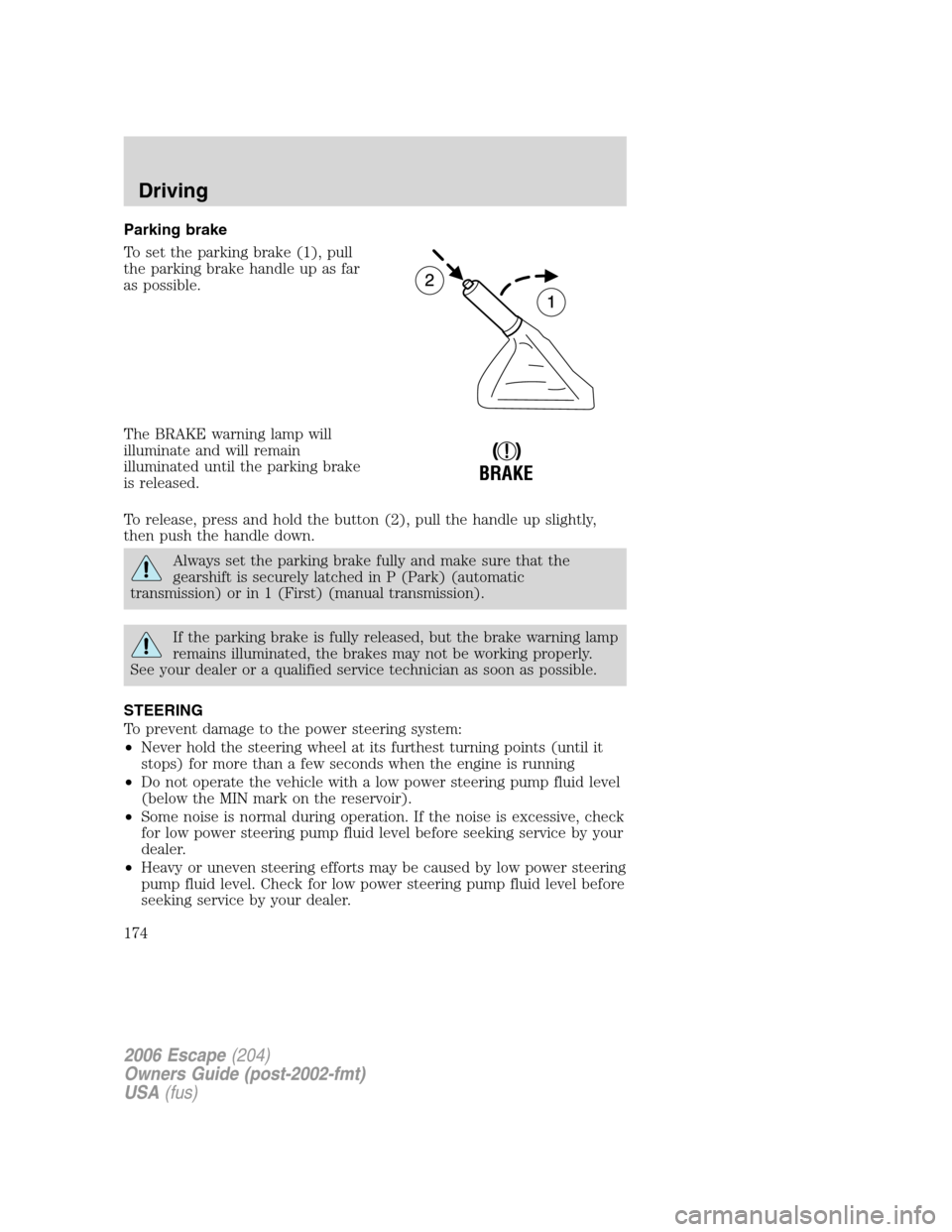
To set the parking brake (1), pull
the parking brake handle up as far
as possible.
The BRAKE warning lamp will
illuminate and will remain
illuminated until the parking brake
is released.
To release, press and hold the button (2), pull the handle up slightly,
then push the handle down.
Always set the parking brake fully and make sure that the
gearshift is securely latched in P (Park) (automatic
transmission) or in 1 (First) (manual transmission).
If the parking brake is fully released, but the brake warning lamp
remains illuminated, the brakes may not be working properly.
See your dealer or a qualified service technician as soon as possible.
STEERING
To prevent damage to the power steering system:
•Never hold the steering wheel at its furthest turning points (until it
stops) for more than a few seconds when the engine is running
•Do not operate the vehicle with a low power steering pump fluid level
(below the MIN mark on the reservoir).
•Some noise is normal during operation. If the noise is excessive, check
for low power steering pump fluid level before seeking service by your
dealer.
•Heavy or uneven steering efforts may be caused by low power steering
pump fluid level. Check for low power steering pump fluid level before
seeking service by your dealer.
!
BRAKE
2006 Escape(204)
Owners Guide (post-2002-fmt)
USA(fus)
Driving
174
Page 175 of 288
•Do not fill the power steering pump reservoir above the MAX mark on
the reservoir, as this may result in leaks from the reservoir.
If the power steering system breaks down (or if the engine is turned
off), you can steer the vehicle manually, but it takes more effort. If the
steering wanders or pulls, check for:
•an improperly inflated tire
•uneven tire wear
•loose or worn suspension components
•loose or worn steering components
•improper steering alignment
PREPARING TO DRIVE
Utility vehicles have a significantly higher rollover rate than
other types of vehicles.
In a rollover crash, an unbelted person is significantly more likely
to die than a person wearing a safety belt.
Your vehicle has larger tires and increased ground clearance, giving the
vehicle a higher center of gravity than a passenger car.
Vehicles with a higher center of gravity such as utility and
four-wheel drive vehicles handle differently than vehicles with a
lower center of gravity. Utility and four-wheel drive vehicles arenot
designed for cornering at speeds as high as passenger cars any more
than low-slung sports cars are designed to perform satisfactorily under
off-road conditions. Avoid sharp turns, excessive speed and abrupt
maneuvers in these vehicles. Failure to drive cautiously could result in
an increased risk of loss of vehicle control, vehicle rollover, personal
injury and death.
Loaded vehicles, with a higher center of gravity, may handle
differently than unloaded vehicles. Extra precautions such as
slower speeds and increased stopping distance should be taken when
driving a heavily loaded vehicle.
2006 Escape(204)
Owners Guide (post-2002-fmt)
USA(fus)
Driving
175
Page 186 of 288
If your vehicle sustains damage to the rear bumper/fascia, leaving
it misaligned or bent, the sensing zone may be altered causing
inaccurate measurement of obstacles or false alarms.
FOUR WHEEL DRIVE (4WD) SYSTEM (IF EQUIPPED)
For important information regarding safe operation of this type
of vehicle, seePreparing to drive your vehiclein this chapter.
Your vehicle is equipped with an intelligent 4WD System that
continuously monitors vehicle conditions and automatically adjusts the
power distribution between the front and rear wheels. It combines
transparent all-surface operation with highly capable four-wheel drive.
The 4WD system is always active and requires no driver input. It is
capable of handling all road conditions, including street and highway
driving as well as off-road and winter driving.
During very extreme off-road events, the 4WD system has a heat
protection mode to protect itself from damage. If the system detects an
overheat condition, it will enter a locked mode. If the heat in the 4WD
system continues to rise in locked mode, it will disable itself. To exit heat
protection mode, simply stop the vehicle and allow it to cool for five
minutes with the key in the 3 (RUN) position.
4WD system indicator lights
•Blinks continuouslywhen 4WD
system is disengaged (i.e. two
wheel drive) due to heat
protection mode.
•Blinks several times every minutewhen 4WD system requires
service. Please bring your vehicle to your local dealer for service.
4WD system messages in Message Center (if equipped)
•SERVICE 4WD:Displayed when 4WD system requires service. Please
bring your vehicle to your local dealer for service.
•4WD LOCKED TEMPORARILY:Displayed when 4WD system is
locked (i.e. permanent four wheel drive) due to heat protection mode.
•4WD DISABLED TEMPORARILY:Displayed when 4WD system is
disengaged (i.e. two wheel drive) due to heat protection mode.
•4WD AUTO RESTORED:Displayed when normal 4WD system
function is restored when heat protection mode is exited.
2006 Escape(204)
Owners Guide (post-2002-fmt)
USA(fus)
Driving
186
Page 191 of 288
Driving on hilly or sloping terrain
Although natural obstacles may make it necessary to travel diagonally up
or down a hill or steep incline, you should always try to drive straight up
or straight down.Avoid driving crosswise or turning on steep
slopes or hills.A danger lies in losing traction, slipping sideways and
possibly rolling over. Whenever driving on a hill, determine beforehand
the route you will use. Do not drive over the crest of a hill without
seeing what conditions are on the other side. Do not drive in reverse
over a hill without the aid of an observer.
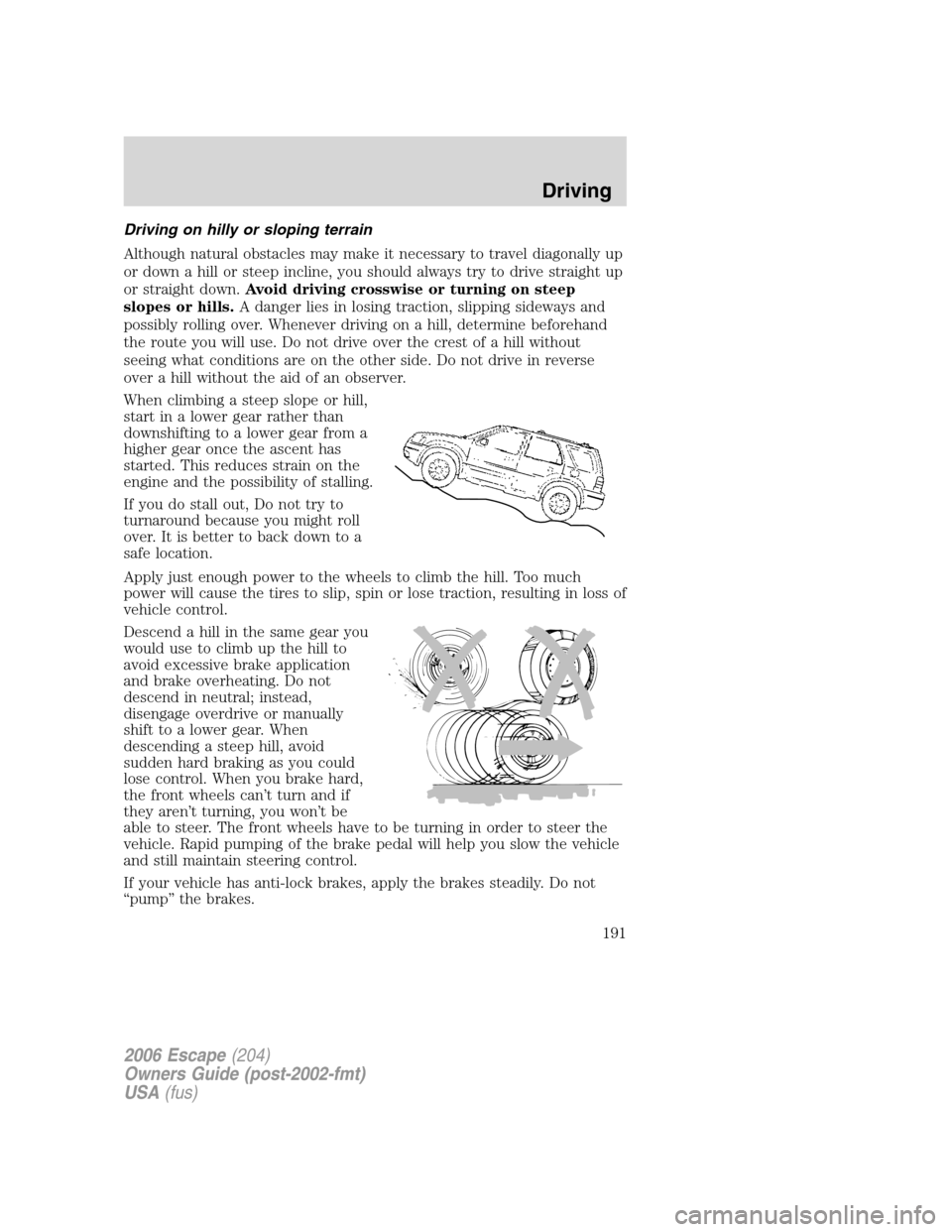
When climbing a steep slope or hill,
start in a lower gear rather than
downshifting to a lower gear from a
higher gear once the ascent has
started. This reduces strain on the
engine and the possibility of stalling.
If you do stall out, Do not try to
turnaround because you might roll
over. It is better to back down to a
safe location.
Apply just enough power to the wheels to climb the hill. Too much
power will cause the tires to slip, spin or lose traction, resulting in loss of
vehicle control.
Descend a hill in the same gear you
would use to climb up the hill to
avoid excessive brake application
and brake overheating. Do not
descend in neutral; instead,
disengage overdrive or manually
shift to a lower gear. When
descending a steep hill, avoid
sudden hard braking as you could
lose control. When you brake hard,
the front wheels can’t turn and if
they aren’t turning, you won’t be
able to steer. The front wheels have to be turning in order to steer the
vehicle. Rapid pumping of the brake pedal will help you slow the vehicle
and still maintain steering control.
If your vehicle has anti-lock brakes, apply the brakes steadily. Do not
“pump” the brakes.
2006 Escape(204)
Owners Guide (post-2002-fmt)
USA(fus)
Driving
191
Page 192 of 288
Driving on snow and ice
4WD vehicles have advantages over 2WD vehicles in snow and ice but
can skid like any other vehicle.
Should you start to slide while driving on snowy or icy roads, turn the
steering wheel in the direction of the slide until you regain control.
Avoid sudden applications of power and quick changes of direction on
snow and ice. Apply the accelerator slowly and steadily when starting
from a full stop.
Avoid sudden braking as well. Although a 4WD vehicle may accelerate
better than a two-wheel drive vehicle in snow and ice, it won’t stop any
faster, because as in other vehicles, braking occurs at all four wheels. Do
not become overconfident as to road conditions.
Make sure you allow sufficient distance between you and other vehicles
for stopping. Drive slower than usual and consider using one of the lower
gears. In emergency stopping situations, avoid locking of the wheels. Use
a “squeeze” technique, push on the brake pedal with a steadily increasing
force which allows the wheels to brake yet continue to roll so that you
may steer in the direction you want to travel. If you lock the wheels,
release the brake pedal and repeat the squeeze technique. Since your
vehicle is equipped with a Four Wheel Anti-Lock Brake System (ABS),
apply the brake steadily. Do not “pump” the brakes. Refer to theBrakes
section of this chapter for additional information on the operation of the
anti-lock brake system.
4WD vehicles should be driven with traction devices as referred to in
Using snow tires and traction devicesin theTires, Wheels and
Loadingchapter.
Maintenance and Modifications
The suspension and steering systems on your vehicle have been designed
and tested to provide predictable performance whether loaded or empty
and durable load carrying capability. For this reason, Ford Motor
Company strongly recommends that you do not make modifications such
as adding or removing parts (such as lift kits or stabilizer bars) or by
using replacement parts not equivalent to the original factory equipment.
Any modifications to a vehicle that raise the center of gravity can make
it more likely the vehicle will roll over as a result of a loss of control.
Ford Motor Company recommends that caution be used with any vehicle
equipped with a high load or device (such as ladder racks or pickup box
cover).
2006 Escape(204)
Owners Guide (post-2002-fmt)
USA(fus)
Driving
192
Page 199 of 288
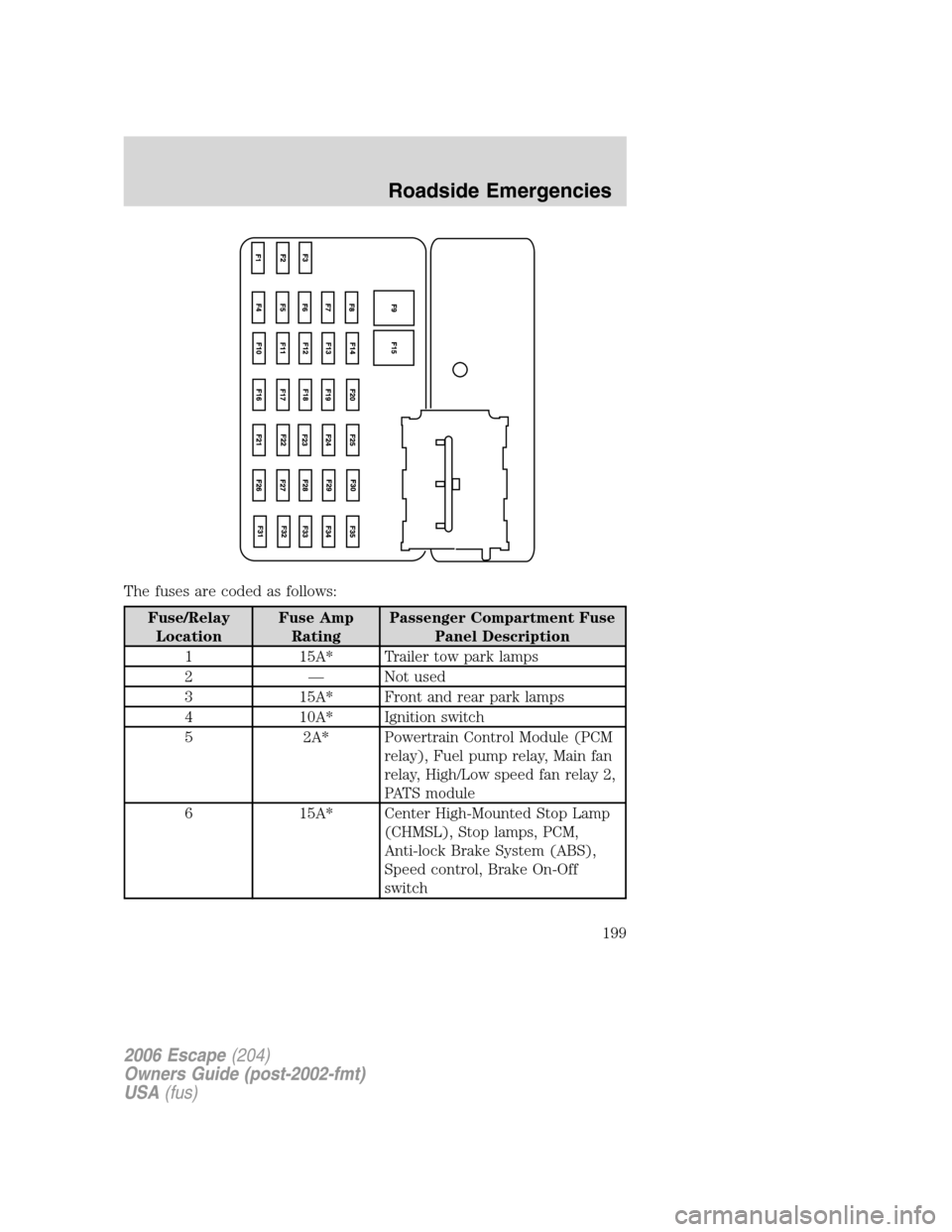
The fuses are coded as follows:
Fuse/Relay
LocationFuse Amp
RatingPassenger Compartment Fuse
Panel Description
1 15A* Trailer tow park lamps
2 — Not used
3 15A* Front and rear park lamps
4 10A* Ignition switch
5 2A* Powertrain Control Module (PCM
relay), Fuel pump relay, Main fan
relay, High/Low speed fan relay 2,
PATS module
6 15A* Center High-Mounted Stop Lamp
(CHMSL), Stop lamps, PCM,
Anti-lock Brake System (ABS),
Speed control, Brake On-Off
switch
2006 Escape(204)
Owners Guide (post-2002-fmt)
USA(fus)
Roadside Emergencies
199
Page 200 of 288
Fuse/Relay
LocationFuse Amp
RatingPassenger Compartment Fuse
Panel Description
7 10A* Instrument cluster, Diagnostic
connector, Power mirror switch,
Radio
8 — Not used
9 30A** Power door locks, Power seats
10 15A* Heated mirrors
11 15A* Sunroof, Electrochromatic mirror
12 5A* Radio
13 — Not used
14 — Not used
15 30A** Power windows
16 15A* Subwoofer
17 15A* Low beams
18 10A* 4WD
19 — Not used
20 15A* Horn
21 10A* Rear wiper motor, Rear wiper
washer
22 10A* Instrument cluster
23 — Not used
24 20A* Cigar lighter
25 20A* Front wiper motor, Front wiper
washer
26 5A* Climate control system mode
switch
27 5A* Canister vent, Speed control
cancel switch
28 10A* Instrument cluster
29 10A* Reverse park aid
30 — Not used
31 — Not used
32 10A* Brake-Transmission shift lock
2006 Escape(204)
Owners Guide (post-2002-fmt)
USA(fus)
Roadside Emergencies
200