trailer FORD ESCAPE 2006 1.G Owner's Manual
[x] Cancel search | Manufacturer: FORD, Model Year: 2006, Model line: ESCAPE, Model: FORD ESCAPE 2006 1.GPages: 288, PDF Size: 2.9 MB
Page 213 of 288
Stowing the flat/spare tire
Note:Failure to follow spare tire stowage instructions may result in
failure of cable or loss of spare tire.
If you are stowing a tire that requires reattaching it to the
vehicle with a tether, perform these steps first, then proceed with
the steps following.
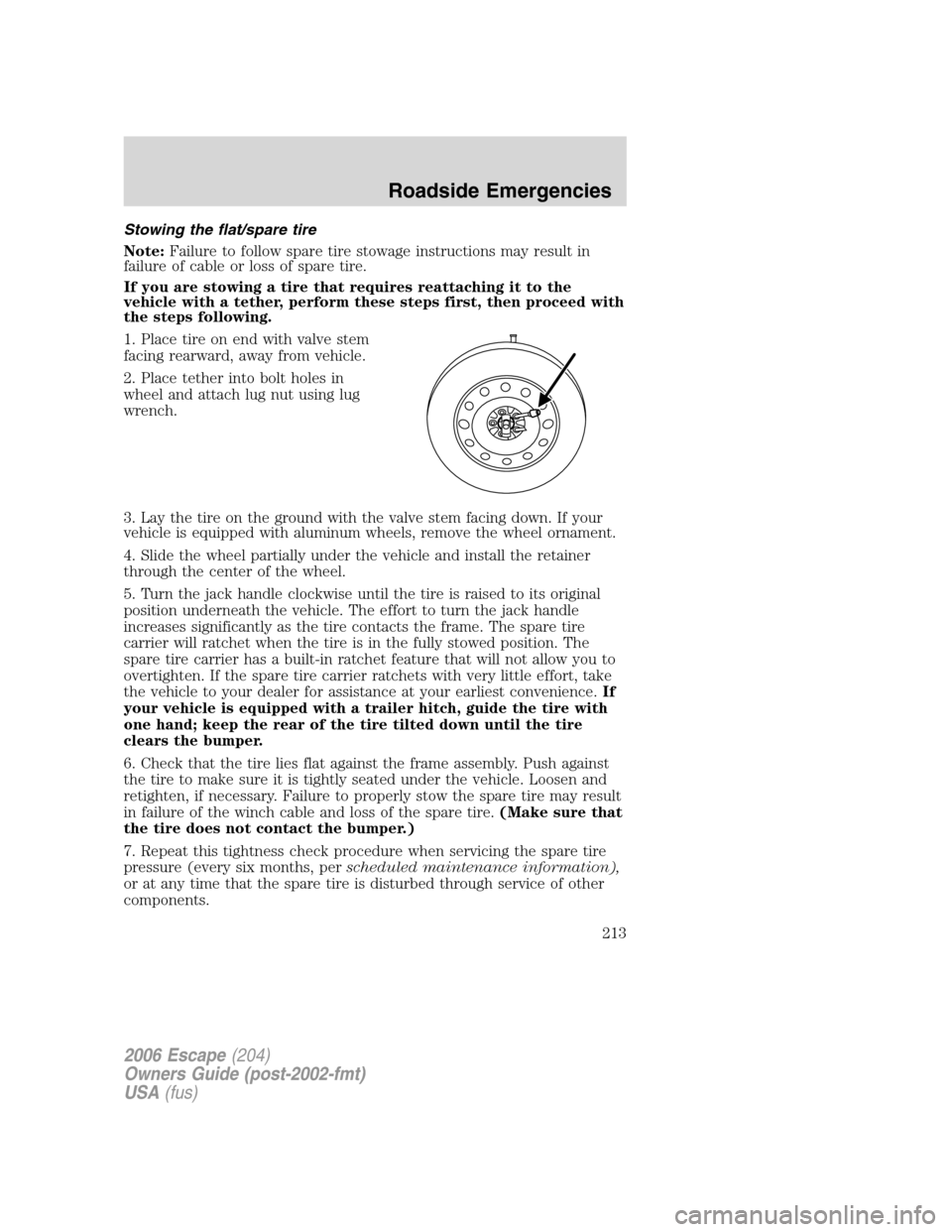
1. Place tire on end with valve stem
facing rearward, away from vehicle.
2. Place tether into bolt holes in
wheel and attach lug nut using lug
wrench.
3. Lay the tire on the ground with the valve stem facing down. If your
vehicle is equipped with aluminum wheels, remove the wheel ornament.
4. Slide the wheel partially under the vehicle and install the retainer
through the center of the wheel.
5. Turn the jack handle clockwise until the tire is raised to its original
position underneath the vehicle. The effort to turn the jack handle
increases significantly as the tire contacts the frame. The spare tire
carrier will ratchet when the tire is in the fully stowed position. The
spare tire carrier has a built-in ratchet feature that will not allow you to
overtighten. If the spare tire carrier ratchets with very little effort, take
the vehicle to your dealer for assistance at your earliest convenience.If
your vehicle is equipped with a trailer hitch, guide the tire with
one hand; keep the rear of the tire tilted down until the tire
clears the bumper.
6. Check that the tire lies flat against the frame assembly. Push against
the tire to make sure it is tightly seated under the vehicle. Loosen and
retighten, if necessary. Failure to properly stow the spare tire may result
in failure of the winch cable and loss of the spare tire.(Make sure that
the tire does not contact the bumper.)
7. Repeat this tightness check procedure when servicing the spare tire
pressure (every six months, perscheduled maintenance information),
or at any time that the spare tire is disturbed through service of other
components.
2006 Escape(204)
Owners Guide (post-2002-fmt)
USA(fus)
Roadside Emergencies
213
Page 221 of 288
If the vehicle is towed by other means or incorrectly, vehicle
damage may occur.
In case of a roadside emergency with a disabled vehicle (without access
to wheel dollies, car hauling trailer, or flatbed transport vehicle) your
vehicle (regardless of transmission powertrain configuration) can be flat
towed (all wheels on the ground) under the following conditions:
•Place the transmission in N (Neutral).
•Maximum distance is 50 miles (80 km).
•Maximum speed is not to exceed 35 mph (56 km/h).
Ford Motor Company produces a towing manual for all authorized tow
truck operators. Have your tow truck operator refer to this manual for
proper hook-up and towing procedures for your vehicle.
2006 Escape(204)
Owners Guide (post-2002-fmt)
USA(fus)
Roadside Emergencies
221
Page 261 of 288
Maintenance
•Keep tires properly inflated and use only recommended size.
•Operating a vehicle with the wheels out of alignment will reduce fuel
economy.
•Use recommended engine oil. Refer toLubricant specificationsin
this chapter.
•Perform all regularly scheduled maintenance items. Follow the
recommended maintenance schedule and owner maintenance checks
found inscheduled maintenance information.
Conditions
•Heavily loading a vehicle or towing a trailer may reduce fuel economy
at any speed.
•Carrying unnecessary weight may reduce fuel economy (approximately
1 mpg [0.4 km/L] is lost for every 400 lb [180 kg] of weight carried).
•Adding certain accessories to your vehicle (for example bug
deflectors, rollbars/light bars, running boards, ski/luggage racks) may
reduce fuel economy.
•Using fuel blended with alcohol may lower fuel economy.
•Fuel economy may decrease with lower temperatures during the first
8–10 miles (12–16 km) of driving.
•Driving on flat terrain offers improved fuel economy as compared to
driving on hilly terrain.
•Transmissions give their best fuel economy when operated in the top
cruise gear and with steady pressure on the gas pedal.
•Close windows for high speed driving.
EPA window sticker
Every new vehicle should have the EPA window sticker. Contact your
dealer if the window sticker is not supplied with your vehicle. The EPA
window sticker should be your guide for the fuel economy comparisons
with other vehicles.
It is important to note the box in the lower left corner of the window
sticker. These numbers represent the Range of MPG (L/100 km)
expected on the vehicle under optimum conditions. Your fuel economy
may vary depending upon the method of operation and conditions.
2006 Escape(204)
Owners Guide (post-2002-fmt)
USA(fus)
Maintenance and Specifications
261
Page 265 of 288
BRAKE/CLUTCH FLUID
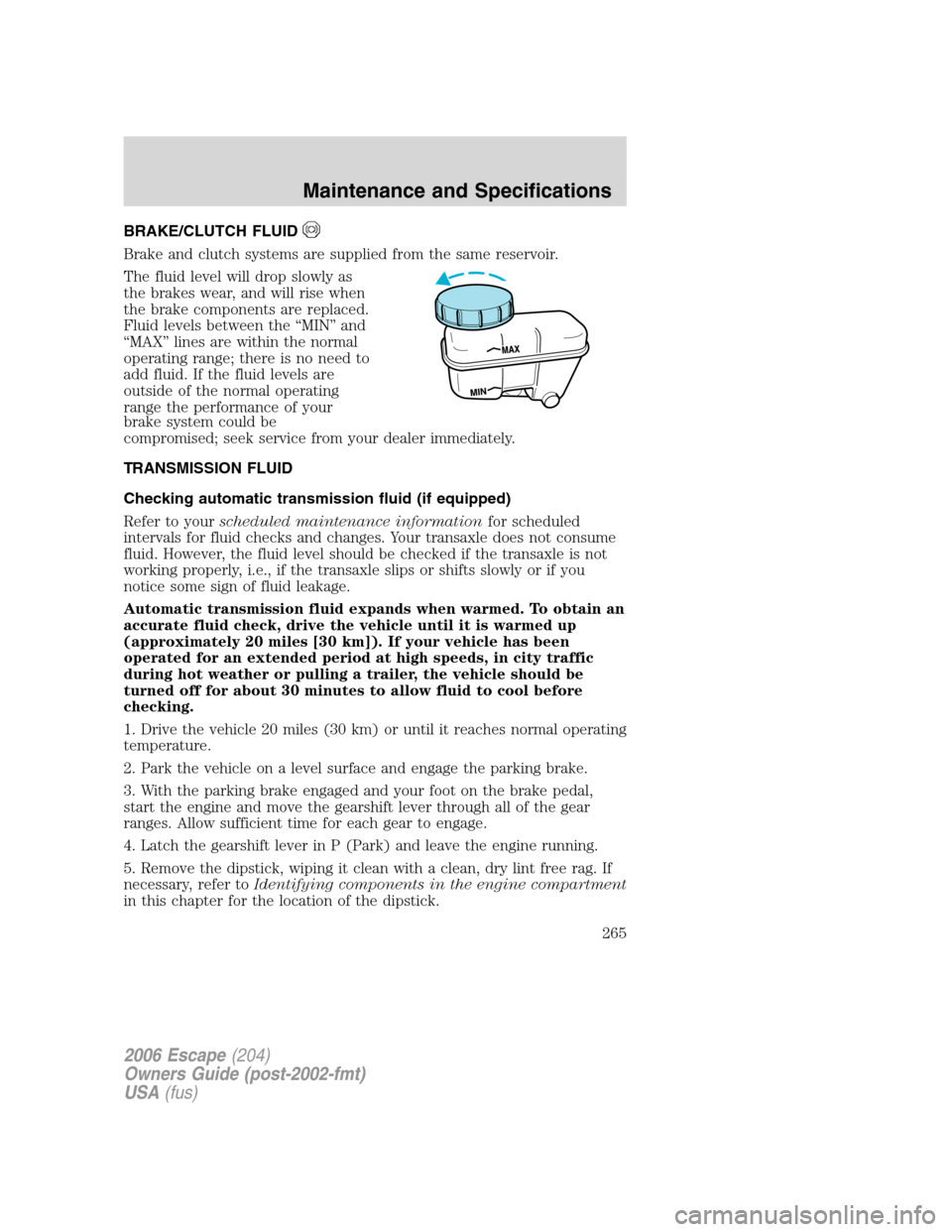
Brake and clutch systems are supplied from the same reservoir.
The fluid level will drop slowly as
the brakes wear, and will rise when
the brake components are replaced.
Fluid levels between the “MIN” and
“MAX” lines are within the normal
operating range; there is no need to
add fluid. If the fluid levels are
outside of the normal operating
range the performance of your
brake system could be
compromised; seek service from your dealer immediately.
TRANSMISSION FLUID
Checking automatic transmission fluid (if equipped)
Refer to yourscheduled maintenance informationfor scheduled
intervals for fluid checks and changes. Your transaxle does not consume
fluid. However, the fluid level should be checked if the transaxle is not
working properly, i.e., if the transaxle slips or shifts slowly or if you
notice some sign of fluid leakage.
Automatic transmission fluid expands when warmed. To obtain an
accurate fluid check, drive the vehicle until it is warmed up
(approximately 20 miles [30 km]). If your vehicle has been
operated for an extended period at high speeds, in city traffic
during hot weather or pulling a trailer, the vehicle should be
turned off for about 30 minutes to allow fluid to cool before
checking.
1. Drive the vehicle 20 miles (30 km) or until it reaches normal operating
temperature.
2. Park the vehicle on a level surface and engage the parking brake.
3. With the parking brake engaged and your foot on the brake pedal,
start the engine and move the gearshift lever through all of the gear
ranges. Allow sufficient time for each gear to engage.
4. Latch the gearshift lever in P (Park) and leave the engine running.
5. Remove the dipstick, wiping it clean with a clean, dry lint free rag. If
necessary, refer toIdentifying components in the engine compartment
in this chapter for the location of the dipstick.
2006 Escape(204)
Owners Guide (post-2002-fmt)
USA(fus)
Maintenance and Specifications
265
Page 280 of 288
Interior style
Electrochromatic compass/temperature interior mirrors
Floor mats
Scuff plates
Lifestyle
Bike racks
Cargo organization and management
Mobile-ease hands-free communication system
Rear seat entertainment systems
Trailer hitches, wiring harnesses and accessories
Peace of mind
First aid and highway safety kits
Full vehicle covers
Keyless entry keypad
Locking gas cap
Navigation systems
Remote start
Vehicle security systems
For maximum vehicle performance, keep the following information in
mind when adding accessories or equipment to your vehicle:
•When adding accessories, equipment, passengers and luggage to your
vehicle, do not exceed the total weight capacity of the vehicle or of
the front or rear axle (GVWR or GAWR as indicated on the Safety
Compliance Certification label). Consult your dealer for specific weight
information.
•The Federal Communications Commission (FCC) and Canadian Radio
Telecommunications Commission (CRTC) regulate the use of mobile
communications systems — such as two-way radios, telephones and
theft alarms - that are equipped with radio transmitters. Any such
equipment installed in your vehicle should comply with FCC or CRTC
regulations and should be installed only by a qualified service
technician.
•Mobile communications systems may harm the operation of your
vehicle, particularly if they are not properly designed for automotive
use.
2006 Escape(204)
Owners Guide (post-2002-fmt)
USA(fus)
Accessories
280
Page 287 of 288
checking the pressure ............144
inspecting and inflating .........144
label .........................................151
replacing ..................................146
rotating ....................................154
safety practices .......................153
sidewall information ...............147
snow tires and chains ............155
spare tire .................................204
terminology .............................143
tire grades ...............................142
treadwear ........................142, 152
Towing .......................................163
recreational towing .................168
trailer towing ..........................163
wrecker ....................................220
Transaxle
fluid, checking and adding
(manual) .................................267
manual operation ....................181
Transmission
automatic operation ...............176
brake-shift interlock (BSI) ....176
fluid, checking and adding
(automatic) .............................265
fluid, refill capacities ..............270
lubricant specifications ..272, 274Turn signal ..................................46
V
Vehicle dimensions ...................274
Vehicle Identification Number
(VIN) ..........................................277
Vehicle loading ..........................156
Ventilating your vehicle ...........172
W
Warning lights (see Lights) .......12
Washer fluid ..............................241
Water, Driving through .............193
Windows
power .........................................57
rear wiper/washer .....................53
Windshield washer fluid and
wipers
checking and adding fluid .....241
liftgate reservoir .....................241
operation ...................................52
replacing wiper blades ...........242
Wrecker towing .........................220
2006 Escape(204)
Owners Guide (post-2002-fmt)
USA(fus)
Index
287