light FORD ESCAPE 2006 1.G Repair Manual
[x] Cancel search | Manufacturer: FORD, Model Year: 2006, Model line: ESCAPE, Model: FORD ESCAPE 2006 1.GPages: 288, PDF Size: 2.9 MB
Page 179 of 288
To put your vehicle in P (Park):
•Come to a complete stop
•Move the gearshift lever and securely latch it in P (Park)
Always set the parking brake fully and make sure the gearshift is
latched in P (Park). Turn the ignition to the LOCK position and
remove the key whenever you leave your vehicle.
R (Reverse)
With the gearshift lever in R (Reverse), the vehicle will move backward.
Always come to a complete stop before shifting into and out of R
(Reverse).
N (Neutral)
With the gearshift lever in N (Neutral), the vehicle can be started and is
free to roll. Hold the brake pedal down while in this position.
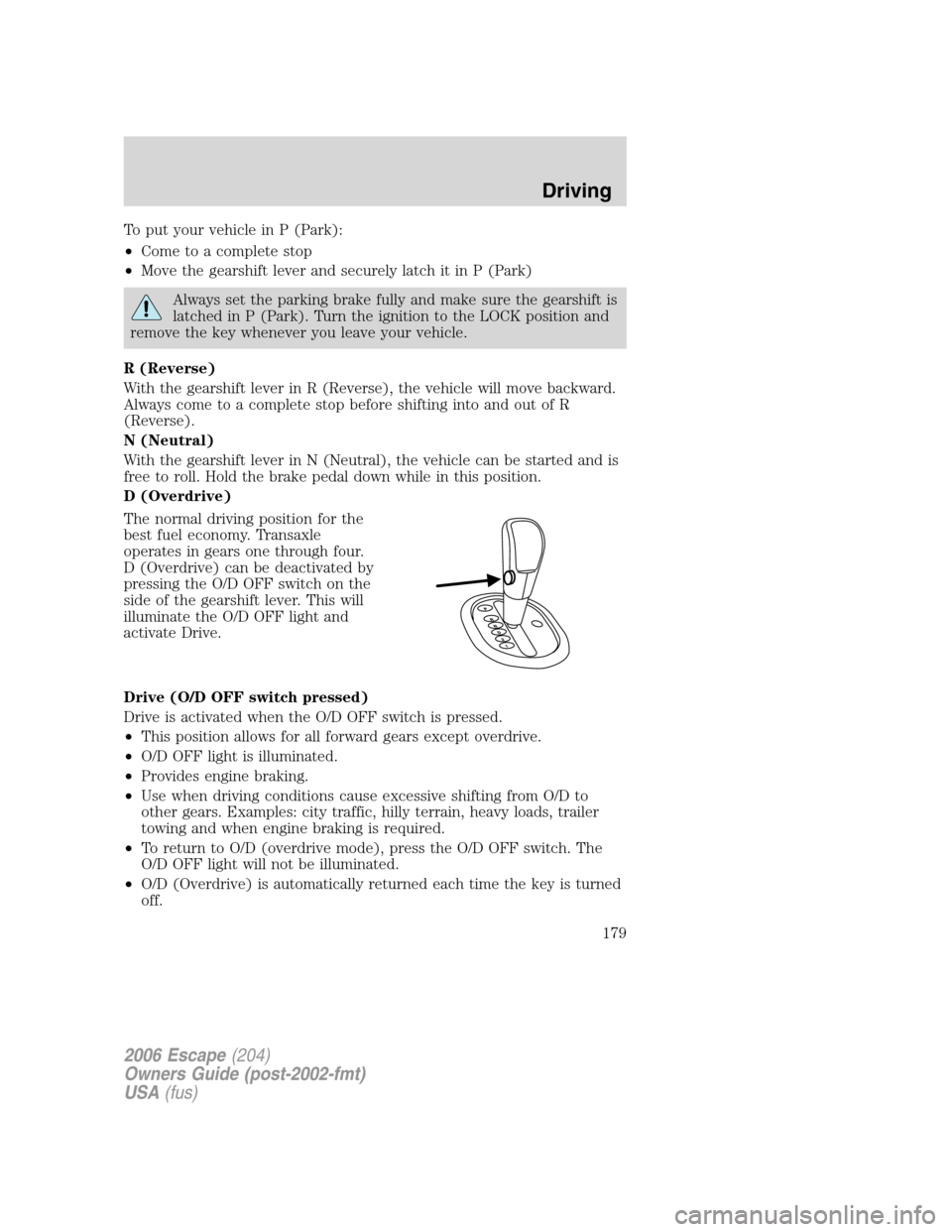
D (Overdrive)
The normal driving position for the
best fuel economy. Transaxle
operates in gears one through four.
D (Overdrive) can be deactivated by
pressing the O/D OFF switch on the
side of the gearshift lever. This will
illuminate the O/D OFF light and
activate Drive.
Drive (O/D OFF switch pressed)
Drive is activated when the O/D OFF switch is pressed.
•This position allows for all forward gears except overdrive.
•O/D OFF light is illuminated.
•Provides engine braking.
•Use when driving conditions cause excessive shifting from O/D to
other gears. Examples: city traffic, hilly terrain, heavy loads, trailer
towing and when engine braking is required.
•To return to O/D (overdrive mode), press the O/D OFF switch. The
O/D OFF light will not be illuminated.
•O/D (Overdrive) is automatically returned each time the key is turned
off.
2006 Escape(204)
Owners Guide (post-2002-fmt)
USA(fus)
Driving
179
Page 180 of 288
2 (Second)
This position allows for second gear only.
•Provides engine braking.
•Use to start-up on slippery roads.
•To return to D (Overdrive), move the gearshift lever into the D
(Overdrive) position.
•Selecting 2 (Second) at higher speeds will cause the transaxle to
downshift to second gear at the appropriate vehicle speed.
1 (First)
•Provides maximum engine braking.
•Allows upshifts by moving gearshift lever.
•Will not downshift into 1 (First) at high speeds; allows for 1 (First)
when vehicle reaches slower speeds.
When parking, do not use the gearshift in place of the parking
brake. Always set the parking brake fully and make sure that the
gearshift is securely latched in P (Park). Turn off the ignition
whenever you leave your vehicle. Never leave your vehicle unattended
while it is running. If you do not take these precautions, your vehicle
may move unexpectedly and injure someone.
Forced downshifts
•Allowed in D (Overdrive) or Drive.
•Depress the accelerator to the floor.
•Allows transmission to select an appropriate gear.
If your vehicle gets stuck in mud or snow
If your vehicle gets stuck in mud or snow, it may be rocked out by
shifting between forward and reverse gears, stopping between shifts in a
steady pattern. Press lightly on the accelerator in each gear.
Do not rock the vehicle if the engine is not at normal operating
temperature or damage to the transmission may occur.
Do not rock the vehicle for more than a minute or damage to the
transmission and tires may occur, or the engine may overheat.
2006 Escape(204)
Owners Guide (post-2002-fmt)
USA(fus)
Driving
180
Page 185 of 288
Certain add-on devices such as large trailer hitches, bike or
surfboard racks and any device that may block the normal
detection zone of the RSS system may create false beeps.
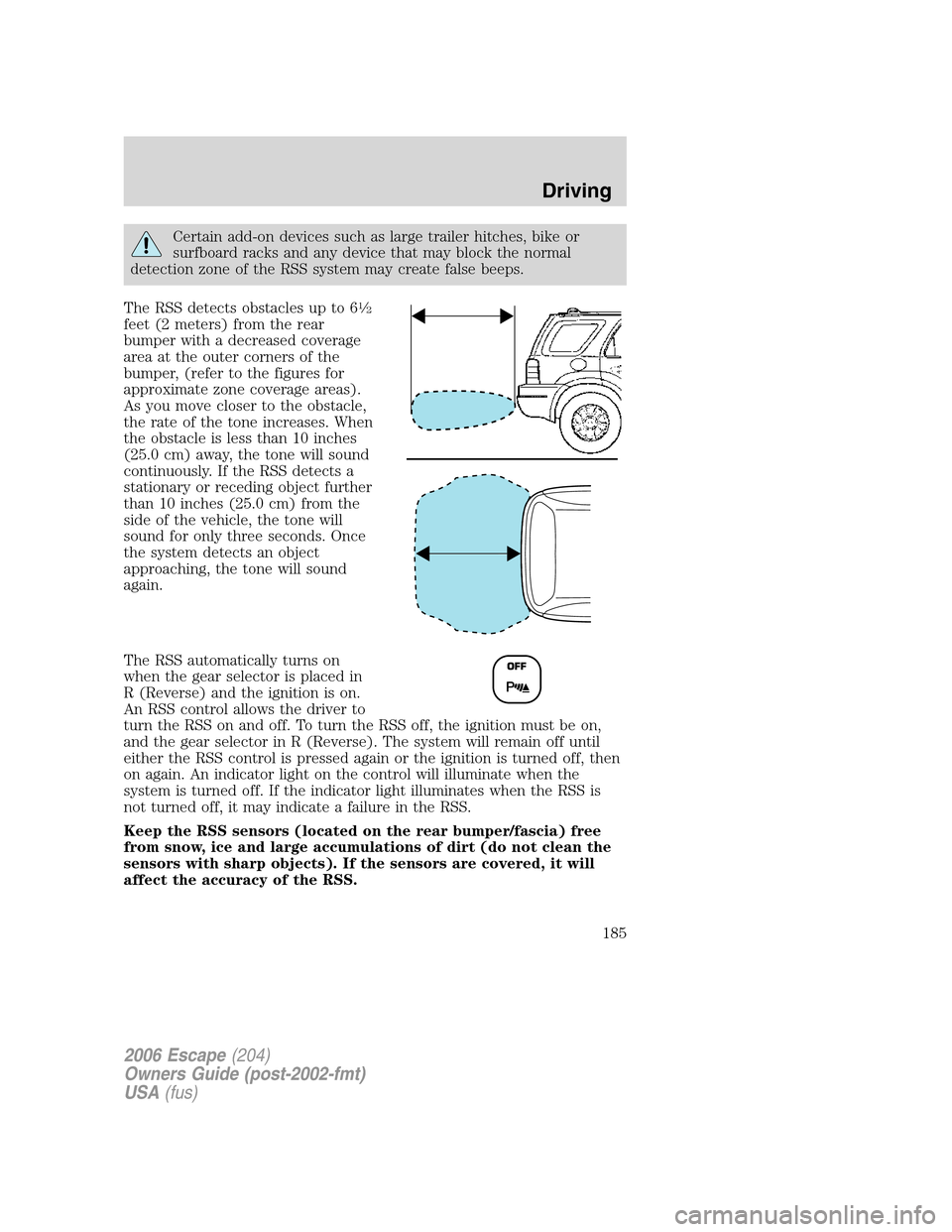
The RSS detects obstacles up to 6
12
feet (2 meters) from the rear
bumper with a decreased coverage
area at the outer corners of the
bumper, (refer to the figures for
approximate zone coverage areas).
As you move closer to the obstacle,
the rate of the tone increases. When
the obstacle is less than 10 inches
(25.0 cm) away, the tone will sound
continuously. If the RSS detects a
stationary or receding object further
than 10 inches (25.0 cm) from the
side of the vehicle, the tone will
sound for only three seconds. Once
the system detects an object
approaching, the tone will sound
again.
The RSS automatically turns on
when the gear selector is placed in
R (Reverse) and the ignition is on.
An RSS control allows the driver to
turn the RSS on and off. To turn the RSS off, the ignition must be on,
and the gear selector in R (Reverse). The system will remain off until
either the RSS control is pressed again or the ignition is turned off, then
on again. An indicator light on the control will illuminate when the
system is turned off. If the indicator light illuminates when the RSS is
not turned off, it may indicate a failure in the RSS.
Keep the RSS sensors (located on the rear bumper/fascia) free
from snow, ice and large accumulations of dirt (do not clean the
sensors with sharp objects). If the sensors are covered, it will
affect the accuracy of the RSS.
2006 Escape(204)
Owners Guide (post-2002-fmt)
USA(fus)
Driving
185
Page 186 of 288
If your vehicle sustains damage to the rear bumper/fascia, leaving
it misaligned or bent, the sensing zone may be altered causing
inaccurate measurement of obstacles or false alarms.
FOUR WHEEL DRIVE (4WD) SYSTEM (IF EQUIPPED)
For important information regarding safe operation of this type
of vehicle, seePreparing to drive your vehiclein this chapter.
Your vehicle is equipped with an intelligent 4WD System that
continuously monitors vehicle conditions and automatically adjusts the
power distribution between the front and rear wheels. It combines
transparent all-surface operation with highly capable four-wheel drive.
The 4WD system is always active and requires no driver input. It is
capable of handling all road conditions, including street and highway
driving as well as off-road and winter driving.
During very extreme off-road events, the 4WD system has a heat
protection mode to protect itself from damage. If the system detects an
overheat condition, it will enter a locked mode. If the heat in the 4WD
system continues to rise in locked mode, it will disable itself. To exit heat
protection mode, simply stop the vehicle and allow it to cool for five
minutes with the key in the 3 (RUN) position.
4WD system indicator lights
•Blinks continuouslywhen 4WD
system is disengaged (i.e. two
wheel drive) due to heat
protection mode.
•Blinks several times every minutewhen 4WD system requires
service. Please bring your vehicle to your local dealer for service.
4WD system messages in Message Center (if equipped)
•SERVICE 4WD:Displayed when 4WD system requires service. Please
bring your vehicle to your local dealer for service.
•4WD LOCKED TEMPORARILY:Displayed when 4WD system is
locked (i.e. permanent four wheel drive) due to heat protection mode.
•4WD DISABLED TEMPORARILY:Displayed when 4WD system is
disengaged (i.e. two wheel drive) due to heat protection mode.
•4WD AUTO RESTORED:Displayed when normal 4WD system
function is restored when heat protection mode is exited.
2006 Escape(204)
Owners Guide (post-2002-fmt)
USA(fus)
Driving
186
Page 188 of 288
•It often may be less risky to strike small objects, such as highway
reflectors, with minor damage to your vehicle rather than attempt a
sudden return to the pavement which could cause the vehicle to slide
sideways out of control or roll over. Remember, your safety and the
safety of others should be your primary concern.
Vehicles with a higher center of gravity such as utility and
four-wheel drive vehicles handle differently than vehicles with a
lower center of gravity. Utility and four-wheel drive vehicles arenot
designed for cornering at speeds as high as passenger cars any more
than low-slung sports cars are designed to perform satisfactorily under
off-road conditions. Avoid sharp turns, excessive speed and abrupt
maneuvers in these vehicles. Failure to drive cautiously could result in
an increased risk of loss of vehicle control, vehicle rollover, personal
injury and death.
If your vehicle gets stuck
If your vehicle gets stuck in mud or snow it may be rocked out by
shifting between forward and reverse gears, stopping between shifts, in a
steady pattern. Press lightly on the accelerator in each gear.
Do not rock the vehicle if the engine is not at normal operating
temperature or damage to the transmission may occur.
Do not rock the vehicle for more than a few minutes or damage
to the transmission and tires may occur or the engine may
overheat.
Always set the parking brake fully and make sure the gearshift is
latched in P (Park). Turn the ignition to the LOCK position and
remove the key whenever you leave your vehicle.
If the parking brake is fully released, but the brake warning lamp
remains illuminated, the brakes may not be working properly.
See your dealer or a qualified service technician.
Do not spin the wheels at over 35 mph (56 km/h). The tires may
fail and injure a passenger or bystander.
2006 Escape(204)
Owners Guide (post-2002-fmt)
USA(fus)
Driving
188
Page 190 of 288
Mud and water
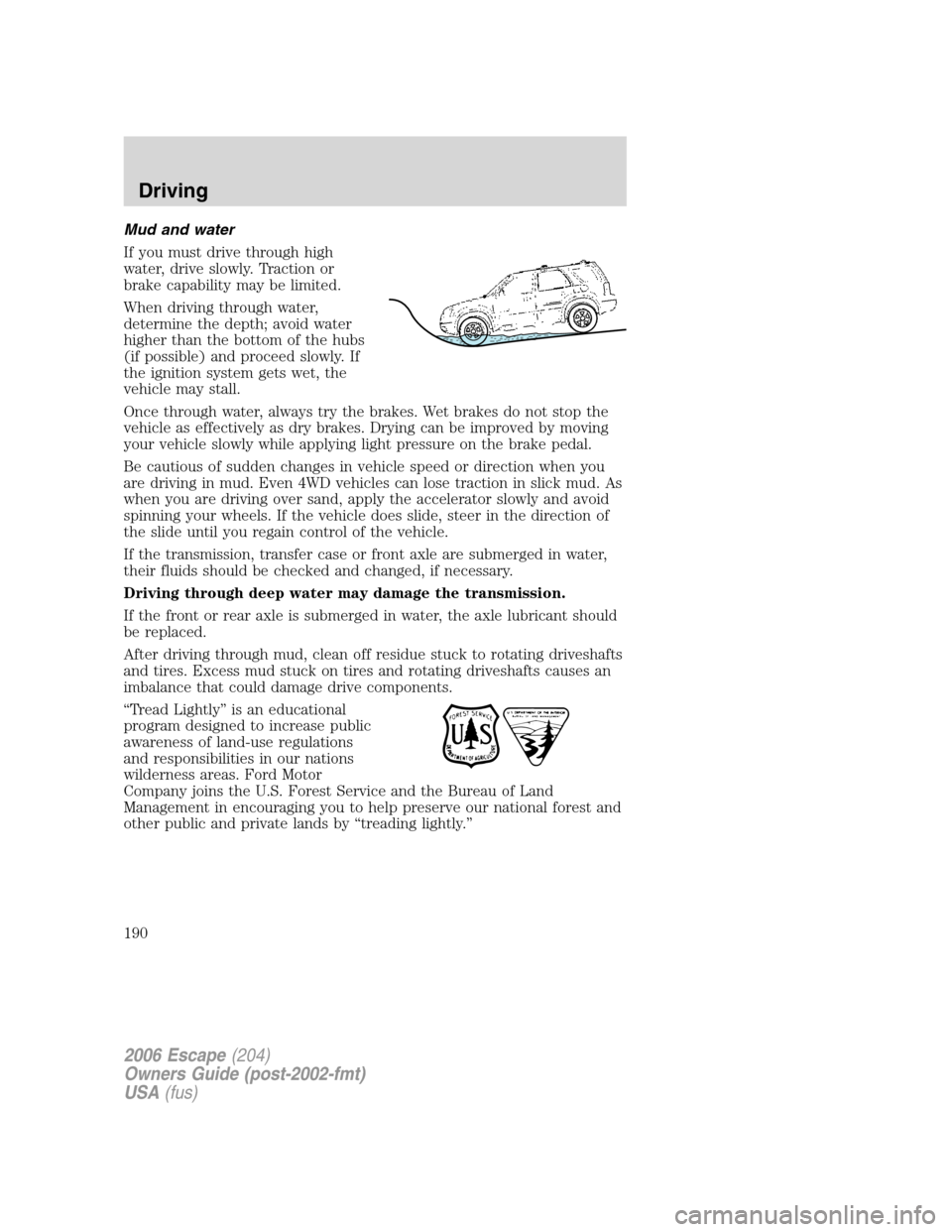
If you must drive through high
water, drive slowly. Traction or
brake capability may be limited.
When driving through water,
determine the depth; avoid water
higher than the bottom of the hubs
(if possible) and proceed slowly. If
the ignition system gets wet, the
vehicle may stall.
Once through water, always try the brakes. Wet brakes do not stop the
vehicle as effectively as dry brakes. Drying can be improved by moving
your vehicle slowly while applying light pressure on the brake pedal.
Be cautious of sudden changes in vehicle speed or direction when you
are driving in mud. Even 4WD vehicles can lose traction in slick mud. As
when you are driving over sand, apply the accelerator slowly and avoid
spinning your wheels. If the vehicle does slide, steer in the direction of
the slide until you regain control of the vehicle.
If the transmission, transfer case or front axle are submerged in water,
their fluids should be checked and changed, if necessary.
Driving through deep water may damage the transmission.
If the front or rear axle is submerged in water, the axle lubricant should
be replaced.
After driving through mud, clean off residue stuck to rotating driveshafts
and tires. Excess mud stuck on tires and rotating driveshafts causes an
imbalance that could damage drive components.
“Tread Lightly” is an educational
program designed to increase public
awareness of land-use regulations
and responsibilities in our nations
wilderness areas. Ford Motor
Company joins the U.S. Forest Service and the Bureau of Land
Management in encouraging you to help preserve our national forest and
other public and private lands by “treading lightly.”
2006 Escape(204)
Owners Guide (post-2002-fmt)
USA(fus)
Driving
190
Page 193 of 288
Failure to maintain your vehicle properly may void the warranty, increase
your repair cost, reduce vehicle performance and operational capabilities
and adversely affect driver and passenger safety. Frequent inspection of
vehicle chassis components is recommended if the vehicle is subjected to
heavy off-road usage.
DRIVING THROUGH WATER
If driving through deep or standing water is unavoidable, proceed very
slowly especially if the depth is not known. Never drive through water
that is higher than the bottom of the hubs (for trucks) or the bottom of
the wheel rims (for cars). Traction or brake capability may be limited
and your vehicle may stall. Water may also enter your engine’s air intake
and severely damage your engine.
Once through the water, always dry the brakes by moving your vehicle
slowly while applying light pressure on the brake pedal. Wet brakes do
not stop the vehicle as quickly as dry brakes.Driving through deep
water where the transaxle is submerged may allow water into the
transaxle and cause internal damage. Have the fluid checked and,
if water is found, replace the fluid.
2006 Escape(204)
Owners Guide (post-2002-fmt)
USA(fus)
Driving
193
Page 200 of 288
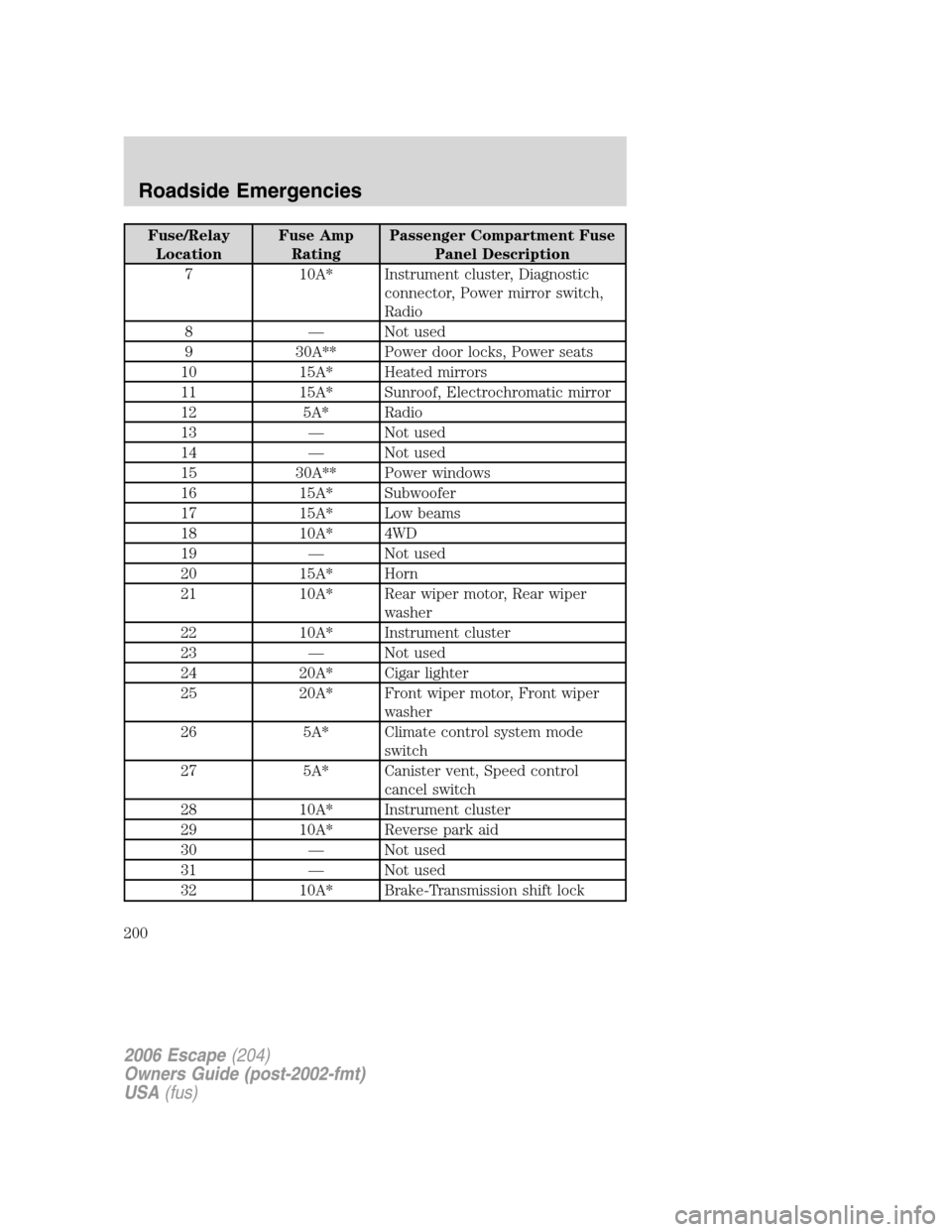
Fuse/Relay
LocationFuse Amp
RatingPassenger Compartment Fuse
Panel Description
7 10A* Instrument cluster, Diagnostic
connector, Power mirror switch,
Radio
8 — Not used
9 30A** Power door locks, Power seats
10 15A* Heated mirrors
11 15A* Sunroof, Electrochromatic mirror
12 5A* Radio
13 — Not used
14 — Not used
15 30A** Power windows
16 15A* Subwoofer
17 15A* Low beams
18 10A* 4WD
19 — Not used
20 15A* Horn
21 10A* Rear wiper motor, Rear wiper
washer
22 10A* Instrument cluster
23 — Not used
24 20A* Cigar lighter
25 20A* Front wiper motor, Front wiper
washer
26 5A* Climate control system mode
switch
27 5A* Canister vent, Speed control
cancel switch
28 10A* Instrument cluster
29 10A* Reverse park aid
30 — Not used
31 — Not used
32 10A* Brake-Transmission shift lock
2006 Escape(204)
Owners Guide (post-2002-fmt)
USA(fus)
Roadside Emergencies
200
Page 202 of 288
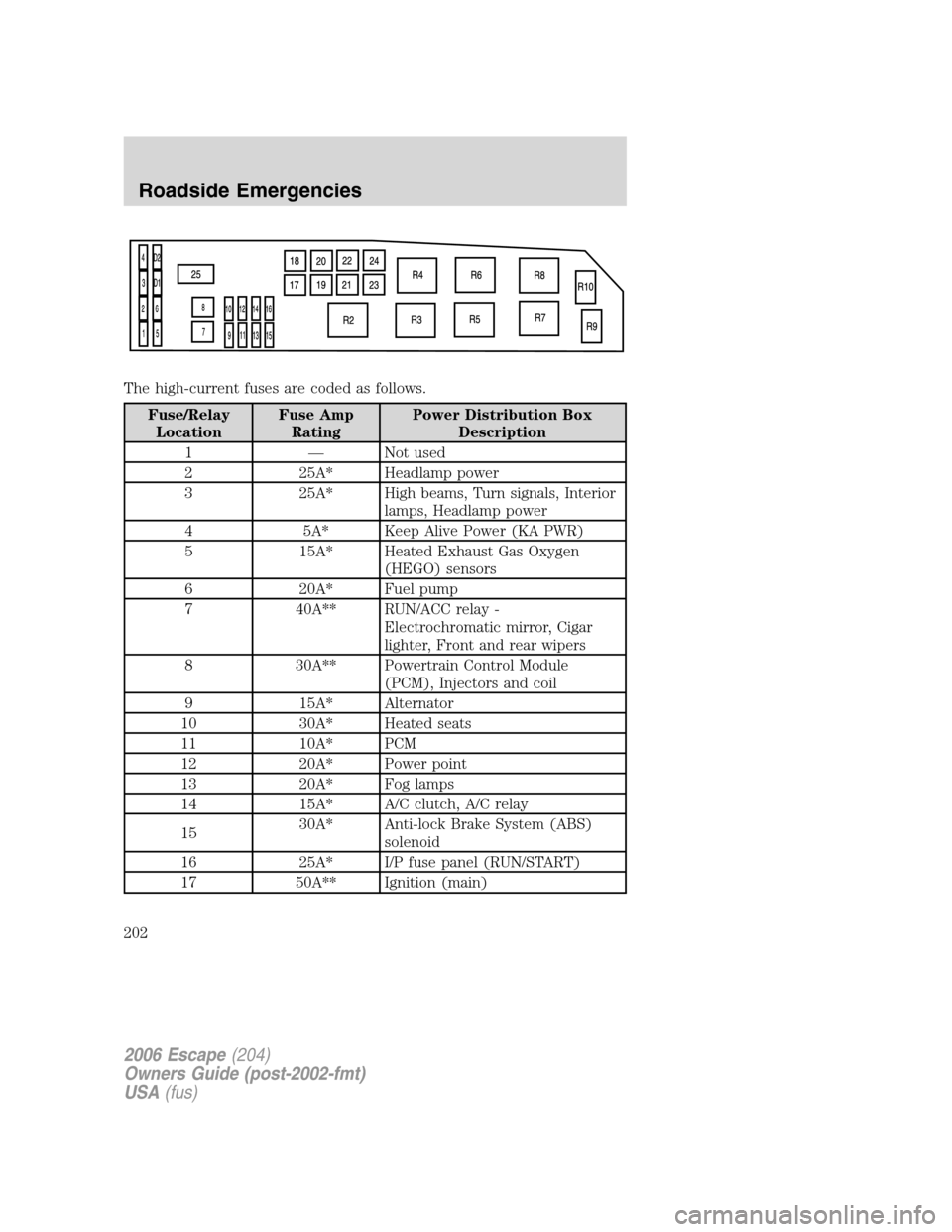
The high-current fuses are coded as follows.
Fuse/Relay
LocationFuse Amp
RatingPower Distribution Box
Description
1 — Not used
2 25A* Headlamp power
3 25A* High beams, Turn signals, Interior
lamps, Headlamp power
4 5A* Keep Alive Power (KA PWR)
5 15A* Heated Exhaust Gas Oxygen
(HEGO) sensors
6 20A* Fuel pump
7 40A** RUN/ACC relay -
Electrochromatic mirror, Cigar
lighter, Front and rear wipers
8 30A** Powertrain Control Module
(PCM), Injectors and coil
9 15A* Alternator
10 30A* Heated seats
11 10A* PCM
12 20A* Power point
13 20A* Fog lamps
14 15A* A/C clutch, A/C relay
1530A* Anti-lock Brake System (ABS)
solenoid
16 25A* I/P fuse panel (RUN/START)
17 50A** Ignition (main)
2006 Escape(204)
Owners Guide (post-2002-fmt)
USA(fus)
Roadside Emergencies
202
Page 215 of 288
2. Do not disconnect the battery of the disabled vehicle as this could
damage the vehicle’s electrical system.
3. Park the booster vehicle close to the hood of the disabled vehicle
making sure the two vehiclesdo nottouch. Set the parking brake on
both vehicles and stay clear of the engine cooling fan and other moving
parts.
4. Check all battery terminals and remove any excessive corrosion before
you attach the battery cables. Ensure that vent caps are tight and level.
5. Turn the heater fan on in both vehicles to protect any electrical
surges. Turn all other accessories off.
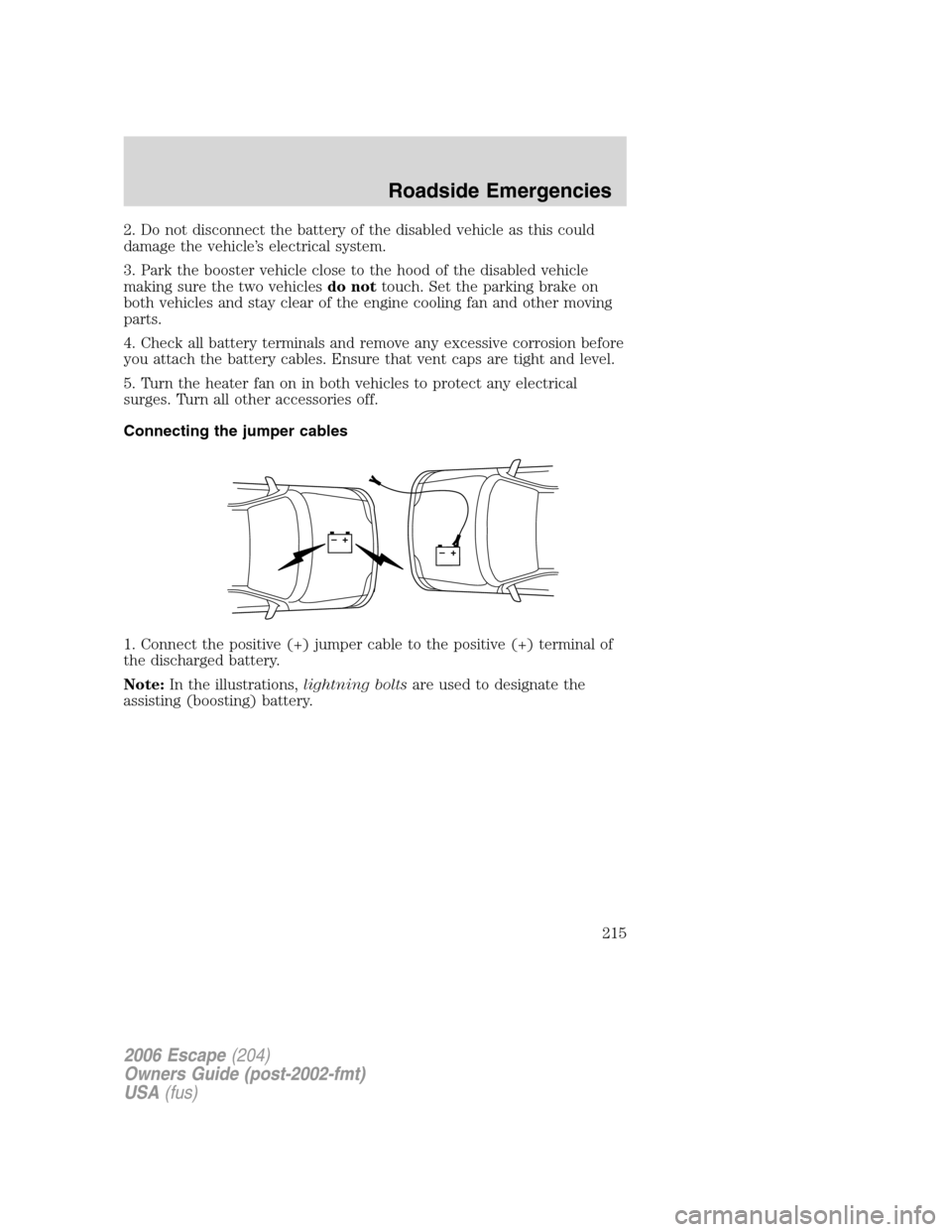
Connecting the jumper cables
1. Connect the positive (+) jumper cable to the positive (+) terminal of
the discharged battery.
Note:In the illustrations,lightning boltsare used to designate the
assisting (boosting) battery.
+–+–
2006 Escape(204)
Owners Guide (post-2002-fmt)
USA(fus)
Roadside Emergencies
215