4WD FORD ESCAPE 2007 2.G User Guide
[x] Cancel search | Manufacturer: FORD, Model Year: 2007, Model line: ESCAPE, Model: FORD ESCAPE 2007 2.GPages: 288, PDF Size: 3.12 MB
Page 194 of 288
slopes or hills.A danger lies in losing traction, slipping sideways and
possibly rolling over. Whenever driving on a hill, determine beforehand
the route you will use. Do not drive over the crest of a hill without
seeing what conditions are on the other side. Do not drive in reverse
over a hill without the aid of an observer.
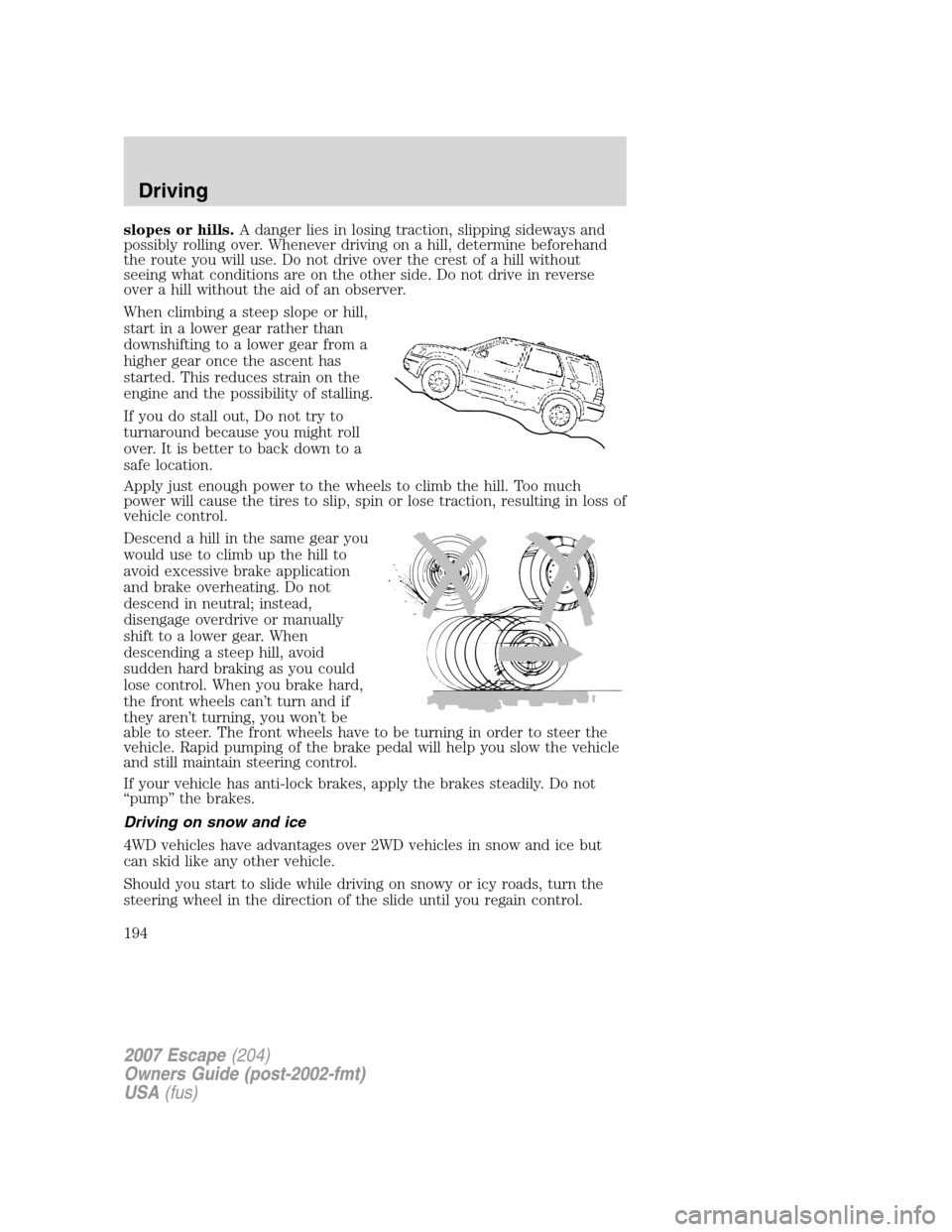
When climbing a steep slope or hill,
start in a lower gear rather than
downshifting to a lower gear from a
higher gear once the ascent has
started. This reduces strain on the
engine and the possibility of stalling.
If you do stall out, Do not try to
turnaround because you might roll
over. It is better to back down to a
safe location.
Apply just enough power to the wheels to climb the hill. Too much
power will cause the tires to slip, spin or lose traction, resulting in loss of
vehicle control.
Descend a hill in the same gear you
would use to climb up the hill to
avoid excessive brake application
and brake overheating. Do not
descend in neutral; instead,
disengage overdrive or manually
shift to a lower gear. When
descending a steep hill, avoid
sudden hard braking as you could
lose control. When you brake hard,
the front wheels can’t turn and if
they aren’t turning, you won’t be
able to steer. The front wheels have to be turning in order to steer the
vehicle. Rapid pumping of the brake pedal will help you slow the vehicle
and still maintain steering control.
If your vehicle has anti-lock brakes, apply the brakes steadily. Do not
“pump” the brakes.
Driving on snow and ice
4WD vehicles have advantages over 2WD vehicles in snow and ice but
can skid like any other vehicle.
Should you start to slide while driving on snowy or icy roads, turn the
steering wheel in the direction of the slide until you regain control.
2007 Escape(204)
Owners Guide (post-2002-fmt)
USA(fus)
Driving
194
Page 195 of 288
Avoid sudden applications of power and quick changes of direction on
snow and ice. Apply the accelerator slowly and steadily when starting
from a full stop.
Avoid sudden braking as well. Although a 4WD vehicle may accelerate
better than a two-wheel drive vehicle in snow and ice, it won’t stop any
faster, because as in other vehicles, braking occurs at all four wheels. Do
not become overconfident as to road conditions.
Make sure you allow sufficient distance between you and other vehicles
for stopping. Drive slower than usual and consider using one of the lower
gears. In emergency stopping situations, avoid locking of the wheels. Use
a “squeeze” technique, push on the brake pedal with a steadily increasing
force which allows the wheels to brake yet continue to roll so that you
may steer in the direction you want to travel. If you lock the wheels,
release the brake pedal and repeat the squeeze technique. Since your
vehicle is equipped with a Four Wheel Anti-Lock Brake System (ABS),
apply the brake steadily. Do not “pump” the brakes. Refer to theBrakes
section of this chapter for additional information on the operation of the
anti-lock brake system.
4WD vehicles should be driven with traction devices as referred to in
Using snow tires and traction devicesin theTires, Wheels and
Loadingchapter.
Maintenance and Modifications
The suspension and steering systems on your vehicle have been designed
and tested to provide predictable performance whether loaded or empty
and durable load carrying capability. For this reason, Ford Motor
Company strongly recommends that you do not make modifications such
as adding or removing parts (such as lift kits or stabilizer bars) or by
using replacement parts not equivalent to the original factory equipment.
Any modifications to a vehicle that raise the center of gravity can make
it more likely the vehicle will roll over as a result of a loss of control.
Ford Motor Company recommends that caution be used with any vehicle
equipped with a high load or device (such as ladder racks or pickup box
cover).
Failure to maintain your vehicle properly may void the warranty, increase
your repair cost, reduce vehicle performance and operational capabilities
and adversely affect driver and passenger safety. Frequent inspection of
vehicle chassis components is recommended if the vehicle is subjected to
heavy off-road usage.
2007 Escape(204)
Owners Guide (post-2002-fmt)
USA(fus)
Driving
195
Page 202 of 288
The fuses are coded as follows:
Fuse/Relay
LocationFuse Amp
RatingPassenger Compartment Fuse
Panel Description
1 15A* Trailer tow park lamps
2 — Not used
3 15A* Front and rear park lamps
4 10A* Ignition switch
5 2A* Powertrain Control Module (PCM
relay), Fuel pump relay, Main fan
relay, High/Low speed fan relay 2,
PATS module
6 15A* Center High-Mounted Stop Lamp
(CHMSL), Stop lamps, PCM,
Anti-lock Brake System (ABS),
Speed control, Brake On-Off
switch
7 10A* Instrument cluster, Diagnostic
connector, Power mirror switch,
Radio
8 5A* Canister vent
9 30A** Power door locks, Power seats
10 15A* Heated mirrors
11 15A* Sunroof, Electrochromatic mirror
12 5A* Radio
13 — Not used
14 — Not used
15 30A** Power windows
16 15A* Subwoofer
17 15A* Low beams
18 10A* 4WD
19 — Not used
20 15A* Horn
21 10A* Rear wiper motor, Rear wiper
washer
2007 Escape(204)
Owners Guide (post-2002-fmt)
USA(fus)
Roadside Emergencies
202
Page 203 of 288
Fuse/Relay
LocationFuse Amp
RatingPassenger Compartment Fuse
Panel Description
22 10A* Instrument cluster
23 — Not used
24 20A* Cigar lighter
25 20A* Front wiper motor, Front wiper
washer
26 5A* Climate control system mode
switch
27 5A* Speed control cancel switch
28 10A* Instrument cluster
29 10A* Reverse park aid
30 — Not used
31 — Not used
32 10A* Brake-Transmission shift lock
33 15A* Air bag module, Passenger Air bag
Deactivation (PAD) indicator
lamp, Occupant Classification
Sensor (OCS)
34 5A* ABS module, Evac and Fill, Speed
control
35 5A* Heated seats module, 4WD
* Mini fuse ** Cartridge fuse
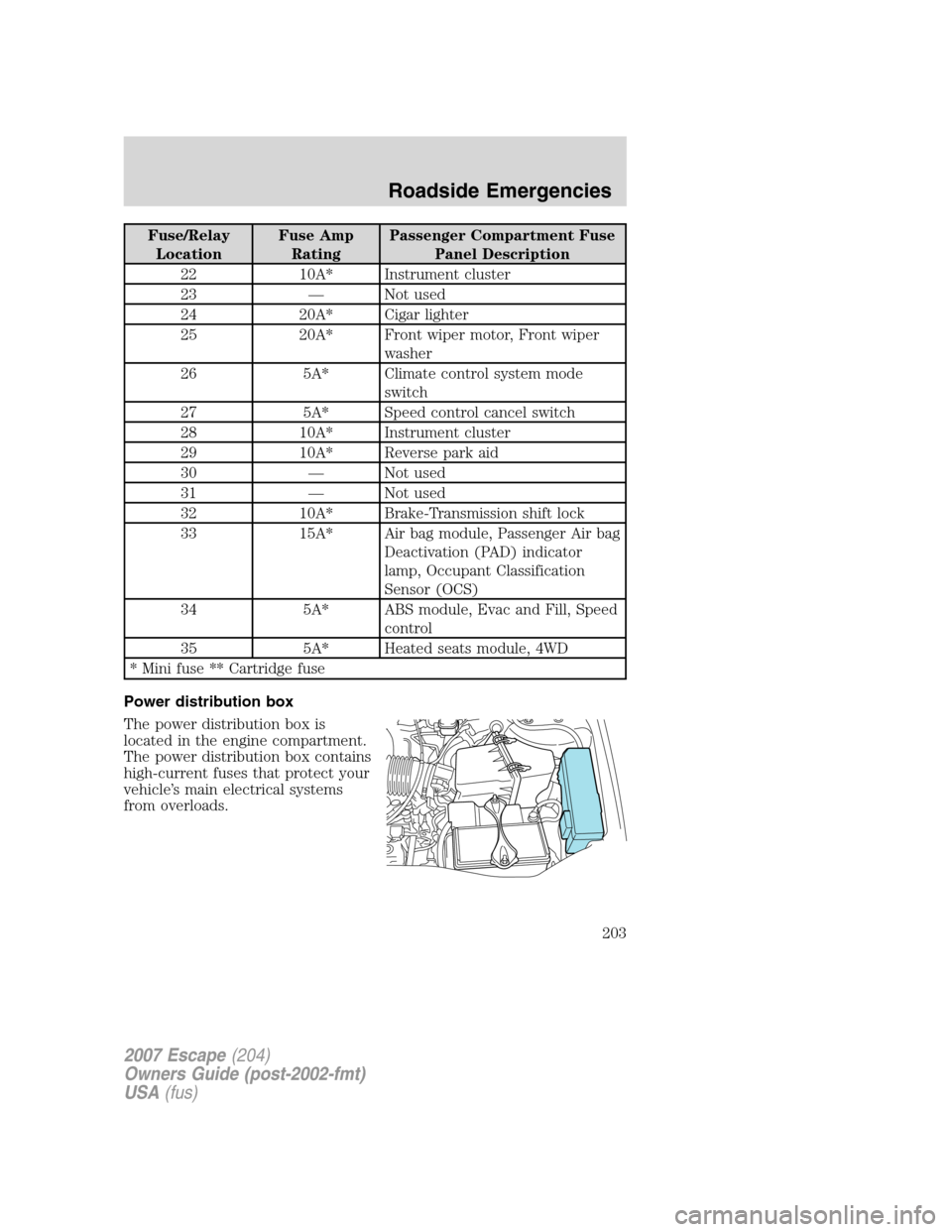
Power distribution box
The power distribution box is
located in the engine compartment.
The power distribution box contains
high-current fuses that protect your
vehicle’s main electrical systems
from overloads.
2007 Escape(204)
Owners Guide (post-2002-fmt)
USA(fus)
Roadside Emergencies
203
Page 205 of 288
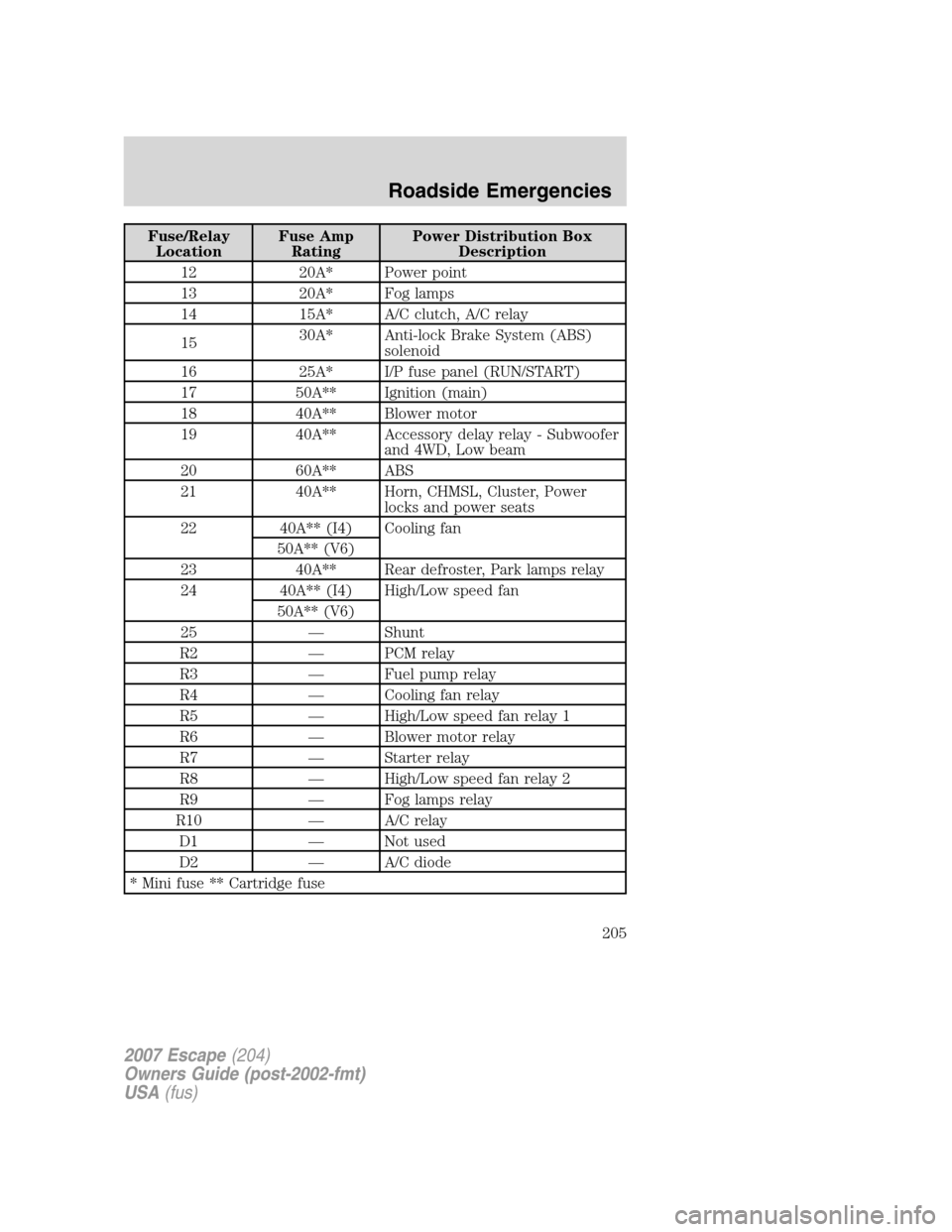
Fuse/Relay
LocationFuse Amp
RatingPower Distribution Box
Description
12 20A* Power point
13 20A* Fog lamps
14 15A* A/C clutch, A/C relay
1530A* Anti-lock Brake System (ABS)
solenoid
16 25A* I/P fuse panel (RUN/START)
17 50A** Ignition (main)
18 40A** Blower motor
19 40A** Accessory delay relay - Subwoofer
and 4WD, Low beam
20 60A** ABS
21 40A** Horn, CHMSL, Cluster, Power
locks and power seats
22 40A** (I4) Cooling fan
50A** (V6)
23 40A** Rear defroster, Park lamps relay
24 40A** (I4) High/Low speed fan
50A** (V6)
25 — Shunt
R2 — PCM relay
R3 — Fuel pump relay
R4 — Cooling fan relay
R5 — High/Low speed fan relay 1
R6 — Blower motor relay
R7 — Starter relay
R8 — High/Low speed fan relay 2
R9 — Fog lamps relay
R10 — A/C relay
D1 — Not used
D2 — A/C diode
* Mini fuse ** Cartridge fuse
2007 Escape(204)
Owners Guide (post-2002-fmt)
USA(fus)
Roadside Emergencies
205
Page 207 of 288
When driving with one of the dissimilar spare tires listed above,do not:
•Exceed 50 mph (80 km/h)
•Load the vehicle beyond maximum vehicle load rating listed on the
Safety Compliance Label
•Tow a trailer
•Use snow chains on the end of the vehicle with the dissimilar spare
tire
•Use more than one dissimilar spare tire at a time
•Use commercial car washing equipment
•Try to repair the dissimilar spare tire
Use of one of the dissimilar spare tires listed above at any one wheel
location can lead to impairment of the following:
•Handling, stability and braking performance
•Comfort and noise
•Ground clearance and parking at curbs
•Winter weather driving capability
•Wet weather driving capability
For vehicles equipped with 4WD, it is not recommended that the vehicle
be operated in 4WD modes with a temporary emergency spare tire. If
4WD operation is necessary, do not operate above speeds of 10 mph
(16 km/h) or for distances above 50 miles (80 km).
3.Full-size dissimilar spare without label on wheel
When driving with the full-size dissimilar spare tire/wheel,do not:
•Exceed 70 mph (113 km/h)
•Use more than one dissimilar spare tire/wheel at a time
•Use commercial car washing equipment
•Use snow chains on the end of the vehicle with the dissimilar spare
tire/wheel
The usage of a full-size dissimilar spare tire/wheel can lead to
impairment of the following:
•Handling, stability and braking performance
•Comfort and noise
•Ground clearance and parking at curbs
2007 Escape(204)
Owners Guide (post-2002-fmt)
USA(fus)
Roadside Emergencies
207
Page 224 of 288
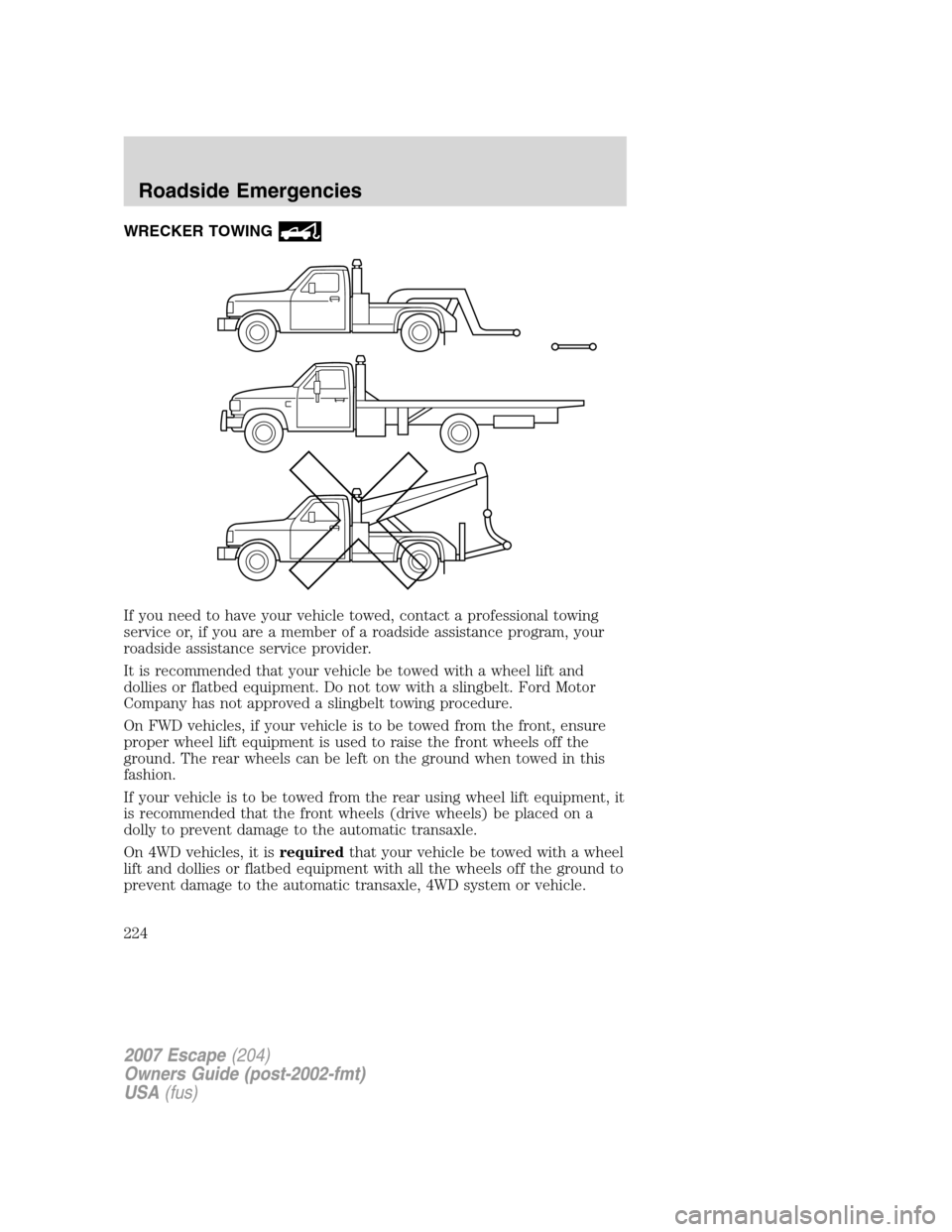
WRECKER TOWING
If you need to have your vehicle towed, contact a professional towing
service or, if you are a member of a roadside assistance program, your
roadside assistance service provider.
It is recommended that your vehicle be towed with a wheel lift and
dollies or flatbed equipment. Do not tow with a slingbelt. Ford Motor
Company has not approved a slingbelt towing procedure.
On FWD vehicles, if your vehicle is to be towed from the front, ensure
proper wheel lift equipment is used to raise the front wheels off the
ground. The rear wheels can be left on the ground when towed in this
fashion.
If your vehicle is to be towed from the rear using wheel lift equipment, it
is recommended that the front wheels (drive wheels) be placed on a
dolly to prevent damage to the automatic transaxle.
On 4WD vehicles, it isrequiredthat your vehicle be towed with a wheel
lift and dollies or flatbed equipment with all the wheels off the ground to
prevent damage to the automatic transaxle, 4WD system or vehicle.
2007 Escape(204)
Owners Guide (post-2002-fmt)
USA(fus)
Roadside Emergencies
224