oil filter FORD ESCAPE 2019 Owners Manual
[x] Cancel search | Manufacturer: FORD, Model Year: 2019, Model line: ESCAPE, Model: FORD ESCAPE 2019Pages: 509, PDF Size: 6.69 MB
Page 7 of 509
Driving Hints
Breaking-In
.....................................................218
Economical Driving .....................................
218
Driving Through Water ...............................
219
Floor Mats .......................................................
219
Roadside Emergencies
Roadside Assistance ..................................
221
Hazard Flashers ...........................................
222
Fuel Shutoff ..................................................
222
Jump Starting the Vehicle ........................
223
Post-Crash Alert System .........................
224
Transporting the Vehicle ..........................
225
Customer Assistance
Getting the Services You Need ..............
226
In California (U.S. Only) ............................
227
The Better Business Bureau (BBB) Auto Line Program (U.S. Only) .....................
228
Utilizing the Mediation/Arbitration Program (Canada Only) ......................
229
Getting Assistance Outside the U.S. and Canada .......................................................
229
Ordering Additional Owner's Literature ........................................................................\
.
231
Reporting Safety Defects (U.S. Only) ........................................................................\
.
231
Reporting Safety Defects (Canada Only) ........................................................................\
.
231
Fuses
Fuse Specification Chart ..........................
233
Changing a Fuse ..........................................
242
Maintenance
General Information ..................................
244
Opening and Closing the Hood .............
244
Under Hood Overview - 1.5L EcoBoost™ ........................................................................\
246
Under Hood Overview - 2.0L EcoBoost™ ........................................................................\
247 Under Hood Overview - 2.5L
..................
248
Engine Oil Dipstick - 1.5L EcoBoost™ ........................................................................\
249
Engine Oil Dipstick - 2.0L EcoBoost™/ 2.5L ..............................................................
249
Engine Oil Check .........................................
249
Oil Change Indicator Reset .....................
250
Engine Coolant Check ................................
251
Automatic Transmission Fluid Check ........................................................................\
255
Brake Fluid Check .......................................
255
Power Steering Fluid Check ....................
256
Washer Fluid Check ...................................
256
Fuel Filter .......................................................
256
Changing the 12V Battery ........................
256
Checking the Wiper Blades ....................
258
Changing the Wiper Blades ....................
259
Adjusting the Headlamps .......................
259
Changing a Bulb ...........................................
261
Changing the Engine Air Filter ...............
265
Vehicle Care
General Information ..................................
267
Cleaning Products ......................................
267
Cleaning the Exterior .................................
267
Waxing ............................................................
269
Cleaning the Engine ..................................
269
Cleaning the Windows and Wiper Blades ........................................................................\
269
Cleaning the Interior ..................................
270
Cleaning the Instrument Panel and Instrument Cluster Lens ......................
270
Cleaning Leather Seats ..............................
271
Repairing Minor Paint Damage ..............
272
Cleaning the Wheels ..................................
272
Vehicle Storage ............................................
272
Body Styling Kits .........................................
274
Wheels and Tires
General Information ...................................
275
4
Escape (TM2) Canada/United States of America, enUSA, Edition date: 201807, Second-Printing Table of Contents
Page 11 of 509
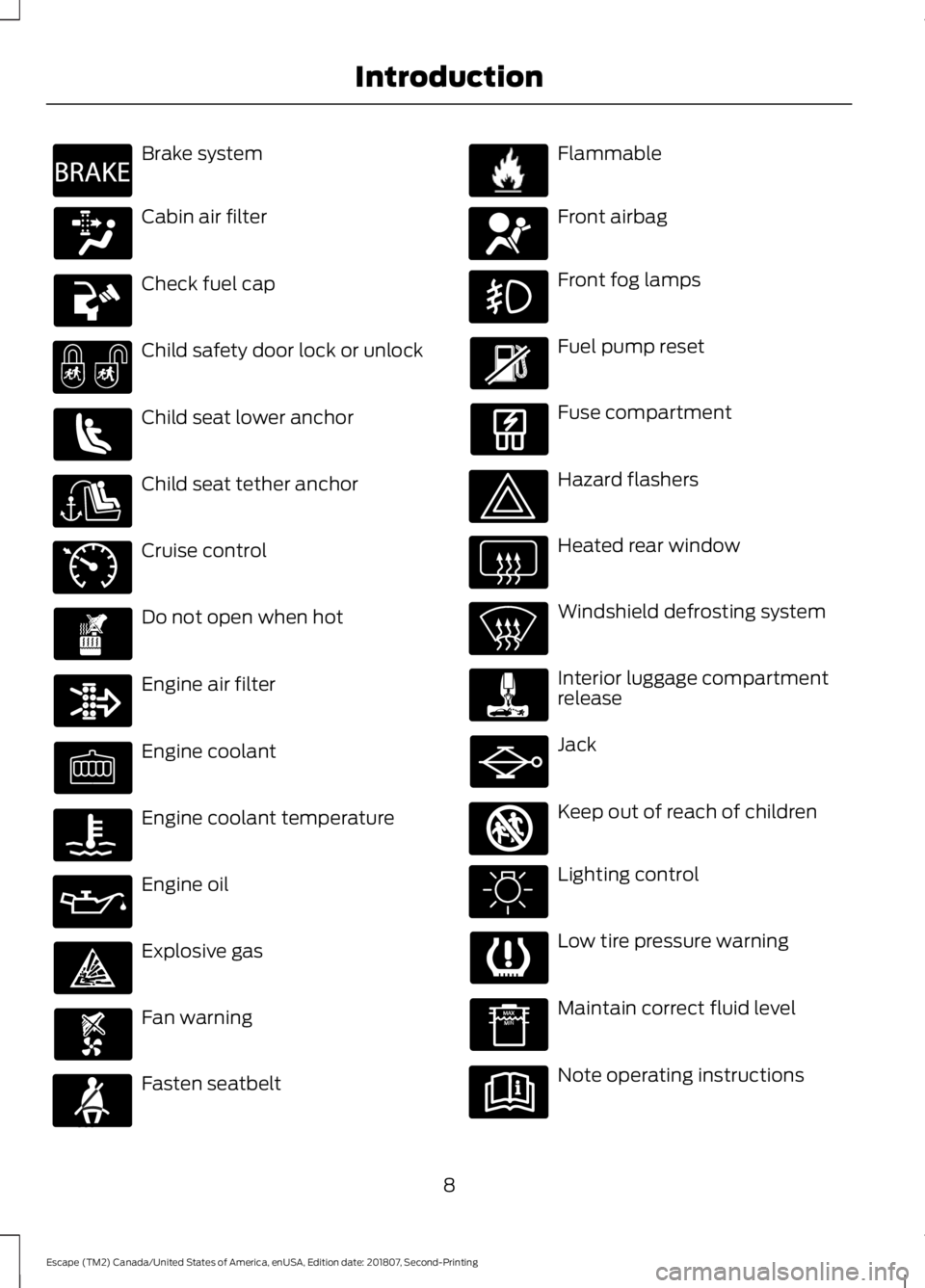
Brake system
Cabin air filter
Check fuel cap
Child safety door lock or unlock
Child seat lower anchor
Child seat tether anchor
Cruise control
Do not open when hot
Engine air filter
Engine coolant
Engine coolant temperature
Engine oil
Explosive gas
Fan warning
Fasten seatbelt Flammable
Front airbag
Front fog lamps
Fuel pump reset
Fuse compartment
Hazard flashers
Heated rear window
Windshield defrosting system
Interior luggage compartment
release
Jack
Keep out of reach of children
Lighting control
Low tire pressure warning
Maintain correct fluid level
Note operating instructions
8
Escape (TM2) Canada/United States of America, enUSA, Edition date: 201807, Second-Printing IntroductionE270480 E71340 E71880 E231160 E67017 E161353
Page 153 of 509
EMISSION LAW
WARNING: Do not remove or alter
the original equipment floor covering or
insulation between it and the metal floor
of the vehicle. The floor covering and
insulation protect occupants of the
vehicle from the engine and exhaust
system heat and noise. On vehicles with
no original equipment floor covering
insulation, do not carry passengers in a
manner that permits prolonged skin
contact with the metal floor. Failure to
follow these instructions may result in
fire or personal injury.
U.S. federal laws and certain state laws
prohibit removing or rendering inoperative
emission control system components.
Similar federal or provincial laws may
apply in Canada. We do not approve of any
vehicle modification without first
determining applicable laws. Tampering with emissions
control systems including
related sensors or the Diesel
Exhaust Fluid system can result in reduced
engine power and the illumination of the
service engine soon light. Tampering With a Noise Control
System
Federal laws prohibit the following acts:
•
Removal or rendering inoperative by
any person other than for purposes of
maintenance.
• Repair or replacement of any device or
element of the design incorporated into
a new vehicle for the purpose of noise
control prior to its sale or delivery to
the ultimate purchaser or while it is in
use.
• The use of the vehicle after any person
removes or renders inoperative any
device or element of the design.
The U.S. Environmental Protection Agency
may presume to constitute tampering as
follows:
• Removal of hood blanket, fender apron
absorbers, fender apron barriers,
underbody noise shields or acoustically
absorptive material.
• Tampering or rendering inoperative the
engine speed governor, to allow engine
speed to exceed manufacturer
specifications.
If the engine does not start, runs rough,
experiences a decrease in engine
performance, experiences excess fuel
consumption or produces excessive
exhaust smoke, check for the following:
• A plugged or disconnected air inlet
system hose.
• A plugged engine air filter element.
• Water in the fuel filter and water
separator.
• A clogged fuel filter.
• Contaminated fuel.
• Air in the fuel system, due to loose
connections.
• An open or pinched sensor hose.
• Incorrect engine oil level.
150
Escape (TM2) Canada/United States of America, enUSA, Edition date: 201807, Second-Printing Engine Emission Control
Page 154 of 509
•
Incorrect fuel for climatic conditions.
• Incorrect engine oil viscosity for
climactic conditions.
Note: Some vehicles have a lifetime fuel
filter that is integrated with the fuel tank.
Regular maintenance or replacement is not
needed.
Note: If these checks do not help you
correct the concern, have your vehicle
checked as soon as possible.
Noise Emissions Warranty,
Prohibited Tampering Acts and
Maintenance
On January 1, 1978, Federal regulation
became effective governing the noise
emission on trucks over 10,000 lb
(4,536 kg) Gross Vehicle Weight Rating
(GVWR). The preceding statements
concerning prohibited tampering acts and
maintenance, and the noise warranty
found in the Warranty Guide, are
applicable to complete chassis cabs over
10,000 lb (4,536 kg)
GVWR.
CATALYTIC CONVERTER WARNING:
Do not park, idle or
drive your vehicle on dry grass or other
dry ground cover. The emission system
heats up the engine compartment and
exhaust system, creating the risk of fire. WARNING:
The normal operating
temperature of the exhaust system is
very high. Never work around or attempt
to repair any part of the exhaust system
until it has cooled. Use special care when
working around the catalytic converter.
The catalytic converter heats up to a very
high temperature after only a short
period of engine operation and stays hot
after the engine is switched off. WARNING:
Exhaust leaks may
result in entry of harmful and potentially
lethal fumes into the passenger
compartment. If you smell exhaust
fumes inside your vehicle, have your
vehicle inspected immediately. Do not
drive if you smell exhaust fumes.
Your vehicle has various emission control
components and a catalytic converter that
enables it to comply with applicable
exhaust emission standards.
To make sure that the catalytic converter
and other emission control components
continue to work properly:
• Do not crank the engine for more than
10 seconds at a time.
• Do not run the engine with a spark plug
lead disconnected.
• Do not push-start or tow-start your
vehicle. Use booster cables. See Jump
Starting the Vehicle
(page 223).
• Use only the specified fuel listed.
• Do not switch the ignition off when your
vehicle is moving.
• Avoid running out of fuel.
• Have the items listed in scheduled
maintenance information performed
according to the specified schedule.
Note: Resulting component damage may
not be covered by the vehicle Warranty.
The scheduled maintenance items listed
in scheduled maintenance information are
essential to the life and performance of
your vehicle and to its emissions system.
If you use anything other than Ford,
Motorcraft or Ford-authorized parts for
maintenance replacements or for service
of components affecting emission control,
such non-Ford parts should be equivalent
to genuine Ford Motor Company parts in
performance and durability.
151
Escape (TM2) Canada/United States of America, enUSA, Edition date: 201807, Second-Printing Engine Emission Control
Page 249 of 509
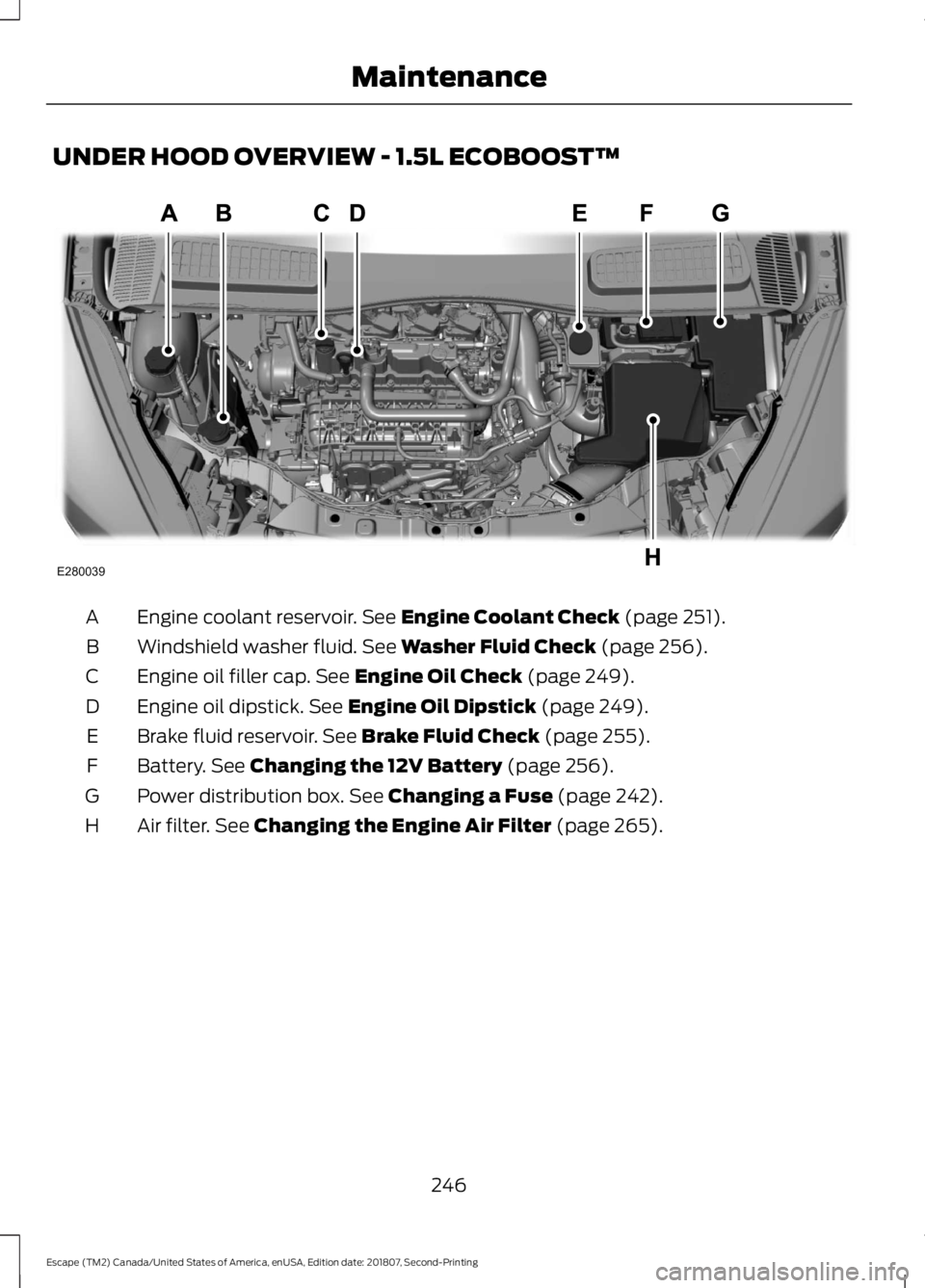
UNDER HOOD OVERVIEW - 1.5L ECOBOOST™
Engine coolant reservoir. See Engine Coolant Check (page 251).
A
Windshield washer fluid.
See Washer Fluid Check (page 256).
B
Engine oil filler cap.
See Engine Oil Check (page 249).
C
Engine oil dipstick.
See Engine Oil Dipstick (page 249).
D
Brake fluid reservoir.
See Brake Fluid Check (page 255).
E
Battery.
See Changing the 12V Battery (page 256).
F
Power distribution box.
See Changing a Fuse (page 242).
G
Air filter.
See Changing the Engine Air Filter (page 265).
H
246
Escape (TM2) Canada/United States of America, enUSA, Edition date: 201807, Second-Printing MaintenanceE280039
Page 250 of 509
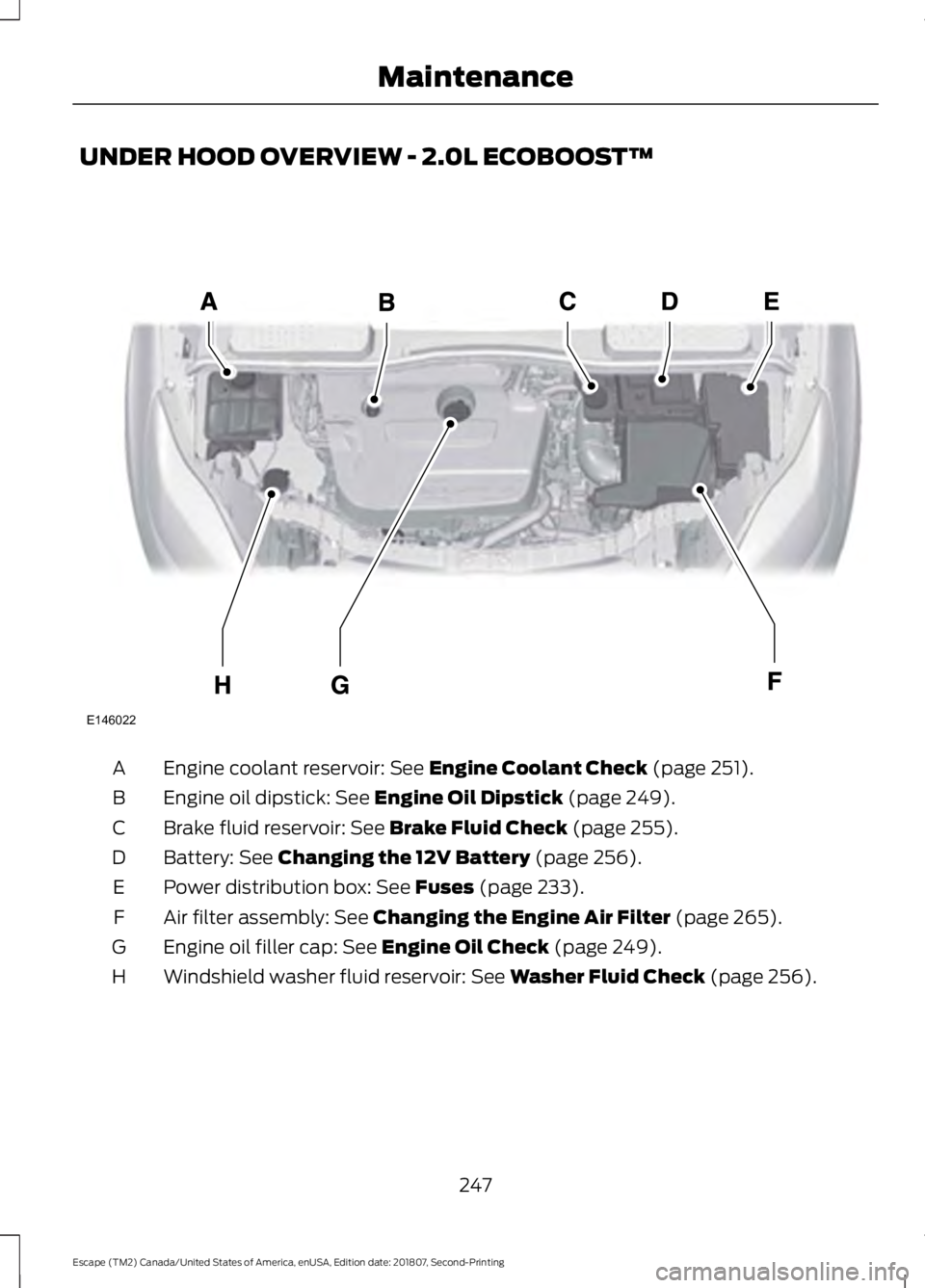
UNDER HOOD OVERVIEW - 2.0L ECOBOOST™
Engine coolant reservoir: See Engine Coolant Check (page 251).
A
Engine oil dipstick:
See Engine Oil Dipstick (page 249).
B
Brake fluid reservoir:
See Brake Fluid Check (page 255).
C
Battery:
See Changing the 12V Battery (page 256).
D
Power distribution box:
See Fuses (page 233).
E
Air filter assembly:
See Changing the Engine Air Filter (page 265).
F
Engine oil filler cap:
See Engine Oil Check (page 249).
G
Windshield washer fluid reservoir:
See Washer Fluid Check (page 256).
H
247
Escape (TM2) Canada/United States of America, enUSA, Edition date: 201807, Second-Printing MaintenanceE146022
Page 251 of 509
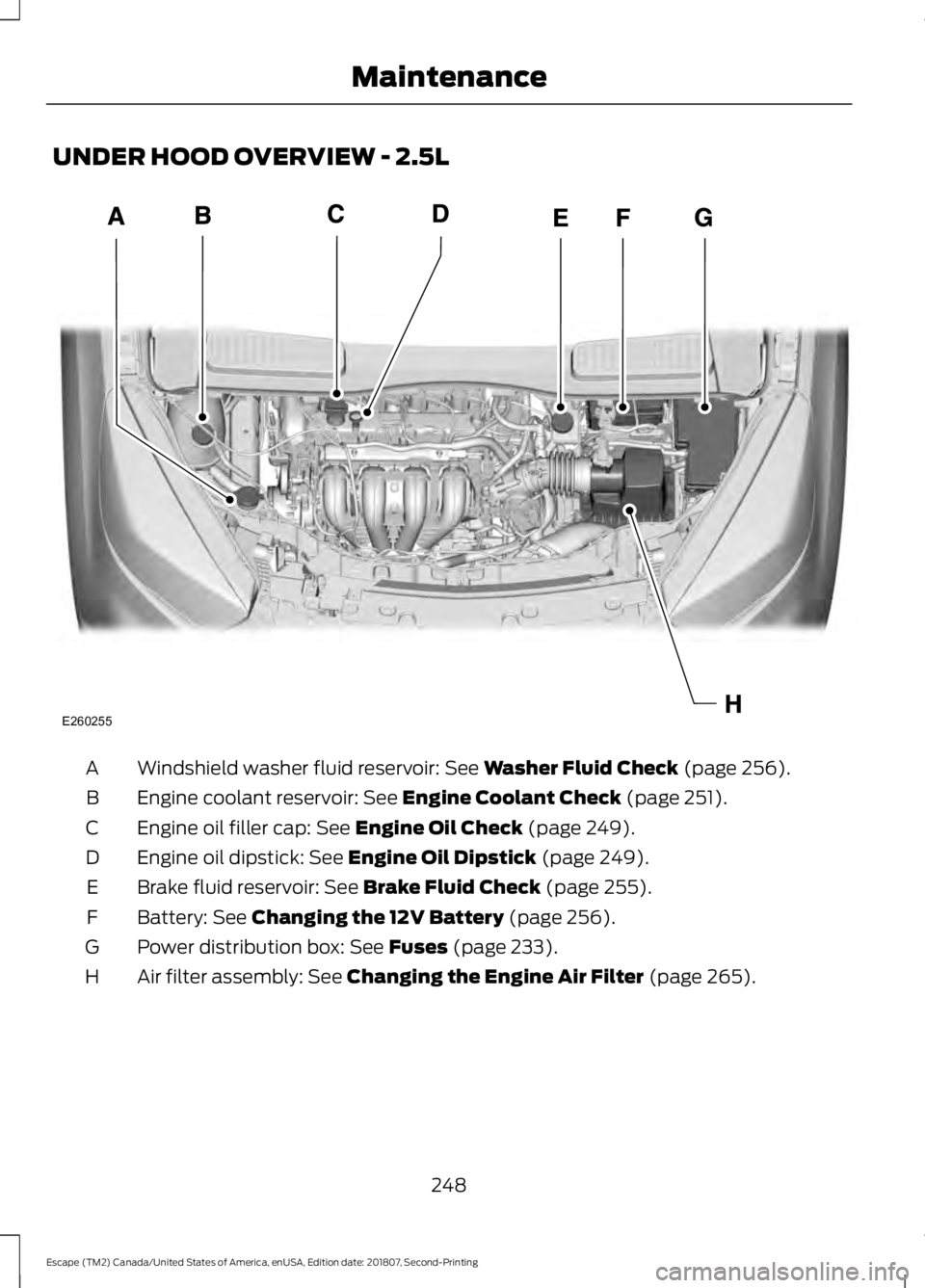
UNDER HOOD OVERVIEW - 2.5L
Windshield washer fluid reservoir: See Washer Fluid Check (page 256).
A
Engine coolant reservoir:
See Engine Coolant Check (page 251).
B
Engine oil filler cap:
See Engine Oil Check (page 249).
C
Engine oil dipstick:
See Engine Oil Dipstick (page 249).
D
Brake fluid reservoir:
See Brake Fluid Check (page 255).
E
Battery:
See Changing the 12V Battery (page 256).
F
Power distribution box:
See Fuses (page 233).
G
Air filter assembly:
See Changing the Engine Air Filter (page 265).
H
248
Escape (TM2) Canada/United States of America, enUSA, Edition date: 201807, Second-Printing MaintenanceE260255
Page 268 of 509
4. Gently pull the lamp assembly away
from the vehicle.
5. Disconnect the electrical connector.
6. Remove the turn signal bulb by turning
the lower bulb socket
counterclockwise. Gently pull the bulb
straight out of the socket.
Install the new bulb in reverse order.
Replacing Reverse Lamp Assembly
For bulb replacement, see your authorized
dealer.
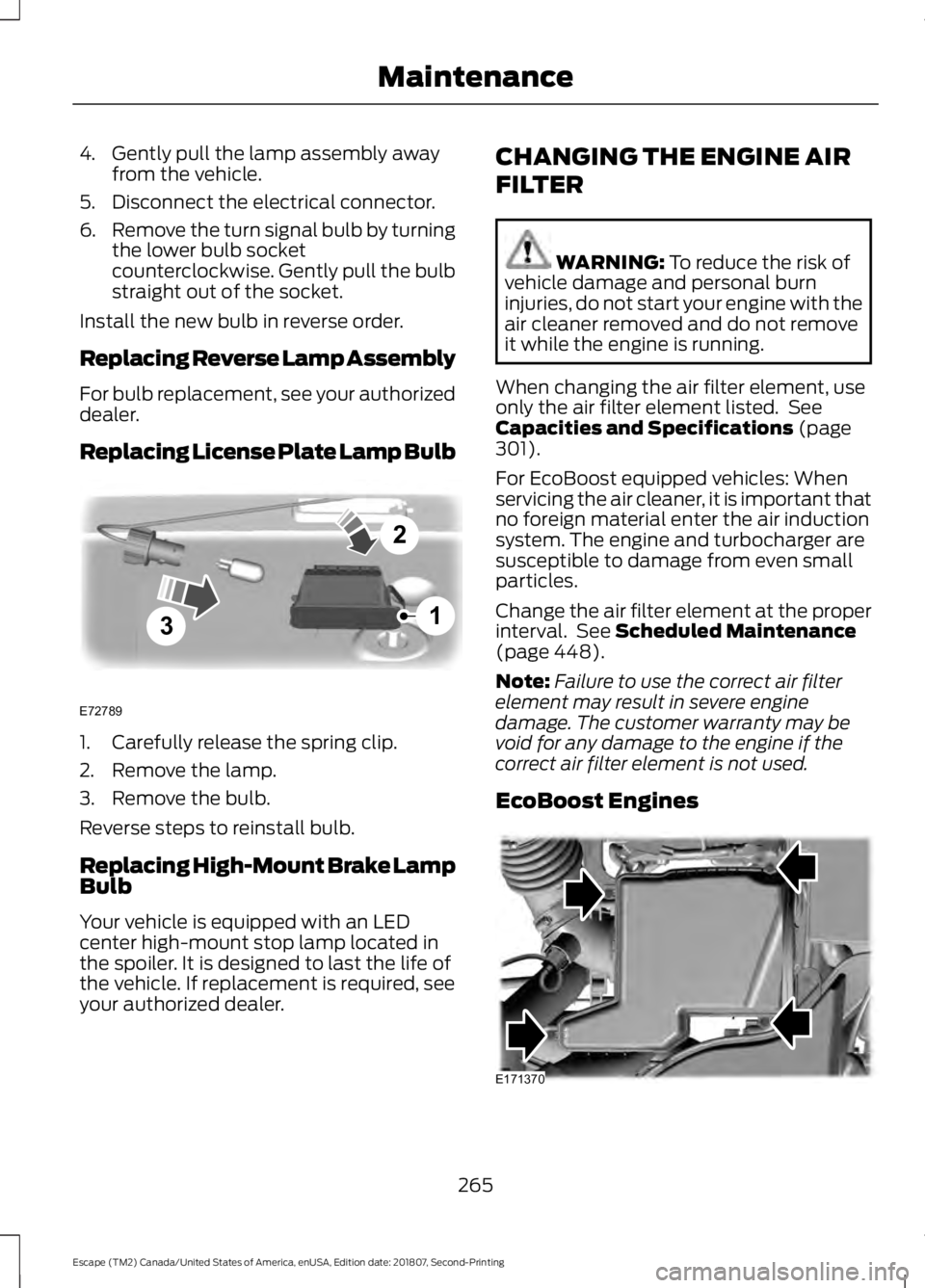
Replacing License Plate Lamp Bulb 1. Carefully release the spring clip.
2. Remove the lamp.
3. Remove the bulb.
Reverse steps to reinstall bulb.
Replacing High-Mount Brake Lamp
Bulb
Your vehicle is equipped with an LED
center high-mount stop lamp located in
the spoiler. It is designed to last the life of
the vehicle. If replacement is required, see
your authorized dealer. CHANGING THE ENGINE AIR
FILTER WARNING: To reduce the risk of
vehicle damage and personal burn
injuries, do not start your engine with the
air cleaner removed and do not remove
it while the engine is running.
When changing the air filter element, use
only the air filter element listed. See
Capacities and Specifications
(page
301).
For EcoBoost equipped vehicles: When
servicing the air cleaner, it is important that
no foreign material enter the air induction
system. The engine and turbocharger are
susceptible to damage from even small
particles.
Change the air filter element at the proper
interval. See
Scheduled Maintenance
(page 448).
Note: Failure to use the correct air filter
element may result in severe engine
damage. The customer warranty may be
void for any damage to the engine if the
correct air filter element is not used.
EcoBoost Engines 265
Escape (TM2) Canada/United States of America, enUSA, Edition date: 201807, Second-Printing Maintenance3
2
1
E72789 E171370
Page 272 of 509
WAXING
Regular waxing is necessary to protect your
car's paint from the elements. We
recommend that you wash and wax the
painted surface once or twice a year.
When washing and waxing, park your
vehicle in a shaded area out of direct
sunlight. Always wash your vehicle before
applying wax.
•
Use a quality wax that does not contain
abrasives.
• Follow the manufacturer ’s instructions
to apply and remove the wax.
• Apply a small amount of wax in a
back-and-forth motion, not in circles.
• Do not allow wax to come in contact
with any non-body (low-gloss black)
colored trim. The wax will discolor or
stain the parts over time.
•Roof racks.
• Bumpers.
• Grained door handles.
• Side moldings.
• Mirror housings.
• Windshield cowl area.
• Do not apply wax to glass areas.
• After waxing, your car's paint should
feel smooth, and be free of streaks and
smudges.
CLEANING THE ENGINE
Engines are more efficient when they are
clean because grease and dirt buildup keep
the engine warmer than normal. When washing:
•
Take care when using a power washer
to clean the engine. The high-pressure
fluid could penetrate the sealed parts
and cause damage.
• Do not spray a hot engine with cold
water to avoid cracking the engine
block or other engine components.
• Spray Motorcraft Engine Shampoo and
Degreaser on all parts that require
cleaning and pressure rinse clean. In
Canada, use Motorcraft Engine
Shampoo.
Note: If your vehicle has an engine cover
remove the cover before application of
Motorcraft Engine Shampoo and Degreaser.
Immediately rinse away any over spray.
• Never wash or rinse the engine while it
is hot or running; water in the running
engine may cause internal damage.
• Never wash or rinse any ignition coil,
spark plug wire or spark plug well, or
the area in and around these locations.
• Cover the battery, power distribution
box, and air filter assembly to prevent
water damage when cleaning the
engine.
CLEANING THE WINDOWS AND
WIPER BLADES
Car wash chemicals and environmental
fallout can result in windshield and wiper
blade contamination. Dirty windshield and
wipers will result in poor windshield wiper
operation. Keep the windshield and wiper
blades clean to maintain windshield wiper
performance.
269
Escape (TM2) Canada/United States of America, enUSA, Edition date: 201807, Second-Printing Vehicle Care
Page 276 of 509
•
Cover interior trim to prevent fading.
• Keep all rubber parts free from oil and
solvents.
Engine
• Change the engine oil and filter prior to
storage because used engine oil
contains contaminates which may
cause engine damage.
• Start the engine every 15 days for a
minimum of 15 minutes. Run at fast idle
with the climate controls set to defrost
until the engine reaches normal
operating temperature.
• With your foot on the brake, shift
through all the gears while the engine
is running.
• We recommend that you change the
engine oil before you use your vehicle
again.
Fuel system
• Fill the fuel tank with high-quality fuel
until the first automatic shutoff of the
fuel pump nozzle.
Cooling system
• Protect against freezing temperatures.
• When removing your vehicle from
storage, check coolant fluid level.
Confirm that there are no cooling
system leaks and that fluid is at the
recommended level.
Battery
• Check and recharge as necessary. Keep
connections clean.
• If storing your vehicle for more than 30
days without recharging the battery,
we recommend that you disconnect
the battery cables to maintain battery
charge for quick starting. Note:
It is necessary to reset memory
features if battery cables are disconnected.
Brakes
• Make sure the brakes and parking brake
release fully.
Tires
• Maintain recommended air pressure.
Miscellaneous
• Make sure all linkages, cables, levers
and pins under your vehicle are covered
with grease to prevent rust.
• Move vehicles at least 25 ft (7.5 m)
every 15 days to lubricate working parts
and prevent corrosion.
Removing Vehicle From Storage
When your vehicle is ready to come out of
storage, do the following:
• Wash your vehicle to remove any dirt
or grease film build-up on window
surfaces.
• Check windshield wipers for any
deterioration.
• Check under the hood for any foreign
material that may have collected
during storage such as mice or squirrel
nests.
• Check the exhaust for any foreign
material that may have collected
during storage.
• Check tire pressures and set tire
inflation per the Tire Label.
• Check brake pedal operation. Drive
your vehicle
15 ft (4.5 m) back and
forth to remove rust build-up.
273
Escape (TM2) Canada/United States of America, enUSA, Edition date: 201807, Second-Printing Vehicle Care