seats FORD ESCAPE 2022 Owners Manual
[x] Cancel search | Manufacturer: FORD, Model Year: 2022, Model line: ESCAPE, Model: FORD ESCAPE 2022Pages: 585, PDF Size: 6.15 MB
Page 4 of 585
Contacting Us
Contacting Us ..................................................15
Introduction
About This Publication .................................17
Using This Publication .................................18
Symbols Glossary
Symbols Used on Your Vehicle .................19
Data Privacy
Data Privacy .....................................................22
Service Data ....................................................23
Event Data ........................................................23
Settings Data ..................................................24
Connected Vehicle Data .............................24
Mobile Device Data .......................................25
Emergency Call System Data ...................25
At a Glance
Instrument Panel ..........................................26
Child Safety
Child Safety Precautions ............................28
Child Restraint Anchor Points ..................29
Child Restraints .............................................30
Installing Child Restraints ...........................31
Booster Seats .................................................36
Child Safety Locks ........................................38
Seatbelts
Seatbelt Precautions ...................................39
Fastening the Seatbelts .............................40
Sensitive Locking Mode .............................40
Automatic Locking Mode ............................41
Adjusting the Seatbelts DuringPregnancy ....................................................42
Adjusting the Seatbelt Height ..................42
Seatbelt Reminder ........................................42 Checking the Seatbelts ..............................44
Seatbelt Extensions .....................................45
Personal Safety System™
What Is the Personal Safety System
........................................................................\
..4 6
How Does the Personal Safety System Work ..............................................................46
Personal Safety System Components ........................................................................\
..4 6
Airbags
How Do the Front Airbags Work ..............47
How Do the Side Airbags Work ................47
How Do the Knee Airbags Work ..............48
How Does the Safety Canopy™ Work........................................................................\
..4 8
Airbag Precautions .......................................49
Properly Adjusting the Driver and Front Passenger Seats .......................................50
Children and Airbags ...................................50
Front Passenger Sensing System ............51
Crash Sensors and Airbag Indicator .......54
Disposing of Airbags ....................................55
Pedestrian Alert System
What Is the Pedestrian Alert System ........................................................................\
..5 6
911 Assist
What Is 911 Assist ..........................................57
Emergency Call Requirements .................57
Emergency Call Limitations .......................57
Keys and Remote Controls
Remote Control Limitations .....................58
Using the Remote Control .........................58
Opening and Closing the Flip Key ...........58
Removing the Key Blade ............................59
Sounding the Panic Alarm .........................59
Locating Your Vehicle ..................................59
1
Table of Contents
Page 8 of 585
Head Up Display Settings ..........................131
Head Up Display Indicators ......................132
Head Up Display – Troubleshooting........................................................................\
.1 3 3
Remote Start
What Is Remote Start ................................134
Remote Start Precautions .......................134
Remote Start Limitations .........................134
Enabling Remote Start ..............................134
Remotely Starting and Stopping theVehicle .........................................................134
Extending the Remote Start Duration ........................................................................\
.134
Remote Start Remote Control Indicators ........................................................................\
.135
Remote Start Settings ...............................135
Climate Control
Manual Climate Control ............................137
Automatic Climate Control - Vehicles With: Dual Automatic Temperature
Control (DATC) ........................................138
Automatic Climate Control - Vehicles With: Electronic Automatic
Temperature Control (EATC) ...............141
Hints on Controlling the Interior Climate - Vehicles With: Automatic
Temperature Control .............................144
Hints on Controlling the Interior Climate - Vehicles With: Manual Temperature
Control .........................................................145
Heated Windshield .....................................146
Heated Rear Window .................................146
Heated Exterior Mirrors .............................146
Interior Air Quality
What Is the Cabin Air Filter .......................147
Replacing the Cabin Air Filter ..................147
Front Seats
Front Seat Precautions .............................148 Sitting in the Correct Position .................148
Manual Seats ................................................149
Power Seats ....................................................151
Heated Seats ................................................154
Rear Seats
Manual Seats ................................................155
Rear Occupant Alert System
What is the Rear Occupant Alert System
........................................................................\
.158
How Does the Rear Occupant Alert System Work .............................................158
Rear Occupant Alert System Precautions ........................................................................\
.158
Rear Occupant Alert System Limitations ........................................................................\
.158
Switching Rear Occupant Alert System On and Off .................................................158
Rear Occupant Alert System Indicators ........................................................................\
.159
Rear Occupant Alert System Audible Warnings .....................................................159
Memory Function
How Does the Memory Function Work........................................................................\
1 6 0
Memory Function Precautions ...............160
Locating the Memory Function Buttons ........................................................................\
1 6 0
Saving a Preset Position ...........................160
Recalling a Preset Position ......................160
Garage Door Opener
What Is the Garage Door Opener ..........162
How Does the Garage Door Opener Work
........................................................................\
.162
Garage Door Opener Precautions .........162
Garage Door Opener Limitations ..........162
Programming the Garage Door Opener to Your Hand-Held Transmitter .........163
5
Table of Contents
Page 32 of 585
WARNING: Do not allow a
passenger to hold a child on their lap
when your vehicle is moving. Failure to
follow this instruction could result in
personal injury or death in the event of a
sudden stop or crash.
WARNING: Do not use pillows,
books or towels to boost your child's
height. Failure to follow this instruction
could result in personal injury or death.
WARNING: Properly secure child
restraints or booster seats when they are
not in use. They could become projectiles
in a sudden stop or crash. Failure to
follow this instruction could result in
personal injury or death.
WARNING: Do not put the shoulder
section of the seatbelt or allow the child
to put the shoulder section of the
seatbelt under their arm or behind their
back. Failure to follow this instruction
could reduce the effectiveness of the
seatbelt and increase the risk of injury or
death in a crash.
WARNING: Do not leave children
or pets unattended in your vehicle.
Failure to follow this instruction could
result in personal injury or death.
When installing a child restraint with
seatbelts:
• Place the vehicle seat in the upright position before you install the child
restraint.
• Use the correct seatbelt buckle for that seating position.
• Insert the belt tongue into the buckle. Make sure the tongue is securely
fastened in the buckle. • Keep the buckle release button
pointing up and away from the child
restraint, with the tongue between the
child restraint and the release button,
to prevent accidental unbuckling.
• Put the seatbelt in the automatic locking mode.
CHILD RESTRAINT ANCHOR
POINTS
WHAT ARE THE CHILD RESTRAINT
ANCHOR POINTS
Anchor points allow you to quickly and
safely install a child restraint.
LOCATING THE CHILD RESTRAINT
LOWER ANCHOR POINTS
E316405E316405
29
Child Safety
Page 34 of 585
CHILD RESTRAINTS RECOMMENDATION
Recommended Restraint Type
Child Size, Height, Weight, or Age
Use a child restraint (sometimes
called an infant carrier, convertible seat, or toddler seat).
Children weighing 40 lb (18 kg) or less (generally
age four or younger).
Use a belt-positioning boosterseat.
Children who have outgrown or no longer properly
fit in a child restraint (generally children who areless than 57 in (1.45 m) tall, are greater than age
four and less than age 12, and between 40 lb (18 kg) and 80 lb (36 kg) and upward to 100 lb (45 kg) if
recommended by your child restraint manufacturer).
Use a vehicle seatbelt having thelap belt snug and low across the
hips, shoulder belt centered across the shoulder and chest, and seat backrest upright.
Children who have outgrown or no longer properly
fit in a belt-positioning booster seat (generally chil- dren who are at least 57 in (1.45 m) tall or greater
than 80 lb (36 kg) or 100 lb (45 kg) if recommended by child restraint manufacturer).
You are required by law to properly use
child restraints for infants and toddlers in
the United States, Canada and Mexico.
Many states and provinces require that
small children use approved booster seats
until they reach age eight, a height of 57 in
(1.45 m) tall, or 80 lb (36 kg). Check your
local and state or provincial laws for
specific requirements about the safety of
children in your vehicle.
When possible, properly restrain children
12 years of age and under in a rear seating
position of your vehicle. Accident statistics
suggest that children are safer when
properly restrained in the rear seating
positions than in a front seating position.
When installing a rear facing child restraint,
adjust the vehicle seats to avoid
interference between the child restraint
and the vehicle seat in front of the child
restraint.
INSTALLING CHILD
RESTRAINTS
USING SEATBELTS
WARNING: Depending on where
you secure a child restraint, and
depending on the child restraint design,
you may block access to certain seatbelt
buckle assemblies and LATCH lower
anchors, rendering those features
potentially unusable. To avoid risk of
injury, make sure occupants only use
seating positions where they are able to
be properly restrained.
Note: Although the child restraint
illustrated is a forward-facing child restraint,
the steps are the same for installing a
rear-facing child restraint.
Perform the following steps when
installing the child restraint with seatbelts:
31
Child Safety
Page 35 of 585
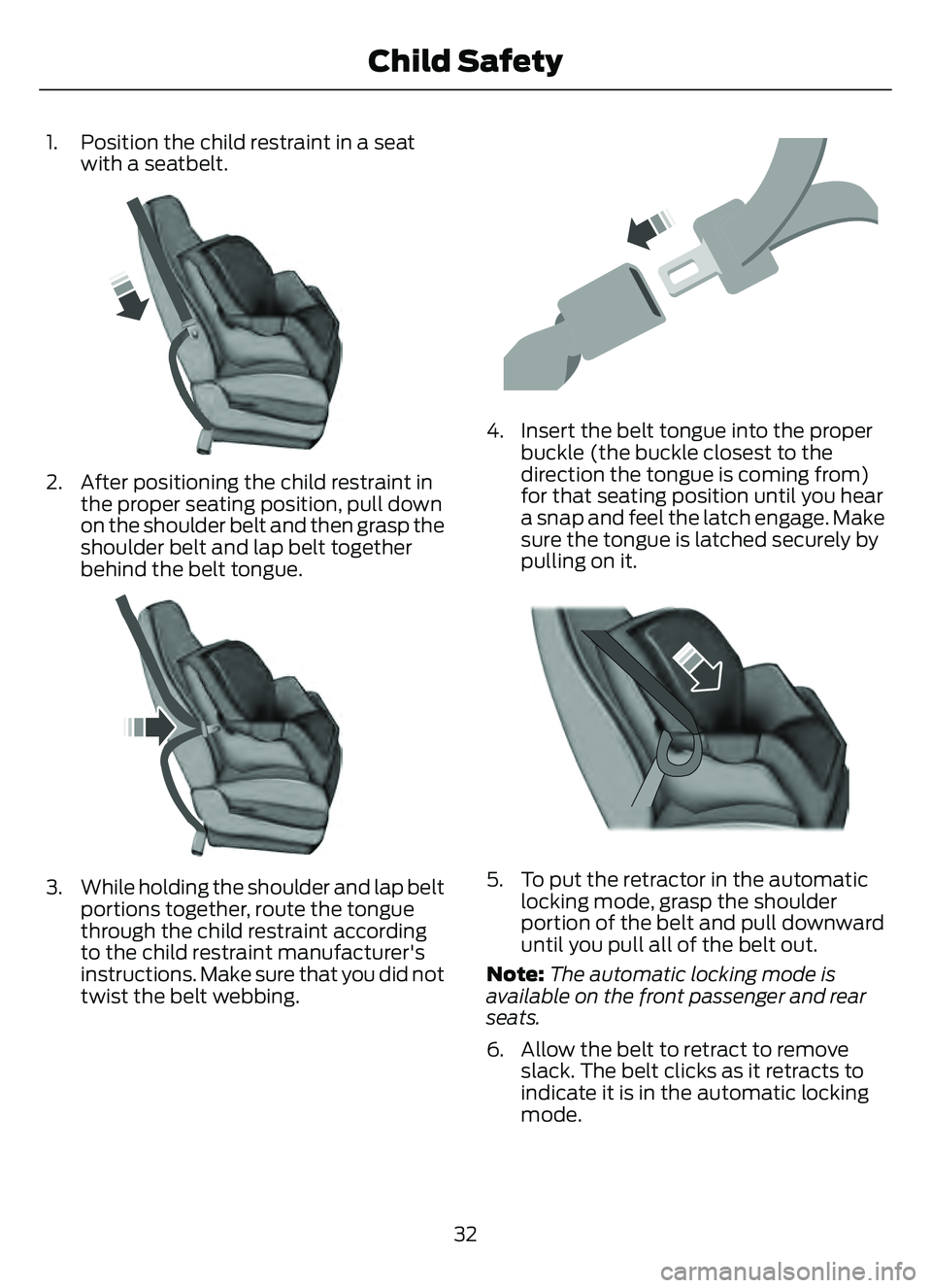
1. Position the child restraint in a seatwith a seatbelt.
E142529
2. After positioning the child restraint inthe proper seating position, pull down
on the shoulder belt and then grasp the
shoulder belt and lap belt together
behind the belt tongue.
E142530
3. While holding the shoulder and lap beltportions together, route the tongue
through the child restraint according
to the child restraint manufacturer's
instructions. Make sure that you did not
twist the belt webbing.
4. Insert the belt tongue into the properbuckle (the buckle closest to the
direction the tongue is coming from)
for that seating position until you hear
a snap and feel the latch engage. Make
sure the tongue is latched securely by
pulling on it.
5. To put the retractor in the automaticlocking mode, grasp the shoulder
portion of the belt and pull downward
until you pull all of the belt out.
Note: The automatic locking mode is
available on the front passenger and rear
seats.
6. Allow the belt to retract to remove slack. The belt clicks as it retracts to
indicate it is in the automatic locking
mode.
32
Child Safety
Page 39 of 585
If your child restraint system has a tether
strap, and the child restraint manufacturer
recommends its use, we also recommend
its use.
BOOSTER SEATS
Use a belt-positioning booster seat for
children who have outgrown or no longer
properly fit in a child restraint and meet
the following criteria.
• Generally children who are less than57 in (1.45 m) tall.
• Are greater than age four (4) and less than age twelve (12).
• Are between 40 lb (18 kg) and 80 lb (36 kg) and upward to 100 lb (45 kg).
Many state and provincial laws require that
children use approved booster seats until
they reach age eight, a height of 57 in
(1.45 m) tall, or 80 lb (36 kg).
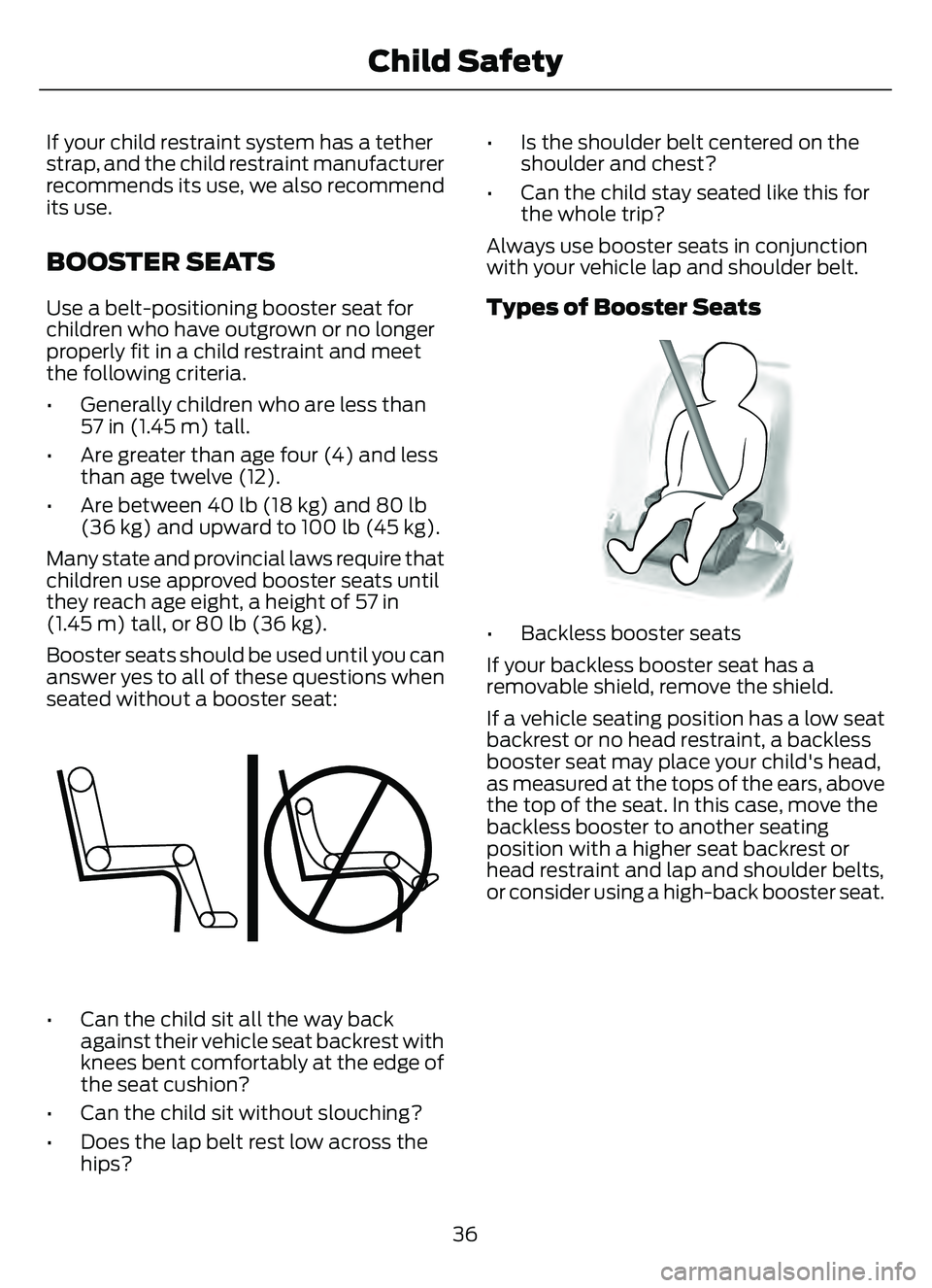
Booster seats should be used until you can
answer yes to all of these questions when
seated without a booster seat:
E142595
• Can the child sit all the way back against their vehicle seat backrest with
knees bent comfortably at the edge of
the seat cushion?
• Can the child sit without slouching?
• Does the lap belt rest low across the hips? • Is the shoulder belt centered on the
shoulder and chest?
• Can the child stay seated like this for the whole trip?
Always use booster seats in conjunction
with your vehicle lap and shoulder belt.
Types of Booster Seats
E68924
• Backless booster seats
If your backless booster seat has a
removable shield, remove the shield.
If a vehicle seating position has a low seat
backrest or no head restraint, a backless
booster seat may place your child's head,
as measured at the tops of the ears, above
the top of the seat. In this case, move the
backless booster to another seating
position with a higher seat backrest or
head restraint and lap and shoulder belts,
or consider using a high-back booster seat.
36
Child Safety
Page 40 of 585
E70710
• High-back booster seatsIf, with a backless booster seat, you cannot
find a seating position that adequately
supports your child's head, a high-back
booster seat would be a better choice.
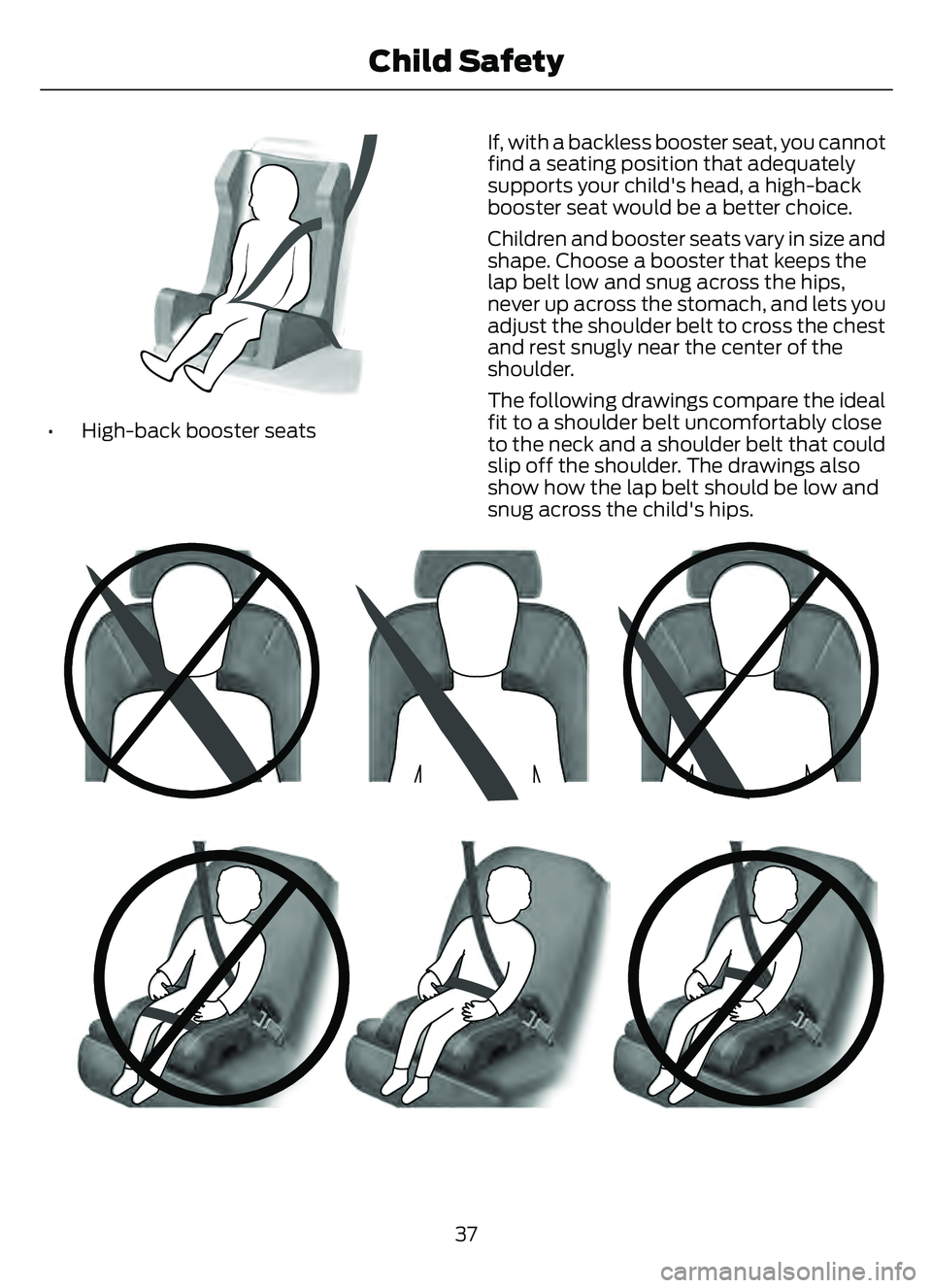
Children and booster seats vary in size and
shape. Choose a booster that keeps the
lap belt low and snug across the hips,
never up across the stomach, and lets you
adjust the shoulder belt to cross the chest
and rest snugly near the center of the
shoulder.
The following drawings compare the ideal
fit to a shoulder belt uncomfortably close
to the neck and a shoulder belt that could
slip off the shoulder. The drawings also
show how the lap belt should be low and
snug across the child's hips.
E142596
42597
37
Child Safety
Page 42 of 585
SEATBELT PRECAUTIONS
WARNING: Always drive and ride
with your seatback upright and the lap
belt snug and low across the hips.
WARNING: Children must always
be properly restrained.
WARNING: Do not allow a
passenger to hold a child on their lap
when your vehicle is moving. Failure to
follow this instruction could result in
personal injury or death in the event of a
sudden stop or crash.
WARNING: All occupants of your
vehicle, including the driver, should
always properly wear their seatbelts,
even when an airbag supplemental
restraint system is provided. Failure to
properly wear your seatbelt could
seriously increase the risk of injury or
death.
WARNING: It is extremely
dangerous to ride in a cargo area, inside
or outside of a vehicle. In a crash, people
riding in these areas are more likely to be
seriously injured or killed. Do not allow
people to ride in any area of your vehicle
that is not equipped with seats and
seatbelts. Make sure everyone in your
vehicle is in a seat and properly using a
seatbelt. Failure to follow this warning
could result in serious personal injury or
death.
WARNING: In a rollover crash, an
unbelted person is significantly more
likely to die than a person wearing a
seatbelt.
WARNING: Each seating position
in your vehicle has a specific seatbelt
assembly made up of one buckle and
one tongue designed to be used as a pair.
Use the shoulder belt on the outside
shoulder only. Never wear the shoulder
belt under the arm. Never use a single
seatbelt for more than one person.
WARNING: Even with advanced
restraints systems, properly restrain
children 12 and under in a rear seating
position. Failure to follow this could
seriously increase the risk of injury or
death.
WARNING: Seatbelts and seats
may be hot in a vehicle that is in the
sunshine. The hot seatbelts or seats may
burn a small child. Check seat covers and
buckles before you place a child
anywhere near them.
WARNING: If your vehicle is
involved in a crash, have the seatbelts
and associated components inspected
as soon as possible. Failure to follow this
instruction could result in personal injury
or death.
All seating positions in this vehicle have
lap and shoulder seatbelts. All occupants
of the vehicle should properly wear their
seatbelts, even when an airbag
supplemental restraint system is provided.
The seatbelt system consists of:
• Lap and shoulder seatbelts.
• A shoulder seatbelt with automatic locking mode, except driver seatbelt.
• Height adjusters at the front outermost seating positions.
39
Seatbelts
Page 44 of 585
HOW DOES SENSITIVE LOCKING
MODE WORK
If the driver suddenly brakes, turns a corner
sharply, or the vehicle receives an impact
of about 5 mph (8 km/h) or more, the
seatbelts lock to help reduce forward
movement of the driver and passengers.
In addition, the seatbelt retractor locks if
you pull the seatbelt webbing out too
quickly. If the retractor locks, slowly lower
the height adjuster to allow the seatbelt
to retract.
If the retractor does not unlock, pull the
seatbelt out slowly then feed a small
length of webbing back toward the stowed
position.
AUTOMATIC LOCKING MODE
WHAT IS AUTOMATIC LOCKING
MODE
This is a safety feature built into the
seatbelt retractors that keeps the
seatbelts pre-locked.
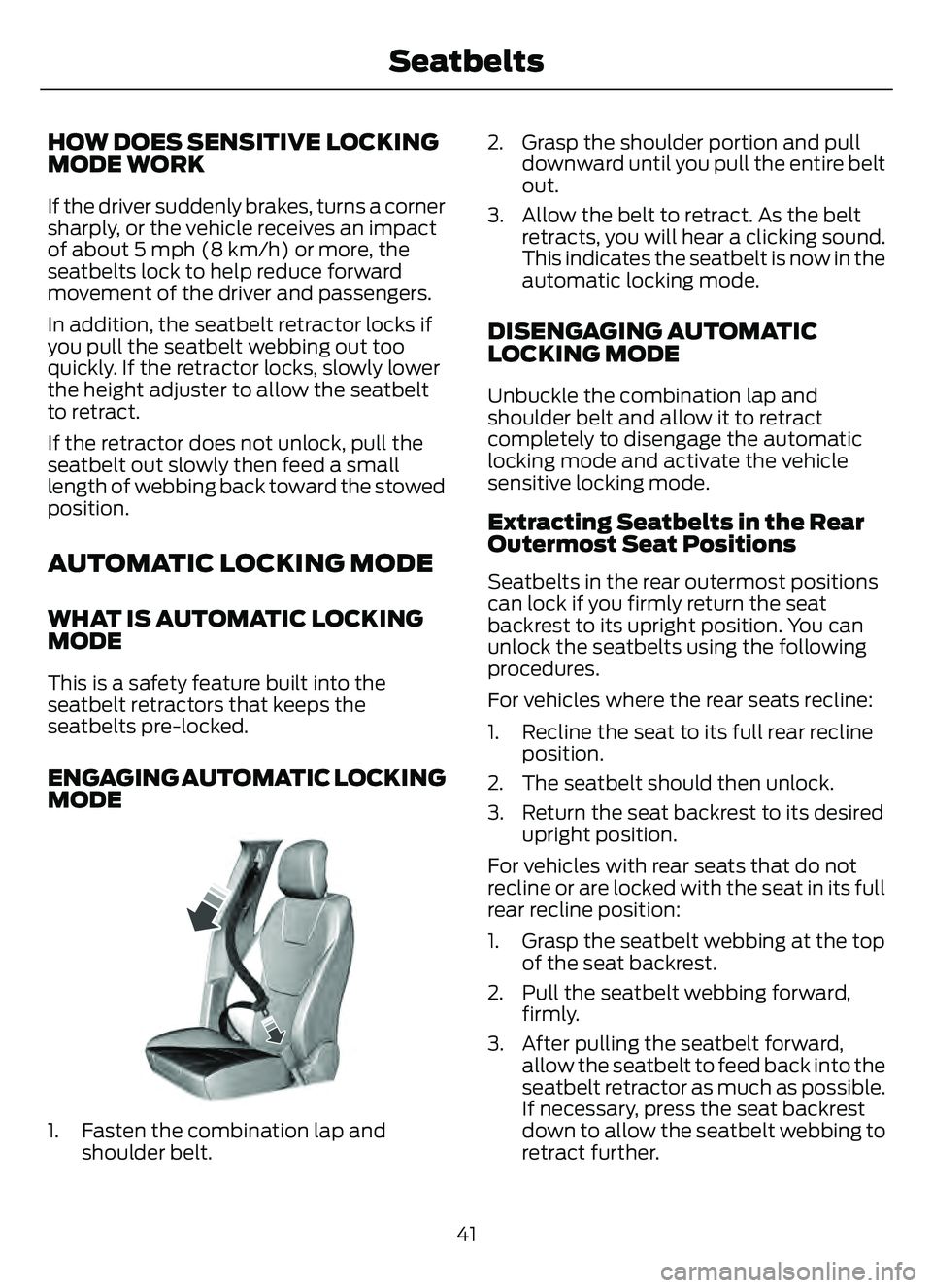
ENGAGING AUTOMATIC LOCKING
MODE
E142591E142591
1. Fasten the combination lap andshoulder belt. 2. Grasp the shoulder portion and pull
downward until you pull the entire belt
out.
3. Allow the belt to retract. As the belt retracts, you will hear a clicking sound.
This indicates the seatbelt is now in the
automatic locking mode.
DISENGAGING AUTOMATIC
LOCKING MODE
Unbuckle the combination lap and
shoulder belt and allow it to retract
completely to disengage the automatic
locking mode and activate the vehicle
sensitive locking mode.
Extracting Seatbelts in the Rear
Outermost Seat Positions
Seatbelts in the rear outermost positions
can lock if you firmly return the seat
backrest to its upright position. You can
unlock the seatbelts using the following
procedures.
For vehicles where the rear seats recline:
1. Recline the seat to its full rear reclineposition.
2. The seatbelt should then unlock.
3. Return the seat backrest to its desired upright position.
For vehicles with rear seats that do not
recline or are locked with the seat in its full
rear recline position:
1. Grasp the seatbelt webbing at the top of the seat backrest.
2. Pull the seatbelt webbing forward, firmly.
3. After pulling the seatbelt forward, allow the seatbelt to feed back into the
seatbelt retractor as much as possible.
If necessary, press the seat backrest
down to allow the seatbelt webbing to
retract further.
41
Seatbelts
Page 51 of 585
WARNING: Do not lean your head
on the door. The side airbag could injure
you as it deploys from the side of the
seatback.
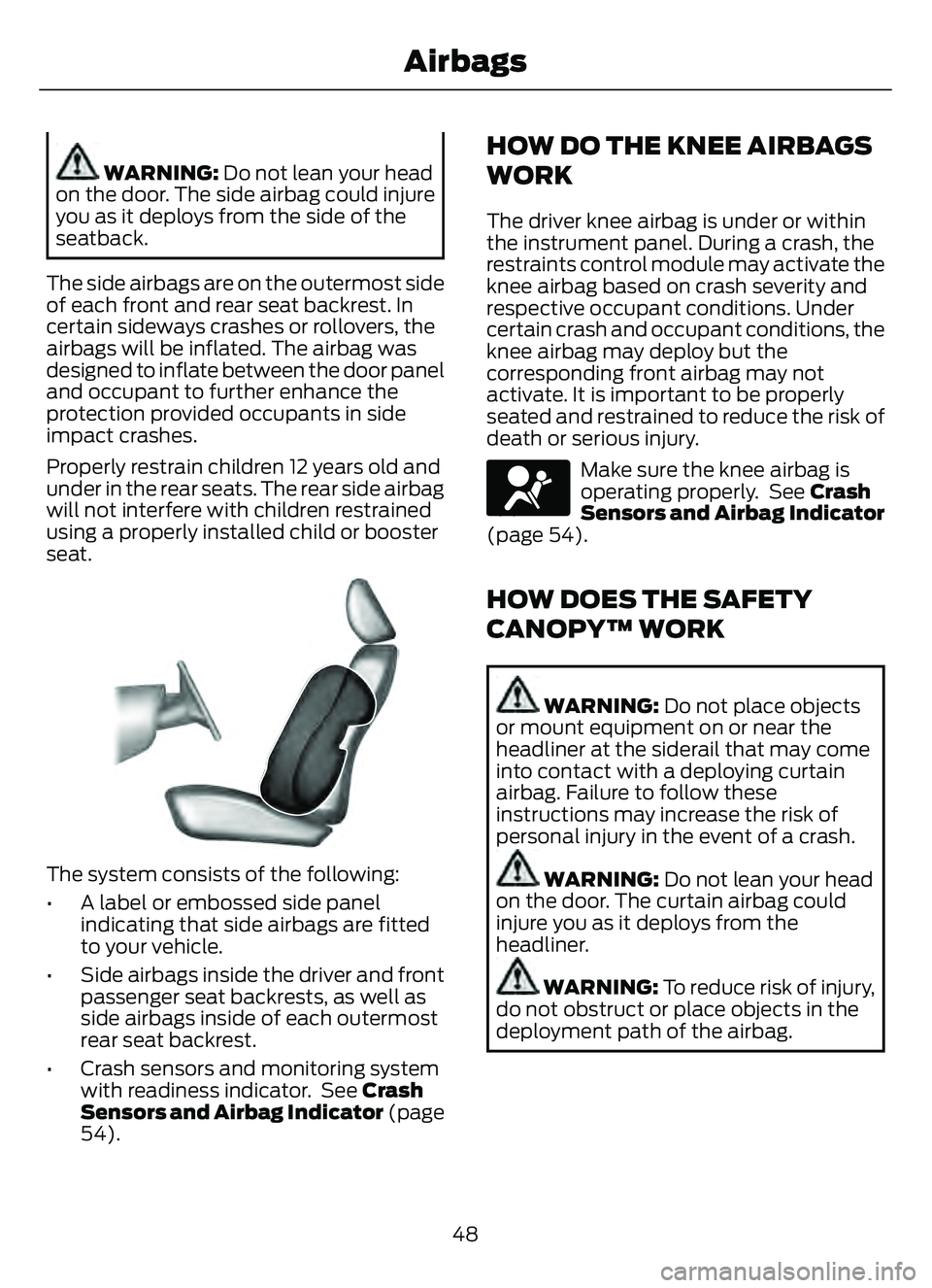
The side airbags are on the outermost side
of each front and rear seat backrest. In
certain sideways crashes or rollovers, the
airbags will be inflated. The airbag was
designed to inflate between the door panel
and occupant to further enhance the
protection provided occupants in side
impact crashes.
Properly restrain children 12 years old and
under in the rear seats. The rear side airbag
will not interfere with children restrained
using a properly installed child or booster
seat.
E152533
The system consists of the following:
• A label or embossed side panel indicating that side airbags are fitted
to your vehicle.
• Side airbags inside the driver and front passenger seat backrests, as well as
side airbags inside of each outermost
rear seat backrest.
• Crash sensors and monitoring system with readiness indicator. See Crash
Sensors and Airbag Indicator (page
54).
HOW DO THE KNEE AIRBAGS
WORK
The driver knee airbag is under or within
the instrument panel. During a crash, the
restraints control module may activate the
knee airbag based on crash severity and
respective occupant conditions. Under
certain crash and occupant conditions, the
knee airbag may deploy but the
corresponding front airbag may not
activate. It is important to be properly
seated and restrained to reduce the risk of
death or serious injury.
E67017
Make sure the knee airbag is
operating properly. See Crash
Sensors and Airbag Indicator
(page 54).
HOW DOES THE SAFETY
CANOPY™ WORK
WARNING: Do not place objects
or mount equipment on or near the
headliner at the siderail that may come
into contact with a deploying curtain
airbag. Failure to follow these
instructions may increase the risk of
personal injury in the event of a crash.
WARNING: Do not lean your head
on the door. The curtain airbag could
injure you as it deploys from the
headliner.
WARNING: To reduce risk of injury,
do not obstruct or place objects in the
deployment path of the airbag.
48
Airbags