service FORD ESCORT 1997 6.G User Guide
[x] Cancel search | Manufacturer: FORD, Model Year: 1997, Model line: ESCORT, Model: FORD ESCORT 1997 6.GPages: 191, PDF Size: 2.02 MB
Page 105 of 191

Driving while towing a trailer
Do not drive faster than 88 km/h
(55 mph) while towing a 454 kg
(1000 lb) trailer. Do not drive
faster than 72 km/h (45 mph) with
any weight trailer while towing in
hilly country or on hot days.
Speed control (if equipped) may
not work properly while towing on
very long, steep grades.
If driving with an automatic
transaxle:
²use D or L rather than
Dwhile towing up or down
steep hills.
²anticipate stops and brake
gradually.
If driving with a manual transaxle:
²select a gear that avoids jerking
or excessive engine speed.
²avoid driving excessively in first
or second gear. In first or
second gear the trailer may be
too big or too heavily loaded for
the vehicle drivetrain.
²shift to a lower gear while
towing up or down steep hills.
²anticipate stops and brake
gradually.
Servicing while towing
If you tow a trailer for long
distances, your vehicle requires
more frequent service than a
vehicle not used for towing. Refer
to theService Guidefor more
information.
Driving
105
Page 107 of 191
USING THE HAZARD SWITCH
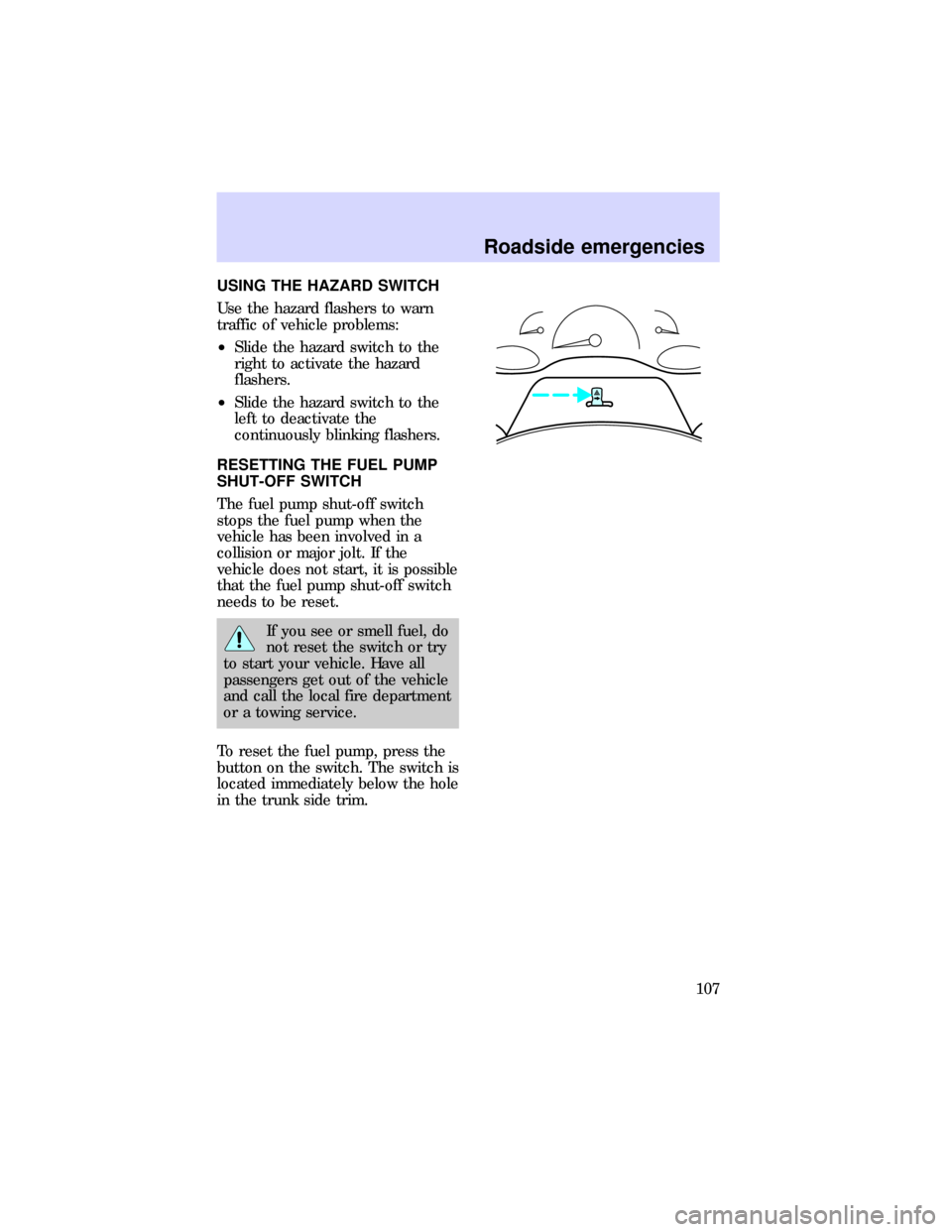
Use the hazard flashers to warn
traffic of vehicle problems:
²Slide the hazard switch to the
right to activate the hazard
flashers.
²Slide the hazard switch to the
left to deactivate the
continuously blinking flashers.
RESETTING THE FUEL PUMP
SHUT-OFF SWITCH
The fuel pump shut-off switch
stops the fuel pump when the
vehicle has been involved in a
collision or major jolt. If the
vehicle does not start, it is possible
that the fuel pump shut-off switch
needs to be reset.
If you see or smell fuel, do
not reset the switch or try
to start your vehicle. Have all
passengers get out of the vehicle
and call the local fire department
or a towing service.
To reset the fuel pump, press the
button on the switch. The switch is
located immediately below the hole
in the trunk side trim.
Roadside emergencies
107
Page 120 of 191
JUMP-STARTING A DISABLED
VEHICLE
The gases around the
battery can explode if
exposed to flames, sparks, or lit
smoking materials. An explosion
could result in injury or vehicle
damage.
To protect yourself when
charging a battery, always
shield your face and eyes. Make
sure that you can breathe fresh
air.
Batteries contain sulfuric
acid which burns skin,
eyes, and clothing.
If the battery acid touches
someone's skin, eyes, or clothing,
immediately flush the area with
water for at least fifteen minutes.
If someone swallows acid, have
him or her drink lots of milk or
water first, then Milk of Magnesia,
a beaten egg, or vegetable oil.
Consult a physician immediately.
To avoid damage or injury,
follow these directions in
the order they are given. If in
doubt, call for road service.
Before jump-starting a vehicle:
²make sure the booster battery
vehicle has a 12-volt starting
Roadside emergencies
120
Page 124 of 191

SERVICE RECOMMENDATIONS
Whenever possible, Ford has
designed parts that do not require
servicing. However when servicing
is required, Ford's goal is to make
servicing your vehicle as easy as
possible. To help you:
²We highlight do-it-yourself items
in the engine compartment for
easy location.
²Often, parts (such as the
headlamp bulbs) may be
replaced without tools.
²We provide you with aService
Guidethat makes tracking
routine service of your vehicle
easy.
If your vehicle requires
professional servicing, your
dealership can provide the
necessary parts and service. Check
theWarranty Information Guide
to find out what parts and services
are covered. Use only
recommended fuels, lubricants,
fluids, and service parts
conforming to Ford specifications.
Motorcraft parts are designed and
built to provide the best
performance in your vehicle.
Precautions for servicing your
vehicle
Be particularly careful when
inspecting or servicing your
vehicle. Here are some general
precautions for your safety:
Maintenance and care
124
Page 130 of 191
CHECKING AND ADDING
ENGINE OIL
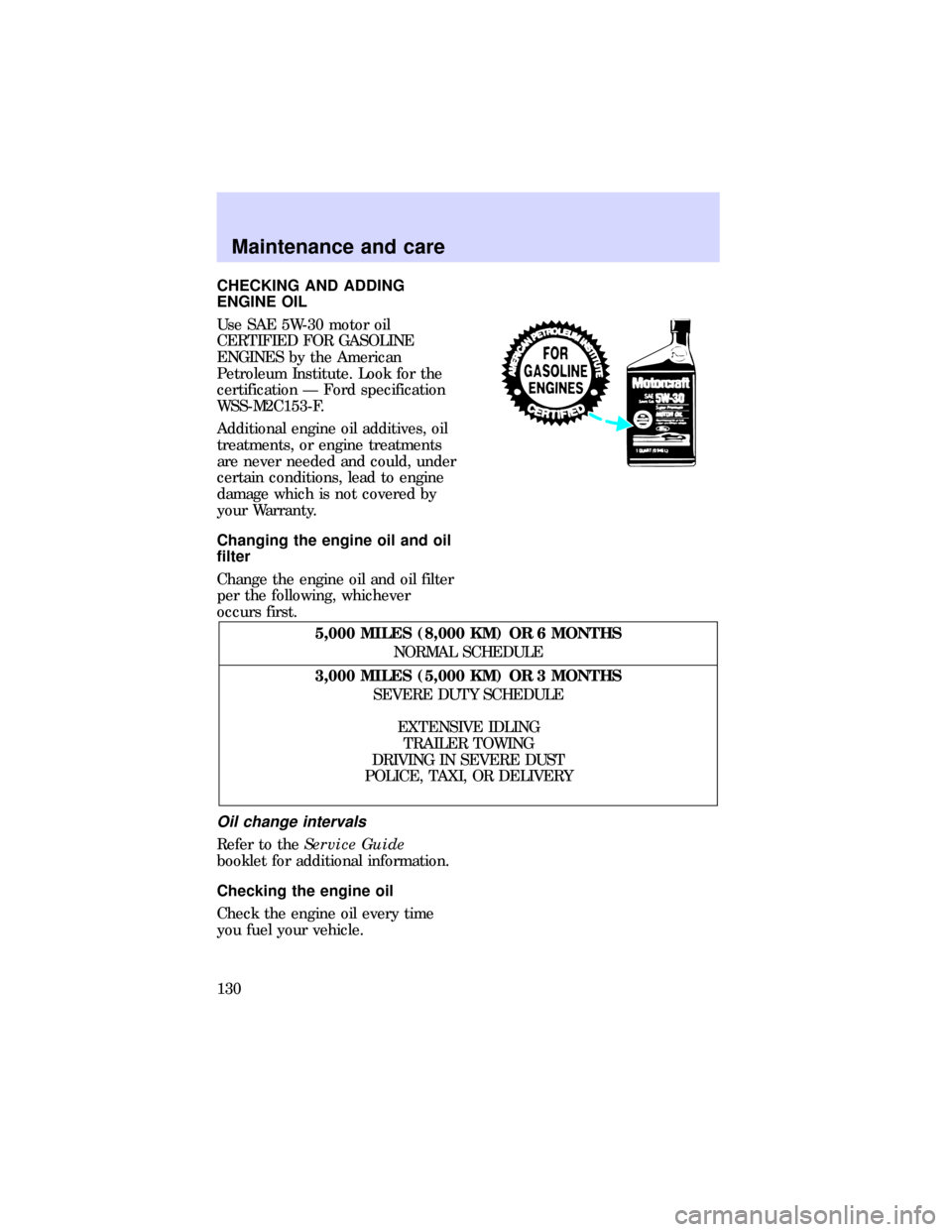
Use SAE 5W-30 motor oil
CERTIFIED FOR GASOLINE
ENGINES by the American
Petroleum Institute. Look for the
certification Ð Ford specification
WSS-M2C153-F.
Additional engine oil additives, oil
treatments, or engine treatments
are never needed and could, under
certain conditions, lead to engine
damage which is not covered by
your Warranty.
Changing the engine oil and oil
filter
Change the engine oil and oil filter
per the following, whichever
occurs first.
5,000 MILES (8,000 KM) OR 6 MONTHS
NORMAL SCHEDULE
3,000 MILES (5,000 KM) OR 3 MONTHS
SEVERE DUTY SCHEDULE
EXTENSIVE IDLING
TRAILER TOWING
DRIVING IN SEVERE DUST
POLICE, TAXI, OR DELIVERY
Oil change intervals
Refer to theService Guide
booklet for additional information.
Checking the engine oil
Check the engine oil every time
you fuel your vehicle.
Maintenance and care
130
Page 139 of 191
CHECKING AND ADDING
POWER STEERING FLUID
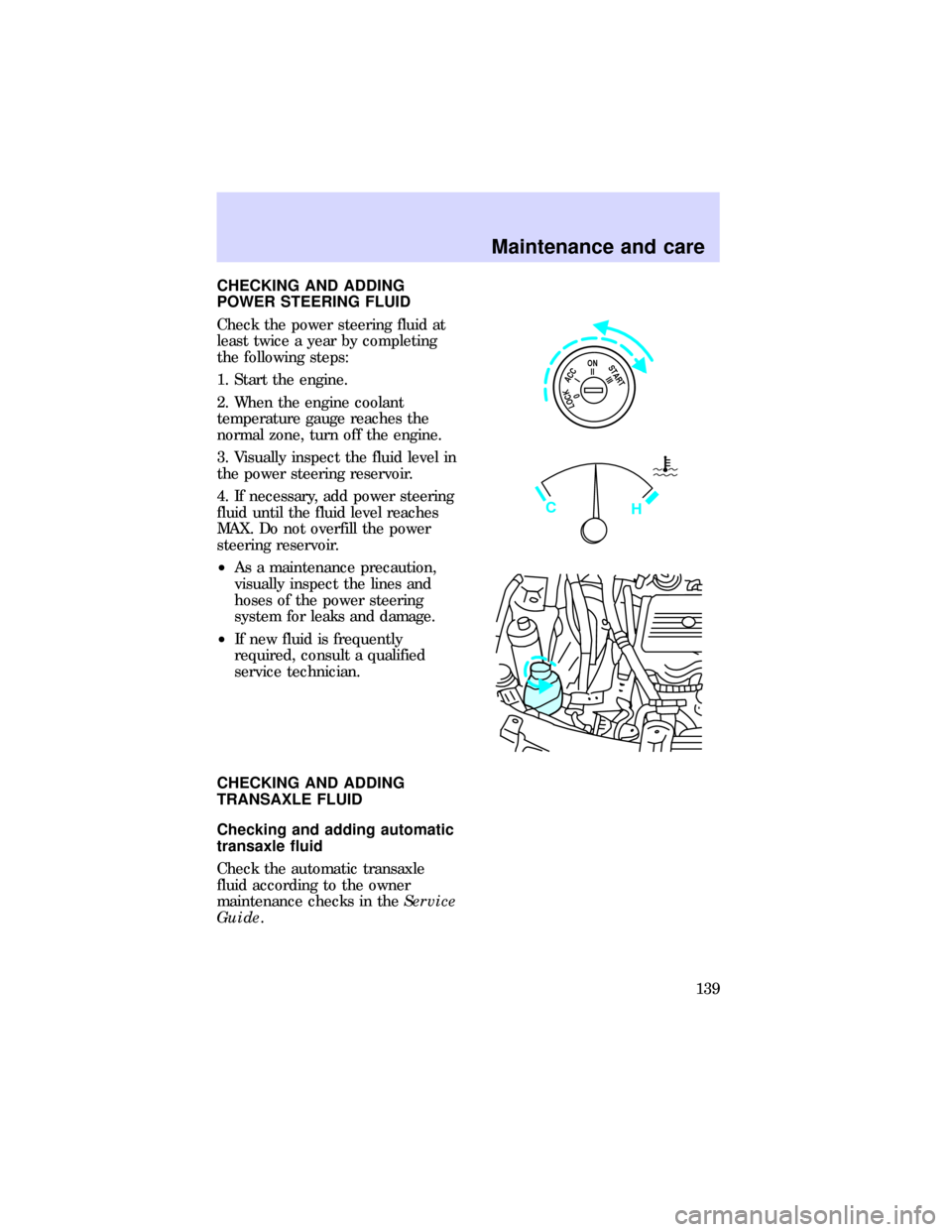
Check the power steering fluid at
least twice a year by completing
the following steps:
1. Start the engine.
2. When the engine coolant
temperature gauge reaches the
normal zone, turn off the engine.
3. Visually inspect the fluid level in
the power steering reservoir.
4. If necessary, add power steering
fluid until the fluid level reaches
MAX. Do not overfill the power
steering reservoir.
²As a maintenance precaution,
visually inspect the lines and
hoses of the power steering
system for leaks and damage.
²If new fluid is frequently
required, consult a qualified
service technician.
CHECKING AND ADDING
TRANSAXLE FLUID
Checking and adding automatic
transaxle fluid
Check the automatic transaxle
fluid according to the owner
maintenance checks in theService
Guide.
ON
II
ACC
I
LOCK
0
START
III
C
H
Maintenance and care
139
Page 148 of 191
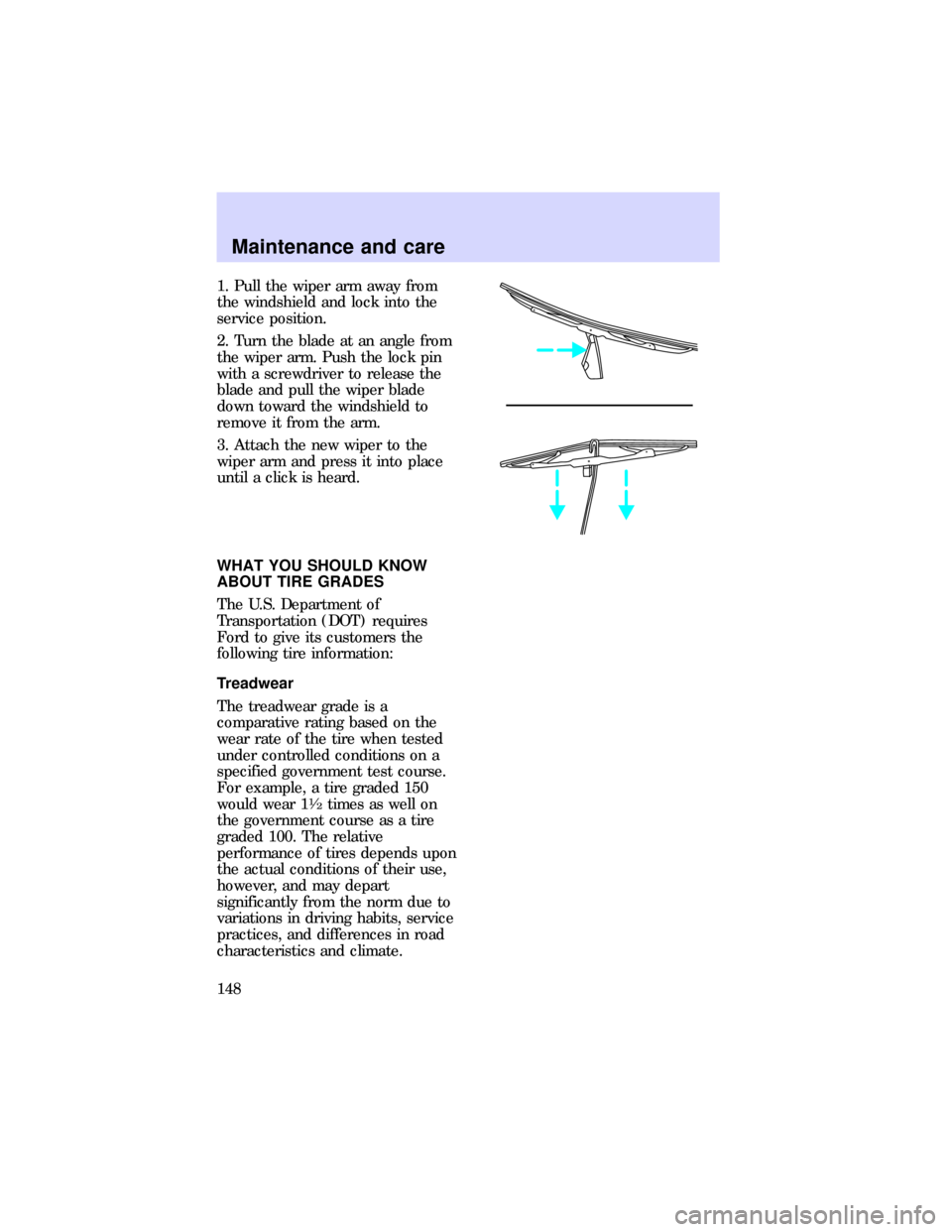
1. Pull the wiper arm away from
the windshield and lock into the
service position.
2. Turn the blade at an angle from
the wiper arm. Push the lock pin
with a screwdriver to release the
blade and pull the wiper blade
down toward the windshield to
remove it from the arm.
3. Attach the new wiper to the
wiper arm and press it into place
until a click is heard.
WHAT YOU SHOULD KNOW
ABOUT TIRE GRADES
The U.S. Department of
Transportation (DOT) requires
Ford to give its customers the
following tire information:
Treadwear
The treadwear grade is a
comparative rating based on the
wear rate of the tire when tested
under controlled conditions on a
specified government test course.
For example, a tire graded 150
would wear 1
1¤2times as well on
the government course as a tire
graded 100. The relative
performance of tires depends upon
the actual conditions of their use,
however, and may depart
significantly from the norm due to
variations in driving habits, service
practices, and differences in road
characteristics and climate.
Maintenance and care
148
Page 151 of 191
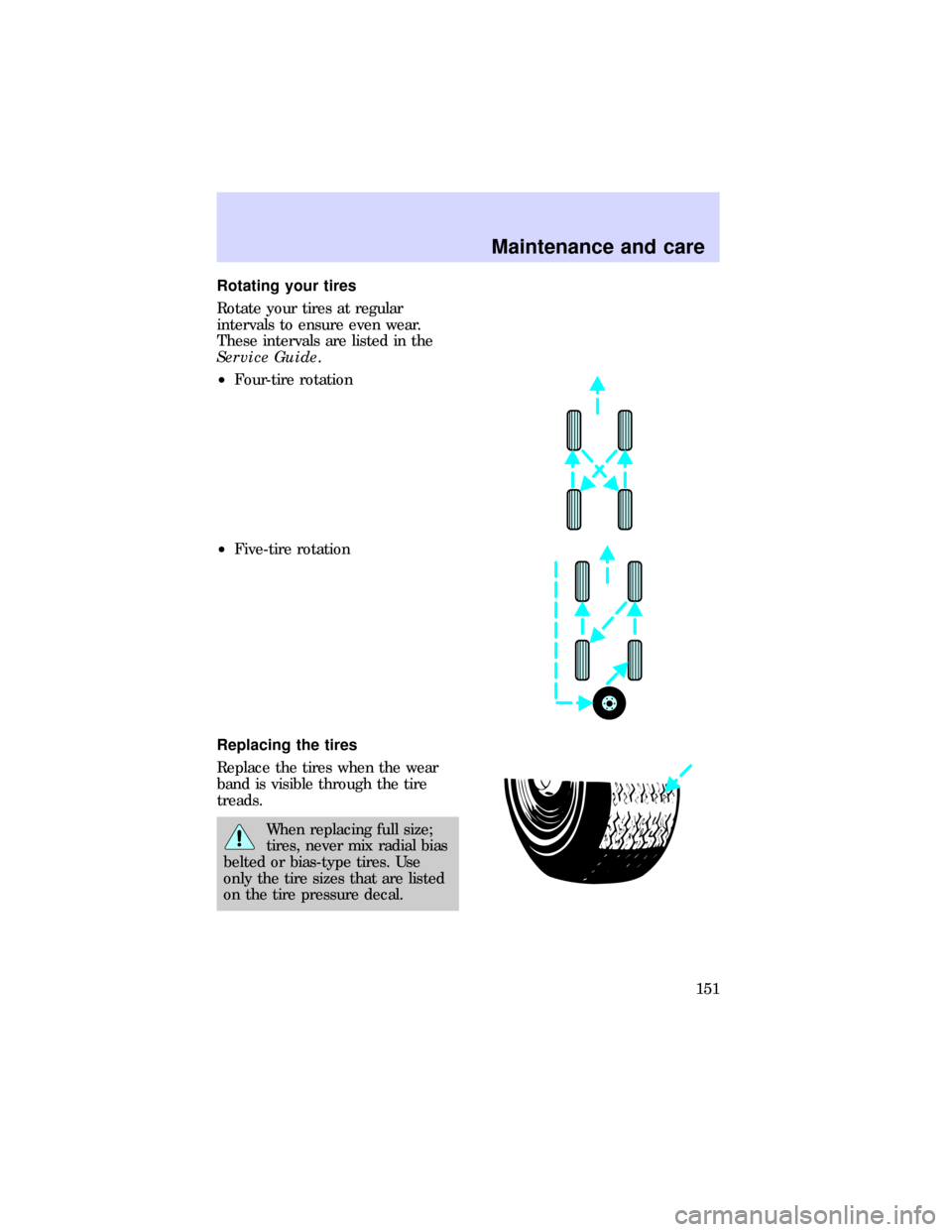
Rotating your tires
Rotate your tires at regular
intervals to ensure even wear.
These intervals are listed in the
Service Guide.
²Four-tire rotation
²Five-tire rotation
Replacing the tires
Replace the tires when the wear
band is visible through the tire
treads.
When replacing full size;
tires, never mix radial bias
belted or bias-type tires. Use
only the tire sizes that are listed
on the tire pressure decal.
Maintenance and care
151
Page 152 of 191
Make sure all replacement
tires are of the same type,
load-carrying capacity, and tread
design (e.g. ªAll Terrainº), as
originally offered by Ford.
Failure to follow these
precautions may adversely
affect the handling of the vehicle
and make it easier to lose control
and roll over.
IDENTIFYING TIRE TYPES
Your vehicle requires the use of
the following tire types: wagon and
sedan 18565R14 tires and
T115/70D14 mini-spare. When
purchasing replacemment tires for
your vehicle, consult your Ford or
Lincoln-Mercury dealer or qualified
service technician to assure that
correct tire types are used.
USING SNOW TIRES AND
CHAINS
Snow tires must be the
same size and grade as the
tires currently on your vehicle.
The tires on your vehicle have all
weather treads to provide traction
in rain and snow. However, in some
climates using snow tires and
chains may be necessary. Follow
these guidelines when using snow
tires and chains:
²Use only SAE Class ªSº chains.
Maintenance and care
152
Page 156 of 191

Octane Recommendation
Your vehicle is designed to use regular gasoline with an (R+M)/2
octane rating of 87. We do not recommend gasolines labeled as
``regular'' in high altitude areas that are sold with octane ratings
of 86 or even less.
Do not be concerned if your
vehicle sometimes knocks lightly.
However, if it knocks heavily under
most driving conditions on the
recommended octane fuel, see
your dealer or a qualified service
technician to prevent any engine
damage.
Fuel Quality
If you are experiencing starting,
rough idle or hesitation problems,
try a different brand of fuel. If the
condition persists, see your dealer
or a qualified service technician.
The American Automobile
Manufacturers Association (AAMA)
issued a gasoline specification to
provide information on high quality
fuels that optimize the
performance of your vehicle. We
recommend the use of gasolines
that meet the AAMA specification
if they are available.
It should not be necessary to add
any aftermarket products to your
fuel tank if you continue to use a
high-quality fuel.
Cleaner Air
Ford approves the use of gasolines
to improve air quality, including
reformulated gasolines, that
contain oxygenates such as a
Maintenance and care
156