radio FORD ESCORT 1997 7.G Audio Guide
[x] Cancel search | Manufacturer: FORD, Model Year: 1997, Model line: ESCORT, Model: FORD ESCORT 1997 7.GPages: 21, PDF Size: 0.09 MB
Page 12 of 21
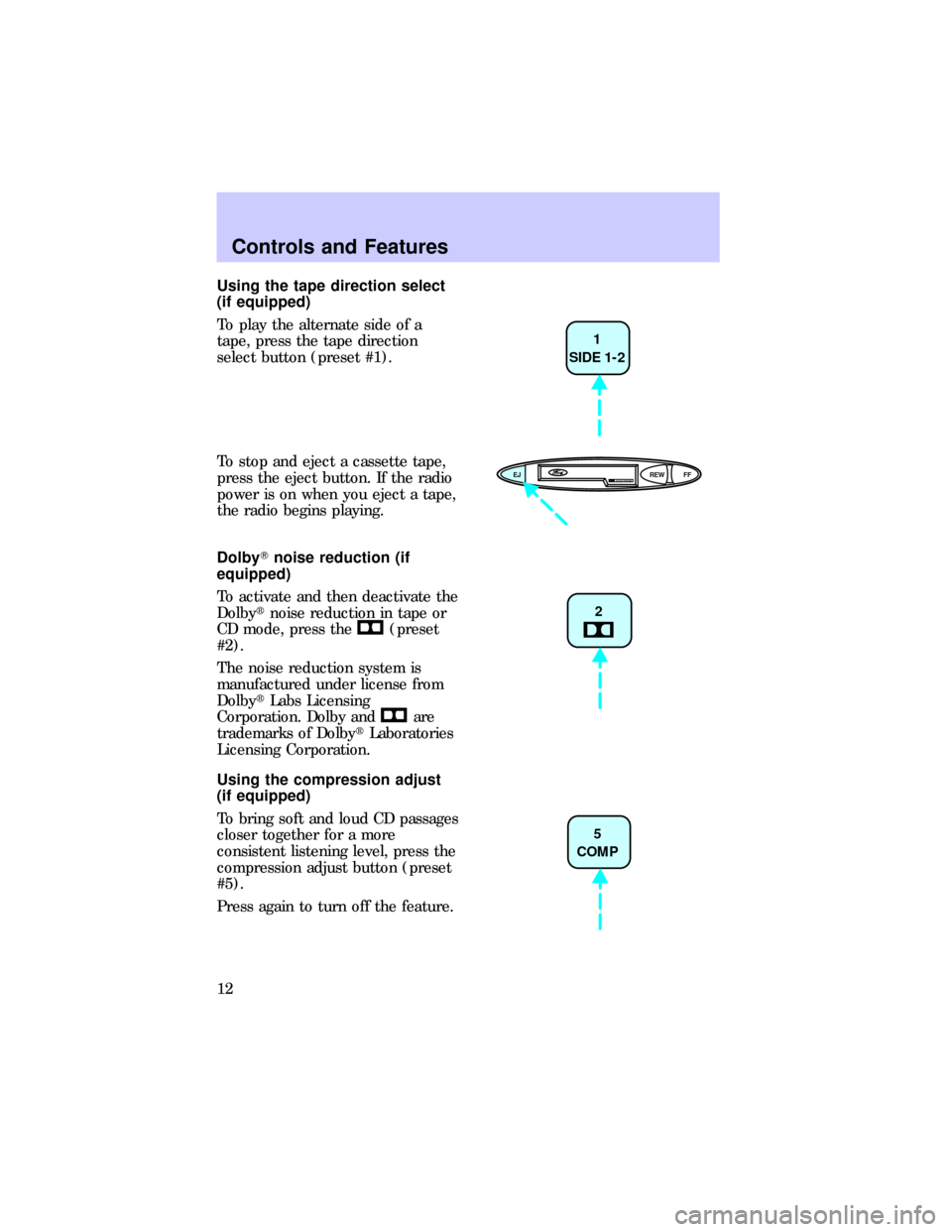
Using the tape direction select
(if equipped)
To play the alternate side of a
tape, press the tape direction
select button (preset #1).
To stop and eject a cassette tape,
press the eject button. If the radio
power is on when you eject a tape,
the radio begins playing.
DolbyTnoise reduction (if
equipped)
To activate and then deactivate the
Dolbytnoise reduction in tape or
CD mode, press the
(preset
#2).
The noise reduction system is
manufactured under license from
DolbytLabs Licensing
Corporation. Dolby and
are
trademarks of DolbytLaboratories
Licensing Corporation.
Using the compression adjust
(if equipped)
To bring soft and loud CD passages
closer together for a more
consistent listening level, press the
compression adjust button (preset
#5).
Press again to turn off the feature.
1
SIDE 1-2
EJ REW FFDOLBY SYSTEM
2
5
COMP
Controls and Features
12
Page 14 of 21
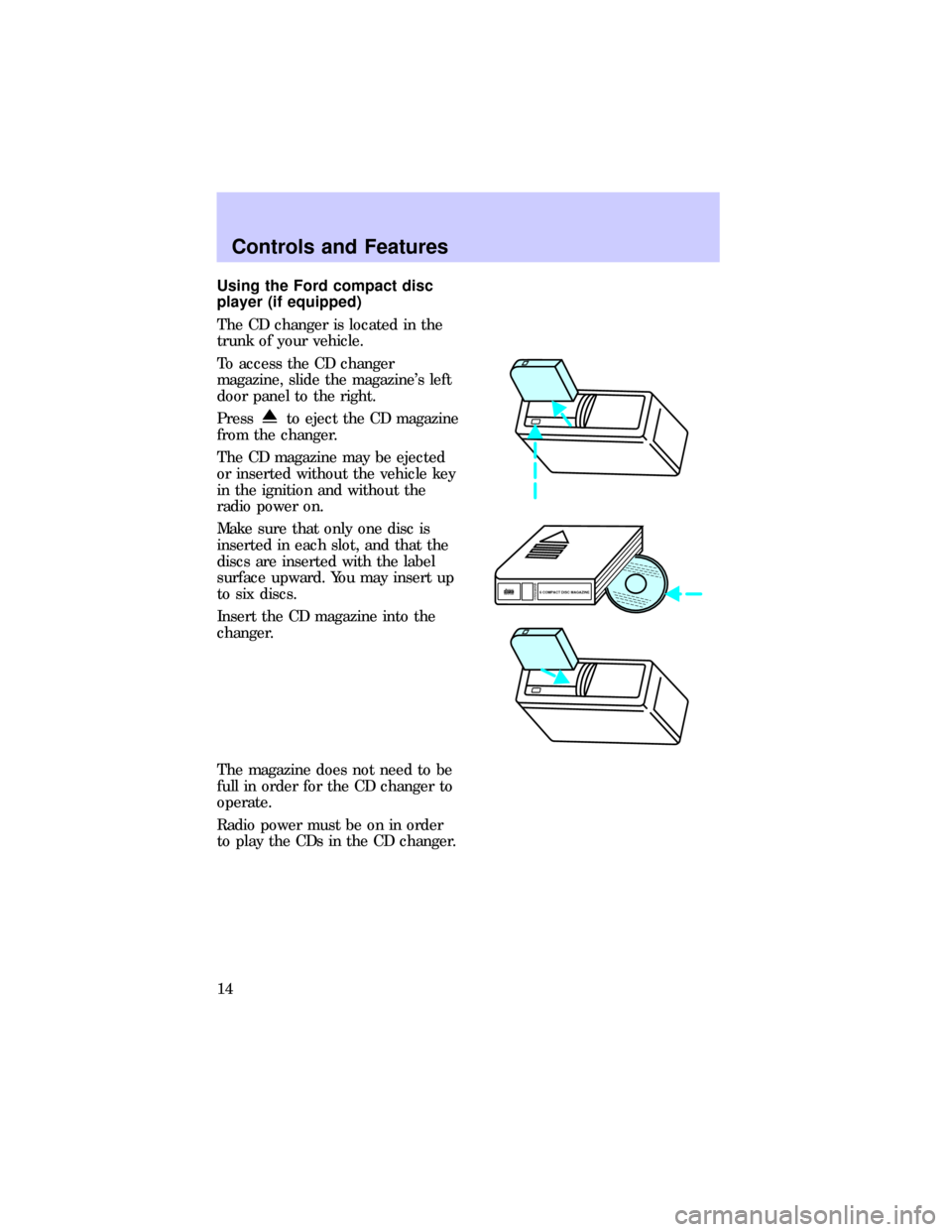
Using the Ford compact disc
player (if equipped)
The CD changer is located in the
trunk of your vehicle.
To access the CD changer
magazine, slide the magazine's left
door panel to the right.
Press
to eject the CD magazine
from the changer.
The CD magazine may be ejected
or inserted without the vehicle key
in the ignition and without the
radio power on.
Make sure that only one disc is
inserted in each slot, and that the
discs are inserted with the label
surface upward. You may insert up
to six discs.
Insert the CD magazine into the
changer.
The magazine does not need to be
full in order for the CD changer to
operate.
Radio power must be on in order
to play the CDs in the CD changer.
6
5
4
3
2
16 COMPACT DISC MAGAZINECOMPACT
DIGITAL AUDIO
Controls and Features
14
Page 16 of 21
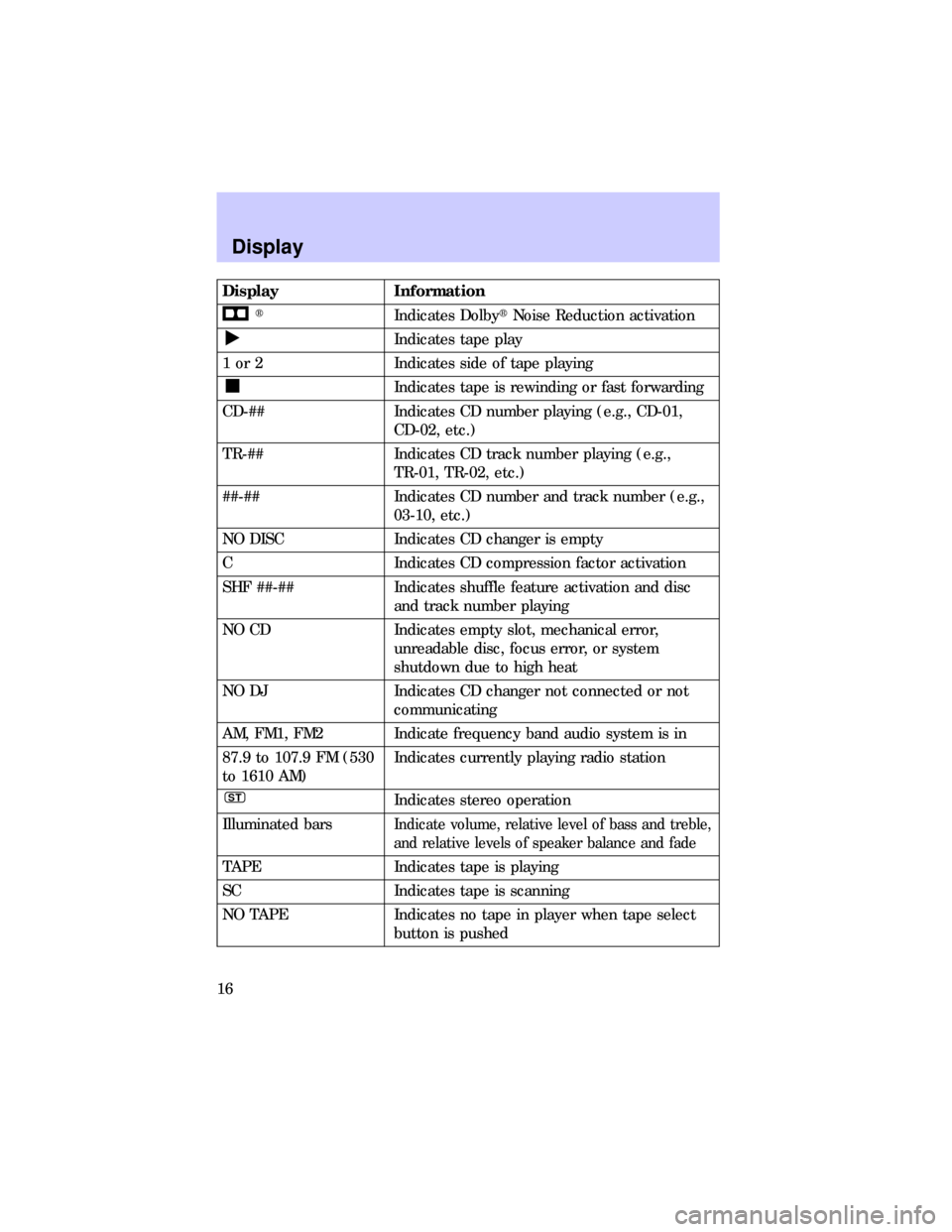
Display Information
tIndicates DolbytNoise Reduction activation
Indicates tape play
1 or 2 Indicates side of tape playing
Indicates tape is rewinding or fast forwarding
CD-## Indicates CD number playing (e.g., CD-01,
CD-02, etc.)
TR-## Indicates CD track number playing (e.g.,
TR-01, TR-02, etc.)
##-## Indicates CD number and track number (e.g.,
03-10, etc.)
NO DISC Indicates CD changer is empty
C Indicates CD compression factor activation
SHF ##-## Indicates shuffle feature activation and disc
and track number playing
NO CD Indicates empty slot, mechanical error,
unreadable disc, focus error, or system
shutdown due to high heat
NO DJ Indicates CD changer not connected or not
communicating
AM, FM1, FM2 Indicate frequency band audio system is in
87.9 to 107.9 FM (530
to 1610 AM)Indicates currently playing radio station
STIndicates stereo operation
Illuminated bars
Indicate volume, relative level of bass and treble,
and relative levels of speaker balance and fade
TAPE Indicates tape is playing
SC Indicates tape is scanning
NO TAPE Indicates no tape in player when tape select
button is pushed
Display
16
Page 17 of 21

Troubleshooting problems with
your compact disc player
If play does not begin once a disc
is inserted:
²the radio is not on.
²the unit is in the stop mode.
²moisture is condensed on the
lenses within the unit. Remove
the disc and wait approximately
one hour for moisture to
evaporate.
If the sound skips:
²you may be traveling on a rough
road or playing badly scratched
discs. Skipping will not scratch
the discs or damage the player.
If the CD player does not work:
²the disc is already loaded into
the player.
²the disc is inserted with the
label surface downward.
²the disc is dusty or defective.
²the player's internal temperature
is above 75ÉC (167ÉF). Allow
the player to cool down before
operating.
²a disc with format and
dimensions not within industry
standards is inserted.
Caring for your compact discs
and player (if applicable)
²Handle discs by their edges only.
Never touch the playing surface.
Care and Cleaning
17
Page 19 of 21
RADIO FREQUENCY
INFORMATION
The Federal Communications
Commission (FCC) and the
Canadian Radio and
Telecommunications Commission
(CRTC) establish the frequencies
AM and FM stations may use for
their broadcasts. Allowable
frequencies are:
AM 530, 540Ð1600, 1610 kHz in
10 kHz steps
FM 87.9, 88.1Ð107.7, 107.9 Mhz
in .02 Mhz steps
Not all frequencies are used in a
given area.
Radio reception factors
Three factors primarily affect radio
reception:
²Distance/strength.The farther
an FM signal travels, the weaker
it is. The listenable range of the
average FM station is
approximately 40 km (24 miles).
This range can be affected by
signal modulation. Signal
modulation is a process radio
stations use to increase their
strength and/or volume relative
to other stations.
²Terrain.Hills, mountains, and
tall buildings between your
vehicle's antenna and the radio
station signal can cause FM
signal reception problems. Static
can be caused on AM stations
by power lines, electric fences,
traffic lights, and thunderstorms.
Radio Frequency Information
19
Page 20 of 21
Moving away from the
interfering structure (out of its
ªshadowº) returns your
reception to normal.
²Station overload.Weak
stations are sometimes captured
by stronger stations when you
pass a broadcast tower. A
stronger station may temporarily
overtake a weaker station and
play while the weak station 's
frequency is displayed.
The audio system automatically
switches to single channel
reception if it will improve the
reception of a station normally
received in stereo.
Radio Frequency Information
20
Page 21 of 21

AM/FM select ................................6
Audio power ..................................6
Bass adjust ....................................9
Cassette player
operation ..............................10,18
CD select .....................................11
Cleaning your vehicle
CD player and discs .................17
Clock
setting the clock .......................13
Compact disc changer
care ............................................17
operation ...................................14
troubleshooting .........................17
Compression adjust ....................12
Display .........................................16
Dolbytnoise reduction ..............12Fast forward function .................11
Memory preset buttons ................9
Power button ................................6
Radio frequency
information ................................19
reception ...................................19
Rewind function ..........................11
Scan function ................................8
Seek function ................................7
Shuffle mode ...............................13
Speaker balance adjust ..............10
Stations
selecting ......................................9
Tape direction select ..................12
Tape select ..................................11
Treble adjust .................................9
Tune adjust ...................................7
Index
21