key FORD ESCORT 1997 7.G User Guide
[x] Cancel search | Manufacturer: FORD, Model Year: 1997, Model line: ESCORT, Model: FORD ESCORT 1997 7.GPages: 191, PDF Size: 2.02 MB
Page 51 of 191

Press once to arm the anti-theft
system.
The THEFT light in the instrument
cluster illuminates until the arming
procedure is complete. After the
arming procedure is complete, the
THEFT light flashes.
Disarming an untriggered
system
Press once to disarm the
untriggered anti-theft system.
If the driver armed the system but
did not exit the vehicle, the system
can also be disarmed by inserting
the key and turning the ignition to
ON.
The system will not disarm by
using the key in any door/trunk
lock cylinder.
UN
LOCK
LOCK
PANIC
UN
LOCKLOCK
TRUNK
PANIC
UN
LOCK
LOCK
PANIC
UN
LOCKLOCK
TRUNK
PANIC
Controls and features
51
Page 52 of 191

Disarming a triggered system
Press either the UNLOCK or
PANIC button to disarm a
triggered anti-theft system.
A triggered system can also be
disarmed by inserting the key and
turning the ignition to ON.
This device complies with Part 15
of the FCC rules. Operation is
subject to the two following
conditions: (1) this device may not
cause harmful interference, and
(2) this device must accept any
interference received, including
interference that may cause
undesired operation.
Replacement batteries for the
remote entry and/or anti-theft
system transmitters can be
purchased at pharmacies, watch
stores, or at authorized dealers.
If a transmitter is lost, a new one
may be programmed by your
dealer. Take any remaining
transmitters with you to the dealer
so they may be reprogrammed.
The system will work with up to
four transmitters. Your vehicle
comes equipped with two
transmitters; additional
transmitters can be ordered from
your dealer. It will be necessary to
have all of the transmitters
programmed to the remote entry
system by the dealer at the same
time.
UN
LOCK
LOCK
PANIC
UN
LOCKLOCK
TRUNK
PANIC
Controls and features
52
Page 62 of 191
SAFETY BELT INDICATOR
LIGHT AND WARNING CHIME
illuminates in the instrument
cluster and a chime sounds to
remind the occupants to fasten
their safety belts.
Conditions of operation
If...Then...
The driver's safety belt is not
buckled before the ignition key is
turned to ON...The safety belt indicator
illuminates for one to two minutes
and the warning chime sounds for
4-8 seconds.
The driver's side safety belt is
buckled while the indicator light is
illuminated and the warning
chime is sounding...The safety belt indicator light and
the warning chime turn off.
The driver's safety belt is buckled
before the ignition key is turned
to ON...The safety belt indicator light and
warning chime remain off.
AIR BAG PRECAUTIONS
Your vehicle is equipped with an
air bag supplemental restraint
system (SRS) designed to work
with the safety belts to help
protect you and your right front
seat passenger in the event of a
collision.
All occupants of the
vehicle, including the
driver, should always wear their
safety belts, even when an air
bag SRS is provided.
Seating and safety restraints
62
Page 64 of 191
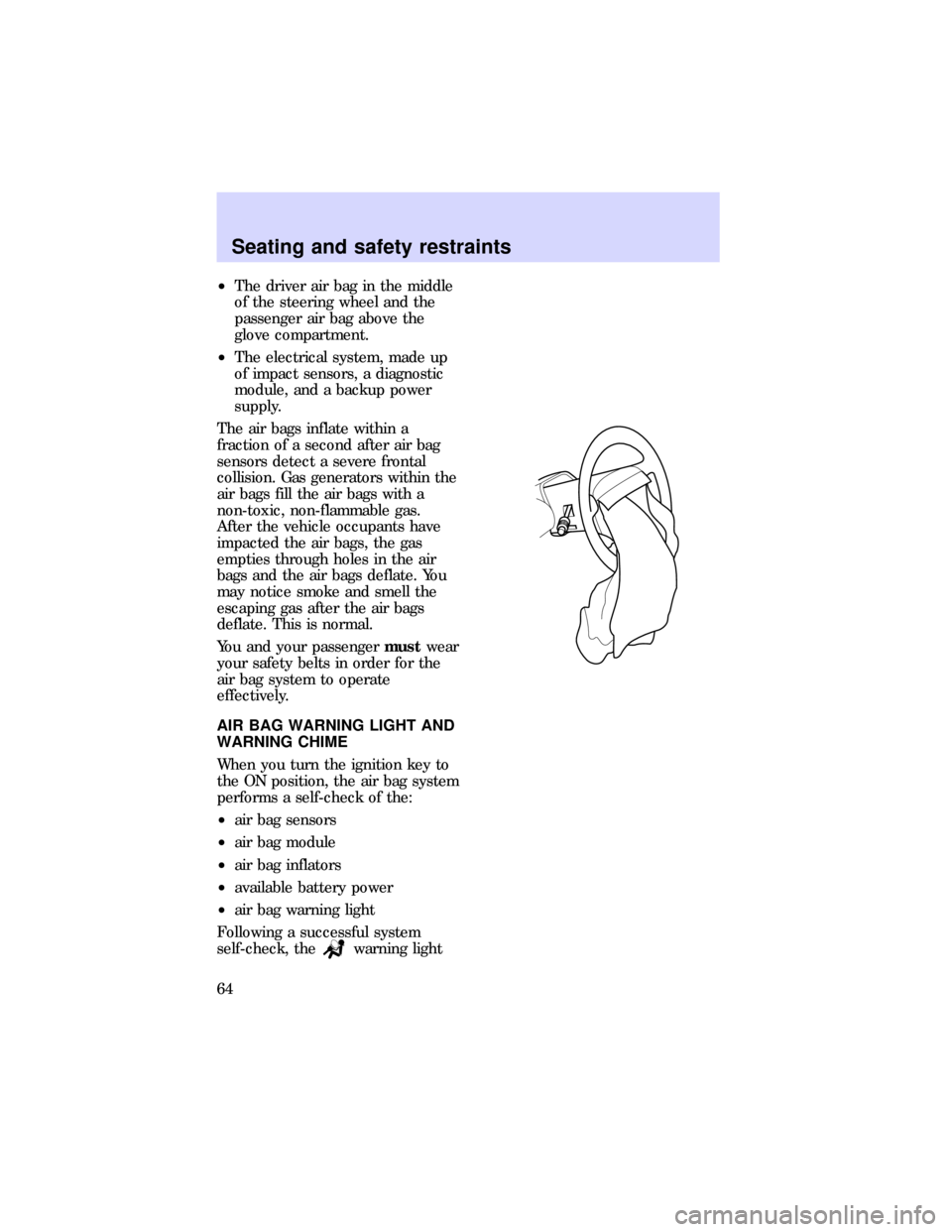
²The driver air bag in the middle
of the steering wheel and the
passenger air bag above the
glove compartment.
²The electrical system, made up
of impact sensors, a diagnostic
module, and a backup power
supply.
The air bags inflate within a
fraction of a second after air bag
sensors detect a severe frontal
collision. Gas generators within the
air bags fill the air bags with a
non-toxic, non-flammable gas.
After the vehicle occupants have
impacted the air bags, the gas
empties through holes in the air
bags and the air bags deflate. You
may notice smoke and smell the
escaping gas after the air bags
deflate. This is normal.
You and your passengermustwear
your safety belts in order for the
air bag system to operate
effectively.
AIR BAG WARNING LIGHT AND
WARNING CHIME
When you turn the ignition key to
the ON position, the air bag system
performs a self-check of the:
²air bag sensors
²air bag module
²air bag inflators
²available battery power
²air bag warning light
Following a successful system
self-check, the
warning light
Seating and safety restraints
64
Page 88 of 191
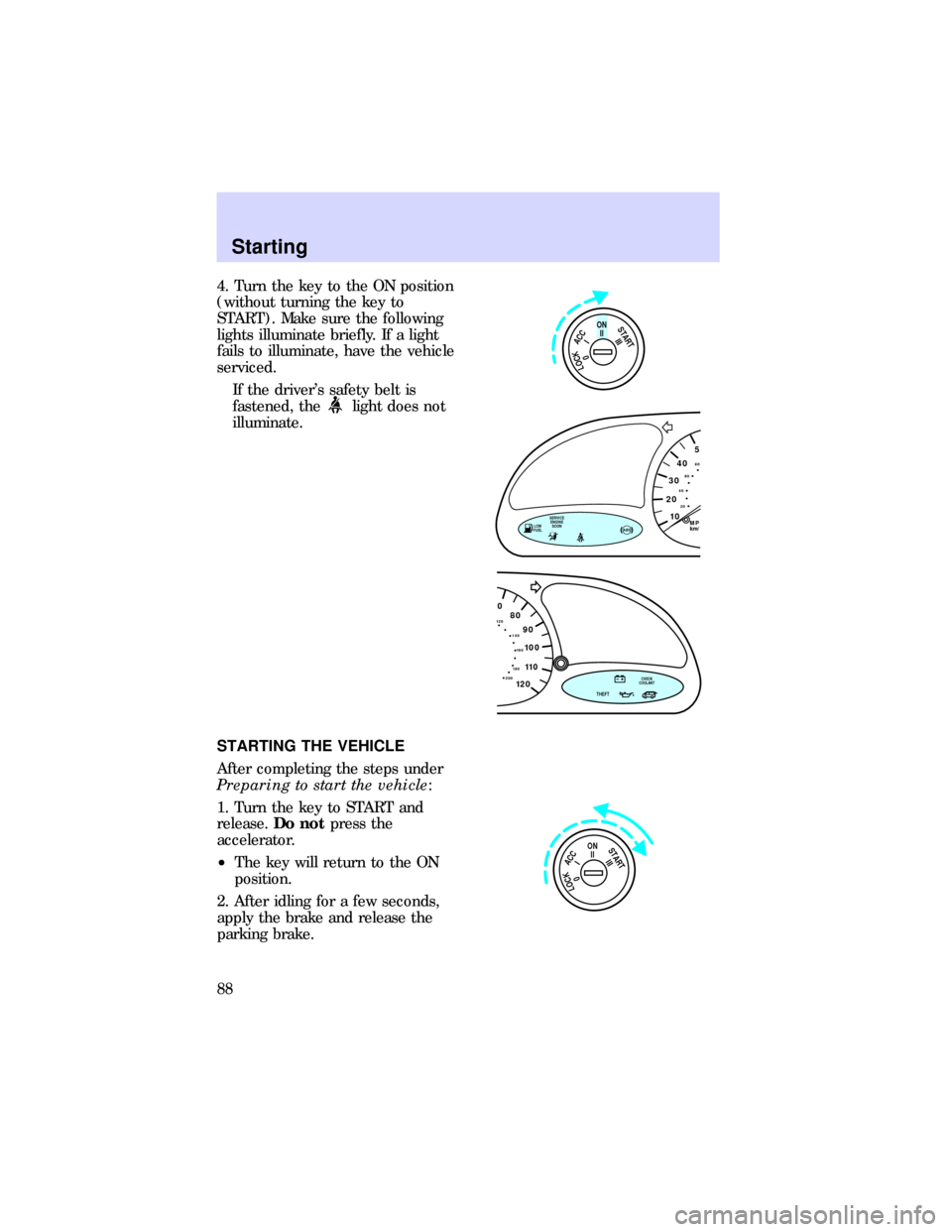
4. Turn the key to the ON position
(without turning the key to
START). Make sure the following
lights illuminate briefly. If a light
fails to illuminate, have the vehicle
serviced.
If the driver's safety belt is
fastened, the
light does not
illuminate.
STARTING THE VEHICLE
After completing the steps under
Preparing to start the vehicle:
1. Turn the key to START and
release.Do notpress the
accelerator.
²The key will return to the ON
position.
2. After idling for a few seconds,
apply the brake and release the
parking brake.
ON
II
ACC
I
LOCK
0
START
III
MP
km/10 203040520 4060
80
SERVICE
ENGINE
SOON
LOW
FUELABS
0
80
90
10 0
12 011 012 0
16 0
18 0 140
200
CHECK
COOLANTTHEFT
ON
II
ACC
I
LOCK
0
START
III
Starting
88
Page 89 of 191

Special conditions when
starting
Starting a cold engine
At temperatures -12ÉC (10ÉF) and
below, do not hold the key in the
START position longer than 15
seconds. If the engine does not
start on the first attempt:
1. Turn the ignition key to LOCK
and wait approximately ten
seconds.
2. Try starting the engine again.
At temperatures above -12ÉC
(10ÉF), do not hold the key in the
START position longer than five
seconds. If the engine does not
start on the first attempt:
1. Turn the ignition key to LOCK
and wait approximately five
seconds.
2. Try starting the engine again.
Starting a warm engine
Do not hold the key in the START
position longer than five seconds.
If the engine does not start on the
first attempt:
1. Turn the ignition key to LOCK
and wait a few seconds until the
starter stops.
2. Try starting the engine again.
Starting the engine after two
failed attempts
If the engine does not start after
two attempts:
1. Turn the key to LOCK and wait
about two minutes.
Starting
89
Page 90 of 191

2. Press the accelerator all the way
to the floor and hold.
3. Turn the key to START. Release
it once the engine starts.
4. Release the accelerator
gradually as the engine speeds up.
If the engine still does not start,
refer toFuel pump shut-off
switchin theRoadside
emergencieschapter.
Using the engine block heater
(if equipped)
Engine block heaters are strongly
recommended if you live in a
region where temperatures
consistently reach -29ÉC (-20ÉF) or
below during the winter months.
An engine block heater warms the
engine coolant, which improves
starting, warms up the engine
faster, and allows the
heater-defrost system to respond
quickly.
If your vehicle is equipped with an
engine block heater, use it
whenever the temperature is -23ÉC
(-10ÉF) or below.
To turn the heater on, plug it into
a grounded 110-volt outlet. It is
recommended that you use a
110-volt circuit that is protected
by a Ground Fault Circuit
Interrupter.
For best results, plug the heater in
at least three hours before you
start your vehicle. Using the heater
for longer than three hours will not
damage the engine, so you can
Starting
90
Page 112 of 191

Number Fuse amperage
ratingCircuits protected
9 Meter 10 amp Backup lamps, shift
lock, gauges, speed
control, turn signals,
key-in-ignition
reminder chime
10 Wiper 20 amp Windshield wipers
and washer
11 (Rear wiper) 10 amp Rear wiper and
washer
12 Hazard 15 amp Hazard flashers, turn
signals
13 Room 10 amp Clock, interior lamp,
luggage compartment
lamp, safety belt
warning chime, radio
power
14 Engine 15 amp Engine control system
15 Mirrors 5 amp Power mirrors
16 Ð Ð Not used
17 Ð Ð Not used
18 (Fog) 10 amp Daytime running
lamps / fog lamps
19 Ð Ð Not used
20 Cigar 20 amp Cigar lighter
21 (Radio) 15 amp Radio (Premium
sound)
Roadside emergencies
112
Page 125 of 191
²Never get under a vehicle that is
supported only by a jack. If you
must work under a vehicle, use
safety stands.
²Keep all lit cigarettes and other
smoking materials away from
the battery and all fuel-related
parts.
Working with the engine off
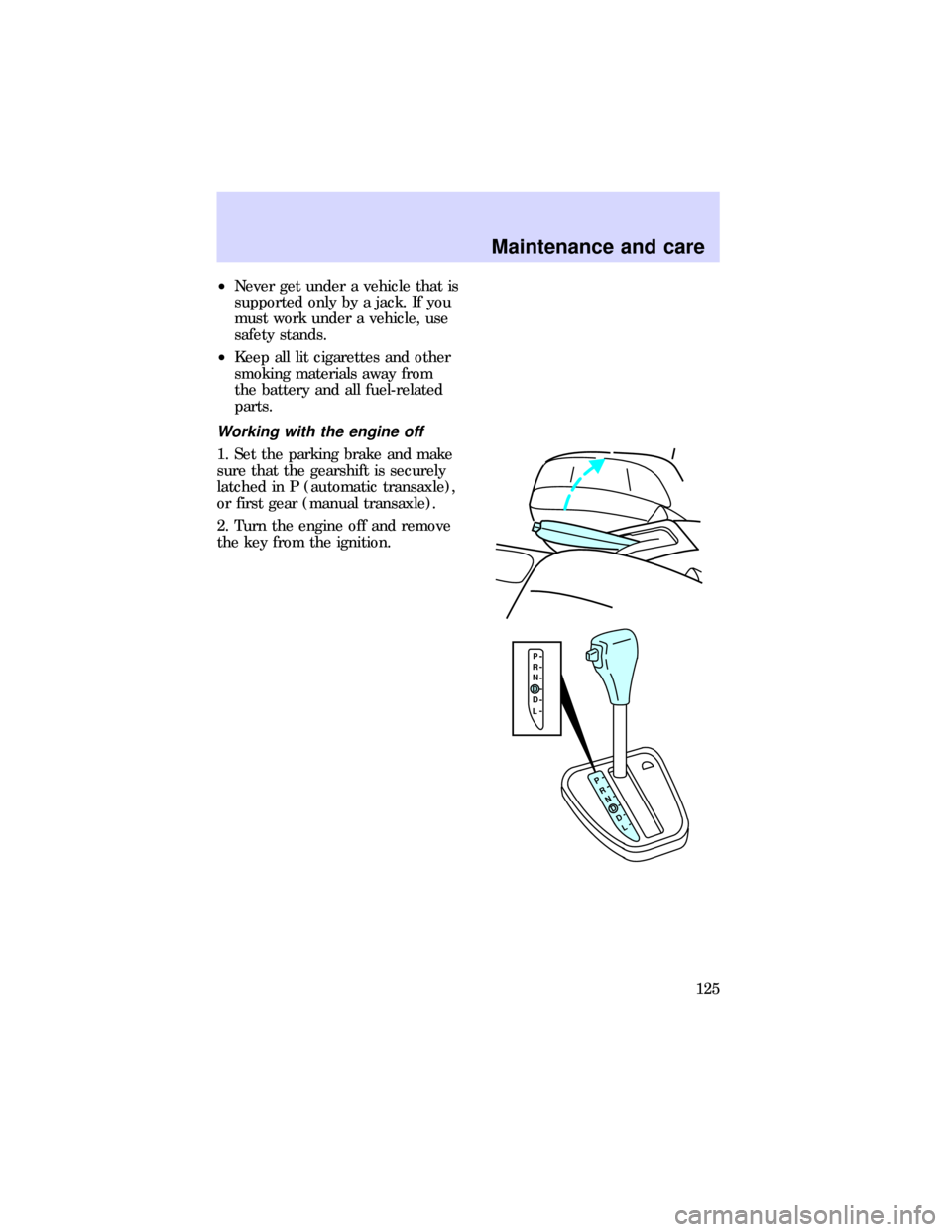
1. Set the parking brake and make
sure that the gearshift is securely
latched in P (automatic transaxle),
or first gear (manual transaxle).
2. Turn the engine off and remove
the key from the ignition.
P
R
N
D
D
L
R
N
D
D
LP
Maintenance and care
125
Page 190 of 191

head restraints ..........................54
split-folding rear seat ...............54
Servicing your vehicle
precautions when servicing ...124
servicing when you tow .........105
Special driving conditions ..........89
Specification chart, lubricants .180
Speed control ..............................27
Starting your vehicle ..................88
preparing to start your
vehicle .......................................86
starting a cold engine ..............89
starting a warm engine ............89
Steering wheel
tilting .........................................29
Tail lamps
bulb replacement .............167,168
Tilt steering wheel ......................29
Tire types ..................................152
Tires ...........................................148
changing ..................................114
checking the pressure ............150
replacing ..................................151
rotating ....................................151
snow tires and chains ............152
tire grades ...............................148
treadwear ................................148
Trailer towing ............................102
safety chains ...........................104
tips ...........................................105
trailer brakes ...........................104
trailer lamps ............................104
Transaxle .....................................96
fluid, checking and adding
(automatic) .............................139
Turn signal
indicator lights ............................9
Upshift indicator light ...........8,100
Upshift speeds ..........................100
Vehicle dimensions ...................182
Vehicle headlamp aiming
device (VHAD) .........................173Vehicle Identification Number
(VIN) ..........................................185
Ventilating your vehicle (see
Climate control) ................18,19,23
Warning chimes ...........................10
headlamps on ............................11
key in ignition ...........................11
safety belt .................................10
Washer fluid ..............................134
reservoir ..................................135
windshield .................................30
Windows
one-touch down ........................35
power windows, operating .......34
Windshield
washing ......................................30
Windshield washer fluid and
wipers
checking and adding fluid .....134
checking and replacing wiper
blades ......................................146
liftgate reservoir .....................135
operation ...................................30
Wrecker towing .........................123
Index
190