light FORD ESCORT 1998 7.G Owner's Manual
[x] Cancel search | Manufacturer: FORD, Model Year: 1998, Model line: ESCORT, Model: FORD ESCORT 1998 7.GPages: 191, PDF Size: 1.51 MB
Page 106 of 191
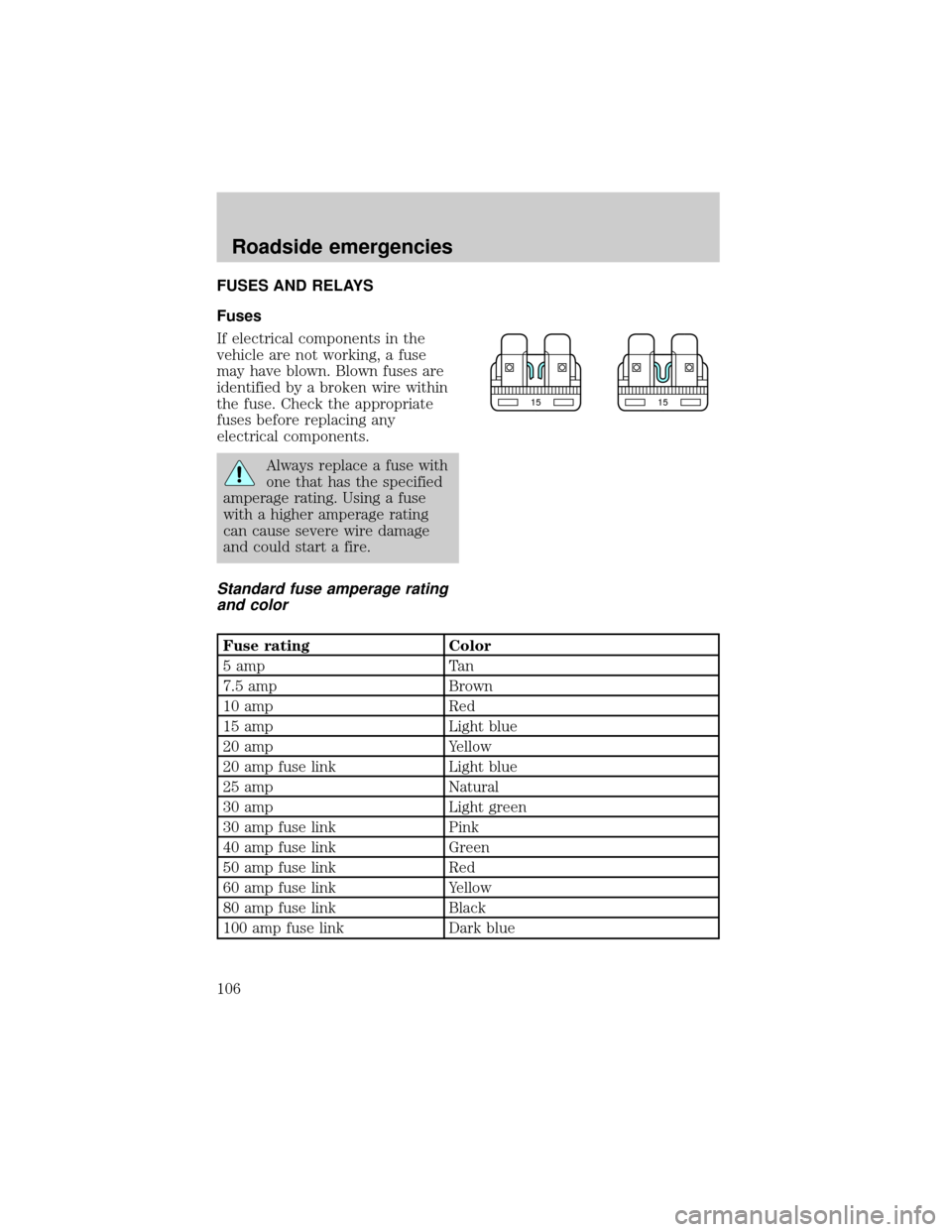
FUSES AND RELAYS
Fuses
If electrical components in the
vehicle are not working, a fuse
may have blown. Blown fuses are
identified by a broken wire within
the fuse. Check the appropriate
fuses before replacing any
electrical components.
Always replace a fuse with
one that has the specified
amperage rating. Using a fuse
with a higher amperage rating
can cause severe wire damage
and could start a fire.
Standard fuse amperage rating
and color
Fuse rating Color
5 amp Tan
7.5 amp Brown
10 amp Red
15 amp Light blue
20 amp Yellow
20 amp fuse link Light blue
25 amp Natural
30 amp Light green
30 amp fuse link Pink
40 amp fuse link Green
50 amp fuse link Red
60 amp fuse link Yellow
80 amp fuse link Black
100 amp fuse link Dark blue
1515
Roadside emergencies
106
Page 108 of 191
Fuse/Relay
LocationFuse Amp
RatingDescription
METER 10A Backup Lamps, Engine Coolant
Level Switch, Instrument Cluster,
Rear Window Defrost, Shift Lock,
Warning Chime, Turn Signal
Switch
WIPER 20A Wiper/Washer, Blower Motor Relay
STOP 20A Stop Lamps, Brake Pressure
Switch
TAIL 15A Exterior Lamps, Instrument
Illumination
SUN ROOF 15A Power Moonroof
ASC 10A Speed Control
P. WINDOW 30A CB Power Windows
CIGAR 20A Cigar Lighter
AIR BAG 10A Air Bags
FOG 10A Fog Lamps, Daytime Running
Lamps (DRL)
AUDIO 15A Premium Sound Amplifier, CD
Changer
FUEL INJ. 10A H02S, Evaporative Emission
Purge Flow Sensor
BLOWER 30A CB Blower Motor Relay
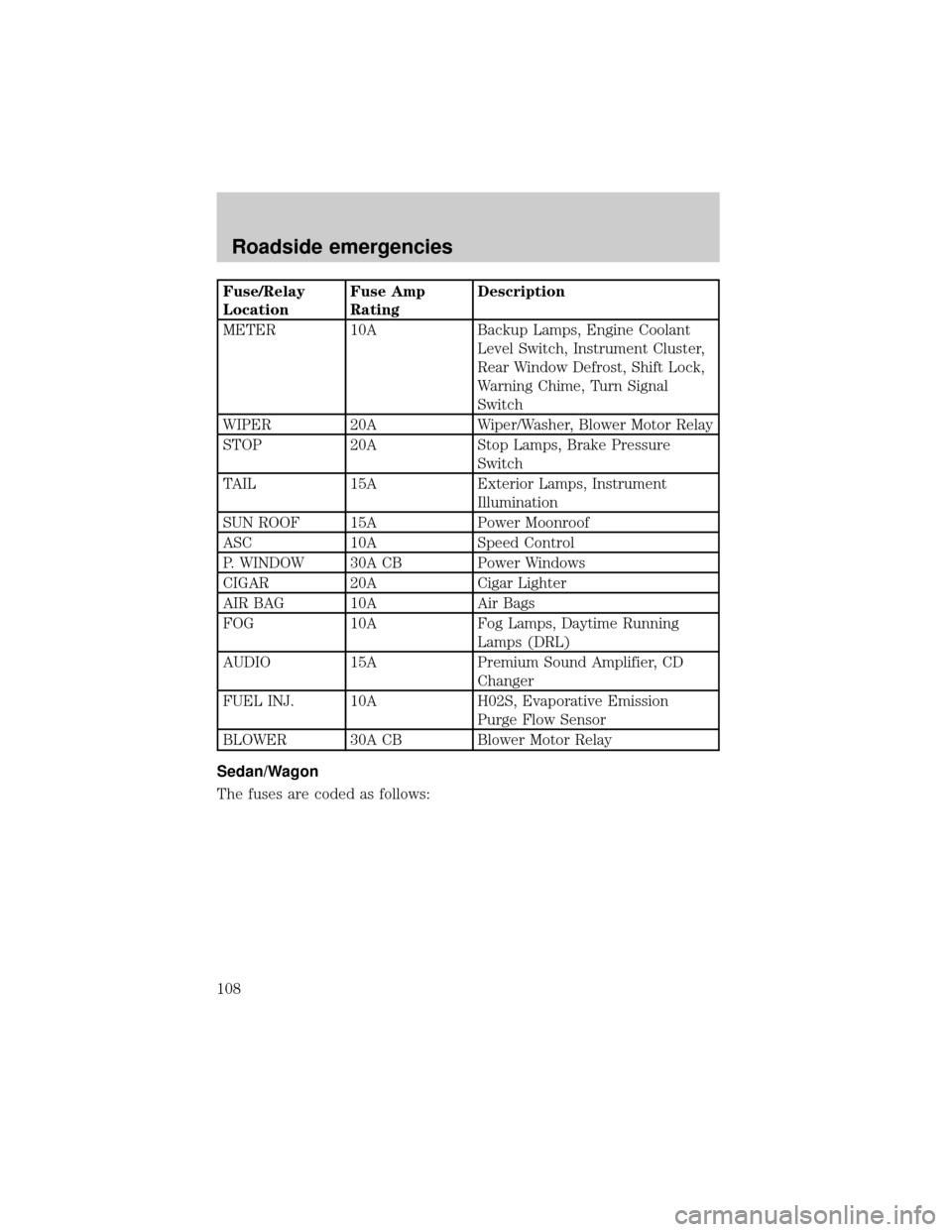
Sedan/Wagon
The fuses are coded as follows:
Roadside emergencies
108
Page 110 of 191
Fuse/Relay
LocationFuse Amp
RatingDescription
METER 10A Backup Lamps, Engine Controls,
Instrument Cluster, Rear Window
Defrost, Shift Lock, Warning
Chime, Turn Signal Switch
WIPER 20A Wiper/Washer, Blower Relay
STOP 15A Stop Lamps
TAIL 15A Exterior Lamps, Instrument
Illumination
ASC 10A Speed Control
CIGAR 20A Cigar Lighter
AIR BAG 10A Joint Connector, Air Bag
Diagnostic Monitor
FOG 10A Fog Lamps, Daytime Running
Lamps (DRL)
AUDIO 15A Radio
FUEL
INJECTOR10A H02S, Evaporative Emission
Purge Flow Sensor
P. WINDOW 30A CB Power Windows
BLOWER 30A CB A/C-Heater
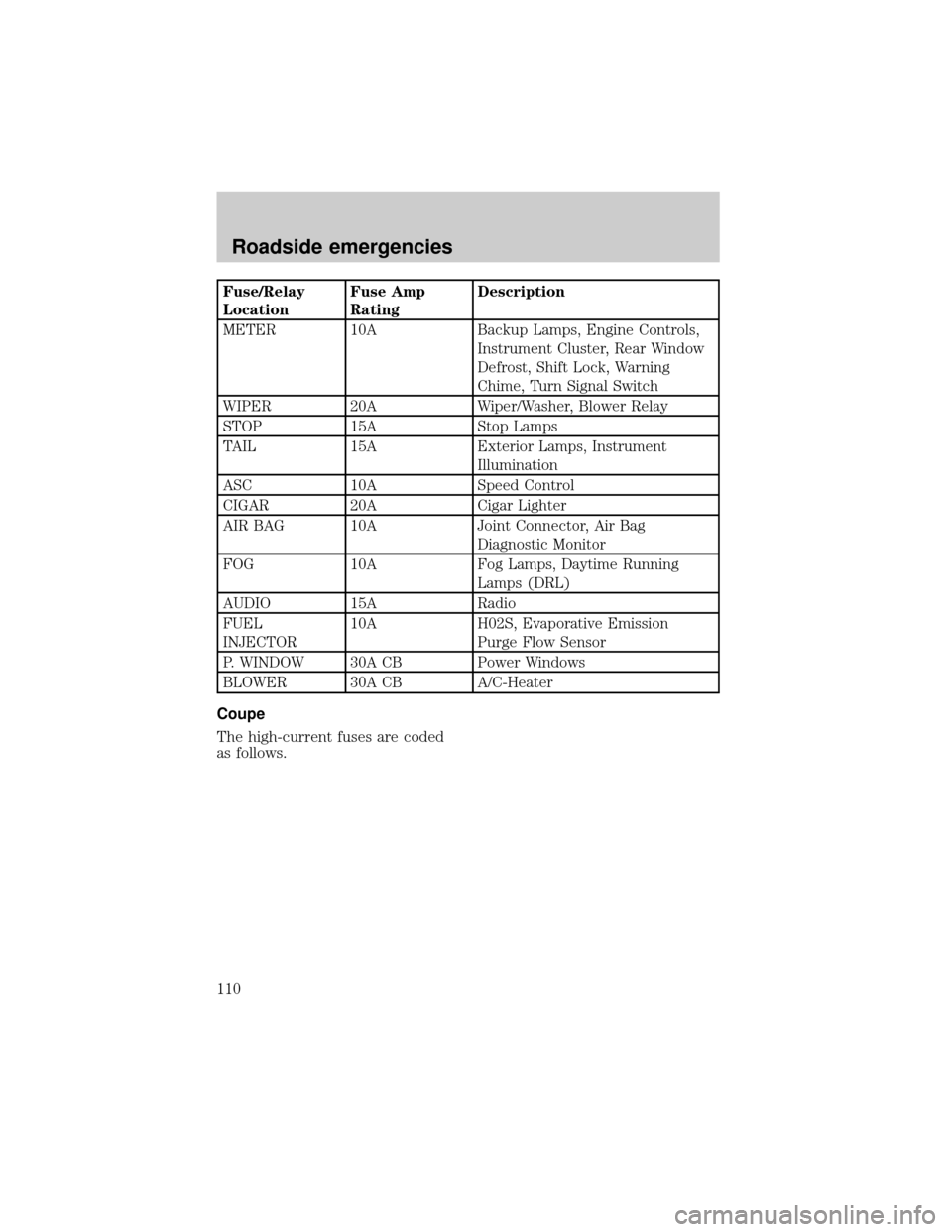
Coupe
The high-current fuses are coded
as follows.
Roadside emergencies
110
Page 123 of 191
SERVICE RECOMMENDATIONS
To help you service your vehicle:
²We highlight do-it-yourself items
in the engine compartment for
easy location.
²We provide a ªService Guideº
which makes tracking routine
service easy.
If your vehicle requires
professional service, your
dealership can provide necessary
parts and service. Check your
ªWarranty Guideº to find out which
parts and services are covered.
Use only recommended fuels,
lubricants, fluids and service parts
conforming to specifications.
Motorcraft parts are designed and
built to provide the best
performance in your vehicle.
PRECAUTIONS WHEN
SERVICING YOUR VEHICLE
Be especially careful when
inspecting or servicing your
vehicle.
²Do not work on a hot engine.
The cooling fan is
automatic and may come
on at any time. Always
disconnect the negative terminal
of the battery before working
near the fan.
²When the engine is running,
avoid wearing loose clothing,
jewelry or long hair that could
get caught up in moving parts.
Maintenance and care
123
Page 137 of 191
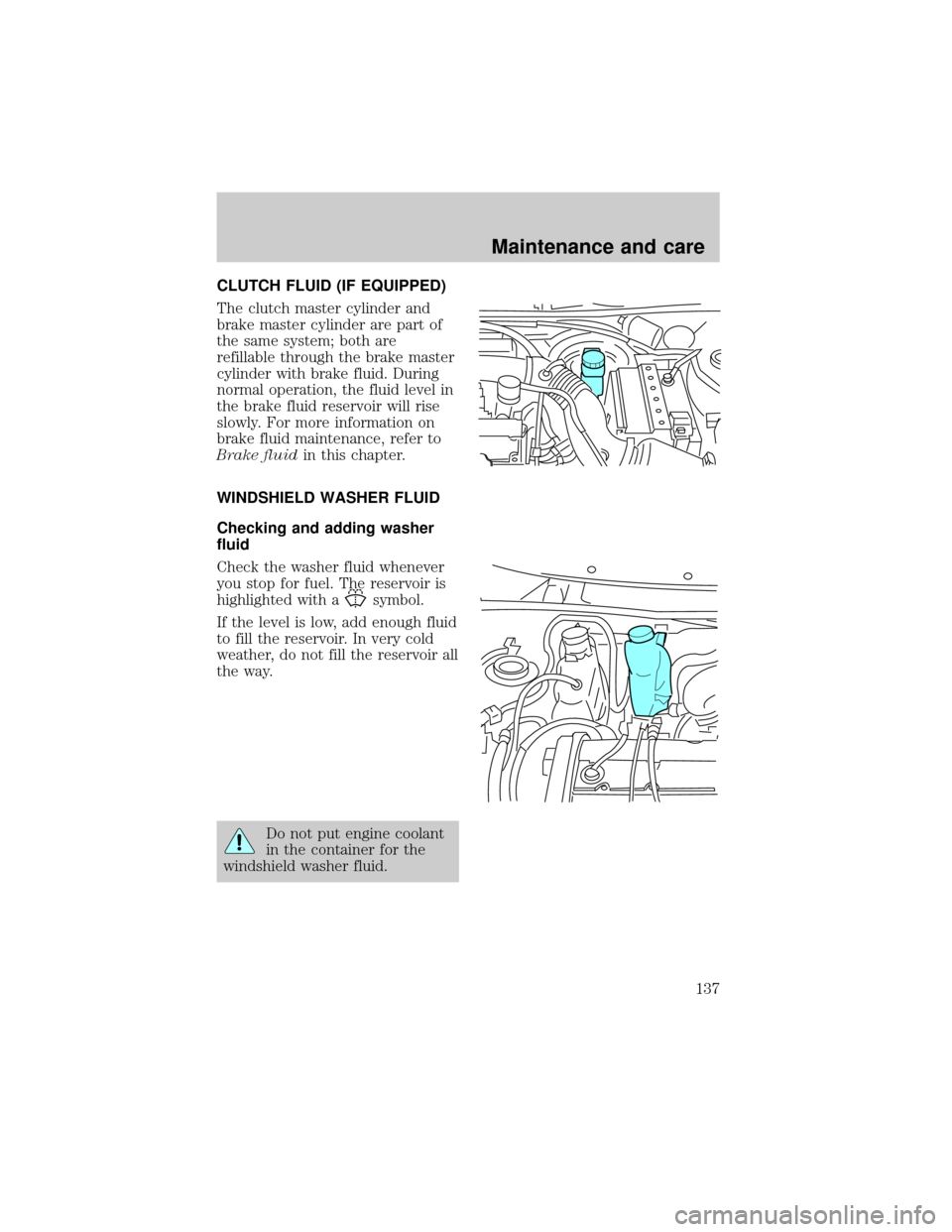
CLUTCH FLUID (IF EQUIPPED)
The clutch master cylinder and
brake master cylinder are part of
the same system; both are
refillable through the brake master
cylinder with brake fluid. During
normal operation, the fluid level in
the brake fluid reservoir will rise
slowly. For more information on
brake fluid maintenance, refer to
Brake fluidin this chapter.
WINDSHIELD WASHER FLUID
Checking and adding washer
fluid
Check the washer fluid whenever
you stop for fuel. The reservoir is
highlighted with a
symbol.
If the level is low, add enough fluid
to fill the reservoir. In very cold
weather, do not fill the reservoir all
the way.
Do not put engine coolant
in the container for the
windshield washer fluid.
Maintenance and care
137
Page 157 of 191
Your vehicle was not designed to
use fuel or fuel additives with
metallic compounds, including
manganese-based compounds
containing MMT.
Vehicles certified to California
emission standards (indicated on
the underhood Vehicle Emissions
Control Information label) are
designed to operate on California
reformulated gasolines. If
California reformulated gasoline is
not available when you refuel, your
vehicle can be operated on
non-California fuels. However, even
though your engine will perform
adequately on other gasolines, the
performance of the emission
control devices and systems may
be adversely affected.
Repair of damage caused by using
a fuel that your vehicle was not
designed for may not be covered
by your warranty.
Octane recommendations
Your vehicle is designed to use
regular unleaded with an (R+M)/2
octane rating of 87. We do not
recommend gasolines labeled as
ªregularº in high altitude areas that
are sold with octane ratings of 86
or even less.
Do not be concerned if your
vehicle sometimes knocks lightly.
However, if it knocks heavily under
most driving conditions on fuel
with the recommended octane, see
your dealer or a qualified service
87
Maintenance and care
157
Page 159 of 191
affect on modern powertrain
components.
You may need to crank the engine
several times before the system
starts to pump fuel from the tank
to the engine. If you run out of
fuel, your Service Engine Soon
light may come on. For more
information on the Service Engine
Soon light, refer to the
Instrumentationchapter.
Calculating fuel economy
To accurately calculate your
vehicle's fuel economy:
1. Fill the tank completely and
record the initial odometer
reading.
2. Each time you fill the tank,
record the amount of fuel added
(in liters or gallons).
3. After at least three to five fuel
tank fill-ups, fill the fuel tank and
record the current mileage
reading.
4. Use one of the following
equations to calculate fuel
economy.
Liters used x 1004Total
kilometers traveled
Total miles traveled4Total
gallons used
Keep a record for at least one
month. This will provide an
accurate estimate of the vehicle's
fuel economy.
Maintenance and care
159
Page 161 of 191
Do not park, idle, or drive
your vehicle in dry grass
or other dry ground cover. The
emission system heats up the
engine compartment and exhaust
system, which can start a fire.
Watch for fluid leaks, strange
odors, smoke, loss of oil pressure,
the charging system warning light,
the ªService Engine Soonº light or
the temperature warning light.
These events could indicate that
the emission control system is not
working properly.
If you smell exhaust fumes
of any kind inside your
vehicle, have the dealer inspect
and fix your vehicle immediately.
Do not drive if you smell exhaust
fumes. These fumes are harmful
and could kill you.
Do not make any unauthorized
changes to your vehicle or engine.
By law, vehicle owners and anyone
who manufactures, repairs,
services, sells, leases, trades
vehicles, or supervises a fleet of
vehicles are not permitted to
intentionally remove an emission
control device or prevent it from
working. Information about your
vehicle's emission system is on the
Vehicle Emission Control
Information Decal located on or
near the engine. This decal
identifies engine displacement and
gives some tune up specifications.
Maintenance and care
161
Page 162 of 191
Please consult your ªWarranty
Guideº for complete emission
warranty information.
Readiness for
inspection/maintenance (I/M)
testing
In some localities, it may be a legal
requirement to pass an I/M test of
the on-board diagnostic (OBD-II)
system. If your ªcheck
engine/service engine soonº light is
on, reference the applicable light
description in theWarning Lights
and Chimessection of your
owners guide. Your vehicle may
not pass the I/M test with the
ªcheck engine/service engine soonº
light on.
If the vehicle's powertrain system
or its battery has just been
serviced, the OBD-II system is
reset to a ªnot ready for I/M testº
condition. To ready the OBD-II
system for I/M testing, a minimum
of 30 minutes of city and highway
driving is necessary as described
below:
²First, at least 10 minutes of
driving on an expressway or
highway.
²Next, at least 20 minutes driving
in stop and go, city type traffic
with at least four idle periods.
Allow the vehicle to sit for at least
eight hours without starting the
engine. Then, start the engine and
complete the above driving cycle.
The engine must warm up to its
normal operating temperature.
Maintenance and care
162
Page 163 of 191
Once started, do not turn off the
engine until the above driving
cycle is complete.
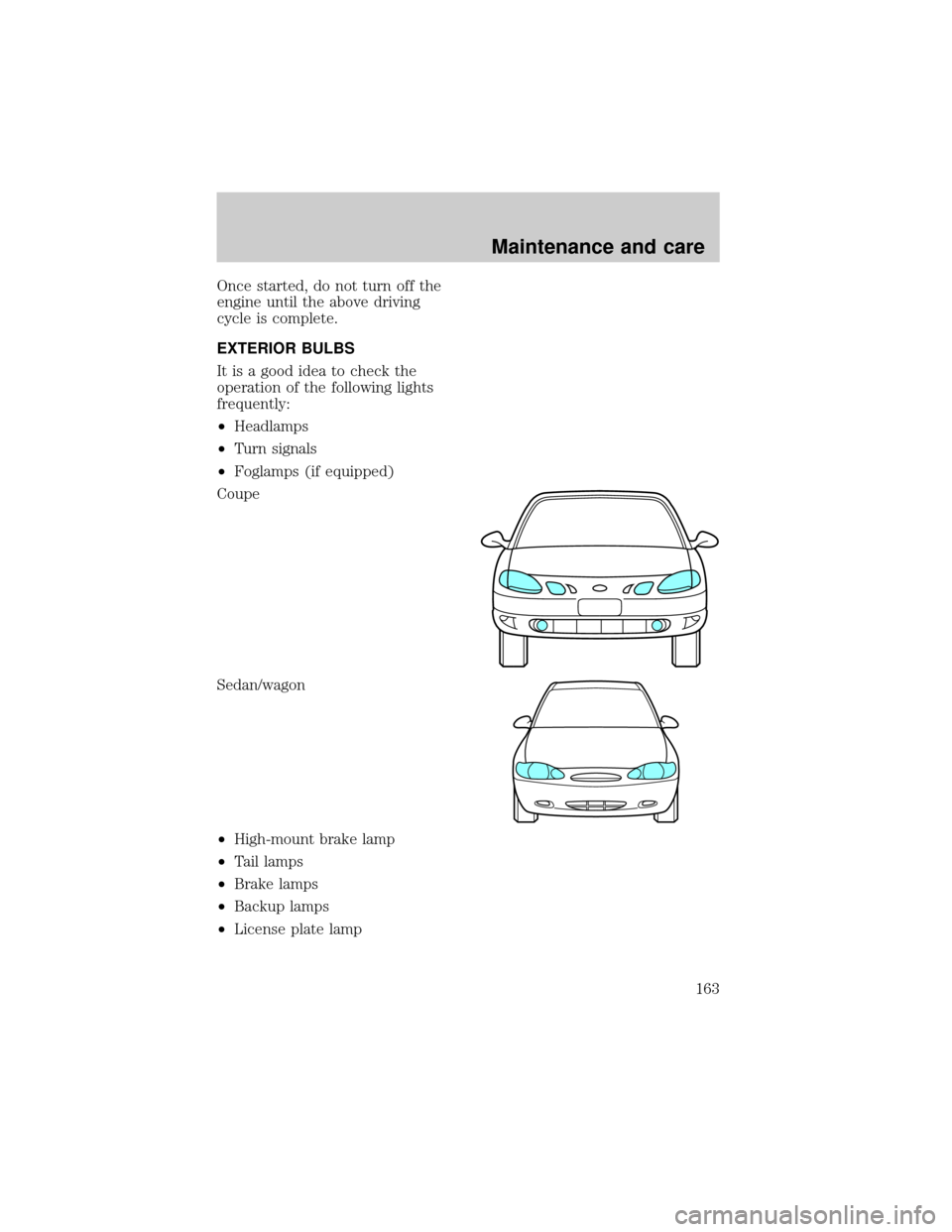
EXTERIOR BULBS
It is a good idea to check the
operation of the following lights
frequently:
²Headlamps
²Turn signals
²Foglamps (if equipped)
Coupe
Sedan/wagon
²High-mount brake lamp
²Tail lamps
²Brake lamps
²Backup lamps
²License plate lamp
Maintenance and care
163