maintenance FORD ESCORT 1998 7.G Owner's Manual
[x] Cancel search | Manufacturer: FORD, Model Year: 1998, Model line: ESCORT, Model: FORD ESCORT 1998 7.GPages: 191, PDF Size: 1.51 MB
Page 134 of 191
Adding engine oil
1. Check the engine oil. For
instructions, refer toChecking the
engine oilin this chapter.
2. If the fluid level is not within
the normal range, add only
certified engine oil of the preferred
viscosity. Add engine oil through
the oil filler cap. Remove the filler
cap and use a funnel to pour oil in
the opening.
3. Recheck the oil level. Make sure
the oil level is not above the F in
FULL mark on the dipstick.
Engine oil recommendations
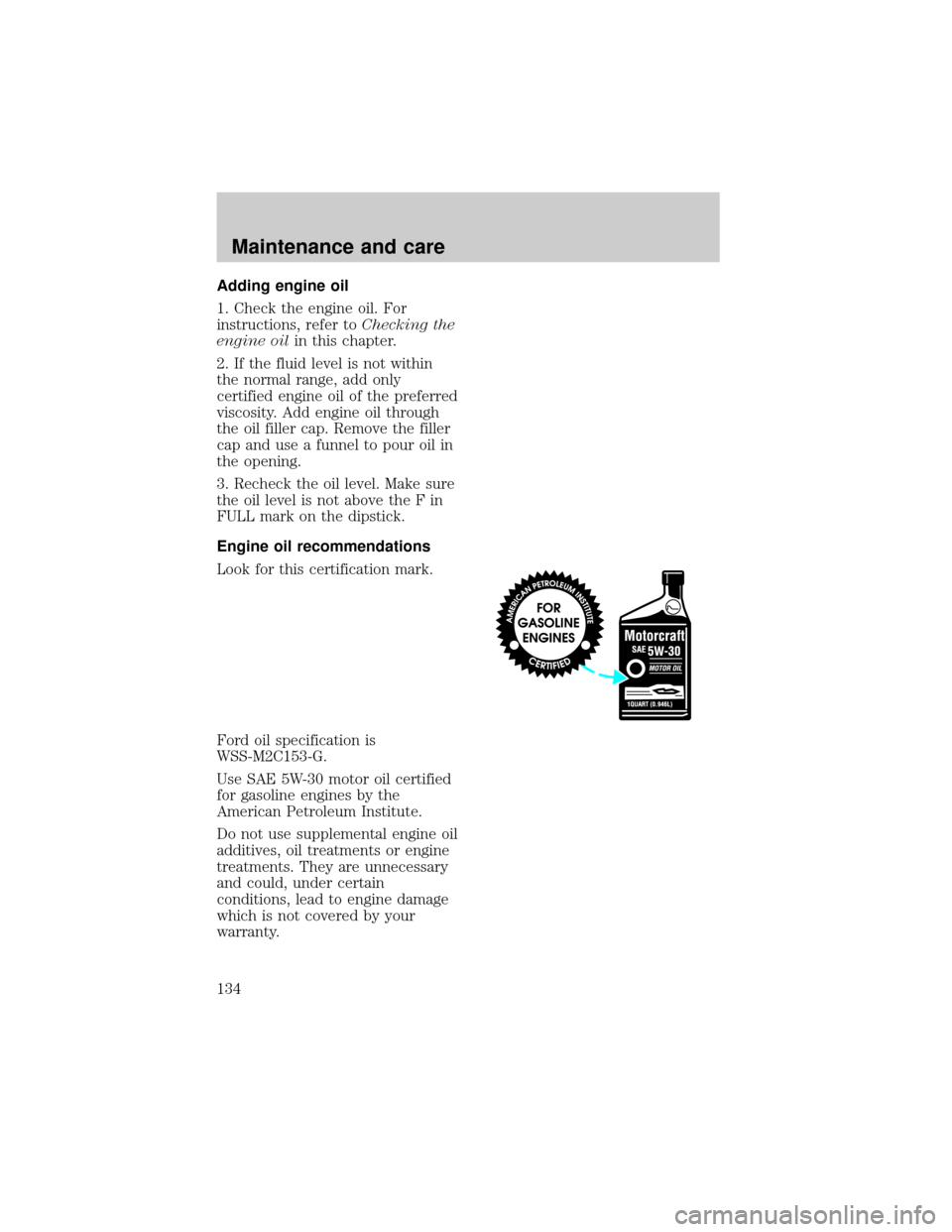
Look for this certification mark.
Ford oil specification is
WSS-M2C153-G.
Use SAE 5W-30 motor oil certified
for gasoline engines by the
American Petroleum Institute.
Do not use supplemental engine oil
additives, oil treatments or engine
treatments. They are unnecessary
and could, under certain
conditions, lead to engine damage
which is not covered by your
warranty.
Maintenance and care
134
Page 135 of 191
Changing the engine oil and
filter
Change your engine oil and filter
according to the following mileage
and time requirements, whichever
occurs first:
²Normal Schedule ± 8,000 km
(5,000 miles) or six months.
²Severe Duty Schedule -
5,000 km (3,000 miles) or three
months. Severe duty operation
would include extensive idling,
trailer towing, driving in severe
dust and police, taxi or delivery
service.
Ford production and aftermarket
(Motorcraft) oil filters are designed
for added engine protection and
long life. If a replacement oil filter
is used that does not meet Ford
material and design specifications,
startup engine noises or knock
may be experienced.
It is recommended you use the
appropriate Motorcraft oil filter (or
another brand meeting Ford
specifications) for your engine
application.
Maintenance and care
135
Page 136 of 191
BRAKE FLUID
Checking and adding brake
fluid
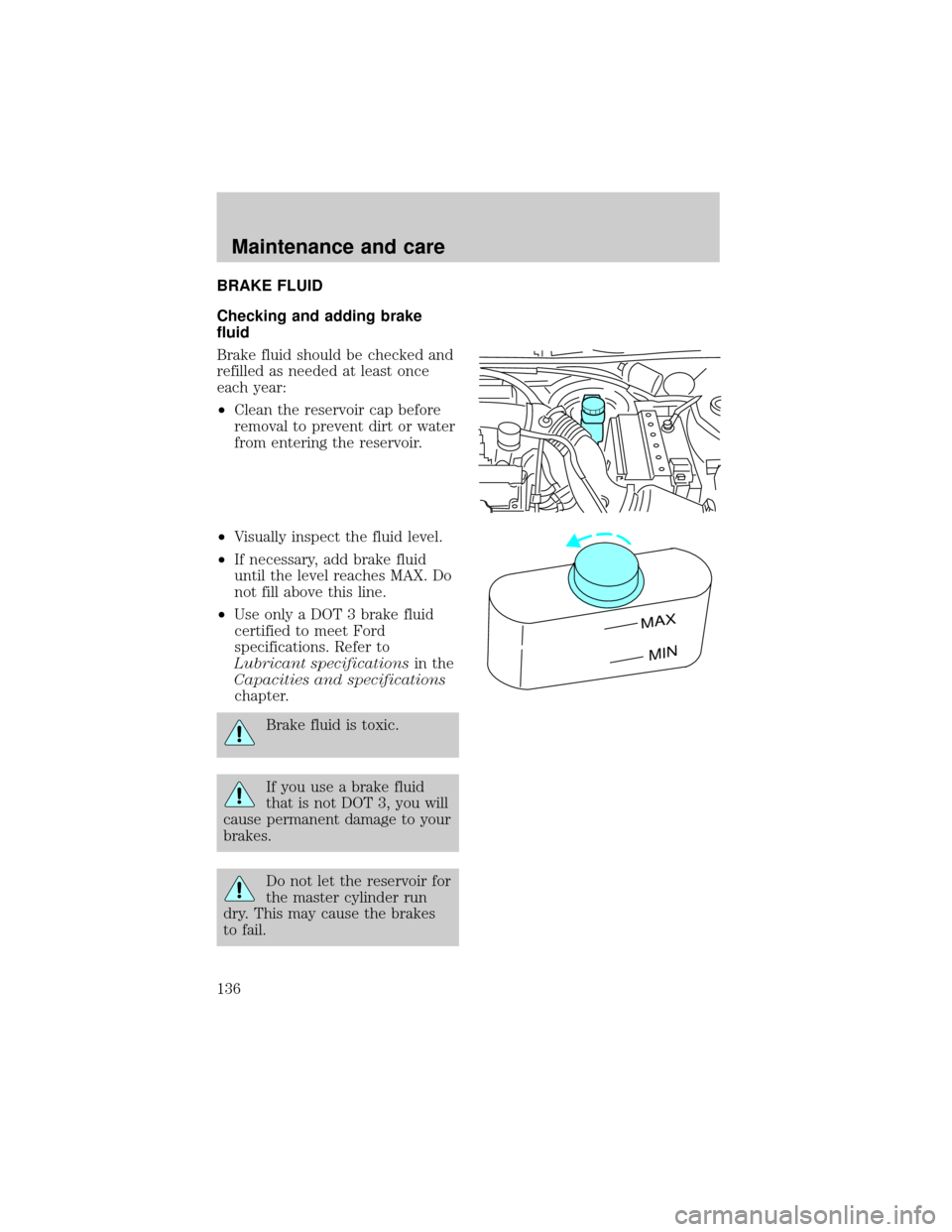
Brake fluid should be checked and
refilled as needed at least once
each year:
²Clean the reservoir cap before
removal to prevent dirt or water
from entering the reservoir.
²Visually inspect the fluid level.
²If necessary, add brake fluid
until the level reaches MAX. Do
not fill above this line.
²Use only a DOT 3 brake fluid
certified to meet Ford
specifications. Refer to
Lubricant specificationsin the
Capacities and specifications
chapter.
Brake fluid is toxic.
If you use a brake fluid
that is not DOT 3, you will
cause permanent damage to your
brakes.
Do not let the reservoir for
the master cylinder run
dry. This may cause the brakes
to fail.
MAX
MIN
Maintenance and care
136
Page 137 of 191
CLUTCH FLUID (IF EQUIPPED)
The clutch master cylinder and
brake master cylinder are part of
the same system; both are
refillable through the brake master
cylinder with brake fluid. During
normal operation, the fluid level in
the brake fluid reservoir will rise
slowly. For more information on
brake fluid maintenance, refer to
Brake fluidin this chapter.
WINDSHIELD WASHER FLUID
Checking and adding washer
fluid
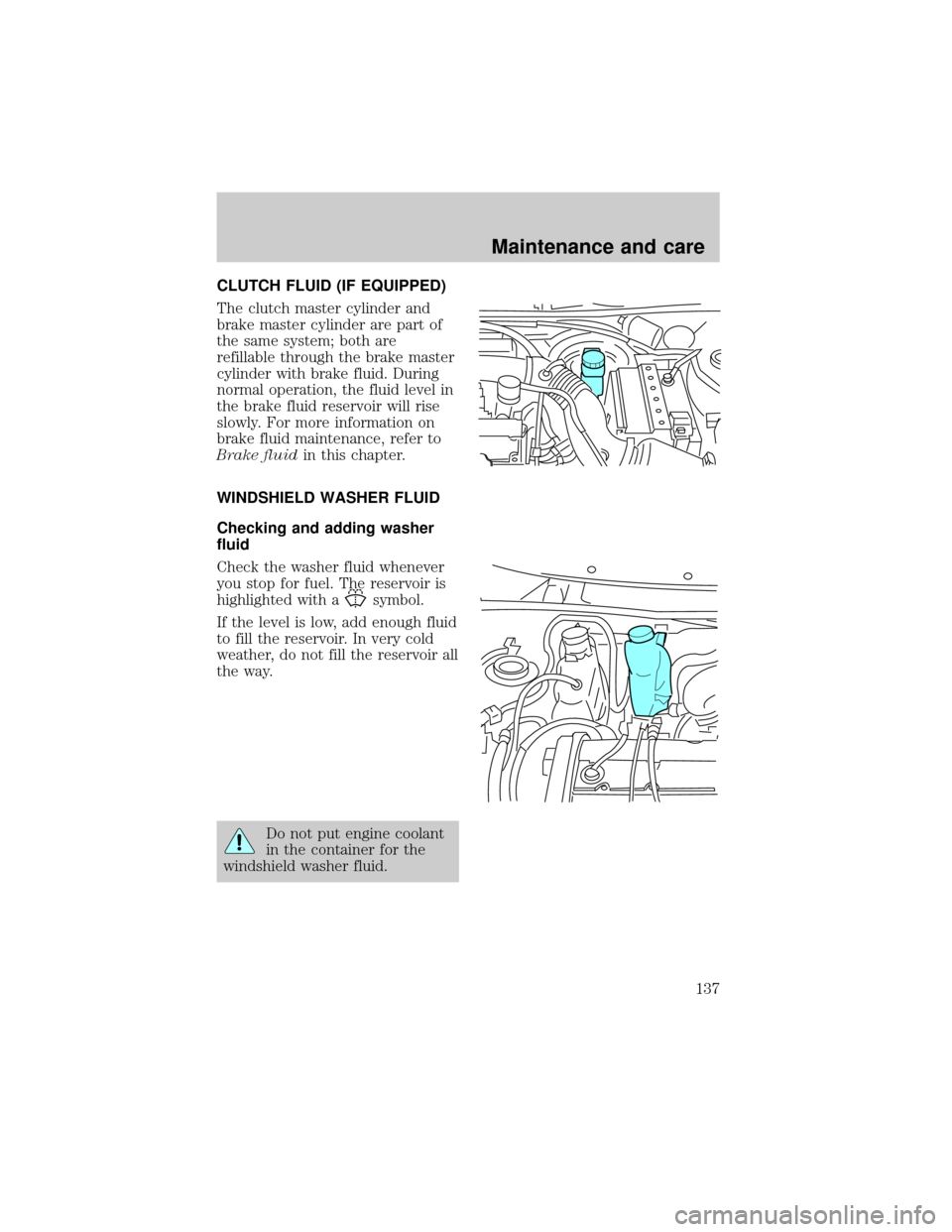
Check the washer fluid whenever
you stop for fuel. The reservoir is
highlighted with a
symbol.
If the level is low, add enough fluid
to fill the reservoir. In very cold
weather, do not fill the reservoir all
the way.
Do not put engine coolant
in the container for the
windshield washer fluid.
Maintenance and care
137
Page 138 of 191
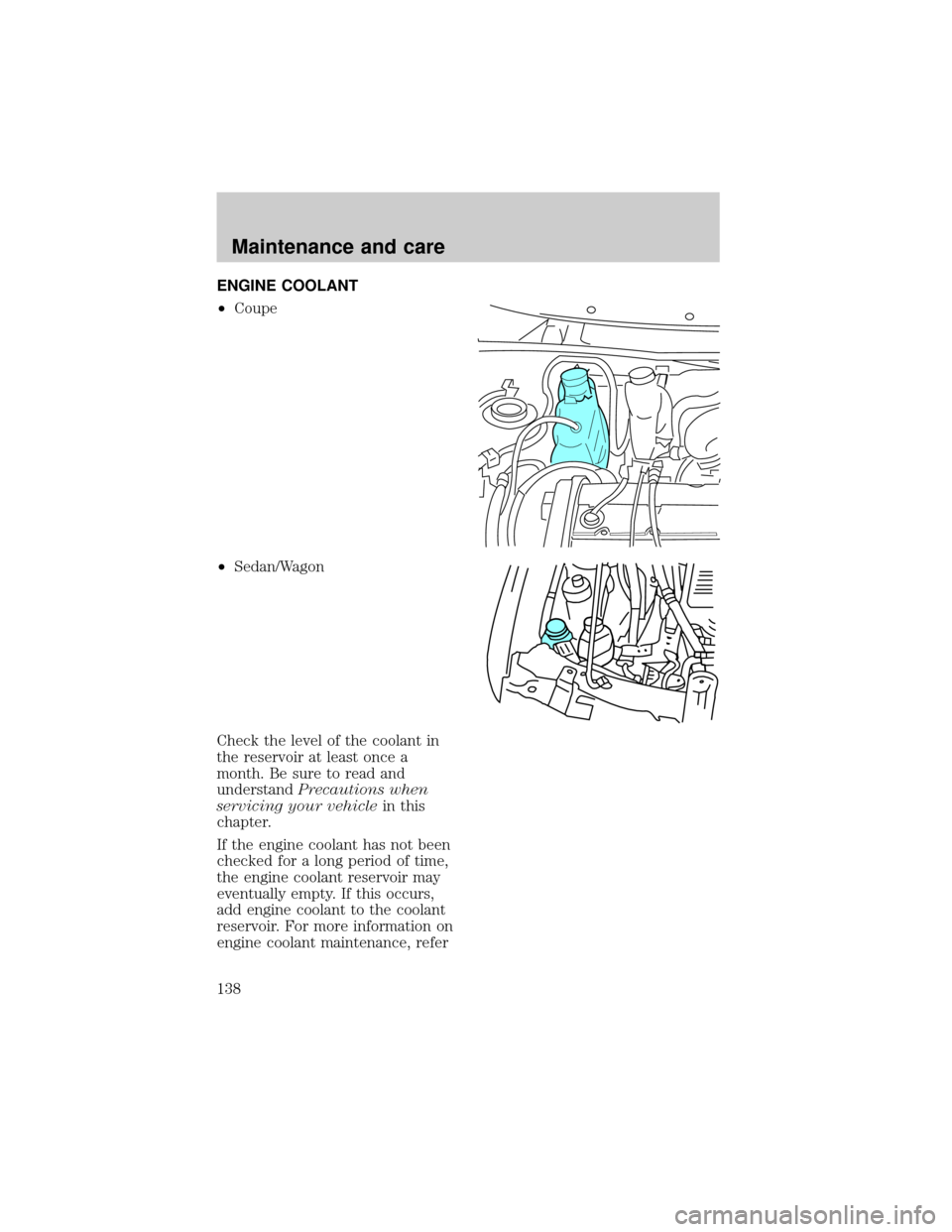
ENGINE COOLANT
²Coupe
²Sedan/Wagon
Check the level of the coolant in
the reservoir at least once a
month. Be sure to read and
understandPrecautions when
servicing your vehiclein this
chapter.
If the engine coolant has not been
checked for a long period of time,
the engine coolant reservoir may
eventually empty. If this occurs,
add engine coolant to the coolant
reservoir. For more information on
engine coolant maintenance, refer
Maintenance and care
138
Page 139 of 191
toAdding engine coolantin this
chapter.
Automotive fluids are not
interchangeable; do not use engine
coolant, antifreeze or windshield
washer fluid outside of its specified
function and vehicle location.
Adding engine coolant
Do not put engine coolant
in the container for the
windshield washer fluid.
If sprayed on the windshield,
engine coolant could make it
difficult to see through the
windshield.
When the engine is cool, add a
50/50 mixture of engine coolant
and water to the engine coolant
recovery reservoir-DO NOT ADD
DIRECTLY TO THE RADIATOR.
Add straight water only in an
emergency, but you should replace
it with a 50/50 mixture of coolant
and distilled water as soon as
possible.
Check the coolant level in the
coolant recovery reservoir the next
few times you drive the vehicle. If
necessary, add enough of a 50/50
mixture of coolant and water to
bring the liquid level to the fill line
on the reservoir.
Never remove the coolant
recovery cap while the
engine is running or hot.
Maintenance and care
139
Page 140 of 191
If you must remove the coolant
recovery cap, follow these steps to
avoid personal injury:
1. Before you remove the cap, turn
the engine off and let it cool.
2. When the engine is cool, wrap a
thick cloth around the cap. Slowly
turn cap counterclockwise to the
first stop.
3. Step back while the pressure
releases.
4. When you are sure that all the
pressure has been released, use
the cloth to press the cap down,
turn it counterclockwise and
remove it.
Use Ford Premium Cooling System
Fluid E2FZ-19549±AA (in Canada,
Motorcraft CXC-8±B) or an
equivalent premium engine coolant
that meets Ford specification
ESE-M97B44±A. Ford Premium
Engine Coolant is an optimized
formula that will protect all metals
and rubber elastomers used in
Ford cooling systems for four years
or 80,000 km (50,000 miles).
Do not use alcohol or methanol
antifreeze or any engine coolants
mixed with alcohol or methanol
antifreeze. Do not use
supplemental coolant additives in
your vehicle. These additives may
harm your engine cooling system.
The use of an improper coolant
may void your warranty of your
vehicle's engine cooling system.
Maintenance and care
140
Page 141 of 191
Recycled engine coolant
Ford Motor Company recommends
that Ford and Lincoln-Mercury
dealers use recycled engine
coolant produced by
Ford-approved processes. Not all
coolant recycling processes
produce coolant which meets Ford
specification ESE-M97B44±A, and
use of such coolant may harm
engine and cooling system
components.
Always dispose of used
automotive fluids in a responsible
manner. Follow your community's
regulations and standards for
recycling and disposing of
automotive fluids.
Coolant refill capacity
To find out how much fluid your
vehicle's cooling system can hold,
refer toRefill capacitiesin the
Capacities and specifications
chapter.
Have your dealer check the engine
cooling system for leaks if you
have to add more than a liter
(quart) of engine coolant per
month.
Severe winter climate
If you drive in extremely cold
climates (less than ±36ÉC [±34ÉF]),
it may be necessary to increase the
coolant concentration above 50%.
Refer to the chart on the coolant
container to ensure the coolant
concentration in your vehicle is
Maintenance and care
141
Page 142 of 191
such that the coolant will not
freeze at the temperature level in
which you drive during winter
months. Never increase the engine
coolant concentration above 60%.
Leave a 50/50 mixture of engine
coolant and water in your vehicle
year-round in non-extreme
climates.
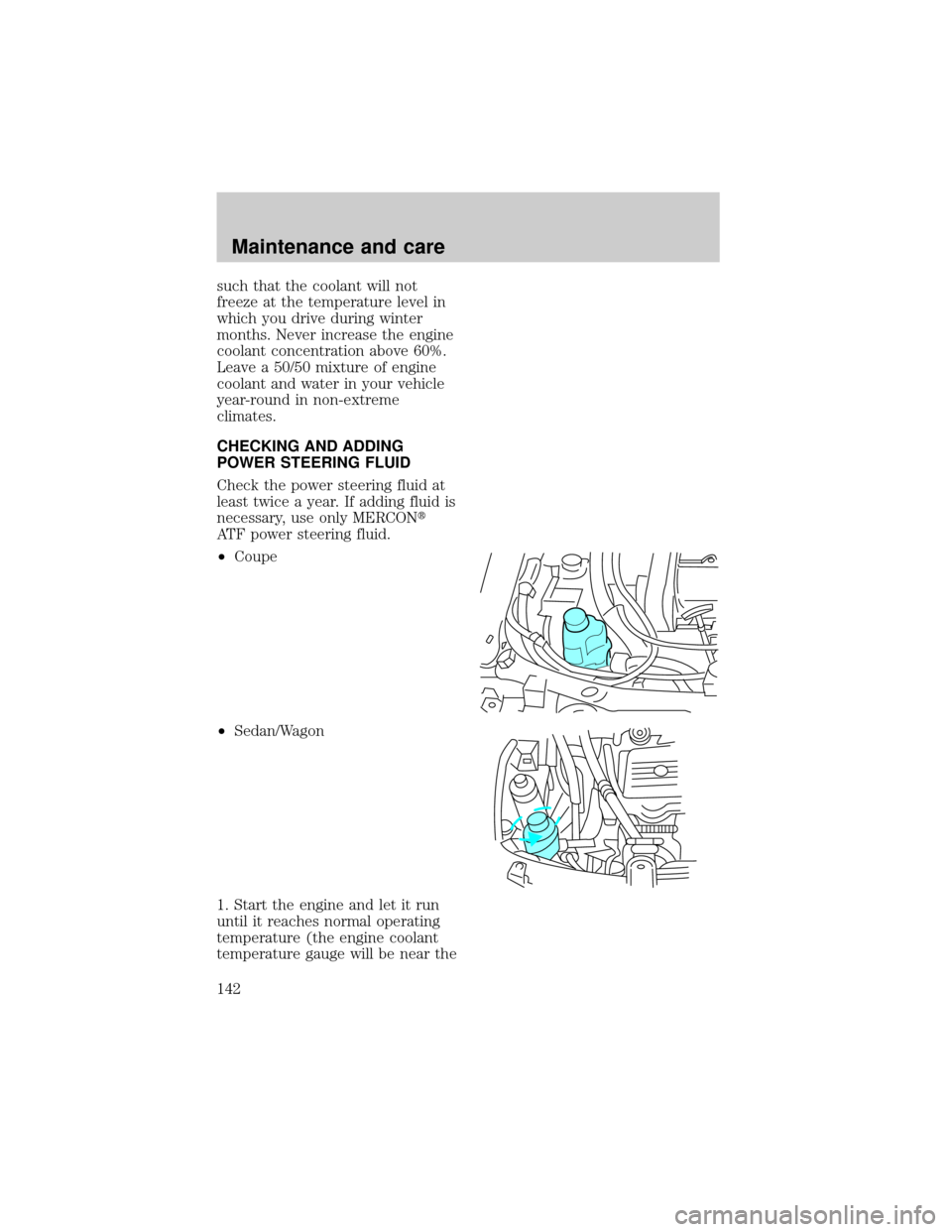
CHECKING AND ADDING
POWER STEERING FLUID
Check the power steering fluid at
least twice a year. If adding fluid is
necessary, use only MERCONt
ATF power steering fluid.
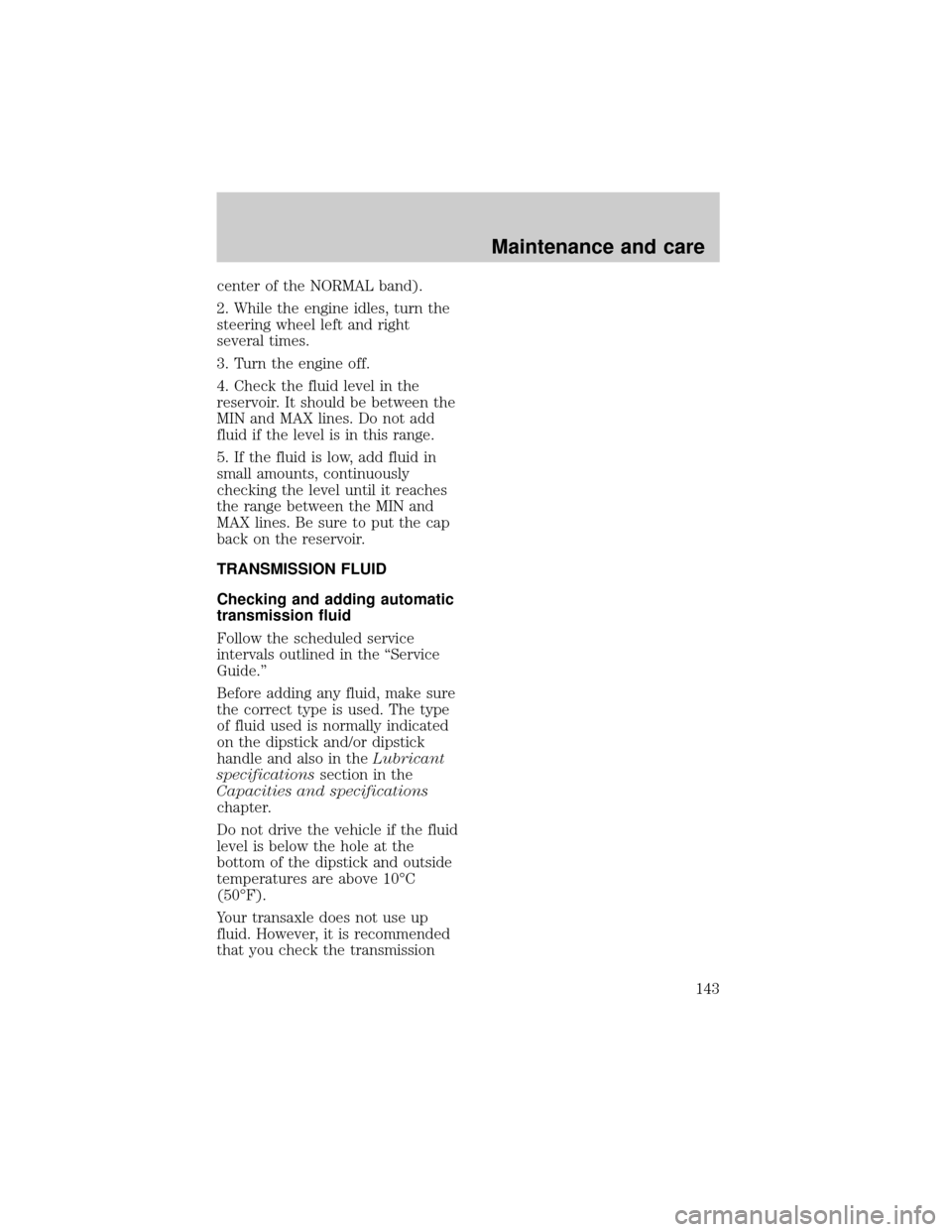
²Coupe
²Sedan/Wagon
1. Start the engine and let it run
until it reaches normal operating
temperature (the engine coolant
temperature gauge will be near the
Maintenance and care
142
Page 143 of 191
center of the NORMAL band).
2. While the engine idles, turn the
steering wheel left and right
several times.
3. Turn the engine off.
4. Check the fluid level in the
reservoir. It should be between the
MIN and MAX lines. Do not add
fluid if the level is in this range.
5. If the fluid is low, add fluid in
small amounts, continuously
checking the level until it reaches
the range between the MIN and
MAX lines. Be sure to put the cap
back on the reservoir.
TRANSMISSION FLUID
Checking and adding automatic
transmission fluid
Follow the scheduled service
intervals outlined in the ªService
Guide.º
Before adding any fluid, make sure
the correct type is used. The type
of fluid used is normally indicated
on the dipstick and/or dipstick
handle and also in theLubricant
specificationssection in the
Capacities and specifications
chapter.
Do not drive the vehicle if the fluid
level is below the hole at the
bottom of the dipstick and outside
temperatures are above 10ÉC
(50ÉF).
Your transaxle does not use up
fluid. However, it is recommended
that you check the transmission
Maintenance and care
143