radio FORD ESCORT 2000 7.G User Guide
[x] Cancel search | Manufacturer: FORD, Model Year: 2000, Model line: ESCORT, Model: FORD ESCORT 2000 7.GPages: 200, PDF Size: 1.67 MB
Page 33 of 200
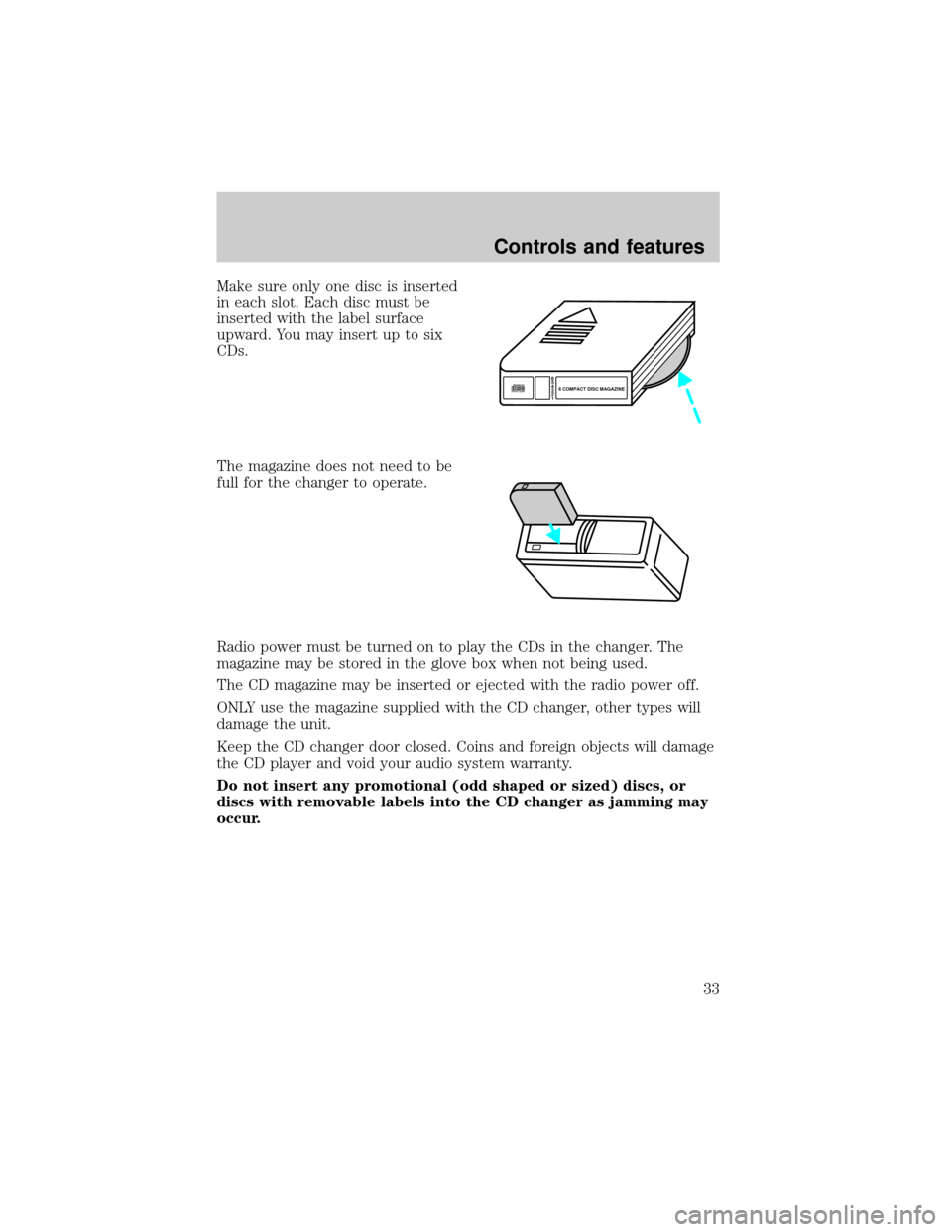
Make sure only one disc is inserted
in each slot. Each disc must be
inserted with the label surface
upward. You may insert up to six
CDs.
The magazine does not need to be
full for the changer to operate.
Radio power must be turned on to play the CDs in the changer. The
magazine may be stored in the glove box when not being used.
The CD magazine may be inserted or ejected with the radio power off.
ONLY use the magazine supplied with the CD changer, other types will
damage the unit.
Keep the CD changer door closed. Coins and foreign objects will damage
the CD player and void your audio system warranty.
Do not insert any promotional (odd shaped or sized) discs, or
discs with removable labels into the CD changer as jamming may
occur.
6
5
4
3
2
16 COMPACT DISC MAGAZINECOMPACT
DIGITAL AUDIO
Controls and features
33
Page 35 of 200

²Do not expose tapes to direct sunlight, high humidity, extreme heat or
extreme cold. Allow tapes that may have been exposed to extreme
temperatures to reach a moderate temperature before playing.
²Tighten very loose tapes by inserting a finger or pencil into the hole
and turning the hub.
²Remove loose labels before inserting tapes.
²Do not leave tapes in the cassette player for a long time when not
being played.
Radio frequency information
The Federal Communications Commission (FCC) and the Canadian Radio
and Telecommunications Commission(CRTC) establish the frequencies
AM and FM stations may use for their broadcasts. Allowable frequencies
are:
AM 530, 540±1600, 1610 kHz
FM 87.7, 87.9±107.7, 107.9 MHz
Not all frequencies are used in a given area.
Radio reception factors
Three factors can affect radio reception:
²Distance/strength.The further an FM signal travels, the weaker it is.
The listenable range of the average FM station is approximately 40 km
(24 miles). This range can be affected by ªsignal modulation.º Signal
modulation is a process radio stations use to increase their
strength/volume relative to other stations.
²Terrain.Hills, mountains and tall buildings between your vehicle's
antenna and the radio station signal can cause FM reception problems.
Static can be caused on AM stations by power lines, electric fences,
traffic lights and thunderstorms. Moving away from an interfering
structure (out of its ªshadowº) returns your reception to normal.
²Station overload.Weak signals are sometimes captured by stronger
signals when you pass a broadcast tower. A stronger signal may
temporarily overtake a weaker signal and play while the weak station
frequency is displayed.
The audio system automatically switches to single channel reception if it
will improve the reception of a station normally received in stereo.
Controls and features
35
Page 41 of 200
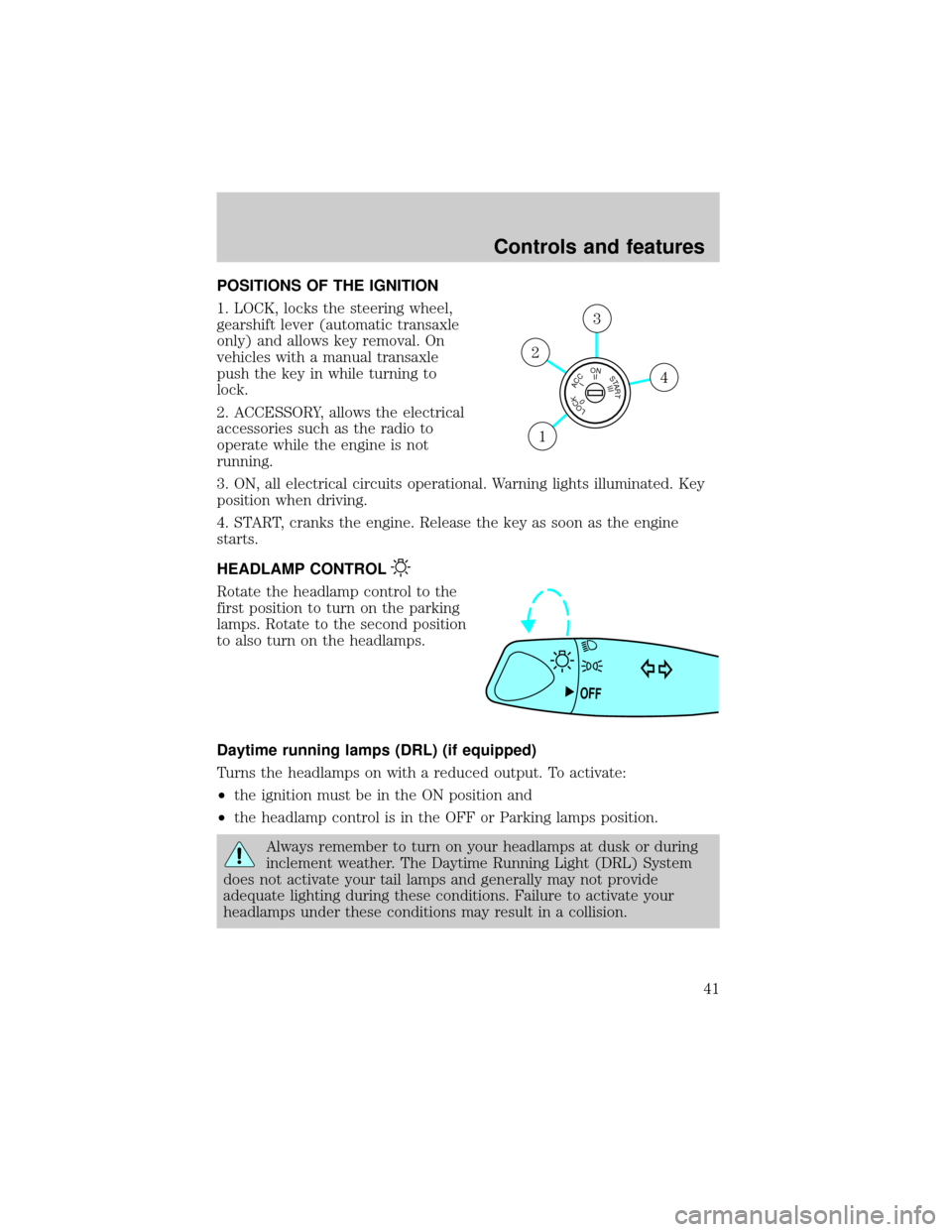
POSITIONS OF THE IGNITION
1. LOCK, locks the steering wheel,
gearshift lever (automatic transaxle
only) and allows key removal. On
vehicles with a manual transaxle
push the key in while turning to
lock.
2. ACCESSORY, allows the electrical
accessories such as the radio to
operate while the engine is not
running.
3. ON, all electrical circuits operational. Warning lights illuminated. Key
position when driving.
4. START, cranks the engine. Release the key as soon as the engine
starts.
HEADLAMP CONTROL
Rotate the headlamp control to the
first position to turn on the parking
lamps. Rotate to the second position
to also turn on the headlamps.
Daytime running lamps (DRL) (if equipped)
Turns the headlamps on with a reduced output. To activate:
²the ignition must be in the ON position and
²the headlamp control is in the OFF or Parking lamps position.
Always remember to turn on your headlamps at dusk or during
inclement weather. The Daytime Running Light (DRL) System
does not activate your tail lamps and generally may not provide
adequate lighting during these conditions. Failure to activate your
headlamps under these conditions may result in a collision.
LOCKACCONSTART0IIIIII4
3
2
1
OFF
Controls and features
41
Page 55 of 200
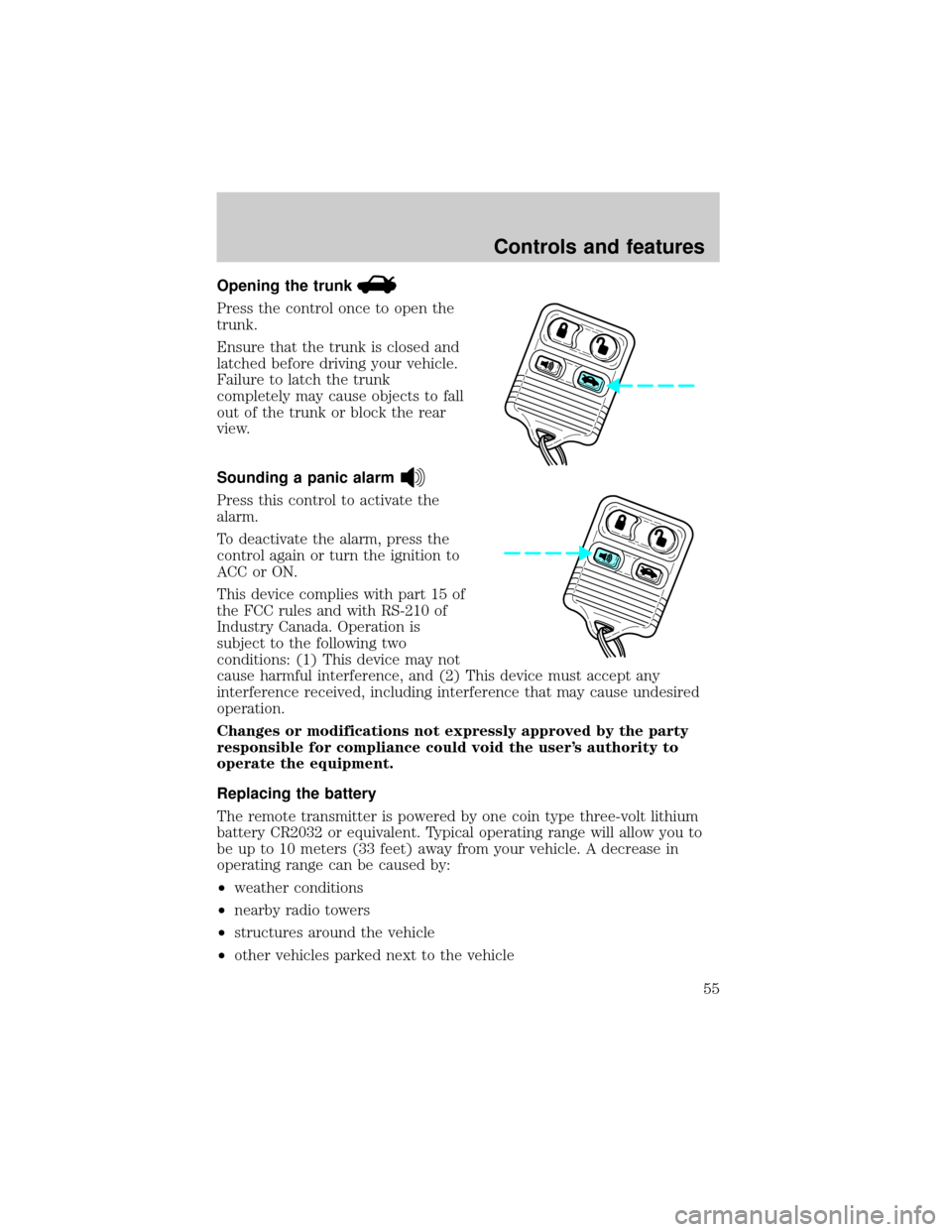
Opening the trunk
Press the control once to open the
trunk.
Ensure that the trunk is closed and
latched before driving your vehicle.
Failure to latch the trunk
completely may cause objects to fall
out of the trunk or block the rear
view.
Sounding a panic alarm
Press this control to activate the
alarm.
To deactivate the alarm, press the
control again or turn the ignition to
ACC or ON.
This device complies with part 15 of
the FCC rules and with RS-210 of
Industry Canada. Operation is
subject to the following two
conditions: (1) This device may not
cause harmful interference, and (2) This device must accept any
interference received, including interference that may cause undesired
operation.
Changes or modifications not expressly approved by the party
responsible for compliance could void the user's authority to
operate the equipment.
Replacing the battery
The remote transmitter is powered by one coin type three-volt lithium
battery CR2032 or equivalent. Typical operating range will allow you to
be up to 10 meters (33 feet) away from your vehicle. A decrease in
operating range can be caused by:
²weather conditions
²nearby radio towers
²structures around the vehicle
²other vehicles parked next to the vehicle
Controls and features
55
Page 84 of 200
PREPARING TO START YOUR VEHICLE
Engine starting is controlled by the powertrain control system. This
system meets all Canadian Interference-Causing Equipment standard
requirements regulating the impulse electrical field strength of radio
noise.
When starting a fuel-injected engine, avoid pressing the accelerator
before or during starting. Only use the accelerator when you have
difficulty starting the engine. For more information on starting the
vehicle, refer toStarting the enginein this chapter.
Extended idling at high engine speeds can produce very high
temperatures in the engine and exhaust system, creating the risk
of fire or other damage.
Do not park, idle, or drive your vehicle in dry grass or other dry
ground cover. The emission system heats up the engine
compartment and exhaust system, which can start a fire.
Do not start your vehicle in a closed garage or in other enclosed
areas. Exhaust fumes can be toxic. Always open the garage door
before you start the engine. SeeGuarding against exhaust fumesin
this chapter for more instructions.
If you smell exhaust fumes inside your vehicle, have your dealer
inspect your vehicle immediately. Do not drive if you smell
exhaust fumes.
Important safety precautions
A computer system controls the engine's idle revolutions per minute
(RPM). When the engine starts, the idle RPM runs faster to warm the
engine. If the engine idle speed does not slow down automatically, have
the vehicle checked. Do not allow the vehicle to idle for more than 10
minutes at the higher RPM.
Before starting the vehicle:
1. Make sure all vehicle occupants have buckled their safety belts. For
more information on safety belts and their proper usage, refer to the
Seating and safety restraintschapter.
Starting
84
Page 110 of 200
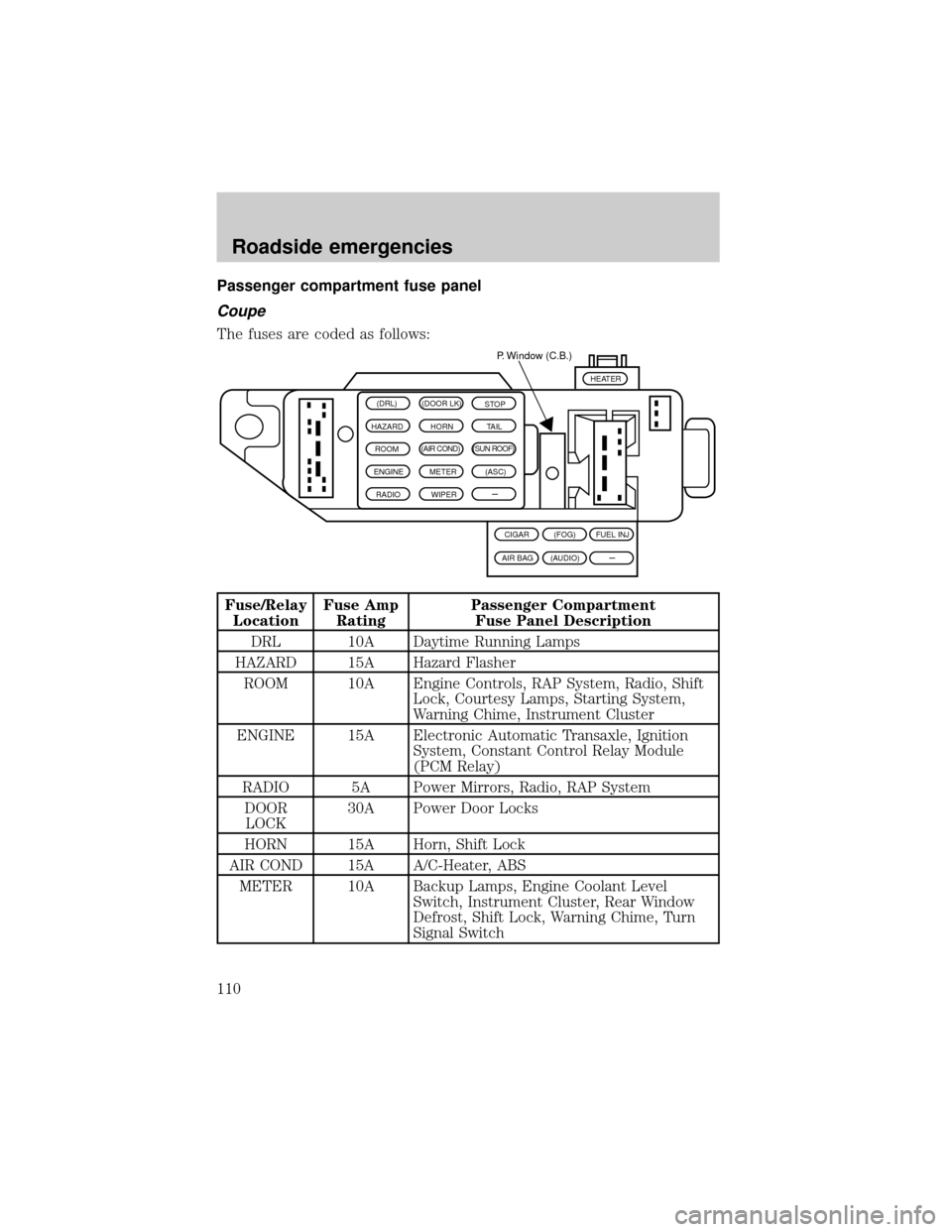
Passenger compartment fuse panel
Coupe
The fuses are coded as follows:
Fuse/Relay
LocationFuse Amp
RatingPassenger Compartment
Fuse Panel Description
DRL 10A Daytime Running Lamps
HAZARD 15A Hazard Flasher
ROOM 10A Engine Controls, RAP System, Radio, Shift
Lock, Courtesy Lamps, Starting System,
Warning Chime, Instrument Cluster
ENGINE 15A Electronic Automatic Transaxle, Ignition
System, Constant Control Relay Module
(PCM Relay)
RADIO 5A Power Mirrors, Radio, RAP System
DOOR
LOCK30A Power Door Locks
HORN 15A Horn, Shift Lock
AIR COND 15A A/C-Heater, ABS
METER 10A Backup Lamps, Engine Coolant Level
Switch, Instrument Cluster, Rear Window
Defrost, Shift Lock, Warning Chime, Turn
Signal Switch
(DRL) (DOOR LK)
STOP
HAZARD HORN
TAIL
ROOM(AIR COND) (SUN ROOF)
ENGINE METER(ASC)
RADIO
WIPER
–P. Window (C.B.)
(FOG) CIGAR
(AUDIO)
AIR BAGFUEL INJ
HEATER
–
Roadside emergencies
110
Page 112 of 200
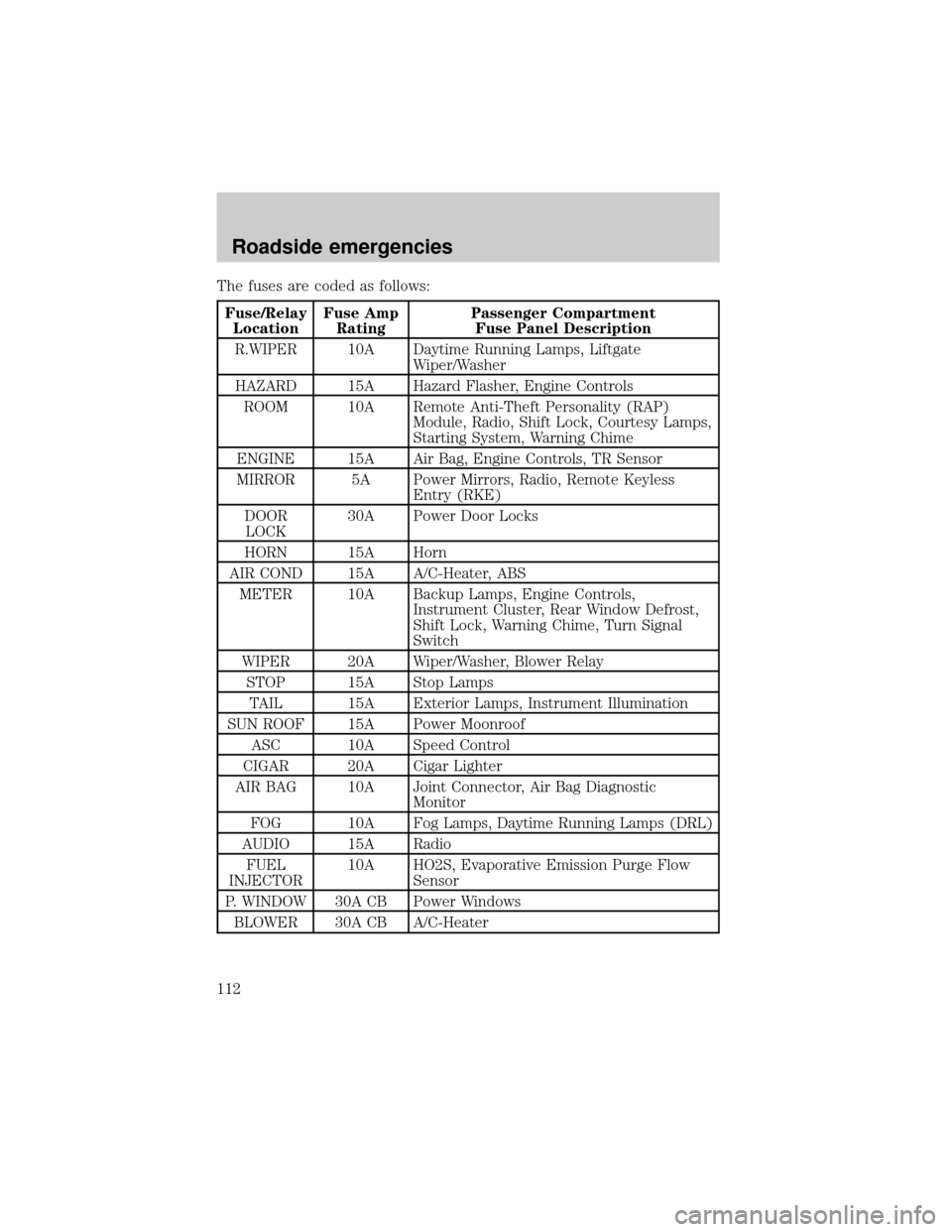
The fuses are coded as follows:
Fuse/Relay
LocationFuse Amp
RatingPassenger Compartment
Fuse Panel Description
R.WIPER 10A Daytime Running Lamps, Liftgate
Wiper/Washer
HAZARD 15A Hazard Flasher, Engine Controls
ROOM 10A Remote Anti-Theft Personality (RAP)
Module, Radio, Shift Lock, Courtesy Lamps,
Starting System, Warning Chime
ENGINE 15A Air Bag, Engine Controls, TR Sensor
MIRROR 5A Power Mirrors, Radio, Remote Keyless
Entry (RKE)
DOOR
LOCK30A Power Door Locks
HORN 15A Horn
AIR COND 15A A/C-Heater, ABS
METER 10A Backup Lamps, Engine Controls,
Instrument Cluster, Rear Window Defrost,
Shift Lock, Warning Chime, Turn Signal
Switch
WIPER 20A Wiper/Washer, Blower Relay
STOP 15A Stop Lamps
TAIL 15A Exterior Lamps, Instrument Illumination
SUN ROOF 15A Power Moonroof
ASC 10A Speed Control
CIGAR 20A Cigar Lighter
AIR BAG 10A Joint Connector, Air Bag Diagnostic
Monitor
FOG 10A Fog Lamps, Daytime Running Lamps (DRL)
AUDIO 15A Radio
FUEL
INJECTOR10A HO2S, Evaporative Emission Purge Flow
Sensor
P. WINDOW 30A CB Power Windows
BLOWER 30A CB A/C-Heater
Roadside emergencies
112
Page 147 of 200
When lifting a plastic-cased battery, excessive pressure on the
end walls could cause acid to flow through the vent caps,
resulting in personal injury and/or damage to the vehicle or battery.
Lift the battery with a battery carrier or with your hands on opposite
corners.
Keep batteries out of reach of children. Batteries contain sulfuric
acid. Avoid contact with skin, eyes or clothing. Shield your eyes
when working near the battery to protect against possible splashing of
acid solution. In case of acid contact with skin or eyes, flush
immediately with water for a minimum of 15 minutes and get prompt
medical attention. If acid is swallowed, call a physician immediately.
Because your vehicle's engine is electronically controlled by a computer,
some control conditions are maintained by power from the battery. When
the battery is disconnected or a new battery is installed, the engine must
relearn its idle and fuel trim strategy for optimum driveability and
performance. To begin this process:
1. With the vehicle at a complete stop, set the parking brake.
2. Put the gearshift in P (Park) (automatic transaxle) or the neutral
position (manual transaxle), turn off all accessories and start the engine.
3. Run the engine until it reaches normal operating temperature.
4. Allow the engine to idle for at least one minute.
5. Turn the A/C on and allow the engine to idle for at least one minute.
6. Drive the vehicle to complete the relearning process.
²The vehicle may need to be driven 16 km (10 miles) or more to
relearn the idle and fuel trim strategy.
²If you do not allow the engine to relearn its idle trim, the idle
quality of your vehicle may be adversely affected until the idle
trim is eventually relearned.
If the battery has been disconnected or a new battery has been installed,
the clock and the preset radio stations must be reset once the battery is
reconnected.
Maintenance and care
147
Page 192 of 200

²When adding accessories, equipment, passengers and luggage to your
vehicle, do not exceed the total weight capacity of the vehicle or of
the front or rear axle (GVWR or GAWR as indicated on the Safety
compliance certification label). Consult your dealer for specific weight
information.
²The Federal Communications Commission (FCC) and Canadian Radio
Telecommunications Commission (CRTC) regulate the use of mobile
communications systems - such as two-way radios, telephones and
theft alarms - that are equipped with radio transmitters. Any such
equipment installed in your vehicle should comply with FCC or CRTC
regulations and should be installed only by a qualified service
technician.
²Mobile communications systems may harm the operation of your
vehicle, particularly if they are not properly designed for automotive
use or are not properly installed. When operated, such systems may
cause the engine to stumble or stall. In addition, such systems may be
damaged or their performance may be affected by operating your
vehicle. (Citizens band [CB] transceivers, garage door openers and
other transmitters with outputs of five watts or less will not ordinarily
affect your vehicle's operation.)
²Ford cannot assume responsibility for any adverse effects or damage
that may result from the use of such equipment.
ORDERING ADDITIONAL OWNER'S LITERATURE
To order the publications in this portfolio:
Make checks payable to:
HELM, INCORPORATED
P.O. Box 07150
Detroit, Michigan 48207
For a free publication catalog, order toll free: 1-800-782-4356
Monday-Friday 8:00 a.m. - 6:00 p.m. EST,
for credit card holders only
Obtaining a French owner's guide
French Owner's Guides can be obtained from your dealer or by writing to
Ford Motor Company of Canada, Limited, Service Publications, P.O. Box
1580, Station B, Mississauga, Ontario L4Y 4G3.
Customer assistance
192
Page 194 of 200

Air bag supplemental
restraint system ..........................72
and child safety seats ..............74
description ................................72
disposal ......................................76
driver air bag ............................74
indicator light ......................10,76
operation ...................................74
passenger air bag .....................74
Air cleaner filter ................148,175
Air conditioning ..........................36
Antifreeze
(see Engine coolant) ................137
Anti-lock brake system
(see Brakes) ...........................89,90
Anti-theft system ...................57,58
arming the system ....................58
disarming
a triggered system ...............58,59
disarming an
untriggered system ...................58
warning light .............................11
Audio system (see Radio) .........18
Automatic transaxle ...................92
driving with ...............................94
fluid, adding ............................143
fluid, checking ........................143
fluid, refill capacities ..............175
fluid, specification ..................177
Axle
lubricant specifications ..........176
Battery .......................................146
acid, treating emergencies .....146
charging
system warning light ................11
jumping a disabled battery ....119
maintenance-free ....................146
replacement, specifications ...175
servicing ..................................146
Belt minder .................................68
Brakes ..........................................89
anti-lock ................................89,90anti-lock brake system (ABS)
warning light ........................11,90
brake warning light ..................10
fluid, checking and adding ....135
fluid, refill capacities ..............175
fluid, specifications ..........176,177
lubricant specifications ...176,177
parking ......................................90
shift interlock ............................92
Break-in period .............................3
Capacities for refilling fluids ....175
Certification Label ....................180
Child safety restraints ................77
child safety belts ......................77
Child safety seats ........................78
attaching with tether straps ....82
in front seat ..............................79
in rear seat ................................79
Cleaning your vehicle ...............170
engine compartment ..............172
exterior .............................171,172
exterior lamps .........................172
instrument panel ....................173
instrument panel lens ............173
interior ..............................173,174
mirrors .....................................172
plastic parts ............................171
safety belts ..............................174
washing ....................................170
waxing .....................................171
wheels ......................................171
windows ..................................174
wiper blades ............................172
woodtone trim ........................174
Climate control (see Air
conditioning or Heating) ............36
Clock .......................................24,32
Clutch
fluid ..........................................136
operation while driving ............97
recommended shift speeds ......99
Index
194