belt FORD ESCORT 2000 7.G Owner's Manual
[x] Cancel search | Manufacturer: FORD, Model Year: 2000, Model line: ESCORT, Model: FORD ESCORT 2000 7.GPages: 200, PDF Size: 1.67 MB
Page 84 of 200
PREPARING TO START YOUR VEHICLE
Engine starting is controlled by the powertrain control system. This
system meets all Canadian Interference-Causing Equipment standard
requirements regulating the impulse electrical field strength of radio
noise.
When starting a fuel-injected engine, avoid pressing the accelerator
before or during starting. Only use the accelerator when you have
difficulty starting the engine. For more information on starting the
vehicle, refer toStarting the enginein this chapter.
Extended idling at high engine speeds can produce very high
temperatures in the engine and exhaust system, creating the risk
of fire or other damage.
Do not park, idle, or drive your vehicle in dry grass or other dry
ground cover. The emission system heats up the engine
compartment and exhaust system, which can start a fire.
Do not start your vehicle in a closed garage or in other enclosed
areas. Exhaust fumes can be toxic. Always open the garage door
before you start the engine. SeeGuarding against exhaust fumesin
this chapter for more instructions.
If you smell exhaust fumes inside your vehicle, have your dealer
inspect your vehicle immediately. Do not drive if you smell
exhaust fumes.
Important safety precautions
A computer system controls the engine's idle revolutions per minute
(RPM). When the engine starts, the idle RPM runs faster to warm the
engine. If the engine idle speed does not slow down automatically, have
the vehicle checked. Do not allow the vehicle to idle for more than 10
minutes at the higher RPM.
Before starting the vehicle:
1. Make sure all vehicle occupants have buckled their safety belts. For
more information on safety belts and their proper usage, refer to the
Seating and safety restraintschapter.
Starting
84
Page 86 of 200
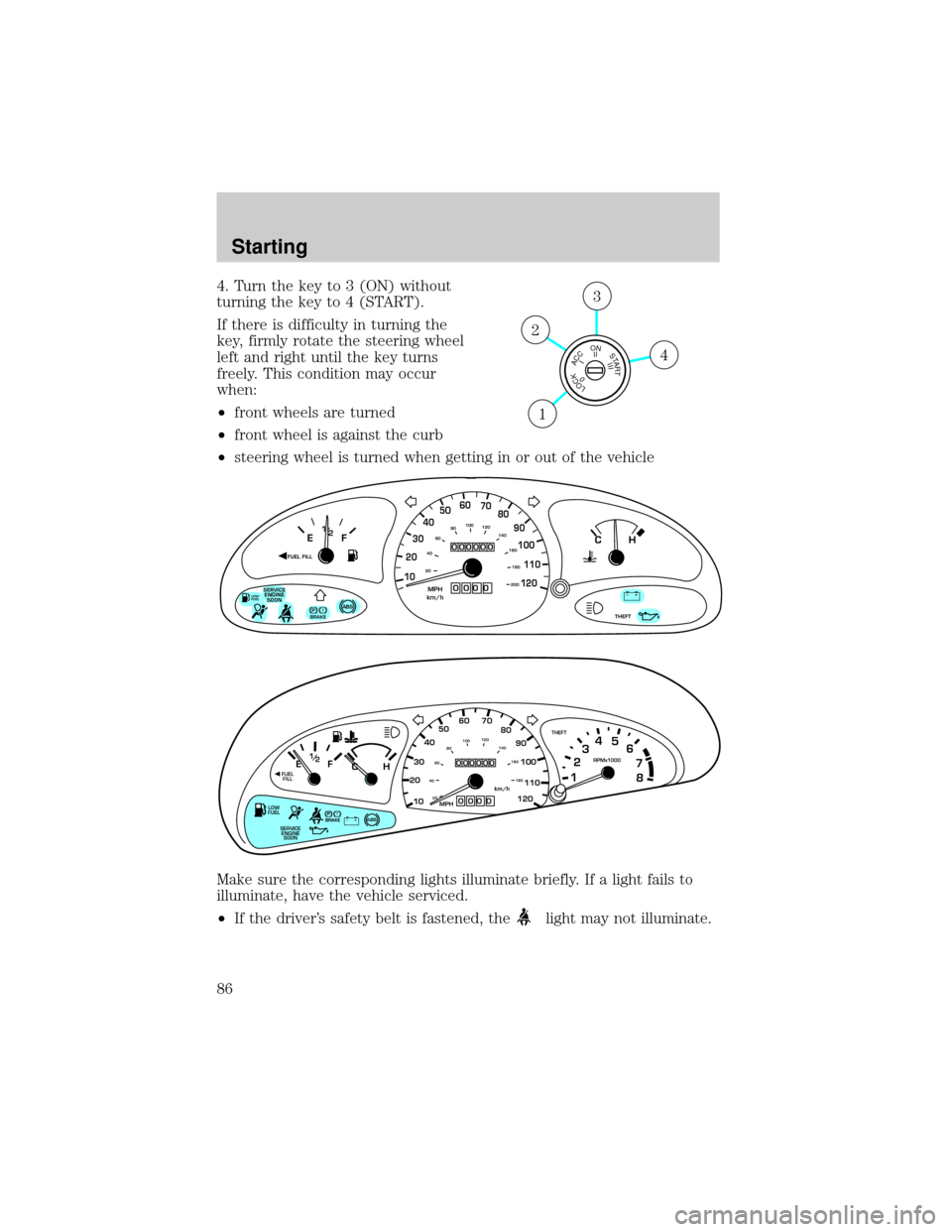
4. Turn the key to 3 (ON) without
turning the key to 4 (START).
If there is difficulty in turning the
key, firmly rotate the steering wheel
left and right until the key turns
freely. This condition may occur
when:
²front wheels are turned
²front wheel is against the curb
²steering wheel is turned when getting in or out of the vehicle
Make sure the corresponding lights illuminate briefly. If a light fails to
illuminate, have the vehicle serviced.
²If the driver's safety belt is fastened, the
light may not illuminate.
LOCKACCONSTART0IIIIII4
3
2
1
!THEFT SERVICE
ENGINE
SOONPBRAKEABS+ –MPH
205060
70FUEL FILL
EF
CH1
2 /304080
90
100
110
120 10
20406080100
120
140
160
180200km/h
0
000000
00 0 LOW
FUEL
!
THEFT
LOW
FUEL
SERVICE
ENGINE
SOON
PBRAKEABS+ –MPH
205060 70FUEL
FILLEF
CH1
2 /RPMx1000
1234
5
6
7
8
304080
90
100
110
120
10
20 406080100120
140
160
180km/h
0
000000
00 0
Starting
86
Page 121 of 200
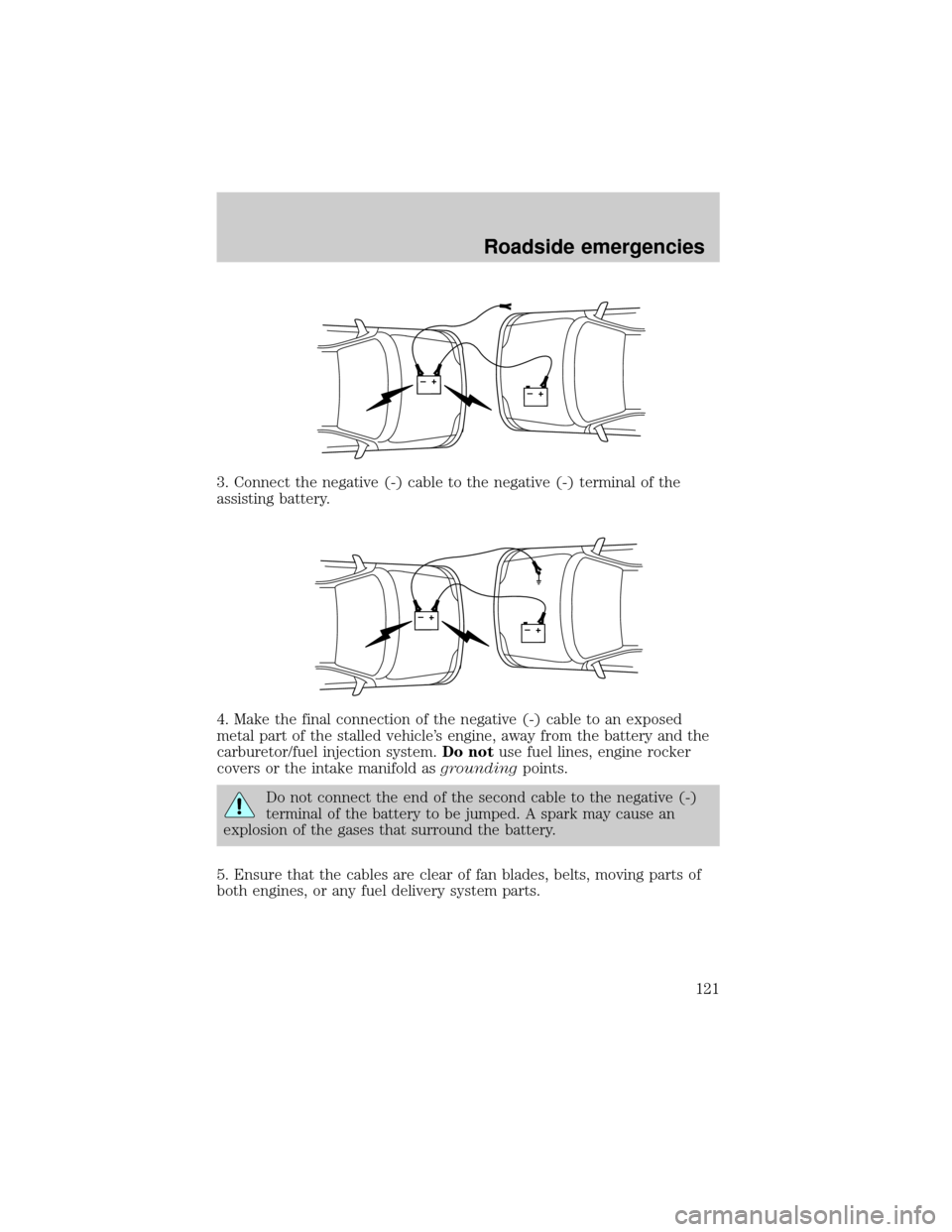
3. Connect the negative (-) cable to the negative (-) terminal of the
assisting battery.
4. Make the final connection of the negative (-) cable to an exposed
metal part of the stalled vehicle's engine, away from the battery and the
carburetor/fuel injection system.Do notuse fuel lines, engine rocker
covers or the intake manifold asgroundingpoints.
Do not connect the end of the second cable to the negative (-)
terminal of the battery to be jumped. A spark may cause an
explosion of the gases that surround the battery.
5. Ensure that the cables are clear of fan blades, belts, moving parts of
both engines, or any fuel delivery system parts.
+–+–
+–+–
Roadside emergencies
121
Page 124 of 200
WRECKER TOWING
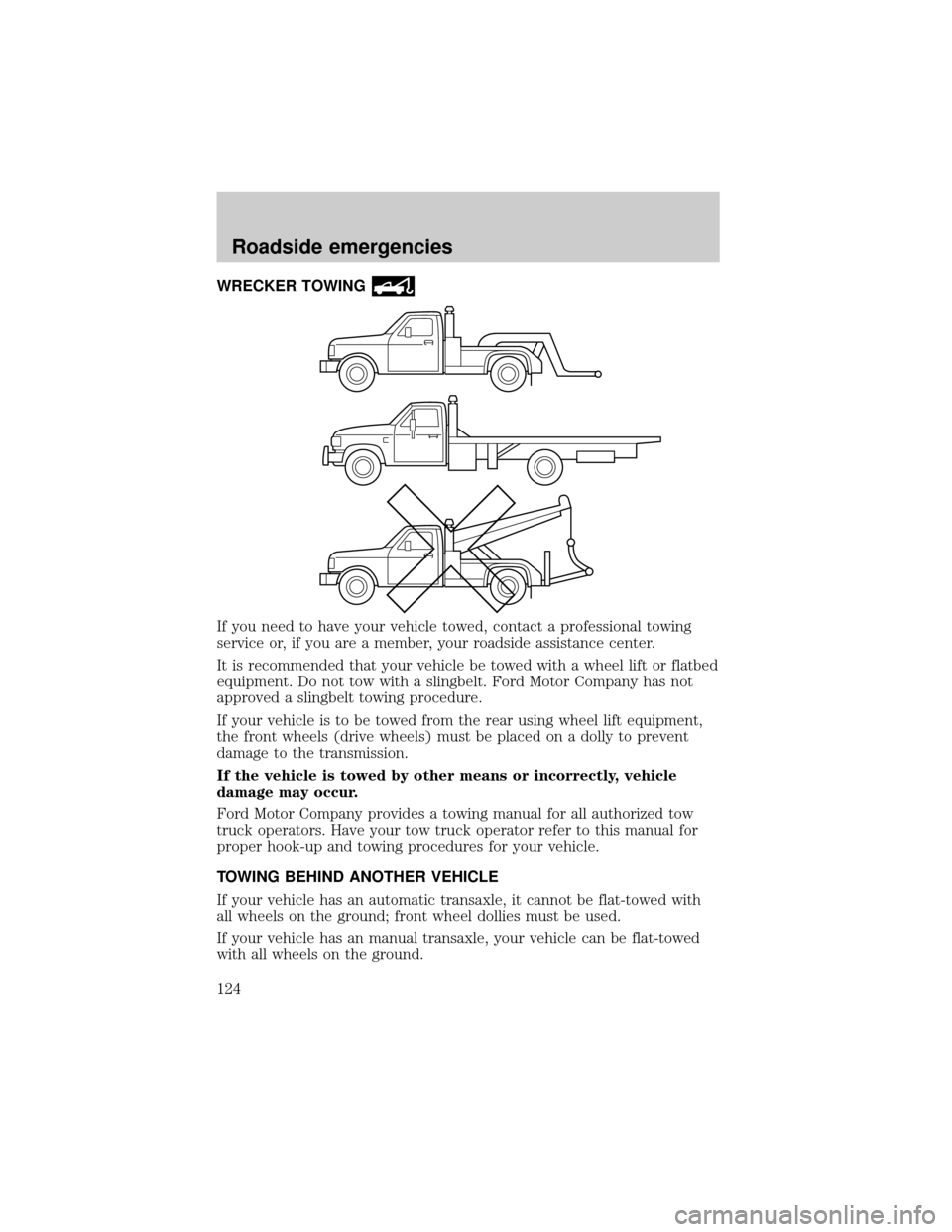
If you need to have your vehicle towed, contact a professional towing
service or, if you are a member, your roadside assistance center.
It is recommended that your vehicle be towed with a wheel lift or flatbed
equipment. Do not tow with a slingbelt. Ford Motor Company has not
approved a slingbelt towing procedure.
If your vehicle is to be towed from the rear using wheel lift equipment,
the front wheels (drive wheels) must be placed on a dolly to prevent
damage to the transmission.
If the vehicle is towed by other means or incorrectly, vehicle
damage may occur.
Ford Motor Company provides a towing manual for all authorized tow
truck operators. Have your tow truck operator refer to this manual for
proper hook-up and towing procedures for your vehicle.
TOWING BEHIND ANOTHER VEHICLE
If your vehicle has an automatic transaxle, it cannot be flat-towed with
all wheels on the ground; front wheel dollies must be used.
If your vehicle has an manual transaxle, your vehicle can be flat-towed
with all wheels on the ground.
Roadside emergencies
124
Page 152 of 200
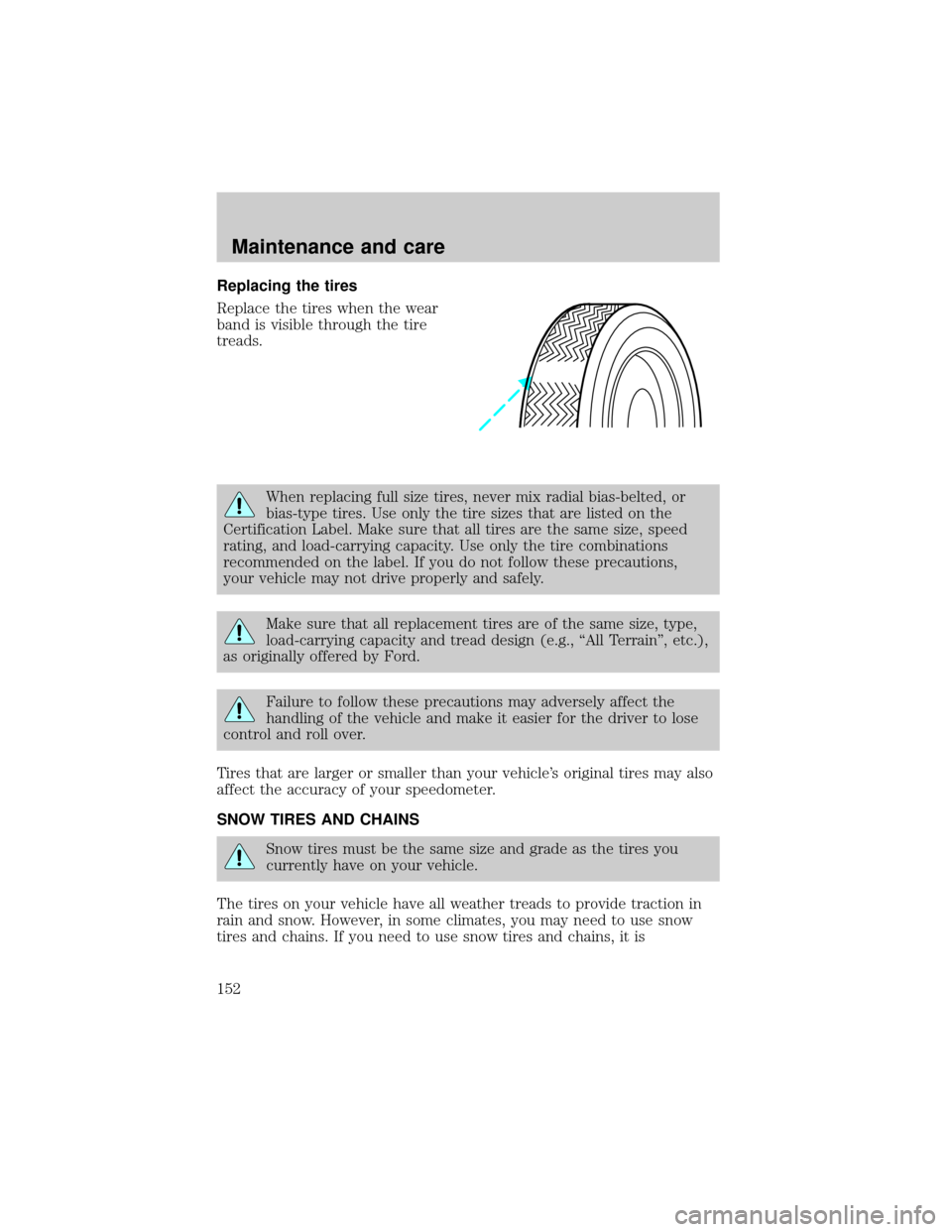
Replacing the tires
Replace the tires when the wear
band is visible through the tire
treads.
When replacing full size tires, never mix radial bias-belted, or
bias-type tires. Use only the tire sizes that are listed on the
Certification Label. Make sure that all tires are the same size, speed
rating, and load-carrying capacity. Use only the tire combinations
recommended on the label. If you do not follow these precautions,
your vehicle may not drive properly and safely.
Make sure that all replacement tires are of the same size, type,
load-carrying capacity and tread design (e.g., ªAll Terrainº, etc.),
as originally offered by Ford.
Failure to follow these precautions may adversely affect the
handling of the vehicle and make it easier for the driver to lose
control and roll over.
Tires that are larger or smaller than your vehicle's original tires may also
affect the accuracy of your speedometer.
SNOW TIRES AND CHAINS
Snow tires must be the same size and grade as the tires you
currently have on your vehicle.
The tires on your vehicle have all weather treads to provide traction in
rain and snow. However, in some climates, you may need to use snow
tires and chains. If you need to use snow tires and chains, it is
Maintenance and care
152
Page 173 of 200
²Never apply anything to the drive belt (including belt dressing).
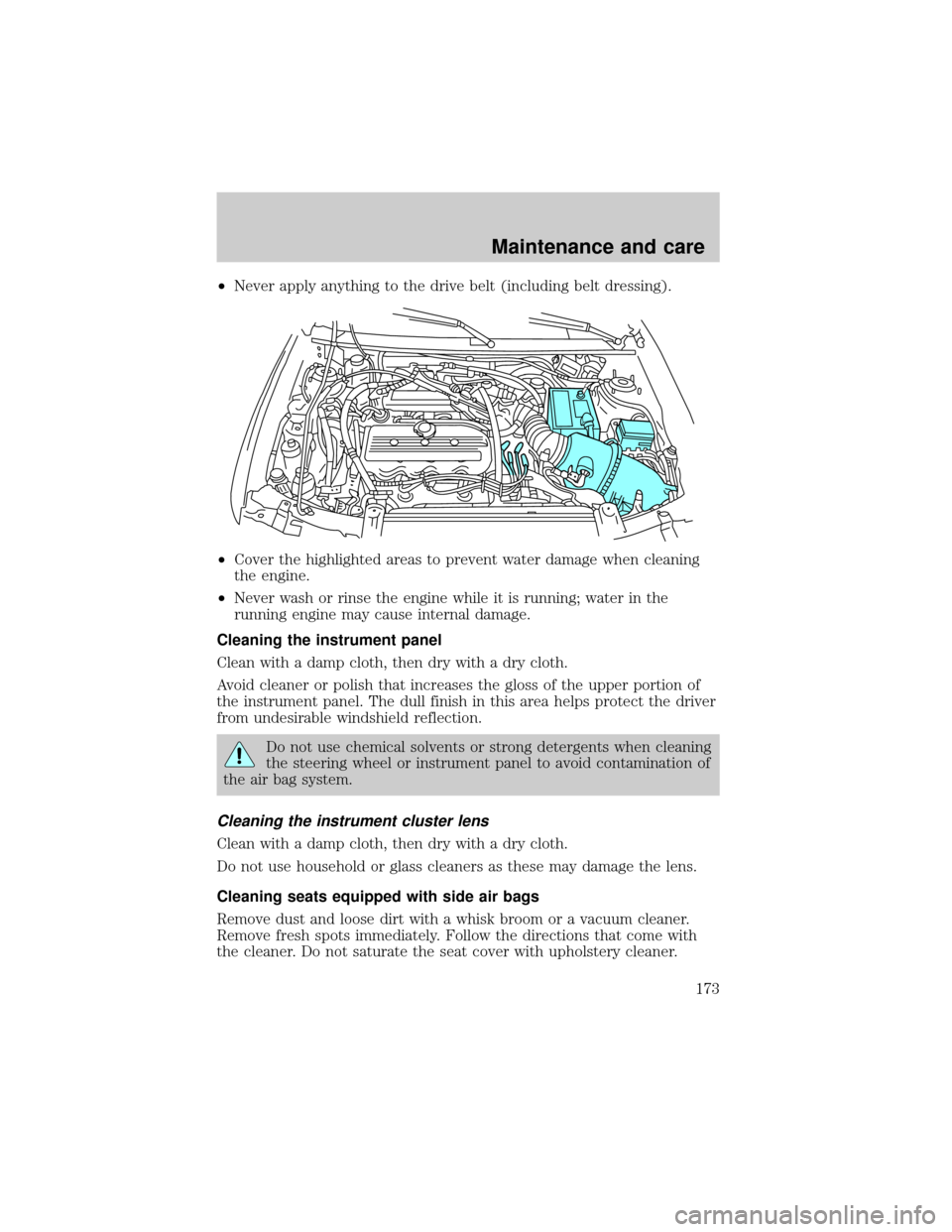
²Cover the highlighted areas to prevent water damage when cleaning
the engine.
²Never wash or rinse the engine while it is running; water in the
running engine may cause internal damage.
Cleaning the instrument panel
Clean with a damp cloth, then dry with a dry cloth.
Avoid cleaner or polish that increases the gloss of the upper portion of
the instrument panel. The dull finish in this area helps protect the driver
from undesirable windshield reflection.
Do not use chemical solvents or strong detergents when cleaning
the steering wheel or instrument panel to avoid contamination of
the air bag system.
Cleaning the instrument cluster lens
Clean with a damp cloth, then dry with a dry cloth.
Do not use household or glass cleaners as these may damage the lens.
Cleaning seats equipped with side air bags
Remove dust and loose dirt with a whisk broom or a vacuum cleaner.
Remove fresh spots immediately. Follow the directions that come with
the cleaner. Do not saturate the seat cover with upholstery cleaner.
Maintenance and care
173
Page 174 of 200
Do not use chemical solvents or strong detergents when cleaning
the seat mounted side air bag. Such products could contaminate
the side air bag system and affect performance of the side air bag in a
collision.
Woodtone trim
Wipe stains with a soft cloth and a multi-purpose cleaning solution.
Inside windows
Use Ultra-Clear Spray Glass Cleaner (E4AZ-19C507±AA) for the inside
windows if they become fogged.
Cleaning and maintaining the safety belts
Clean the safety belts with a mild soap solution recommended for
cleaning upholstery or carpets. Do not bleach or dye the belts, because
these actions may weaken the belt webbing.
Check the safety belt system periodically to make sure there are no
nicks, wear or cuts. If your vehicle has been involved in an accident,
refer to theSafety belt maintenancesection in theSeating and safety
restraintschapter.
Cleaning leather seats (if equipped)
To clean, simply use a soft cloth dampened with water and a mild soap.
Wipe the leather again with a damp cloth to remove soap residue. Dry
with a soft cloth. For tougher soiling concerns, Ford recommends using
the Deluxe Leather Care Kit F8AZ-19G253±AA, which is available from
your Ford Dealer. This mild cleaner and special pad, cleans the leather
and maintains its natural beauty. Follow the instructions on the cleaner
label. Regular cleaning of your leather upholstery helps maintain its
resiliency and color.
Do not use household cleaning products, alcohol solutions,
solvents or cleaners intended for rubber, vinyl or plastics.
Cleaning the interior fabric
Remove dust and loose dirt with a whisk broom or a vacuum cleaner.
Remove fresh spots immediately. Do not use household or glass cleaners.
These agents can stain and discolor the fabric. Use a mild soap and
water solution if necessary.
Maintenance and care
174
Page 194 of 200

Air bag supplemental
restraint system ..........................72
and child safety seats ..............74
description ................................72
disposal ......................................76
driver air bag ............................74
indicator light ......................10,76
operation ...................................74
passenger air bag .....................74
Air cleaner filter ................148,175
Air conditioning ..........................36
Antifreeze
(see Engine coolant) ................137
Anti-lock brake system
(see Brakes) ...........................89,90
Anti-theft system ...................57,58
arming the system ....................58
disarming
a triggered system ...............58,59
disarming an
untriggered system ...................58
warning light .............................11
Audio system (see Radio) .........18
Automatic transaxle ...................92
driving with ...............................94
fluid, adding ............................143
fluid, checking ........................143
fluid, refill capacities ..............175
fluid, specification ..................177
Axle
lubricant specifications ..........176
Battery .......................................146
acid, treating emergencies .....146
charging
system warning light ................11
jumping a disabled battery ....119
maintenance-free ....................146
replacement, specifications ...175
servicing ..................................146
Belt minder .................................68
Brakes ..........................................89
anti-lock ................................89,90anti-lock brake system (ABS)
warning light ........................11,90
brake warning light ..................10
fluid, checking and adding ....135
fluid, refill capacities ..............175
fluid, specifications ..........176,177
lubricant specifications ...176,177
parking ......................................90
shift interlock ............................92
Break-in period .............................3
Capacities for refilling fluids ....175
Certification Label ....................180
Child safety restraints ................77
child safety belts ......................77
Child safety seats ........................78
attaching with tether straps ....82
in front seat ..............................79
in rear seat ................................79
Cleaning your vehicle ...............170
engine compartment ..............172
exterior .............................171,172
exterior lamps .........................172
instrument panel ....................173
instrument panel lens ............173
interior ..............................173,174
mirrors .....................................172
plastic parts ............................171
safety belts ..............................174
washing ....................................170
waxing .....................................171
wheels ......................................171
windows ..................................174
wiper blades ............................172
woodtone trim ........................174
Climate control (see Air
conditioning or Heating) ............36
Clock .......................................24,32
Clutch
fluid ..........................................136
operation while driving ............97
recommended shift speeds ......99
Index
194
Page 196 of 200

Gas mileage
(see Fuel economy) .................158
Gauges ....................................12,13
engine coolant
temperature gauge ...................13
fuel gauge ..................................13
odometer ...................................14
speedometer .............................14
tachometer ................................15
trip odometer ............................14
GAWR
(Gross Axle Weight Rating) .....100
definition .................................100
driving with a heavy load ......100
location ....................................100
GVWR (Gross
Vehicle Weight Rating) .............100
calculating ...............................100
definition .................................100
driving with a heavy load ......100
location ....................................100
Hazard flashers .........................106
Head restraints ...........................60
Headlamps ...................................41
aiming ...............................168,169
bulb specifications ..................168
daytime running lights .............41
flash to pass ..............................42
high beam ............................11,42
replacing bulbs .......................163
turning on and off ....................41
warning chime ..........................12
Heating ........................................36
heater only system ...................36
heating and
air conditioning system ............37
Hood ..........................................129
Ignition ................................177,178
positions of the ignition ...........41
Infant seats (see Safety seats) ..78
Inspection/maintenance
(I/M) testing ..............................162Instrument panel ..........................8
cleaning ...................................173
cluster ...................................8,173
lighting up
panel and interior .....................16
location of components ..............8
Jump-starting your vehicle ......119
Keys
key in ignition chime ...............12
positions of the ignition ...........41
Lamps
bulb replacement
specifications chart ................168
cargo lamps ...............................16
daytime running light ...............41
fog lamps ...................................42
headlamps ..........................41,163
headlamps, flash to pass ..........42
instrument panel, dimming .....16
interior lamps ....................49,167
replacing bulbs ..163,165,166,167
Lane change indicator
(see Turn signal) ........................43
Lights, warning and indicator ......8
air bag ........................................10
anti-lock brakes (ABS) .......11,90
anti-theft ...................................11
brake ..........................................10
charging system ........................11
high beam .................................11
low fuel ........................................8
oil pressure ...............................12
safety belt .................................10
service engine soon ....................9
turn signal indicator .................11
Load limits .................................100
GAWR ......................................100
GVWR ......................................100
trailer towing ..........................100
Locks
childproof ..................................50
Lubricant specifications ....176,177
Index
196
Page 197 of 200

Manual transaxle .........................97
fluid capacities ........................175
lubricant specifications ..........177
reverse .......................................99
Mirrors
cleaning ...................................172
side view mirrors (power) .......17
Moon roof ....................................49
Motorcraft parts .................158,175
Octane rating ............................156
Odometer .....................................14
Oil (see Engine oil) ..................132
Panic alarm feature, remote
entry system ................................55
Parking brake ..............................90
Parts (see Motorcraft parts) ....175
Power distribution box
(see Fuses) ...............................113
Power door locks ........................50
Power steering ............................91
fluid, checking and adding ....142
fluid, refill capacity ................175
fluid, specifications ..........176,177
Radio ............................................18
Relays .................................108,115
Remote entry system ............53,55
illuminated entry ......................57
locking/unlocking doors ...........54
opening the trunk .....................55
panic alarm ...............................55
replacement/additional
transmitters ...............................56
replacing the batteries .............55
Roof rack ...................................104
Safety belts (see Safety
restraints) ................12,63,64,65,66
Safety defects, reporting ..........193
Safety restraints ...........63,64,65,66
belt minder ...............................68
cleaning the safety belts ...71,174
extension assembly ..................67
for adults .........................64,65,66for children ..........................76,77
lap belt ......................................66
warning light
and chime ...................10,12,67,68
Safety seats for children ............78
Seat belts
(see Safety restraints) ...............63
Seats ............................................60
child safety seats ......................78
cleaning ............................173,174
Servicing your vehicle ..............125
Spark plugs,
specifications ...............175,177,178
Specification chart,
lubricants ............................176,177
Speed control ..............................43
Speedometer ...............................14
Starting your vehicle .............84,87
jump starting ..........................119
Steering wheel
tilting .........................................47
Tachometer .................................15
Temperature control
(see Climate control) .................36
Tires ......................115,149,150,151
changing ...........................115,116
checking the pressure ............151
replacing ..................................152
rotating ....................................151
snow tires and chains ............152
tire grades ...............................150
treadwear ................................150
Towing .......................................151
wrecker ....................................124
Transaxle
automatic operation .................92
fluid, refill capacities ..............175
lubricant specifications ..........177
manual operation ......................97
Transmission
fluid, checking and adding
(automatic) .............................143
Index
197