transmission FORD ESCORT 2001 7.G User Guide
[x] Cancel search | Manufacturer: FORD, Model Year: 2001, Model line: ESCORT, Model: FORD ESCORT 2001 7.GPages: 216, PDF Size: 1.78 MB
Page 155 of 216
1. Drive the vehicle 30 km (20 miles) or until it reaches normal operating
temperature.
2. Park the vehicle on a level surface and engage the parking brake.
3. With the parking brake engaged and your foot on the brake pedal,
start the engine and move the gearshift lever through all of the gear
ranges. Allow sufficient time for each gear to engage.
4. Latch the gearshift lever in P (Park) and leave the engine running.
5. Remove the dipstick, wiping it clean with a clean, dry lint free rag. If
necessary, refer toIdentifying components in the engine compartment
in this chapter for the location of the dipstick.
6. Install the dipstick making sure it is fully seated in the filler tube.
7. Remove the dipstick and inspect the fluid level. The fluid should be in
the designated areas for normal operating temperature.
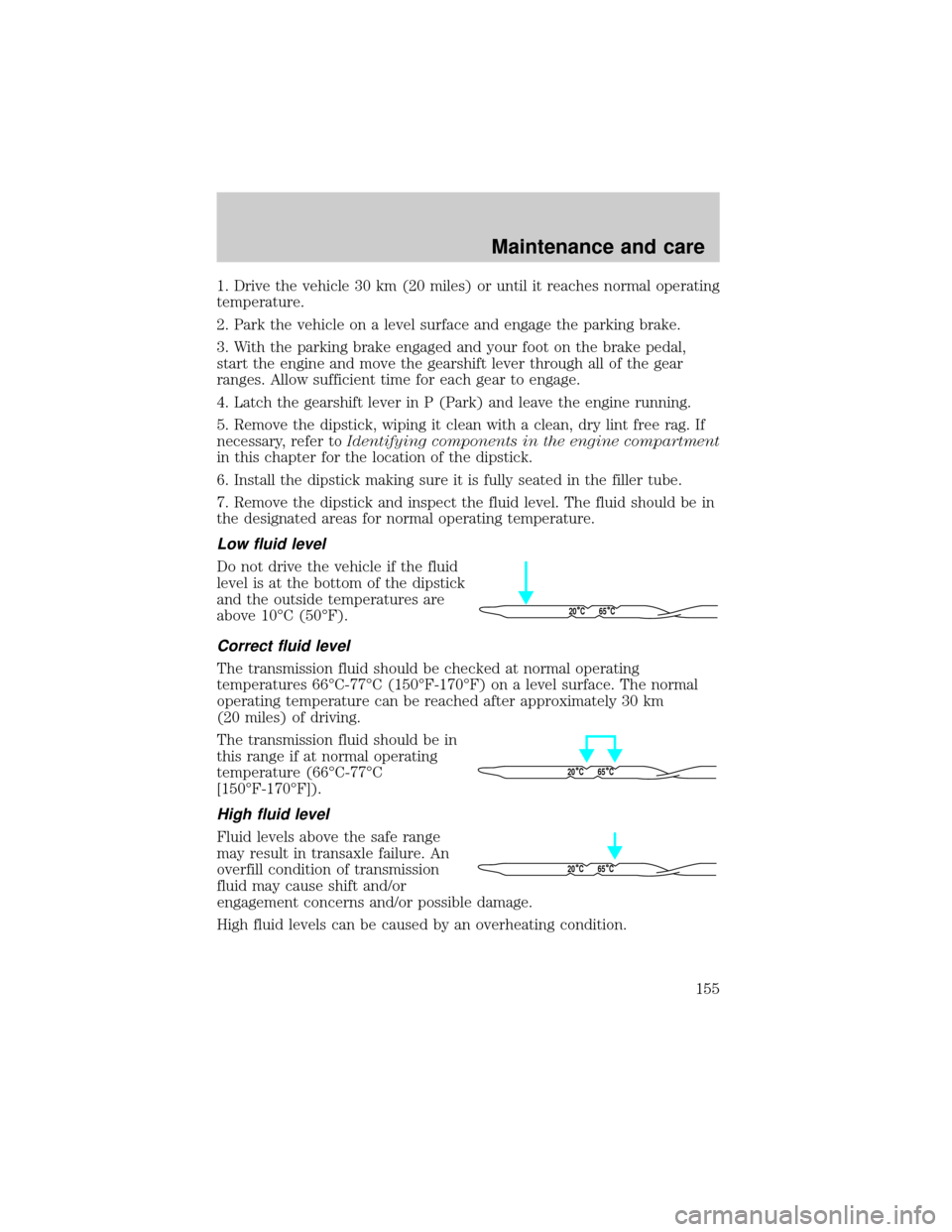
Low fluid level
Do not drive the vehicle if the fluid
level is at the bottom of the dipstick
and the outside temperatures are
above 10ÉC (50ÉF).
Correct fluid level
The transmission fluid should be checked at normal operating
temperatures 66ÉC-77ÉC (150ÉF-170ÉF) on a level surface. The normal
operating temperature can be reached after approximately 30 km
(20 miles) of driving.
The transmission fluid should be in
this range if at normal operating
temperature (66ÉC-77ÉC
[150ÉF-170ÉF]).
High fluid level
Fluid levels above the safe range
may result in transaxle failure. An
overfill condition of transmission
fluid may cause shift and/or
engagement concerns and/or possible damage.
High fluid levels can be caused by an overheating condition.
20 C65 C
20 C65 C
20 C65 C
Maintenance and care
155
Page 156 of 216
Adjusting automatic transmission fluid levels
Before adding any fluid, make sure the correct type is used. The type of
fluid used is normally indicated on the dipstick and also in the
Lubricant specificationssection in theCapacities and specifications
chapter.
Use of a non-approved automatic transmission fluid may cause
internal transaxle component damage.
If necessary, add fluid in 250 mL (1/2 pint) increments through the filler
tube until the level is correct.
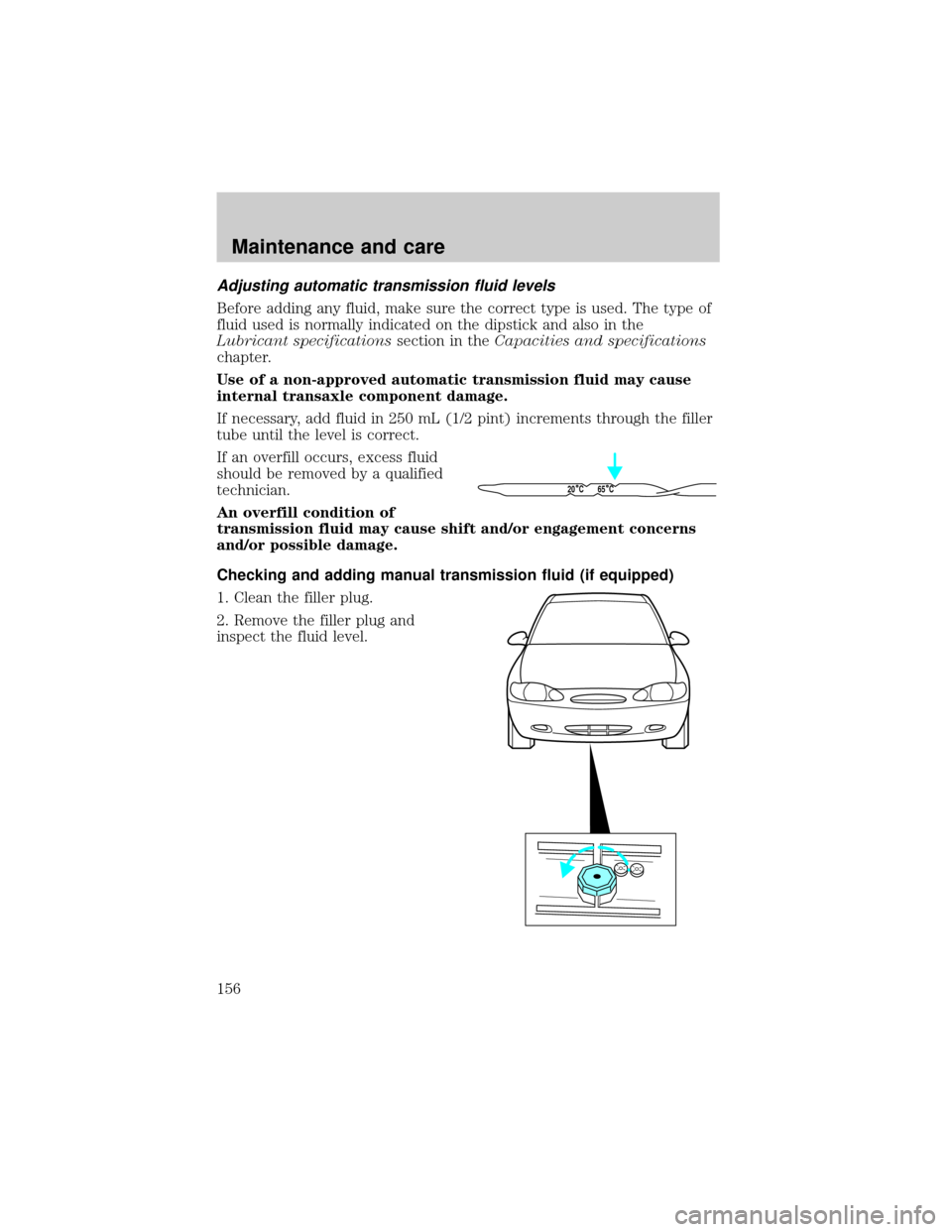
If an overfill occurs, excess fluid
should be removed by a qualified
technician.
An overfill condition of
transmission fluid may cause shift and/or engagement concerns
and/or possible damage.
Checking and adding manual transmission fluid (if equipped)
1. Clean the filler plug.
2. Remove the filler plug and
inspect the fluid level.
20 C65 C
Maintenance and care
156
Page 159 of 216
4. Allow the engine to idle for at least one minute.
5. Turn the A/C on and allow the engine to idle for at least one minute.
6. Drive the vehicle to complete the relearning process.
²The vehicle may need to be driven 16 km (10 miles) or more to
relearn the idle and fuel trim strategy.
²If you do not allow the engine to relearn its idle trim, the idle
quality of your vehicle may be adversely affected until the idle
trim is eventually relearned.
When the battery is disconnected or a new battery installed, the
transmission must learn its adaptive strategy. As a result of this, the
transmission may shift firmly. This operation is considered normal and
will fully update transmission operation to its optimum shift feel.
If the battery has been disconnected or a new battery has been installed,
the clock and the preset radio stations must be reset once the battery is
reconnected.
²Always dispose of automotive
batteries in a responsible manner.
Follow your local authorized
standards for disposal. Call your
local authorized recycling center
to find out more about recycling
automotive batteries.
AIR FILTER MAINTENANCE
Refer to the scheduled maintenance guide for the appropriate intervals
for changing the air filter element.
When changing the air filter element, use only the Motorcraft air filter
element listed. Refer toMotorcraft Part Numbers.
Note:Do not start your engine with the air cleaner removed and do not
remove it while the engine is running.
LEAD
RETURN
RECYCLE
Maintenance and care
159
Page 174 of 216
²Driving on flat terrain offers improved fuel economy as compared to
driving on hilly terrain.
²Transmissions give their best fuel economy when operated in the top
cruise gear and with steady pressure on the gas pedal.
²Close windows for high speed driving.
EPA window sticker
Every new vehicle should have the EPA window sticker. Contact your
dealer if the window sticker is not supplied with your vehicle. The EPA
window sticker should be your guide for the fuel economy comparisons
with other vehicles.
It is important to note the box in the lower left corner of the window
sticker. These numbers represent the Range of L/100 km (MPG)
expected on the vehicle under optimum conditions. Your fuel economy
may vary depending upon the method of operation and conditions.
EMISSION CONTROL SYSTEM
Your vehicle is equipped with various emission control components and a
catalytic converter which will enable your vehicle to comply with
applicable exhaust emission standards. To make sure that the catalytic
converter and other emission control components continue to work
properly:
²Use only the specified fuel listed.
²Avoid running out of fuel.
²Do not turn off the ignition while your vehicle is moving, especially at
high speeds.
²Have the items listed in your scheduled maintenance guide performed
according to the specified schedule.
The scheduled maintenance items listed in the scheduled maintenance
guide are essential to the life and performance of your vehicle and to its
emissions system.
If other than Ford, Motorcraft or Ford-authorized parts are used for
maintenance replacements or for service of components affecting
emission control, such non-Ford parts should be equivalent to genuine
Ford Motor Company parts in performance and durability.
Maintenance and care
174
Page 190 of 216
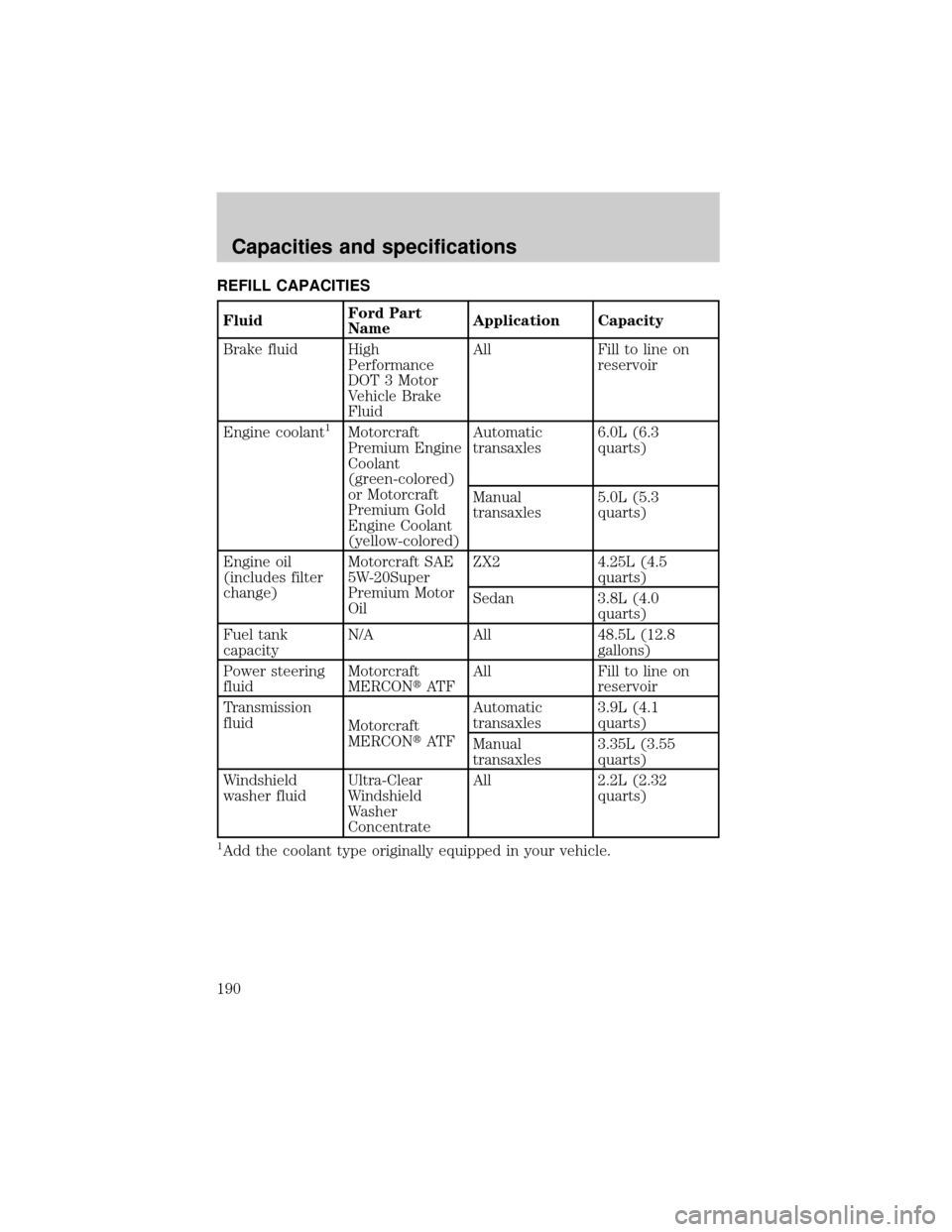
REFILL CAPACITIES
FluidFord Part
NameApplication Capacity
Brake fluid High
Performance
DOT 3 Motor
Vehicle Brake
FluidAll Fill to line on
reservoir
Engine coolant
1Motorcraft
Premium Engine
Coolant
(green-colored)
or Motorcraft
Premium Gold
Engine Coolant
(yellow-colored)Automatic
transaxles6.0L (6.3
quarts)
Manual
transaxles5.0L (5.3
quarts)
Engine oil
(includes filter
change)Motorcraft SAE
5W-20Super
Premium Motor
OilZX2 4.25L (4.5
quarts)
Sedan 3.8L (4.0
quarts)
Fuel tank
capacityN/A All 48.5L (12.8
gallons)
Power steering
fluidMotorcraft
MERCONtAT FAll Fill to line on
reservoir
Transmission
fluid
Motorcraft
MERCONtAT FAutomatic
transaxles3.9L (4.1
quarts)
Manual
transaxles3.35L (3.55
quarts)
Windshield
washer fluidUltra-Clear
Windshield
Washer
ConcentrateAll 2.2L (2.32
quarts)
1Add the coolant type originally equipped in your vehicle.
Capacities and specifications
190
Page 195 of 216
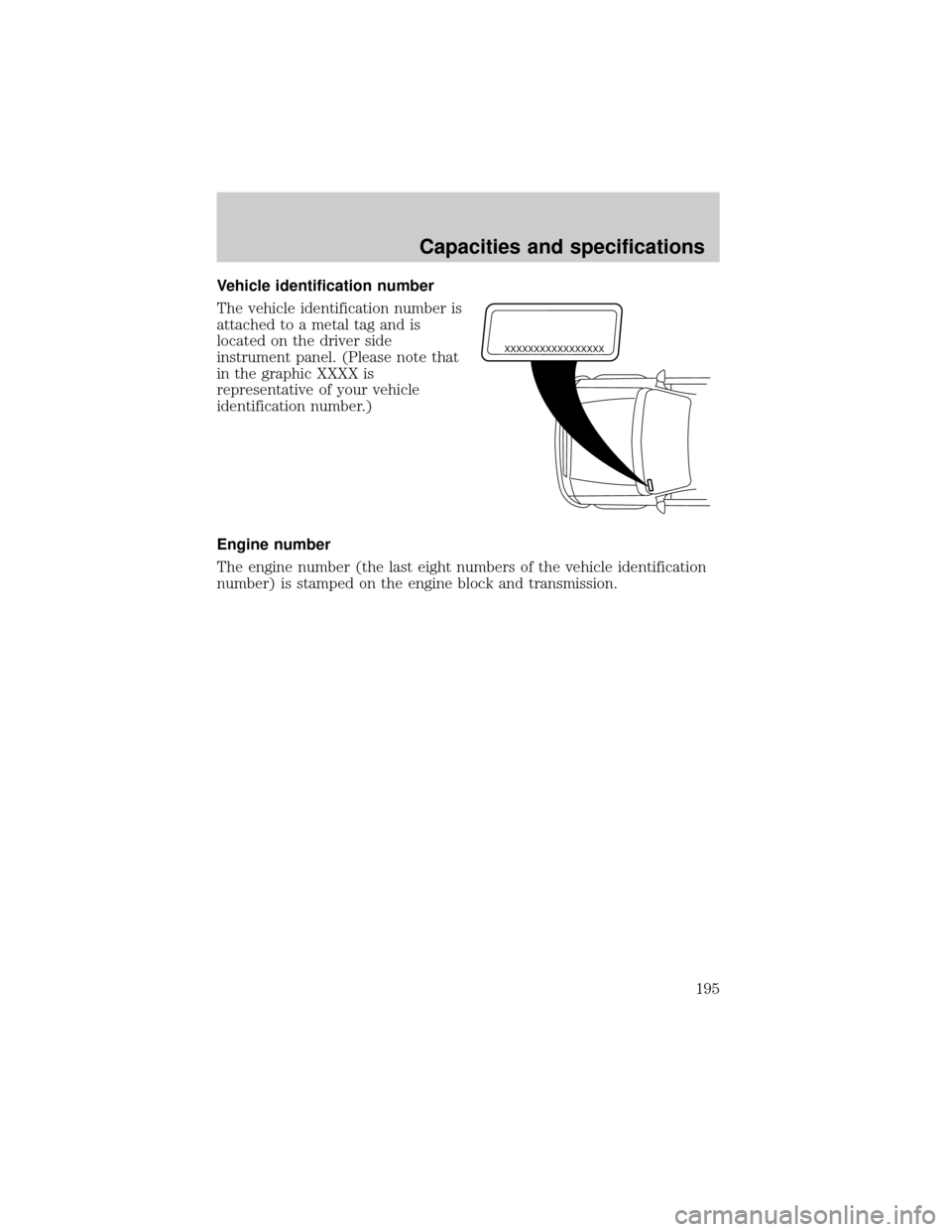
Vehicle identification number
The vehicle identification number is
attached to a metal tag and is
located on the driver side
instrument panel. (Please note that
in the graphic XXXX is
representative of your vehicle
identification number.)
Engine number
The engine number (the last eight numbers of the vehicle identification
number) is stamped on the engine block and transmission.
XXXXXXXXXXXXXXXXX
Capacities and specifications
195
Page 206 of 216
For maximum vehicle performance, keep the following information in
mind when adding accessories or equipment to your vehicle:
²When adding accessories, equipment, passengers and luggage to your
vehicle, do not exceed the total weight capacity of the vehicle or of
the front or rear axle (GVWR or GAWR as indicated on the Safety
compliance certification label). Consult your dealer for specific weight
information.
²The Federal Communications Commission (FCC) and Canadian Radio
Telecommunications Commission (CRTC) regulate the use of mobile
communications systems - such as two-way radios, telephones and
theft alarms - that are equipped with radio transmitters. Any such
equipment installed in your vehicle should comply with FCC or CRTC
regulations and should be installed only by a qualified service
technician.
²Mobile communications systems may harm the operation of your
vehicle, particularly if they are not properly designed for automotive
use or are not properly installed. When operated, such systems may
cause the engine to stumble or stall or cause the transmission to be
damaged or operate improperly. In addition, such systems may be
damaged or their performance may be affected by operating your
vehicle. (Citizens band [CB] transceivers, garage door openers and
other transmitters with outputs of five watts or less will not ordinarily
affect your vehicle's operation.)
²Ford cannot assume responsibility for any adverse effects or damage
that may result from the use of such equipment.
ORDERING ADDITIONAL OWNER'S LITERATURE
To order the publications in this portfolio, contact Helm, Incorporated at:
HELM, INCORPORATED
P.O. Box 07150
Detroit, Michigan 48207
Or call:
For a free publication catalog, order toll free: 1-800-782-4356
Monday-Friday 8:00 a.m. - 6:00 p.m. EST
(Items in this catalog may be purchased by credit card holders only.)
Customer assistance
206
Page 210 of 216

safety belts ..............................188
washing ....................................184
waxing .....................................184
wheels ......................................185
windows ..................................188
wiper blades ............................186
woodtone trim ........................188
Climate control (see Air
conditioning or Heating) ............38
Clock ......................................25, 33
Clutch
fluid ..........................................146
operation while driving ..........106
recommended shift speeds ....108
Coolant
checking and adding ..............148
refill capacities ................152, 190
specifications ..................191±192
Cruise control (see Speed
control) ........................................46
Customer Assistance ................114
Ford accessories for your
vehicle .....................................203
Ford Extended Service
Plan ..........................................196
Getting assistance outside the
U.S. and Canada .....................202
Getting roadside assistance ...114
Getting the service you
need .........................................196
Ordering additional owner's
literature .................................206
The Dispute Settlement
Board .......................................199
Utilizing the
Mediation/Arbitration
Program ...................................202D
Daytime running lamps (see
Lamps) .........................................44
Defrost
rear window ..............................43
Dipstick
automatic transmission
fluid ..........................................154
engine oil .................................142
Doors
lubricant specifications ..........191
Driving under special
conditions
through water .........................113
E
Emergencies, roadside
jump-starting ..........................129
Emission control system ..........174
Engine ................................192±193
check engine/service engine
soon light ....................................9
cleaning ...................................186
coolant .....................................148
idle speed control ...................157
lubrication
specifications ..................191±192
refill capacities ........................190
service points ..................140±141
starting after a collision .........115
Engine block heater ...................96
Engine oil ..................................142
checking and adding ..............142
dipstick ....................................142
filter, specifications ........144, 189
recommendations ...................144
refill capacities ........................190
Index
210
Page 214 of 216

Towing .......................................111
trailer towing ..........................111
wrecker ....................................134
Transaxle
automatic operation ...............101
fluid, refill capacities ..............190
lubricant specifications ..........192
Transmission
fluid, checking and adding
(automatic) .............................154
fluid, checking and adding
(manual) .................................156
lubricant specifications ..........191
Trip odometer .............................16
Trunk ...........................................56
remote release ....................18, 59
Turn signal ............................11, 46
V
Vehicle dimensions ...................193
Vehicle Identification Number
(VIN) ..........................................195Vehicle loading ..........................109
Ventilating your vehicle .............97
W
Warning chimes .....................12±13
Warning lights (see Lights) .........8
Washer fluid ..............................147
Water, Driving through .............113
Windows
power .........................................55
Windshield washer fluid and
wipers
checking and adding fluid .....147
checking and cleaning ............160
operation ...................................51
replacing wiper blades ...........161
Wrecker towing .........................134
Index
214