brake light FORD ESCORT 2002 7.G User Guide
[x] Cancel search | Manufacturer: FORD, Model Year: 2002, Model line: ESCORT, Model: FORD ESCORT 2002 7.GPages: 216, PDF Size: 1.8 MB
Page 106 of 216
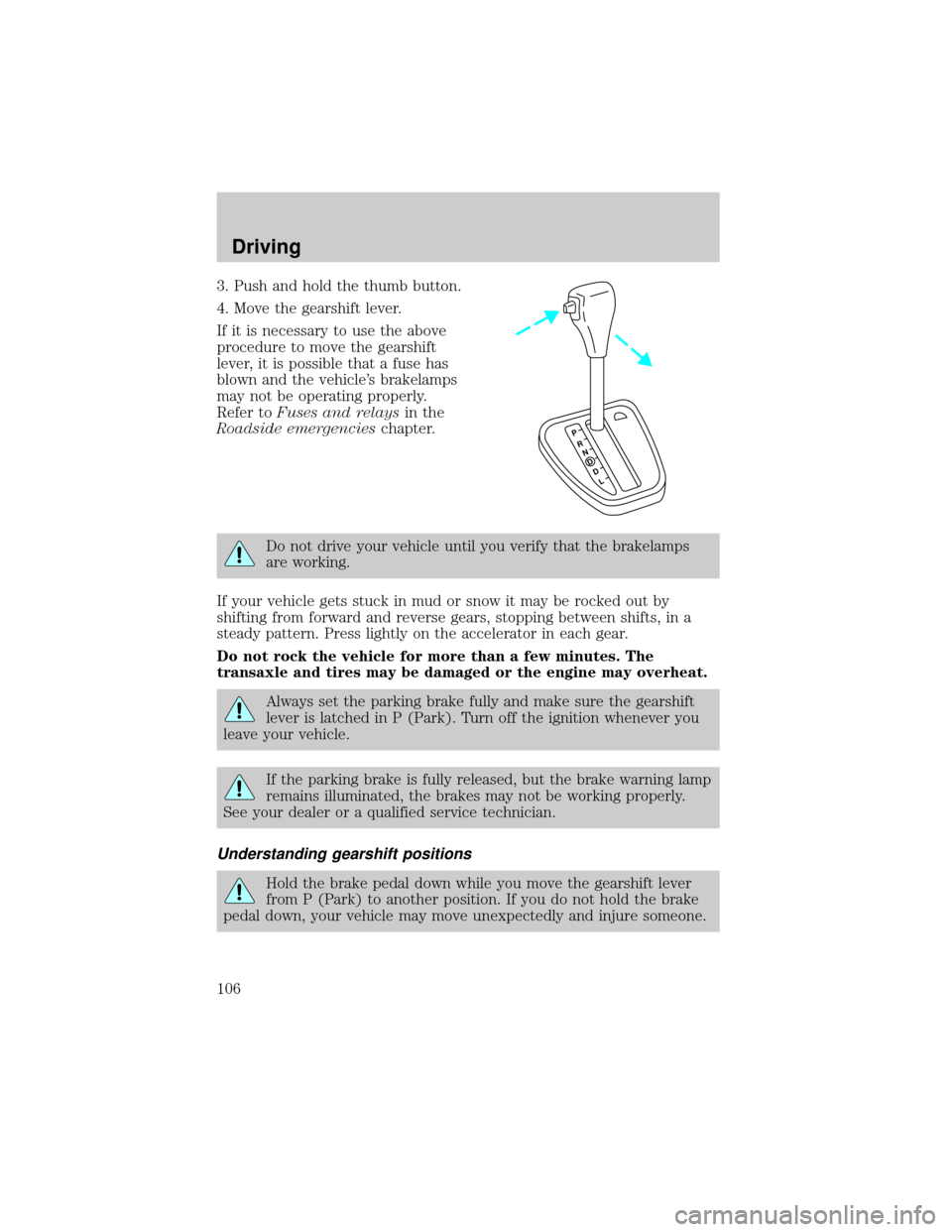
3. Push and hold the thumb button.
4. Move the gearshift lever.
If it is necessary to use the above
procedure to move the gearshift
lever, it is possible that a fuse has
blown and the vehicle's brakelamps
may not be operating properly.
Refer toFuses and relaysin the
Roadside emergencieschapter.
Do not drive your vehicle until you verify that the brakelamps
are working.
If your vehicle gets stuck in mud or snow it may be rocked out by
shifting from forward and reverse gears, stopping between shifts, in a
steady pattern. Press lightly on the accelerator in each gear.
Do not rock the vehicle for more than a few minutes. The
transaxle and tires may be damaged or the engine may overheat.
Always set the parking brake fully and make sure the gearshift
lever is latched in P (Park). Turn off the ignition whenever you
leave your vehicle.
If the parking brake is fully released, but the brake warning lamp
remains illuminated, the brakes may not be working properly.
See your dealer or a qualified service technician.
Understanding gearshift positions
Hold the brake pedal down while you move the gearshift lever
from P (Park) to another position. If you do not hold the brake
pedal down, your vehicle may move unexpectedly and injure someone.
PRND
D
L
Driving
106
Page 113 of 216
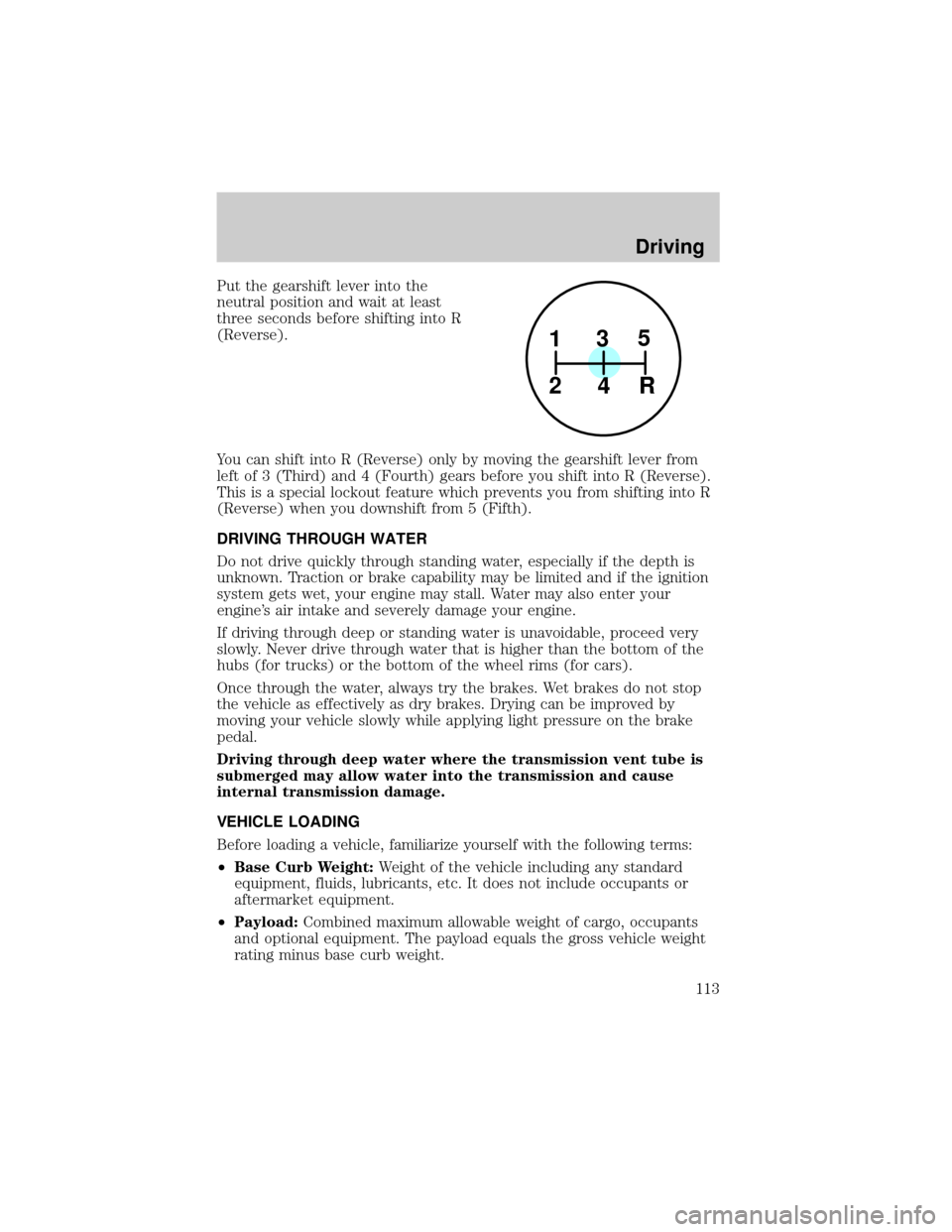
Put the gearshift lever into the
neutral position and wait at least
three seconds before shifting into R
(Reverse).
You can shift into R (Reverse) only by moving the gearshift lever from
left of 3 (Third) and 4 (Fourth) gears before you shift into R (Reverse).
This is a special lockout feature which prevents you from shifting into R
(Reverse) when you downshift from 5 (Fifth).
DRIVING THROUGH WATER
Do not drive quickly through standing water, especially if the depth is
unknown. Traction or brake capability may be limited and if the ignition
system gets wet, your engine may stall. Water may also enter your
engine's air intake and severely damage your engine.
If driving through deep or standing water is unavoidable, proceed very
slowly. Never drive through water that is higher than the bottom of the
hubs (for trucks) or the bottom of the wheel rims (for cars).
Once through the water, always try the brakes. Wet brakes do not stop
the vehicle as effectively as dry brakes. Drying can be improved by
moving your vehicle slowly while applying light pressure on the brake
pedal.
Driving through deep water where the transmission vent tube is
submerged may allow water into the transmission and cause
internal transmission damage.
VEHICLE LOADING
Before loading a vehicle, familiarize yourself with the following terms:
²Base Curb Weight:Weight of the vehicle including any standard
equipment, fluids, lubricants, etc. It does not include occupants or
aftermarket equipment.
²Payload:Combined maximum allowable weight of cargo, occupants
and optional equipment. The payload equals the gross vehicle weight
rating minus base curb weight.
1
24R35
Driving
113
Page 123 of 216
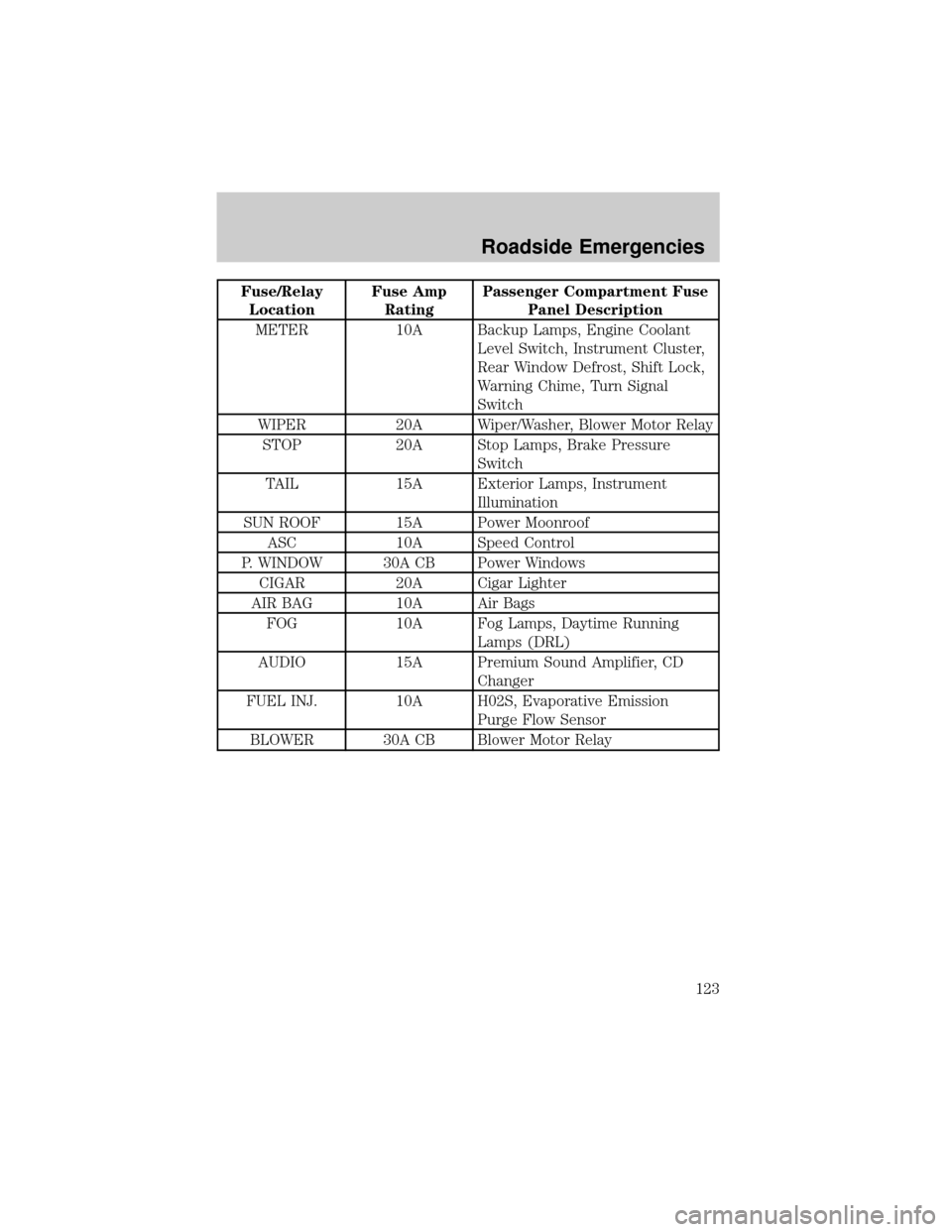
Fuse/Relay
LocationFuse Amp
RatingPassenger Compartment Fuse
Panel Description
METER 10A Backup Lamps, Engine Coolant
Level Switch, Instrument Cluster,
Rear Window Defrost, Shift Lock,
Warning Chime, Turn Signal
Switch
WIPER 20A Wiper/Washer, Blower Motor Relay
STOP 20A Stop Lamps, Brake Pressure
Switch
TAIL 15A Exterior Lamps, Instrument
Illumination
SUN ROOF 15A Power Moonroof
ASC 10A Speed Control
P. WINDOW 30A CB Power Windows
CIGAR 20A Cigar Lighter
AIR BAG 10A Air Bags
FOG 10A Fog Lamps, Daytime Running
Lamps (DRL)
AUDIO 15A Premium Sound Amplifier, CD
Changer
FUEL INJ. 10A H02S, Evaporative Emission
Purge Flow Sensor
BLOWER 30A CB Blower Motor Relay
Roadside Emergencies
123
Page 156 of 216
SERVICE RECOMMENDATIONS
To help you service your vehicle:
²We highlight do-it-yourself items in the engine compartment for easy
location.
²We provide a scheduled maintenance guide which makes tracking
routine service easy.
If your vehicle requires professional service, your dealership can provide
the necessary parts and service. Check yourWarranty Guideto find out
which parts and services are covered.
Use only recommended fuels, lubricants, fluids and service parts
conforming to specifications. Motorcraft parts are designed and built to
provide the best performance in your vehicle.
PRECAUTIONS WHEN SERVICING YOUR VEHICLE
Be especially careful when inspecting or servicing your vehicle.
²Do not work on a hot engine.
²When the engine is running, keep loose clothing, jewelry or long hair
away from moving parts.
²Do not work on a vehicle with the engine running in an enclosed
space, unless you are sure you have enough ventilation.
²Keep all lit cigarettes, open flames and other lit material away from
the battery and all fuel related parts.
If you disconnect the battery, the engine must ªrelearnº its idle
conditions before your vehicle will drive properly, as explained in the
Batterysection in this chapter.
Working with the engine off
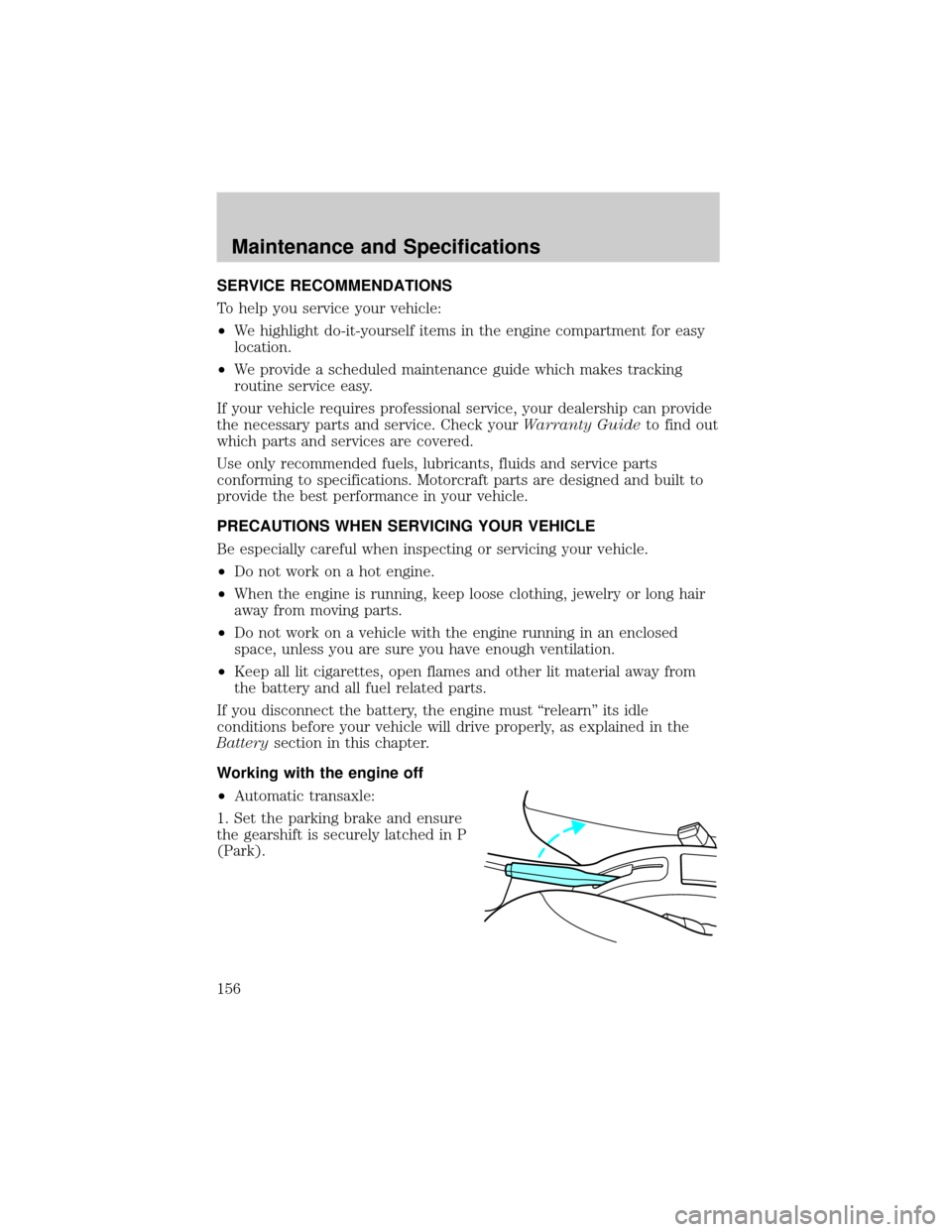
²Automatic transaxle:
1. Set the parking brake and ensure
the gearshift is securely latched in P
(Park).
Maintenance and Specifications
156
Page 168 of 216
Batteries normally produce explosive gases which can cause
personal injury. Therefore, do not allow flames, sparks or lighted
substances to come near the battery. When working near the battery,
always shield your face and protect your eyes. Always provide proper
ventilation.
When lifting a plastic-cased battery, excessive pressure on the
end walls could cause acid to flow through the vent caps,
resulting in personal injury and/or damage to the vehicle or battery.
Lift the battery with a battery carrier or with your hands on opposite
corners.
Keep batteries out of reach of children. Batteries contain sulfuric
acid. Avoid contact with skin, eyes or clothing. Shield your eyes
when working near the battery to protect against possible splashing of
acid solution. In case of acid contact with skin or eyes, flush
immediately with water for a minimum of 15 minutes and get prompt
medical attention. If acid is swallowed, call a physician immediately.
Battery posts, terminals and related accessories contain lead and
lead compounds.Wash hands after handling.
Because your vehicle's engine is electronically controlled by a computer,
some control conditions are maintained by power from the battery. When
the battery is disconnected or a new battery is installed, the engine must
relearn its idle and fuel trim strategy for optimum driveability and
performance. To begin this process:
1. With the vehicle at a complete stop, set the parking brake.
2. Put the gearshift in P (Park) (automatic transaxle) or the neutral
position (manual transaxle), turn off all accessories and start the engine.
3. Run the engine until it reaches normal operating temperature.
4. Allow the engine to idle for at least one minute.
5. Turn the A/C on and allow the engine to idle for at least one minute.
6. Drive the vehicle to complete the relearning process.
²The vehicle may need to be driven 16 km (10 miles) or more to
relearn the idle and fuel trim strategy.
Maintenance and Specifications
168
Page 182 of 216
![FORD ESCORT 2002 7.G User Guide ²Slow down gradually.
²Driving at reasonable speeds (traveling at 88 km/h [55 mph] uses 15%
less fuel than traveling at 105 km/h [65 mph]).
²Revving the engine before turning it off may reduce fuel](/img/11/4895/w960_4895-181.png "FORD ESCORT 2002 7.G User Guide ²Slow down gradually.
²Driving at reasonable speeds (traveling at 88 km/h [55 mph] uses 15%
less fuel than traveling at 105 km/h [65 mph]).
²Revving the engine before turning it off may reduce fuel")
²Slow down gradually.
²Driving at reasonable speeds (traveling at 88 km/h [55 mph] uses 15%
less fuel than traveling at 105 km/h [65 mph]).
²Revving the engine before turning it off may reduce fuel economy.
²Using the air conditioner or defroster may reduce fuel economy.
²You may want to turn off the speed control in hilly terrain if
unnecessary shifting between third and fourth gear occurs.
Unnecessary shifting of this type could result in reduced fuel
economy.
²Warming up a vehicle on cold mornings is not required and may
reduce fuel economy.
²Resting your foot on the brake pedal while driving may reduce fuel
economy.
²Combine errands and minimize stop-and-go driving.
Maintenance
²Keep tires properly inflated and use only recommended size.
²Operating a vehicle with the wheels out of alignment will reduce fuel
economy.
²Use recommended engine oil. Refer toLubricant specificationsin
this chapter.
²Perform all regularly scheduled maintenance items. Follow the
recommended maintenance schedule and owner maintenance checks
found in your vehicle scheduled maintenance guide.
Conditions
²Heavily loading a vehicle or towing a trailer may reduce fuel economy
at any speed.
²Carrying unnecessary weight may reduce fuel economy (approximately
0.4 km/L [1 mpg] is lost for every 180 kg [400 lb] of weight carried).
²Adding certain accessories to your vehicle (for example bug
deflectors, rollbars/light bars, running boards, ski/luggage racks) may
reduce fuel economy.
²Using fuel blended with alcohol may lower fuel economy.
²Fuel economy may decrease with lower temperatures during the first
12±16 km (8±10 miles) of driving.
Maintenance and Specifications
182
Page 205 of 216

A
Air bag supplemental
restraint system ..........................85
and child safety seats ..............87
description ................................85
disposal ......................................89
driver air bag ............................87
indicator light .....................12, 89
operation ...................................87
passenger air bag .....................87
Air cleaner filter ...............190, 195
Air conditioning
manual heating and air
conditioning system .................38
Antifreeze
(see Engine coolant) ................169
Anti-lock brake system
(see Brakes) ......................102±103
Anti-theft system ..................69±70
arming the system ....................70
disarming a triggered
system .................................70±71
disarming an untriggered
system .......................................70
warning light .............................14
Automatic transaxle .................105
driving with .............................106
fluid, adding ............................187
fluid, checking ........................187
fluid, refill capacities ..............195
fluid, specification ..................198
Axle
lubricant specifications ..........196
B
Battery .......................................167
acid, treating emergencies .....167charging system
warning light .............................12
jumping a disabled battery ....132
maintenance-free ....................167
replacement, specifications ...195
servicing ..................................167
Belt minder .................................81
Brakes ........................................102
anti-lock ...........................102±103
anti-lock brake system
(ABS) warning light .........12, 103
brake warning light ..................12
fluid, checking and adding ....186
fluid, refill capacities ..............195
fluid, specifications .........196, 198
lubricant specifications ..196, 198
parking ....................................104
shift interlock ..........................105
Break-in period .............................6
C
Capacities for refilling fluids ....195
Certification Label ....................200
Child safety restraints ................90
child safety belts ......................90
Child safety seats ........................91
attaching with tether straps ....95
in front seat ..............................92
in rear seat ................................92
Cleaning your vehicle
engine compartment ..............150
exterior ....................................154
instrument cluster lens ..........153
instrument panel ....................152
interior .....................................153
plastic parts ....................151±152
safety belts ..............................154
washing ....................................148
Index
205
Page 208 of 216

J
Jack ............................................128
positioning ...............................128
storage .....................................128
Jump-starting your vehicle ......132
K
Keys
key in ignition chime ...............14
positions of the ignition ...........97
L
Lamps
bulb replacement
specifications chart ..................48
cargo lamps ...............................43
daytime running light ...............42
fog lamps ...................................42
headlamps ...........................42, 49
headlamps, flash to pass ..........43
instrument panel, dimming .....43
interior lamps .....................46±49
replacing bulbs .............47, 50±52
Lane change indicator
(see Turn signal) ........................46
Lights, warning and indicator ....10
air bag ........................................12
anti-lock brakes (ABS) ....12, 103
anti-theft ...................................14
brake ..........................................12
charging system ........................12
fuel cap light .............................13
high beam .................................14
low fuel ......................................13
oil pressure ...............................13
safety belt .................................12
service engine soon ..................11
turn signal indicator .................13
Load limits .................................113GAWR ......................................113
GVWR ......................................113
trailer towing ..........................113
Locks
childproof ..................................63
Lubricant specifications ...196, 198
M
Manual transaxle
fluid capacities ........................195
lubricant specifications ..........198
reverse .....................................112
Mirrors
side view mirrors (power) .......56
Moon roof ....................................61
Motorcraft parts ................179, 195
O
Octane rating ............................178
Odometer .....................................17
Oil (see Engine oil) ..................164
P
Panic alarm feature, remote
entry system ................................67
Parking brake ............................104
Parts (see Motorcraft parts) ....195
Power distribution box
(see Fuses) ...............................125
Power door locks ........................63
Power steering ..........................104
fluid, checking and adding ....185
fluid, refill capacity ................195
fluid,
specifications ..................196, 198
Index
208