wheel FORD ESCORT 2002 7.G Owner's Manual
[x] Cancel search | Manufacturer: FORD, Model Year: 2002, Model line: ESCORT, Model: FORD ESCORT 2002 7.GPages: 216, PDF Size: 1.8 MB
Page 182 of 216
![FORD ESCORT 2002 7.G Owners Manual ²Slow down gradually.
²Driving at reasonable speeds (traveling at 88 km/h [55 mph] uses 15%
less fuel than traveling at 105 km/h [65 mph]).
²Revving the engine before turning it off may reduce fuel](/img/11/4895/w960_4895-181.png "FORD ESCORT 2002 7.G Owners Manual ²Slow down gradually.
²Driving at reasonable speeds (traveling at 88 km/h [55 mph] uses 15%
less fuel than traveling at 105 km/h [65 mph]).
²Revving the engine before turning it off may reduce fuel")
²Slow down gradually.
²Driving at reasonable speeds (traveling at 88 km/h [55 mph] uses 15%
less fuel than traveling at 105 km/h [65 mph]).
²Revving the engine before turning it off may reduce fuel economy.
²Using the air conditioner or defroster may reduce fuel economy.
²You may want to turn off the speed control in hilly terrain if
unnecessary shifting between third and fourth gear occurs.
Unnecessary shifting of this type could result in reduced fuel
economy.
²Warming up a vehicle on cold mornings is not required and may
reduce fuel economy.
²Resting your foot on the brake pedal while driving may reduce fuel
economy.
²Combine errands and minimize stop-and-go driving.
Maintenance
²Keep tires properly inflated and use only recommended size.
²Operating a vehicle with the wheels out of alignment will reduce fuel
economy.
²Use recommended engine oil. Refer toLubricant specificationsin
this chapter.
²Perform all regularly scheduled maintenance items. Follow the
recommended maintenance schedule and owner maintenance checks
found in your vehicle scheduled maintenance guide.
Conditions
²Heavily loading a vehicle or towing a trailer may reduce fuel economy
at any speed.
²Carrying unnecessary weight may reduce fuel economy (approximately
0.4 km/L [1 mpg] is lost for every 180 kg [400 lb] of weight carried).
²Adding certain accessories to your vehicle (for example bug
deflectors, rollbars/light bars, running boards, ski/luggage racks) may
reduce fuel economy.
²Using fuel blended with alcohol may lower fuel economy.
²Fuel economy may decrease with lower temperatures during the first
12±16 km (8±10 miles) of driving.
Maintenance and Specifications
182
Page 185 of 216
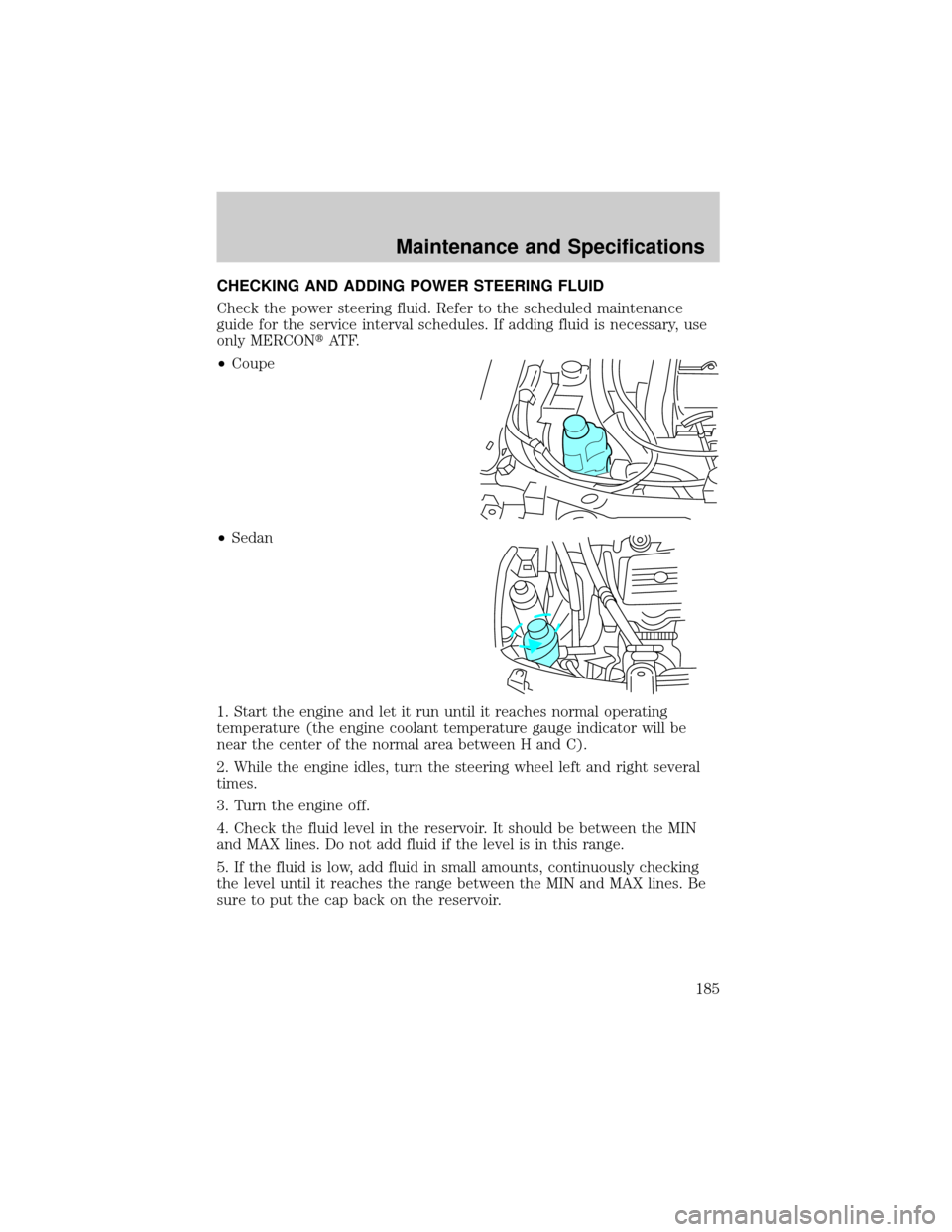
CHECKING AND ADDING POWER STEERING FLUID
Check the power steering fluid. Refer to the scheduled maintenance
guide for the service interval schedules. If adding fluid is necessary, use
only MERCONtAT F.
²Coupe
²Sedan
1. Start the engine and let it run until it reaches normal operating
temperature (the engine coolant temperature gauge indicator will be
near the center of the normal area between H and C).
2. While the engine idles, turn the steering wheel left and right several
times.
3. Turn the engine off.
4. Check the fluid level in the reservoir. It should be between the MIN
and MAX lines. Do not add fluid if the level is in this range.
5. If the fluid is low, add fluid in small amounts, continuously checking
the level until it reaches the range between the MIN and MAX lines. Be
sure to put the cap back on the reservoir.
Maintenance and Specifications
185
Page 192 of 216
The traction grade assigned to this tire is based on
straight-ahead braking traction tests, and does not include
acceleration, cornering, hydroplaning or peak traction characteristics.
Temperature A B C
The temperature grades are A (the highest), B, and C, representing the tire's
resistance to the generation of heat and its ability to dissipate heat when
tested under controlled conditions on a specified indoor laboratory test
wheel. Sustained high temperature can cause the material of the tire to
degenerate and reduce tire life, and excessive temperature can lead to
sudden tire failure. The grade C corresponds to a level of performance which
all passenger car tires must meet under the Federal Motor Vehicle Safety
Standard No. 109. Grades B and A represent higher levels of performance on
the laboratory test wheel than the minimum required by law.
The temperature grade for this tire is established for a tire that
is properly inflated and not overloaded. Excessive speed,
underinflation, or excessive loading, either separately or in
combination, can cause heat buildup and possible tire failure.
SERVICING YOUR TIRES
Checking the tire pressure
²Use an accurate tire pressure gauge.
²Check the tire pressure when tires are cold, after the vehicle has been
parked for at least one hour or has been driven less than 5 km
(3 miles).
²Adjust tire pressure to recommended specifications found on the Tire
Label located on the right hand door frame.
Improperly inflated tires can affect vehicle handling and can fail
suddenly, possibly resulting in loss of vehicle control.
Tire rotation
Because your vehicle's tires perform different jobs, they often wear
differently. To make sure your tires wear evenly and last longer, rotate
them as indicated in the scheduled maintenance guide. If you notice that
the tires wear unevenly, have them checked.
Maintenance and Specifications
192
Page 194 of 216
Failure to follow these precautions may adversely affect the
handling of the vehicle and make it easier for the driver to lose
control and roll over.
Tires that are larger or smaller than your vehicle's original tires may also
affect the accuracy of your speedometer.
SNOW TIRES AND CHAINS
Snow tires must be the same size and grade as the tires you
currently have on your vehicle.
The tires on your vehicle have all weather treads to provide traction in
rain and snow. However, in some climates, you may need to use snow
tires and chains. If you need to use snow tires and chains, it is
recommended that steel wheels are used of the same size and
specifications as those originally installed.
Follow these guidelines when using snow tires and chains:
²Do not use tire chains on aluminum wheels. Chains may chip the
wheels.
²SAE Class S chains may be used on P185/65R14 tires.
²Do not use tire chains with 38 cm (15 inch) wheel/tire options. Using
chains on this size tire may cause damage to steering, suspension
and/or body components.
²Install chains securely, verifying that the chains do not touch any
wiring, brake lines or fuel lines.
²Drive cautiously. If you hear the chains rub or bang against your
vehicle, stop and re-tighten the chains. If this does not work, remove
the chains to prevent damage to your vehicle.
²If possible, avoid fully loading your vehicle.
²Remove the tire chains when they are no longer needed. Do not use
tire chains on dry roads.
²The suspension insulation and bumpers will help prevent vehicle
damage. Do not remove these components from your vehicle when
using snow tires and chains.
Maintenance and Specifications
194
Page 198 of 216
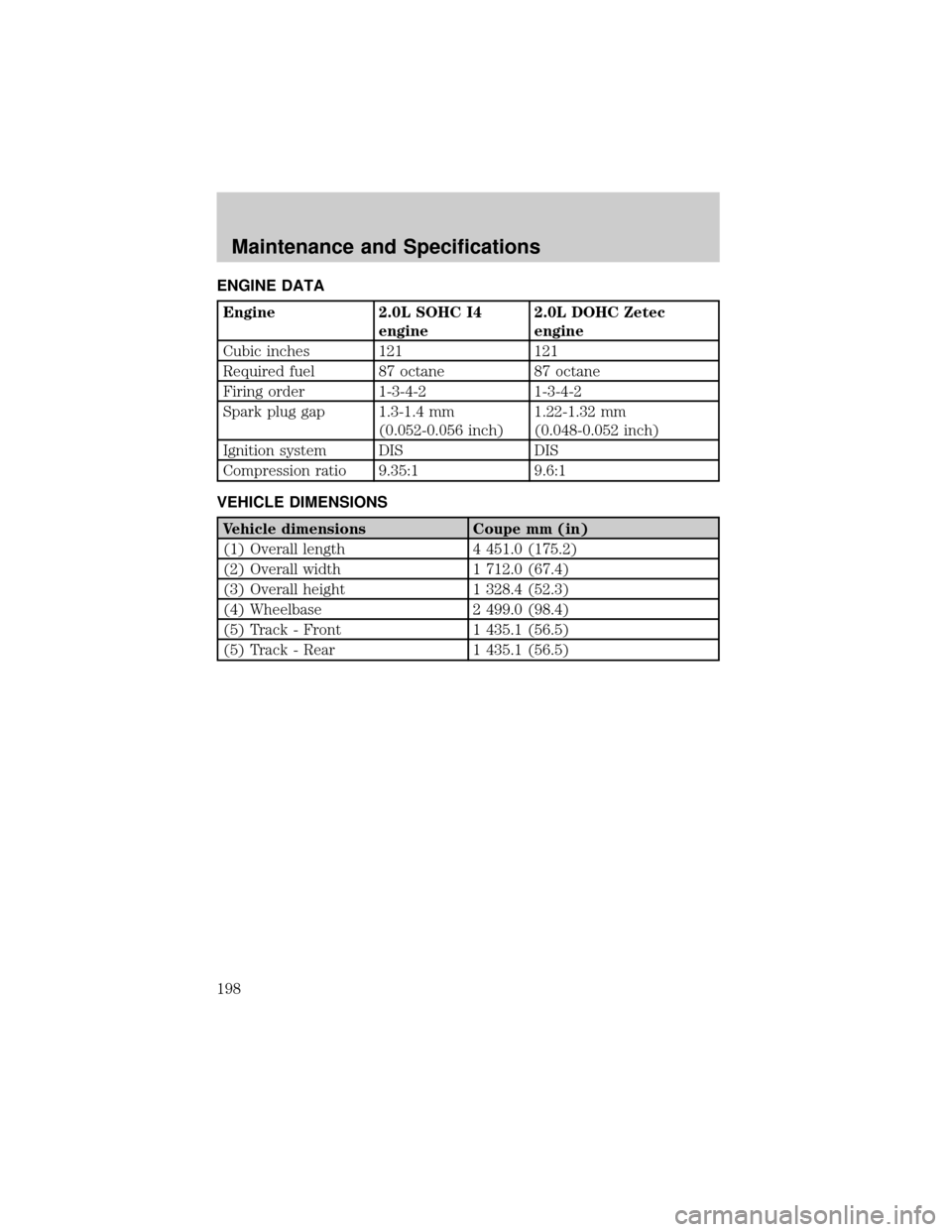
ENGINE DATA
Engine 2.0L SOHC I4
engine2.0L DOHC Zetec
engine
Cubic inches 121 121
Required fuel 87 octane 87 octane
Firing order 1-3-4-2 1-3-4-2
Spark plug gap 1.3-1.4 mm
(0.052-0.056 inch)1.22-1.32 mm
(0.048-0.052 inch)
Ignition system DIS DIS
Compression ratio 9.35:1 9.6:1
VEHICLE DIMENSIONS
Vehicle dimensions Coupe mm (in)
(1) Overall length 4 451.0 (175.2)
(2) Overall width 1 712.0 (67.4)
(3) Overall height 1 328.4 (52.3)
(4) Wheelbase 2 499.0 (98.4)
(5) Track - Front 1 435.1 (56.5)
(5) Track - Rear 1 435.1 (56.5)
Maintenance and Specifications
198
Page 202 of 216

FORD ACCESSORIES FOR YOUR VEHICLE
A wide selection of genuine Ford accessories are available for your
vehicle through your local authorized Ford, Lincoln, Mercury or Ford of
Canada dealer. These quality accessories have been specifically
engineered to fulfill your automotive needs; they are custom designed to
complement the style and aerodynamic appearance of your vehicle. In
addition, each accessory is made from high quality materials and meets
or exceeds Ford's rigorous engineering and safety specifications. Ford
Motor Company will repair or replace any properly dealer-installed Ford
accessory found to be defective in factory-supplied materials or
workmanship during the warranty period, as well as any component
damaged by the defective accessory. The accessory will be warranted for
whichever provides you the greatest benefit:
²12 months or 20 000 km (12 000 miles) (whichever occurs first), or
²The remainder of your new vehicle limited warranty.
This means that genuine Ford accessories purchased along with your
new vehicle and installed by the dealer are covered for the full length of
your New Vehicle's Limited Warranty Ð 3 years or 60 000 km (36 000 miles)
(whichever occurs first). Contact your dealer for details and a copy of
the warranty.
Not all accessories are available for all models.
Vehicle Security
Remote keyless entry
Wheel locks for alloy wheels
Vehicle security systems
Comfort and convenience
Air conditioner
Cargo net
Cargo organizer
Engine block heater
Remote start system
Accessories
202
Page 206 of 216

waxing .....................................148
wheels ......................................149
windows ..................................154
wiper blades ............................152
Clock ......................................21, 28
Clutch
fluid ..........................................187
operation while driving ..........110
recommended shift speeds ....112
Coolant
checking and adding ..............169
refill capacities ................173, 195
specifications ..................196, 198
Cruise control
(see Speed control) ....................57
Customer Assistance ................118
Ford accessories for your
vehicle .....................................155
Ford Extended Service
Plan ..........................................138
Getting assistance outside
the U.S. and Canada ..............144
Getting roadside assistance ...118
Getting the service
you need .................................138
Ordering additional
owner's literature ...................145
The Dispute Settlement
Board .......................................141
Utilizing the Mediation/
Arbitration Program ...............144
D
Daytime running lamps
(see Lamps) ................................42
Defrost
rear window ..............................41Dipstick
automatic transmission
fluid ..........................................187
engine oil .................................164
Doors
lubricant specifications ..........196
Driving under special
conditions
through water .........................113
E
Emergencies, roadside
jump-starting ..........................132
Emission control system ..........183
Engine ........................................198
check engine/service engine
soon light ..................................11
cleaning ...................................150
coolant .....................................169
idle speed control ...................167
lubrication
specifications ..................196, 198
refill capacities ........................195
service points ..................161±162
starting after a collision .........119
Engine block heater .................101
Engine oil ..................................164
checking and adding ..............164
dipstick ....................................164
filter, specifications ........166, 195
recommendations ...................166
refill capacities ........................195
specifications ..................196, 198
Exhaust fumes ..........................101
F
Floor mats ...................................62
Index
206
Page 209 of 216

R
Rear window defroster ...............41
Relays ................................121, 128
Remote entry system ...........65, 67
illuminated entry ......................69
locking/unlocking doors .....63, 66
opening the trunk .....................67
panic alarm ...............................67
replacement/additional
transmitters ...............................68
replacing the batteries .............67
S
Safety belts (see
Safety restraints) ............14, 75±79
Safety defects, reporting ..........147
Safety restraints ....................75±79
belt minder ...............................81
cleaning the safety
belts ...................................84, 154
extension assembly ..................80
for adults .............................76±78
for children .........................89±90
lap belt ......................................79
warning light and
chime .............................12, 14, 80
Safety seats for children ............91
Seat belts
(see Safety restraints) ...............75
Seats ............................................72
child safety seats ......................91
Servicing your vehicle ..............156
Spark plugs, specifications ......195,
198
Specification chart,
lubricants ...........................196, 198Speed control ..............................57
Speedometer ...............................17
Starting your vehicle ....97±98, 100
jump starting ..........................132
Steering wheel
controls ................................54, 57
tilting .........................................54
T
Tachometer .................................17
Temperature control
(see Climate control) .................37
Tires ...........................128, 191±192
changing ..........................128±129
checking the pressure ............192
replacing ..................................193
rotating ....................................192
snow tires and chains ............194
tire grades ...............................192
treadwear ................................191
Towing .......................................115
trailer towing ..........................115
wrecker ....................................137
Transaxle
automatic operation ...............105
fluid, refill capacities ..............195
lubricant specifications ..........198
Transmission
fluid, checking and adding
(automatic) .............................187
fluid, checking and adding
(manual) .................................189
lubricant specifications ..........196
Trip odometer .............................17
Trunk ...........................................64
remote release ....................62, 67
Turn signal ............................13, 46
Index
209