steering FORD EXCURSION 2000 1.G User Guide
[x] Cancel search | Manufacturer: FORD, Model Year: 2000, Model line: EXCURSION, Model: FORD EXCURSION 2000 1.GPages: 232, PDF Size: 2.01 MB
Page 146 of 232
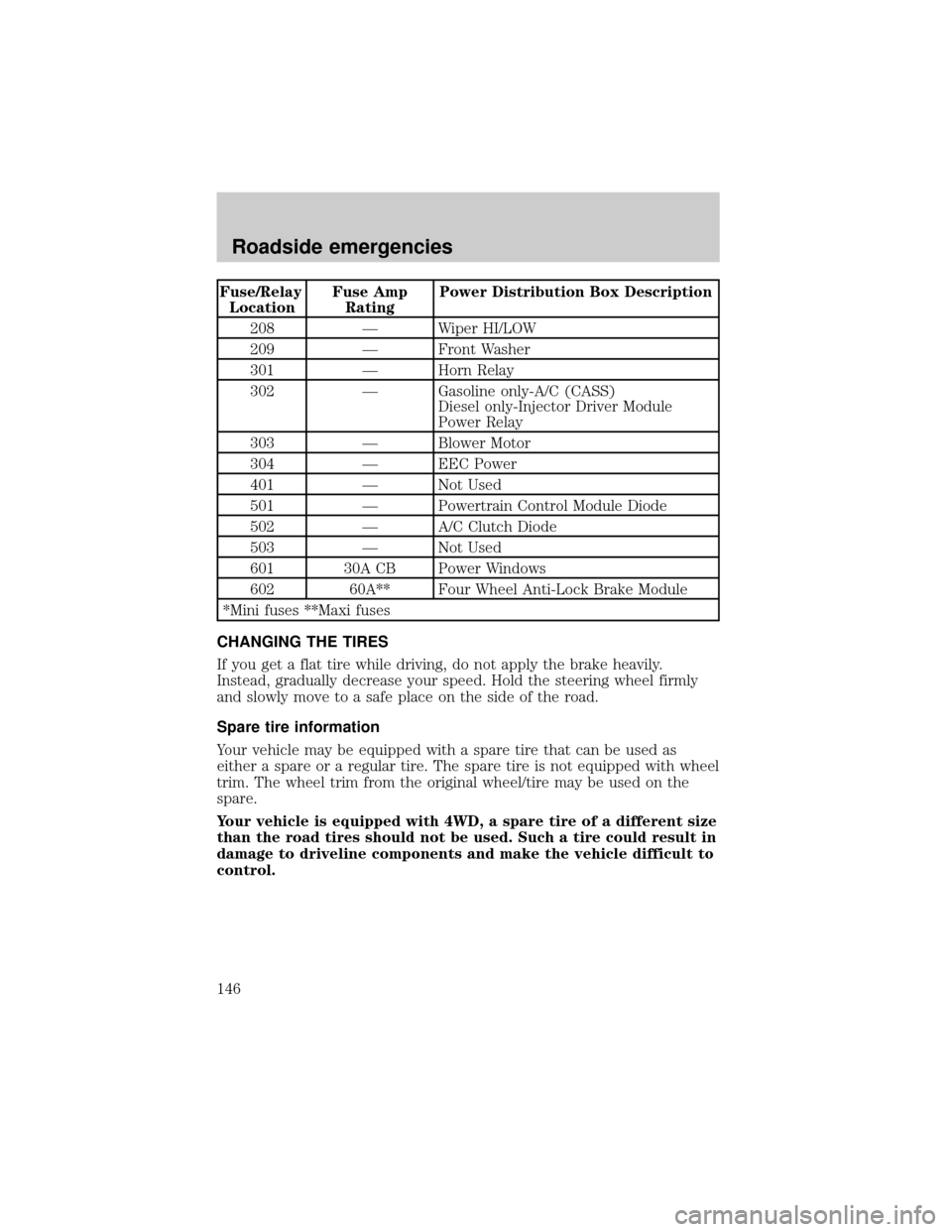
Fuse/Relay
LocationFuse Amp
RatingPower Distribution Box Description
208 Ð Wiper HI/LOW
209 Ð Front Washer
301 Ð Horn Relay
302 Ð Gasoline only-A/C (CASS)
Diesel only-Injector Driver Module
Power Relay
303 Ð Blower Motor
304 Ð EEC Power
401 Ð Not Used
501 Ð Powertrain Control Module Diode
502 Ð A/C Clutch Diode
503 Ð Not Used
601 30A CB Power Windows
602 60A** Four Wheel Anti-Lock Brake Module
*Mini fuses **Maxi fuses
CHANGING THE TIRES
If you get a flat tire while driving, do not apply the brake heavily.
Instead, gradually decrease your speed. Hold the steering wheel firmly
and slowly move to a safe place on the side of the road.
Spare tire information
Your vehicle may be equipped with a spare tire that can be used as
either a spare or a regular tire. The spare tire is not equipped with wheel
trim. The wheel trim from the original wheel/tire may be used on the
spare.
Your vehicle is equipped with 4WD, a spare tire of a different size
than the road tires should not be used. Such a tire could result in
damage to driveline components and make the vehicle difficult to
control.
Roadside emergencies
146
Page 160 of 232
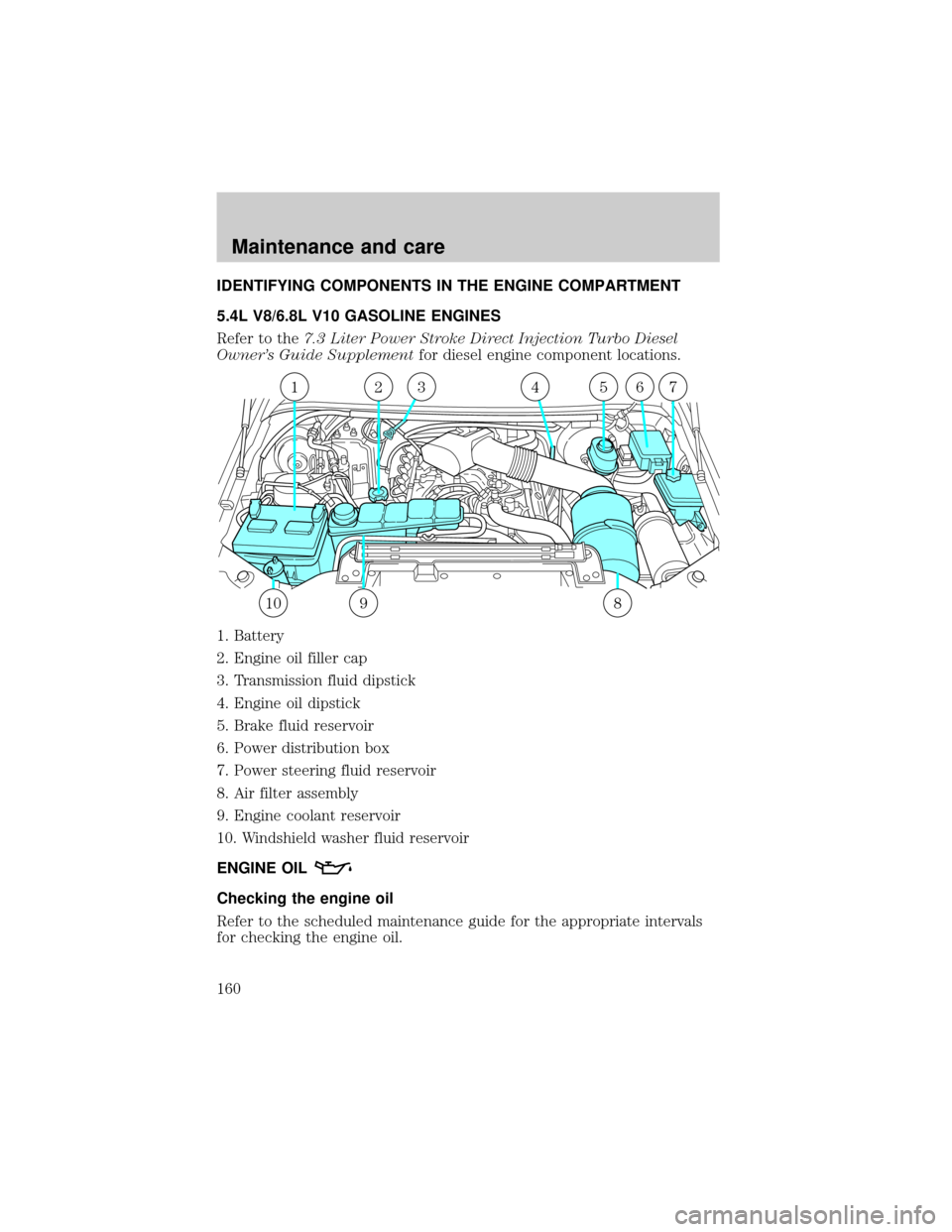
IDENTIFYING COMPONENTS IN THE ENGINE COMPARTMENT
5.4L V8/6.8L V10 GASOLINE ENGINES
Refer to the7.3 Liter Power Stroke Direct Injection Turbo Diesel
Owner's Guide Supplementfor diesel engine component locations.
1. Battery
2. Engine oil filler cap
3. Transmission fluid dipstick
4. Engine oil dipstick
5. Brake fluid reservoir
6. Power distribution box
7. Power steering fluid reservoir
8. Air filter assembly
9. Engine coolant reservoir
10. Windshield washer fluid reservoir
ENGINE OIL
Checking the engine oil
Refer to the scheduled maintenance guide for the appropriate intervals
for checking the engine oil.
123456
1089
7
Maintenance and care
160
Page 170 of 232
What you should know about fail-safe cooling (if equipped)
If the engine coolant supply is depleted, this feature allows the vehicle to
be driven temporarily before incremental component damage is incurred.
The ªfail-safeº distance depends on ambient temperatures, vehicle load
and terrain.
How fail-safe cooling works
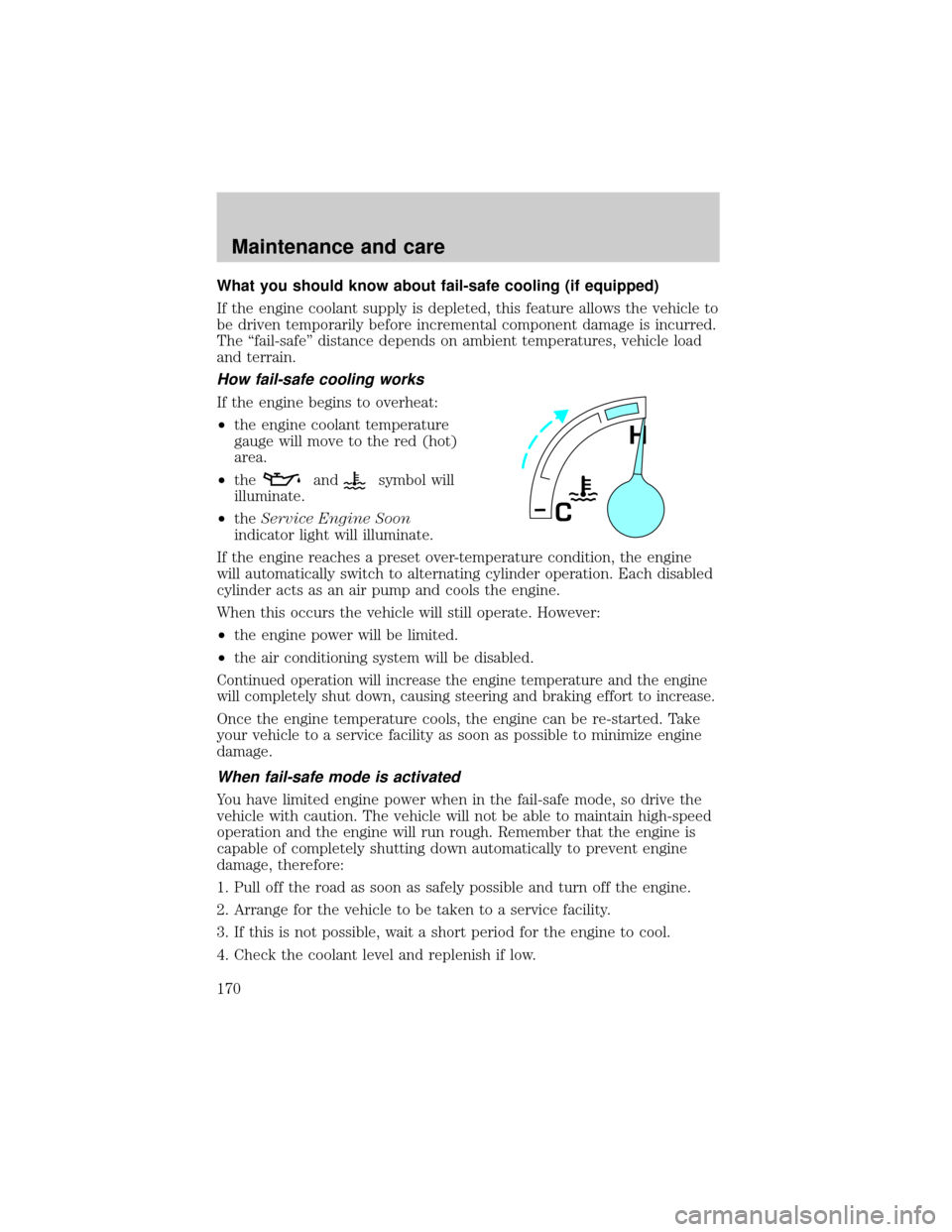
If the engine begins to overheat:
²the engine coolant temperature
gauge will move to the red (hot)
area.
²the
andsymbol will
illuminate.
²theService Engine Soon
indicator light will illuminate.
If the engine reaches a preset over-temperature condition, the engine
will automatically switch to alternating cylinder operation. Each disabled
cylinder acts as an air pump and cools the engine.
When this occurs the vehicle will still operate. However:
²the engine power will be limited.
²the air conditioning system will be disabled.
Continued operation will increase the engine temperature and the engine
will completely shut down, causing steering and braking effort to increase.
Once the engine temperature cools, the engine can be re-started. Take
your vehicle to a service facility as soon as possible to minimize engine
damage.
When fail-safe mode is activated
You have limited engine power when in the fail-safe mode, so drive the
vehicle with caution. The vehicle will not be able to maintain high-speed
operation and the engine will run rough. Remember that the engine is
capable of completely shutting down automatically to prevent engine
damage, therefore:
1. Pull off the road as soon as safely possible and turn off the engine.
2. Arrange for the vehicle to be taken to a service facility.
3. If this is not possible, wait a short period for the engine to cool.
4. Check the coolant level and replenish if low.
H
C
Maintenance and care
170
Page 171 of 232
Never remove the coolant reservoir cap while the engine is
running or hot.
5. Re-start the engine and take your vehicle to a service facility.
Driving the vehicle without repairing the engine problem
increases the chance of engine damage. Take your vehicle to a
service facility as soon as possible.
CHECKING AND ADDING POWER STEERING FLUID
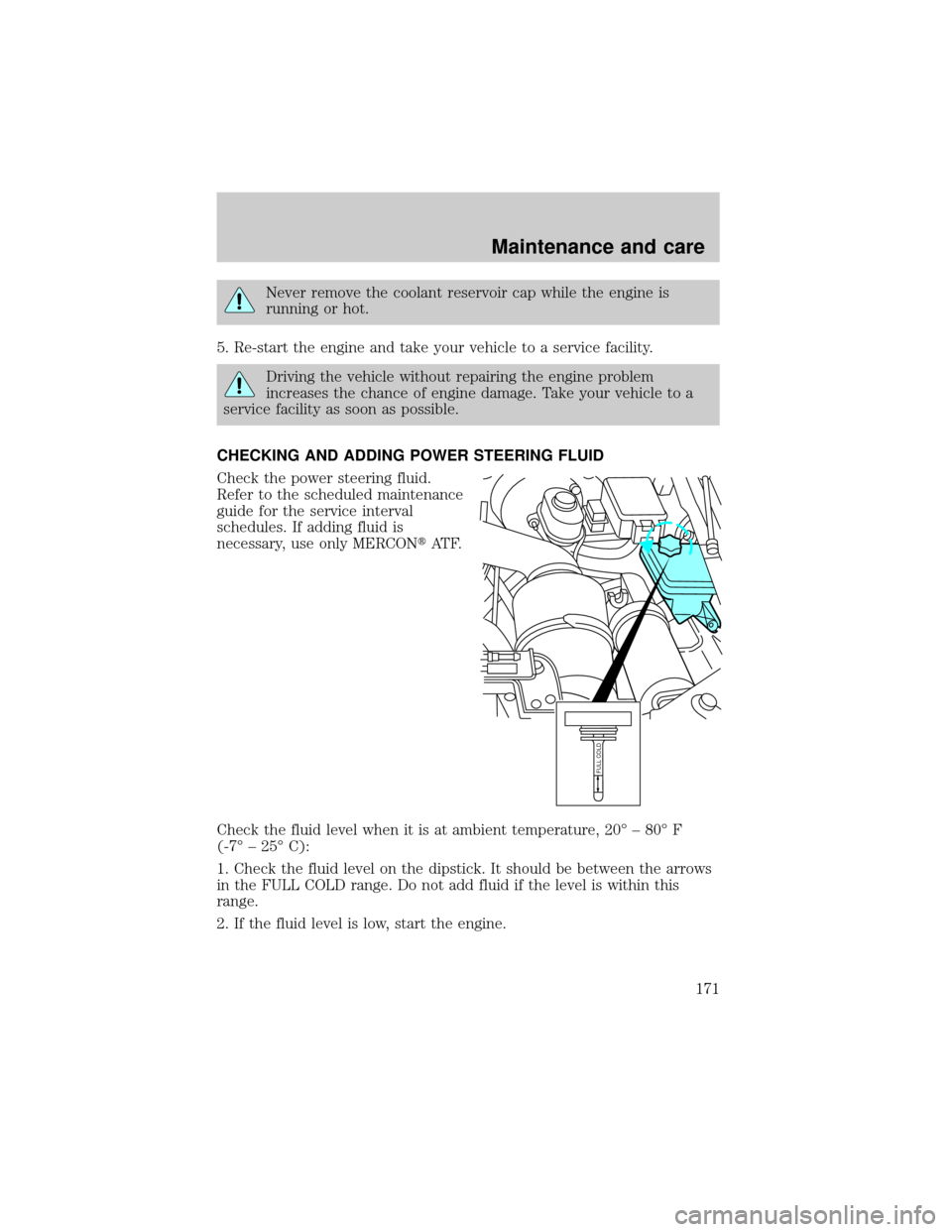
Check the power steering fluid.
Refer to the scheduled maintenance
guide for the service interval
schedules. If adding fluid is
necessary, use only MERCONtAT F.
Check the fluid level when it is at ambient temperature, 20É ± 80É F
(-7É ± 25É C):
1. Check the fluid level on the dipstick. It should be between the arrows
in the FULL COLD range. Do not add fluid if the level is within this
range.
2. If the fluid level is low, start the engine.
FULL COLD
Maintenance and care
171
Page 172 of 232
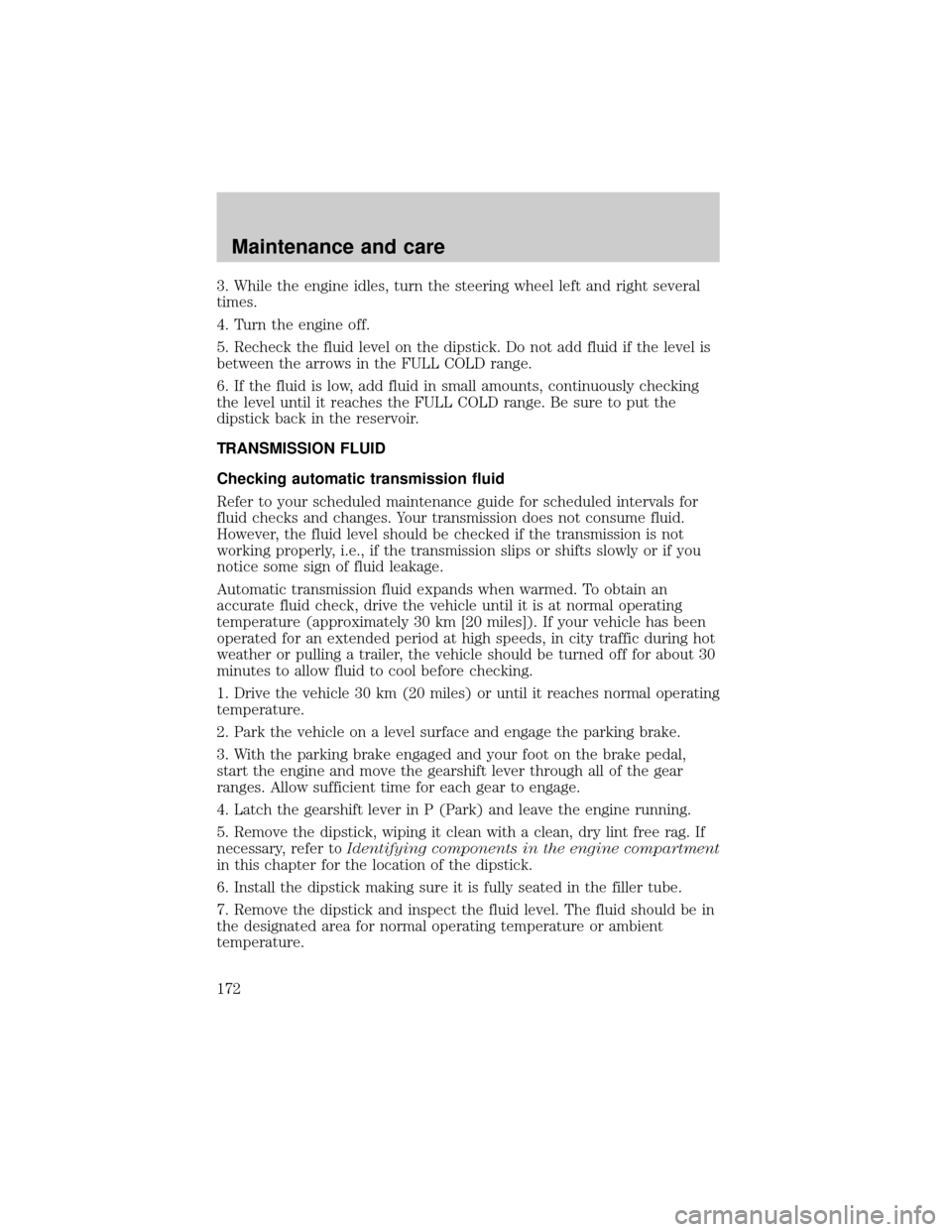
3. While the engine idles, turn the steering wheel left and right several
times.
4. Turn the engine off.
5. Recheck the fluid level on the dipstick. Do not add fluid if the level is
between the arrows in the FULL COLD range.
6. If the fluid is low, add fluid in small amounts, continuously checking
the level until it reaches the FULL COLD range. Be sure to put the
dipstick back in the reservoir.
TRANSMISSION FLUID
Checking automatic transmission fluid
Refer to your scheduled maintenance guide for scheduled intervals for
fluid checks and changes. Your transmission does not consume fluid.
However, the fluid level should be checked if the transmission is not
working properly, i.e., if the transmission slips or shifts slowly or if you
notice some sign of fluid leakage.
Automatic transmission fluid expands when warmed. To obtain an
accurate fluid check, drive the vehicle until it is at normal operating
temperature (approximately 30 km [20 miles]). If your vehicle has been
operated for an extended period at high speeds, in city traffic during hot
weather or pulling a trailer, the vehicle should be turned off for about 30
minutes to allow fluid to cool before checking.
1. Drive the vehicle 30 km (20 miles) or until it reaches normal operating
temperature.
2. Park the vehicle on a level surface and engage the parking brake.
3. With the parking brake engaged and your foot on the brake pedal,
start the engine and move the gearshift lever through all of the gear
ranges. Allow sufficient time for each gear to engage.
4. Latch the gearshift lever in P (Park) and leave the engine running.
5. Remove the dipstick, wiping it clean with a clean, dry lint free rag. If
necessary, refer toIdentifying components in the engine compartment
in this chapter for the location of the dipstick.
6. Install the dipstick making sure it is fully seated in the filler tube.
7. Remove the dipstick and inspect the fluid level. The fluid should be in
the designated area for normal operating temperature or ambient
temperature.
Maintenance and care
172
Page 202 of 232
Cleaning the exterior lamps
Wash with the same detergent as the exterior of your vehicle. If
necessary, use a tar remover such as Ford Extra Strength Tar and Road
Oil Remover (B7A-19520±AA).
To avoid scratching the lamps, do not use a dry paper towel, chemical
solvents or abrasive cleaners.
Cleaning the wiper blades, windshield and rear window
If the wiper blades do not wipe properly, clean the wiper blade rubber
element with undiluted windshield washer solution or a mild detergent.
To avoid damaging the blades, do not use fuel, kerosene, paint thinner or
other solvents.
If the wiper still does not wipe properly, this could be caused by
substances on the windshield or rear window such as tree sap and some
hot wax treatments used by commercial car washes. Clean the outside of
the windshield or rear window with a non-abrasive cleaner such as Ford
Ultra-Clear Spray Glass Cleaner, (E4AZ-19C507±AA), available from your
Ford Dealer.Do notuse abrasive cleansers on glass as they may cause
scratches. The windshield or rear window is clean if beads do not form
when you rinse it with water. The windshield, rear window and wiper
blades should be cleaned on a regular basis, and blades or rubber
elements replaced when worn.
Cleaning the instrument panel
Clean with a damp cloth, then dry with a dry cloth.
Avoid cleaner or polish that increases the gloss of the upper portion of
the instrument panel. The dull finish in this area helps protect the driver
from undesirable windshield reflection.
Do not use chemical solvents or strong detergents when cleaning
the steering wheel or instrument panel to avoid contamination of
the air bag system.
Cleaning the instrument cluster lens
Clean with a damp cloth, then dry with a dry cloth.
Do not use household or glass cleaners as these may damage the lens.
Maintenance and care
202
Page 205 of 232
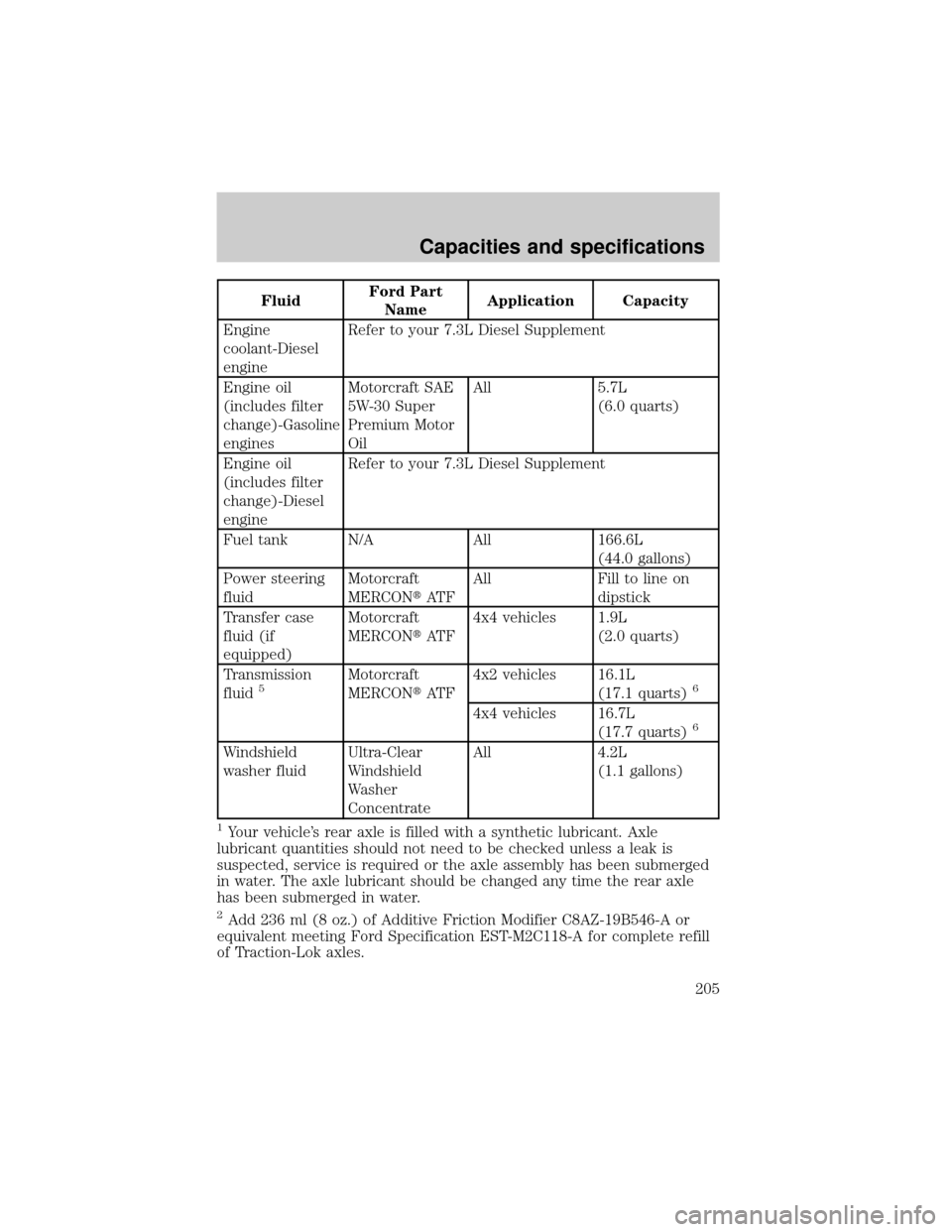
FluidFord Part
NameApplication Capacity
Engine
coolant-Diesel
engineRefer to your 7.3L Diesel Supplement
Engine oil
(includes filter
change)-Gasoline
enginesMotorcraft SAE
5W-30 Super
Premium Motor
OilAll 5.7L
(6.0 quarts)
Engine oil
(includes filter
change)-Diesel
engineRefer to your 7.3L Diesel Supplement
Fuel tank N/A All 166.6L
(44.0 gallons)
Power steering
fluidMotorcraft
MERCONtAT FAll Fill to line on
dipstick
Transfer case
fluid (if
equipped)Motorcraft
MERCONtAT F4x4 vehicles 1.9L
(2.0 quarts)
Transmission
fluid
5Motorcraft
MERCONtAT F4x2 vehicles 16.1L
(17.1 quarts)6
4x4 vehicles 16.7L
(17.7 quarts)6
Windshield
washer fluidUltra-Clear
Windshield
Washer
ConcentrateAll 4.2L
(1.1 gallons)
1Your vehicle's rear axle is filled with a synthetic lubricant. Axle
lubricant quantities should not need to be checked unless a leak is
suspected, service is required or the axle assembly has been submerged
in water. The axle lubricant should be changed any time the rear axle
has been submerged in water.
2Add 236 ml (8 oz.) of Additive Friction Modifier C8AZ-19B546-A or
equivalent meeting Ford Specification EST-M2C118-A for complete refill
of Traction-Lok axles.
Capacities and specifications
205
Page 208 of 232
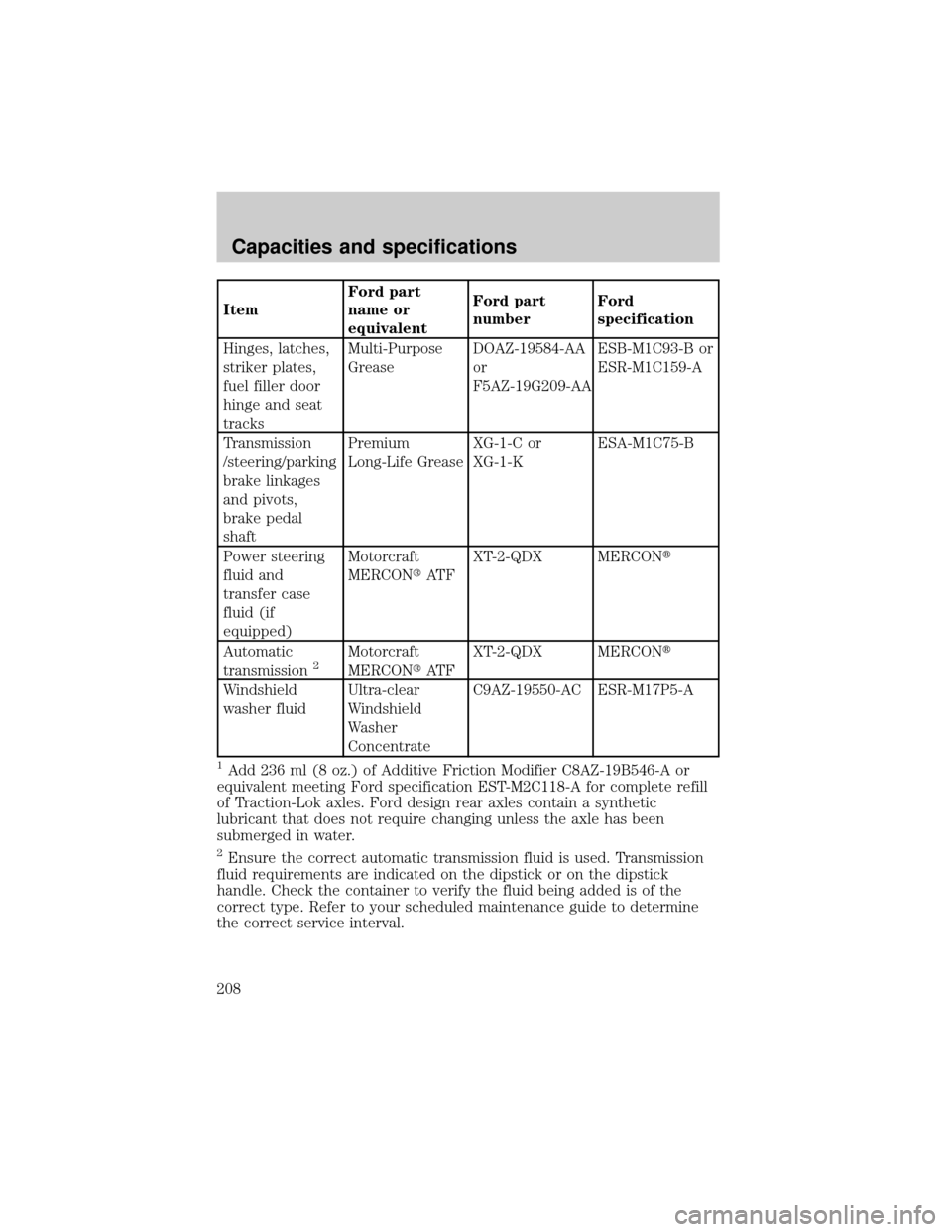
ItemFord part
name or
equivalentFord part
numberFord
specification
Hinges, latches,
striker plates,
fuel filler door
hinge and seat
tracksMulti-Purpose
GreaseDOAZ-19584-AA
or
F5AZ-19G209-AAESB-M1C93-B or
ESR-M1C159-A
Transmission
/steering/parking
brake linkages
and pivots,
brake pedal
shaftPremium
Long-Life GreaseXG-1-C or
XG-1-KESA-M1C75-B
Power steering
fluid and
transfer case
fluid (if
equipped)Motorcraft
MERCONtAT FXT-2-QDX MERCONt
Automatic
transmission
2Motorcraft
MERCONtAT FXT-2-QDX MERCONt
Windshield
washer fluidUltra-clear
Windshield
Washer
ConcentrateC9AZ-19550-AC ESR-M17P5-A
1Add 236 ml (8 oz.) of Additive Friction Modifier C8AZ-19B546-A or
equivalent meeting Ford specification EST-M2C118-A for complete refill
of Traction-Lok axles. Ford design rear axles contain a synthetic
lubricant that does not require changing unless the axle has been
submerged in water.
2Ensure the correct automatic transmission fluid is used. Transmission
fluid requirements are indicated on the dipstick or on the dipstick
handle. Check the container to verify the fluid being added is of the
correct type. Refer to your scheduled maintenance guide to determine
the correct service interval.
Capacities and specifications
208
Page 229 of 232

Locks
childproof ..................................53
doors ..........................................53
Lubricant specifications ...207, 209
Lumbar support, seats .........76±77
M
Manual transmission
fluid capacities ........................204
lubricant specifications ..........209
Message center ...........................58
english/metric button ...............58
menu button .............................59
Mirrors .........................................58
automatic dimming rearview
mirror ........................................57
fold away ...................................55
heated ........................................55
side view mirrors (power) .......54
Motorcraft parts ................189, 204
O
Octane rating ............................187
Odometer .....................................16
Oil (see Engine oil) ..................160
Overdrive .....................................51
P
Panic alarm feature, remote
entry system ................................66
Parking brake ............................113
Parts (see Motorcraft parts) ....204
Power distribution box
(see Fuses) ...............................143Power door locks ........................53
Power steering ..........................114
fluid, checking and adding ....171
fluid, refill capacity ................204
fluid, specifications .........207, 209
Preparing to
drive your vehicle .....................115
R
Radio ............................................27
Relays ........................................138
Remote entry system ...........64, 66
illuminated entry ......................67
locking/unlocking doors ...........65
panic alarm ...............................66
replacement/additional
transmitters ...............................68
replacing the batteries .............66
Roof rack ...................................133
S
Safety belts (see Safety
restraints) ..................14, 84±87, 89
Safety defects, reporting ..........224
Safety restraints ..............84±87, 89
belt minder ...............................91
cleaning the safety belts ..94, 203
extension assembly ..................90
for adults .............................85±87
for children .......................99±100
lap belt ......................................89
warning light
and chime ......................11, 14, 91
Safety seats for children ..........101
Seat belts
(see Safety restraints) ...............84
Index
229
Page 230 of 232

Seats ............................................74
child safety seats ....................101
cleaning ...................................203
SecuriLock passive
anti-theft system ...................70±72
Servicing your vehicle ..............158
Snowplowing .................................3
Spark plugs,
specifications .....................204, 209
Special notice ................................3
diesel-powered vehicles .............3
utility-type vehicles ....................3
Specification chart,
lubricants ...........................207, 209
Speed control ..............................45
Speedometer ...............................15
Starting your vehicle ........108, 110
jump starting ..........................151
Steering wheel
tilting .........................................49
T
Tachometer .................................17
Tires ...........................146, 180±182
changing ..........................146±147
checking the pressure ............182
replacing ..................................183
rotating ....................................182
snow tires and chains ............184
tire grades ...............................181
treadwear ................................181
Towing .......................................182
recreational towing .................133
wrecker ....................................157
Traction-lok rear axle ...............179Transfer case
fluid checking .........................174
Transmission .............................115
fluid, checking and adding
(automatic) .............................172
fluid, refill capacities ..............204
lubricant specifications ..207, 209
Transmission control
indicator light ..............................11
Trip odometer .............................16
Turn signal ............................12, 44
V
Vehicle dimensions ...................209
Vehicle Identification
Number (VIN) ...........................211
Vehicle loading ..........................125
Ventilating your vehicle ...........111
W
Warning chimes ...........................14
Warning lights (see Lights) .........8
Washer fluid ..............................165
Water, Driving through .............128
Windows
power .........................................52
rear wiper/washer .....................50
Windshield washer fluid and
wipers
checking and adding fluid .....165
checking and cleaning ....179±180
liftgate reservoir .....................165
operation ...................................49
replacing wiper blades ...........180
Wrecker towing .........................157
Index
230