fuses FORD EXCURSION 2000 1.G Owners Manual
[x] Cancel search | Manufacturer: FORD, Model Year: 2000, Model line: EXCURSION, Model: FORD EXCURSION 2000 1.GPages: 232, PDF Size: 2.01 MB
Page 96 of 232
All occupants of the vehicle, including the driver, should always
properly wear their safety belts, even when an air bag SRS is
provided.
Always transport children 12 years old and under in the back
seat and always properly use appropriate child restraints.
National Highway Traffic Safety Administration (NHTSA)
recommends a minimum distance of at least 25 cm (10 inches)
between an occupant's chest and the driver air bag module.
Never place your arm over the air bag module as a deploying air
bag can result in serious arm fractures or other injuries.
Steps you can take to properly position yourself away from the air bag:
²Move your seat to the rear as far as you can while still reaching the
pedals comfortably.
²Recline the seat slightly (one or two degrees) from the upright
position.
Do not put anything on or over the air bag module. Placing
objects on or over the air bag inflation area may cause those
objects to be propelled by the air bag into your face and torso causing
serious injury.
Do not attempt to service, repair, or modify the Air Bag
Supplemental Restraint System or its fuses. See your Ford or
Lincoln-Mercury dealer.
Seating and safety restraints
96
Page 116 of 232
If you cannot move the gearshift lever out of P (Park) with ignition in
the ON position and the brake pedal depressed:
1. Apply the parking brake, turn ignition to the LOCK position, then
remove the key.
2. Reinsert the key and turn the ignition to the OFF position.
3. Press and hold down the brake pedal and shift into N (Neutral).
4. Start the vehicle.
If it is necessary to use the above procedure to move the gearshift lever,
it is possible that a fuse has blown or the vehicle's brakelamps are not
operating properly. Refer toFuses and relaysin theRoadside
emergencieschapter.
Do not drive your vehicle until you verify that the brakelamps
are working.
If your vehicle gets stuck in mud or snow it may be rocked out by
shifting from forward and reverse gears, stopping between shifts, in a
steady pattern. Press lightly on the accelerator in each gear.
Do not rock the vehicle for more than a few minutes. The
transmission and tires may be damaged or the engine may
overheat.
Always set the parking brake fully and make sure the gearshift is
latched in P (Park). Turn off the ignition whenever you leave
your vehicle.
If the parking brake is fully released, but the brake warning lamp
remains illuminated, the brakes may not be working properly.
See your dealer or a qualified service technician.
Driving with a 4±speed automatic transmission
Understanding gearshift positions
To put your vehicle in gear, start the engine, depress the brake pedal,
then move gearshift lever out of P (Park).
Driving
116
Page 132 of 232

²Consult your local motor vehicle speed regulations for towing a trailer.
²Use a lower gear when towing up or down steep hills. This will
eliminate excessive downshifting and upshifting for optimum fuel
economy and transmission cooling.
²Anticipate stops and brake gradually.
Exceeding the GCWR rating may cause internal transmission
damage and void your warranty coverage.
Servicing after towing
If you tow a trailer for long distances, your vehicle will require more
frequent service intervals. Refer to your scheduled maintenance guide for
more information.
Trailer towing tips
²Practice turning, stopping and backing up before starting on a trip to
get the feel of the vehicle trailer combination. When turning, make
wider turns so the trailer wheels will clear curbs and other obstacles.
²Allow more distance for stopping with a trailer attached.
²The trailer tongue weight should be no more than 10±15% of the
loaded trailer weight.
²After you have traveled 80 km (50 miles), thoroughly check your
hitch, electrical connections and trailer wheel lug nuts.
²When stopped in traffic for long periods of time in hot weather, place
the gearshift in P (Park) (automatic transmissions) or N (Neutral)
(manual transmissions). This aids engine cooling and air conditioner
efficiency.
²Vehicles with trailers should not be parked on a grade. If you must
park on a grade, place wheel chocks under the trailer's wheels.
Launching or retrieving a boat
When backing down a ramp during boat launching or retrieval,
²Do not allow the static water level to rise above the bottom edge of
the rear bumper and
²Do not allow waves to break higher than 15 cm (6 inches) above the
bottom edge of the rear bumper.
²Disconnect the trailer tow electrical connector to prevent blown fuses
caused by water entering into your trailer's electrical wiring.
Driving
132
Page 138 of 232
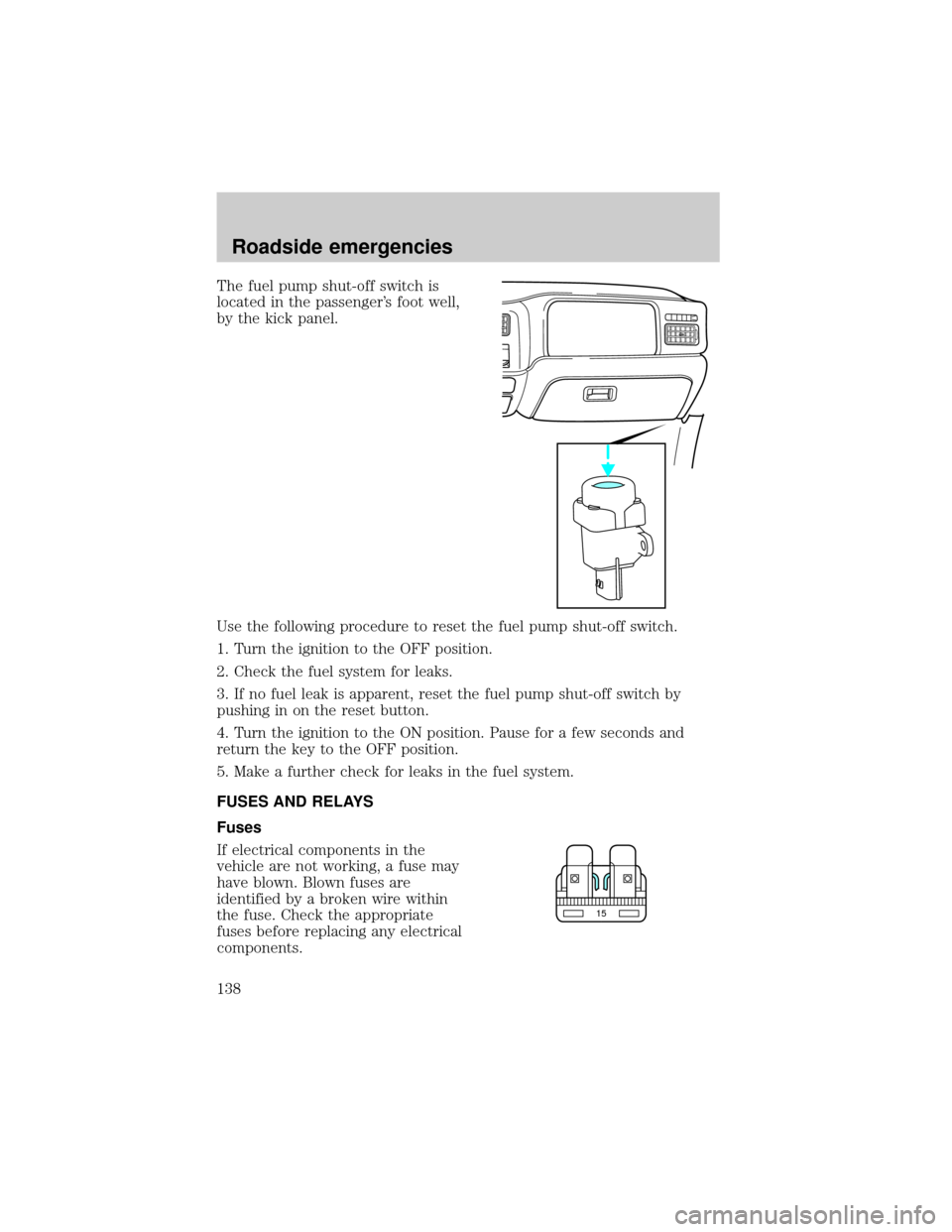
The fuel pump shut-off switch is
located in the passenger's foot well,
by the kick panel.
Use the following procedure to reset the fuel pump shut-off switch.
1. Turn the ignition to the OFF position.
2. Check the fuel system for leaks.
3. If no fuel leak is apparent, reset the fuel pump shut-off switch by
pushing in on the reset button.
4. Turn the ignition to the ON position. Pause for a few seconds and
return the key to the OFF position.
5. Make a further check for leaks in the fuel system.
FUSES AND RELAYS
Fuses
If electrical components in the
vehicle are not working, a fuse may
have blown. Blown fuses are
identified by a broken wire within
the fuse. Check the appropriate
fuses before replacing any electrical
components.
15
Roadside emergencies
138
Page 139 of 232
Always replace a fuse with one that has the specified amperage
rating. Using a fuse with a higher amperage rating can cause
severe wire damage and could start a fire.
Standard fuse amperage rating and color
COLOR
Fuse
RatingMini
FusesStandard
FusesMaxi
FusesCartridge
Maxi
FusesFuse Link
Cartridge
2A Grey Grey Ð Ð Ð
3A Violet Violet Ð Ð Ð
4A Pink Pink Ð Ð Ð
5A Tan Tan Ð Ð Ð
7.5A Brown Brown Ð Ð Ð
10A Red Red Ð Ð Ð
15A Blue Blue Ð Ð Ð
20A Yellow Yellow Yellow Blue Blue
25A Natural Natural Ð Ð Ð
30A Green Green Green Pink Pink
40A Ð Ð Orange Green Green
50A Ð Ð Red Red Red
60A Ð Ð Blue Ð Yellow
70A Ð Ð Tan Ð Brown
80A Ð Ð Natural Ð Black
Passenger compartment fuse panel
The fuse panel is located below and to the left of the steering wheel by
the brake pedal. Remove the panel cover to access the fuses.
Roadside emergencies
139
Page 141 of 232
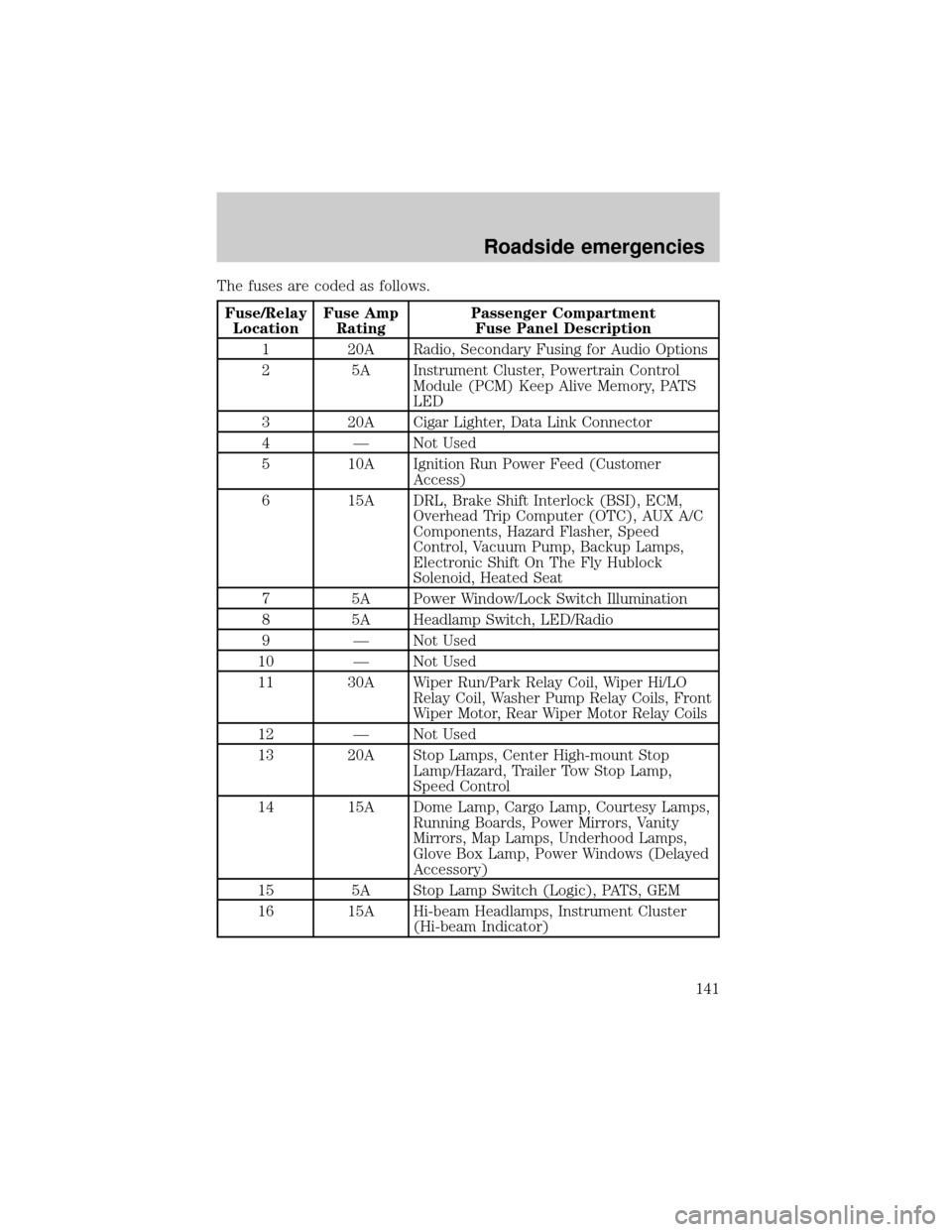
The fuses are coded as follows.
Fuse/Relay
LocationFuse Amp
RatingPassenger Compartment
Fuse Panel Description
1 20A Radio, Secondary Fusing for Audio Options
2 5A Instrument Cluster, Powertrain Control
Module (PCM) Keep Alive Memory, PATS
LED
3 20A Cigar Lighter, Data Link Connector
4 Ð Not Used
5 10A Ignition Run Power Feed (Customer
Access)
6 15A DRL, Brake Shift Interlock (BSI), ECM,
Overhead Trip Computer (OTC), AUX A/C
Components, Hazard Flasher, Speed
Control, Vacuum Pump, Backup Lamps,
Electronic Shift On The Fly Hublock
Solenoid, Heated Seat
7 5A Power Window/Lock Switch Illumination
8 5A Headlamp Switch, LED/Radio
9 Ð Not Used
10 Ð Not Used
11 30A Wiper Run/Park Relay Coil, Wiper Hi/LO
Relay Coil, Washer Pump Relay Coils, Front
Wiper Motor, Rear Wiper Motor Relay Coils
12 Ð Not Used
13 20A Stop Lamps, Center High-mount Stop
Lamp/Hazard, Trailer Tow Stop Lamp,
Speed Control
14 15A Dome Lamp, Cargo Lamp, Courtesy Lamps,
Running Boards, Power Mirrors, Vanity
Mirrors, Map Lamps, Underhood Lamps,
Glove Box Lamp, Power Windows (Delayed
Accessory)
15 5A Stop Lamp Switch (Logic), PATS, GEM
16 15A Hi-beam Headlamps, Instrument Cluster
(Hi-beam Indicator)
Roadside emergencies
141
Page 143 of 232
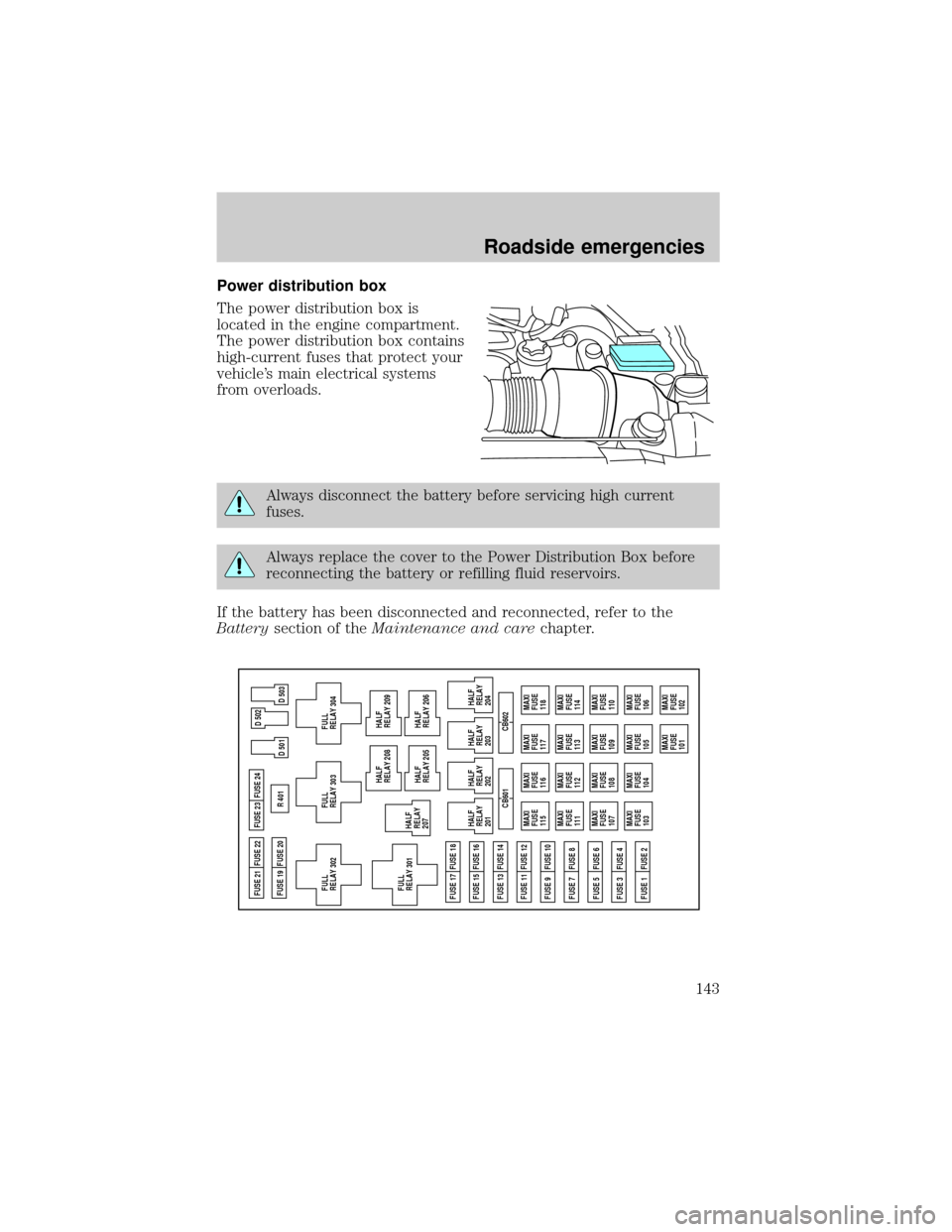
Power distribution box
The power distribution box is
located in the engine compartment.
The power distribution box contains
high-current fuses that protect your
vehicle's main electrical systems
from overloads.
Always disconnect the battery before servicing high current
fuses.
Always replace the cover to the Power Distribution Box before
reconnecting the battery or refilling fluid reservoirs.
If the battery has been disconnected and reconnected, refer to the
Batterysection of theMaintenance and carechapter.
MAXI
FUSE
115MAXI
FUSE
116MAXI
FUSE
117
MAXI
FUSE
118
MAXI
FUSE
111MAXI
FUSE
112MAXI
FUSE
113
MAXI
FUSE
114
MAXI
FUSE
107MAXI
FUSE
108MAXI
FUSE
109
MAXI
FUSE
110
MAXI
FUSE
103MAXI
FUSE
104MAXI
FUSE
105
MAXI
FUSE
106
MAXI
FUSE
101MAXI
FUSE
102 CB601 CB602 FUSE 17 FUSE 18FUSE 21 FUSE 22
FUSE 19 FUSE 20FUSE 23
FULL
RELAY 302R 401
D 501 FUSE 24
FUSE 15 FUSE 16
FUSE 13 FUSE 14
FUSE 11 FUSE 12
FUSE 9 FUSE 10
FUSE 7 FUSE 8
FUSE 5 FUSE 6
FUSE 3 FUSE 4
FUSE 1 FUSE 2
D 503 D 502
FULL
RELAY 301HALF
RELAY
207
FULL
RELAY 303
FULL
RELAY 304
HALF
RELAY
201
HALF
RELAY
202HALF
RELAY 208
HALF
RELAY 209
HALF
RELAY 205
HALF
RELAY 206
HALF
RELAY
203
HALF
RELAY
204
Roadside emergencies
143
Page 144 of 232
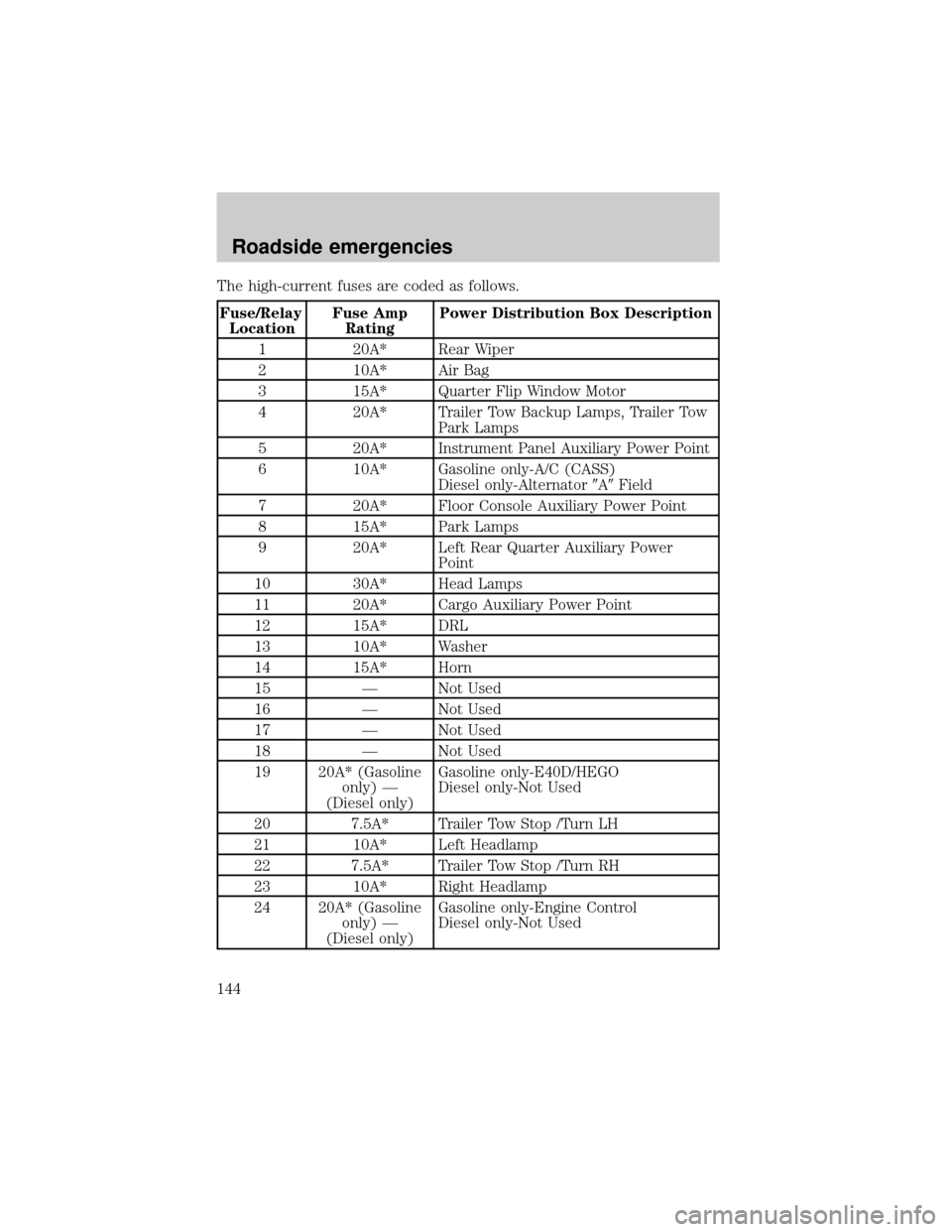
The high-current fuses are coded as follows.
Fuse/Relay
LocationFuse Amp
RatingPower Distribution Box Description
1 20A* Rear Wiper
2 10A* Air Bag
3 15A* Quarter Flip Window Motor
4 20A* Trailer Tow Backup Lamps, Trailer Tow
Park Lamps
5 20A* Instrument Panel Auxiliary Power Point
6 10A* Gasoline only-A/C (CASS)
Diesel only-Alternator9A9Field
7 20A* Floor Console Auxiliary Power Point
8 15A* Park Lamps
9 20A* Left Rear Quarter Auxiliary Power
Point
10 30A* Head Lamps
11 20A* Cargo Auxiliary Power Point
12 15A* DRL
13 10A* Washer
14 15A* Horn
15 Ð Not Used
16 Ð Not Used
17 Ð Not Used
18 Ð Not Used
19 20A* (Gasoline
only) Ð
(Diesel only)Gasoline only-E40D/HEGO
Diesel only-Not Used
20 7.5A* Trailer Tow Stop /Turn LH
21 10A* Left Headlamp
22 7.5A* Trailer Tow Stop /Turn RH
23 10A* Right Headlamp
24 20A* (Gasoline
only) Ð
(Diesel only)Gasoline only-Engine Control
Diesel only-Not Used
Roadside emergencies
144
Page 146 of 232
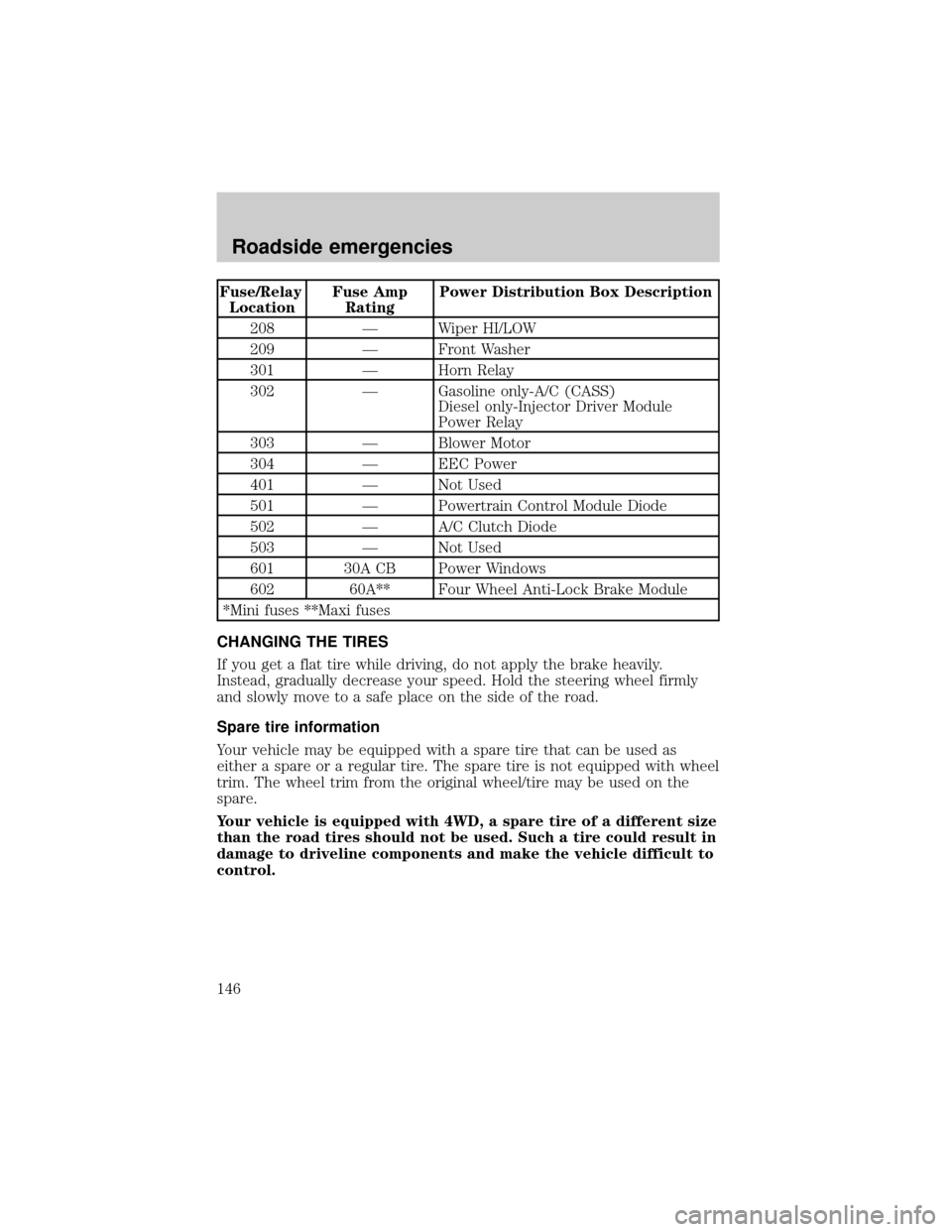
Fuse/Relay
LocationFuse Amp
RatingPower Distribution Box Description
208 Ð Wiper HI/LOW
209 Ð Front Washer
301 Ð Horn Relay
302 Ð Gasoline only-A/C (CASS)
Diesel only-Injector Driver Module
Power Relay
303 Ð Blower Motor
304 Ð EEC Power
401 Ð Not Used
501 Ð Powertrain Control Module Diode
502 Ð A/C Clutch Diode
503 Ð Not Used
601 30A CB Power Windows
602 60A** Four Wheel Anti-Lock Brake Module
*Mini fuses **Maxi fuses
CHANGING THE TIRES
If you get a flat tire while driving, do not apply the brake heavily.
Instead, gradually decrease your speed. Hold the steering wheel firmly
and slowly move to a safe place on the side of the road.
Spare tire information
Your vehicle may be equipped with a spare tire that can be used as
either a spare or a regular tire. The spare tire is not equipped with wheel
trim. The wheel trim from the original wheel/tire may be used on the
spare.
Your vehicle is equipped with 4WD, a spare tire of a different size
than the road tires should not be used. Such a tire could result in
damage to driveline components and make the vehicle difficult to
control.
Roadside emergencies
146
Page 227 of 232

Engine block heater .................110
Engine oil ..................................160
checking and adding ..............160
dipstick ....................................160
filter, specifications ........162, 204
recommendations ...................162
refill capacities ........................204
specifications ..................207, 209
Exhaust fumes ..........................111
F
Fail safe cooling ........................170
Fluid capacities .........................204
Four-Wheel Drive vehicles..13, 119
control trac ...............................19
description ..............................121
driving off road .......................123
electronic shift ..........19, 120±121
indicator light ...................12, 120
preparing to drive your
vehicle .....................................115
Fuel ............................................185
calculating fuel economy .......189
cap ...........................................188
capacity ...................................204
choosing the right fuel ...........187
comparisons with EPA fuel
economy estimates .................192
detergent in fuel .....................188
filling your vehicle
with fuel ..................185, 188±189
filter, specifications ........189, 204
fuel pump shut-off switch .....137
gauge .........................................15
improving fuel economy ........189
low fuel warning light ................8
octane rating ...................187, 209
quality ......................................187
running out of fuel .................188safety information relating to
automotive fuels .....................185
Fuses ..................................138±139
G
Garage door opener ....................56
Gas cap (see Fuel cap) ............188
Gas mileage
(see Fuel economy) .................189
Gauges .........................................14
battery voltage gauge ...............17
engine coolant temperature
gauge .........................................15
engine oil pressure gauge ........17
fuel gauge ..................................15
odometer ...................................16
speedometer .............................15
tachometer ................................17
trip odometer ............................16
GAWR (Gross
Axle Weight Rating) .................125
calculating ...............................127
definition .................................125
driving with a heavy load ......125
location ....................................125
GVWR (Gross
Vehicle Weight Rating) .............125
calculating .......................125, 127
definition .................................125
driving with a heavy load ......125
location ....................................125
H
Hazard flashers .........................137
Head restraints ...........................77
Headlamps ...................................18
aiming ......................................199
Index
227