heating FORD EXCURSION 2002 1.G User Guide
[x] Cancel search | Manufacturer: FORD, Model Year: 2002, Model line: EXCURSION, Model: FORD EXCURSION 2002 1.GPages: 272, PDF Size: 5.06 MB
Page 174 of 272
20815.psp Ford O/G 2002 Excursion English 4th Print 2C3J-19A321-HB 04/24/2003 09:14:57 87 B
or straight down.Avoid driving crosswise or turning on steep
slopes or hills. A danger lies in losing traction, slipping sideways and
possibly rolling over. Whenever driving on a hill, determine beforehand
the route you will use. Do not drive over the crest of a hill without
seeing what conditions are on the other side. Do not drive in reverse
over a hill without the aid of an observer.
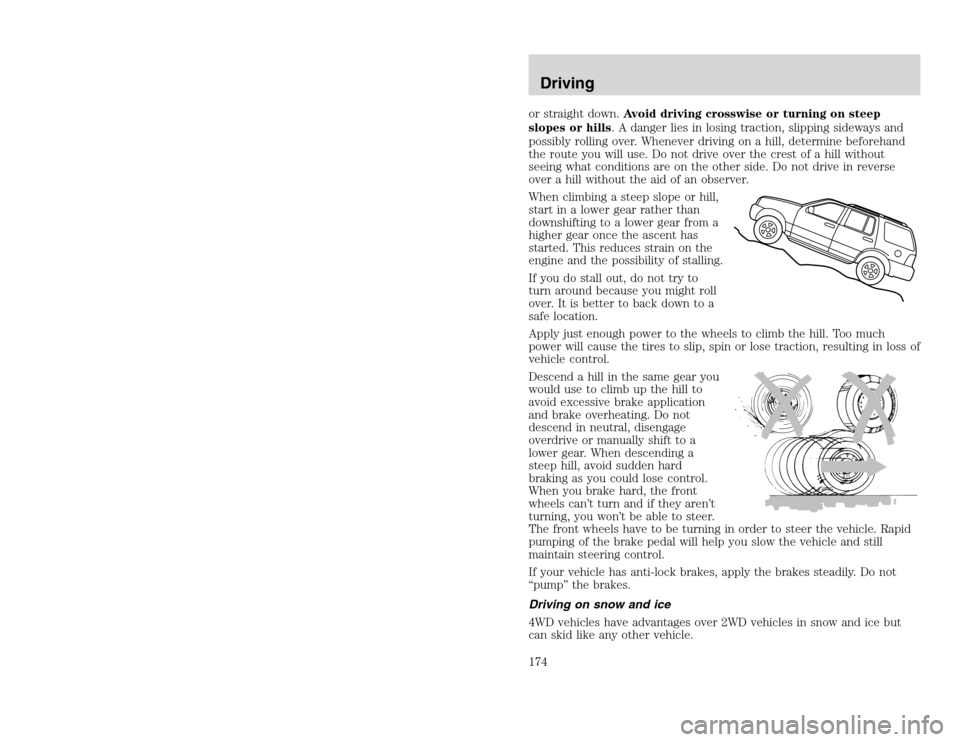
When climbing a steep slope or hill,
start in a lower gear rather than
downshifting to a lower gear from a
higher gear once the ascent has
started. This reduces strain on the
engine and the possibility of stalling.
If you do stall out, do not try to
turn around because you might roll
over. It is better to back down to a
safe location.
Apply just enough power to the wheels to climb the hill. Too much
power will cause the tires to slip, spin or lose traction, resulting in loss of
vehicle control.
Descend a hill in the same gear you
would use to climb up the hill to
avoid excessive brake application
and brake overheating. Do not
descend in neutral, disengage
overdrive or manually shift to a
lower gear. When descending a
steep hill, avoid sudden hard
braking as you could lose control.
When you brake hard, the front
wheels can’t turn and if they aren’t
turning, you won’t be able to steer.
The front wheels have to be turning in order to steer the vehicle. Rapid
pumping of the brake pedal will help you slow the vehicle and still
maintain steering control.
If your vehicle has anti-lock brakes, apply the brakes steadily. Do not
“pump” the brakes.
Driving on snow and ice
4WD vehicles have advantages over 2WD vehicles in snow and ice but
can skid like any other vehicle.Driving174
or straight down.Avoid driving crosswise or turning on steep
slopes or hills. A danger lies in losing traction, slipping sideways and
possibly rolling over. Whenever driving on a hill, determine beforehand
the route you will use. Do not drive over the crest of a hill without
seeing what conditions are on the other side. Do not drive in reverse
over a hill without the aid of an observer.
When climbing a steep slope or hill,
start in a lower gear rather than
downshifting to a lower gear from a
higher gear once the ascent has
started. This reduces strain on the
engine and the possibility of stalling.
If you do stall out, do not try to
turn around because you might roll
over. It is better to back down to a
safe location.
Apply just enough power to the wheels to climb the hill. Too much
power will cause the tires to slip, spin or lose traction, resulting in loss of
vehicle control.
Descend a hill in the same gear you
would use to climb up the hill to
avoid excessive brake application
and brake overheating. Do not
descend in neutral, disengage
overdrive or manually shift to a
lower gear. When descending a
steep hill, avoid sudden hard
braking as you could lose control.
When you brake hard, the front
wheels can’t turn and if they aren’t
turning, you won’t be able to steer.
The front wheels have to be turning in order to steer the vehicle. Rapid
pumping of the brake pedal will help you slow the vehicle and still
maintain steering control.
If your vehicle has anti-lock brakes, apply the brakes steadily. Do not
“pump” the brakes.
Driving on snow and ice
4WD vehicles have advantages over 2WD vehicles in snow and ice but
can skid like any other vehicle.Driving174
Page 229 of 272
20815.psp Ford O/G 2002 Excursion English 4th Print 2C3J-19A321-HB 04/24/2003 09:14:57 115 A
Do not put engine coolant in the windshield washer fluid
container. If sprayed on the windshield, engine coolant could
make it difficult to see through the windshield.
The cooling system in your vehicle is filled with either green-colored
Motorcraft Premium Engine Coolant meeting Ford specification
ESE-M97B44–A or yellow-colored Motorcraft Premium Gold Engine
Coolant meeting Ford Specification WSS-M97B51–A1. To determine your
vehicle’s coolant type (color), check your coolant reservoir.
•Add Motorcraft Premium Engine Coolant (green-colored),
VC-4–A (U.S.) or CXC-10 (Canada) or Motorcraft Premium
Gold Engine Coolant (yellow-colored), VC-7–A (VC-7–B in
Oregon), depending on the type of coolant originally equipped
in your vehicle.If you are unsure which type of coolant your vehicle
requires, check your coolant reservoir or contact your local dealer.
Note:Use of Motorcraft Cooling System Stop Leak Pellets, VC-6,
darkens the color of Motorcraft Premium Gold Engine Coolant from
yellow to golden tan.
•Do not add/mix an orange-colored, extended life coolant such
as Motorcraft Speciality Orange Engine Coolant, VC-2 (US) or
CXC-209 (Canada), meeting Ford specification WSS-M97B44–D
with the factory-filled coolant.Mixing Motorcraft Speciality Orange
Engine Coolant or any orange-colored extended life product with your
factory filled coolant can result in degraded corrosion protection.
•A large amount of water without engine coolant may be added, in case
of emergency, to reach a vehicle service location. In this instance, the
cooling system must be drained and refilled with a 50/50 mixture of
engine coolant and distilled water as soon as possible. Water alone
(without engine coolant) can cause engine damage from corrosion,
overheating or freezing.
•Do not use alcohol, methanol, brine or any engine coolants
mixed with alcohol or methanol antifreeze (coolant).Alcohol
and other liquids can cause engine damage from overheating or
freezing.
•Do not add extra inhibitors or additives to the coolant.These
can be harmful and compromise the corrosion protection of the engine
coolant.
•Do not mix with recycled coolant unless from a Ford-approved
recycling process (seeUse of Recycled engine coolantsection).
Maintenance and Specifications
229
Do not put engine coolant in the windshield washer fluid
container. If sprayed on the windshield, engine coolant could
make it difficult to see through the windshield.
The cooling system in your vehicle is filled with either green-colored
Motorcraft Premium Engine Coolant meeting Ford specification
ESE-M97B44–A or yellow-colored Motorcraft Premium Gold Engine
Coolant meeting Ford Specification WSS-M97B51–A1. To determine your
vehicle’s coolant type (color), check your coolant reservoir.
•Add Motorcraft Premium Engine Coolant (green-colored),
VC-4–A (U.S.) or CXC-10 (Canada) or Motorcraft Premium
Gold Engine Coolant (yellow-colored), VC-7–A (VC-7–B in
Oregon), depending on the type of coolant originally equipped
in your vehicle.If you are unsure which type of coolant your vehicle
requires, check your coolant reservoir or contact your local dealer.
Note:Use of Motorcraft Cooling System Stop Leak Pellets, VC-6,
darkens the color of Motorcraft Premium Gold Engine Coolant from
yellow to golden tan.
•Do not add/mix an orange-colored, extended life coolant such
as Motorcraft Speciality Orange Engine Coolant, VC-2 (US) or
CXC-209 (Canada), meeting Ford specification WSS-M97B44–D
with the factory-filled coolant.Mixing Motorcraft Speciality Orange
Engine Coolant or any orange-colored extended life product with your
factory filled coolant can result in degraded corrosion protection.
•A large amount of water without engine coolant may be added, in case
of emergency, to reach a vehicle service location. In this instance, the
cooling system must be drained and refilled with a 50/50 mixture of
engine coolant and distilled water as soon as possible. Water alone
(without engine coolant) can cause engine damage from corrosion,
overheating or freezing.
•Do not use alcohol, methanol, brine or any engine coolants
mixed with alcohol or methanol antifreeze (coolant).Alcohol
and other liquids can cause engine damage from overheating or
freezing.
•Do not add extra inhibitors or additives to the coolant.These
can be harmful and compromise the corrosion protection of the engine
coolant.
•Do not mix with recycled coolant unless from a Ford-approved
recycling process (seeUse of Recycled engine coolantsection).
Maintenance and Specifications
229
Page 230 of 272
20815.psp Ford O/G 2002 Excursion English 4th Print 2C3J-19A321-HB 04/24/2003 09:14:57 115 B
For vehicles with overflow coolant systems with a non-pressurized cap
on the coolant recovery system, add coolant to the coolant recovery
reservoir when the engine is cool. Add the proper mixture of coolant and
water to the “cold full” level. For all other vehicles, which have a coolant
degas system with a pressurized cap, or if it is necessary to remove the
coolant pressure relief cap on the radiator of a vehicle with an overflow
system, follow these steps to add engine coolant.
To reduce the risk of personal injury, make sure the engine is
cool before unscrewing the coolant pressure relief cap. The
cooling system is under pressure; steam and hot liquid can come out
forcefully when the cap is loosened slightly.
1. Before you begin, turn the engine off and let it cool.
2. When the engine is cool, wrap a thick cloth around the coolant
pressure relief cap on the coolant reservoir (an opaque plastic bottle).
Slowly turn cap counterclockwise (left) until pressure begins to release.
3. Step back while the pressure releases.
4. When you are sure that all the pressure has been released, use the
cloth to turn it counterclockwise and remove the cap.
5. Fill the coolant reservoir slowly with the proper coolant mixture (see
above), to within the “cold fill range” or the “cold full” level on the
reservoir. If you removed the radiator cap in an overflow system, fill the
radiator until the coolant is visible and radiator is almost full.
6. Replace the cap. Turn until tightly installed. (Cap must be tightly
installed to prevent coolant loss.)
After any coolant has been added, check the coolant concentration see
Checking Engine Coolant section). If the concentration is not 50/50
(protection to –34° F/–36° C), drain some coolant and adjust the
concentration. It may take several drains and additions to obtain a 50/50
coolant concentration.
Whenever coolant has been added, the coolant level in the coolant
reservoir should be checked the next few times you drive the vehicle. If
necessary, add enough 50/50 concentration of engine coolant and
distilled water to bring the liquid level to the proper level.
If you have to add more than 1.0 liter (1.0 quart) of engine coolant per
month, have your dealer check the engine cooling system. Your cooling
system may have a leak. Operating an engine with a low level of coolant
can result in engine overheating and possible engine damage.
Maintenance and Specifications230
For vehicles with overflow coolant systems with a non-pressurized cap
on the coolant recovery system, add coolant to the coolant recovery
reservoir when the engine is cool. Add the proper mixture of coolant and
water to the “cold full” level. For all other vehicles, which have a coolant
degas system with a pressurized cap, or if it is necessary to remove the
coolant pressure relief cap on the radiator of a vehicle with an overflow
system, follow these steps to add engine coolant.
To reduce the risk of personal injury, make sure the engine is
cool before unscrewing the coolant pressure relief cap. The
cooling system is under pressure; steam and hot liquid can come out
forcefully when the cap is loosened slightly.
1. Before you begin, turn the engine off and let it cool.
2. When the engine is cool, wrap a thick cloth around the coolant
pressure relief cap on the coolant reservoir (an opaque plastic bottle).
Slowly turn cap counterclockwise (left) until pressure begins to release.
3. Step back while the pressure releases.
4. When you are sure that all the pressure has been released, use the
cloth to turn it counterclockwise and remove the cap.
5. Fill the coolant reservoir slowly with the proper coolant mixture (see
above), to within the “cold fill range” or the “cold full” level on the
reservoir. If you removed the radiator cap in an overflow system, fill the
radiator until the coolant is visible and radiator is almost full.
6. Replace the cap. Turn until tightly installed. (Cap must be tightly
installed to prevent coolant loss.)
After any coolant has been added, check the coolant concentration see
Checking Engine Coolant section). If the concentration is not 50/50
(protection to –34° F/–36° C), drain some coolant and adjust the
concentration. It may take several drains and additions to obtain a 50/50
coolant concentration.
Whenever coolant has been added, the coolant level in the coolant
reservoir should be checked the next few times you drive the vehicle. If
necessary, add enough 50/50 concentration of engine coolant and
distilled water to bring the liquid level to the proper level.
If you have to add more than 1.0 liter (1.0 quart) of engine coolant per
month, have your dealer check the engine cooling system. Your cooling
system may have a leak. Operating an engine with a low level of coolant
can result in engine overheating and possible engine damage.
Maintenance and Specifications230
Page 246 of 272
20815.psp Ford O/G 2002 Excursion English 4th Print 2C3J-19A321-HB 04/24/2003 09:14:57 123 B
Correct fluid level
The transmission fluid should be checked at normal operating
temperature 66°C-77°C (150°F-170°F) on a level surface. The normal
operating temperature can be reached after approximately 30 km (20
miles) of driving.
You can check the fluid without driving if the ambient temperature is
above 10°C (50°F). However, if fluid is added at this time, an overfill
condition could result when the vehicle reaches normal operating
temperature.
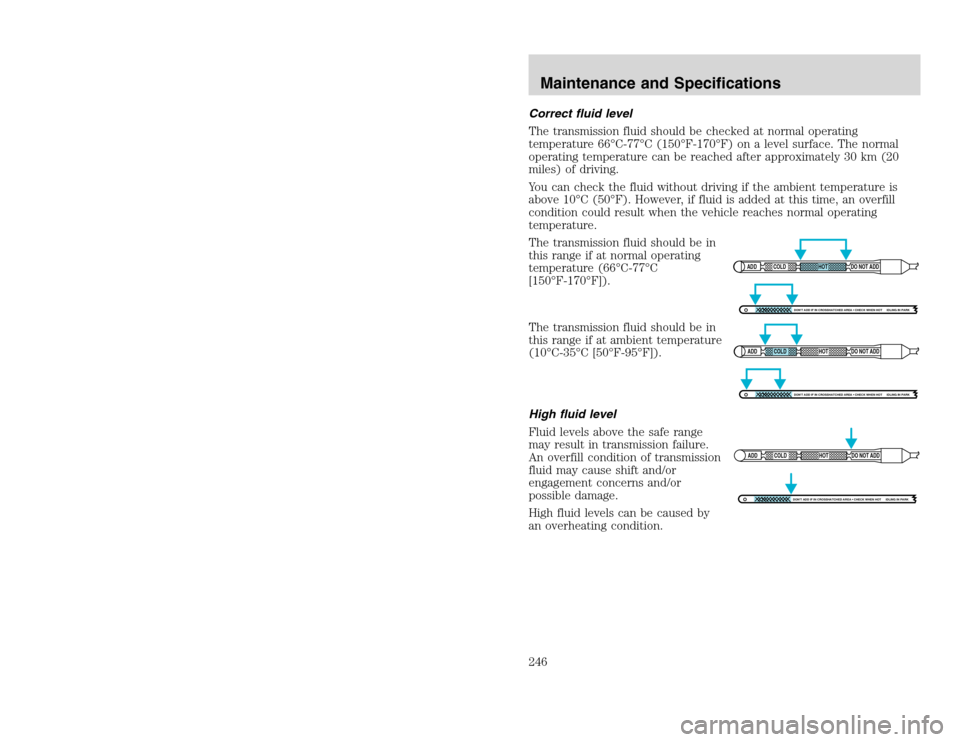
The transmission fluid should be in
this range if at normal operating
temperature (66°C-77°C
[150°F-170°F]).
The transmission fluid should be in
this range if at ambient temperature
(10°C-35°C [50°F-95°F]).
High fluid level
Fluid levels above the safe range
may result in transmission failure.
An overfill condition of transmission
fluid may cause shift and/or
engagement concerns and/or
possible damage.
High fluid levels can be caused by
an overheating condition.
ADD COLD HOT DO NOT ADD
DON'T ADD IF IN CROSSHATCHED AREA IDLING IN PARK
ADD COLD HOT DO NOT ADD
DON'T ADD IF IN CROSSHATCHED AREA IDLING IN PARK
ADD COLD HOT DO NOT ADD
DON'T ADD IF IN CROSSHATCHED AREA IDLING IN PARK
Maintenance and Specifications246
Correct fluid level
The transmission fluid should be checked at normal operating
temperature 66°C-77°C (150°F-170°F) on a level surface. The normal
operating temperature can be reached after approximately 30 km (20
miles) of driving.
You can check the fluid without driving if the ambient temperature is
above 10°C (50°F). However, if fluid is added at this time, an overfill
condition could result when the vehicle reaches normal operating
temperature.
The transmission fluid should be in
this range if at normal operating
temperature (66°C-77°C
[150°F-170°F]).
The transmission fluid should be in
this range if at ambient temperature
(10°C-35°C [50°F-95°F]).
High fluid level
Fluid levels above the safe range
may result in transmission failure.
An overfill condition of transmission
fluid may cause shift and/or
engagement concerns and/or
possible damage.
High fluid levels can be caused by
an overheating condition.
ADD COLD HOT DO NOT ADD
DON'T ADD IF IN CROSSHATCHED AREA IDLING IN PARK
ADD COLD HOT DO NOT ADD
DON'T ADD IF IN CROSSHATCHED AREA IDLING IN PARK
ADD COLD HOT DO NOT ADD
DON'T ADD IF IN CROSSHATCHED AREA IDLING IN PARK
Maintenance and Specifications246
Page 266 of 272
20815.psp Ford O/G 2002 Excursion English 4th Print 2C3J-19A321-HB 04/24/2003 09:14:57 133 B
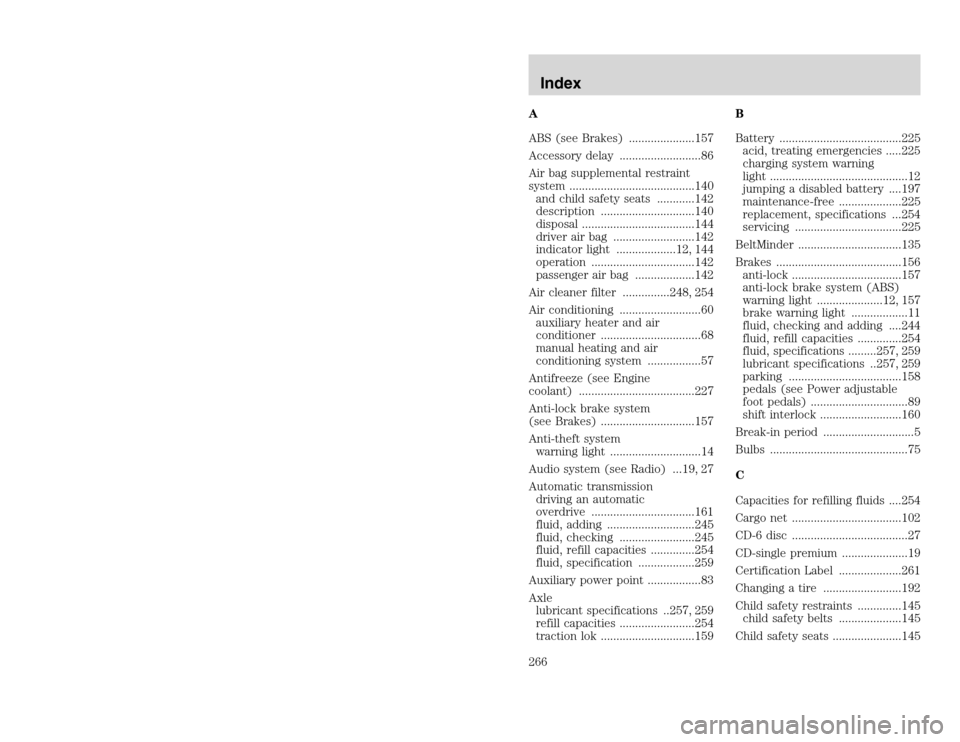
A
ABS (see Brakes) .....................157
Accessory delay ..........................86
Air bag supplemental restraint
system ........................................140
and child safety seats ............142
description ..............................140
disposal ....................................144
driver air bag ..........................142
indicator light ...................12, 144
operation .................................142
passenger air bag ...................142
Air cleaner filter ...............248, 254
Air conditioning ..........................60
auxiliary heater and air
conditioner ................................68
manual heating and air
conditioning system .................57
Antifreeze (see Engine
coolant) .....................................227
Anti-lock brake system
(see Brakes) ..............................157
Anti-theft system
warning light .............................14
Audio system (see Radio) ...19, 27
Automatic transmission
driving an automatic
overdrive .................................161
fluid, adding ............................245
fluid, checking ........................245
fluid, refill capacities ..............254
fluid, specification ..................259
Auxiliary power point .................83
Axle
lubricant specifications ..257, 259
refill capacities ........................254
traction lok ..............................159B
Battery .......................................225
acid, treating emergencies .....225
charging system warning
light ............................................12
jumping a disabled battery ....197
maintenance-free ....................225
replacement, specifications ...254
servicing ..................................225
BeltMinder .................................135
Brakes ........................................156
anti-lock ...................................157
anti-lock brake system (ABS)
warning light .....................12, 157
brake warning light ..................11
fluid, checking and adding ....244
fluid, refill capacities ..............254
fluid, specifications .........257, 259
lubricant specifications ..257, 259
parking ....................................158
pedals (see Power adjustable
foot pedals) ...............................89
shift interlock ..........................160
Break-in period .............................5
Bulbs ............................................75
C
Capacities for refilling fluids ....254
Cargo net ...................................102
CD-6 disc .....................................27
CD-single premium .....................19
Certification Label ....................261
Changing a tire .........................192
Child safety restraints ..............145
child safety belts ....................145
Child safety seats ......................145Index266
A
ABS (see Brakes) .....................157
Accessory delay ..........................86
Air bag supplemental restraint
system ........................................140
and child safety seats ............142
description ..............................140
disposal ....................................144
driver air bag ..........................142
indicator light ...................12, 144
operation .................................142
passenger air bag ...................142
Air cleaner filter ...............248, 254
Air conditioning ..........................60
auxiliary heater and air
conditioner ................................68
manual heating and air
conditioning system .................57
Antifreeze (see Engine
coolant) .....................................227
Anti-lock brake system
(see Brakes) ..............................157
Anti-theft system
warning light .............................14
Audio system (see Radio) ...19, 27
Automatic transmission
driving an automatic
overdrive .................................161
fluid, adding ............................245
fluid, checking ........................245
fluid, refill capacities ..............254
fluid, specification ..................259
Auxiliary power point .................83
Axle
lubricant specifications ..257, 259
refill capacities ........................254
traction lok ..............................159B
Battery .......................................225
acid, treating emergencies .....225
charging system warning
light ............................................12
jumping a disabled battery ....197
maintenance-free ....................225
replacement, specifications ...254
servicing ..................................225
BeltMinder .................................135
Brakes ........................................156
anti-lock ...................................157
anti-lock brake system (ABS)
warning light .....................12, 157
brake warning light ..................11
fluid, checking and adding ....244
fluid, refill capacities ..............254
fluid, specifications .........257, 259
lubricant specifications ..257, 259
parking ....................................158
pedals (see Power adjustable
foot pedals) ...............................89
shift interlock ..........................160
Break-in period .............................5
Bulbs ............................................75
C
Capacities for refilling fluids ....254
Cargo net ...................................102
CD-6 disc .....................................27
CD-single premium .....................19
Certification Label ....................261
Changing a tire .........................192
Child safety restraints ..............145
child safety belts ....................145
Child safety seats ......................145Index266
Page 267 of 272
20815.psp Ford O/G 2002 Excursion English 4th Print 2C3J-19A321-HB 04/24/2003 09:14:57 134 A
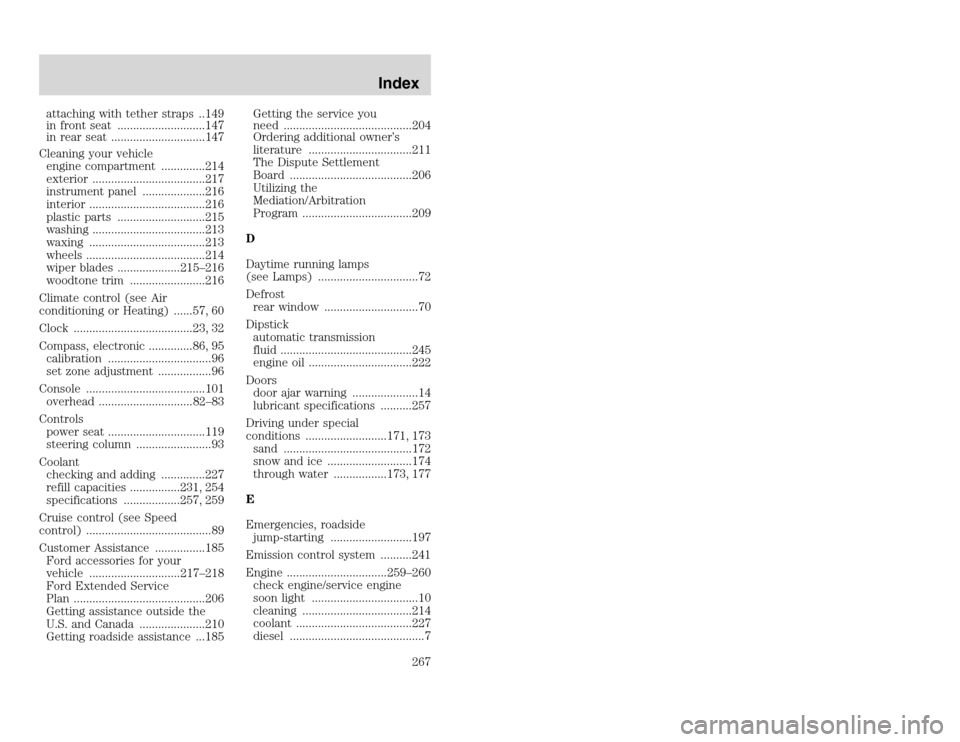
attaching with tether straps ..149
in front seat ............................147
in rear seat ..............................147
Cleaning your vehicle
engine compartment ..............214
exterior ....................................217
instrument panel ....................216
interior .....................................216
plastic parts ............................215
washing ....................................213
waxing .....................................213
wheels ......................................214
wiper blades ....................215–216
woodtone trim ........................216
Climate control (see Air
conditioning or Heating) ......57, 60
Clock ......................................23, 32
Compass, electronic ..............86, 95
calibration .................................96
set zone adjustment .................96
Console ......................................101
overhead ..............................82–83
Controls
power seat ...............................119
steering column ........................93
Coolant
checking and adding ..............227
refill capacities ................231, 254
specifications ..................257, 259
Cruise control (see Speed
control) ........................................89
Customer Assistance ................185
Ford accessories for your
vehicle .............................217–218
Ford Extended Service
Plan ..........................................206
Getting assistance outside the
U.S. and Canada .....................210
Getting roadside assistance ...185Getting the service you
need .........................................204
Ordering additional owner’s
literature .................................211
The Dispute Settlement
Board .......................................206
Utilizing the
Mediation/Arbitration
Program ...................................209
D
Daytime running lamps
(see Lamps) ................................72
Defrost
rear window ..............................70
Dipstick
automatic transmission
fluid ..........................................245
engine oil .................................222
Doors
door ajar warning .....................14
lubricant specifications ..........257
Driving under special
conditions ..........................171, 173
sand .........................................172
snow and ice ...........................174
through water .................173, 177
E
Emergencies, roadside
jump-starting ..........................197
Emission control system ..........241
Engine ................................259–260
check engine/service engine
soon light ..................................10
cleaning ...................................214
coolant .....................................227
diesel ...........................................7
Index
267
attaching with tether straps ..149
in front seat ............................147
in rear seat ..............................147
Cleaning your vehicle
engine compartment ..............214
exterior ....................................217
instrument panel ....................216
interior .....................................216
plastic parts ............................215
washing ....................................213
waxing .....................................213
wheels ......................................214
wiper blades ....................215–216
woodtone trim ........................216
Climate control (see Air
conditioning or Heating) ......57, 60
Clock ......................................23, 32
Compass, electronic ..............86, 95
calibration .................................96
set zone adjustment .................96
Console ......................................101
overhead ..............................82–83
Controls
power seat ...............................119
steering column ........................93
Coolant
checking and adding ..............227
refill capacities ................231, 254
specifications ..................257, 259
Cruise control (see Speed
control) ........................................89
Customer Assistance ................185
Ford accessories for your
vehicle .............................217–218
Ford Extended Service
Plan ..........................................206
Getting assistance outside the
U.S. and Canada .....................210
Getting roadside assistance ...185Getting the service you
need .........................................204
Ordering additional owner’s
literature .................................211
The Dispute Settlement
Board .......................................206
Utilizing the
Mediation/Arbitration
Program ...................................209
D
Daytime running lamps
(see Lamps) ................................72
Defrost
rear window ..............................70
Dipstick
automatic transmission
fluid ..........................................245
engine oil .................................222
Doors
door ajar warning .....................14
lubricant specifications ..........257
Driving under special
conditions ..........................171, 173
sand .........................................172
snow and ice ...........................174
through water .................173, 177
E
Emergencies, roadside
jump-starting ..........................197
Emission control system ..........241
Engine ................................259–260
check engine/service engine
soon light ..................................10
cleaning ...................................214
coolant .....................................227
diesel ...........................................7
Index
267
Page 269 of 272
20815.psp Ford O/G 2002 Excursion English 4th Print 2C3J-19A321-HB 04/24/2003 09:14:57 135 A
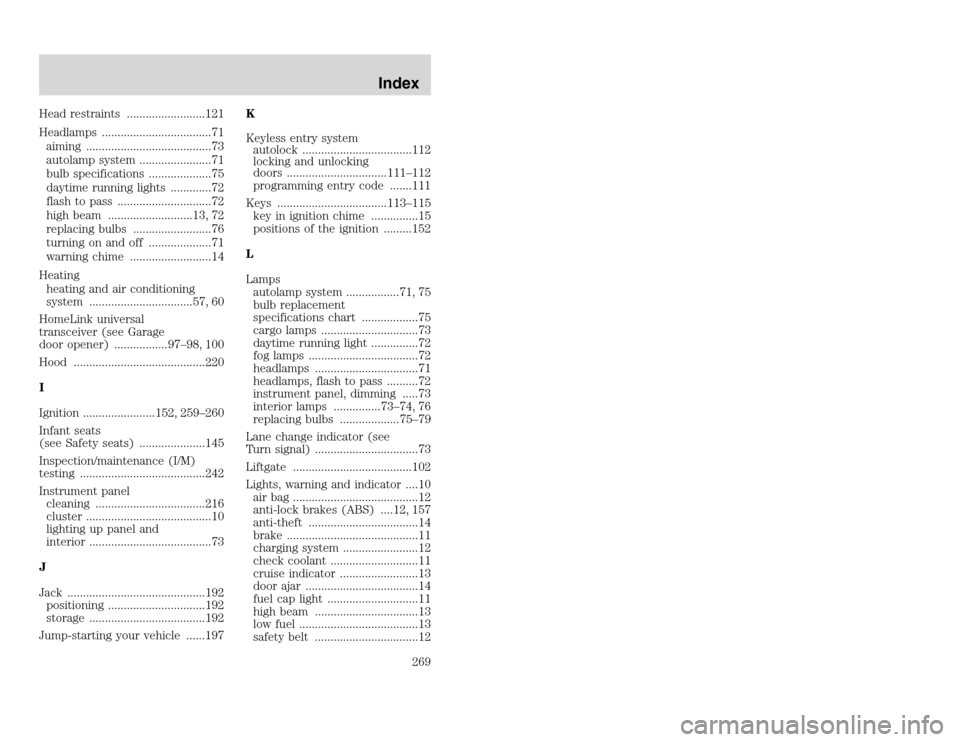
Head restraints .........................121
Headlamps ...................................71
aiming ........................................73
autolamp system .......................71
bulb specifications ....................75
daytime running lights .............72
flash to pass ..............................72
high beam ...........................13, 72
replacing bulbs .........................76
turning on and off ....................71
warning chime ..........................14
Heating
heating and air conditioning
system .................................57, 60
HomeLink universal
transceiver (see Garage
door opener) .................97–98, 100
Hood ..........................................220
I
Ignition .......................152, 259–260
Infant seats
(see Safety seats) .....................145
Inspection/maintenance (I/M)
testing ........................................242
Instrument panel
cleaning ...................................216
cluster ........................................10
lighting up panel and
interior .......................................73
J
Jack ............................................192
positioning ...............................192
storage .....................................192
Jump-starting your vehicle ......197K
Keyless entry system
autolock ...................................112
locking and unlocking
doors ................................111–112
programming entry code .......111
Keys ...................................113–115
key in ignition chime ...............15
positions of the ignition .........152
L
Lamps
autolamp system .................71, 75
bulb replacement
specifications chart ..................75
cargo lamps ...............................73
daytime running light ...............72
fog lamps ...................................72
headlamps .................................71
headlamps, flash to pass ..........72
instrument panel, dimming .....73
interior lamps ...............73–74, 76
replacing bulbs ...................75–79
Lane change indicator (see
Turn signal) .................................73
Liftgate ......................................102
Lights, warning and indicator ....10
air bag ........................................12
anti-lock brakes (ABS) ....12, 157
anti-theft ...................................14
brake ..........................................11
charging system ........................12
check coolant ............................11
cruise indicator .........................13
door ajar ....................................14
fuel cap light .............................11
high beam .................................13
low fuel ......................................13
safety belt .................................12
Index
269
Head restraints .........................121
Headlamps ...................................71
aiming ........................................73
autolamp system .......................71
bulb specifications ....................75
daytime running lights .............72
flash to pass ..............................72
high beam ...........................13, 72
replacing bulbs .........................76
turning on and off ....................71
warning chime ..........................14
Heating
heating and air conditioning
system .................................57, 60
HomeLink universal
transceiver (see Garage
door opener) .................97–98, 100
Hood ..........................................220
I
Ignition .......................152, 259–260
Infant seats
(see Safety seats) .....................145
Inspection/maintenance (I/M)
testing ........................................242
Instrument panel
cleaning ...................................216
cluster ........................................10
lighting up panel and
interior .......................................73
J
Jack ............................................192
positioning ...............................192
storage .....................................192
Jump-starting your vehicle ......197K
Keyless entry system
autolock ...................................112
locking and unlocking
doors ................................111–112
programming entry code .......111
Keys ...................................113–115
key in ignition chime ...............15
positions of the ignition .........152
L
Lamps
autolamp system .................71, 75
bulb replacement
specifications chart ..................75
cargo lamps ...............................73
daytime running light ...............72
fog lamps ...................................72
headlamps .................................71
headlamps, flash to pass ..........72
instrument panel, dimming .....73
interior lamps ...............73–74, 76
replacing bulbs ...................75–79
Lane change indicator (see
Turn signal) .................................73
Liftgate ......................................102
Lights, warning and indicator ....10
air bag ........................................12
anti-lock brakes (ABS) ....12, 157
anti-theft ...................................14
brake ..........................................11
charging system ........................12
check coolant ............................11
cruise indicator .........................13
door ajar ....................................14
fuel cap light .............................11
high beam .................................13
low fuel ......................................13
safety belt .................................12
Index
269