air condition FORD EXCURSION 2003 1.G User Guide
[x] Cancel search | Manufacturer: FORD, Model Year: 2003, Model line: EXCURSION, Model: FORD EXCURSION 2003 1.GPages: 240, PDF Size: 2.2 MB
Page 182 of 240
2. Four or more repair attempts are made on the same nonconformity (a
defect or condition that substantially impairs the use, value or safety of
the vehicle) OR
3. The vehicle is out of service for repair of nonconformities for a total of
more than 30 calendar days (not necessarily all at one time)
In the case of 1 or 2 above, the consumer must also notify the
manufacturer of the need for the repair of the nonconformity at the
following address:
Ford Motor Company
16800 Executive Plaza Drive
Mail Drop 3NE-B
Dearborn, MI 48126
REPORTING SAFETY DEFECTS (U.S. ONLY)
If you believe that your vehicle has
a defect which could cause a crash
or could cause injury or death, you
should immediately inform the National Highway Traffic Safety
Administration (NHTSA) in addition to notifying Ford Motor Company.
If NHTSA receives similar complaints, it may open an investigation, and
if it finds that a safety defect exists in a group of vehicles, it may order a
recall and remedy campaign. However, NHTSA cannot become involved
in individual problems between you, your dealer, or Ford Motor
Company.
To contact NHTSA, you may either call the Auto Safety Hotline toll-free
at 1–800–424–9393 (or 366–0123 in the Washington D.C. area) or write
to:
NHTSA
U.S. Department of Transportation
Washington, D.C. 20590
You can also obtain other information about motor vehicle safety from
the Hotline.
Customer Assistance
182
Page 202 of 240
•Decreased engine coolant concentrations below 40% will
decrease the corrosion protection characteristics of the engine
coolant and may cause engine damage.
•Decreased engine coolant concentrations below 40% will
decrease the freeze protection characteristics of the engine
coolant and may cause engine damage.
•Refer to the chart on the coolant container to ensure the
coolant concentration in your vehicle will provide adequate
protection at the temperatures in which you drive.
Vehicles driven year-round in non-extreme climates should use a 50/50
mixture of engine coolant and distilled water for optimum cooling system
and engine protection.
What you should know about fail-safe cooling (if equipped)
If the engine coolant supply is depleted, this feature allows the vehicle to
be driven temporarily before incremental component damage is incurred.
The “fail-safe” distance depends on ambient temperatures, vehicle load
and terrain.
How fail-safe cooling works
If the engine begins to overheat:
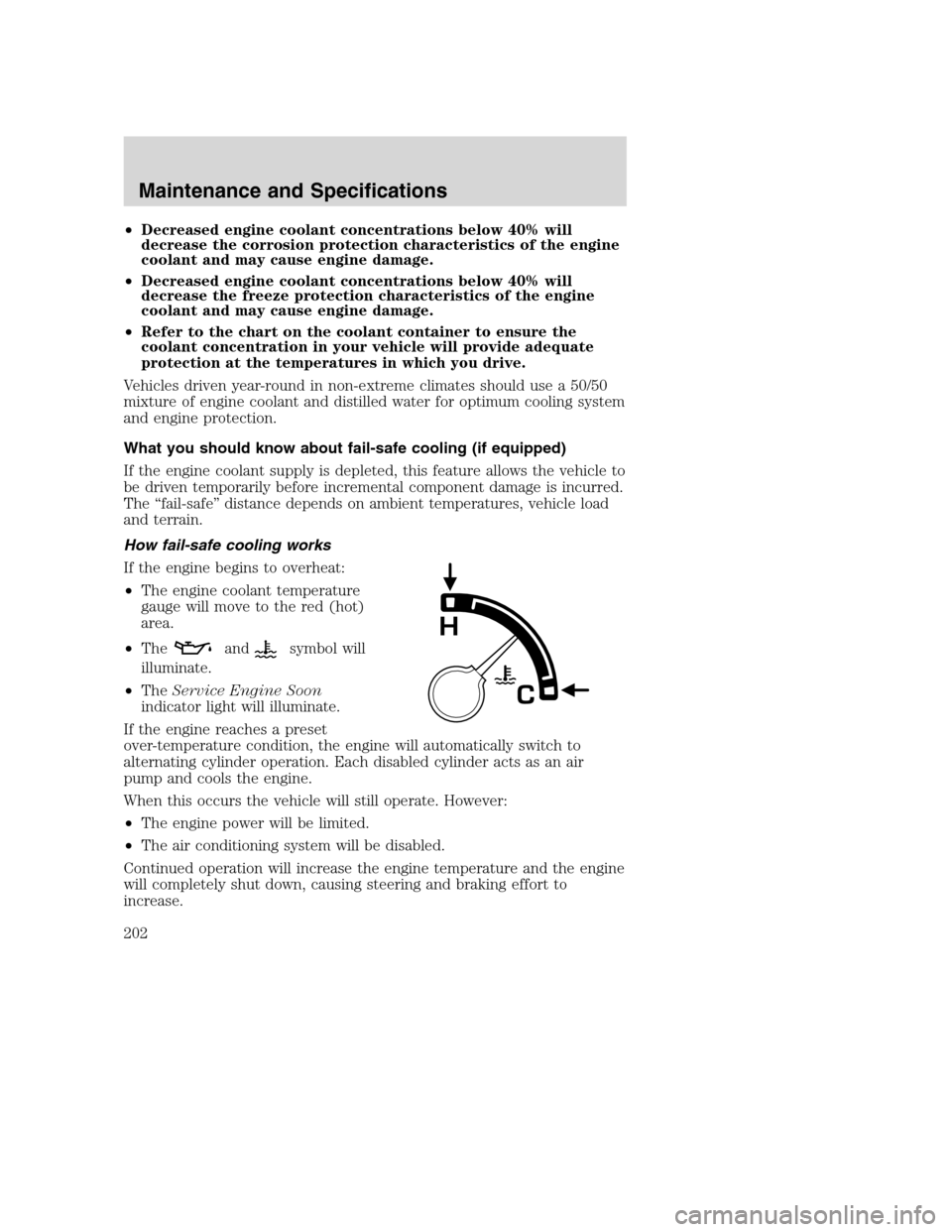
•The engine coolant temperature
gauge will move to the red (hot)
area.
•The
andsymbol will
illuminate.
•TheService Engine Soon
indicator light will illuminate.
If the engine reaches a preset
over-temperature condition, the engine will automatically switch to
alternating cylinder operation. Each disabled cylinder acts as an air
pump and cools the engine.
When this occurs the vehicle will still operate. However:
•The engine power will be limited.
•The air conditioning system will be disabled.
Continued operation will increase the engine temperature and the engine
will completely shut down, causing steering and braking effort to
increase.
Maintenance and Specifications
202
Page 206 of 240
be void for any damage to the fuel tank or fuel system if the
correct genuine Ford or Motorcraft fuel filler cap is not used.
The fuel system may be under pressure. If the fuel filler cap is
venting vapor or if you hear a hissing sound, wait until it stops
before completely removing the fuel filler cap. Otherwise, fuel may
spray out and injure you or others.
If you do not use the proper fuel filler cap, excessive pressure or
vacuum in the fuel tank may damage the fuel system or cause
the fuel cap to disengage in a collision, which may result in possible
personal injury.
Choosing the right fuel
Use only UNLEADED FUEL. The use of leaded fuel is prohibited by law
and could damage your vehicle.
Do not use fuel containing methanol. It can damage critical fuel system
components.
Your vehicle was not designed to use fuel or fuel additives with metallic
compounds, including manganese-based compounds containing MMT.
Repairs to correct the effects of using a fuel for which your vehicle was
not designed may not be covered by your warranty.
Octane recommendations
Your vehicle is designed to use
“Regular” unleaded gasoline with
pump (R+M)/2 octane rating of 87.
We do not recommend the use of
gasolines labeled as “Regular” that
are sold with octane ratings of 86 or lower in high altitude areas.
Do not be concerned if your engine sometimes knocks lightly. However, if
it knocks heavily under most driving conditions while you are using fuel
with the recommended octane rating, see your dealer or a qualified
service technician to prevent any engine damage.
Fuel quality
If you are experiencing starting, rough idle or hesitation driveability
problems during a cold start, try a different brand of “Regular” unleaded
gasoline. “Premium” unleaded gasoline is not recommended (particularly
87(R+M)/2 METHOD
Maintenance and Specifications
206
Page 210 of 240
•Revving the engine before turning it off may reduce fuel economy.
•Using the air conditioner or defroster may reduce fuel economy.
•You may want to turn off the speed control in hilly terrain if
unnecessary shifting between third and fourth gear occurs.
Unnecessary shifting of this type could result in reduced fuel
economy.
•Warming up a vehicle on cold mornings is not required and may
reduce fuel economy.
•Resting your foot on the brake pedal while driving may reduce fuel
economy.
•Combine errands and minimize stop-and-go driving.
Maintenance
•Keep tires properly inflated and use only recommended size.
•Operating a vehicle with the wheels out of alignment will reduce fuel
economy.
•Use recommended engine oil. Refer toLubricant specificationsin
this chapter.
•Perform all regularly scheduled maintenance items. Follow the
recommended maintenance schedule and owner maintenance checks
found in your vehicle scheduled maintenance guide.
Conditions
•Heavily loading a vehicle or towing a trailer may reduce fuel economy
at any speed.
•Carrying unnecessary weight may reduce fuel economy (approximately
0.4 km/L [1 mpg] is lost for every 180 kg [400 lb] of weight carried).
•Adding certain accessories to your vehicle (for example bug
deflectors, rollbars/light bars, running boards, ski/luggage racks) may
reduce fuel economy.
•Using fuel blended with alcohol may lower fuel economy.
•Fuel economy may decrease with lower temperatures during the first
12–16 km (8–10 miles) of driving.
•Driving on flat terrain offers improved fuel economy as compared to
driving on hilly terrain.
•Transmissions give their best fuel economy when operated in the top
cruise gear and with steady pressure on the gas pedal.
Maintenance and Specifications
210
Page 212 of 240
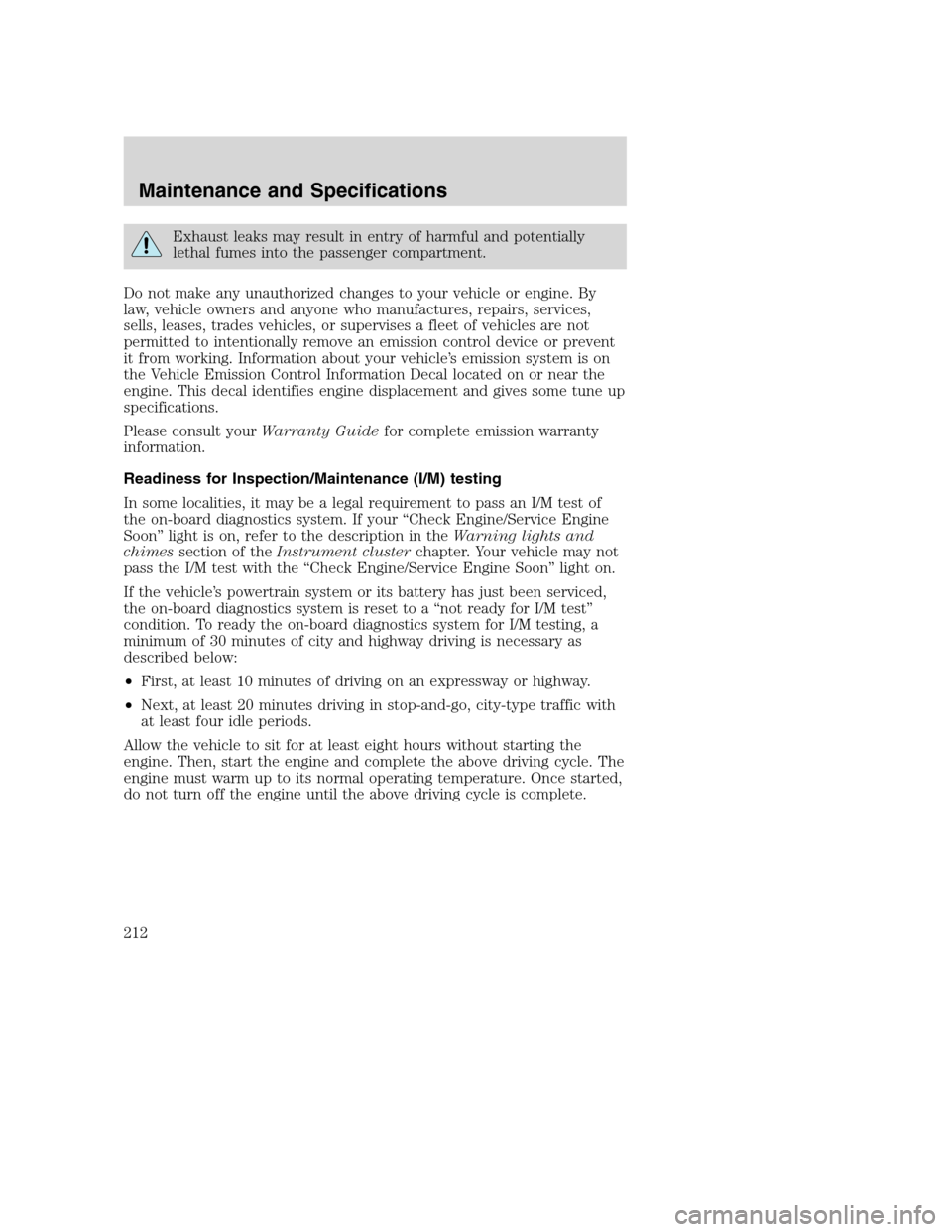
Exhaust leaks may result in entry of harmful and potentially
lethal fumes into the passenger compartment.
Do not make any unauthorized changes to your vehicle or engine. By
law, vehicle owners and anyone who manufactures, repairs, services,
sells, leases, trades vehicles, or supervises a fleet of vehicles are not
permitted to intentionally remove an emission control device or prevent
it from working. Information about your vehicle’s emission system is on
the Vehicle Emission Control Information Decal located on or near the
engine. This decal identifies engine displacement and gives some tune up
specifications.
Please consult yourWarranty Guidefor complete emission warranty
information.
Readiness for Inspection/Maintenance (I/M) testing
In some localities, it may be a legal requirement to pass an I/M test of
the on-board diagnostics system. If your “Check Engine/Service Engine
Soon” light is on, refer to the description in theWarning lights and
chimessection of theInstrument clusterchapter. Your vehicle may not
pass the I/M test with the “Check Engine/Service Engine Soon” light on.
If the vehicle’s powertrain system or its battery has just been serviced,
the on-board diagnostics system is reset to a “not ready for I/M test”
condition. To ready the on-board diagnostics system for I/M testing, a
minimum of 30 minutes of city and highway driving is necessary as
described below:
•First, at least 10 minutes of driving on an expressway or highway.
•Next, at least 20 minutes driving in stop-and-go, city-type traffic with
at least four idle periods.
Allow the vehicle to sit for at least eight hours without starting the
engine. Then, start the engine and complete the above driving cycle. The
engine must warm up to its normal operating temperature. Once started,
do not turn off the engine until the above driving cycle is complete.
Maintenance and Specifications
212
Page 235 of 240
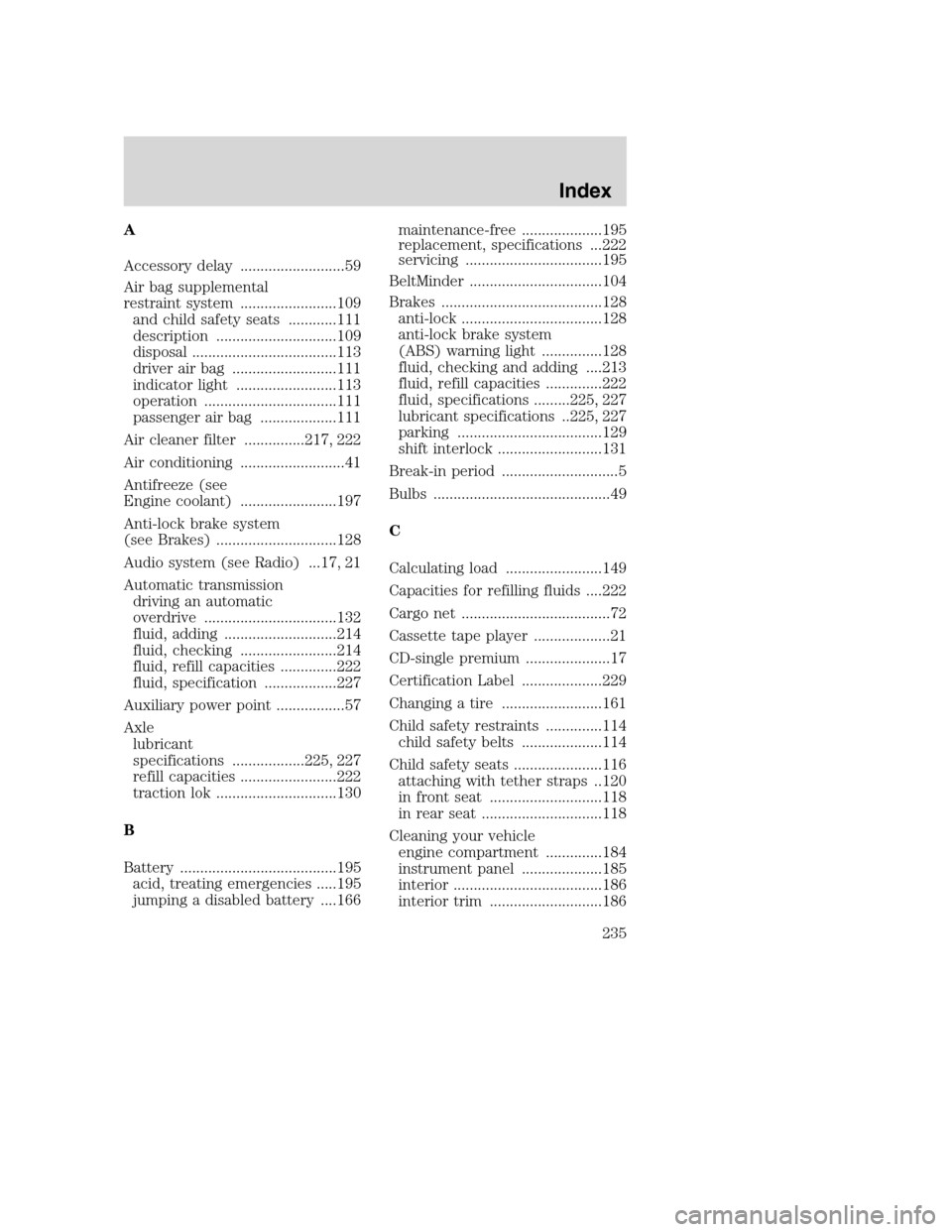
A
Accessory delay ..........................59
Air bag supplemental
restraint system ........................109
and child safety seats ............111
description ..............................109
disposal ....................................113
driver air bag ..........................111
indicator light .........................113
operation .................................111
passenger air bag ...................111
Air cleaner filter ...............217, 222
Air conditioning ..........................41
Antifreeze (see
Engine coolant) ........................197
Anti-lock brake system
(see Brakes) ..............................128
Audio system (see Radio) ...17, 21
Automatic transmission
driving an automatic
overdrive .................................132
fluid, adding ............................214
fluid, checking ........................214
fluid, refill capacities ..............222
fluid, specification ..................227
Auxiliary power point .................57
Axle
lubricant
specifications ..................225, 227
refill capacities ........................222
traction lok ..............................130
B
Battery .......................................195
acid, treating emergencies .....195
jumping a disabled battery ....166maintenance-free ....................195
replacement, specifications ...222
servicing ..................................195
BeltMinder .................................104
Brakes ........................................128
anti-lock ...................................128
anti-lock brake system
(ABS) warning light ...............128
fluid, checking and adding ....213
fluid, refill capacities ..............222
fluid, specifications .........225, 227
lubricant specifications ..225, 227
parking ....................................129
shift interlock ..........................131
Break-in period .............................5
Bulbs ............................................49
C
Calculating load ........................149
Capacities for refilling fluids ....222
Cargo net .....................................72
Cassette tape player ...................21
CD-single premium .....................17
Certification Label ....................229
Changing a tire .........................161
Child safety restraints ..............114
child safety belts ....................114
Child safety seats ......................116
attaching with tether straps ..120
in front seat ............................118
in rear seat ..............................118
Cleaning your vehicle
engine compartment ..............184
instrument panel ....................185
interior .....................................186
interior trim ............................186
Index
235
Page 236 of 240
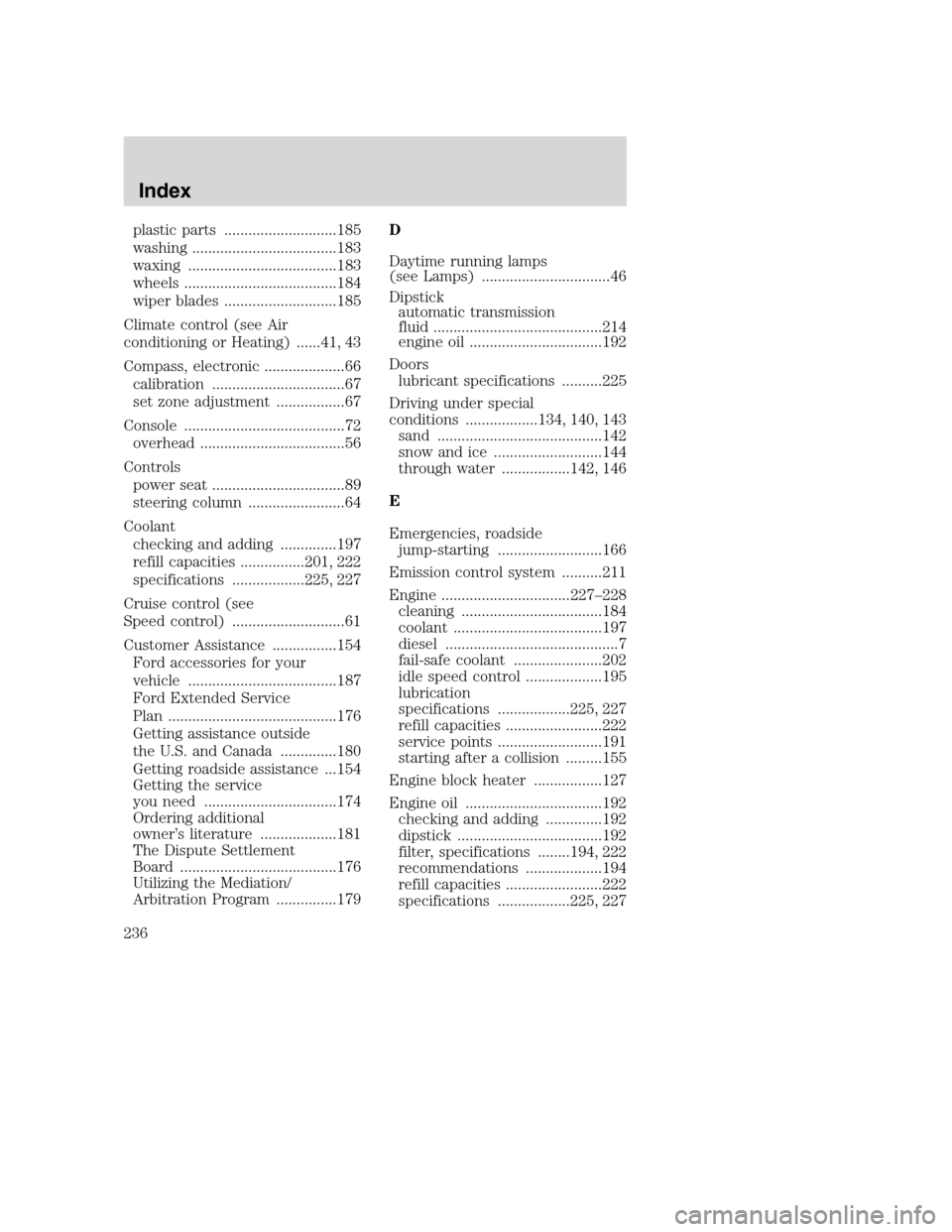
plastic parts ............................185
washing ....................................183
waxing .....................................183
wheels ......................................184
wiper blades ............................185
Climate control (see Air
conditioning or Heating) ......41, 43
Compass, electronic ....................66
calibration .................................67
set zone adjustment .................67
Console ........................................72
overhead ....................................56
Controls
power seat .................................89
steering column ........................64
Coolant
checking and adding ..............197
refill capacities ................201, 222
specifications ..................225, 227
Cruise control (see
Speed control) ............................61
Customer Assistance ................154
Ford accessories for your
vehicle .....................................187
Ford Extended Service
Plan ..........................................176
Getting assistance outside
the U.S. and Canada ..............180
Getting roadside assistance ...154
Getting the service
you need .................................174
Ordering additional
owner’s literature ...................181
The Dispute Settlement
Board .......................................176
Utilizing the Mediation/
Arbitration Program ...............179D
Daytime running lamps
(see Lamps) ................................46
Dipstick
automatic transmission
fluid ..........................................214
engine oil .................................192
Doors
lubricant specifications ..........225
Driving under special
conditions ..................134, 140, 143
sand .........................................142
snow and ice ...........................144
through water .................142, 146
E
Emergencies, roadside
jump-starting ..........................166
Emission control system ..........211
Engine ................................227–228
cleaning ...................................184
coolant .....................................197
diesel ...........................................7
fail-safe coolant ......................202
idle speed control ...................195
lubrication
specifications ..................225, 227
refill capacities ........................222
service points ..........................191
starting after a collision .........155
Engine block heater .................127
Engine oil ..................................192
checking and adding ..............192
dipstick ....................................192
filter, specifications ........194, 222
recommendations ...................194
refill capacities ........................222
specifications ..................225, 227
Index
236
Page 237 of 240
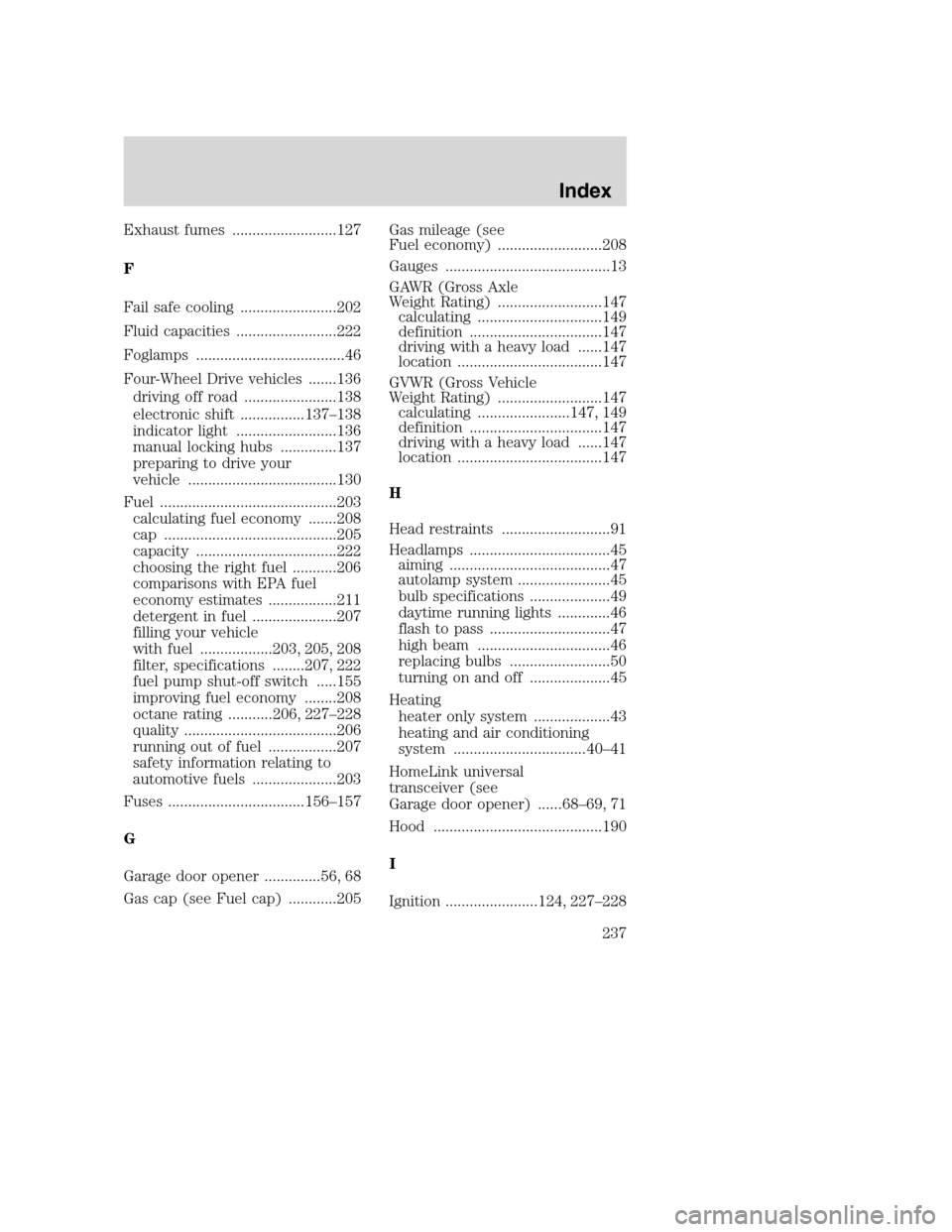
Exhaust fumes ..........................127
F
Fail safe cooling ........................202
Fluid capacities .........................222
Foglamps .....................................46
Four-Wheel Drive vehicles .......136
driving off road .......................138
electronic shift ................137–138
indicator light .........................136
manual locking hubs ..............137
preparing to drive your
vehicle .....................................130
Fuel ............................................203
calculating fuel economy .......208
cap ...........................................205
capacity ...................................222
choosing the right fuel ...........206
comparisons with EPA fuel
economy estimates .................211
detergent in fuel .....................207
filling your vehicle
with fuel ..................203, 205, 208
filter, specifications ........207, 222
fuel pump shut-off switch .....155
improving fuel economy ........208
octane rating ...........206, 227–228
quality ......................................206
running out of fuel .................207
safety information relating to
automotive fuels .....................203
Fuses ..................................156–157
G
Garage door opener ..............56, 68
Gas cap (see Fuel cap) ............205Gas mileage (see
Fuel economy) ..........................208
Gauges .........................................13
GAWR (Gross Axle
Weight Rating) ..........................147
calculating ...............................149
definition .................................147
driving with a heavy load ......147
location ....................................147
GVWR (Gross Vehicle
Weight Rating) ..........................147
calculating .......................147, 149
definition .................................147
driving with a heavy load ......147
location ....................................147
H
Head restraints ...........................91
Headlamps ...................................45
aiming ........................................47
autolamp system .......................45
bulb specifications ....................49
daytime running lights .............46
flash to pass ..............................47
high beam .................................46
replacing bulbs .........................50
turning on and off ....................45
Heating
heater only system ...................43
heating and air conditioning
system .................................40–41
HomeLink universal
transceiver (see
Garage door opener) ......68–69, 71
Hood ..........................................190
I
Ignition .......................124, 227–228
Index
237