trailer FORD EXCURSION 2003 1.G User Guide
[x] Cancel search | Manufacturer: FORD, Model Year: 2003, Model line: EXCURSION, Model: FORD EXCURSION 2003 1.GPages: 240, PDF Size: 2.2 MB
Page 152 of 240
Driving while you tow
When towing a trailer:
•Turn off the speed control. The speed control may shut off
automatically when you are towing on long, steep grades.
•Consult your local motor vehicle speed regulations for towing a trailer.
•To eliminate excessive shifting, use a lower gear. This will also assist
in transmission cooling. (For additional information, refer to the
Understanding the positions of the 4–speed automatic
transmissionsection in this chapter.
•Anticipate stops and brake gradually.
•Do not exceed the GCWR rating or transmission damage may occur.
Servicing after towing
If you tow a trailer for long distances, your vehicle will require more
frequent service intervals. Refer to your scheduled maintenance guide for
more information.
Trailer towing tips
•Practice turning, stopping and backing up before starting on a trip to
get the feel of the vehicle trailer combination. When turning, make
wider turns so the trailer wheels will clear curbs and other obstacles.
•Allow more distance for stopping with a trailer attached.
•If you are driving down a long or steep hill, shift to a lower gear. Do
not apply the brakes continuously, as they may overheat and become
less effective.
•The trailer tongue weight should be 10–15% of the loaded trailer
weight.
•After you have traveled 80 km (50 miles), thoroughly check your
hitch, electrical connections and trailer wheel lug nuts.
•To aid in engine/transmission cooling and A/C efficiency during hot
weather while stopped in traffic, place the gearshift lever in P (Park).
•Vehicles with trailers should not be parked on a grade. If you must
park on a grade, place wheel chocks under the trailer’s wheels.
Launching or retrieving a boat
When backing down a ramp during boat launching or retrieval,
•Do not allow the static water level to rise above the bottom edge of
the rear bumper.
Driving
152
Page 153 of 240
•Do not allow waves to break higher than 15 cm (6 inches) above the
bottom edge of the rear bumper.
•Disconnect the trailer tow electrical connector to prevent blown fuses
caused by water entering into your trailer’s electrical wiring.
Exceeding these limits may allow water to enter critical vehicle
components, adversely affecting driveability, emissions and reliability.
Replace front and rear axle lubricants any time the axles have been
submerged in water. Axle lubricant quantities are not to be checked
unless a leak is suspected.
RECREATIONAL TOWING (ALL WHEELS ON THE GROUND)
An example of recreational towing would be towing your vehicle behind
a motorhome. Follow these guidelines if you have the need for
recreational towing your vehicle with all four wheels on the ground.
These guidelines are designed to ensure that your transmission is not
damaged.
2WD vehicles (with automatic transmissions):
•Place the transmission in N (Neutral)
•Maximum speed is 56 km (35 mph)
•Maximum distance is 80 km (50 miles)
If a distance of 80 km (50 miles) or a speed of 56 km (35 mph) must be
exceeded, the drive shaft will have to be removed before the vehicle is
towed.
Ford recommends the driveshaft be removed/installed only by a qualified
technician. See your local dealer for driveshaft removal/installation.
Improper removal/installation of the driveshaft can cause
transmission fluid loss, damage to the driveshaft and internal
transmission components.
4WD vehicles electronic shift transfer case (with automatic
transmissions):
4x4 vehicles with electronic shift on the fly cannot be towed with any
wheels on the ground.
Driving
153
Page 158 of 240
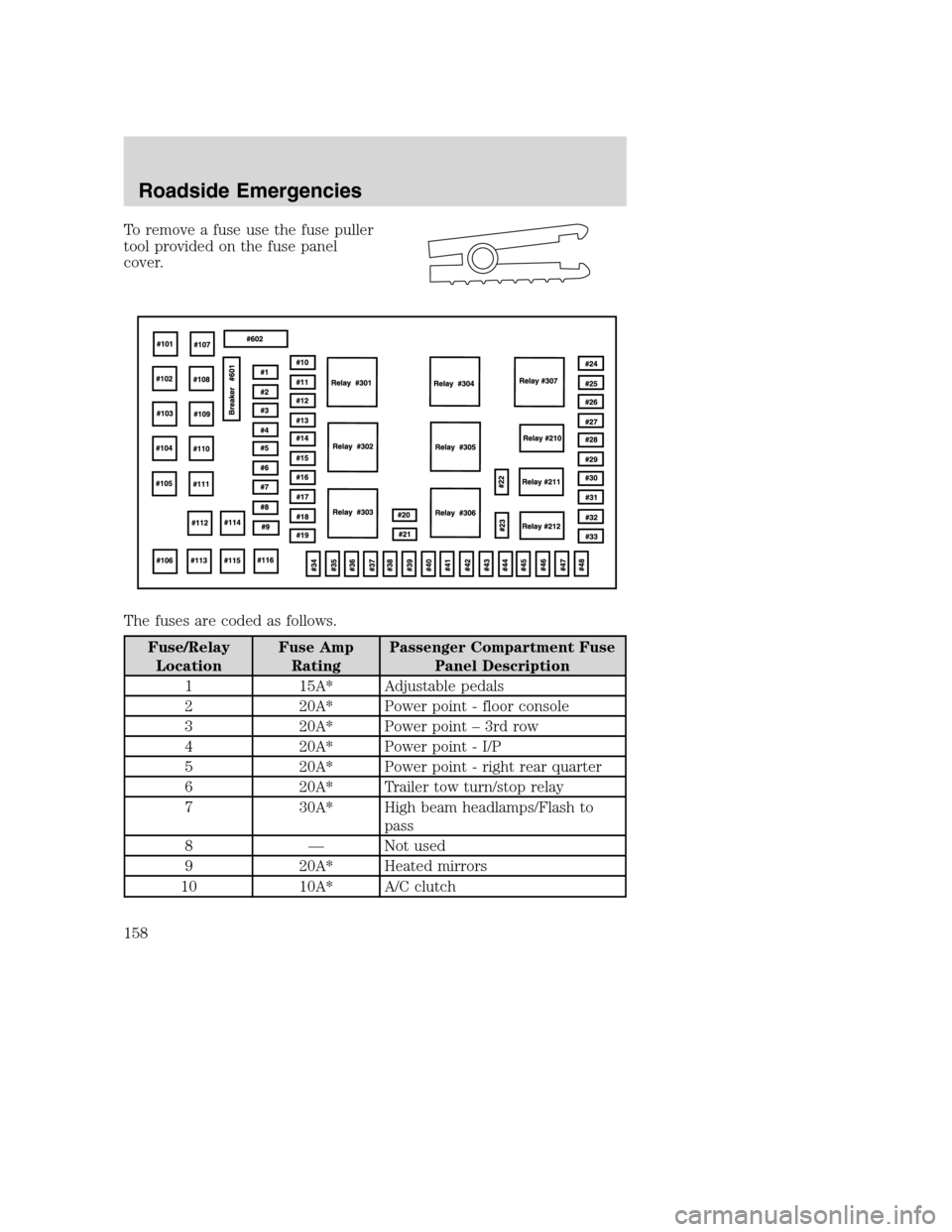
To remove a fuse use the fuse puller
tool provided on the fuse panel
cover.
The fuses are coded as follows.
Fuse/Relay
LocationFuse Amp
RatingPassenger Compartment Fuse
Panel Description
1 15A* Adjustable pedals
2 20A* Power point - floor console
3 20A* Power point – 3rd row
4 20A* Power point - I/P
5 20A* Power point - right rear quarter
6 20A* Trailer tow turn/stop relay
7 30A* High beam headlamps/Flash to
pass
8 — Not used
9 20A* Heated mirrors
10 10A* A/C clutch
Roadside Emergencies
158
Page 160 of 240
Fuse/Relay
LocationFuse Amp
RatingPassenger Compartment Fuse
Panel Description
37 15A* Horn
38 20A* Trailer tow park lamps and
backup lamps
39 — Not used
40 20A* Fuel pump
41 10A* Instrument cluster
42 15A* Delayed accessory
43 10A* Fog lamps
44 10A* PATS module, Transceiver
45 10A* Ignition switch Run/Start feed
46 10A* Left-hand lowbeam
47 10A* Right-hand lowbeam
48 10A* Rear smart wiper motor
101 30A** Trailer tow electric brake
102 30A** Door locks, BSM
103 50A** Ignition switch
104 40A** Heated backlite
105 30A** Injector driver module (Diesel
engine only)
106 30A** Front wiper main
107 40A** Front blower motor
108 40A** Auxiliary blower motor
109 30A** Heated seats
110 50A** Ignition switch
111 30A** 4WD/Shift on the fly
112 30A** Left-hand power seats
113 30A** Starter motor
114 30A** Right-hand power seats
115 20A** Trailer tow battery charge
116 30A** Ignition switch
601 30A CB*** Door window motors
Roadside Emergencies
160
Page 161 of 240
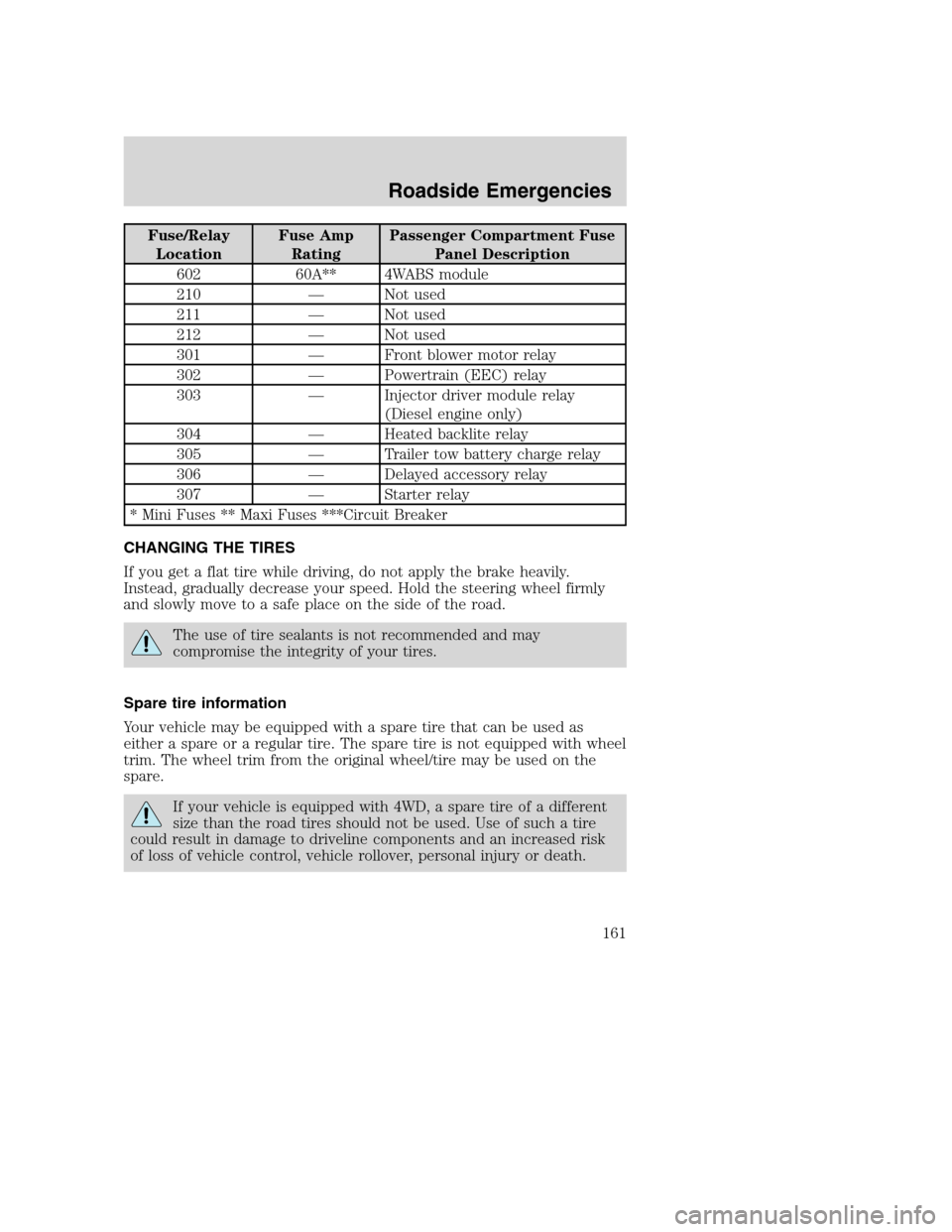
Fuse/Relay
LocationFuse Amp
RatingPassenger Compartment Fuse
Panel Description
602 60A** 4WABS module
210 — Not used
211 — Not used
212 — Not used
301 — Front blower motor relay
302 — Powertrain (EEC) relay
303 — Injector driver module relay
(Diesel engine only)
304 — Heated backlite relay
305 — Trailer tow battery charge relay
306 — Delayed accessory relay
307 — Starter relay
* Mini Fuses ** Maxi Fuses ***Circuit Breaker
CHANGING THE TIRES
If you get a flat tire while driving, do not apply the brake heavily.
Instead, gradually decrease your speed. Hold the steering wheel firmly
and slowly move to a safe place on the side of the road.
The use of tire sealants is not recommended and may
compromise the integrity of your tires.
Spare tire information
Your vehicle may be equipped with a spare tire that can be used as
either a spare or a regular tire. The spare tire is not equipped with wheel
trim. The wheel trim from the original wheel/tire may be used on the
spare.
If your vehicle is equipped with 4WD, a spare tire of a different
size than the road tires should not be used. Use of such a tire
could result in damage to driveline components and an increased risk
of loss of vehicle control, vehicle rollover, personal injury or death.
Roadside Emergencies
161
Page 210 of 240
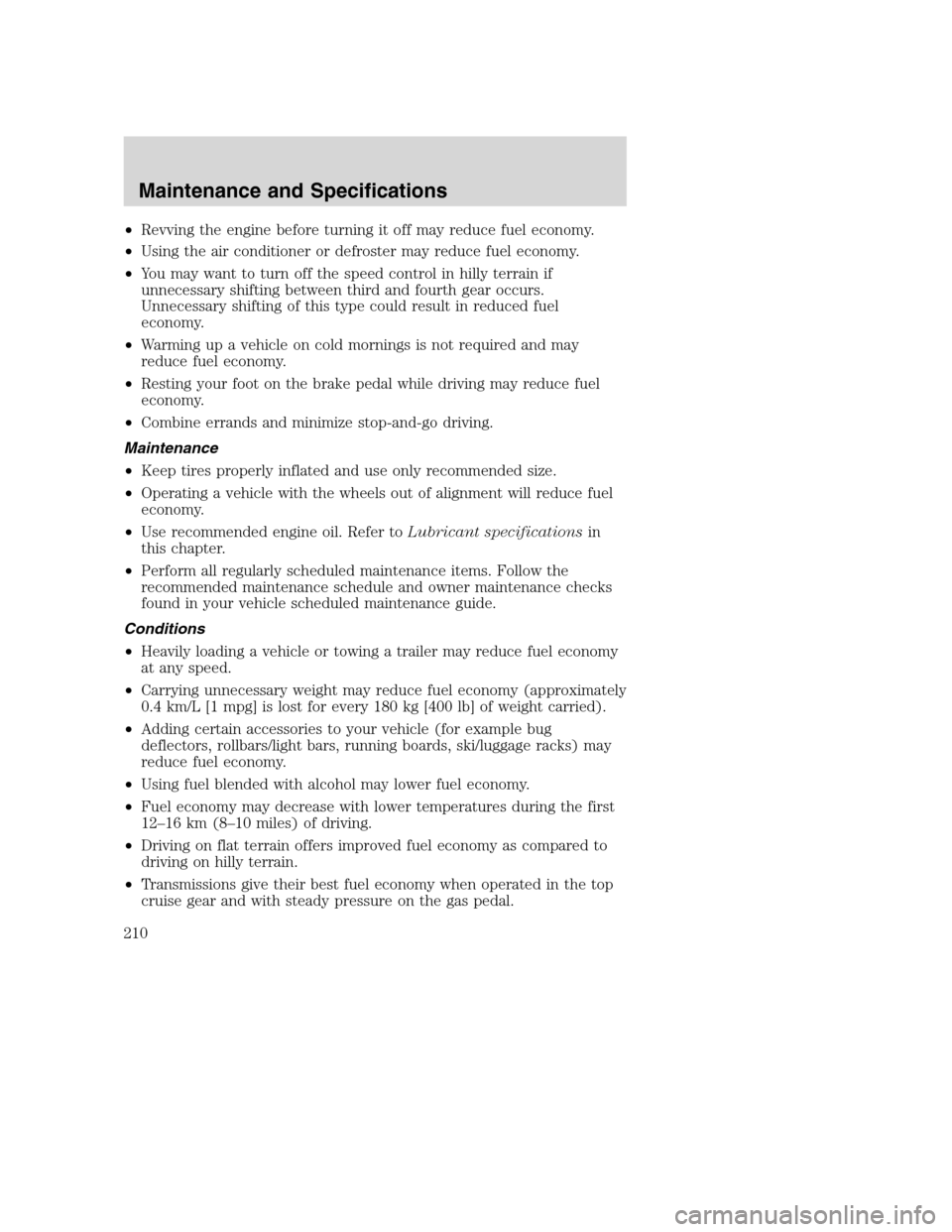
•Revving the engine before turning it off may reduce fuel economy.
•Using the air conditioner or defroster may reduce fuel economy.
•You may want to turn off the speed control in hilly terrain if
unnecessary shifting between third and fourth gear occurs.
Unnecessary shifting of this type could result in reduced fuel
economy.
•Warming up a vehicle on cold mornings is not required and may
reduce fuel economy.
•Resting your foot on the brake pedal while driving may reduce fuel
economy.
•Combine errands and minimize stop-and-go driving.
Maintenance
•Keep tires properly inflated and use only recommended size.
•Operating a vehicle with the wheels out of alignment will reduce fuel
economy.
•Use recommended engine oil. Refer toLubricant specificationsin
this chapter.
•Perform all regularly scheduled maintenance items. Follow the
recommended maintenance schedule and owner maintenance checks
found in your vehicle scheduled maintenance guide.
Conditions
•Heavily loading a vehicle or towing a trailer may reduce fuel economy
at any speed.
•Carrying unnecessary weight may reduce fuel economy (approximately
0.4 km/L [1 mpg] is lost for every 180 kg [400 lb] of weight carried).
•Adding certain accessories to your vehicle (for example bug
deflectors, rollbars/light bars, running boards, ski/luggage racks) may
reduce fuel economy.
•Using fuel blended with alcohol may lower fuel economy.
•Fuel economy may decrease with lower temperatures during the first
12–16 km (8–10 miles) of driving.
•Driving on flat terrain offers improved fuel economy as compared to
driving on hilly terrain.
•Transmissions give their best fuel economy when operated in the top
cruise gear and with steady pressure on the gas pedal.
Maintenance and Specifications
210
Page 214 of 240
TRANSMISSION FLUID
Checking automatic transmission fluid (if equipped)
Refer to your scheduled maintenance guide for scheduled intervals for
fluid checks and changes. Your transmission does not consume fluid.
However, the fluid level should be checked if the transmission is not
working properly, i.e., if the transmission slips or shifts slowly or if you
notice some sign of fluid leakage.
Automatic transmission fluid expands when warmed. To obtain an
accurate fluid check, drive the vehicle until it is at normal operating
temperature (approximately 30 km [20 miles]). If your vehicle has been
operated for an extended period at high speeds, in city traffic during hot
weather or pulling a trailer, the vehicle should be turned off for about 30
minutes to allow fluid to cool before checking.
1. Drive the vehicle 30 km (20 miles) or until it reaches normal operating
temperature.
2. Park the vehicle on a level surface and engage the parking brake.
3. With the parking brake engaged and your foot on the brake pedal,
start the engine and move the gearshift lever through all of the gear
ranges. Allow sufficient time for each gear to engage.
4. Latch the gearshift lever in P (Park) and leave the engine running.
5. Remove the dipstick, wiping it clean with a clean, dry lint free rag. If
necessary, refer toIdentifying components in the engine compartment
in this chapter for the location of the dipstick.
6. Install the dipstick making sure it is fully seated in the filler tube.
7. Remove the dipstick and inspect the fluid level. The fluid should be in
the designated area for normal operating temperature or ambient
temperature.
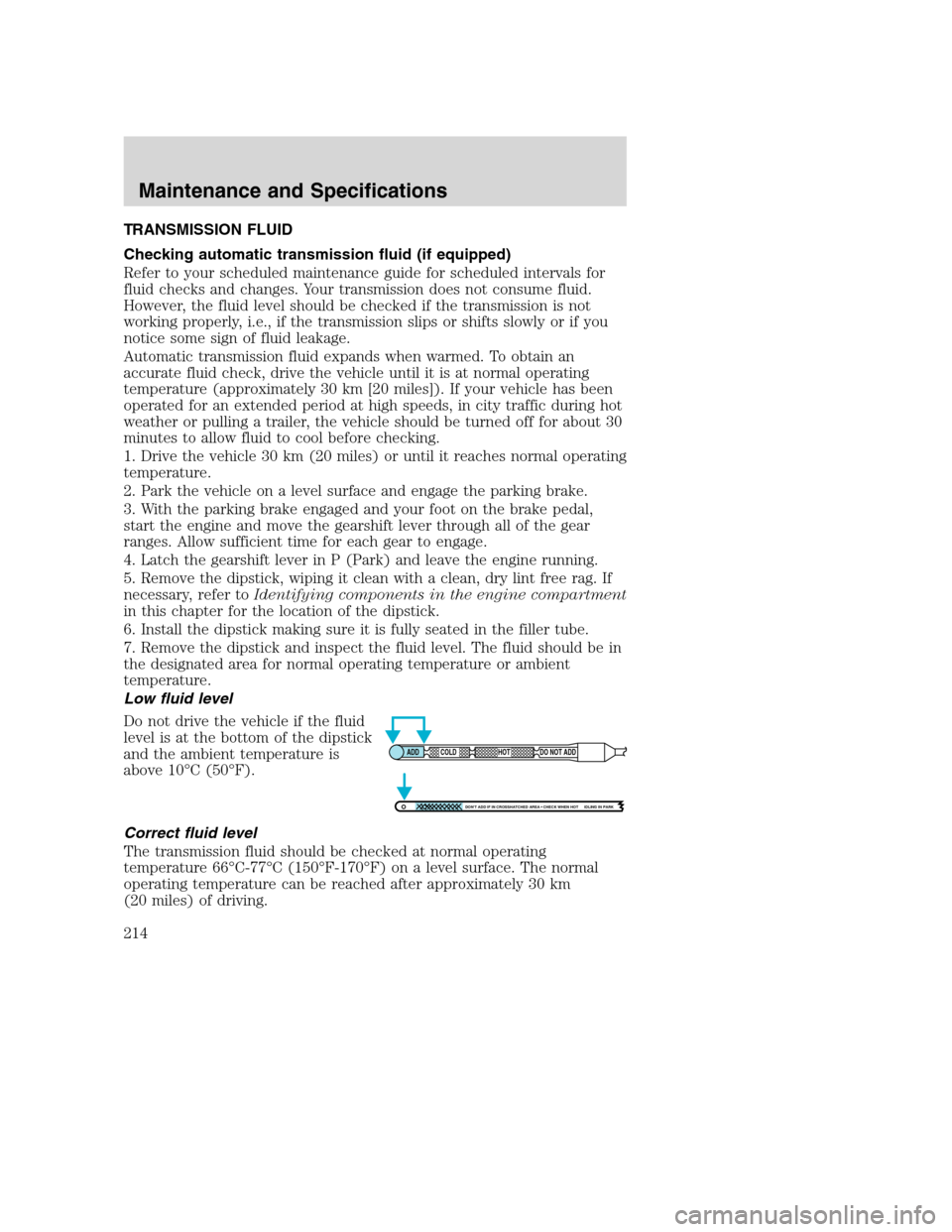
Low fluid level
Do not drive the vehicle if the fluid
level is at the bottom of the dipstick
and the ambient temperature is
above 10°C (50°F).
Correct fluid level
The transmission fluid should be checked at normal operating
temperature 66°C-77°C (150°F-170°F) on a level surface. The normal
operating temperature can be reached after approximately 30 km
(20 miles) of driving.
ADD COLD HOT DO NOT ADD
DON'T ADD IF IN CROSSHATCHED AREA CHECK WHEN HOT IDLING IN PARK
Maintenance and Specifications
214
Page 232 of 240
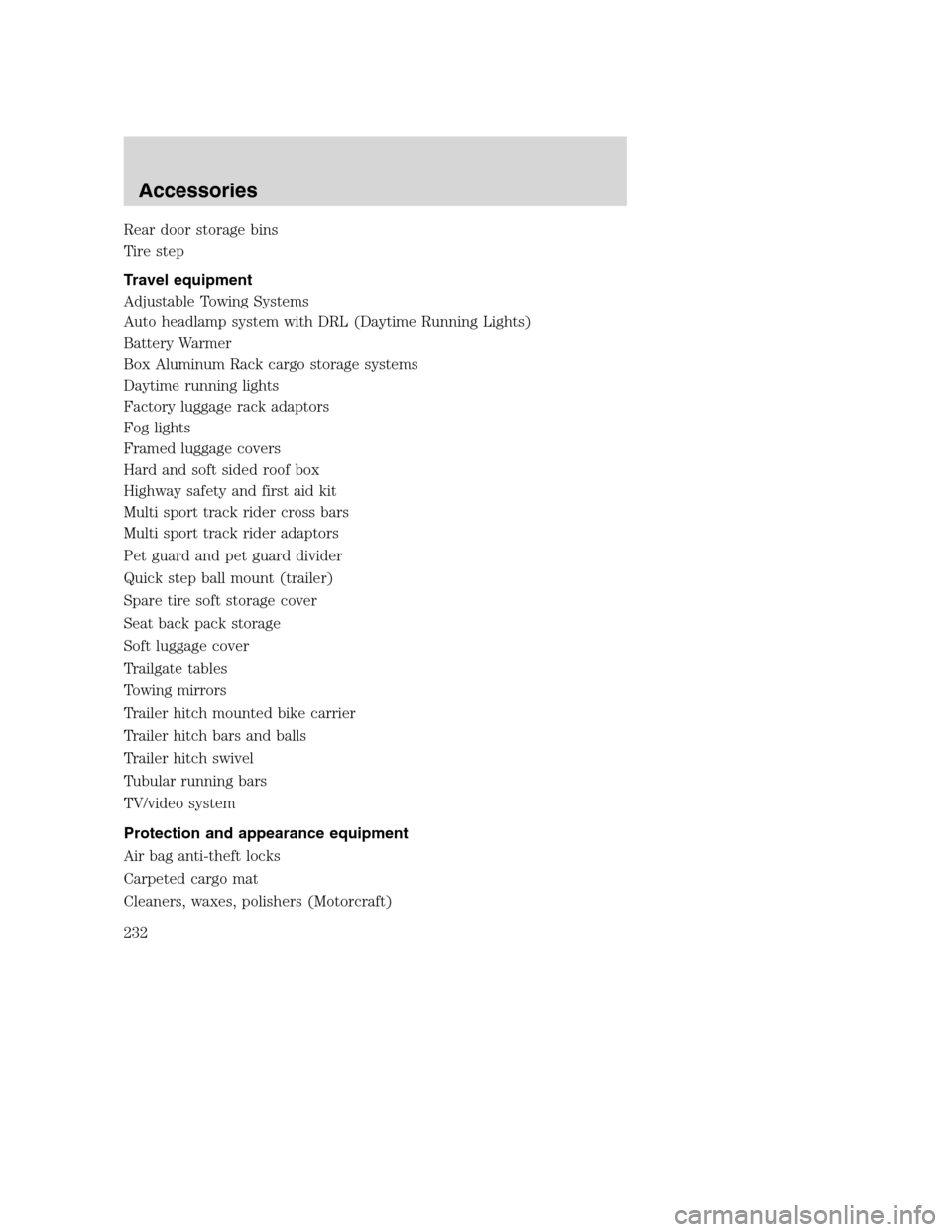
Rear door storage bins
Tire step
Travel equipment
Adjustable Towing Systems
Auto headlamp system with DRL (Daytime Running Lights)
Battery Warmer
Box Aluminum Rack cargo storage systems
Daytime running lights
Factory luggage rack adaptors
Fog lights
Framed luggage covers
Hard and soft sided roof box
Highway safety and first aid kit
Multi sport track rider cross bars
Multi sport track rider adaptors
Pet guard and pet guard divider
Quick step ball mount (trailer)
Spare tire soft storage cover
Seat back pack storage
Soft luggage cover
Trailgate tables
Towing mirrors
Trailer hitch mounted bike carrier
Trailer hitch bars and balls
Trailer hitch swivel
Tubular running bars
TV/video system
Protection and appearance equipment
Air bag anti-theft locks
Carpeted cargo mat
Cleaners, waxes, polishers (Motorcraft)
Accessories
232
Page 238 of 240
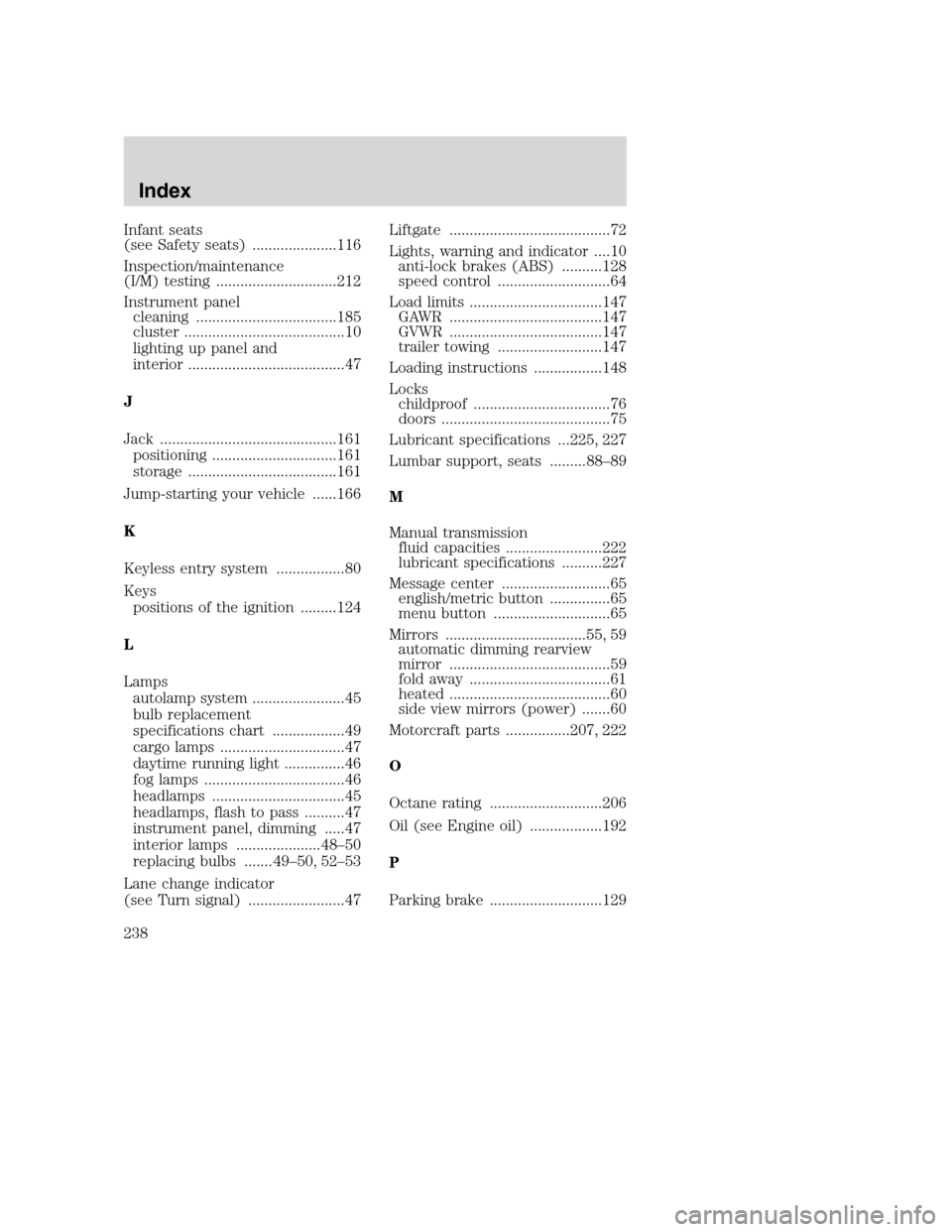
Infant seats
(see Safety seats) .....................116
Inspection/maintenance
(I/M) testing ..............................212
Instrument panel
cleaning ...................................185
cluster ........................................10
lighting up panel and
interior .......................................47
J
Jack ............................................161
positioning ...............................161
storage .....................................161
Jump-starting your vehicle ......166
K
Keyless entry system .................80
Keys
positions of the ignition .........124
L
Lamps
autolamp system .......................45
bulb replacement
specifications chart ..................49
cargo lamps ...............................47
daytime running light ...............46
fog lamps ...................................46
headlamps .................................45
headlamps, flash to pass ..........47
instrument panel, dimming .....47
interior lamps .....................48–50
replacing bulbs ....... 49–50, 52–53
Lane change indicator
(see Turn signal) ........................47Liftgate ........................................72
Lights, warning and indicator ....10
anti-lock brakes (ABS) ..........128
speed control ............................64
Load limits .................................147
GAWR ......................................147
GVWR ......................................147
trailer towing ..........................147
Loading instructions .................148
Locks
childproof ..................................76
doors ..........................................75
Lubricant specifications ...225, 227
Lumbar support, seats .........88–89
M
Manual transmission
fluid capacities ........................222
lubricant specifications ..........227
Message center ...........................65
english/metric button ...............65
menu button .............................65
Mirrors ...................................55, 59
automatic dimming rearview
mirror ........................................59
fold away ...................................61
heated ........................................60
side view mirrors (power) .......60
Motorcraft parts ................207, 222
O
Octane rating ............................206
Oil (see Engine oil) ..................192
P
Parking brake ............................129
Index
238
Page 240 of 240
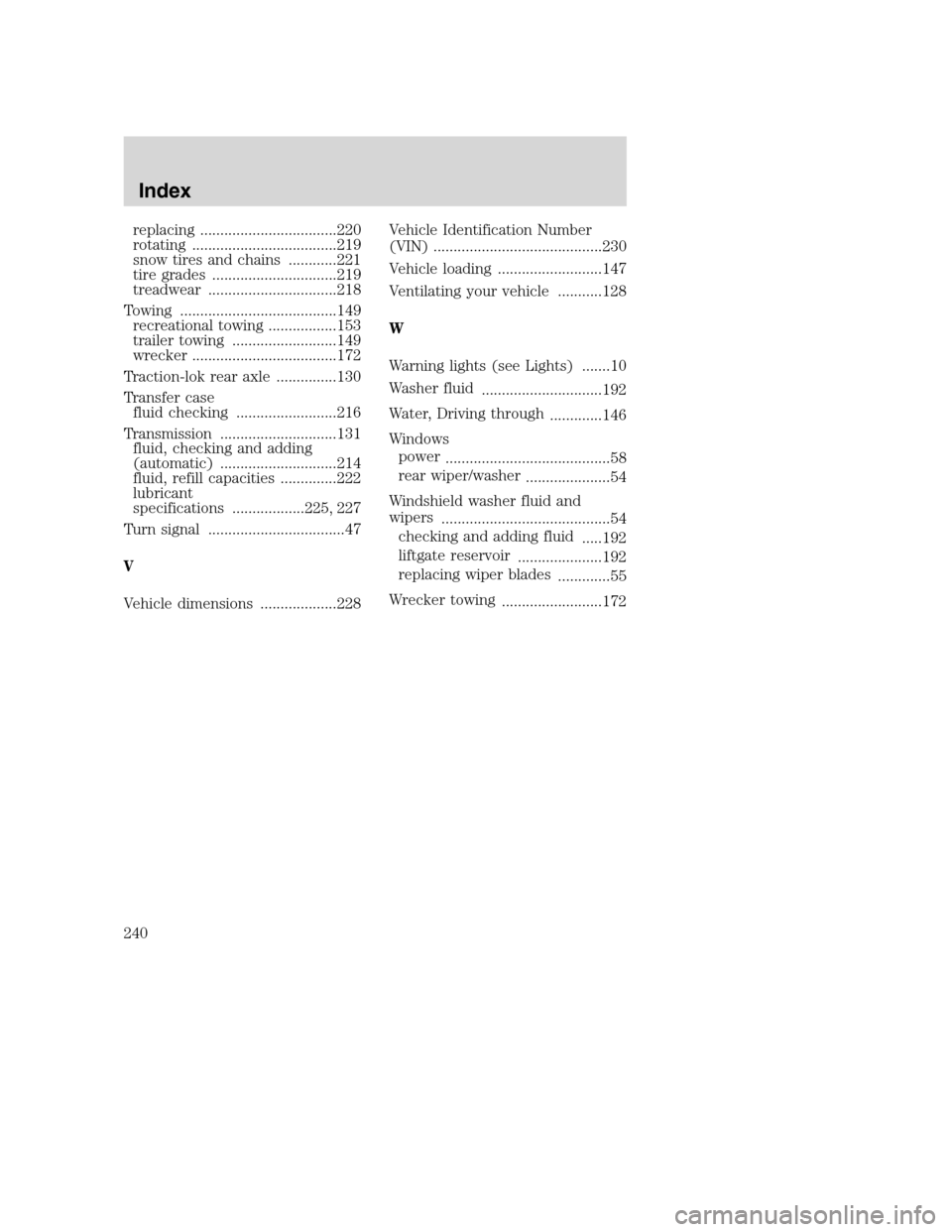
replacing ..................................220
rotating ....................................219
snow tires and chains ............221
tire grades ...............................219
treadwear ................................218
Towing .......................................149
recreational towing .................153
trailer towing ..........................149
wrecker ....................................172
Traction-lok rear axle ...............130
Transfer case
fluid checking .........................216
Transmission .............................131
fluid, checking and adding
(automatic) .............................214
fluid, refill capacities ..............222
lubricant
specifications ..................225, 227
Turn signal ..................................47
V
Vehicle dimensions ...................228Vehicle Identification Number
(VIN) ..........................................230
Vehicle loading ..........................147
Ventilating your vehicle ...........128
W
Warning lights (see Lights) .......10
Washer fluid
..............................192
Water, Driving through
.............146
Windows
power
.........................................58
rear wiper/washer
.....................54
Windshield washer fluid and
wipers
..........................................54
checking and adding fluid
.....192
liftgate reservoir
.....................192
replacing wiper blades
.............55
Wrecker towing
.........................172
Index
240