maintenance FORD EXPEDITION 1997 1.G Repair Manual
[x] Cancel search | Manufacturer: FORD, Model Year: 1997, Model line: EXPEDITION, Model: FORD EXPEDITION 1997 1.GPages: 224, PDF Size: 2.2 MB
Page 204 of 224
4. Replace the connector by
placing it back into the assembly
and turning it
1¤4turn clockwise.
REPLACING THE INTERIOR
BULBS
Check the operation of the
following interior bulbs frequently:
²interior overhead lamp
²map lamp
²courtesy and cargo lamps
²hazard flasher
Map lamps
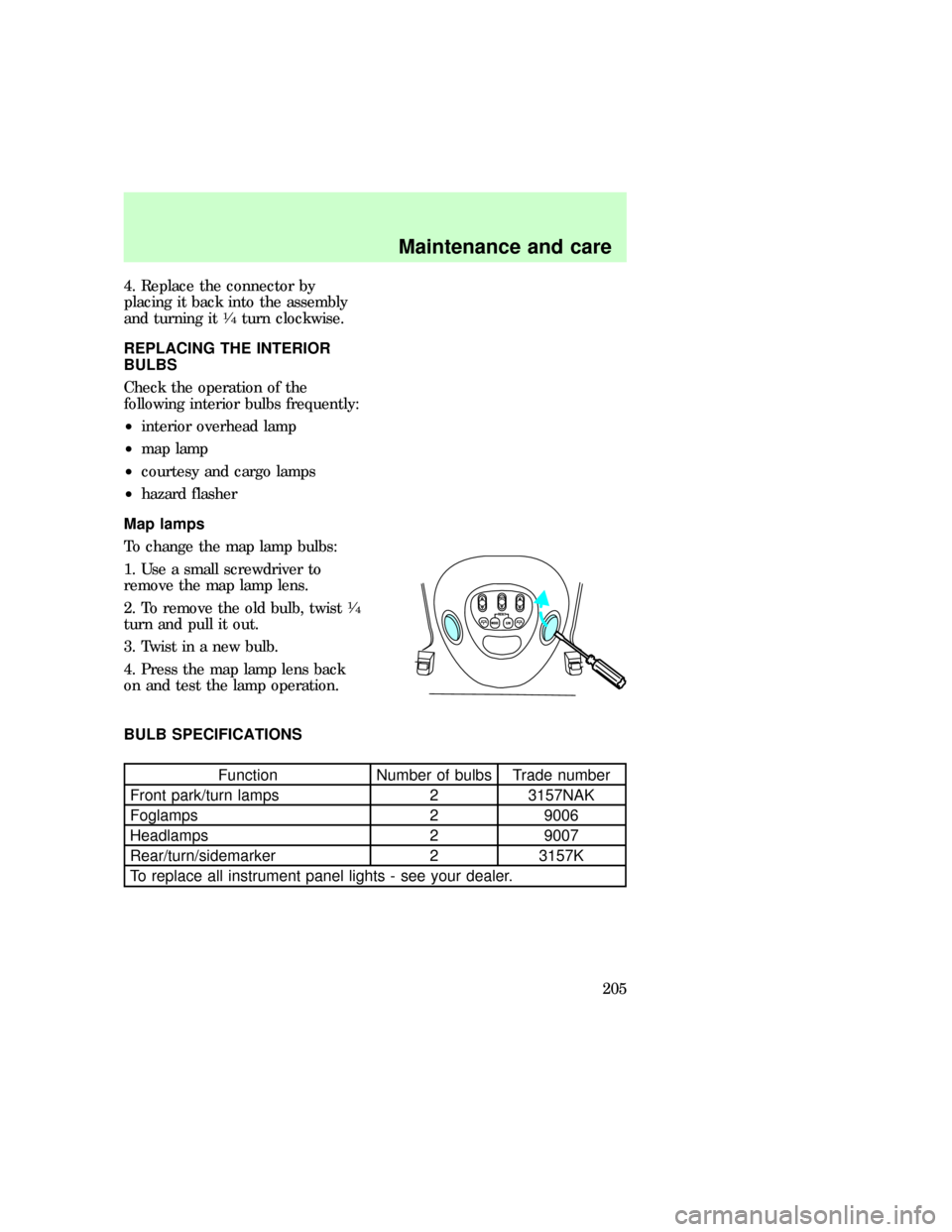
To change the map lamp bulbs:
1. Use a small screwdriver to
remove the map lamp lens.
2. To remove the old bulb, twist
1¤4
turn and pull it out.
3. Twist in a new bulb.
4. Press the map lamp lens back
on and test the lamp operation.
BULB SPECIFICATIONS
Function Number of bulbs Trade number
Front park/turn lamps 2 3157NAK
Foglamps 2 9006
Headlamps 2 9007
Rear/turn/sidemarker 2 3157K
To replace all instrument panel lights - see your dealer.
exd_interior_bulbs
exd_changing_maplamps
exd_bulb_specs_chart
Maintenance and care
205
Page 205 of 224
AIMING THE HEADLAMPS
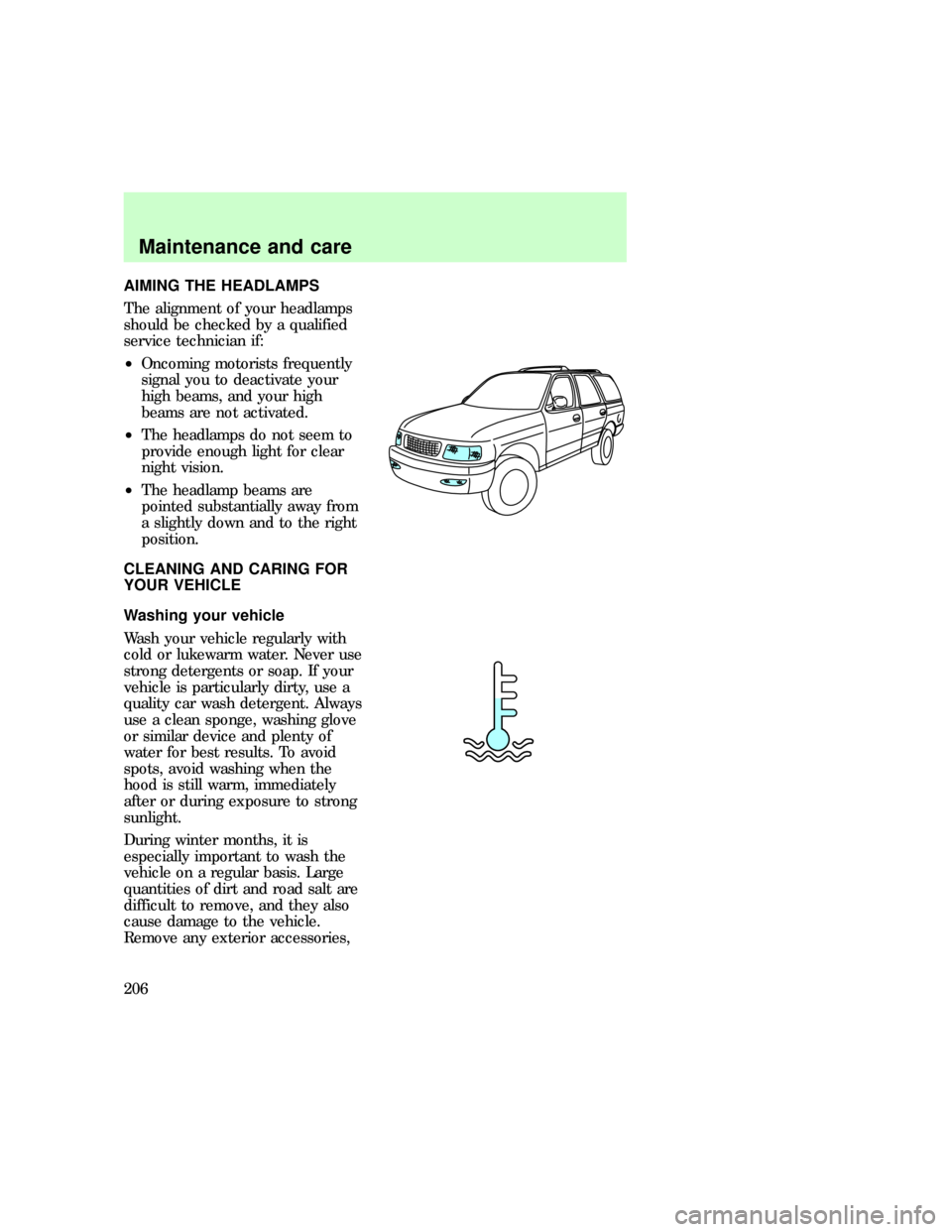
The alignment of your headlamps
should be checked by a qualified
service technician if:
²Oncoming motorists frequently
signal you to deactivate your
high beams, and your high
beams are not activated.
²The headlamps do not seem to
provide enough light for clear
night vision.
²The headlamp beams are
pointed substantially away from
a slightly down and to the right
position.
CLEANING AND CARING FOR
YOUR VEHICLE
Washing your vehicle
Wash your vehicle regularly with
cold or lukewarm water. Never use
strong detergents or soap. If your
vehicle is particularly dirty, use a
quality car wash detergent. Always
use a clean sponge, washing glove
or similar device and plenty of
water for best results. To avoid
spots, avoid washing when the
hood is still warm, immediately
after or during exposure to strong
sunlight.
During winter months, it is
especially important to wash the
vehicle on a regular basis. Large
quantities of dirt and road salt are
difficult to remove, and they also
cause damage to the vehicle.
Remove any exterior accessories,exd_headlamp_aiming
exd_cleaning_info
com_washing_vehicle.01
Maintenance and care
206
Page 206 of 224

such as antennas, before entering
a car wash.
²After washing, apply the brakes
several times to dry them.
Waxing your vehicle
The best way to determine when
the paintwork needs waxing is by
noting when water stops beading
on the surface. This could be every
three or four months, depending
on operating conditions.
Use only carnauba or
synthetic-based waxes. Remove
any bugs and tar before waxing
vehicle. Use cleaning fluid or
alcohol with a clean cloth to
remove. Use tar remover to
remove any tar spots.
Repairing paint chips
Minor scratches or paint damage
from road debris may be repaired
with touch-up paint, paint repair
foil or aerosol paint spray from the
Ford accessory line. Observe the
application instructions on the
products.
Remove particles such as bird
droppings, tree sap, insect
remains, tar spots, road salt and
industrial fallout immediately.
com_waxing_vehicle.01
com_repairing_chips
com_wheels_cleaning.01
Maintenance and care
207
Page 207 of 224
Cleaning the wheels
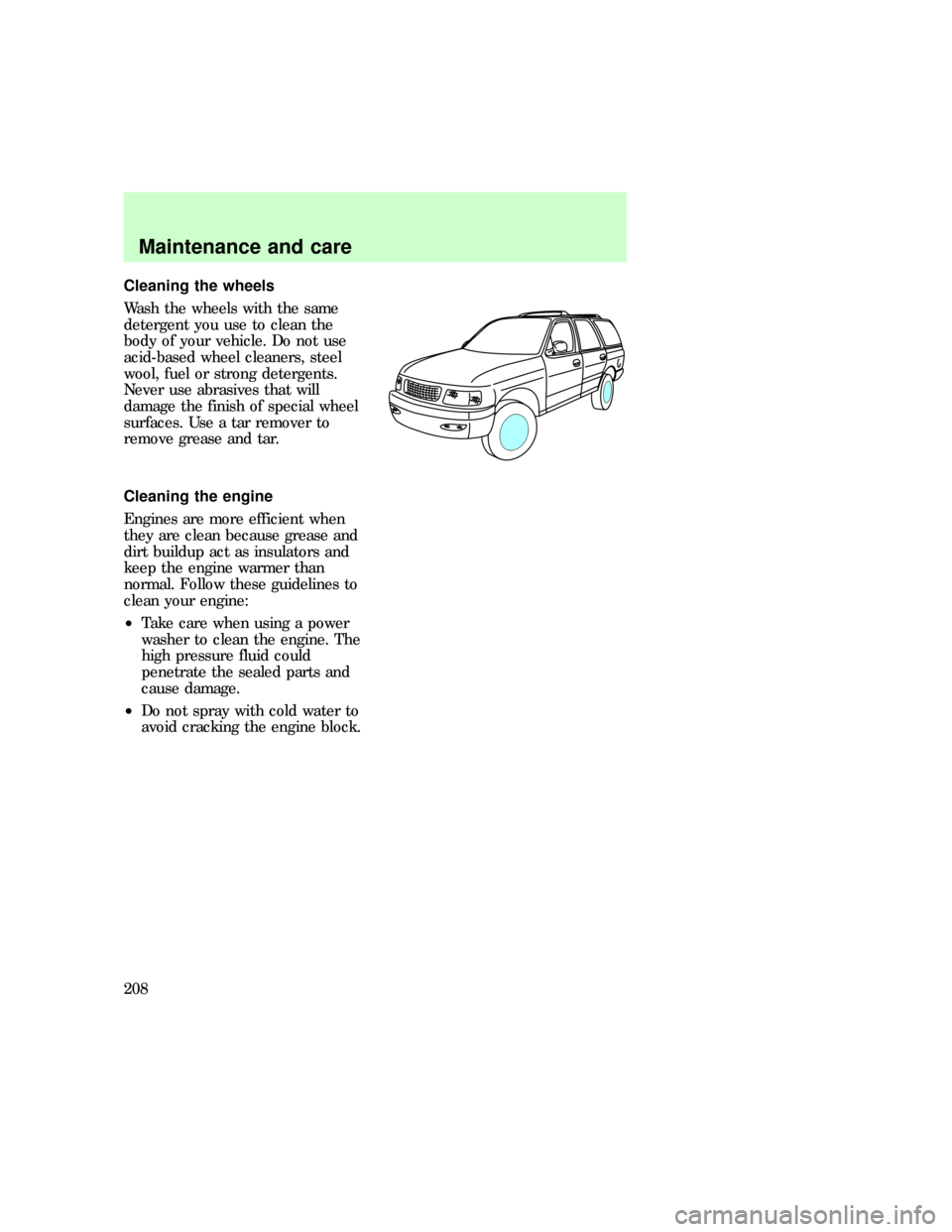
Wash the wheels with the same
detergent you use to clean the
body of your vehicle. Do not use
acid-based wheel cleaners, steel
wool, fuel or strong detergents.
Never use abrasives that will
damage the finish of special wheel
surfaces. Use a tar remover to
remove grease and tar.
Cleaning the engine
Engines are more efficient when
they are clean because grease and
dirt buildup act as insulators and
keep the engine warmer than
normal. Follow these guidelines to
clean your engine:
²Take care when using a power
washer to clean the engine. The
high pressure fluid could
penetrate the sealed parts and
cause damage.
²Do not spray with cold water to
avoid cracking the engine block.
com_engine_cleaning.01
Maintenance and care
208
Page 208 of 224
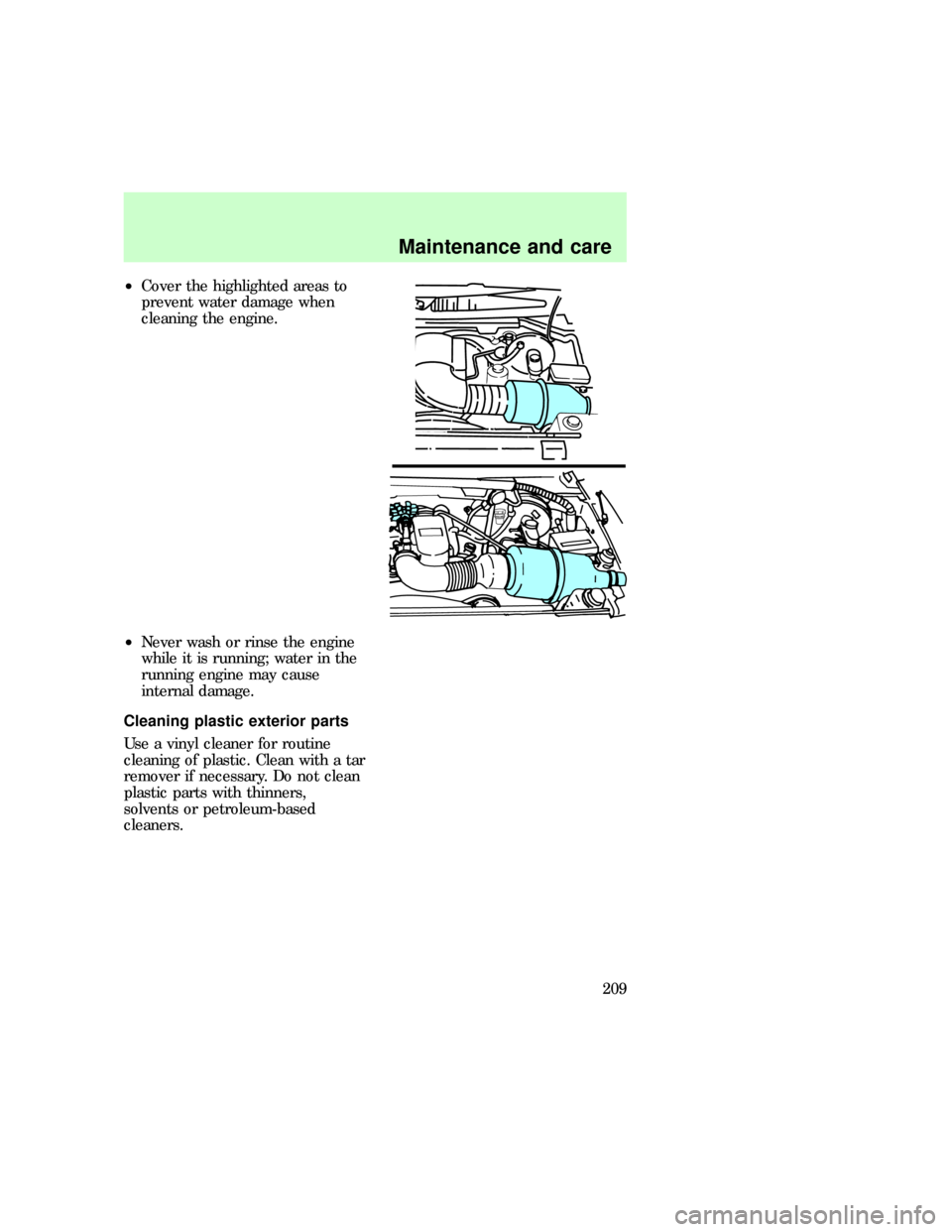
²Cover the highlighted areas to
prevent water damage when
cleaning the engine.
²Never wash or rinse the engine
while it is running; water in the
running engine may cause
internal damage.
Cleaning plastic exterior parts
Use a vinyl cleaner for routine
cleaning of plastic. Clean with a tar
remover if necessary. Do not clean
plastic parts with thinners,
solvents or petroleum-based
cleaners.
com_plastic_exterior.01
com_exterior_lamps.01
Maintenance and care
209
Page 209 of 224
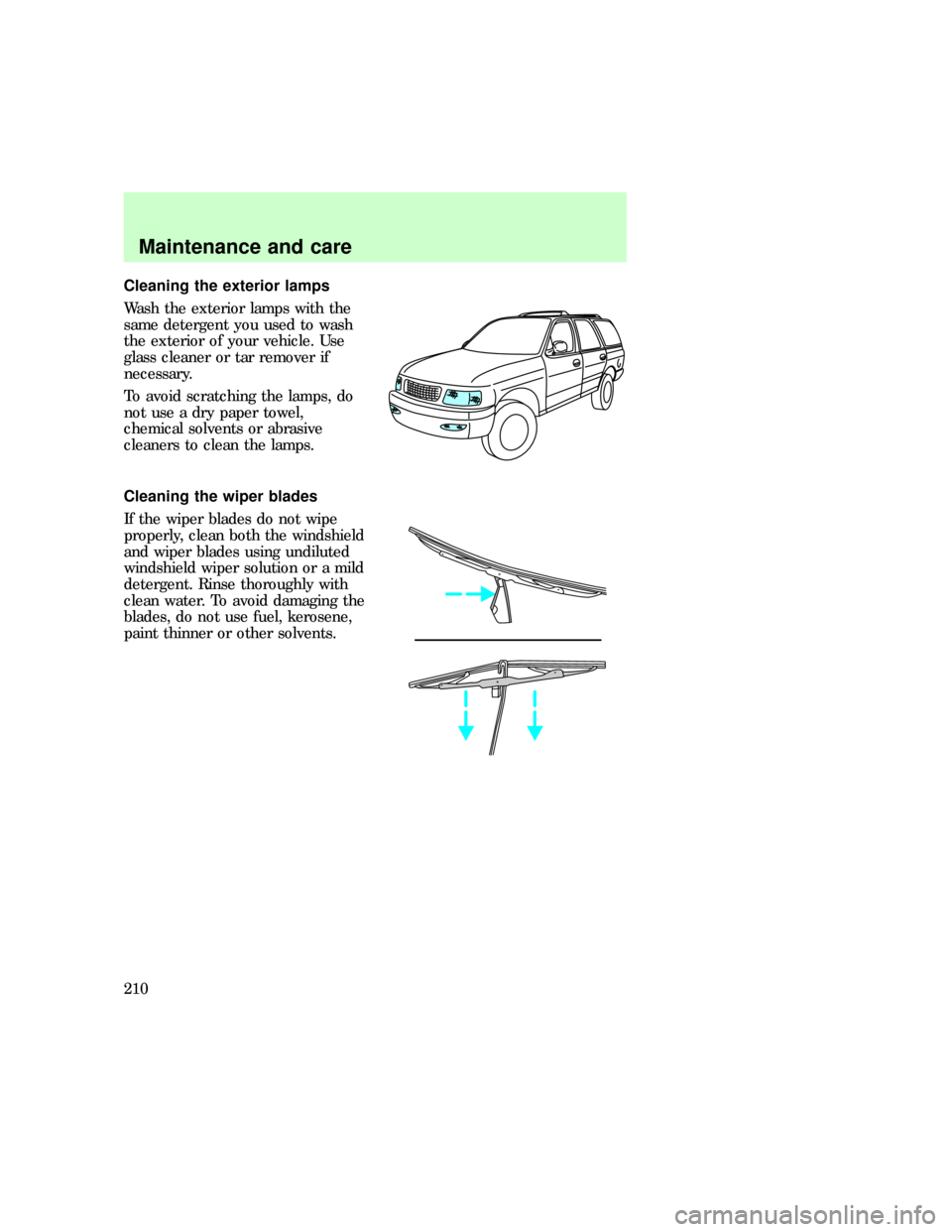
Cleaning the exterior lamps
Wash the exterior lamps with the
same detergent you used to wash
the exterior of your vehicle. Use
glass cleaner or tar remover if
necessary.
To avoid scratching the lamps, do
not use a dry paper towel,
chemical solvents or abrasive
cleaners to clean the lamps.
Cleaning the wiper blades
If the wiper blades do not wipe
properly, clean both the windshield
and wiper blades using undiluted
windshield wiper solution or a mild
detergent. Rinse thoroughly with
clean water. To avoid damaging the
blades, do not use fuel, kerosene,
paint thinner or other solvents.
com_wiper_cleaning.01
com_instru-panel_cleaning.01
Maintenance and care
210
Page 210 of 224
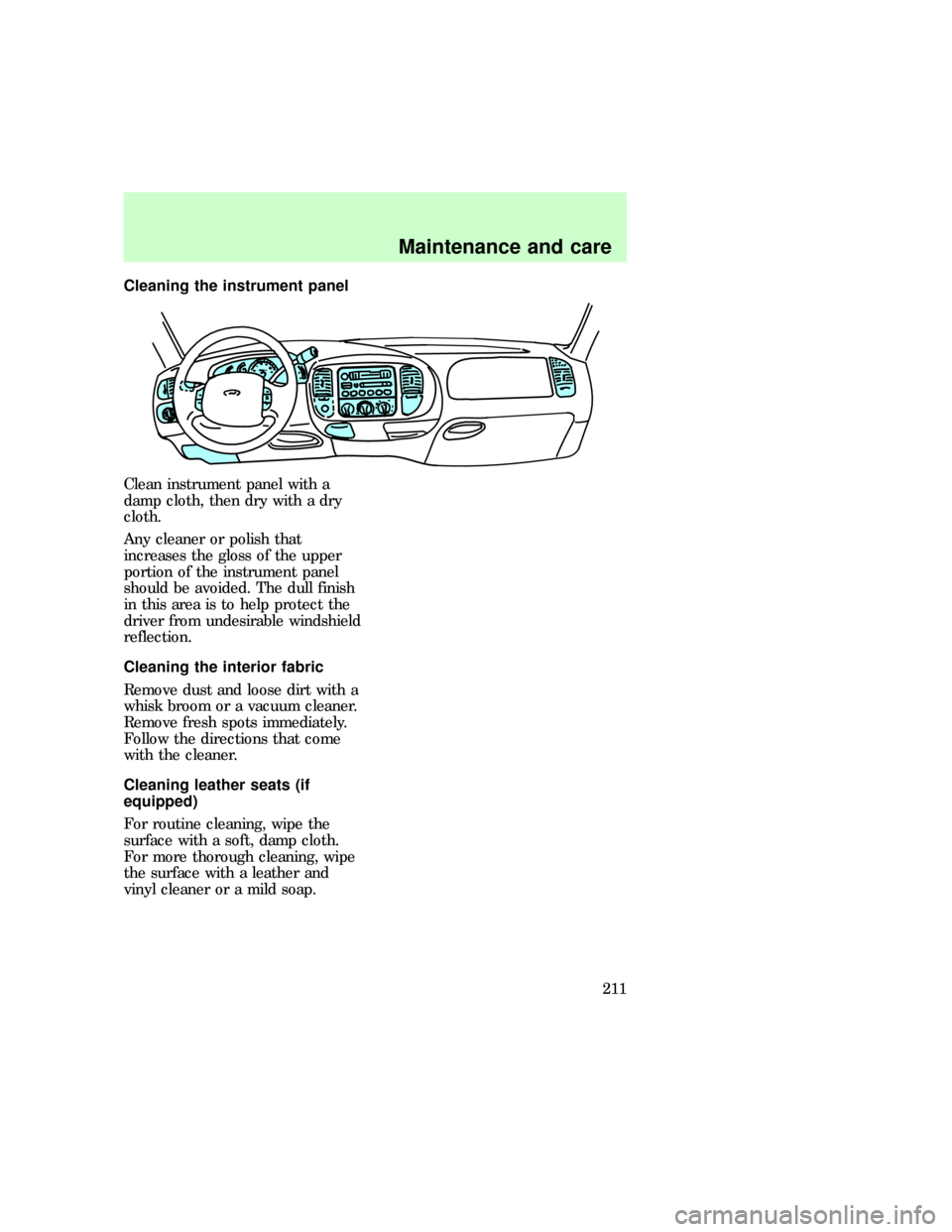
Cleaning the instrument panel
Clean instrument panel with a
damp cloth, then dry with a dry
cloth.
Any cleaner or polish that
increases the gloss of the upper
portion of the instrument panel
should be avoided. The dull finish
in this area is to help protect the
driver from undesirable windshield
reflection.
Cleaning the interior fabric
Remove dust and loose dirt with a
whisk broom or a vacuum cleaner.
Remove fresh spots immediately.
Follow the directions that come
with the cleaner.
Cleaning leather seats (if
equipped)
For routine cleaning, wipe the
surface with a soft, damp cloth.
For more thorough cleaning, wipe
the surface with a leather and
vinyl cleaner or a mild soap.
com_int_fabric_cleaning.01
com_leather_seats_cleaning.01
exd_cleaning_safety_belts
Maintenance and care
211
Page 211 of 224

Cleaning and maintaining the
safety belts
Clean the safety belts with a mild
soap solution recommended for
cleaning upholstery or carpets. Do
not bleach or dye the belts,
because these actions may weaken
the belt webbing.
Check your safety belt system
periodically to ensure that it works
properly and isn't damaged. If the
webbing shows any signs of wear,
nicks or cuts, have it inspected by
a qualified technician to determine
if replacement is necessary. Always
have your safety belt system
checked after a collision by a
qualified technician.
All safety belt assemblies,
including retractors, buckles, front
seat belt buckle support assemblies
(slide bar if equipped), child safety
seat tether bracket assemblies (if
equipped) and attaching hardware
should be inspected after any
collision. Ford recommends that all
safety belt assemblies used in
vehicles involved in a collision be
replaced. However, if the collision
was minor and a qualified
technician finds that the belts do
not show damage and continue to
operate properly, they do not need
to be replaced. Safety belt
assemblies not in use during a
collision should be inspected and
replaced if either damage or
improper operation is noted.
Maintenance and care
212
Page 212 of 224
MOTORCRAFT PART NUMBERS
Component 4.6 L engine 5.4 L engine
Air filter FA-1632 FA-1632
Battery
- standard
- optionalBXT-59
BXT-65-750BXT-59
BXT-65-750
Fuel filter FG-872 FG-872
Oil filter FL-820-S FL-820-S
PCV valve EV-98 EV-233
Spark plug* - platinum AWSF-32PP AWSF-22F
* Replacement double platinum spark plug9EE9will replace9E9and
9EG9and9P9will replace9P9and9PG9suffixed plugs. Refer to the
Engine datachart for spark plug gap specifications.
CAPACITIES
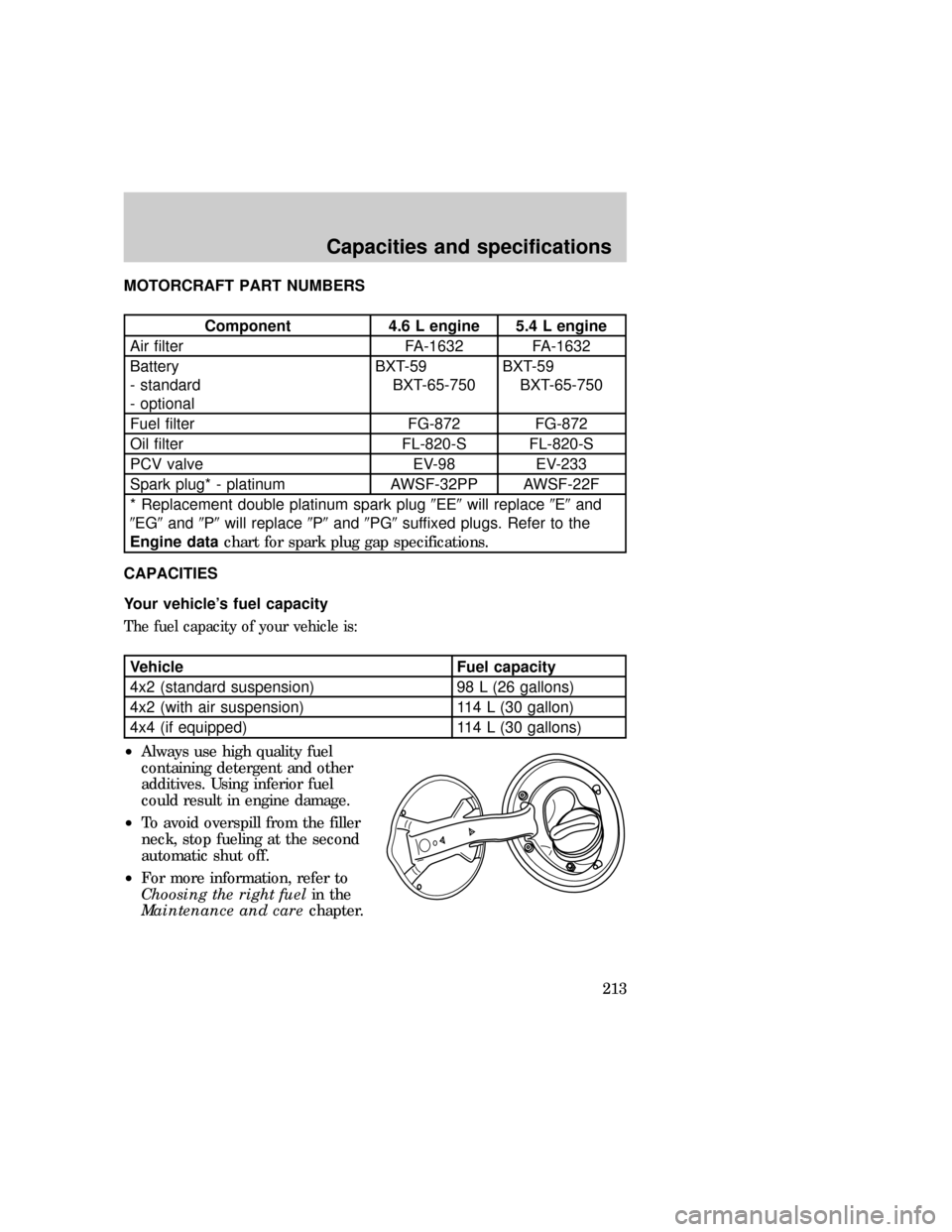
Your vehicle's fuel capacity
The fuel capacity of your vehicle is:
Vehicle Fuel capacity
4x2 (standard suspension) 98 L (26 gallons)
4x2 (with air suspension) 114 L (30 gallon)
4x4 (if equipped) 114 L (30 gallons)
²Always use high quality fuel
containing detergent and other
additives. Using inferior fuel
could result in engine damage.
²To avoid overspill from the filler
neck, stop fueling at the second
automatic shut off.
²For more information, refer to
Choosing the right fuelin the
Maintenance and carechapter.
exd_motorcraft_parts_numbers
exd_fuel_capacity
exd_refill_capacities
Capacities and specifications
213
Page 222 of 224

Idle
relearning ................................178
Ignition .........................................68
Instrument panel ........................20
Jack ..............................................66
Jump-starting your vehicle 151,152
attaching cables ......................152
disconnecting cables ..............153
Lamps
interior lamps ...........................54
parking lamps .........................201
Lights, warning and indicator
anti-lock brakes (ABS) ............12
brake ..........................................10
charging system ..........................9
high beam .................................12
safety belt ............................10,86
Message center ...........................17
english/metric button ...............18
low fuel level ........................18,19
Motorcraft parts ........................213
Odometer .....................................17
Overdrive .....................................48
Overdrive lockout button ...........11
Overhead console
compass/temperature display ..50
Power features
door locks ..................................60
windows ...............................58,59
Power steering
fluid, checking and adding ....170
Rear console ................................63
Rear window
wiper ..........................................46
Relays ........................................135
Remote entry system
locking/unlocking doors ...........69
panic alarm ...............................69
replacement/additional
transmitters ...............................70
replacing the batteries .............70
Reporting safety defects ..........221Safety restraints
extension assembly ..................85
for children ...............................91
lap and shoulder belts ........82,83
proper use ............................80,81
Safety seats for children ............94
attaching with tether straps ....99
automatic locking mode
(retractor) ............................95,98
Seats ............................................72
bench (60-40 split) .............72,73
lumbar support .........................73
power seat recliner/lumbar ......74
rear flip fold seat ......................75
rear seat access ........................74
third row seat .................76,77,79
Servicing your vehicle ..............155
precautions when servicing ...155
Special notice
utility-type vehicles ....................2
Speed control ..............................41
accelerating ...............................42
resetting ....................................43
resuming a set speed ...............43
turning off .................................41
Speedometer ...............................14
Starting your vehicle ................100
preparing to start your
vehicle .....................................101
starting a warm engine ..........103
Steering, power .........................109
Steering wheel ............................40
Tachometer
mechanical cluster ...................15
Temperature control (see
Climate control) .....................28,29
Tires
changing ..................................144
inspection and maintenance ..182
tire grades ...............................182
treadwear ................................182
Traction-lok rear axle ...............111
Index
223