trailer FORD EXPEDITION 1998 1.G User Guide
[x] Cancel search | Manufacturer: FORD, Model Year: 1998, Model line: EXPEDITION, Model: FORD EXPEDITION 1998 1.GPages: 216, PDF Size: 1.51 MB
Page 124 of 216

upshifting for optimum fuel
economy and transmission
cooling.
²Anticipate stops and brake
gradually.
Servicing after towing
If you tow a trailer for long
distances, your vehicle will require
more frequent service intervals.
Refer to the Severe Duty Schedule
in your ªService Guideº for more
information.
Towing behind another vehicle
Do not tow your vehicle behind
another vehicle, such as an RV.
Your vehicle cannot be flat towed
with all wheels on the ground.
Trailer towing tips
²Practice turning, stopping and
backing up in an area before
starting on a trip to get the feel
of the vehicle trailer
combination. When turning,
make wider turns so the trailer
wheels will clear curbs and
other obstacles.
²Allow more distance for
stopping with a trailer attached.
²The trailer tongue weight should
be 10±15% of the loaded trailer
weight.
²After you have traveled 80 km
(50 miles), thoroughly check
your hitch, electrical
connections and trailer wheel
lug nuts.
Driving
124
Page 125 of 216

²When stopped in traffic for long
periods of time in hot weather,
place the gearshift in P (Park)
and increase idle speed. This
aids engine cooling and air
conditioner efficiency.
²Vehicles with trailers should not
be parked on a grade. If you
must park on a grade, place
wheel chocks under the trailer's
wheels.
Launching or retrieving a boat
When backing down a ramp during
boat launching or retrieval,
²Do not allow the static water
level to rise above the bottom
edge of the rear bumper and
²Do not allow waves to break
higher than 15 cm (six inches)
above the bottom edge of the
rear bumper.
Exceeding these limits may allow
water to enter critical vehicle
components, adversely affecting
driveability, emissions and
reliability.
If the rear axle is submerged in
water, the rear axle lubricant
should be checked and changed, if
necessary. The rear axle is filled
with a synthetic lubricant and does
not normally require a lubricant
change for the life of the vehicle.
Rear axle lubricant quantities
should not need to be checked
unless a leak is suspected.
Driving
125
Page 132 of 216
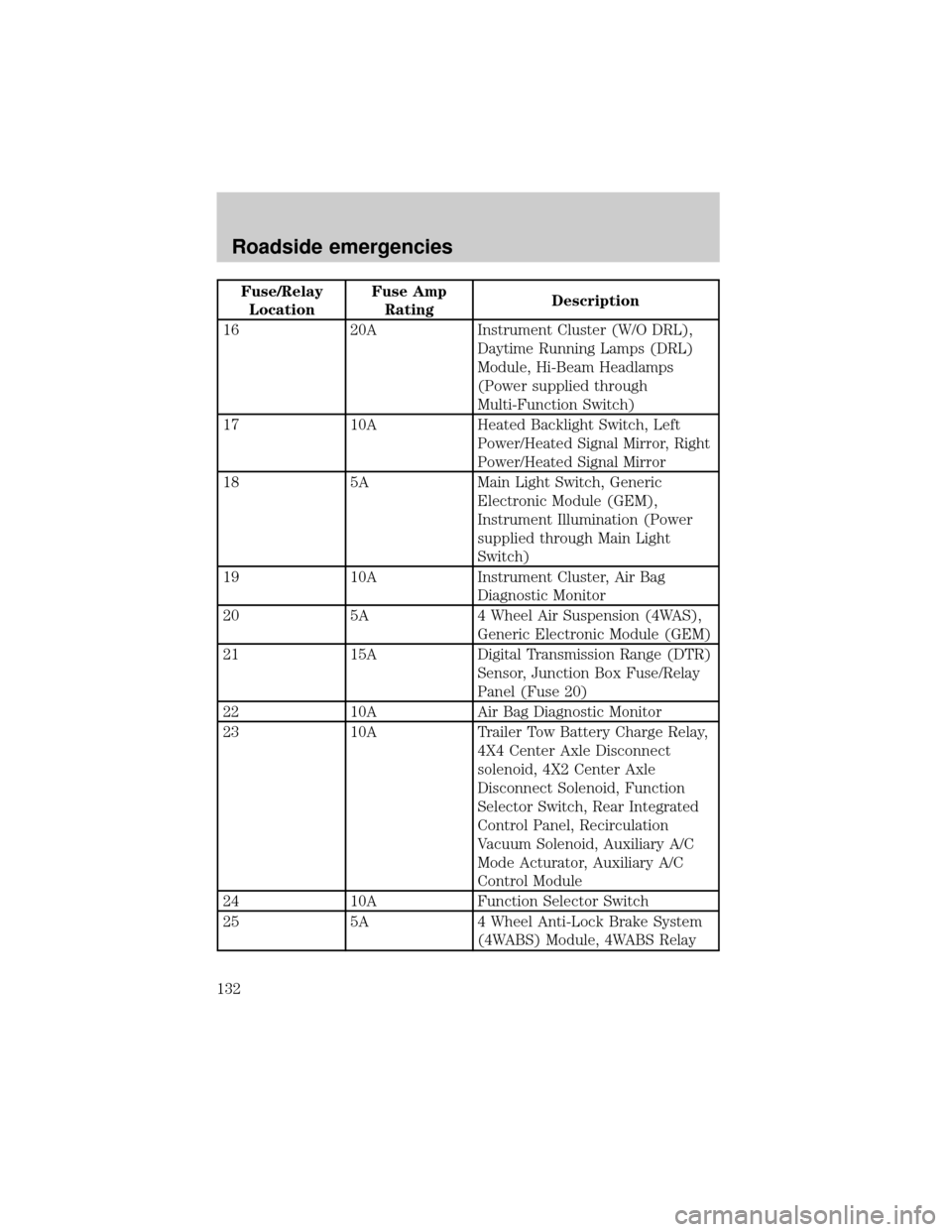
Fuse/Relay
LocationFuse Amp
RatingDescription
16 20A Instrument Cluster (W/O DRL),
Daytime Running Lamps (DRL)
Module, Hi-Beam Headlamps
(Power supplied through
Multi-Function Switch)
17 10A Heated Backlight Switch, Left
Power/Heated Signal Mirror, Right
Power/Heated Signal Mirror
18 5A Main Light Switch, Generic
Electronic Module (GEM),
Instrument Illumination (Power
supplied through Main Light
Switch)
19 10A Instrument Cluster, Air Bag
Diagnostic Monitor
20 5A 4 Wheel Air Suspension (4WAS),
Generic Electronic Module (GEM)
21 15A Digital Transmission Range (DTR)
Sensor, Junction Box Fuse/Relay
Panel (Fuse 20)
22 10A Air Bag Diagnostic Monitor
23 10A Trailer Tow Battery Charge Relay,
4X4 Center Axle Disconnect
solenoid, 4X2 Center Axle
Disconnect Solenoid, Function
Selector Switch, Rear Integrated
Control Panel, Recirculation
Vacuum Solenoid, Auxiliary A/C
Mode Acturator, Auxiliary A/C
Control Module
24 10A Function Selector Switch
25 5A 4 Wheel Anti-Lock Brake System
(4WABS) Module, 4WABS Relay
Roadside emergencies
132
Page 134 of 216
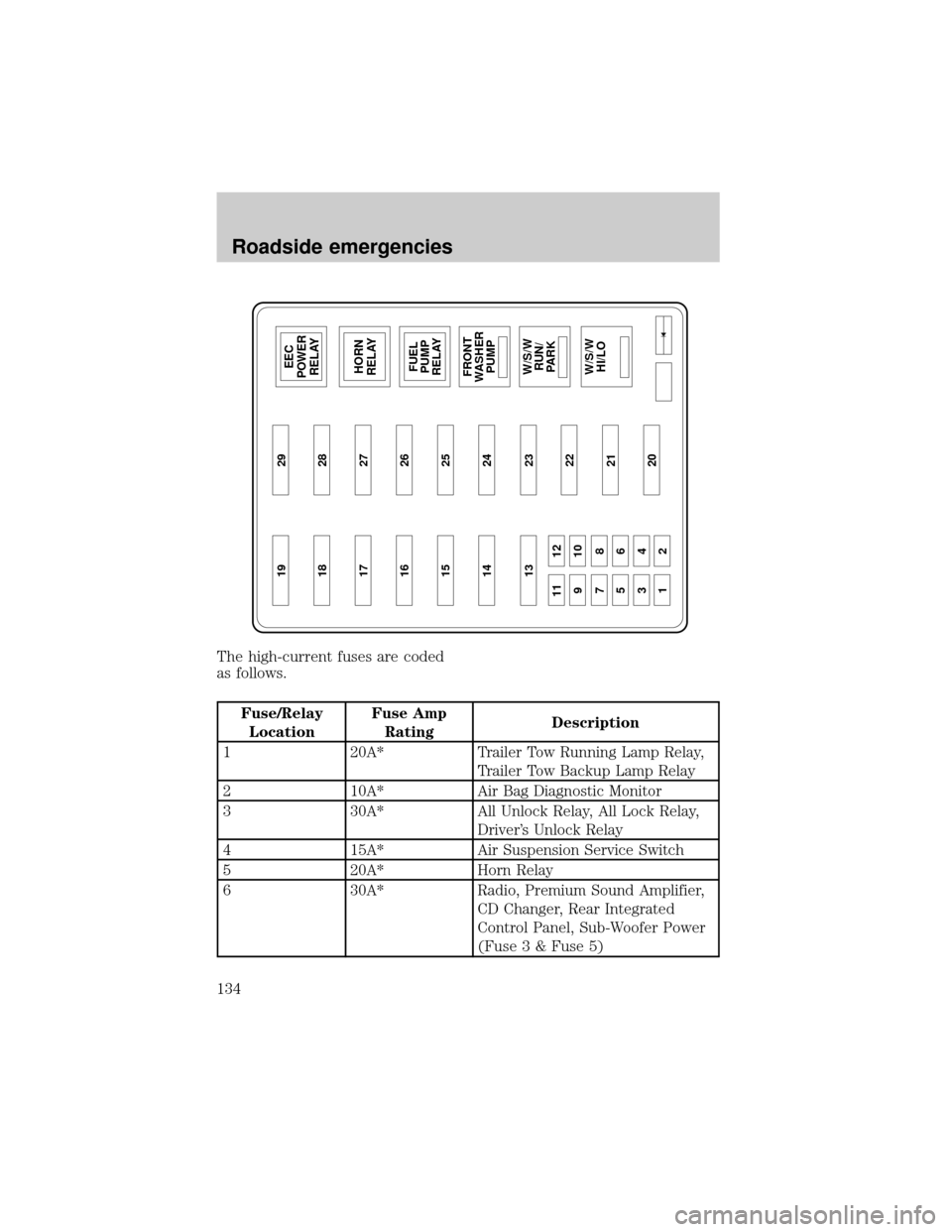
The high-current fuses are coded
as follows.
Fuse/Relay
LocationFuse Amp
RatingDescription
1 20A* Trailer Tow Running Lamp Relay,
Trailer Tow Backup Lamp Relay
2 10A* Air Bag Diagnostic Monitor
3 30A* All Unlock Relay, All Lock Relay,
Driver's Unlock Relay
4 15A* Air Suspension Service Switch
5 20A* Horn Relay
6 30A* Radio, Premium Sound Amplifier,
CD Changer, Rear Integrated
Control Panel, Sub-Woofer Power
(Fuse 3 & Fuse 5)
19 29
18 28EEC
POWER
RELAY
FUEL
PUMP
RELAY
FRONT
WASHER
PUMP HORN
RELAY 17 27
16 26
15 25
14 24
13
11 12
910
78
56
34
1223
22
21
20
W/S/W
RUN/
PARKW/S/W
HI/LO
Roadside emergencies
134
Page 135 of 216
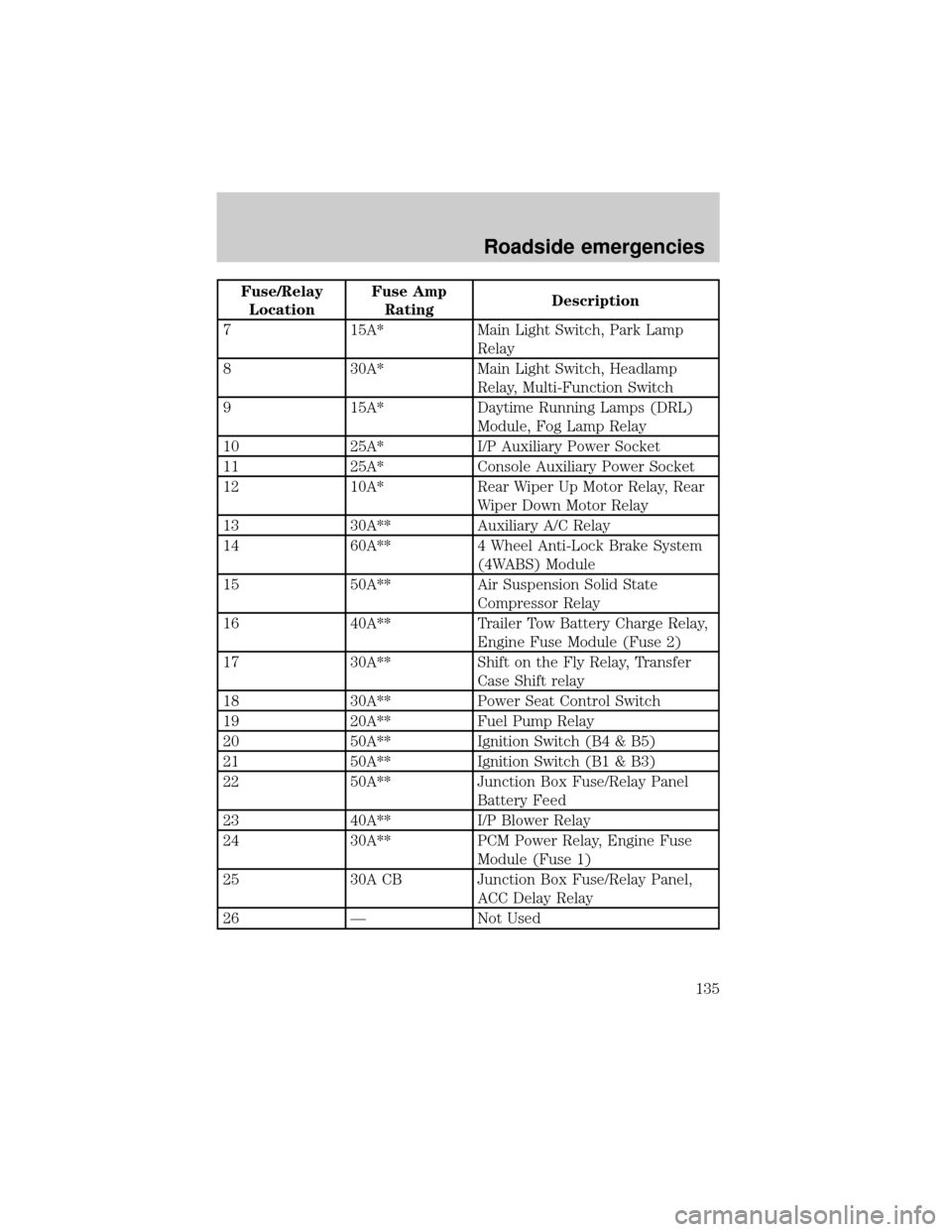
Fuse/Relay
LocationFuse Amp
RatingDescription
7 15A* Main Light Switch, Park Lamp
Relay
8 30A* Main Light Switch, Headlamp
Relay, Multi-Function Switch
9 15A* Daytime Running Lamps (DRL)
Module, Fog Lamp Relay
10 25A* I/P Auxiliary Power Socket
11 25A* Console Auxiliary Power Socket
12 10A* Rear Wiper Up Motor Relay, Rear
Wiper Down Motor Relay
13 30A** Auxiliary A/C Relay
14 60A** 4 Wheel Anti-Lock Brake System
(4WABS) Module
15 50A** Air Suspension Solid State
Compressor Relay
16 40A** Trailer Tow Battery Charge Relay,
Engine Fuse Module (Fuse 2)
17 30A** Shift on the Fly Relay, Transfer
Case Shift relay
18 30A** Power Seat Control Switch
19 20A** Fuel Pump Relay
20 50A** Ignition Switch (B4 & B5)
21 50A** Ignition Switch (B1 & B3)
22 50A** Junction Box Fuse/Relay Panel
Battery Feed
23 40A** I/P Blower Relay
24 30A** PCM Power Relay, Engine Fuse
Module (Fuse 1)
25 30A CB Junction Box Fuse/Relay Panel,
ACC Delay Relay
26 Ð Not Used
Roadside emergencies
135
Page 136 of 216
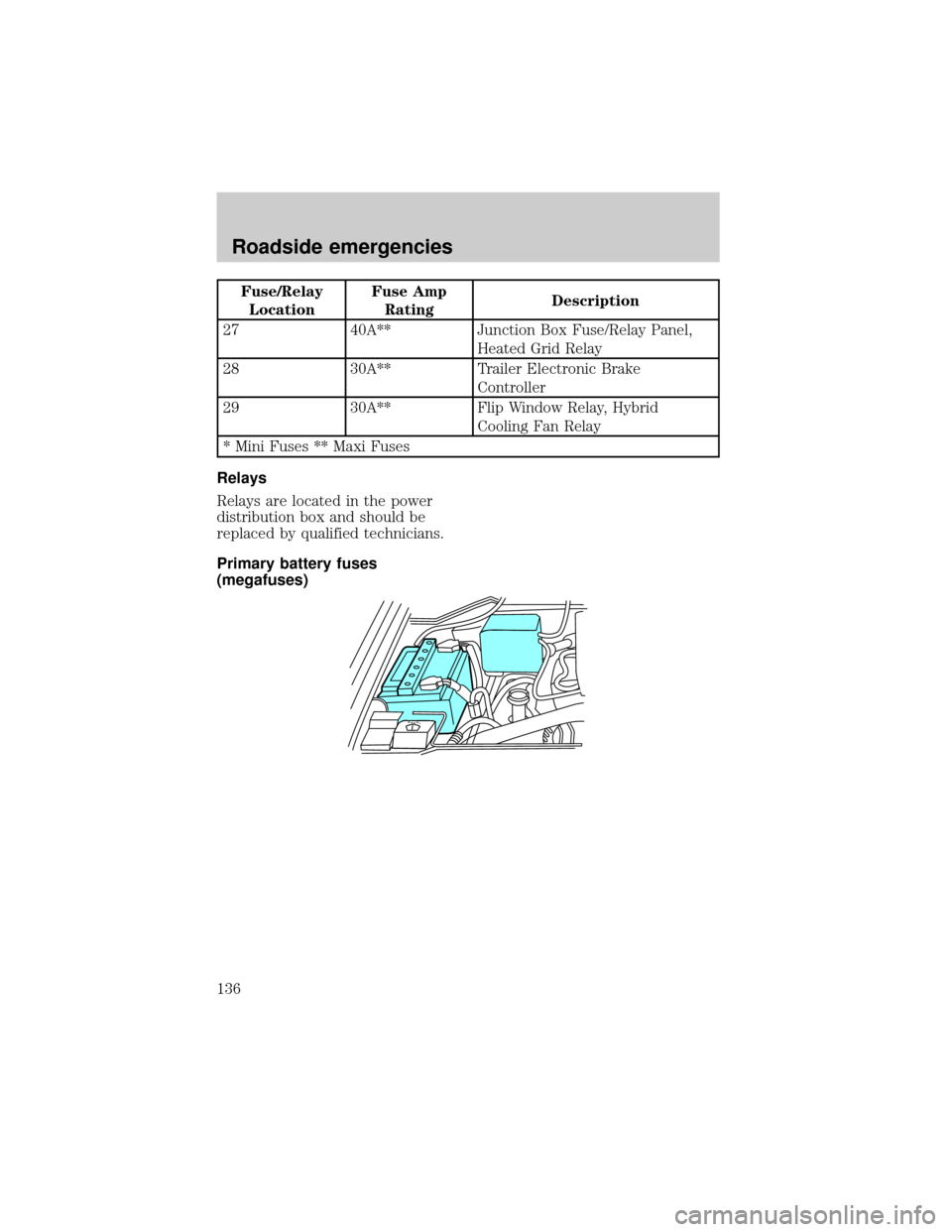
Fuse/Relay
LocationFuse Amp
RatingDescription
27 40A** Junction Box Fuse/Relay Panel,
Heated Grid Relay
28 30A** Trailer Electronic Brake
Controller
29 30A** Flip Window Relay, Hybrid
Cooling Fan Relay
* Mini Fuses ** Maxi Fuses
Relays
Relays are located in the power
distribution box and should be
replaced by qualified technicians.
Primary battery fuses
(megafuses)
Roadside emergencies
136
Page 138 of 216
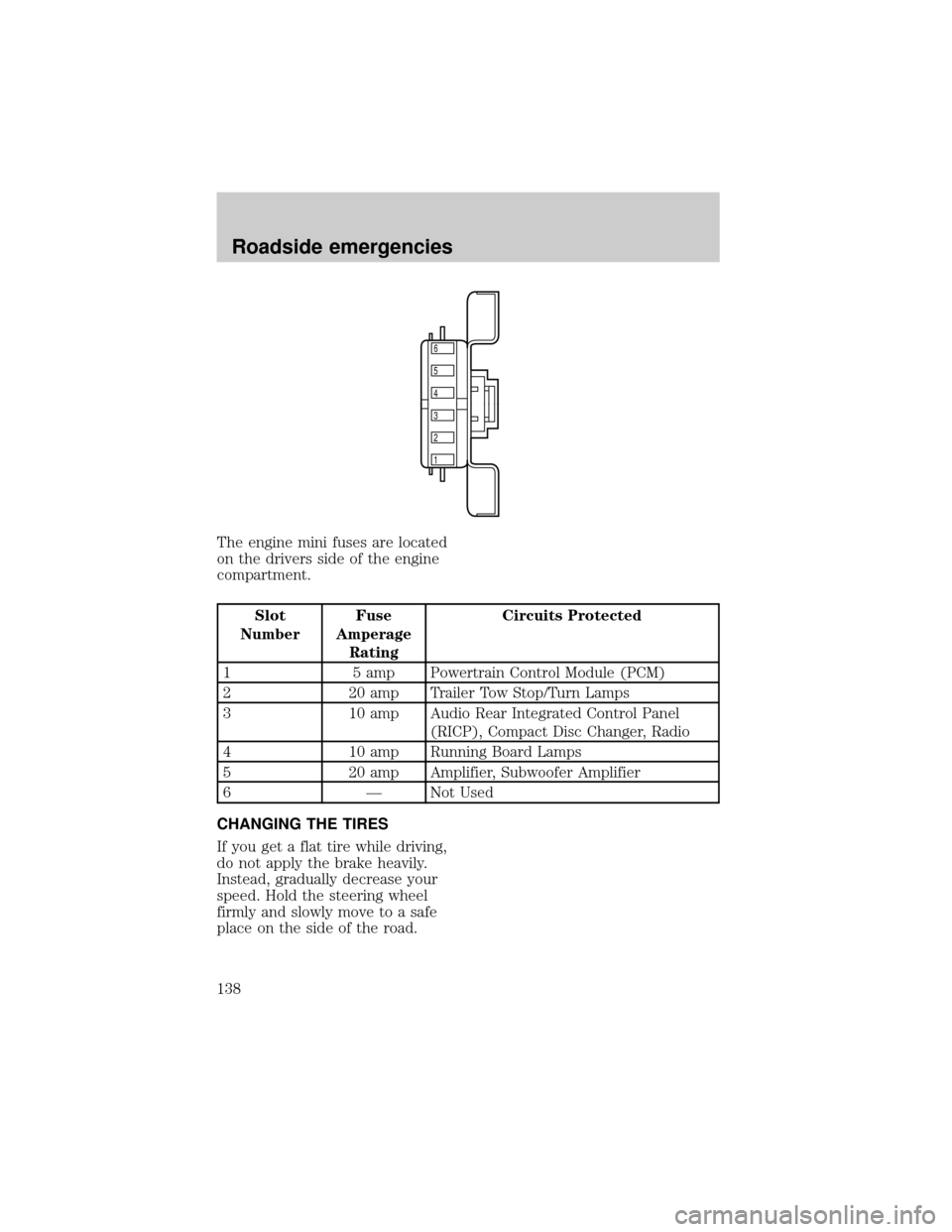
The engine mini fuses are located
on the drivers side of the engine
compartment.
Slot
NumberFuse
Amperage
RatingCircuits Protected
1 5 amp Powertrain Control Module (PCM)
2 20 amp Trailer Tow Stop/Turn Lamps
3 10 amp Audio Rear Integrated Control Panel
(RICP), Compact Disc Changer, Radio
4 10 amp Running Board Lamps
5 20 amp Amplifier, Subwoofer Amplifier
6 Ð Not Used
CHANGING THE TIRES
If you get a flat tire while driving,
do not apply the brake heavily.
Instead, gradually decrease your
speed. Hold the steering wheel
firmly and slowly move to a safe
place on the side of the road.
6
5
4
3
2
1
Roadside emergencies
138
Page 156 of 216
Do not use supplemental engine oil
additives, oil treatments or engine
treatments. They are unnecessary
and could, under certain
conditions, lead to engine damage
which is not covered by your
warranty.
Changing the engine oil and
filter
Change your engine oil and filter
according to the following mileage
and time requirements, whichever
occurs first:
²Normal Schedule ± 8,000 km
(5,000 miles) or six months.
²Severe Duty Schedule - 5,000
km (3,000 miles) or three
months. Severe duty operation
would include extensive idling,
trailer towing, driving in severe
dust and police, taxi or delivery
service.
Ford production and aftermarket
(Motorcraft) oil filters are designed
for added engine protection and
long life. If a replacement oil filter
is used that does not meet Ford
material and design specifications,
startup engine noises or knock
may be experienced.
It is recommended you use the
appropriate Motorcraft oil filter (or
another brand meeting Ford
specifications) for your engine
application.
Maintenance and care
156
Page 166 of 216
![FORD EXPEDITION 1998 1.G User Guide The transmission fluid should be in
this range if at room temperature
(10ÉC-35ÉC [50ÉF-95ÉF]) (see
figure to the right).
If your vehicle has been operated
for an extended period at high
speeds, in](/img/11/4906/w960_4906-165.png "FORD EXPEDITION 1998 1.G User Guide The transmission fluid should be in
this range if at room temperature
(10ÉC-35ÉC [50ÉF-95ÉF]) (see
figure to the right).
If your vehicle has been operated
for an extended period at high
speeds, in")
The transmission fluid should be in
this range if at room temperature
(10ÉC-35ÉC [50ÉF-95ÉF]) (see
figure to the right).
If your vehicle has been operated
for an extended period at high
speeds, in city traffic during hot
weather or pulling a trailer, the
vehicle should be turned off for
about 30 minutes to allow the fluid
to cool before checking.
1. Park the vehicle on a level
surface and engage the parking
brake.
2. With the parking brake engaged
and your foot on the brake pedal,
start the engine and move the
gearshift lever through all of the
gear ranges. Allow sufficient time
for each gear to engage.
3. Latch the gearshift lever in P
(Park) and leave the engine
running.
4. Remove the dipstick, wiping it
clean with a clean, dry lint free
rag.
5. Install the dipstick making sure
it is fully seated in the filler tube.
6. Remove the dipstick and inspect
the fluid level. The fluid level
should be in the crosshatched area
on the dipstick.DON'T ADD IF IN CROSSHATCHED AREA • CHECK WHEN HOT IDLING IN PARK
ADD COLD HOT DO NOT ADD
P R N D 2 1
Maintenance and care
166
Page 206 of 216
IDENTIFYING YOUR VEHICLE
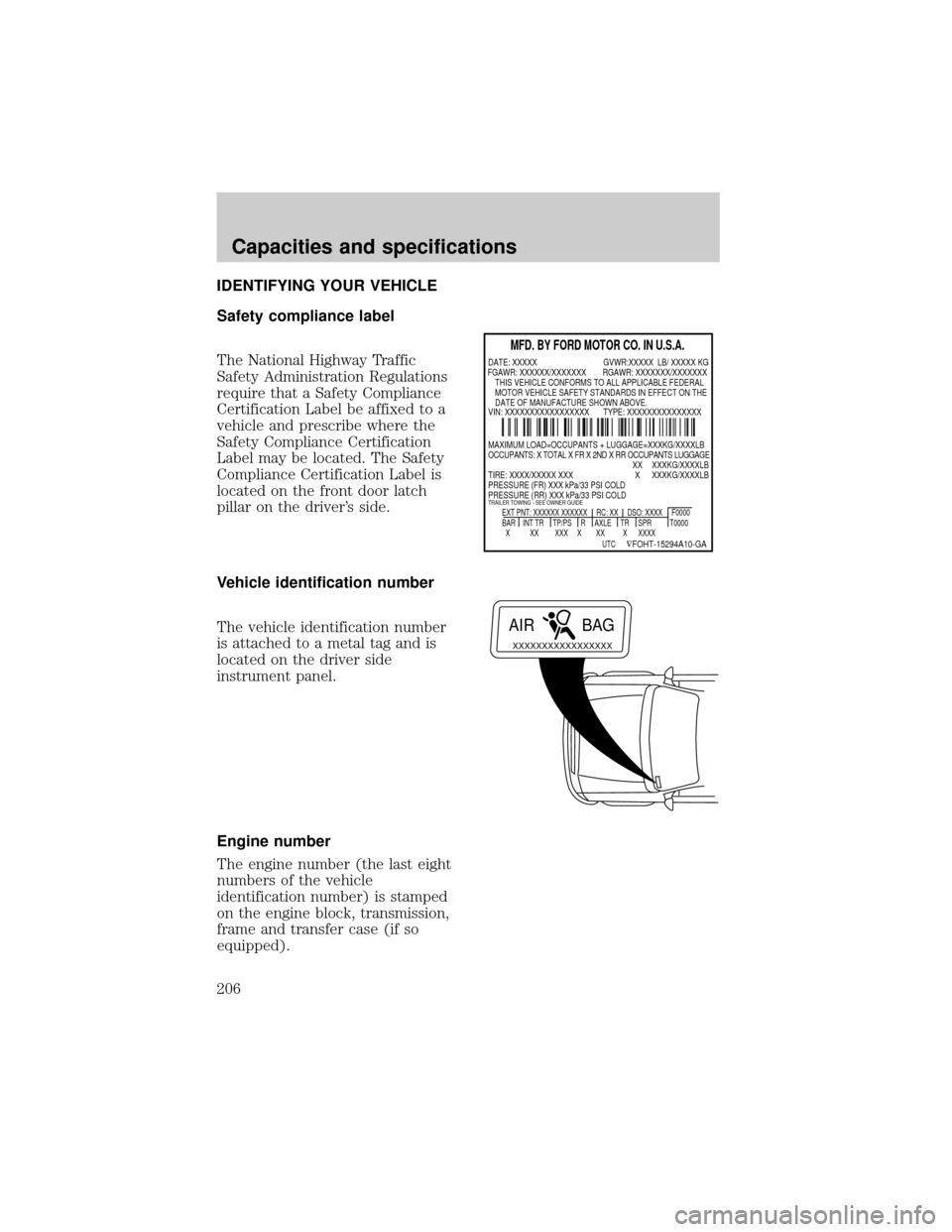
Safety compliance label
The National Highway Traffic
Safety Administration Regulations
require that a Safety Compliance
Certification Label be affixed to a
vehicle and prescribe where the
Safety Compliance Certification
Label may be located. The Safety
Compliance Certification Label is
located on the front door latch
pillar on the driver's side.
Vehicle identification number
The vehicle identification number
is attached to a metal tag and is
located on the driver side
instrument panel.
Engine number
The engine number (the last eight
numbers of the vehicle
identification number) is stamped
on the engine block, transmission,
frame and transfer case (if so
equipped).
MFD. BY FORD MOTOR CO. IN U.S.A.
EXT PNT: XXXXXX XXXXXX RC: XX DSO: XXXX F0000
BAR INT TR TP/PS R AXLE TR SPR T0000
X XX XXX X XX X XXXX
UTC
ÑFOHT-15294A10-GA
MAXIMUM LOAD=OCCUPANTS + LUGGAGE=XXXKG/XXXXLB
OCCUPANTS: X TOTAL X FR X 2ND X RR OCCUPANTS LUGGAGE
XX XXXKG/XXXXLB
TIRE: XXXX/XXXXX XXX X XXXKG/XXXXLB
PRESSURE (FR) XXX kPa/33 PSI COLD
PRESSURE (RR) XXX kPa/33 PSI COLD
TRAILER TOWING - SEE OWNER GUIDE
DATE: XXXXX GVWR:XXXXX LB/ XXXXX KG
VIN: XXXXXXXXXXXXXXXXX TYPE: XXXXXXXXXXXXXXX FGAWR: XXXXXX/XXXXXXX RGAWR: XXXXXXX/XXXXXXX
THIS VEHICLE CONFORMS TO ALL APPLICABLE FEDERAL
MOTOR VEHICLE SAFETY STANDARDS IN EFFECT ON THE
DATE OF MANUFACTURE SHOWN ABOVE.
XXXXXXXXXXXXXXXXX
AIR BAG
Capacities and specifications
206