light FORD EXPEDITION 1998 1.G Service Manual
[x] Cancel search | Manufacturer: FORD, Model Year: 1998, Model line: EXPEDITION, Model: FORD EXPEDITION 1998 1.GPages: 216, PDF Size: 1.51 MB
Page 162 of 216
container to ensure the coolant
concentration in your vehicle is
such that the coolant will not
freeze at the temperature level in
which you drive during winter
months. Never increase the engine
coolant concentration above 60%.
Leave a 50/50 mixture of engine
coolant and water in your vehicle
year-round in non-extreme
climates.
What you should know about
fail-safe cooling
If the engine coolant supply is
depleted, this feature allows the
vehicle to be driven temporarily
before incremental component
damage is incurred. The ªfail safeº
distance depends on ambient
temperatures, vehicle load and
terrain.
How fail-safe cooling works
If the engine overheats, the engine
will automatically switch from
eight to alternating four cylinder
operation. Each disabled cylinder
acts as an air pump and cools the
engine.
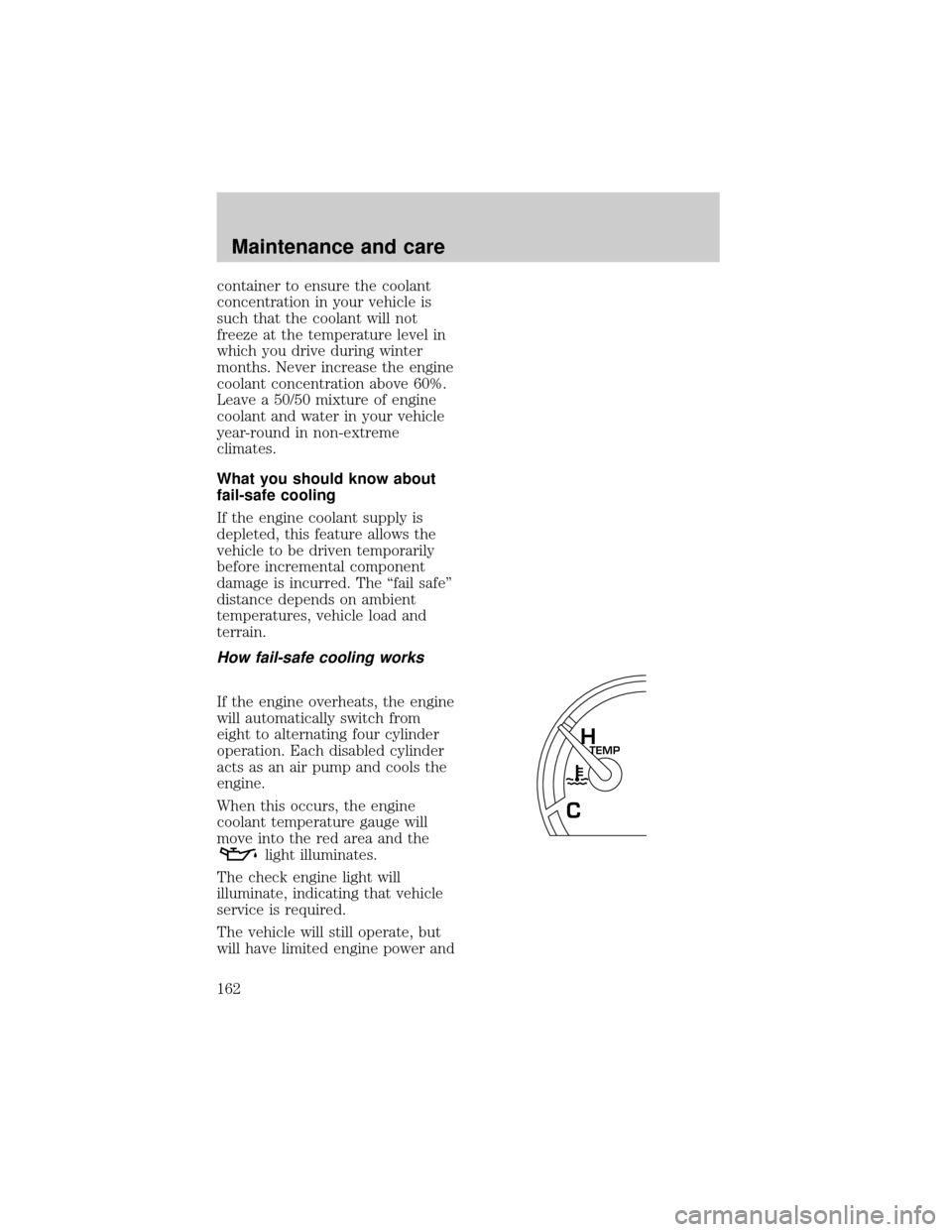
When this occurs, the engine
coolant temperature gauge will
move into the red area and the
light illuminates.
The check engine light will
illuminate, indicating that vehicle
service is required.
The vehicle will still operate, but
will have limited engine power and
TEMPH
C
Maintenance and care
162
Page 180 of 216
control devices and systems may
be adversely affected.
Repair of damage caused by using
a fuel that your vehicle was not
designed for may not be covered
by your warranty.
Octane recommendations
Your vehicle is designed to use
regular unleaded with an (R+M)/2
octane rating of 87. We do not
recommend gasolines labeled as
ªregularº in high altitude areas that
are sold with octane ratings of 86
or even less.
Do not be concerned if your
vehicle sometimes knocks lightly.
However, if it knocks heavily under
most driving conditions on fuel
with the recommended octane, see
your dealer or a qualified service
technician to prevent any engine
damage.
Fuel quality
If you are experiencing starting,
rough idle or hesitation problems
try a different brand of fuel. If the
condition persists, see your dealer
or a qualified service technician.
The American Automobile
Manufacturers Association (AAMA)
issued a gasoline specification to
provide information on high quality
fuels that optimize the
performance of your vehicle. We
87
Maintenance and care
180
Page 182 of 216
![FORD EXPEDITION 1998 1.G Service Manual ²To help reduce early nozzle shut
off and fuel spillage, park your
vehicle so the fuel filler door is
level.
²Avoid excessively fast fuel
dispensing rates (over 38 L
[10 gallons] per minute).
²If y](/img/11/4906/w960_4906-181.png "FORD EXPEDITION 1998 1.G Service Manual ²To help reduce early nozzle shut
off and fuel spillage, park your
vehicle so the fuel filler door is
level.
²Avoid excessively fast fuel
dispensing rates (over 38 L
[10 gallons] per minute).
²If y")
²To help reduce early nozzle shut
off and fuel spillage, park your
vehicle so the fuel filler door is
level.
²Avoid excessively fast fuel
dispensing rates (over 38 L
[10 gallons] per minute).
²If you spill fuel on the body of
your vehicle, clean it off
immediately. The fuel may dull
or soften the paint if it is not
washed off promptly.
²To replace the fuel cap, align
the tabs on the cap with the
notches on the fuel filler pipe.
Turn it clockwise until it stops.
²Push the fuel door closed.
If the check engine warning light
illuminates and remains illuminated
while the engine is started, the
fuel cap may not be properly
seated. Turn off the engine,
remove the fuel cap and replace it,
being sure to align the cap
properly.
If the cap is lost, replace it with an
authorized Motorcraft or equivalent
part.
Calculating fuel economy
To accurately calculate your
vehicle's fuel economy:
1. Fill the tank completely and
record the initial odometer
reading.
2. Each time you fill the tank,
record the amount of fuel added
(in liters or gallons).
Maintenance and care
182
Page 184 of 216
Guideº are required because they
are considered essential to the life
and performance of your vehicle
and to its emissions system.
If other than Ford, Motorcraft or
Ford authorized parts are used for
maintenance replacements or for
service of components affecting
emission control such non-Ford
parts should be equivalent to
genuine Ford Motor Company
parts in performance and
durability.
Do not park, idle, or drive
your vehicle in dry grass
or other dry ground cover. The
emission system heats up the
engine compartment and exhaust
system, which can start a fire.
Watch for fluid leaks, strange
odors, smoke, loss of oil pressure,
the charging system warning light,
the ªCheck Engineº light or the
temperature warning light. These
events could indicate that the
emission control system is not
working properly.
If you smell exhaust fumes
of any kind inside your
vehicle, have the dealer inspect
and fix your vehicle immediately.
Do not drive if you smell exhaust
fumes. These fumes are harmful
and could kill you.
Do not make any unauthorized
changes to your vehicle or engine.
By law, vehicle owners and anyone
Maintenance and care
184
Page 185 of 216

who manufactures, repairs,
services, sells, leases, trades
vehicles, or supervises a fleet of
vehicles are not permitted to
intentionally remove an emission
control device or prevent it from
working. Information about your
vehicle's emission system is on the
Vehicle Emission Control
Information Decal located on or
near the engine. This decal
identifies engine displacement and
gives some tune up specifications.
Please consult your ªWarranty
Guideº for complete emission
warranty information.
Readiness for
inspection/maintenance (I/M)
testing
In some localities, it may be a legal
requirement to pass an I/M test of
the on-board diagnostic (OBD-II)
system. If your ªcheck
engine/service engine soonº light is
on, reference the applicable light
description in theWarning Lights
and Chimessection of your
owners guide. Your vehicle may
not pass the I/M test with the
ªcheck engine/service engine soonº
light on.
If the vehicle's powertrain system
or its battery has just been
serviced, the OBD-II system is
reset to a ªnot ready for I/M testº
condition. To ready the OBD-II
system for I/M testing, a minimum
of 30 minutes of city and highway
driving is necessary as described
below:
Maintenance and care
185
Page 192 of 216
Replacing license plate lamp
bulbs
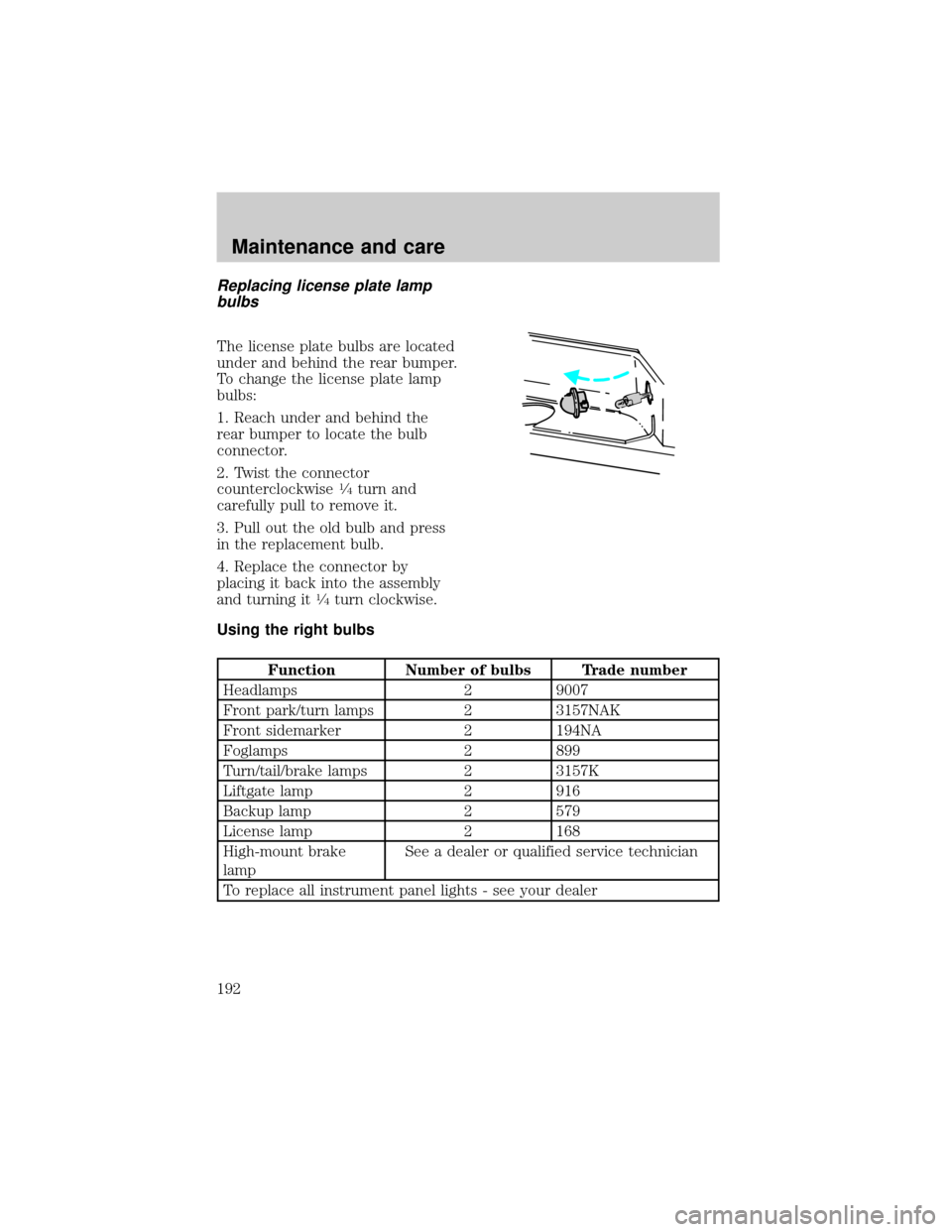
The license plate bulbs are located
under and behind the rear bumper.
To change the license plate lamp
bulbs:
1. Reach under and behind the
rear bumper to locate the bulb
connector.
2. Twist the connector
counterclockwise
1¤4turn and
carefully pull to remove it.
3. Pull out the old bulb and press
in the replacement bulb.
4. Replace the connector by
placing it back into the assembly
and turning it
1¤4turn clockwise.
Using the right bulbs
Function Number of bulbs Trade number
Headlamps 2 9007
Front park/turn lamps 2 3157NAK
Front sidemarker 2 194NA
Foglamps 2 899
Turn/tail/brake lamps 2 3157K
Liftgate lamp 2 916
Backup lamp 2 579
License lamp 2 168
High-mount brake
lampSee a dealer or qualified service technician
To replace all instrument panel lights - see your dealer
Maintenance and care
192
Page 193 of 216
REPLACING THE INTERIOR
BULBS
Check the operation of the
following interior bulbs frequently:
²interior overhead lamp
²map lamp
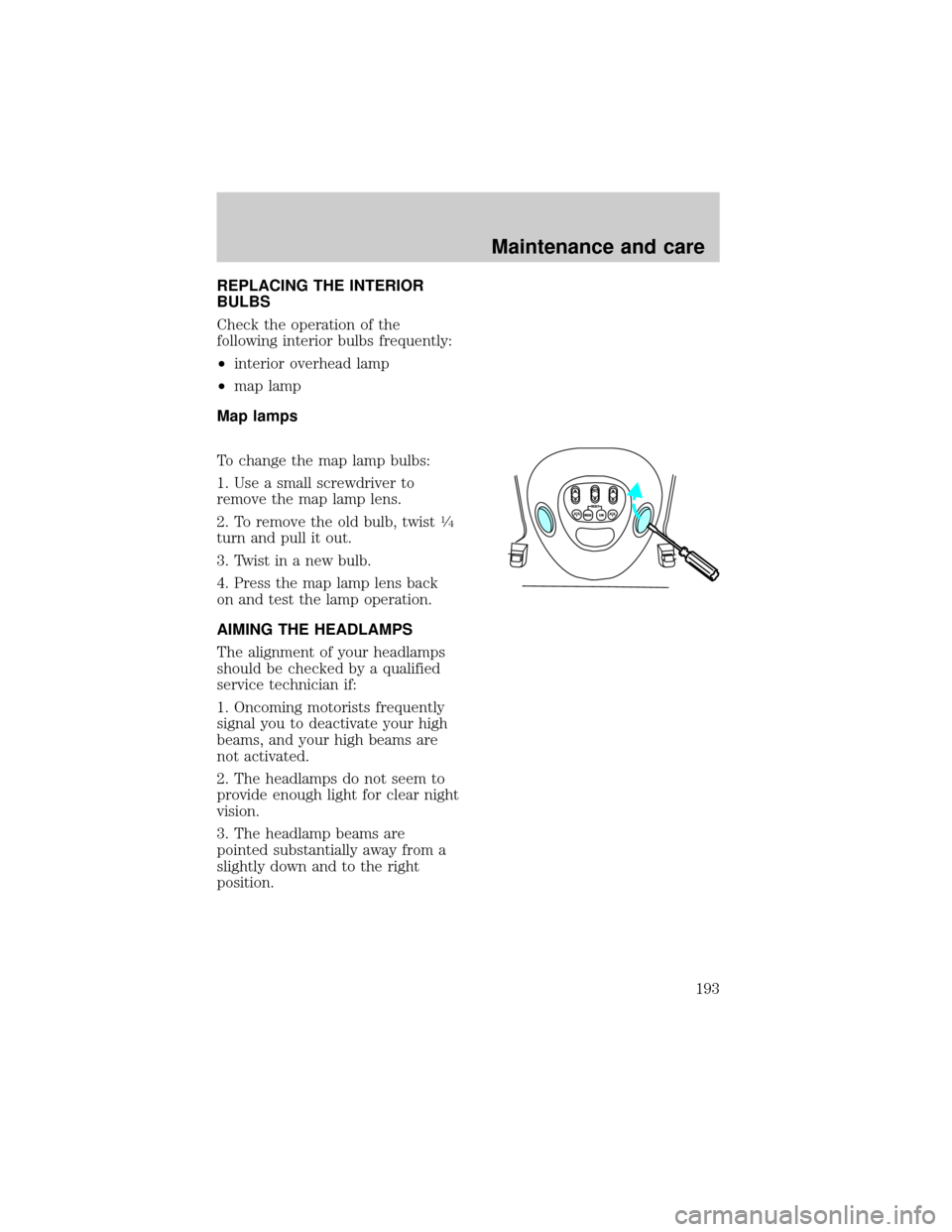
Map lamps
To change the map lamp bulbs:
1. Use a small screwdriver to
remove the map lamp lens.
2. To remove the old bulb, twist
1¤4
turn and pull it out.
3. Twist in a new bulb.
4. Press the map lamp lens back
on and test the lamp operation.
AIMING THE HEADLAMPS
The alignment of your headlamps
should be checked by a qualified
service technician if:
1. Oncoming motorists frequently
signal you to deactivate your high
beams, and your high beams are
not activated.
2. The headlamps do not seem to
provide enough light for clear night
vision.
3. The headlamp beams are
pointed substantially away from a
slightly down and to the right
position.
Maintenance and care
193
Page 194 of 216
CLEANING AND CARING FOR
YOUR VEHICLE
Refer to the ªCustomer Assistance
Guideº for a list of Ford-approved
cleaners, polishes and waxes.
Washing your vehicle
Wash your vehicle regularly with
cold or lukewarm water. Never use
strong detergents or soap. If your
vehicle is particularly dirty, use a
quality car wash detergent. Always
use a clean sponge, washing glove
or similar device and plenty of
water for best results. To avoid
spots, avoid washing when the
hood is still warm, immediately
after or during exposure to strong
sunlight.
During winter months, it is
especially important to wash the
vehicle on a regular basis. Large
quantities of dirt and road salt are
difficult to remove and also cause
damage to the vehicle. Remove any
exterior accessories, such as
antennas, before entering a car
wash.
After washing, apply the brakes
several times to dry them.
Waxing your vehicle
Wax when water stops beading on
the surface. This could be every
three or four months, depending
on operating conditions.
Use only carnauba or
synthetic-based waxes. Remove
Maintenance and care
194
Page 196 of 216

²Do not spray with cold water to
avoid cracking the engine block
or other engine components.
²Cover the highlighted areas to
prevent water damage when
cleaning the engine.
²Never wash or rinse the engine
while it is running; water in the
running engine may cause
internal damage.
Cleaning plastic exterior parts
Use vinyl cleaner for routine
cleaning. Clean with a tar remover
if necessary. Do not clean plastic
parts with thinners, solvents or
petroleum-based cleaners.
Cleaning the exterior lamps
Wash with the same detergent as
the exterior of your vehicle. Use
glass cleaner or tar remover if
necessary.
Maintenance and care
196
Page 208 of 216

Aiming headlamps ....................193
Air bag supplemental restraint
system ..........................................78
and child safety seats ..............80
description ................................79
disposal ......................................83
indicator light ...........................82
passenger air bag .....................81
Air cleaner filter .......................170
Air conditioning
auxiliary heater and air
conditioner ................................29
manual heating and air
conditioning system ..23,24,26,28
Air suspension
description ..............................102
warning light .............................11
Ambulance packages ....................3
Anti-lock brake system (ABS)
description ................................99
Battery .......................................168
voltage gauge ............................16
Brake fluid
checking and adding ..............157
Brakes ..........................................98
anti-lock .....................................98
anti-lock brake system (ABS)
warning light .............................99
fluid, checking and adding ....157
Brake-shift interlock .................104
Break-in period .............................2
Bulbs, replacing ........................186
headlamps ...............................187
rear lamps ........................191,192
Changing a tire .........................138
Child safety seats ........................86
Childproof locks ..........................50
Chime
headlamps on ............................13
Cleaning your vehicle ...............194
engine compartment ..............195
fabric ........................................197instrument panel ....................197
plastic parts ............................196
safety belts ..............................197
tail lamps .................................196
washing ....................................194
waxing .....................................194
wheels ......................................195
Compass, electronic ....................42
calibration .................................44
set zone adjustment .................43
Control trac 4WD system .........108
Controls ..................................51,52
Daytime running light system ...20
Defrost
rear window ..............................22
Driving under special
conditions ..................................111
high water ...............................112
slippery roads ..................113,114
Electronic sound system ............52
Emission control system ..........183
Engine ........................................204
check engine temperature
warning, message center .......152
service points ..........................152
Engine block heater ...................96
Engine coolant
checking and adding .......158,159
disposal ....................................161
refill capacities ........................161
Engine oil ...........................153,155
changing oil and oil filter .......156
checking and adding .......153,155
Exhaust fumes ............................96
Fail safe cooling ........................162
Floor mats ...................................53
Foglamps ...................................190
Four-Wheel Drive vehicles
control trac ........................23,108
indicator light ...........................11
special driving
instructions ......................109,110
Index
208