tires FORD EXPEDITION 1998 1.G Owners Manual
[x] Cancel search | Manufacturer: FORD, Model Year: 1998, Model line: EXPEDITION, Model: FORD EXPEDITION 1998 1.GPages: 216, PDF Size: 1.51 MB
Page 103 of 216
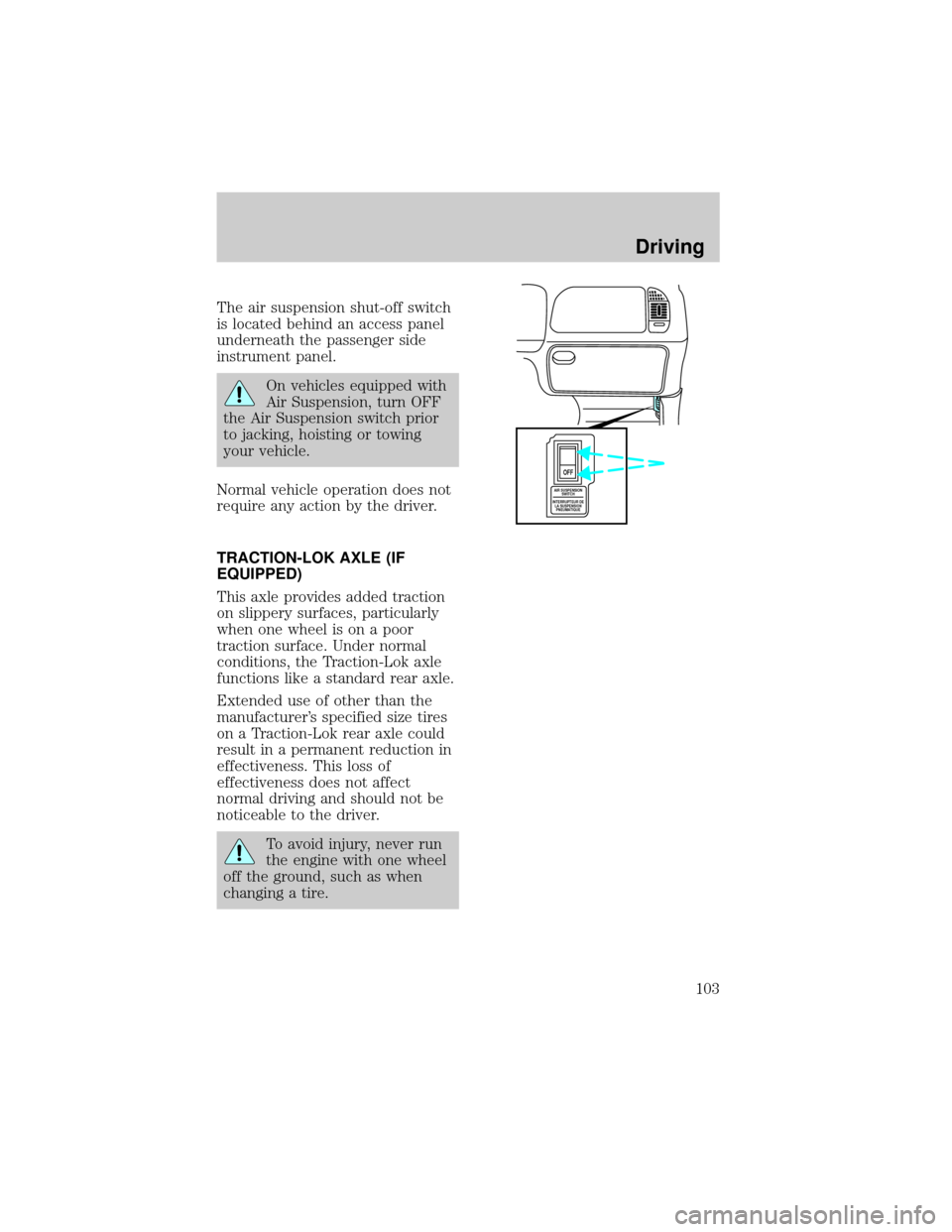
The air suspension shut-off switch
is located behind an access panel
underneath the passenger side
instrument panel.
On vehicles equipped with
Air Suspension, turn OFF
the Air Suspension switch prior
to jacking, hoisting or towing
your vehicle.
Normal vehicle operation does not
require any action by the driver.
TRACTION-LOK AXLE (IF
EQUIPPED)
This axle provides added traction
on slippery surfaces, particularly
when one wheel is on a poor
traction surface. Under normal
conditions, the Traction-Lok axle
functions like a standard rear axle.
Extended use of other than the
manufacturer's specified size tires
on a Traction-Lok rear axle could
result in a permanent reduction in
effectiveness. This loss of
effectiveness does not affect
normal driving and should not be
noticeable to the driver.
To avoid injury, never run
the engine with one wheel
off the ground, such as when
changing a tire.
AIR SUSPENSION
SWITCH
INTERRUPTEUR DE
LA SUSPENSION
PNEUMATIQUE
OFF
Driving
103
Page 105 of 216
Do not rock the vehicle for
more than a few minutes. The
transmission and tires may be
damaged or the engine may
overheat.
Always set the parking
brake fully and make sure
the gearshift is latched in P
(Park). Turn off the ignition
whenever you leave your vehicle.
Driving with a 4±speed
automatic transmission
Understanding gearshift
positions
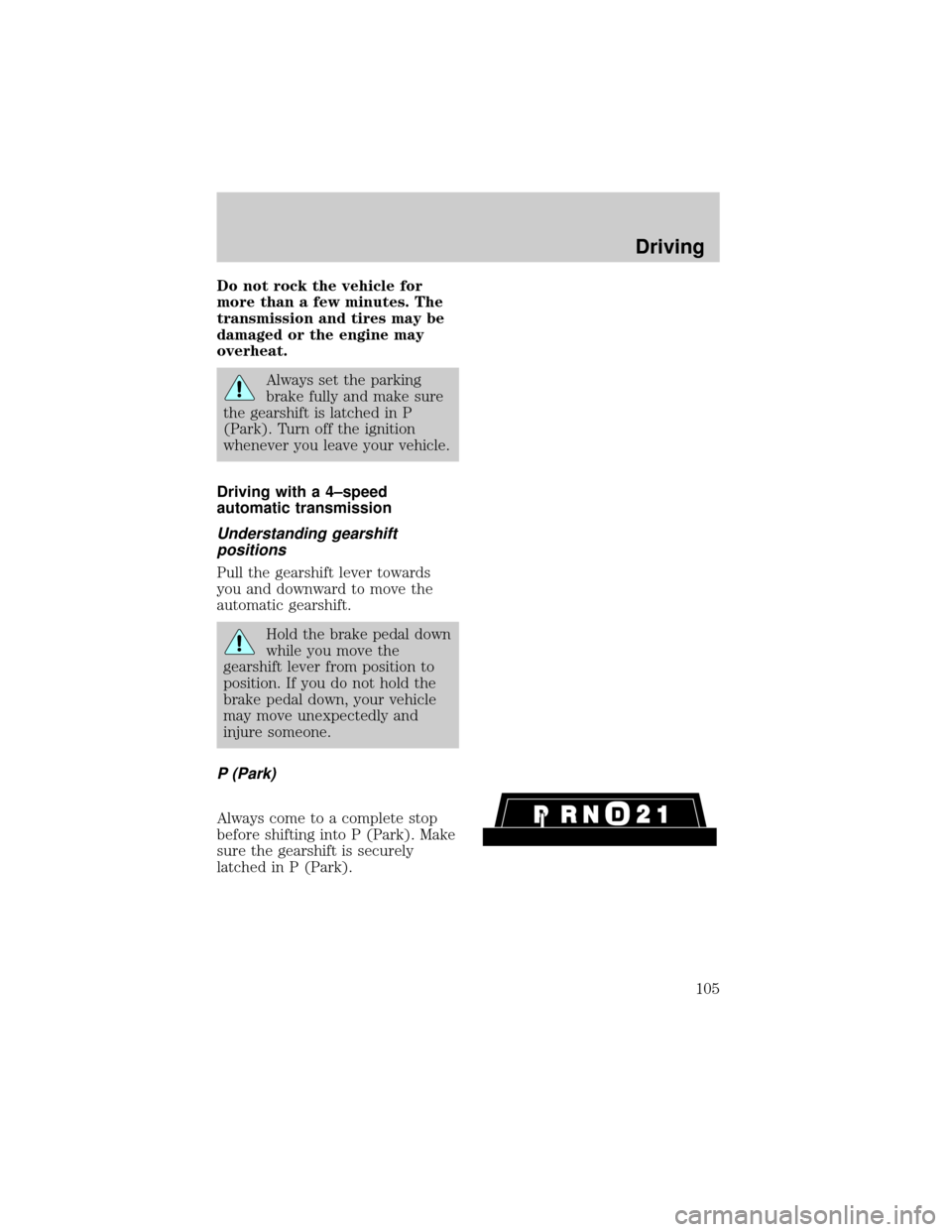
Pull the gearshift lever towards
you and downward to move the
automatic gearshift.
Hold the brake pedal down
while you move the
gearshift lever from position to
position. If you do not hold the
brake pedal down, your vehicle
may move unexpectedly and
injure someone.
P (Park)
Always come to a complete stop
before shifting into P (Park). Make
sure the gearshift is securely
latched in P (Park).
Driving
105
Page 111 of 216
the outside. Do not grip the
spokes.
Drive cautiously to avoid vehicle
damage from concealed objects
such as rocks and stumps.
You should either know the terrain
or examine maps of the area
before driving. Map out your route
before driving in the area. For
more information on driving
off-road, read the ªFour Wheelingº
supplement in your owner's
portfolio.
If your vehicle gets stuck
If the vehicle is stuck, shift the
transmission in a steady motion
between forward and reverse
gears. Allow the transmission to
engage, then press lightly on the
accelerator.
Do not rock the vehicle for
more than a few minutes. The
transmission and tires may be
damaged or the engine can
overheat.
Do not spin the wheels at
over 56 km/h (35 mph).
The tires may fail and injure a
passenger or bystander.
Sand
When driving over sand, try to
keep all four wheels on the most
solid area of the trail. Do not
reduce the tire pressures but shift
to a lower gear and drive steadily
through the terrain. Apply the
Driving
111
Page 112 of 216

accelerator slowly and avoid
spinning the wheels.
Mud and water
If you must drive through high
water, drive slowly. Traction or
brake capability may be limited.
When driving through water,
determine the depth; avoid water
higher than the bottom of the hubs
(if possible) and proceed slowly. If
the ignition system gets wet, the
vehicle may stall.
Once through water, always try the
brakes. Wet brakes do not stop the
vehicle as effectively as dry brakes.
Drying can be improved by moving
your vehicle slowly while applying
light pressure on the brake pedal.
After driving through mud, clean
off residue stuck to rotating
driveshafts and tires. Excess mud
stuck on tires and rotating
driveshafts causes an imbalance
that could damage drive
components.
If the transmission and transfer
case are submerged in water, their
fluids should be checked and
changed, if necessary.
Water intrusion into the
transmission may damage the
transmission.
If the rear axle is submerged in
water, the rear axle lubricant
should be checked and changed, if
necessary. The rear axle is filled
with a synthetic lubricant and does
not normally require a lubricant
Driving
112
Page 117 of 216
Do not exceed the GVWR
or the GAWR specified on
the Safety Compliance
Certification Label.
Do not use replacement tires with
lower weight capacities than the
originals because they may lower
the vehicle's GVWR and GAWR
limitations. Replacement tires with
a higher weight limit than the
originals do not increase the
GVWR and GAWR limitations.
Calculating the load your
vehicle can carry/tow
1. Use the Safety Compliance
Certification Label to find the axle
code number and engine type for
your vehicle.
2. Use the appropriate maximum
gross combined weight rating
(GCWR) chart to find the
maximum GCWR for your type
engine and rear axle ratio.
3. Weigh your vehicle as you
customarily operate the vehicle
without cargo. To obtain correct
weights, try taking your vehicle to
a shipping company or an
inspection station for trucks.
4. Subtract your loaded vehicle
weight from the maximum GCWR
on the following charts. This is the
maximum trailer weight your
vehicle can tow and must fall
below the maximum shown under
maximum trailer weight on the
chart.
Driving
117
Page 118 of 216
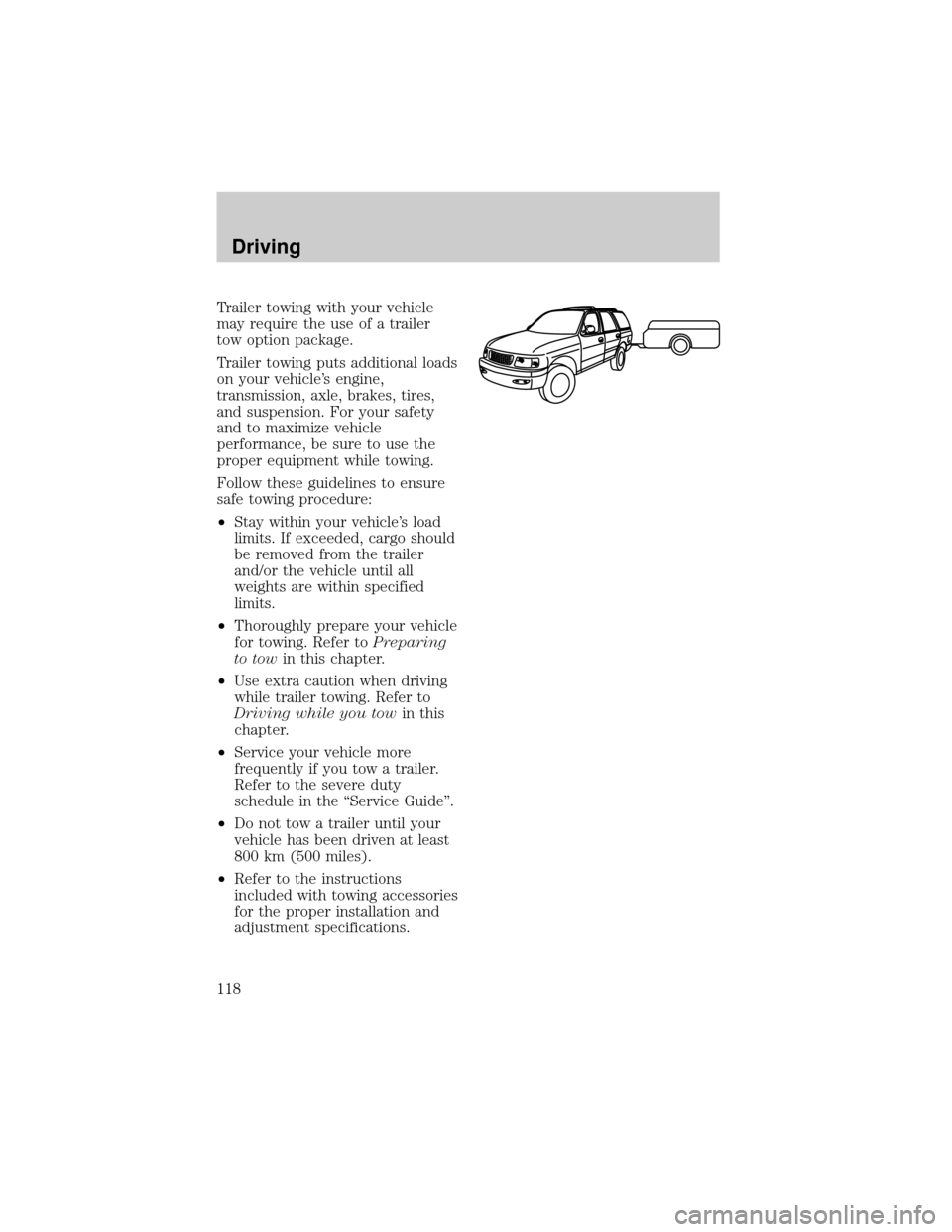
Trailer towing with your vehicle
may require the use of a trailer
tow option package.
Trailer towing puts additional loads
on your vehicle's engine,
transmission, axle, brakes, tires,
and suspension. For your safety
and to maximize vehicle
performance, be sure to use the
proper equipment while towing.
Follow these guidelines to ensure
safe towing procedure:
²Stay within your vehicle's load
limits. If exceeded, cargo should
be removed from the trailer
and/or the vehicle until all
weights are within specified
limits.
²Thoroughly prepare your vehicle
for towing. Refer toPreparing
to towin this chapter.
²Use extra caution when driving
while trailer towing. Refer to
Driving while you towin this
chapter.
²Service your vehicle more
frequently if you tow a trailer.
Refer to the severe duty
schedule in the ªService Guideº.
²Do not tow a trailer until your
vehicle has been driven at least
800 km (500 miles).
²Refer to the instructions
included with towing accessories
for the proper installation and
adjustment specifications.
Driving
118
Page 138 of 216
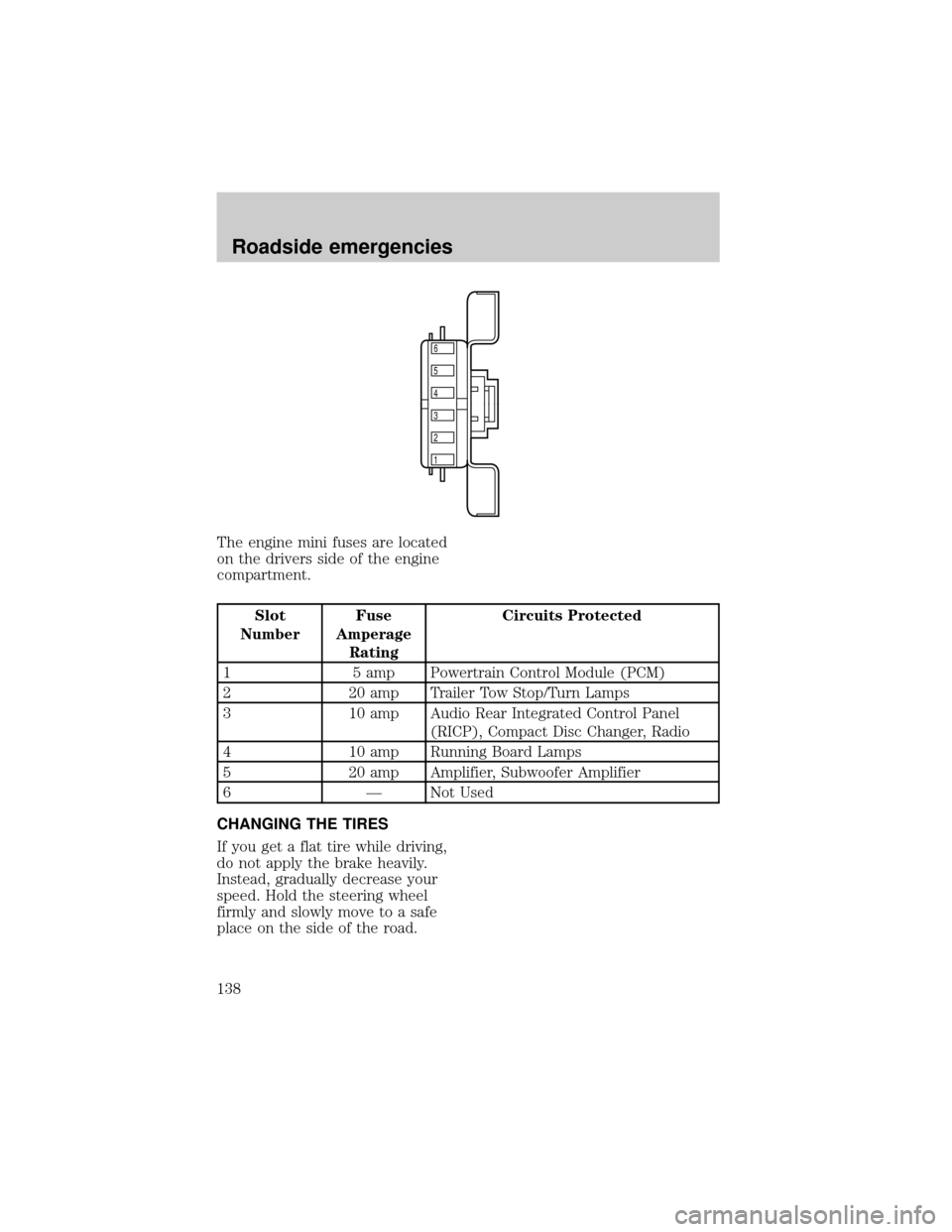
The engine mini fuses are located
on the drivers side of the engine
compartment.
Slot
NumberFuse
Amperage
RatingCircuits Protected
1 5 amp Powertrain Control Module (PCM)
2 20 amp Trailer Tow Stop/Turn Lamps
3 10 amp Audio Rear Integrated Control Panel
(RICP), Compact Disc Changer, Radio
4 10 amp Running Board Lamps
5 20 amp Amplifier, Subwoofer Amplifier
6 Ð Not Used
CHANGING THE TIRES
If you get a flat tire while driving,
do not apply the brake heavily.
Instead, gradually decrease your
speed. Hold the steering wheel
firmly and slowly move to a safe
place on the side of the road.
6
5
4
3
2
1
Roadside emergencies
138
Page 139 of 216
Spare tire information
Your vehicle is equipped with a
spare tire that may be used as a
spare or a regular tire. The spare
is identical to the other tires on
your vehicle, although the wheel
cover may not match.
Location of the spare tire and
tools
The spare tire and tools for your
vehicle are stowed in the following
locations:
Item Location
Spare tire Under the vehicle, just forward of
the rear bumper
Jack, wheel nut wrench,
instructions, work glovesBehind the access panel located
on the right rear quarter panel
interior trim
Jack handle On top of the radiator support at
the front of the engine
compartment
Removing the jack handle
1. Open the hood.
2. Un-snap the end of the handle
that is retained by the clip on the
top of the windshield washer
bottle.
3. Un-snap the shaft of the handle
from the two retaining clips
attached to the top of the radiator
shroud.
Roadside emergencies
139
Page 172 of 216
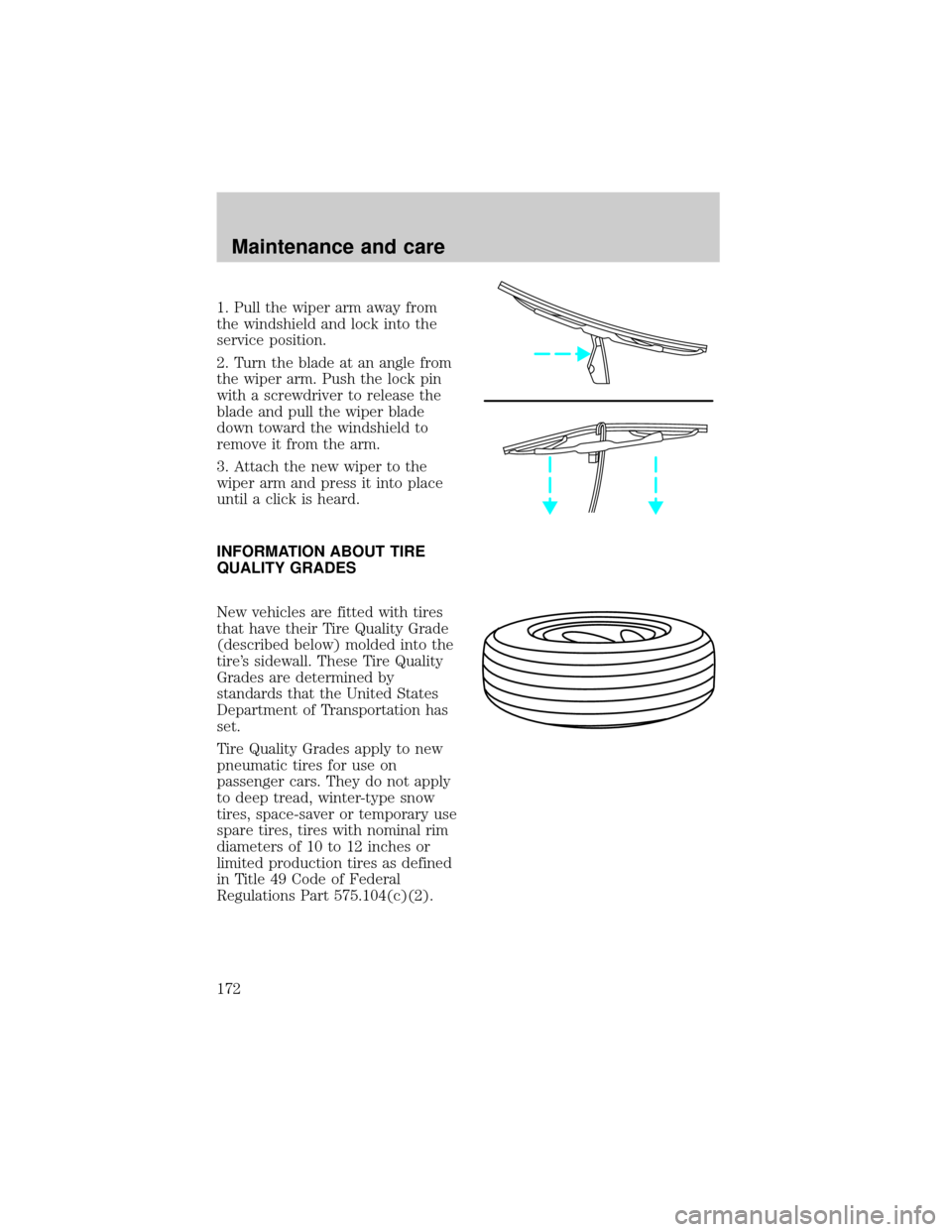
1. Pull the wiper arm away from
the windshield and lock into the
service position.
2. Turn the blade at an angle from
the wiper arm. Push the lock pin
with a screwdriver to release the
blade and pull the wiper blade
down toward the windshield to
remove it from the arm.
3. Attach the new wiper to the
wiper arm and press it into place
until a click is heard.
INFORMATION ABOUT TIRE
QUALITY GRADES
New vehicles are fitted with tires
that have their Tire Quality Grade
(described below) molded into the
tire's sidewall. These Tire Quality
Grades are determined by
standards that the United States
Department of Transportation has
set.
Tire Quality Grades apply to new
pneumatic tires for use on
passenger cars. They do not apply
to deep tread, winter-type snow
tires, space-saver or temporary use
spare tires, tires with nominal rim
diameters of 10 to 12 inches or
limited production tires as defined
in Title 49 Code of Federal
Regulations Part 575.104(c)(2).
Maintenance and care
172
Page 173 of 216
U.S. Department of
Transportation-Tire quality
grades:The U.S. Department of
Transportation requires Ford to
give you the following information
about tire grades exactly as the
government has written it.
Treadwear
The treadwear grade is a
comparative rating based on the
wear rate of the tire when tested
under controlled conditions on a
specified government test course.
For example, a tire grade 150
would wear one and one-half
(1 1/2) times as well on the
government course as a tire grade
100. The relative performance of
tires depends upon the actual
conditions of their use, however,
and may depart significantly from
the norm due to variations in
driving habits, service practices,
and differences in road
characteristics and climate.
Traction A B C
The traction grades, from highest
to lowest are A, B, and C, and they
represent the tire's ability to stop
on wet pavement as measured
under test surfaces of asphalt and
concrete. A tire marked C may
have poor traction performance.
The traction grade
assigned to this tire is
based on braking (straight
ahead) traction tests and does
not include cornering (turning)
traction.
Maintenance and care
173