cooling FORD EXPEDITION 2000 1.G User Guide
[x] Cancel search | Manufacturer: FORD, Model Year: 2000, Model line: EXPEDITION, Model: FORD EXPEDITION 2000 1.GPages: 256, PDF Size: 2.08 MB
Page 190 of 256
Do not put engine coolant in the windshield washer fluid
reservoir. If engine coolant is sprayed onto the windshield, it
could make it difficult to see through the windshield.
When the engine is cool, add a50/50 mixtureof engine coolant and
distilled water to the engine coolant reservoir, until the coolant is at the
ªcold fill levelº or within the ªcold fill rangeº as listed in the engine
coolant reservoir (depending upon application).
²NEVER increase the coolant concentration above 60%.
²NEVER decrease the coolant concentration below 40%.
²Engine coolant concentrations above 60% or below 40% will
decrease the freeze protection characteristics of the engine
coolant and may cause engine damage.
Plain water may be added in an emergency, but youmustreplace it with
a 50/50 mixture of engine coolant and distilled water as soon as possible.
Check the coolant level in the reservoir before you drive your vehicle the
next few times (with the engine cool). If necessary, add a50/50
mixtureof engine coolant and distilled water to the engine coolant
reservoir until the coolant level is at the ªcold fill levelº or within the
ªcold fill rangeº as listed on the reservoir (depending upon application).
Have your dealer check the engine cooling system for leaks if you have
to add more than 1.0 liter (1.0 quart) of engine coolant per month.
To avoid scalding hot steam or coolant from being released from
the engine cooling system, never remove the pressure relief cap
from the engine coolant reservoir while the engine is running or hot.
Failure to follow this warning may result in damage to the engine's
cooling system and possible severe personal injury.
If you must remove the pressure relief cap from the engine coolant
reservoir, follow these steps to avoid personal injury:
1. Before you remove the cap, turn the engine off and let it cool.
2. When the engine is cool, wrap a thick cloth around the cap. Slowly
turn cap counterclockwise until pressure begins to release.
3. Step back while the pressure releases.
4. When you are sure that all the pressure has been released, use the
cloth to turn it counterclockwise and remove the cap.
Maintenance and care
190
Page 191 of 256
Recycled engine coolant
Ford Motor Company recommends the use of a recycled engine coolant
produced by Ford-approved processes.
Not all coolant recycling processes produce coolant which meets Ford
specification ESE-M97B44-A. Use of a recycled engine coolant which
does not meet the Ford specification may harm engine and cooling
system components.
Always dispose of used automotive fluids in a responsible manner.
Follow your community's regulations and standards for recycling and
disposing of automotive fluids.
Coolant refill capacity
To find out how much fluid your vehicle's cooling system can hold, refer
toRefill capacitiesin theCapacities and specificationschapter.
Fill your engine coolant reservoir as outlined inAdding engine coolant
in this chapter.
Severe climates
If you drive in extremely cold climates (less than ±36É C [±34É F]):
²it may be necessary to increase the coolant concentration
above 50%.
²NEVER increase the coolant concentration above 60%.
²increased engine coolant concentrations above 60% will
decrease the overheat protection characteristics of the engine
coolant and may cause engine damage.
²refer to the chart on the coolant container to ensure the
coolant concentration in your vehicle will provide adequate
freeze protection at the temperatures in which you drive in the
winter months.
If you drive in extremely hot climates:
²it is still necessary to maintain the coolant concentration
above 40%.
²NEVER decrease the coolant concentration below 40%.
²decreased engine coolant concentrations below 40% will
decrease the corrosion protection characteristics of the engine
coolant and may cause engine damage.
Maintenance and care
191
Page 192 of 256
²decreased engine coolant concentrations below 40% will
decrease the freeze protection characteristics of the engine
coolant and may cause engine damage.
²refer to the chart on the coolant container to ensure the
coolant concentration in your vehicle will provide adequate
protection at the temperatures in which you drive.
Vehicles driven year-round in non-extreme climates should use a 50/50
mixture of engine coolant and distilled water for optimum cooling system
and engine protection.
What you should know about fail-safe cooling
If the engine coolant supply is depleted, this feature allows the vehicle to
be driven temporarily before incremental component damage is incurred.
The ªfail-safeº distance depends on ambient temperatures, vehicle load
and terrain.
How fail-safe cooling works
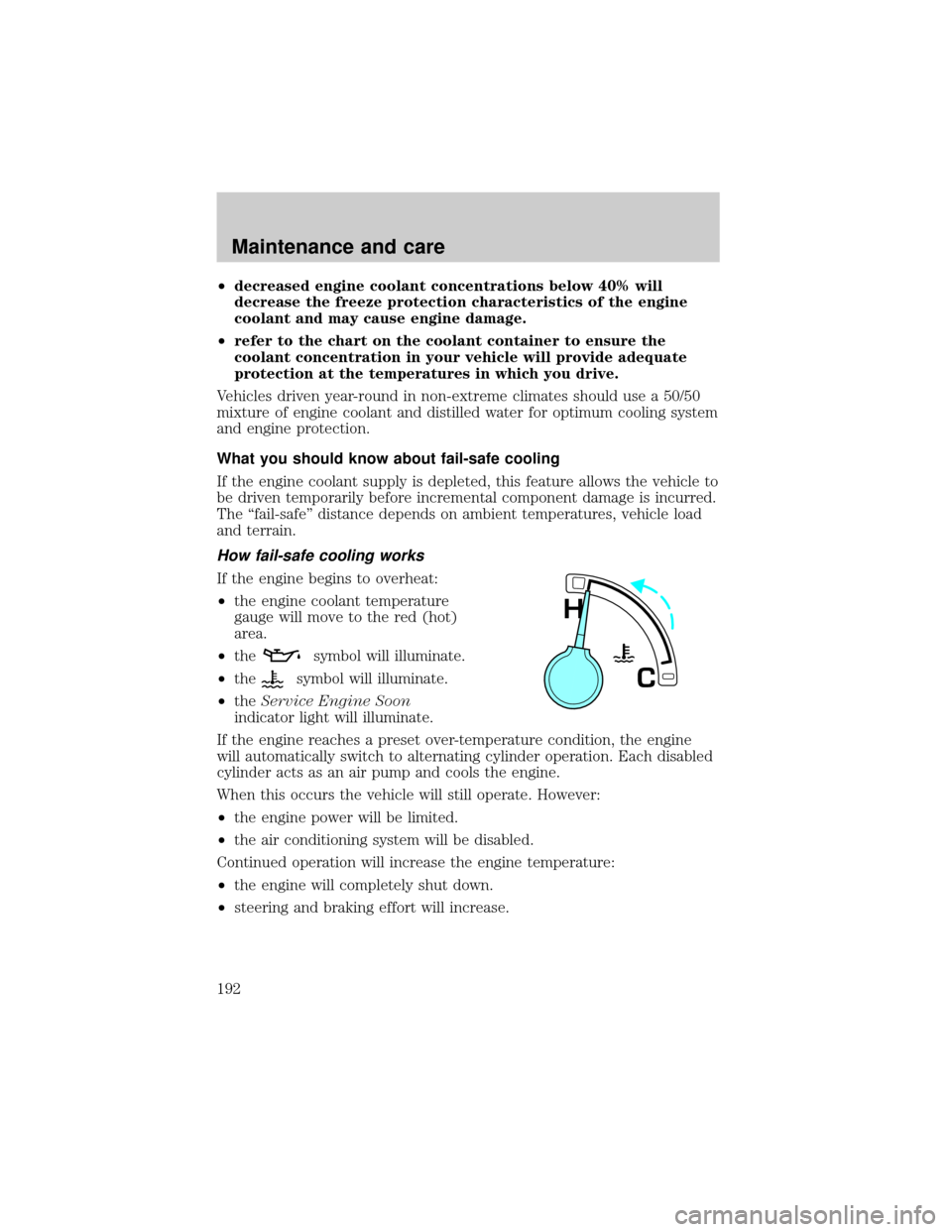
If the engine begins to overheat:
²the engine coolant temperature
gauge will move to the red (hot)
area.
²the
symbol will illuminate.
²the
symbol will illuminate.
²theService Engine Soon
indicator light will illuminate.
If the engine reaches a preset over-temperature condition, the engine
will automatically switch to alternating cylinder operation. Each disabled
cylinder acts as an air pump and cools the engine.
When this occurs the vehicle will still operate. However:
²the engine power will be limited.
²the air conditioning system will be disabled.
Continued operation will increase the engine temperature:
²the engine will completely shut down.
²steering and braking effort will increase.C
H
Maintenance and care
192
Page 249 of 256

washing ....................................221
waxing .....................................221
wheels ......................................222
wiper blades ............................223
Climate control (see Air
conditioning or Heating) ............51
Clock .......................................35,44
Compass, electronic ....................71
calibration .................................73
set zone adjustment .................72
Console ........................................80
overhead ...............................69,74
rear ............................................81
Controls
power seat .................................94
Coolant
checking and adding ..............187
refill capacities .................191,226
specifications ...................229,232
Cruise control
(see Speed control) ....................63
Customer Assistance ................159
Ford accessories for your
vehicle .....................................242
Ford Extended
Service Plan ............................235
Getting assistance outside
the U.S. and Canada ..............241
Getting roadside assistance ...159
Getting the
service you need ....................235
Ordering additional
owner's literature ...................246
The Dispute
Settlement Board ...................238
Utilizing the Mediation/
Arbitration Program ...............241
Daytime running lamps
(see Lamps) ................................19
Defrost
rear window ..............................21Dipstick
automatic
transmission fluid ...................194
engine oil .................................183
Doors
door ajar warning .....................12
lubricant specifications ..........229
Driveline universal
joint and slip yoke ....................196
Driving under special
conditions ..................................148
mud ..........................................147
sand .........................................147
snow and ice ...........................149
through water ..................147,149
Emergencies, roadside
jump-starting ..........................175
Emission control system ..........213
Engine ........................................232
check engine/
service engine soon light ...........8
cleaning ...................................222
coolant .....................................187
fail-safe coolant ......................192
idle speed control ...................197
lubrication
specifications ...................229,232
refill capacities ........................226
service points ..........................183
starting after a collision .........160
Engine block heater .................131
Engine oil ..................................183
change oil soon warning,
message center .......................183
checking and adding ..............183
dipstick ....................................183
filter, specifications .........185,226
recommendations ...................185
refill capacities ........................226
specifications ...................229,232
Exhaust fumes ..........................132
Fail safe cooling ........................192
Index
249