towing FORD EXPEDITION 2003 2.G User Guide
[x] Cancel search | Manufacturer: FORD, Model Year: 2003, Model line: EXPEDITION, Model: FORD EXPEDITION 2003 2.GPages: 320, PDF Size: 3.67 MB
Page 226 of 320
Launching or retrieving a boat
Disconnect the wiring to the trailer before backing the trailer
into the water. Reconnect the wiring to the trailer after the
trailer is removed from the water.
When backing down a ramp during boat launching or retrieval:
•do not allow the static water level to rise above the bottom edge of
the rear bumper.
•do not allow waves to break higher than 15 cm (6 inches) above the
bottom edge of the rear bumper.
Exceeding these limits may allow water to enter vehicle components:
•causing internal damage to the components.
•affecting driveability, emissions and reliability.
Replace the rear axle lubricant any time the axle has been submerged in
water. Rear axle lubricant quantities are not to be checked or changed
unless a leak is suspected or repair required.
RECREATIONAL TOWING (ALL WHEELS ON THE GROUND)
An example of recreational towing would be towing your vehicle behind a
motorhome. Follow these guidelines if you have the need for recreational
towing your vehicle with all four wheels on the ground. These guidelines
are designed to ensure that your transmission is not damaged.
2WD vehicles (with automatic transmissions):
•Place the transmission in N (Neutral)
•Maximum speed is 56 km (35 mph)
•Maximum distance is 80 km (50 miles)
If a distance of 80 km (50 miles) or a speed of 56 km (35 mph) must be
exceeded, the drive shaft will have to be removed before the vehicle is
towed.
Ford recommends the driveshaft be removed/installed only by a qualified
technician. See your local dealer for driveshaft removal/installation.
Improper removal/installation of the driveshaft can cause
transmission fluid loss, damage to the driveshaft and internal
transmission components.
Vehicles equipped with Control Trac four-wheel drive system:
Vehicles equipped with the Control Trac four-wheel drive system cannot be
towed with any wheels on the ground. See your local dealer if you must
flat-tow a vehicle equipped with the Control Trac four-wheel drive system.
Driving
226
Page 227 of 320

GETTING ROADSIDE ASSISTANCE
To fully assist you should you have a vehicle concern, Ford Motor
Company offers a complimentary roadside assistance program. This
program is separate from the New Vehicle Limited Warranty. The service
is available:
•24–hours, seven days a week
•for the New Vehicle Limited Warranty period of three years or 60,000
km (36,000 miles), whichever occurs first on Ford and Mercury
vehicles, and four years or 80,000 km (50,000 miles) on Lincoln
vehicles.
Roadside assistance will cover:
•changing a flat tire.
•jump-starts.
•lock-out assistance.
•limited fuel delivery.
•towing of your disabled vehicle to the nearest Ford Motor Company
dealership, or your selling dealer if within 56.3 km (35 miles) of the
nearest Ford Motor Company dealership (one tow per disablement).
Even non-warranty related tows, like accidents or getting stuck in the
mud or snow, are covered (some exclusions apply, such as impound
towing or repossession).
Canadian customers refer to your Owner Information Guide for
information on:
•Coverage period
•Exact fuel amounts
•Towing of your disabled vehicle
•Emergency travel expense reimbursement
•Travel planning benefits
USING ROADSIDE ASSISTANCE
Complete the roadside assistance identification card and place it in your
wallet for quick reference. In the United States, this card is found in the
Owner Guide portfolio in the glove compartment in Ford vehicles and is
mailed to you if you own a Mercury or Lincoln. In Canada, the card is
found in the Owner Information Guide in the glove compartment.
U.S. Ford or Mercury vehicle customers who require roadside assistance,
call 1–800–241–3673; Lincoln vehicle customers call 1–800–521–4140.
Roadside Emergencies
227
Page 238 of 320
7. To remove the spare tire, turn the handle counterclockwise until the
tire is lowered to the ground and the cable is slightly slack.
8. Slide the retainer through the center of the spare tire wheel.
Tire change procedure
To prevent the vehicle from moving when you change a tire, be
sure the parking brake is set, then block (in both directions) the
wheel that is diagonally opposite (other side and end of the vehicle) to
the tire being changed.
If the vehicle slips off the jack, you or someone else could be
seriously injured.
On vehicles equipped with Air Suspension, turn OFF the Air
Suspension switch prior to jacking, hoisting or towing your
vehicle.
Refer to the instruction sheet (located in the rear floor compartment
behind the 3rd row seat with the jack tray tools assembly kit) for
detailed tire change instructions.
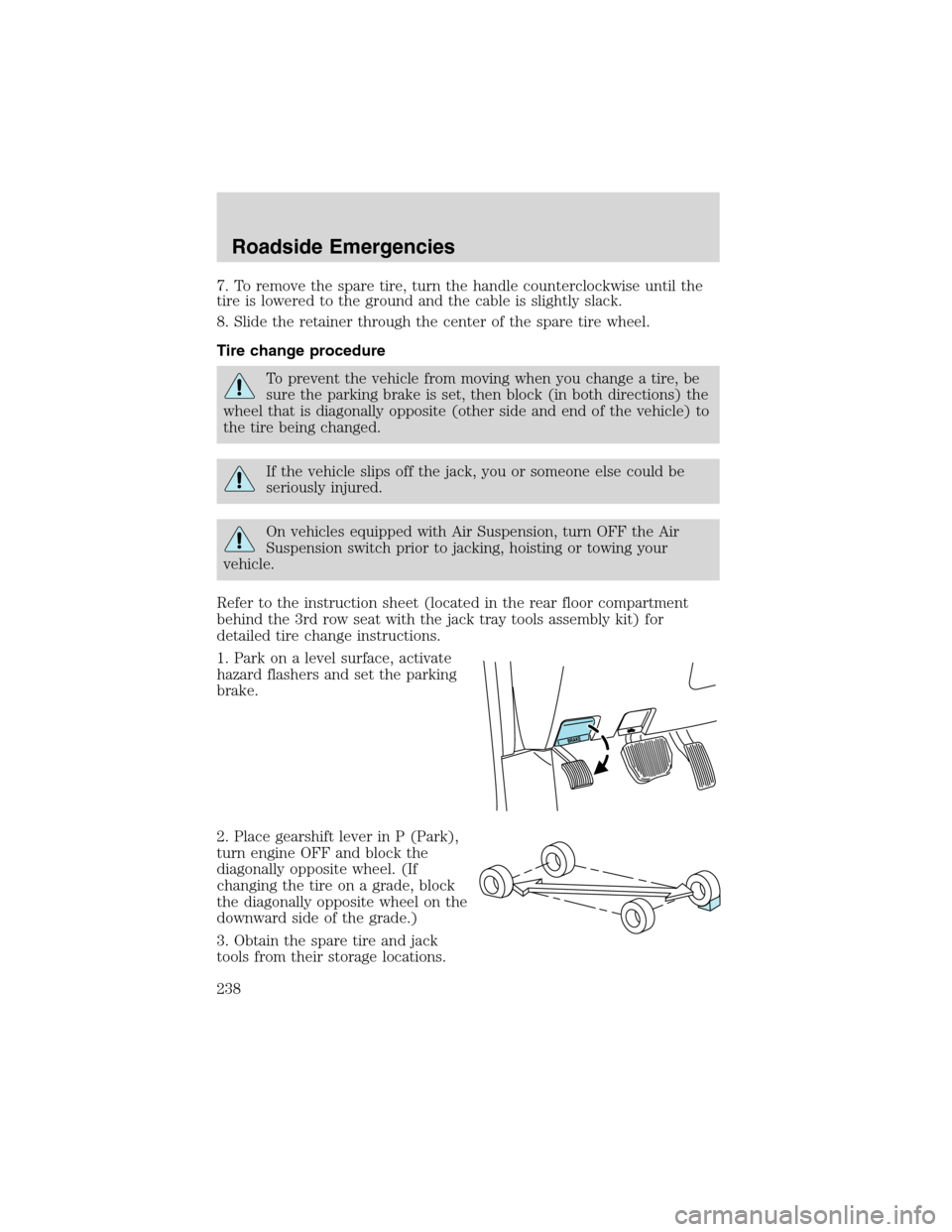
1. Park on a level surface, activate
hazard flashers and set the parking
brake.
2. Place gearshift lever in P (Park),
turn engine OFF and block the
diagonally opposite wheel. (If
changing the tire on a grade, block
the diagonally opposite wheel on the
downward side of the grade.)
3. Obtain the spare tire and jack
tools from their storage locations.
Roadside Emergencies
238
Page 241 of 320
Stowing the spare tire
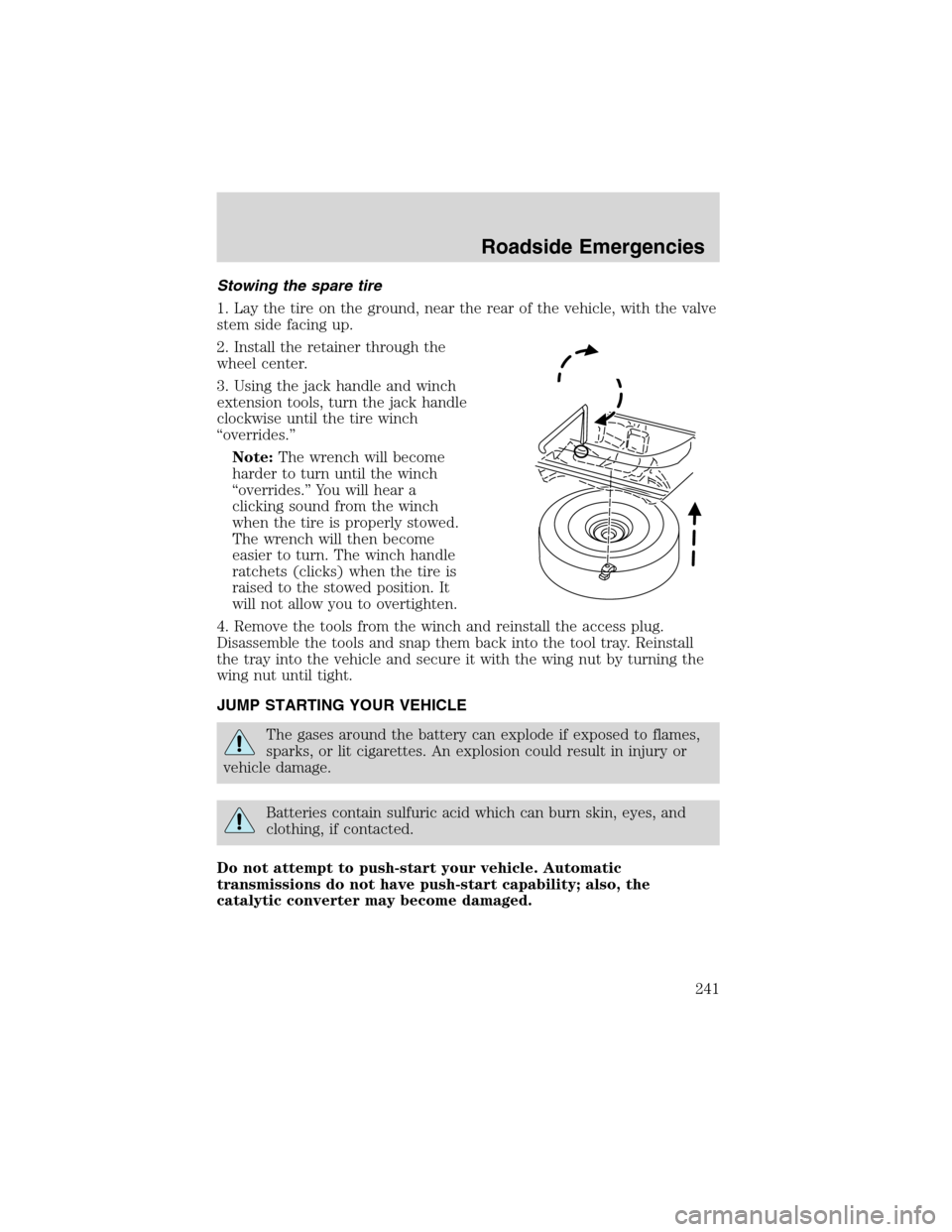
1. Lay the tire on the ground, near the rear of the vehicle, with the valve
stem side facing up.
2. Install the retainer through the
wheel center.
3. Using the jack handle and winch
extension tools, turn the jack handle
clockwise until the tire winch
“overrides.”
Note:The wrench will become
harder to turn until the winch
“overrides.”You will hear a
clicking sound from the winch
when the tire is properly stowed.
The wrench will then become
easier to turn. The winch handle
ratchets (clicks) when the tire is
raised to the stowed position. It
will not allow you to overtighten.
4. Remove the tools from the winch and reinstall the access plug.
Disassemble the tools and snap them back into the tool tray. Reinstall
the tray into the vehicle and secure it with the wing nut by turning the
wing nut until tight.
JUMP STARTING YOUR VEHICLE
The gases around the battery can explode if exposed to flames,
sparks, or lit cigarettes. An explosion could result in injury or
vehicle damage.
Batteries contain sulfuric acid which can burn skin, eyes, and
clothing, if contacted.
Do not attempt to push-start your vehicle. Automatic
transmissions do not have push-start capability; also, the
catalytic converter may become damaged.
Roadside Emergencies
241
Page 247 of 320
WRECKER TOWING
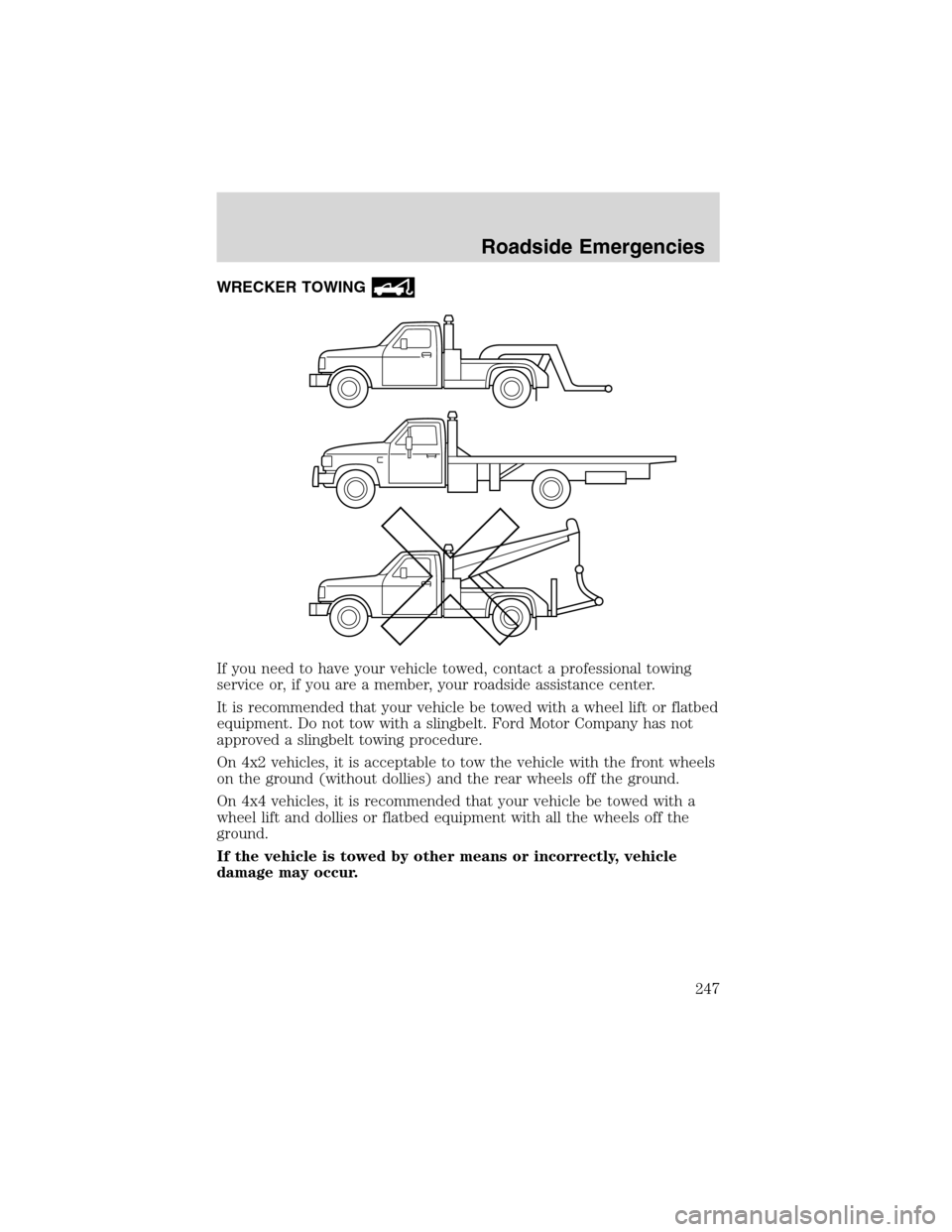
If you need to have your vehicle towed, contact a professional towing
service or, if you are a member, your roadside assistance center.
It is recommended that your vehicle be towed with a wheel lift or flatbed
equipment. Do not tow with a slingbelt. Ford Motor Company has not
approved a slingbelt towing procedure.
On 4x2 vehicles, it is acceptable to tow the vehicle with the front wheels
on the ground (without dollies) and the rear wheels off the ground.
On 4x4 vehicles, it is recommended that your vehicle be towed with a
wheel lift and dollies or flatbed equipment with all the wheels off the
ground.
If the vehicle is towed by other means or incorrectly, vehicle
damage may occur.
Roadside Emergencies
247
Page 248 of 320
Special Conditions:
•Release the parking brake.
•Turn the ignition to the OFF/UNLOCKED position.
•Place the transmission in N (Neutral).
•Do not exceed a distance of 80 km (50 miles).
•Do not exceed 56 km/h (35 mph) vehicle speed.
With a disabled vehicle (without access to wheel dollies, car hauling
trailer or flatbed transport vehicle) your vehicle can be towed (all wheels
on the ground) under the following conditions:
Ford Motor Company produces a towing manual for all authorized tow
truck operators. Have your tow truck operator refer to this manual for
proper hook-up and towing procedures for your vehicle.
Roadside Emergencies
248
Page 251 of 320
In some states (in the U.S.) you must directly notify Ford in writing
before pursuing remedies under your state’s warranty laws. Ford is also
allowed a final repair attempt in some states.
In the United States, a warranty dispute must be submitted to the
Dispute Settlement Board before taking action under the Magnuson-Moss
Warranty Act, or to the extent allowed by state law, before pursuing
replacement or repurchase remedies provided by certain state laws. This
dispute handling procedure is not required prior to enforcing state
created rights or other rights which are independent of the
Magnuson-Moss Warranty Act or state replacement or repurchase laws.
FORD EXTENDED SERVICE PLAN
You can get more protection for your new car or light truck by
purchasing Ford Extended Service Plan (Ford ESP) coverage. Ford ESP
is an optional service contract which is backed by Ford Motor Company
or Ford Motor Service Company (in the U.S.) and Ford of Canada (in
Canada). It provides the following:
•Benefits during the warranty period depending on the plan you
purchase (such as: reimbursement for rentals; coverage for certain
maintenance and wear items).
•Protection against covered repair costs after your Bumper-to-Bumper
Warranty expires.
You may purchase Ford ESP from any participating Ford and Lincoln
Mercury and Ford of Canada dealer. There are several plans available in
various time, distance and deductible combinations which can be tailored
to fit your own driving needs. Ford ESP also offers reimbursement
benefits for towing and rental coverage.
When you buy Ford ESP, you receive Peace-of-Mind protection
throughout the United States and Canada, provided by a network of
more than 5,000 participating Ford or Lincoln Mercury and Ford of
Canada dealers.
If you did not take advantage of the Ford Extended Service Plan at the
time of purchasing your vehicle, you may still be eligible. Please contact
your dealer for further information. Since this information is subject to
change, please ask your dealer for complete details about Ford Extended
Service Plan coverage options, or visit the Ford ESP website at
www.ford-esp.com.
Customer Assistance
251
Page 287 of 320
•Revving the engine before turning it off may reduce fuel economy.
•Using the air conditioner or defroster may reduce fuel economy.
•You may want to turn off the speed control in hilly terrain if
unnecessary shifting between third and fourth gear occurs.
Unnecessary shifting of this type could result in reduced fuel
economy.
•Warming up a vehicle on cold mornings is not required and may
reduce fuel economy.
•Resting your foot on the brake pedal while driving may reduce fuel
economy.
•Combine errands and minimize stop-and-go driving.
Maintenance
•Keep tires properly inflated and use only recommended size.
•Operating a vehicle with the wheels out of alignment will reduce fuel
economy.
•Use recommended engine oil. Refer toLubricant specificationsin
this chapter.
•Perform all regularly scheduled maintenance items. Follow the
recommended maintenance schedule and owner maintenance checks
found in your vehicle scheduled maintenance guide.
Conditions
•Heavily loading a vehicle or towing a trailer may reduce fuel economy
at any speed.
•Carrying unnecessary weight may reduce fuel economy (as much as
0.4 km/L [1 mpg] is lost for every 180 kg [400 lb] of weight carried).
•Adding certain accessories to your vehicle (for example bug
deflectors, rollbars/light bars, running boards, ski/luggage racks) may
reduce fuel economy.
•Using fuel blended with alcohol may lower fuel economy.
•Fuel economy may decrease with lower temperatures during the first
12–16 km (8–10 miles) of driving.
•Driving on flat terrain offers improved fuel economy as compared to
driving on hilly terrain.
•Transmissions give their best fuel economy when operated in the top
cruise gear and with steady pressure on the gas pedal.
Maintenance and Specifications
287
Page 317 of 320
cruise indicator .........................13
door ajar ....................................13
engine oil pressure ...................13
high beam .................................13
low fuel ......................................12
low washer fluid .......................12
overdrive off ..............................14
safety belt .................................12
service engine soon ..................10
speed control ..........................106
turn signal indicator .................13
Limited-slip axle .......................198
Load limits .................................219
GAWR ......................................219
GVWR ......................................219
trailer towing ..........................219
Loading instructions .................221
Locks
childproof ................................128
doors ........................................128
Lubricant specifications ...303, 305
Lumbar support, seats .............143
M
Message center .........................114
english/metric button .............119
system check button ..............120
warning messages ...................120
Mirrors .........................................95
automatic dimming rearview
mirror ......................................100
fold away .................................102
heated ......................................101
programmable
memory ...........................131, 144
side view mirrors
(power) ...................................101
Moon roof ....................................96
Motorcraft parts ................284, 300O
Octane rating ............................283
Odometer .....................................17
Oil (see Engine oil) ..................269
Overdrive ...................................124
P
Panic alarm feature,
remote entry system ................130
Parking brake ............................196
Parts (see Motorcraft parts) ....300
Pedals (see Power
adjustable foot pedals) .............102
Power distribution box
(see Fuses) ...............................231
Power door locks ......................128
Power point .................................97
Power steering ..................197–198
fluid, checking and adding ....289
fluid, refill capacity ................300
fluid, specifications .........303, 305
Power Windows ...........................99
Preparing to drive your
vehicle ........................................198
R
Radio ..........................19, 27, 37–38
Radio reception ...........................56
Rear window defroster ...............80
Relays ........................................230
Remote entry system .......129–130
illuminated entry ....................133
locking/unlocking
doors ........................128–130, 135
Index
317
Page 318 of 320
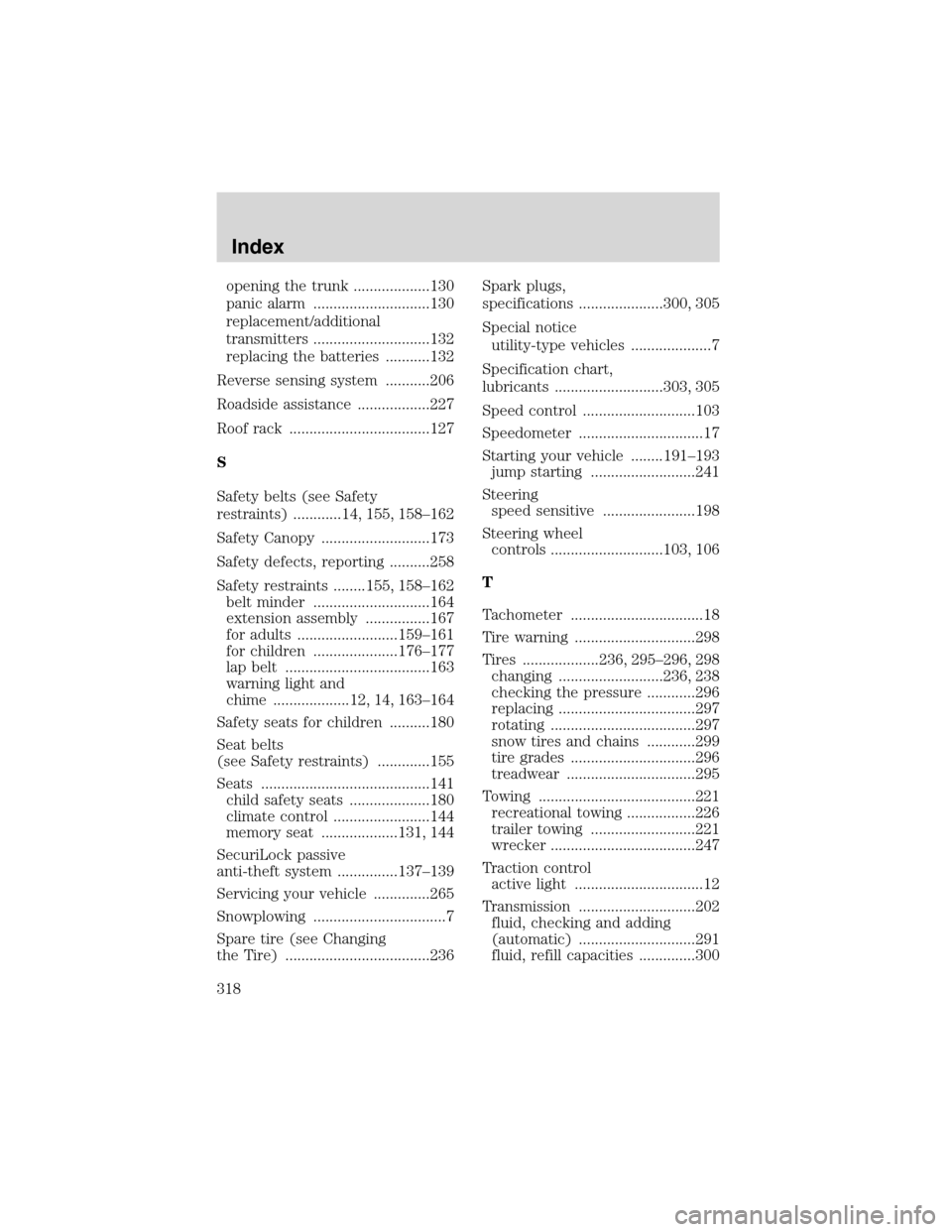
opening the trunk ...................130
panic alarm .............................130
replacement/additional
transmitters .............................132
replacing the batteries ...........132
Reverse sensing system ...........206
Roadside assistance ..................227
Roof rack ...................................127
S
Safety belts (see Safety
restraints) ............14, 155, 158–162
Safety Canopy ...........................173
Safety defects, reporting ..........258
Safety restraints ........155, 158–162
belt minder .............................164
extension assembly ................167
for adults .........................159–161
for children .....................176–177
lap belt ....................................163
warning light and
chime ...................12, 14, 163–164
Safety seats for children ..........180
Seat belts
(see Safety restraints) .............155
Seats ..........................................141
child safety seats ....................180
climate control ........................144
memory seat ...................131, 144
SecuriLock passive
anti-theft system ...............137–139
Servicing your vehicle ..............265
Snowplowing .................................7
Spare tire (see Changing
the Tire) ....................................236Spark plugs,
specifications .....................300, 305
Special notice
utility-type vehicles ....................7
Specification chart,
lubricants ...........................303, 305
Speed control ............................103
Speedometer ...............................17
Starting your vehicle ........191–193
jump starting ..........................241
Steering
speed sensitive .......................198
Steering wheel
controls ............................103, 106
T
Tachometer .................................18
Tire warning ..............................298
Tires ...................236, 295–296, 298
changing ..........................236, 238
checking the pressure ............296
replacing ..................................297
rotating ....................................297
snow tires and chains ............299
tire grades ...............................296
treadwear ................................295
Towing .......................................221
recreational towing .................226
trailer towing ..........................221
wrecker ....................................247
Traction control
active light ................................12
Transmission .............................202
fluid, checking and adding
(automatic) .............................291
fluid, refill capacities ..............300
Index
318