warning light FORD EXPEDITION 2004 2.G Owner's Manual
[x] Cancel search | Manufacturer: FORD, Model Year: 2004, Model line: EXPEDITION, Model: FORD EXPEDITION 2004 2.GPages: 344, PDF Size: 11.56 MB
Page 304 of 344
It is important to note the box in the lower left corner of the window
sticker. These numbers represent the range of fuel economy expected on
the vehicle under optimum conditions. Your fuel economy may vary
depending upon the method of operation and conditions.
EMISSION CONTROL SYSTEM
Your vehicle is equipped with various emission control components and a
catalytic converter which will enable your vehicle to comply with
applicable exhaust emission standards. To make sure that the catalytic
converter and other emission control components continue to work
properly:
•Use only the specified fuel listed.
•Avoid running out of fuel.
•Do not turn off the ignition while your vehicle is moving, especially at
high speeds.
•Have the items listed in your scheduled maintenance guide performed
according to the specified schedule.
The scheduled maintenance items listed in the scheduled maintenance
guide are essential to the life and performance of your vehicle and to its
emissions system.
If other than Ford, Motorcraft or Ford-authorized parts are used for
maintenance replacements or for service of components affecting
emission control, such non-Ford parts should be equivalent to genuine
Ford Motor Company parts in performance and durability.
Do not park, idle, or drive your vehicle in dry grass or other dry
ground cover. The emission system heats up the engine
compartment and exhaust system, which can start a fire.
Illumination of the“Service Engine Soon”light, charging system warning
light or the temperature warning light, fluid leaks, strange odors, smoke
or loss of engine power, could indicate that the emission control system
is not working properly.
Exhaust leaks may result in entry of harmful and potentially
lethal fumes into the passenger compartment.
Do not make any unauthorized changes to your vehicle or engine. By
law, vehicle owners and anyone who manufactures, repairs, services,
sells, leases, trades vehicles, or supervises a fleet of vehicles are not
2004 Expedition(exd)
Owners Guide (post-2002-fmt)
USA English(fus)
Maintenance and Specifications
304
Page 305 of 344
permitted to intentionally remove an emission control device or prevent
it from working. Information about your vehicle’s emission system is on
the Vehicle Emission Control Information Decal located on or near the
engine. This decal identifies engine displacement and gives some tune up
specifications.
Please consult yourWarranty Guidefor complete emission warranty
information.
On board diagnostics (OBD-II)
Your vehicle is equipped with a computer that monitors the engine’s
emission control system. This system is commonly known as the On
Board Diagnostics System (OBD-II). This OBD-II system protects the
environment by ensuring that your vehicle continues to meet
government emission standards. The OBD-II system also assists the
service technician in properly servicing your vehicle. When theCheck
Engine/Service Engine Soonlight illuminates, the OBD-II system has
detected a malfunction. Temporary malfunctions may cause yourCheck
Engine/Service Engine Soonlight to illuminate. Examples are:
1. The vehicle has run out of fuel. (The engine may misfire or run
poorly.)
2. Poor fuel quality or water in the fuel.
3. The fuel cap may not have been securely tightened.
These temporary malfunctions can be corrected by filling the fuel tank
with good quality fuel and/or properly tightening the fuel cap. After three
driving cycles without these or any other temporary malfunctions
present, theCheck Engine/Service Engine Soonlight should turn off.
(A driving cycle consists of a cold engine startup followed by mixed
city/highway driving.) No additional vehicle service is required.
If theCheck Engine/Service Engine Soonlight remains on, have your
vehicle serviced at the first available opportunity.
Readiness for Inspection/Maintenance (I/M) testing
In some localities, it may be a legal requirement to pass an I/M test of
the on-board diagnostics system. If your“Check Engine/Service Engine
Soon”light is on, refer to the description in theWarning lights and
chimessection of theInstrument clusterchapter. Your vehicle may not
pass the I/M test with the“Check Engine/Service Engine Soon”light on.
If the vehicle’s powertrain system or its battery has just been serviced,
the on-board diagnostics system is reset to a“not ready for I/M test”
2004 Expedition(exd)
Owners Guide (post-2002-fmt)
USA English(fus)
Maintenance and Specifications
305
Page 316 of 344
which can be found on either the tire label or certification label which is
located on the structure by the trailing edge of the driver’s door or the
edge of the driver’s door. The cold inflation pressure should never be set
lower than the recommended pressure on the label.
Note:You may not find this information on all tires because it is not
required by federal law.
The tire suppliers may have additional markings, notes or warnings such
as standard load, radial tubeless, etc.
Additional information contained on the tire sidewall for“LT”type
tires
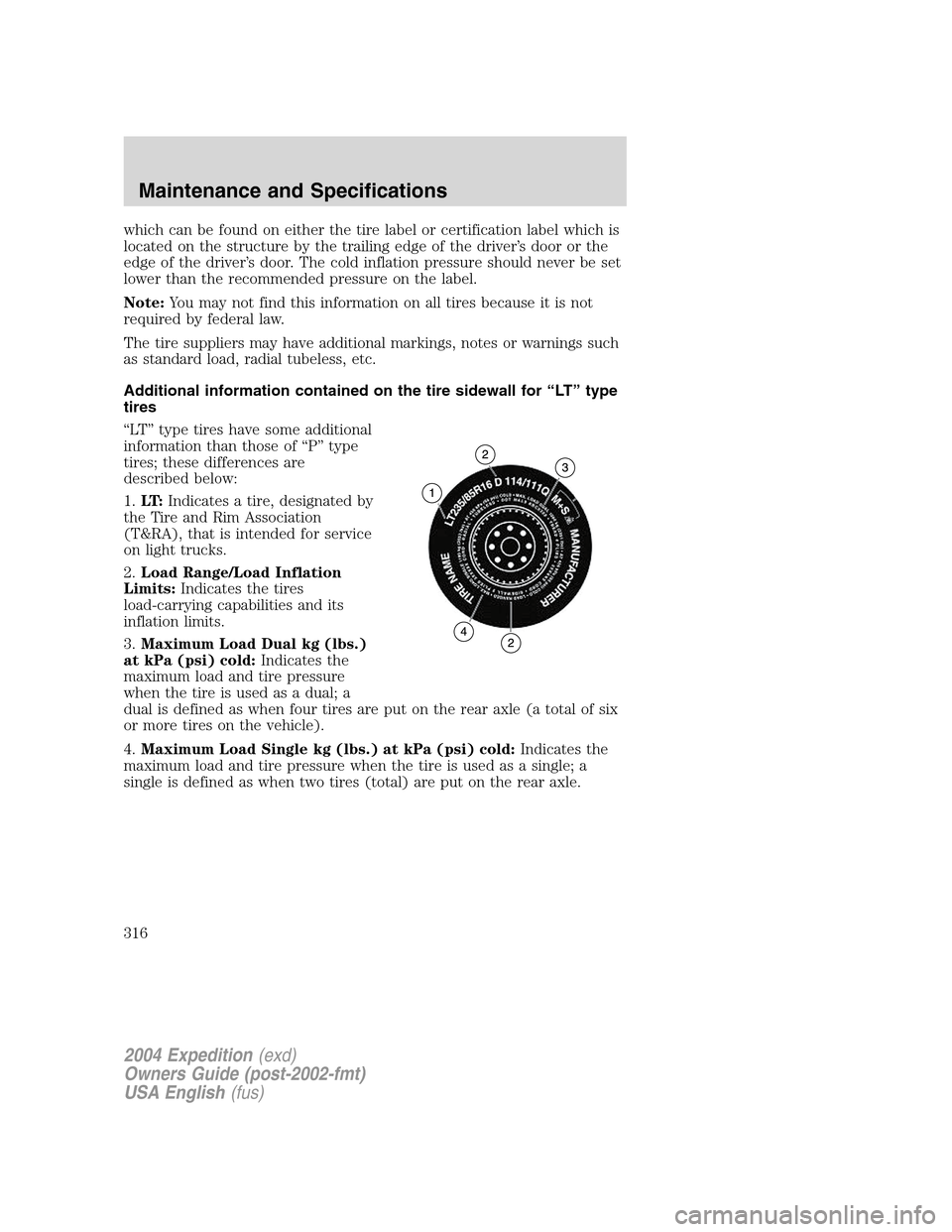
“LT”type tires have some additional
information than those of“P”type
tires; these differences are
described below:
1.LT:Indicates a tire, designated by
the Tire and Rim Association
(T&RA), that is intended for service
on light trucks.
2.Load Range/Load Inflation
Limits:Indicates the tires
load-carrying capabilities and its
inflation limits.
3.Maximum Load Dual kg (lbs.)
at kPa (psi) cold:Indicates the
maximum load and tire pressure
when the tire is used as a dual; a
dual is defined as when four tires are put on the rear axle (a total of six
or more tires on the vehicle).
4.Maximum Load Single kg (lbs.) at kPa (psi) cold:Indicates the
maximum load and tire pressure when the tire is used as a single; a
single is defined as when two tires (total) are put on the rear axle.
2004 Expedition(exd)
Owners Guide (post-2002-fmt)
USA English(fus)
Maintenance and Specifications
316
Page 322 of 344
•Avoid fast starts, stops and turns
•Avoid potholes and objects on the road
•Do not run over curbs or hit the tire against a curb when parking
If you vehicle is stuck in snow, mud, sand, etc.,do notrapidly spin the
tires; spinning the tires can tear the tire and cause an explosion. A tire
can explode in as little as three to five seconds.
Tire explosions can cause death, personal injury or property
damage. Do not allow anyone to stand near, or directly ahead or
behind the spinning tire.
Never spin the tires in excess of the 55 km/h (35 mph) point
indicated on the speedometer.
Highway hazards
No matter how carefully you drive there’s always the possibility that you
may eventually have a flat tire on the highway. Drive slowly to the
closest safe area out of traffic. This may further damage the flat tire, but
your safety is more important.
If you feel a sudden vibration or ride disturbance while driving or you
suspect your tire or vehicle has been damaged, immediately reduce your
speed. Drive with caution until you can safely pull off the road. Stop and
inspect the tire for damage. If the tire is under-inflated or damaged,
deflate it, remove wheel and replace it with your spare tire and wheel. If
you cannot detect a cause, have the vehicle towed to the nearest repair
facility or tire dealer to have the vehicle inspected.
Tire pressure monitoring system (TPMS)(if equipped)
When the tire pressure monitoring
system warning light is lit, one or
more of your tires is significantly
under-inflated. you should stop and
check your tires as soon as possible,
and inflate them to the proper pressure as indicated in the vehicle’s tire
information placard. Driving on a significantly under-inflated tire causes
the tire to overheat and can lead to tire failure. Under-inflation also
reduces fuel efficiency and tire tread life, and may affect the vehicle’s
handling and stopping ability. Each tire should be checked monthly, the
spare tire every six months. Tire pressure should be set when cold to the
recommended inflation pressure as specified in the vehicle placard and
owner’s manual.
2004 Expedition(exd)
Owners Guide (post-2002-fmt)
USA English(fus)
Maintenance and Specifications
322
Page 323 of 344
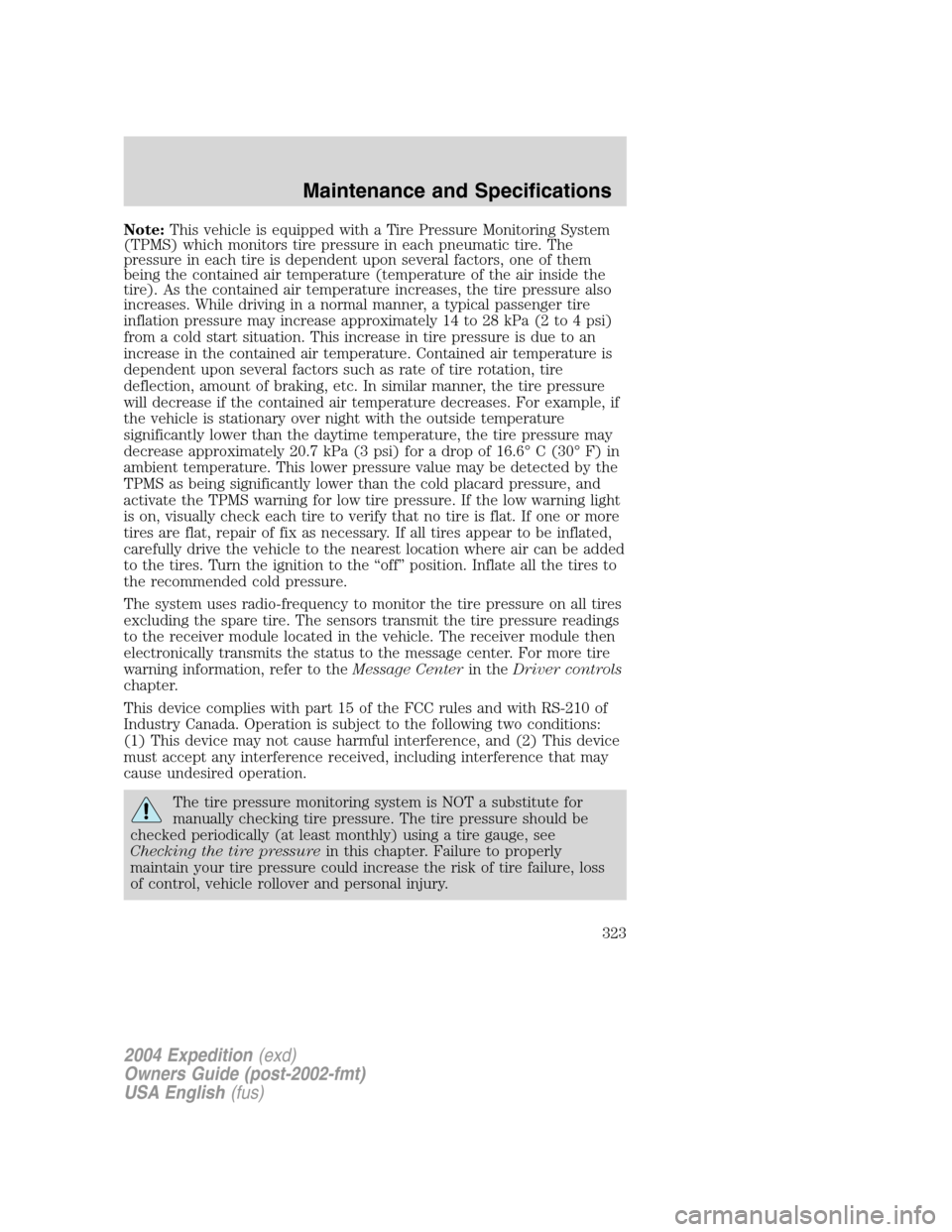
Note:This vehicle is equipped with a Tire Pressure Monitoring System
(TPMS) which monitors tire pressure in each pneumatic tire. The
pressure in each tire is dependent upon several factors, one of them
being the contained air temperature (temperature of the air inside the
tire). As the contained air temperature increases, the tire pressure also
increases. While driving in a normal manner, a typical passenger tire
inflation pressure may increase approximately 14 to 28 kPa (2 to 4 psi)
from a cold start situation. This increase in tire pressure is due to an
increase in the contained air temperature. Contained air temperature is
dependent upon several factors such as rate of tire rotation, tire
deflection, amount of braking, etc. In similar manner, the tire pressure
will decrease if the contained air temperature decreases. For example, if
the vehicle is stationary over night with the outside temperature
significantly lower than the daytime temperature, the tire pressure may
decrease approximately 20.7 kPa (3 psi) for a drop of 16.6°C (30°F) in
ambient temperature. This lower pressure value may be detected by the
TPMS as being significantly lower than the cold placard pressure, and
activate the TPMS warning for low tire pressure. If the low warning light
is on, visually check each tire to verify that no tire is flat. If one or more
tires are flat, repair of fix as necessary. If all tires appear to be inflated,
carefully drive the vehicle to the nearest location where air can be added
to the tires. Turn the ignition to the“off”position. Inflate all the tires to
the recommended cold pressure.
The system uses radio-frequency to monitor the tire pressure on all tires
excluding the spare tire. The sensors transmit the tire pressure readings
to the receiver module located in the vehicle. The receiver module then
electronically transmits the status to the message center. For more tire
warning information, refer to theMessage Centerin theDriver controls
chapter.
This device complies with part 15 of the FCC rules and with RS-210 of
Industry Canada. Operation is subject to the following two conditions:
(1) This device may not cause harmful interference, and (2) This device
must accept any interference received, including interference that may
cause undesired operation.
The tire pressure monitoring system is NOT a substitute for
manually checking tire pressure. The tire pressure should be
checked periodically (at least monthly) using a tire gauge, see
Checking the tire pressurein this chapter. Failure to properly
maintain your tire pressure could increase the risk of tire failure, loss
of control, vehicle rollover and personal injury.
2004 Expedition(exd)
Owners Guide (post-2002-fmt)
USA English(fus)
Maintenance and Specifications
323
Page 339 of 344
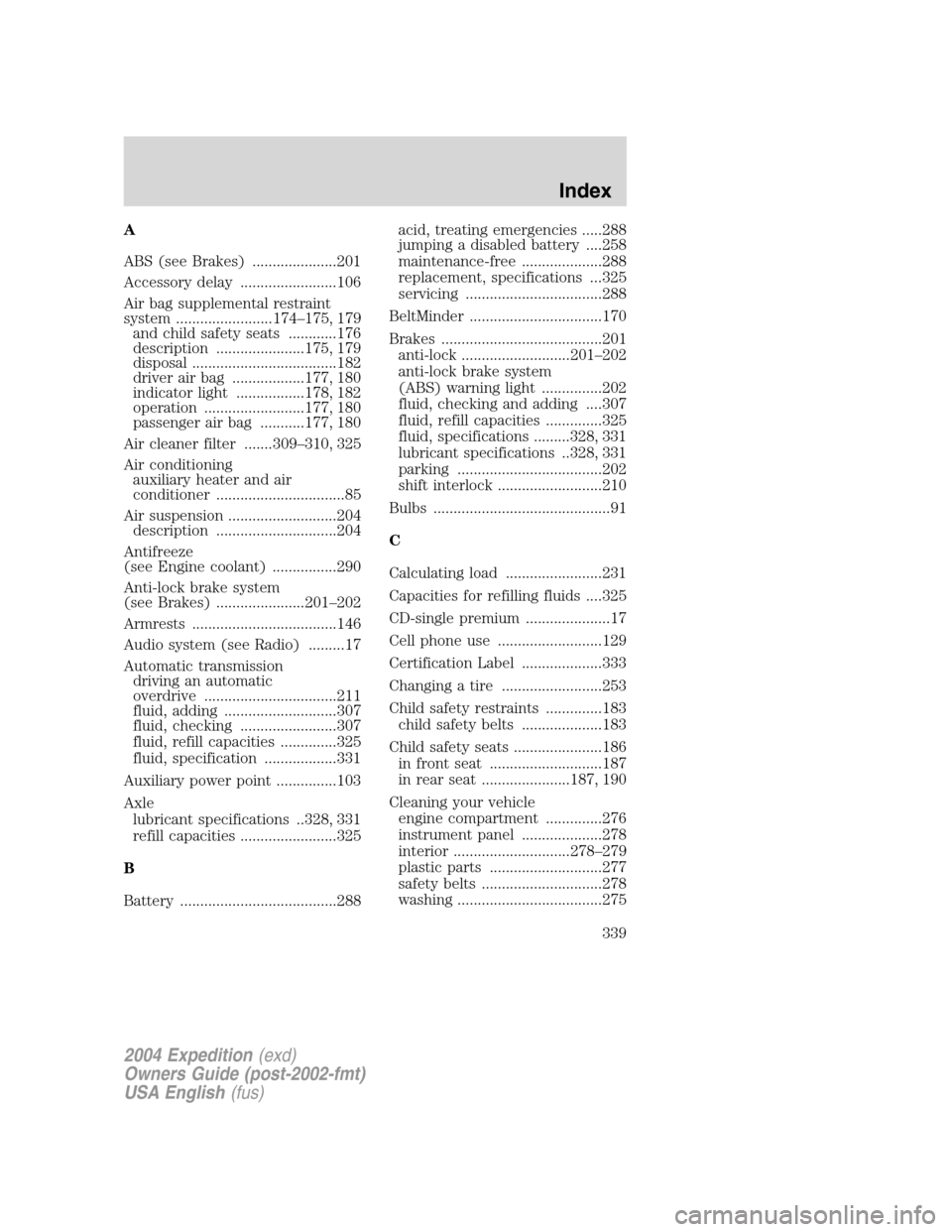
A
ABS (see Brakes) .....................201
Accessory delay ........................106
Air bag supplemental restraint
system ........................174–175, 179
and child safety seats ............176
description ......................175, 179
disposal ....................................182
driver air bag ..................177, 180
indicator light .................178, 182
operation .........................177, 180
passenger air bag ...........177, 180
Air cleaner filter .......309–310, 325
Air conditioning
auxiliary heater and air
conditioner ................................85
Air suspension ...........................204
description ..............................204
Antifreeze
(see Engine coolant) ................290
Anti-lock brake system
(see Brakes) ......................201–202
Armrests ....................................146
Audio system (see Radio) .........17
Automatic transmission
driving an automatic
overdrive .................................211
fluid, adding ............................307
fluid, checking ........................307
fluid, refill capacities ..............325
fluid, specification ..................331
Auxiliary power point ...............103
Axle
lubricant specifications ..328, 331
refill capacities ........................325
B
Battery .......................................288acid, treating emergencies .....288
jumping a disabled battery ....258
maintenance-free ....................288
replacement, specifications ...325
servicing ..................................288
BeltMinder .................................170
Brakes ........................................201
anti-lock ...........................201–202
anti-lock brake system
(ABS) warning light ...............202
fluid, checking and adding ....307
fluid, refill capacities ..............325
fluid, specifications .........328, 331
lubricant specifications ..328, 331
parking ....................................202
shift interlock ..........................210
Bulbs ............................................91
C
Calculating load ........................231
Capacities for refilling fluids ....325
CD-single premium .....................17
Cell phone use ..........................129
Certification Label ....................333
Changing a tire .........................253
Child safety restraints ..............183
child safety belts ....................183
Child safety seats ......................186
in front seat ............................187
in rear seat ......................187, 190
Cleaning your vehicle
engine compartment ..............276
instrument panel ....................278
interior .............................278–279
plastic parts ............................277
safety belts ..............................278
washing ....................................275
2004 Expedition(exd)
Owners Guide (post-2002-fmt)
USA English(fus)
Index
Index
339
Page 342 of 344
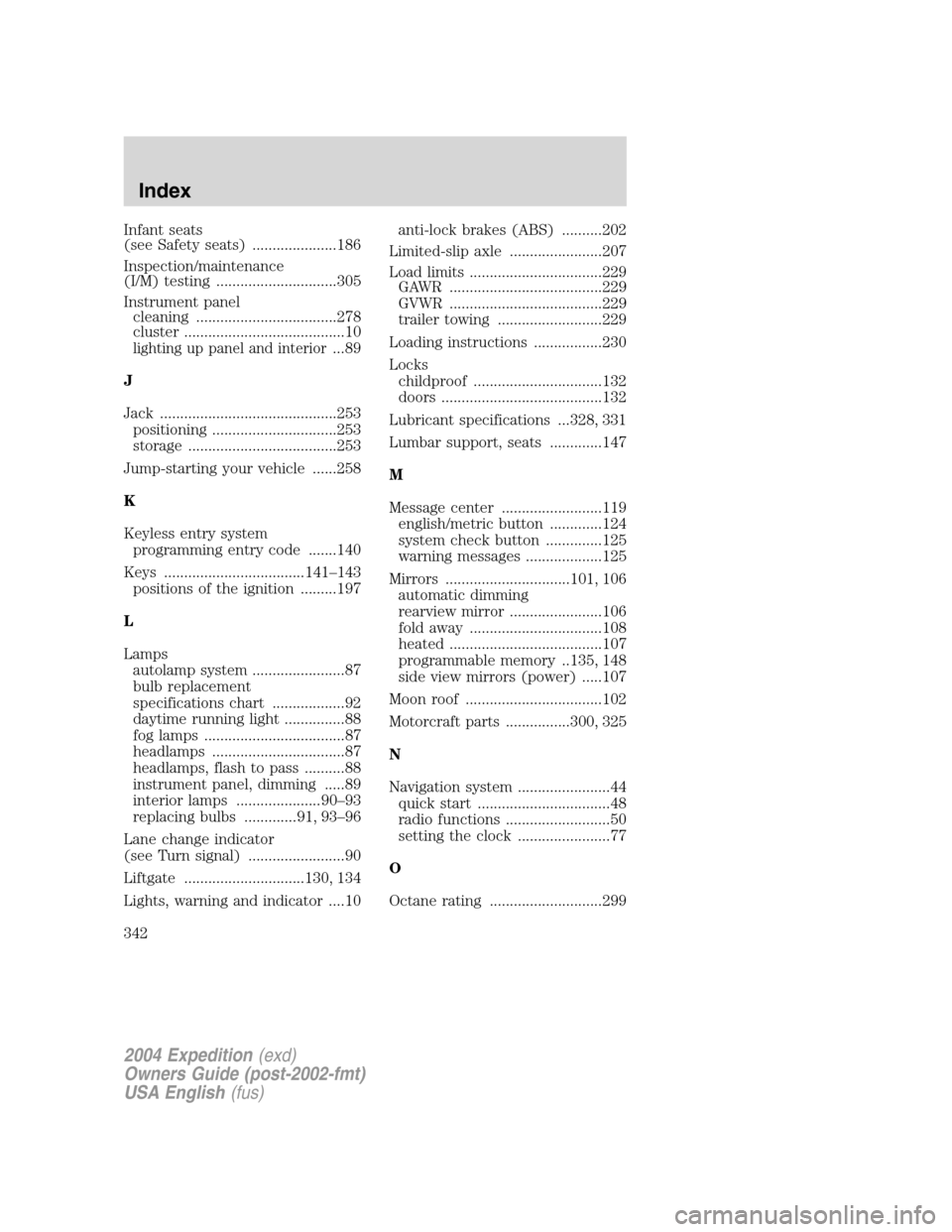
Infant seats
(see Safety seats) .....................186
Inspection/maintenance
(I/M) testing ..............................305
Instrument panel
cleaning ...................................278
cluster ........................................10
lighting up panel and interior...89
J
Jack ............................................253
positioning ...............................253
storage .....................................253
Jump-starting your vehicle ......258
K
Keyless entry system
programming entry code .......140
Keys ...................................141–143
positions of the ignition .........197
L
Lamps
autolamp system .......................87
bulb replacement
specifications chart ..................92
daytime running light ...............88
fog lamps ...................................87
headlamps .................................87
headlamps, flash to pass ..........88
instrument panel, dimming .....89
interior lamps .....................90–93
replacing bulbs .............91, 93–96
Lane change indicator
(see Turn signal) ........................90
Liftgate ..............................130, 134
Lights, warning and indicator ....10anti-lock brakes (ABS) ..........202
Limited-slip axle .......................207
Load limits .................................229
GAWR ......................................229
GVWR ......................................229
trailer towing ..........................229
Loading instructions .................230
Locks
childproof ................................132
doors ........................................132
Lubricant specifications ...328, 331
Lumbar support, seats .............147
M
Message center .........................119
english/metric button .............124
system check button ..............125
warning messages ...................125
Mirrors ...............................101, 106
automatic dimming
rearview mirror .......................106
fold away .................................108
heated ......................................107
programmable memory ..135, 148
side view mirrors (power) .....107
Moon roof ..................................102
Motorcraft parts ................300, 325
N
Navigation system .......................44
quick start .................................48
radio functions ..........................50
setting the clock .......................77
O
Octane rating ............................299
2004 Expedition(exd)
Owners Guide (post-2002-fmt)
USA English(fus)
Index
342
Page 343 of 344
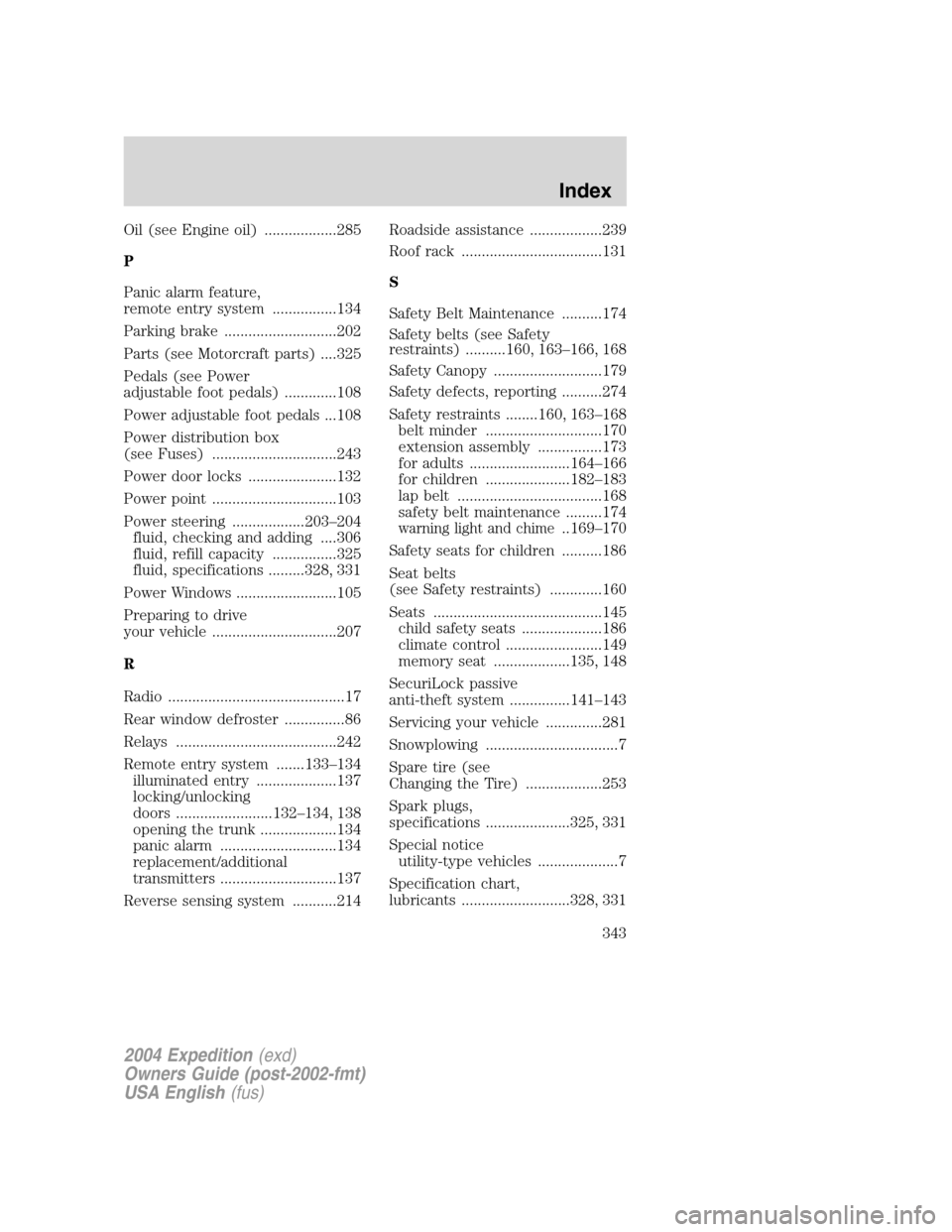
Oil (see Engine oil) ..................285
P
Panic alarm feature,
remote entry system ................134
Parking brake ............................202
Parts (see Motorcraft parts) ....325
Pedals (see Power
adjustable foot pedals) .............108
Power adjustable foot pedals ...108
Power distribution box
(see Fuses) ...............................243
Power door locks ......................132
Power point ...............................103
Power steering ..................203–204
fluid, checking and adding ....306
fluid, refill capacity ................325
fluid, specifications .........328, 331
Power Windows .........................105
Preparing to drive
your vehicle ...............................207
R
Radio ............................................17
Rear window defroster ...............86
Relays ........................................242
Remote entry system .......133–134
illuminated entry ....................137
locking/unlocking
doors ........................132–134, 138
opening the trunk ...................134
panic alarm .............................134
replacement/additional
transmitters .............................137
Reverse sensing system ...........214Roadside assistance ..................239
Roof rack ...................................131
S
Safety Belt Maintenance ..........174
Safety belts (see Safety
restraints) ..........160, 163–166, 168
Safety Canopy ...........................179
Safety defects, reporting ..........274
Safety restraints ........160, 163–168
belt minder .............................170
extension assembly ................173
for adults .........................164–166
for children .....................182–183
lap belt ....................................168
safety belt maintenance .........174
warning light and chime..169–170
Safety seats for children ..........186
Seat belts
(see Safety restraints) .............160
Seats ..........................................145
child safety seats ....................186
climate control ........................149
memory seat ...................135, 148
SecuriLock passive
anti-theft system ...............141–143
Servicing your vehicle ..............281
Snowplowing .................................7
Spare tire (see
Changing the Tire) ...................253
Spark plugs,
specifications .....................325, 331
Special notice
utility-type vehicles ....................7
Specification chart,
lubricants ...........................328, 331
2004 Expedition(exd)
Owners Guide (post-2002-fmt)
USA English(fus)
Index
343
Page 344 of 344
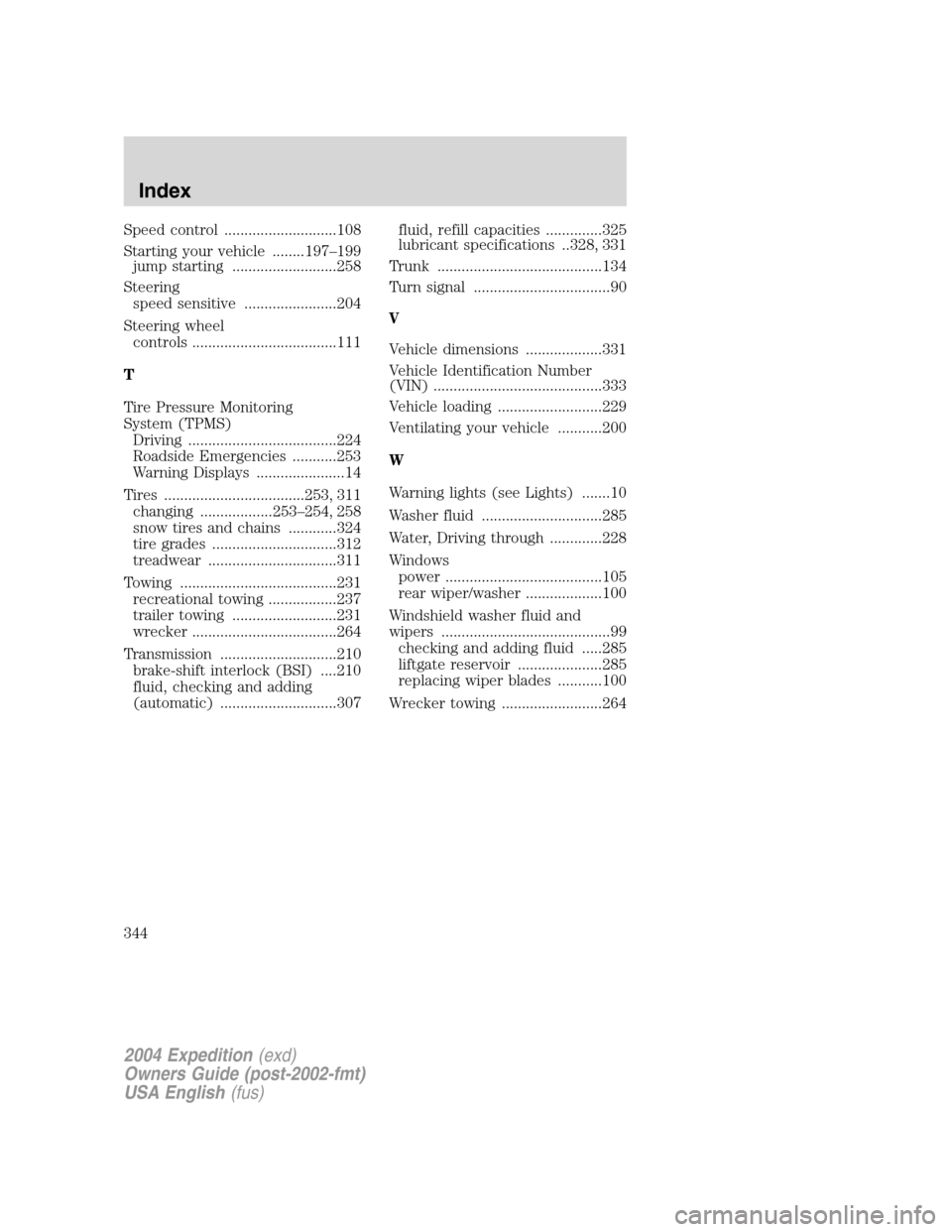
Speed control ............................108
Starting your vehicle ........197–199
jump starting ..........................258
Steering
speed sensitive .......................204
Steering wheel
controls ....................................111
T
Tire Pressure Monitoring
System (TPMS)
Driving .....................................224
Roadside Emergencies ...........253
Warning Displays ......................14
Tires ...................................253, 311
changing ..................253–254, 258
snow tires and chains ............324
tire grades ...............................312
treadwear ................................311
Towing .......................................231
recreational towing .................237
trailer towing ..........................231
wrecker ....................................264
Transmission .............................210
brake-shift interlock (BSI) ....210
fluid, checking and adding
(automatic) .............................307fluid, refill capacities ..............325
lubricant specifications ..328, 331
Trunk .........................................134
Turn signal ..................................90
V
Vehicle dimensions ...................331
Vehicle Identification Number
(VIN) ..........................................333
Vehicle loading ..........................229
Ventilating your vehicle ...........200
W
Warning lights (see Lights) .......10
Washer fluid ..............................285
Water, Driving through .............228
Windows
power .......................................105
rear wiper/washer ...................100
Windshield washer fluid and
wipers ..........................................99
checking and adding fluid .....285
liftgate reservoir .....................285
replacing wiper blades ...........100
Wrecker towing .........................264
2004 Expedition(exd)
Owners Guide (post-2002-fmt)
USA English(fus)
Index
344