driver FORD EXPEDITION 2014 3.G Owners Manual
[x] Cancel search | Manufacturer: FORD, Model Year: 2014, Model line: EXPEDITION, Model: FORD EXPEDITION 2014 3.GPages: 519, PDF Size: 6.9 MB
Page 2 of 519
Introduction 9
Child Safety 17
Child seat positioning...................................19
Booster seats.........................................21
Installing child seats....................................24
Child safety locks......................................35
Safety Belts 36
Fastening the safety belts................................38
Safety belt height adjustment.............................41
Safetybeltwarninglightandindicatorchime..................42
Safety belt-minder.....................................43
Child restraint and safety belt maintenance...................45
Supplementary Restraints System 46
Driver and passenger airbags.............................49
Side airbags..........................................51
Safety canopy curtain airbags.............................52
Crash sensors and airbag indicator.........................54
Airbag disposal........................................55
Keys and Remote Control 56
General information on radio frequencies.....................56
Remote control.......................................56
Keys...............................................56
Replacing a lost key or remote control.......................59
MyKey 60
Settings, MyKey.......................................60
Creating.............................................61
Clearing.............................................62
System status.........................................62
Remote start, MyKey...................................63
Troubleshooting, MyKey.................................65
Table of Contents1
2014 Expedition(exd)
Owners Guide gf, 1st Printing, June 2013
USA(fus)
Page 13 of 519
Ford Motor Company, Ford of Canada, and service and repair facilities
may access or share among them data for vehicle improvement purposes.
For U.S. only (if equipped), if you choose to use the SYNC® Vehicle
Health Report, you consent that certain diagnostic information may also
be accessed electronically by Ford Motor Company and Ford authorized
service facilities, and that the diagnostic information may be used for any
purpose. See theSYNC®chapter for more information.
Event Data Recording
This vehicle is equipped with an event data recorder (EDR).
The main purpose of an EDR is to record, in certain crash or near
crash-like situations, such as an airbag deployment or hitting a
road obstacle; this data will assist in understanding how a
vehicle’s systems performed. The EDR is designed to record data
related to vehicle dynamics and safety systems for a short period
of time, typically 30 seconds or less. The EDR in this vehicle is
designed to record such data as:
•How various systems in your vehicle were operating;
•Whether or not the driver and passenger safety belts were
buckled/fastened;
•How far (if at all) the driver was depressing the accelerator
and/or the brake pedal;
•How fast the vehicle was travelling;
•Where the driver was positioning the steering wheel.
This data can help provide a better understanding of the
circumstances in which crashes and injuries occur.
Note: EDR data is recorded by your vehicle only if a non-trivial
crash situation occurs; no data is recorded by the EDR under
normal driving conditions and no personal data or information
(e.g., name, gender, age, and crash location) is recorded (see
limitations regarding 911 Assist and Traffic, Directions and
Information privacy below). However, parties, such as law
enforcement, could combine the EDR data with the type of
personally identifying data routinely acquired during a crash
investigation.
To read data recorded by an EDR, special equipment is required,
and access to the vehicle or the EDR is needed. In addition to the
vehicle manufacturer, other parties, such as law enforcement,
that have such special equipment, can read the information if
12Introduction
2014 Expedition(exd)
Owners Guide gf, 1st Printing, June 2013
USA(fus)
Page 37 of 519
PRINCIPLES OF OPERATION
WARNING:Always drive and ride with your seat back upright
and the lap belt snug and low across the hips.
WARNING:To reduce the risk of injury, make sure children sit
where they can be properly restrained.
WARNING:Never let a passenger hold a child on his or her lap
while the vehicle is moving. The passenger cannot protect the
child from injury in a crash.
WARNING:All occupants of the vehicle, including the driver,
should always properly wear their safety belts, even when an
airbag supplemental restraint system is provided. Failure to properly
wear your safety belt could seriously increase the risk of injury or
death.
WARNING:It is extremely dangerous to ride in a cargo area,
inside or outside of a vehicle. In a crash, people riding in these
areas are more likely to be seriously injured or killed. Do not allow
people to ride in any area of your vehicle that is not equipped with
seats and safety belts. Be sure everyone in your vehicle is in a seat and
using a safety belt properly.
WARNING:In a rollover crash, an unbelted person is
significantly more likely to die than a person wearing a safety
belt.
WARNING:Each seating position in your vehicle has a specific
safety belt assembly which is made up of one buckle and one
tongue that are designed to be used as a pair. 1) Use the shoulder belt
on the outside shoulder only. Never wear the shoulder belt under the
arm. 2) Never swing the safety belt around your neck over the inside
shoulder. 3) Never use a single belt for more than one person.
36Safety Belts
2014 Expedition(exd)
Owners Guide gf, 1st Printing, June 2013
USA(fus)
Page 38 of 519
WARNING:When possible, all children 12 years old and under
should be properly restrained in a rear seating position. Failure
to follow this could seriously increase the risk of injury or death.
WARNING:Safety belts and seats can become hot in a vehicle
that has been closed up in sunny weather; they could burn a
small child. Check seat covers and buckles before you place a child
anywhere near them.
WARNING:Front and rear seat occupants, including pregnant
women, should wear safety belts for optimum protection in an
accident.
All seating positions in this vehicle have lap and shoulder safety belts. All
occupants of the vehicle should always properly wear their safety belts,
even when an airbag supplemental restraint system is provided.
The safety belt system consists of:
•lap and shoulder safety belts.
•shoulder safety belt with automatic locking mode, (except driver
safety belt).
•height adjuster at the front outboard seating positions
•safety belt pretensioner at the front outboard seating positions.
•safety belt warning light and chime. SeeSafety Belt
Warning Light and Indicator Chimelater in this chapter.
•crash sensors and monitoring system with readiness
indicator. SeeCrash Sensors and Airbag Indicatorin the
Supplemental Restraints Systemchapter.
The safety belt pretensioners are designed to activate in frontal,
near-frontal and side crashes, and in rollovers. The safety belt
pretensioners at the front seating positions are designed to tighten the
safety belts firmly against the occupant’s body when activated. This helps
increase the effectiveness of the safety belts. In frontal crashes, the
safety belt pretensioners can be activated alone or, if the crash is of
sufficient severity, together with the front airbags.
Safety Belts37
2014 Expedition(exd)
Owners Guide gf, 1st Printing, June 2013
USA(fus)
Page 40 of 519
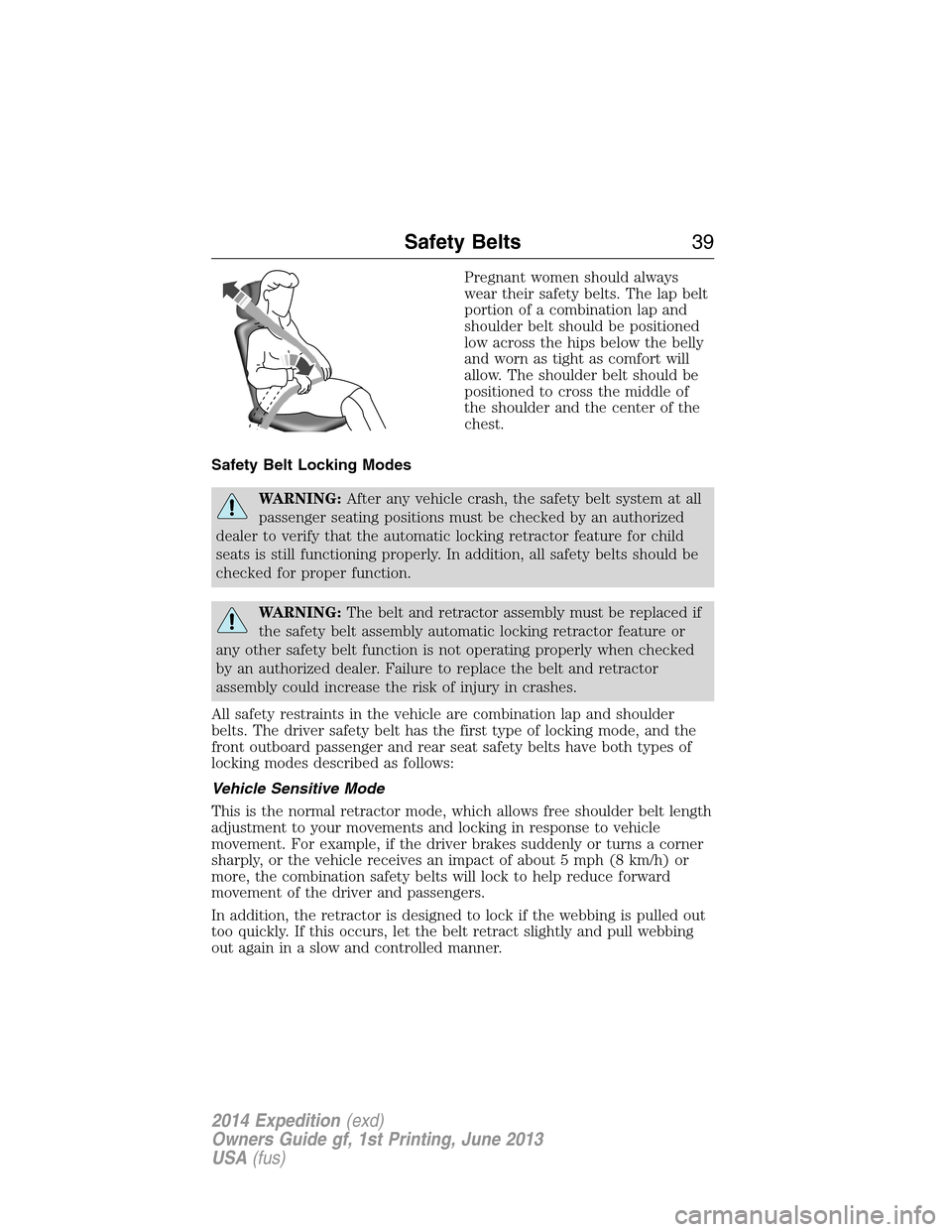
Pregnant women should always
wear their safety belts. The lap belt
portion of a combination lap and
shoulder belt should be positioned
low across the hips below the belly
and worn as tight as comfort will
allow. The shoulder belt should be
positioned to cross the middle of
the shoulder and the center of the
chest.
Safety Belt Locking Modes
WARNING:After any vehicle crash, the safety belt system at all
passenger seating positions must be checked by an authorized
dealer to verify that the automatic locking retractor feature for child
seats is still functioning properly. In addition, all safety belts should be
checked for proper function.
WARNING:The belt and retractor assembly must be replaced if
the safety belt assembly automatic locking retractor feature or
any other safety belt function is not operating properly when checked
by an authorized dealer. Failure to replace the belt and retractor
assembly could increase the risk of injury in crashes.
All safety restraints in the vehicle are combination lap and shoulder
belts. The driver safety belt has the first type of locking mode, and the
front outboard passenger and rear seat safety belts have both types of
locking modes described as follows:
Vehicle Sensitive Mode
This is the normal retractor mode, which allows free shoulder belt length
adjustment to your movements and locking in response to vehicle
movement. For example, if the driver brakes suddenly or turns a corner
sharply, or the vehicle receives an impact of about 5 mph (8 km/h) or
more, the combination safety belts will lock to help reduce forward
movement of the driver and passengers.
In addition, the retractor is designed to lock if the webbing is pulled out
too quickly. If this occurs, let the belt retract slightly and pull webbing
out again in a slow and controlled manner.
Safety Belts39
2014 Expedition(exd)
Owners Guide gf, 1st Printing, June 2013
USA(fus)
Page 41 of 519
Automatic Locking Mode
In this mode, the shoulder belt is automatically pre-locked. The belt will
still retract to remove any slack in the shoulder belt. The automatic
locking mode is not available on the driver safety belt.
When to Use the Automatic Locking Mode
This mode should be used any time a child safety seat, except a booster,
is installed in passenger front or rear seating positions. Children 12 years
old and under should be properly restrained in a rear seating position
whenever possible. See theChild Safetychapter.
How to Use the Automatic Locking Mode
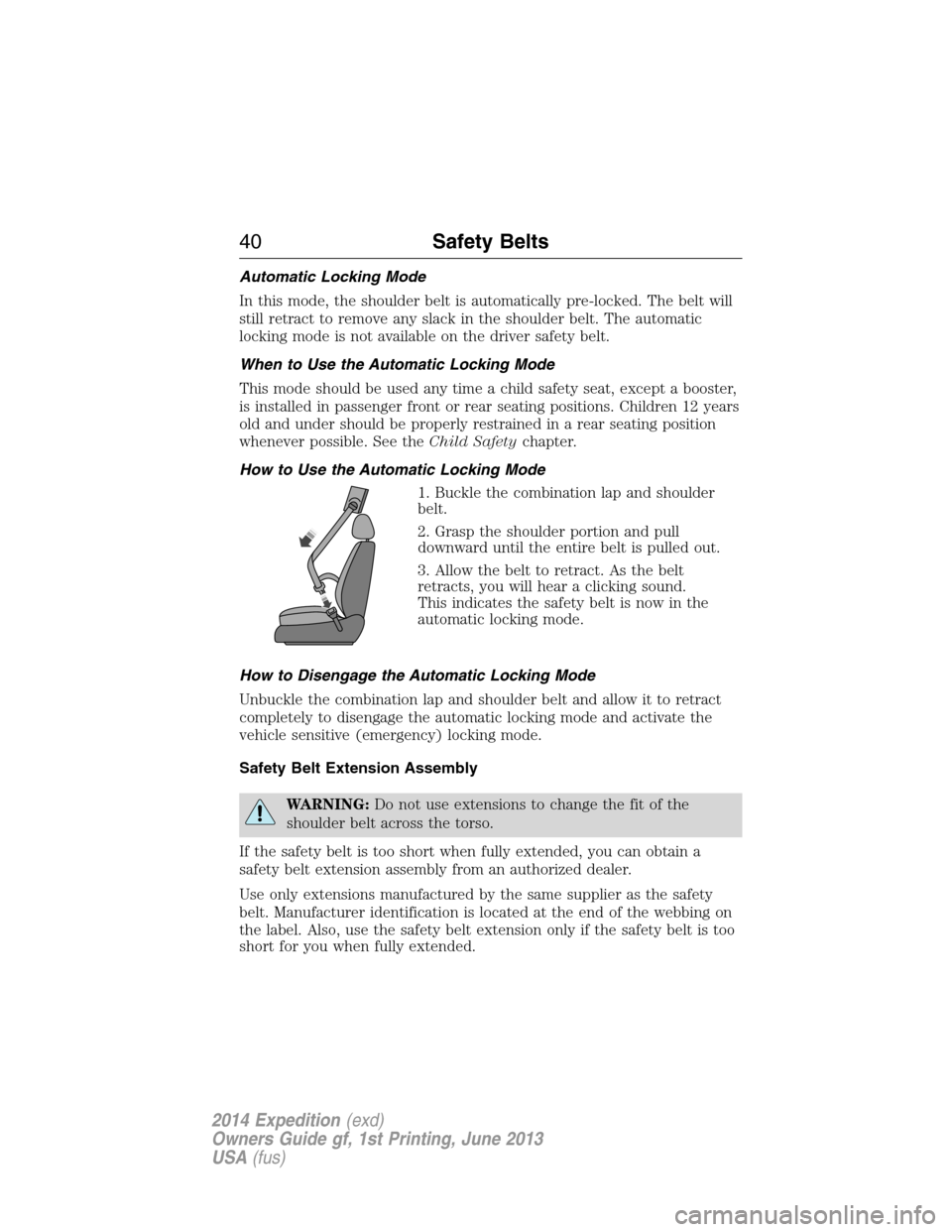
1. Buckle the combination lap and shoulder
belt.
2. Grasp the shoulder portion and pull
downward until the entire belt is pulled out.
3. Allow the belt to retract. As the belt
retracts, you will hear a clicking sound.
This indicates the safety belt is now in the
automatic locking mode.
How to Disengage the Automatic Locking Mode
Unbuckle the combination lap and shoulder belt and allow it to retract
completely to disengage the automatic locking mode and activate the
vehicle sensitive (emergency) locking mode.
Safety Belt Extension Assembly
WARNING:Do not use extensions to change the fit of the
shoulder belt across the torso.
If the safety belt is too short when fully extended, you can obtain a
safety belt extension assembly from an authorized dealer.
Use only extensions manufactured by the same supplier as the safety
belt. Manufacturer identification is located at the end of the webbing on
the label. Also, use the safety belt extension only if the safety belt is too
short for you when fully extended.
40Safety Belts
2014 Expedition(exd)
Owners Guide gf, 1st Printing, June 2013
USA(fus)
Page 43 of 519
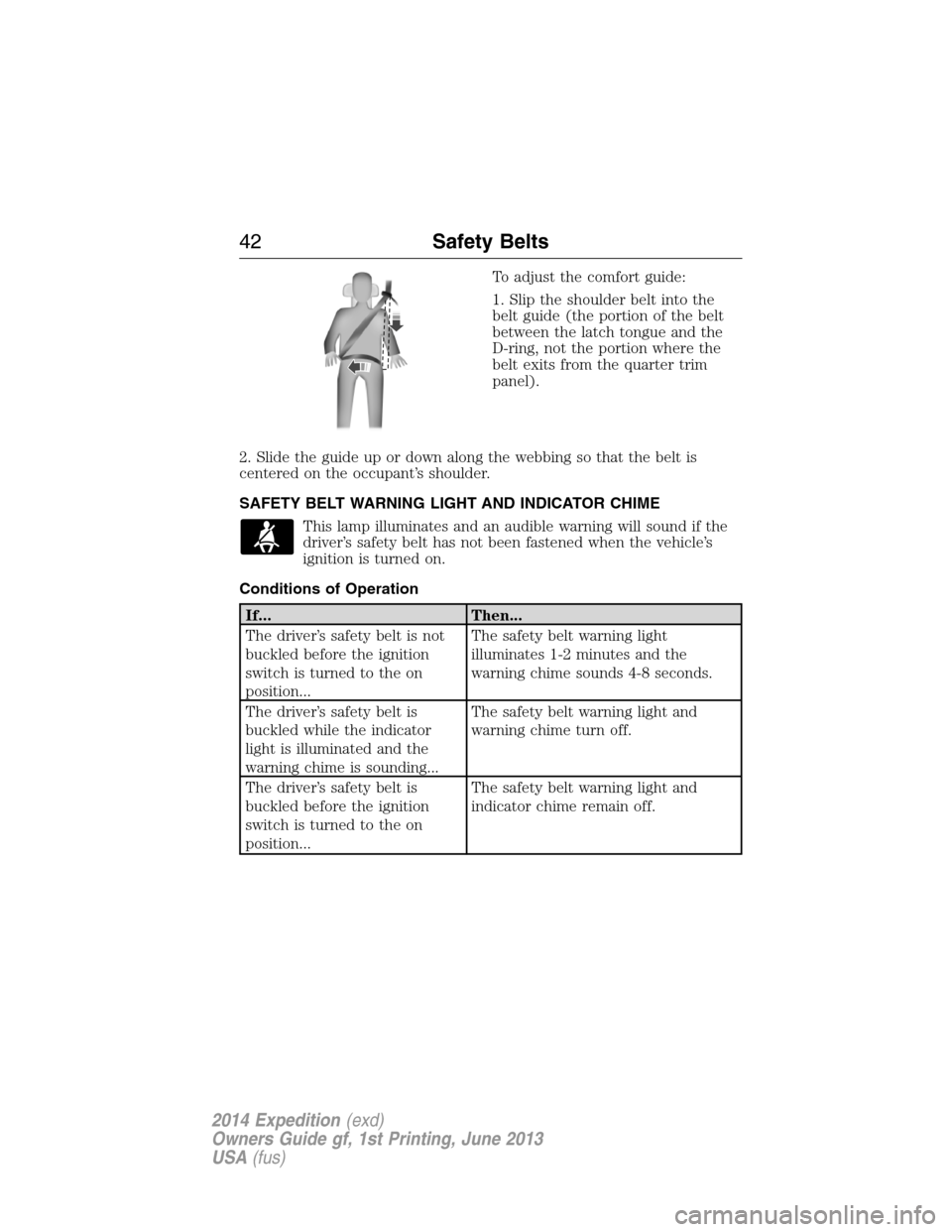
To adjust the comfort guide:
1. Slip the shoulder belt into the
belt guide (the portion of the belt
between the latch tongue and the
D-ring, not the portion where the
belt exits from the quarter trim
panel).
2. Slide the guide up or down along the webbing so that the belt is
centered on the occupant’s shoulder.
SAFETY BELT WARNING LIGHT AND INDICATOR CHIME
This lamp illuminates and an audible warning will sound if the
driver’s safety belt has not been fastened when the vehicle’s
ignition is turned on.
Conditions of Operation
If... Then...
The driver’s safety belt is not
buckled before the ignition
switch is turned to the on
position...The safety belt warning light
illuminates 1-2 minutes and the
warning chime sounds 4-8 seconds.
The driver’s safety belt is
buckled while the indicator
light is illuminated and the
warning chime is sounding...The safety belt warning light and
warning chime turn off.
The driver’s safety belt is
buckled before the ignition
switch is turned to the on
position...The safety belt warning light and
indicator chime remain off.
42Safety Belts
2014 Expedition(exd)
Owners Guide gf, 1st Printing, June 2013
USA(fus)
Page 44 of 519
SAFETY BELT-MINDER®
This feature supplements the safety belt warning function by providing
additional reminders by intermittently sounding a chime and illuminating
the safety belt warning light when the driver’s seat is occupied and the
safety belt is unbuckled.
If... Then...
The driver’s safety belt is
buckled before the ignition
switch is turned to the on
position or less than
1-2 minutes have elapsed since
the ignition switch has been
turned to on...The Belt-Minder feature will not
activate.
The driver’s safety belt is not
buckled when the vehicle has
reached at least 6 mph
(9.7 km/h) and 1-2 minutes
have elapsed since the ignition
switch has been turned to on...The Belt-Minder feature is activated -
the safety belt warning light
illuminates and the warning chime
sounds for six seconds every
25 seconds, repeating for about five
minutes or until the safety belts are
buckled.
The driver’s safety belt
becomes unbuckled for about
one minute while the vehicle is
traveling at least 6 mph
(9.7 km/h) and more than
1-2 minutes have elapsed since
the ignition switch has been
turned to on...The Belt-Minder feature is activated -
the safety belt warning light
illuminates and the warning chime
sounds for six seconds every
25 seconds, repeating for about five
minutes or until the safety belts are
buckled.
Safety Belts43
2014 Expedition(exd)
Owners Guide gf, 1st Printing, June 2013
USA(fus)
Page 45 of 519
Deactivating and Activating the Belt-Minder® Feature
WARNING:While the design allows you to deactivate your
Belt-Minder, this system is designed to improve your chances of
being safely belted and surviving an accident. We recommend you leave
the Belt-Minder system activated for yourself and others who may use
the vehicle. To reduce the risk of injury, do not deactivate or activate
the Belt-Minder feature while driving the vehicle.
Read Steps1-4thoroughly before proceeding with the programming
procedure.
The Belt-Minder feature can be deactivated or activated by performing
the following procedure.
Before following the procedure, make sure that:
•the parking brake is set.
•the transmission selector lever is in positionP.
•the ignition is off.
•all vehicle doors are closed.
•the driver’s safety belt is unbuckled.
1. Switch the ignition on. Do not start the engine.
2. Wait until the safety belt warning light turns off (about 1 to
2 minutes).
•Steps 3 and 4 must be completed within 60 seconds or the procedure
will have to be repeated.
3. Buckle then unbuckle the safety belt three times, ending with the
safety belt unbuckled. The safety belt warning light will come on for
about three seconds.
4. Within seven seconds of the safety belt warning light turning off,
buckle then unbuckle the safety belt. The safety warning light will flash.
This will disable Belt-Minder if it is currently enabled, or enable
Belt-Minder if it is currently disabled.
44Safety Belts
2014 Expedition(exd)
Owners Guide gf, 1st Printing, June 2013
USA(fus)
Page 47 of 519
PRINCIPLES OF OPERATION
WARNING:Airbags do not inflate slowly or gently, and the risk
of injury from a deploying airbag is the greatest close to the trim
covering the airbag module.
WARNING:All occupants of your vehicle, including the driver,
should always properly wear their safety belts, even when an
airbag supplemental restraint system is provided. Failure to properly
wear your safety belt could seriously increase the risk of injury or
death.
WARNING:Airbags can kill or injure a child in a child seat.
Always transport children 12 years old and under in the back
seat and always properly use appropriate child restraints.
WARNING:Never place your arm over the airbag module, as a
deploying airbag can result in serious arm fractures or other
injuries.
WARNING:Airbags can kill or injure a child in a child seat.
Never place a rear-facing child seat in front of an active airbag.
If you must use a forward-facing child seat in the front seat, move the
seat upon which the child seat is installed all the way back.
WARNING:Do not attempt to service, repair, or modify the
airbag supplemental restraint systems or its fuses as you could be
seriously injured or killed. Contact your authorized dealer as soon as
possible.
WARNING:Several airbag system components get hot after
inflation. Do not touch them after inflation as this may result in
serious injury.
46Supplementary Restraints System
2014 Expedition(exd)
Owners Guide gf, 1st Printing, June 2013
USA(fus)