transmission FORD EXPLORER 1997 2.G User Guide
[x] Cancel search | Manufacturer: FORD, Model Year: 1997, Model line: EXPLORER, Model: FORD EXPLORER 1997 2.GPages: 236, PDF Size: 2.43 MB
Page 126 of 236
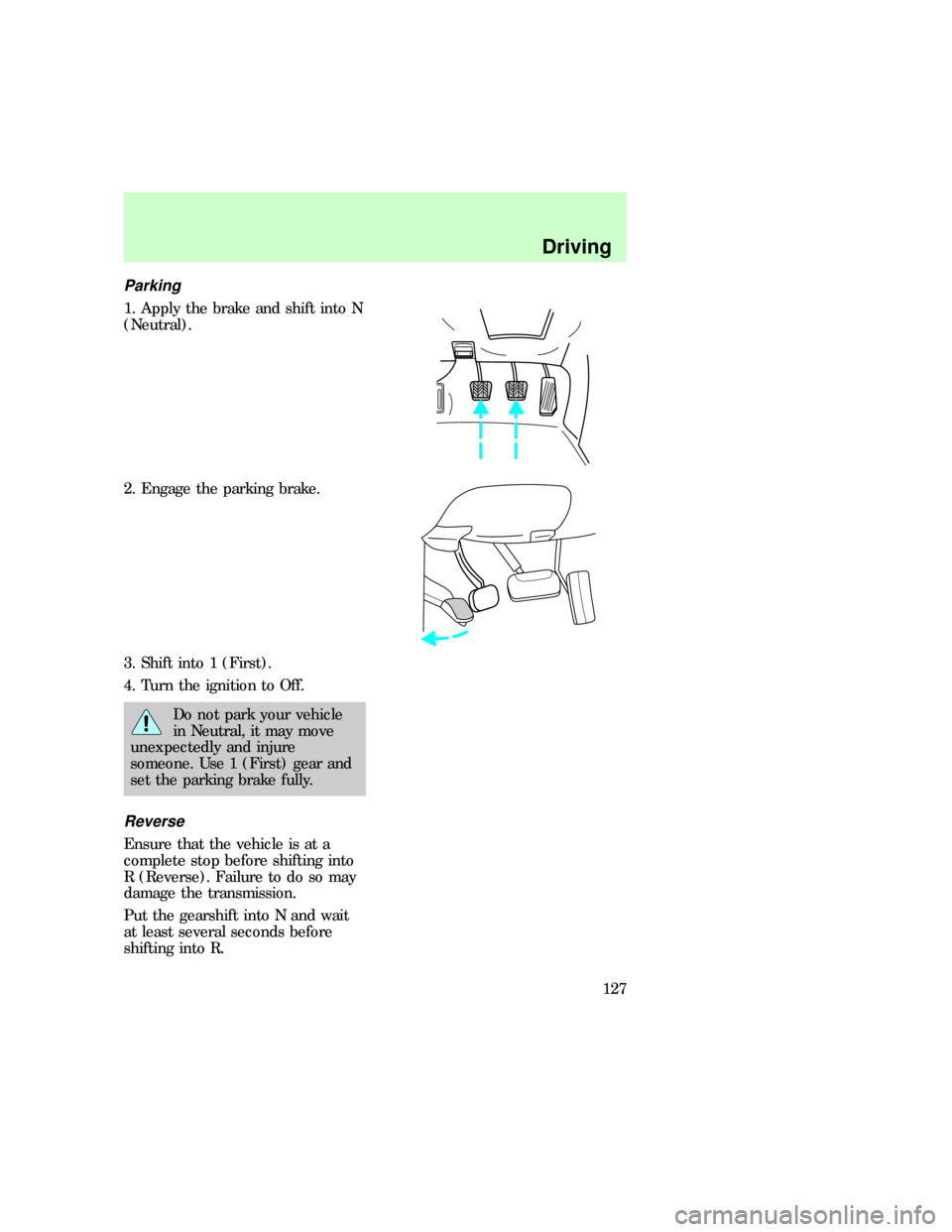
Parking
1. Apply the brake and shift into N
(Neutral).
2. Engage the parking brake.
3. Shift into 1 (First).
4. Turn the ignition to Off.
Do not park your vehicle
in Neutral, it may move
unexpectedly and injure
someone. Use 1 (First) gear and
set the parking brake fully.
Reverse
Ensure that the vehicle is at a
complete stop before shifting into
R (Reverse). Failure to do so may
damage the transmission.
Put the gearshift into N and wait
at least several seconds before
shifting into R.
uno_parking
uno_reverse
Driving
127
Page 128 of 236

Using the Control Trac system
Shifting between 4WD AUTO
and 4WD HIGH
Either shift can be done at a stop,
or at any forward speed.
²The 4WD HIGH light will
illuminate when you switch the
control to 4WD HIGH or turn off
if you switch to 4WD AUTO.
Shifting from 4WD AUTO or
4WD HIGH to 4WD LOW
To perform this shift, complete the
following steps:
1. Stop the vehicle and depress the
brake.
2. Place the automatic
transmission in N (Neutral) or
depress the manual transmission
clutch.
3. Rotate the 4WD control to 4WD
LOW.
Shifting from 4WD LOW to 4WD
AUTO or 4WD HIGH
To perform this shift, complete the
following steps:
1. Bring the vehicle to a stop.
2. Depress and hold the brake.
3. Place the automatic
transmission gearshift lever in N
(Neutral) or depress the manual
transmission clutch.
4. Move the 4WD control to the
4WD AUTO or 4WD HIGH position.
uno_2h_to_4h
uno_4h_to_2h
uno_4h_to_4l
uno_driving_off_road
Driving
129
Page 130 of 236

accelerator slowly and avoid
spinning the wheels.
Driving through mud and water
After driving through mud, clean
off residue stuck to rotating
driveshafts and tires. Excess mud
stuck on tires and rotating
driveshafts causes an imbalance
that could damage drive
components.
If you must drive through high
water, drive slowly. Traction or
brake capability may be limited.
When driving through water,
determine the depth; avoid water
higher than the bottom of the hubs
(if possible) and proceed slowly. If
the ignition system gets wet, the
vehicle may stall.
Once through water, always try the
brakes. Wet brakes do not stop the
vehicle as effectively as dry brakes.
Drying can be improved by moving
your vehicle slowly while applying
light pressure on the brake pedal.
If the transmission and transfer
case are submerged in water, their
fluids should be checked and
changed, if necessary.
If the rear axle is submerged in
water, the rear axle lubricant
should be checked and changed, if
necessary. The rear axle is filled
with a synthetic lubricant and does
not normally require a lubricant
change for the life of the vehicle.
Rear axle lubricant quantities
should not need to be checked
unless a leak is suspected.
uno_driving_mud_water
uno_driving_hill
Driving
131
Page 132 of 236

When descending a steep hill,
avoid sudden braking. Rapid
pumping of the brake pedal will
help slow the vehicle and still
maintain steering control.
When speed control is on and you
are driving uphill, your vehicle
speed may drop considerably,
especially if you are carrying a
heavy load.
If vehicle speed drops more than
15±25 km/h (8±14 mph), the speed
control will cancel automatically.
Resume speed with accelerator
pedal.
If speed control cancels after
climbing the hill, reset speed by
pressing and holding the SET
ACCEL button (to resume speeds
over 50 km/h (30 mph).
Automatic transmission may shift
frequently while driving up steep
grades. Eliminate frequent shifting
by shifting out of
D(Overdrive)
into D (Drive).
Driving on snow and ice
Avoid sudden applications of
power and quick changes of
direction on snow and ice. Apply
the accelerator slowly and steadily
when starting from a full stop.
When braking, apply the brakes as
you normally would. In order to
allow the anti-lock brake system
(ABS) to operate properly, keep
steady pressure on the brake
pedal.
uno_driving_snow_ice
Driving
133
Page 137 of 236

TRAILER TOWING
Trailer towing with your vehicle
may require the use of a trailer
tow option package.
Trailer towing puts additional loads
on your vehicle's engine,
transmission, axle, brakes, tires,
and suspension. For your safety
and to maximize vehicle
performance, be sure to use the
proper equipment while towing.
Follow these guidelines to ensure
safe towing procedure:
²Stay within your vehicle's load
limits.
²Thoroughly prepare your vehicle
for towing. Refer toPreparing
to towin this chapter.
²Use extra caution when driving
while trailer towing. Refer to
Driving while towingin this
chapter.
²Service your vehicle more
frequently if you tow a trailer.
Refer to the severe duty
schedule in the ªService Guideº.
²Do not tow a trailer until your
vehicle has been driven at least
800 km (500 miles).
²Refer to the instructions
included with towing accessories
for the proper installation and
adjustment specifications.
²Speed control may shut off if
you are towing on long, steep
grades.
Driving
138
Page 138 of 236
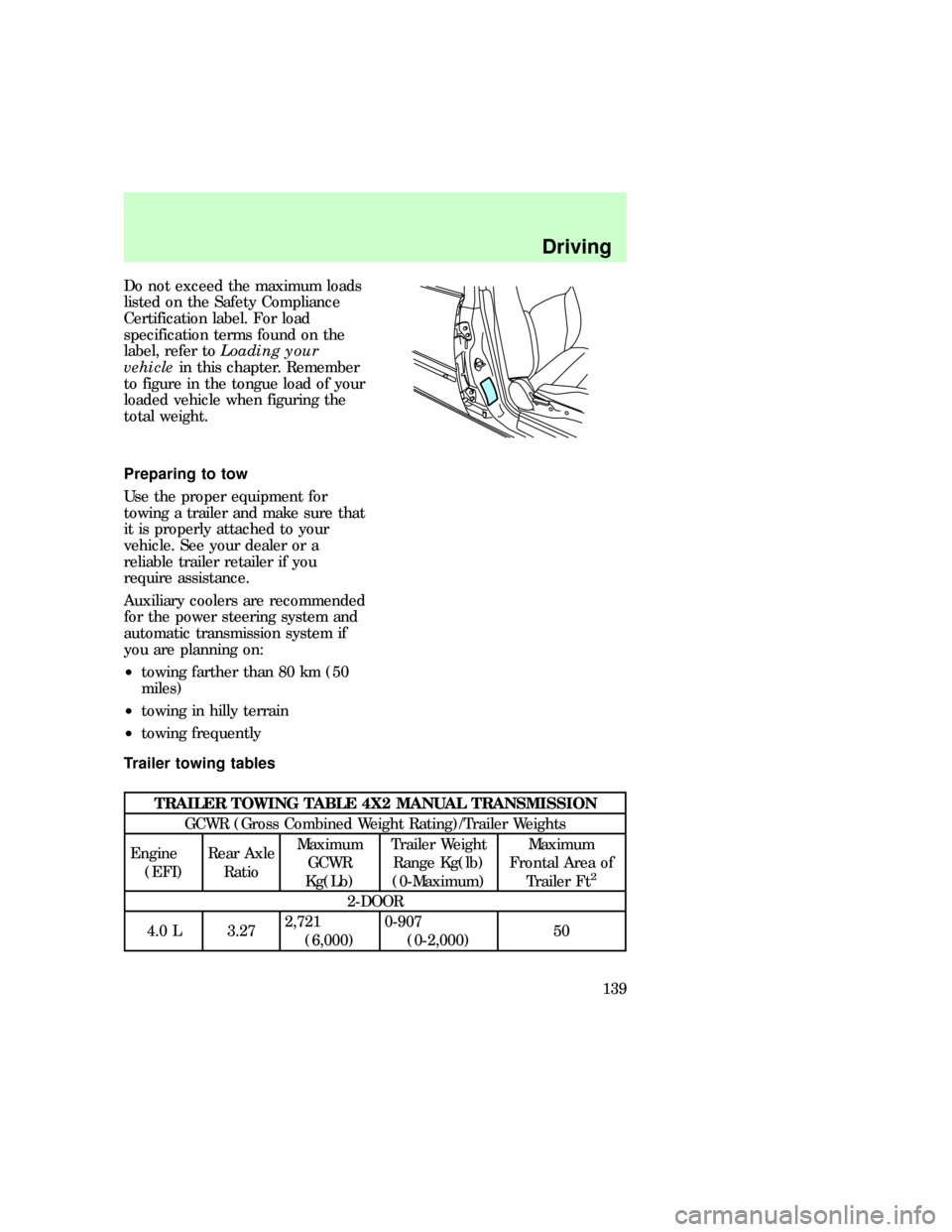
Do not exceed the maximum loads
listed on the Safety Compliance
Certification label. For load
specification terms found on the
label, refer toLoading your
vehiclein this chapter. Remember
to figure in the tongue load of your
loaded vehicle when figuring the
total weight.
Preparing to tow
Use the proper equipment for
towing a trailer and make sure that
it is properly attached to your
vehicle. See your dealer or a
reliable trailer retailer if you
require assistance.
Auxiliary coolers are recommended
for the power steering system and
automatic transmission system if
you are planning on:
²towing farther than 80 km (50
miles)
²towing in hilly terrain
²towing frequently
Trailer towing tables
TRAILER TOWING TABLE 4X2 MANUAL TRANSMISSION
GCWR (Gross Combined Weight Rating)/Trailer Weights
Engine
(EFI)Rear Axle
RatioMaximum
GCWR
Kg(Lb)Trailer Weight
Range Kg(lb)
(0-Maximum)Maximum
Frontal Area of
Trailer Ft
2
2-DOOR
4.0 L 3.272,721
(6,000)0-907
(0-2,000)50
uno_preparing_to_tow_title
uno_tables_towing
Driving
139
Page 139 of 236

TRAILER TOWING TABLE 4X2 MANUAL TRANSMISSION
4.0 L 3.733,175
(7,000)0-1,406
(0-3,100)50
4-DOOR
4.0 L 3.27 2,721(6,000)0-861
(0-1,900 )50
4.0 L 3.73 3,175(7,000)0-1,315
(0-2,900)50
TRAILER TOWING TABLE 4X4 MANUAL TRANSMISSION
GCWR (Gross Combined Weight Rating)/Trailer Weights
2-DOOR
4.0 L3.27 2,721
(6,000)0-816
(0-1,800)50
4.0 L3.55 2,948
(6,500)0-1,043
(0-2,300)50
4.0 L3.73 3,175
(7,000)0-1,270
(0-2,800)50
4-DOOR
4.0 L 3.552,948
(6,500)0-952
(0-2,100)50
4.0 L 3.733,175
(7,000)0-1,179
(0-2,600)50
NOTES:
- For high altitude operation, reduce GCW by 2% per 300 meters
(1,000 ft) elevation.
- For definitions of terms used in this table and instructions on how to
calculate your vehicle load, refer toLoading your vehiclein this
chapter.
- Maximum trailer weights shown. The combined weight of the
completed towing vehicle and the loaded trailer must not exceed the
GCWR.
Driving
140
Page 140 of 236

TRAILER TOWING TABLE 4X2 AUTOMATIC TRANSMISSION
GCWR (Gross Combined Weight Rating)/Trailer Weights
Engine
(EFI)Rear Axle
RatioMaximum
GCWR
Kg(Lb)Trailer Weight
Range Kg(Lb)
0-MaximumMaximum
Frontal Area of
Trailer Ft
2
2-DOOR
4.0 L3.27 3,175
(7,000)0-1,360
(0-3,000)50
4.0 L3.55 3,628
(8,000)0-1,814
(0-4,000)50
4.0 L3.73 4,082
(9,000)0-2,267
(0-5,000)50
4-DOOR
4.0 L 3.554,082
(9,000)0-2,177
(0-4800)50
4.0 L 3.734,535
(10,000)0-2,630
(0-5,800)50
4.0 L 4.104,535
(10,000)0-2,630
(0-5,800)50
5.0 L 3.734,990
(11,080)0-3,039
(0-6,700)50
TRAILER TOWING TABLE 4X4 AUTOMATIC TRANSMISSION
GCWR (Gross Combined Weight Rating)/Trailer Weights
2-DOOR
4.0 L3.27 3,175
(7,000)0-1,270
(0-2,800)50
4.0 L3.55 3,628
(8,000)0-1,723
(0-3,800)50
4.0 L3.73 4,082
(9,000)0-2,177
(0-4,800)50
4-DOOR
4.0 L 3.554,082
(9,000)0-2,086
(0-4,600)50
Driving
141
Page 141 of 236

TRAILER TOWING TABLE 4X4 AUTOMATIC TRANSMISSION
4.0 L 3.734,535
(10,000)0-2,540
(0-5,600)50
4.0 L 4.104,535
(10,000)0-2,540
(0-5,600)50
TRAILER TOWING TABLE AWD AUTOMATIC TRANSMISSION
GCWR (Gross Combined Weight Rating)/Trailer Weights
4-DOOR
5.0 L 3.734,990
(11,000)0-2,902
(0-6,400)50
NOTES:
- For high altitude operation, reduce GCW by 2% per 300 meters
(1,000 ft) elevation.
- For definition of terms and instructions on calculating your vehicle's
load, refer toLoading your vehiclein this chapter.
- Maximum trailer weights shown. The combined weight of the
completed towing vehicle and the loaded trailer must not exceed the
GCWR.
Calculating trailer loads
To determine the amount of weight
that your vehicle can carry:
²Obtain ratings from the Safety
Compliance Certification label
and the trailer towing
specifications in this chapter.
²Weigh your vehicle as you
customarily operate the vehicle
without cargo.
²Subtract the total weight of
passengers, driver and optional
equipment to determine the
total weight that your vehicle
can carry.
uno_calculating_towing
Driving
142
Page 143 of 236

working properly, the warning
lights in the instrument cluster
may not work properly.
Using a hitch
Do not use hitches that:
²clamp onto the vehicle bumper
²attach to the axle.
Distribute the load so that only 10
to 15% of the total weight of the
trailer is on the tongue. tie down
the load so that it does not shift
and change the weight on the
hitch. Follow the towing
instructions of a reputable rental
agency.
Driving while towing a trailer
Do not drive faster than 70 km/h
(45 mph) while towing a 454 kg
(1000 lb) trailer. Do not drive
faster than 72 km/h (45 mph) with
any weight trailer while towing in
hilly terrain or on hot days.
Speed control (if equipped) may
not work properly while towing on
long, steep grades.
If driving with an automatic
transmission:
²use D or L rather than while
towing up or down steep hills
²anticipate stops and brake
gradually.
Towing behind another vehicle
Do not tow your vehicle behind
another vehicle, such as an RV,
unless front wheel dollies are used.
uno_hitch
uno_driving_towing
uno_towing_behind
Driving
144