check engine FORD EXPLORER 1997 2.G Owner's Manual
[x] Cancel search | Manufacturer: FORD, Model Year: 1997, Model line: EXPLORER, Model: FORD EXPLORER 1997 2.GPages: 236, PDF Size: 2.43 MB
Page 178 of 236
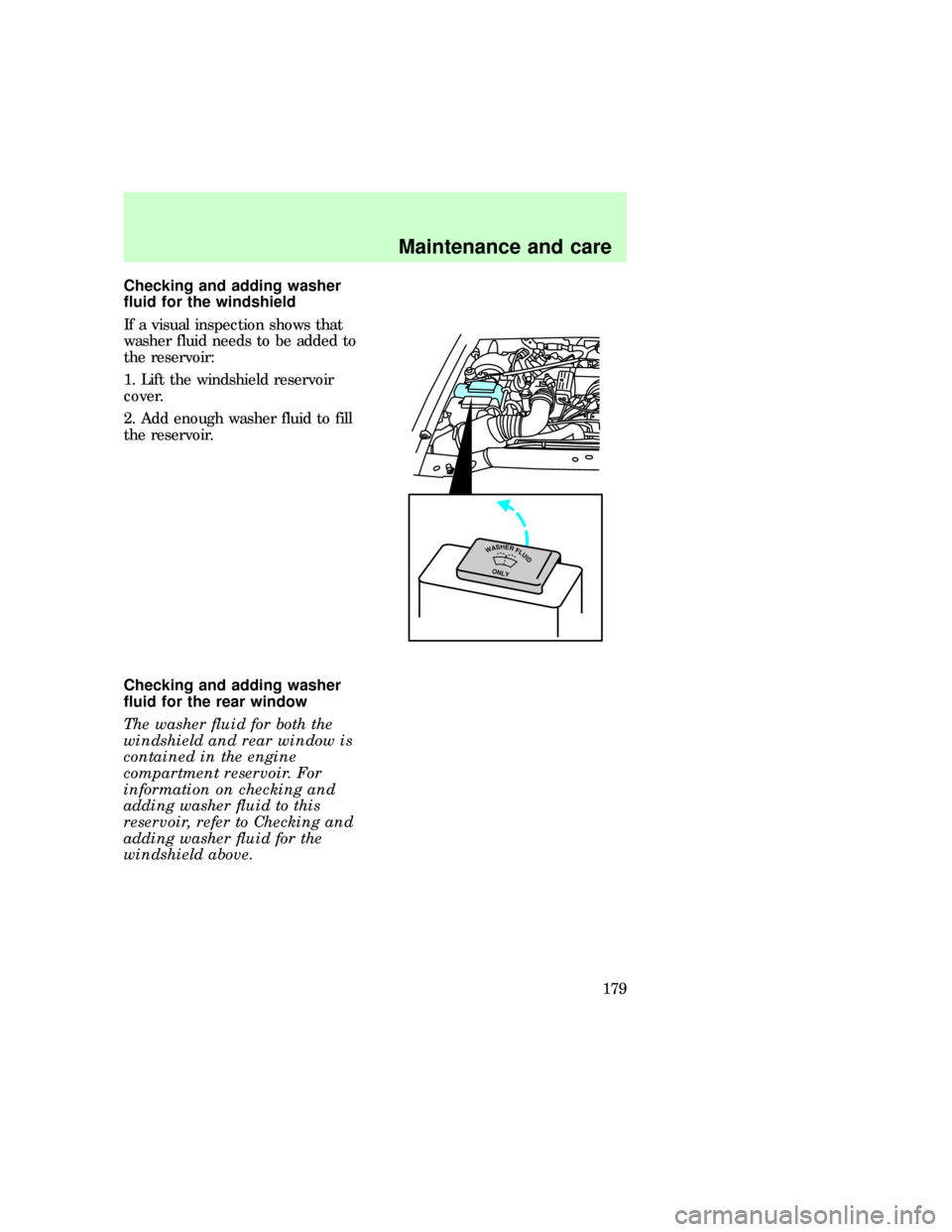
Checking and adding washer
fluid for the windshield
If a visual inspection shows that
washer fluid needs to be added to
the reservoir:
1. Lift the windshield reservoir
cover.
2. Add enough washer fluid to fill
the reservoir.
Checking and adding washer
fluid for the rear window
The washer fluid for both the
windshield and rear window is
contained in the engine
compartment reservoir. For
information on checking and
adding washer fluid to this
reservoir, refer to Checking and
adding washer fluid for the
windshield above.
WASHERFLUIDONLY
uno_liftgate_washer_fluid
uno_title-coolant
Maintenance and care
179
Page 179 of 236
ENGINE COOLANT
MAINTENANCE
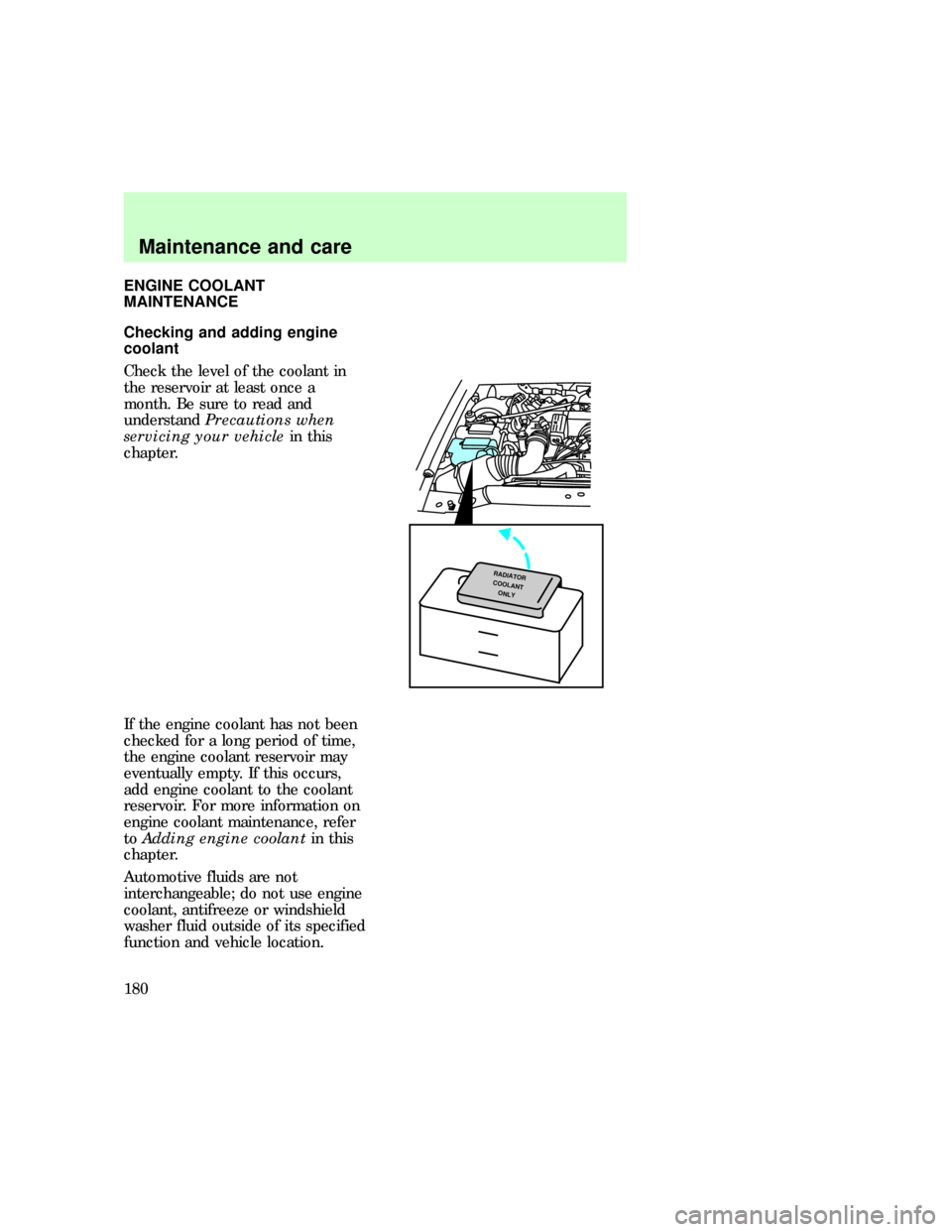
Checking and adding engine
coolant
Check the level of the coolant in
the reservoir at least once a
month. Be sure to read and
understandPrecautions when
servicing your vehiclein this
chapter.
If the engine coolant has not been
checked for a long period of time,
the engine coolant reservoir may
eventually empty. If this occurs,
add engine coolant to the coolant
reservoir. For more information on
engine coolant maintenance, refer
toAdding engine coolantin this
chapter.
Automotive fluids are not
interchangeable; do not use engine
coolant, antifreeze or windshield
washer fluid outside of its specified
function and vehicle location.
RADIATOR
COOLANT
ONLY
uno_checking-adding-coolant
com_adding_coolant.01
Maintenance and care
180
Page 181 of 236
Recycled engine coolant
Ford Motor Company recommends
that Ford and Lincoln-Mercury
dealers use recycled engine
coolant produced by
Ford-approved processes. Not all
coolant recycling processes
produce coolant which meets Ford
specification ESE-M97B44±A, and
use of such coolant may harm
engine and cooling system
components.
Always dispose of used
automotive fluids in a responsible
manner. Follow your community's
regulations and standards for
recycling and disposing of
automotive fluids.
Coolant refill capacity
To find out how much fluid your
vehicle's cooling system can hold,
refer toRefill capacitiesin the
Capacities and specifications
chapter.
Have your dealer check the engine
cooling system for leaks if you
have to add more than a liter
(quart) of engine coolant per
month.
Severe winter climate
If you drive in extremely cold
climates [less than ±36ÉC (±34ÉF)],
it may be necessary to increase the
coolant concentration above 50%.
Refer to the chart on the coolant
container to ensure the coolant
concentration in your vehicle is
such that the coolant will not
com_refill_capacity.01
com_winter_climate.01
Maintenance and care
182
Page 182 of 236
freeze at the temperature level in
which you drive during winter
months. Never increase the engine
coolant concentration above 60%.
Leave a 50/50 mixture of engine
coolant and water in your vehicle
year-round in non-extreme
climates.
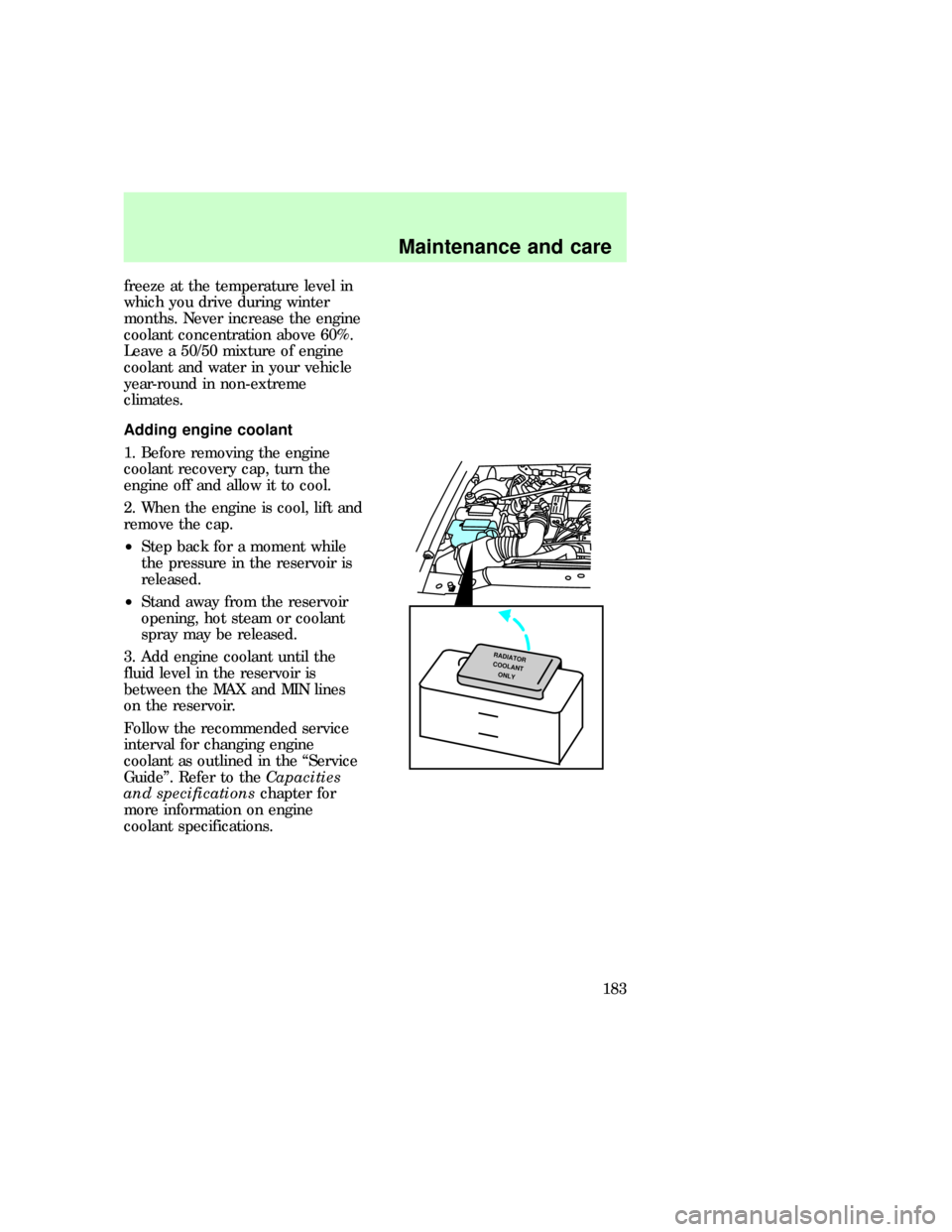
Adding engine coolant
1. Before removing the engine
coolant recovery cap, turn the
engine off and allow it to cool.
2. When the engine is cool, lift and
remove the cap.
²Step back for a moment while
the pressure in the reservoir is
released.
²Stand away from the reservoir
opening, hot steam or coolant
spray may be released.
3. Add engine coolant until the
fluid level in the reservoir is
between the MAX and MIN lines
on the reservoir.
Follow the recommended service
interval for changing engine
coolant as outlined in the ªService
Guideº. Refer to theCapacities
and specificationschapter for
more information on engine
coolant specifications.
RADIATOR
COOLANT
ONLY
uno_adding_engine_coolant
com_checking_hoses.01
Maintenance and care
183
Page 183 of 236
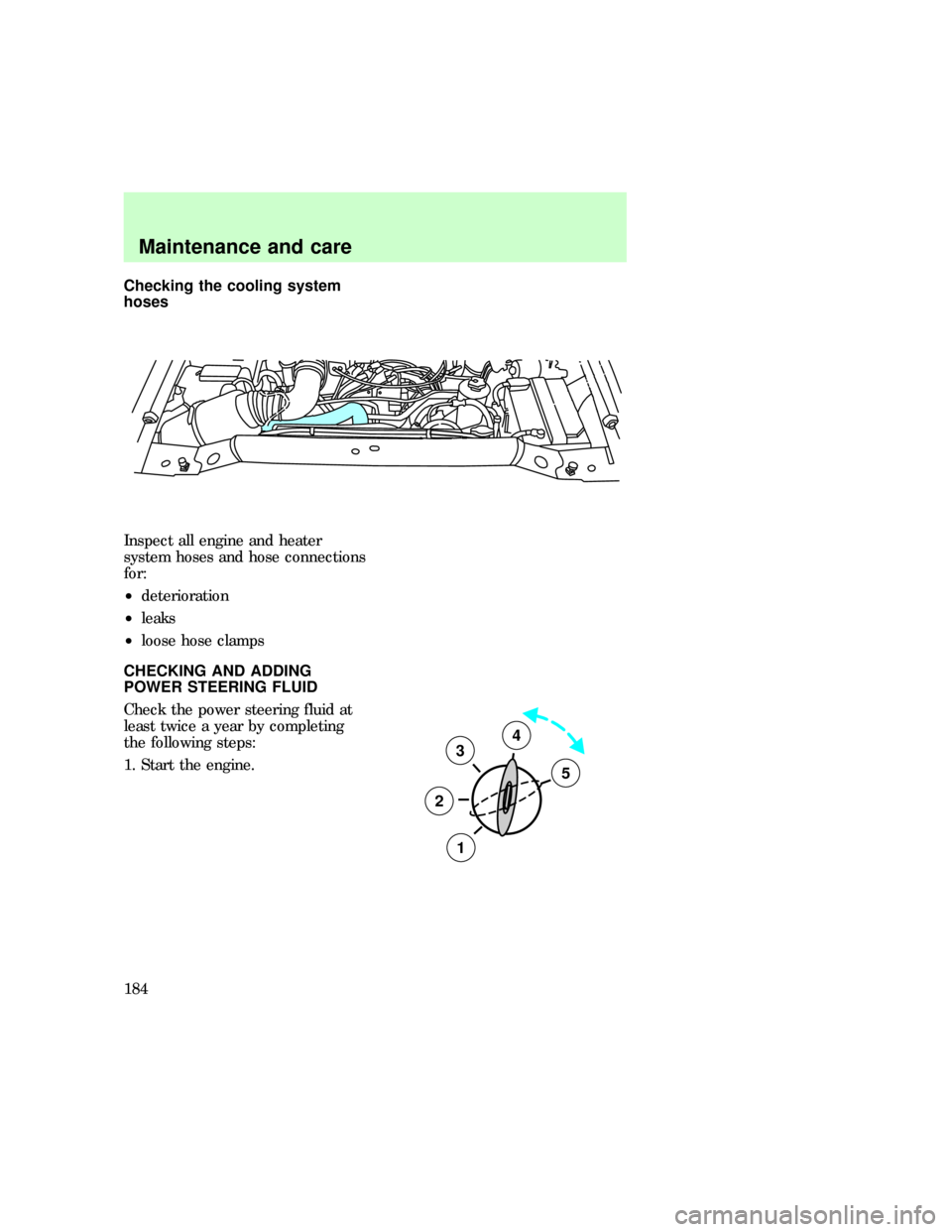
Checking the cooling system
hoses
Inspect all engine and heater
system hoses and hose connections
for:
²deterioration
²leaks
²loose hose clamps
CHECKING AND ADDING
POWER STEERING FLUID
Check the power steering fluid at
least twice a year by completing
the following steps:
1. Start the engine.
3
2
1
5
4
uno_checking_adding_power_st
Maintenance and care
184
Page 189 of 236

water. If necessary, distilled water
may be substituted with tap water
that is not hard and does not have
high mineral or alkali content. If
the battery needs water often,
have the charging system checked
for a possible malfunction.
Relearning the idle function
Because your vehicle's engine is
electronically controlled, some
control conditions are maintained
by power from the battery. When
the battery is disconnected or a
new battery is installed, the
computer must ªrelearnº its idle
conditions before your vehicle can
drive properly. To begin this
process:
Maintenance and care
190
Page 192 of 236
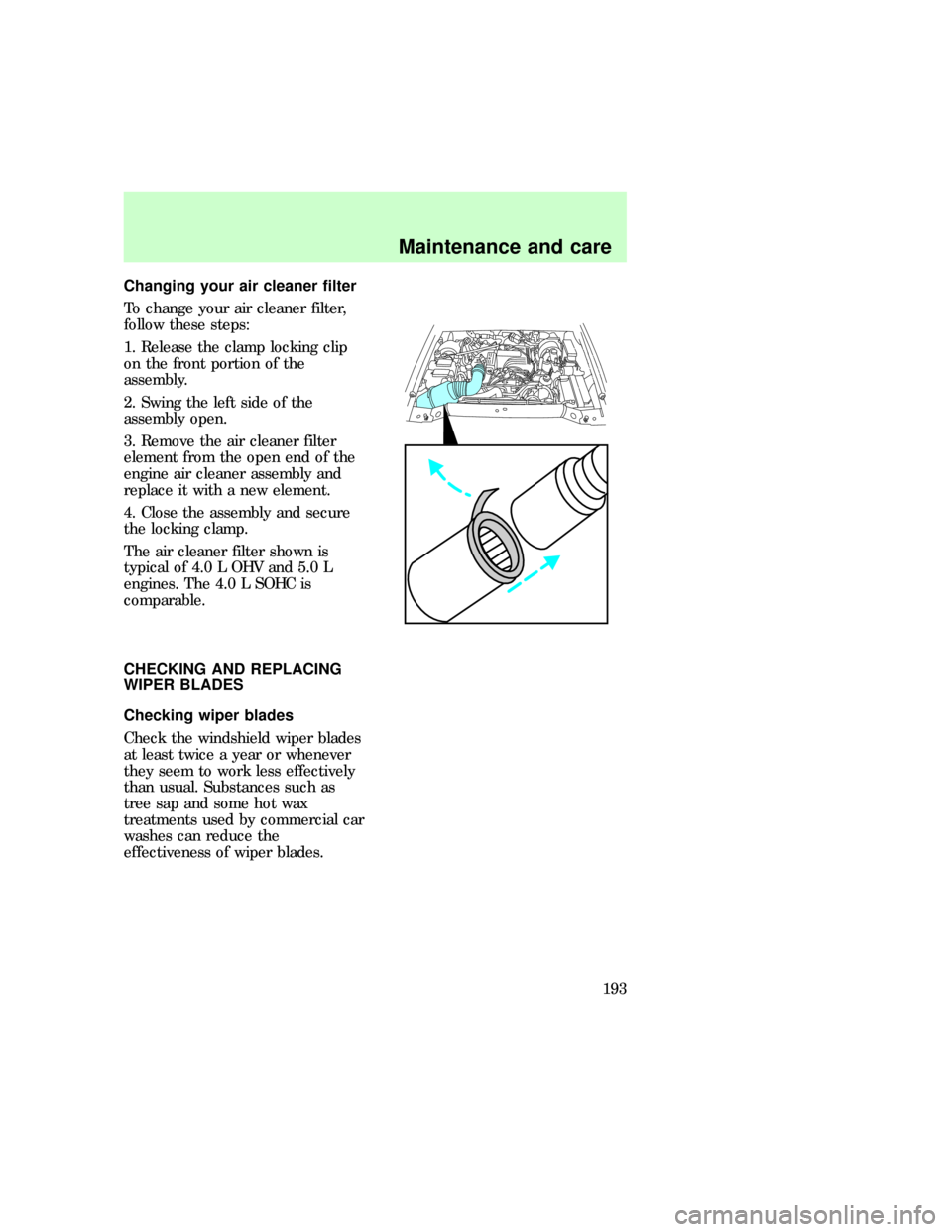
Changing your air cleaner filter
To change your air cleaner filter,
follow these steps:
1. Release the clamp locking clip
on the front portion of the
assembly.
2. Swing the left side of the
assembly open.
3. Remove the air cleaner filter
element from the open end of the
engine air cleaner assembly and
replace it with a new element.
4. Close the assembly and secure
the locking clamp.
The air cleaner filter shown is
typical of 4.0 L OHV and 5.0 L
engines. The 4.0 L SOHC is
comparable.
CHECKING AND REPLACING
WIPER BLADES
Checking wiper blades
Check the windshield wiper blades
at least twice a year or whenever
they seem to work less effectively
than usual. Substances such as
tree sap and some hot wax
treatments used by commercial car
washes can reduce the
effectiveness of wiper blades.
uno_wipers_title
uno_checking_wipers
Maintenance and care
193
Page 208 of 236

the on-board diagnostic (OBD-II)
system. If your ªcheck
engine/service engine soonº light is
on, reference the applicable light
description in theWarning Lights
and Gaugessection of your
owners guide. Your vehicle may
not pass the I/M test with the
ªcheck engine/service engine soonº
light on.
If the vehicle's powertrain system
or its battery has just been
serviced, the OBD-II system is
reset to a ªnot ready for I/M testº
condition. To ready the OBD-II
system for I/M testing, a minimum
of 30 minutes of city and highway
driving is necessary as described
below:
²First, at least ten minutes of
driving on an expressway or
highway.
²Next, at least twenty minutes
driving in stop and go, city type
traffic with at least four idle
periods.
Allow the vehicle to sit for at least
8 hours without starting the
engine. Then, start the engine and
complete the above driving cycle.
The engine must warm up to it's
normal operating temperature.
Once started, do not turn off the
engine until the above driving
cycle is complete.
Maintenance and care
209
Page 223 of 236

Fluid Ford Part
NameApplication Capacity-liters
(quarts)
Rear axle
fluid
1,2,3,4Motorcraft SAE
80W90 Axle
LubricantVehicles with
conventional
axles
2.9-3.1
(5.50-5.80 pints) Motorcraft SAE
75W140 High
Performance
Synthetic Rear
Axle LubricantRefer to
footnotes
2 and 3
Windshield
washer fluidUltra-Clear
Windshield
ConcentrateFront 2.6 (2.7)
Rear (if
equipped)3.1 (3.3)
1Fill to 3 mm (1¤4º to 9/16º) below
bottom of fill hole.
2Vehicles equipped with 4.0L
SOHC and 4.0L EI engines may
have a limited slip differential. If
your vehicles is equipped with a
limited slip differential, add 4
ounces of additive friction modifier
C8AZ-19B546-A, Ford specification
EST-M2C118±A, for complete refill
of 8.8 inch and 9.75 inch rear
axles.
3Vehicles equipped with 4.0L
SOHC or 4.0L EFI engines and
3.73 or 4.10 rear axle ratios or
5.0L engines require synthetic rear
axle lubricant. Rear axles
containing synthetic lubricant are
lubricated for life. These lubricants
are not to be checked or changed
unless a leak is suspected, service
required or the axle assembly has
been submerged in water. The axle
lubricant should be changed any
time the axle has been submerged
Capacities and specifications
224
Page 232 of 236

Air bag supplemental restraint
system
and child safety seats ..............90
description ................................89
disposal ......................................94
indicator light ...........................93
passenger air bag .....................91
Air cleaner filter .......................192
replacing ..................................193
Air conditioning
manual heating and air
conditioning
system ...................28,29,30,31,32
Air suspension ...........................119
All wheel drive (AWD) .............134
Anti-theft system ........................65
arming the system ....................66
disarming a triggered system ..68
disarming an untriggered
system .......................................68
warning light .............................67
Autolamp system (see
Headlamps) .................................49
Automatic dimming mirror ...47,48
Battery .......................................188
battery saver ...........................192
servicing ....................188,189,190
Brakes
adjustment ..............................117
anti-lock ...................................117
fluid, checking and adding ....177
parking ....................................118
Break-in period .............................2
Built-in child seat .......102,107,108
Bulbs,
replacing ........208,210,211,212,213
specifications ..........................213
Capacities for refilling fluids ....225
Cargo area shade ........................64
Childproof locks ..........................55
Cleaning your vehicle ...............215
built-in child seat ...................220engine compartment ..............216
fabric ........................................219
instrument panel ....................219
plastic parts ............................218
safety belts ..............................220
tail lamps .................................218
washing ....................................215
waxing .....................................215
wheels ......................................216
Climate control system ..............28
automatic temperature
control ...................32,33,34,35,36
defrosting .............................59,60
Clutch
fluid ..........................................177
Compass, electronic ....................50
calibration .................................51
set zone adjustment .................51
Console, description ..............58,61
Control trac 4WD system .........128
Controls ..................................58,59
Coolant (see Engine coolant)
proper solution .......................181
Daytime running light system ...26
Differential fluid ........................187
Driveline universal joint and
slip yoke .............................176,187
Driving under special
conditions ..................................130
high water ...............................131
slippery roads ..................132,133
towing a trailer .......................144
Emission control system ..........206
Engine .................................228,231
service points ............170,171,172
Engine block heater .................116
Engine coolant
checking and adding .......180,183
checking hoses .......................184
disposal ....................................182
refill capacities ........................182
Index
233